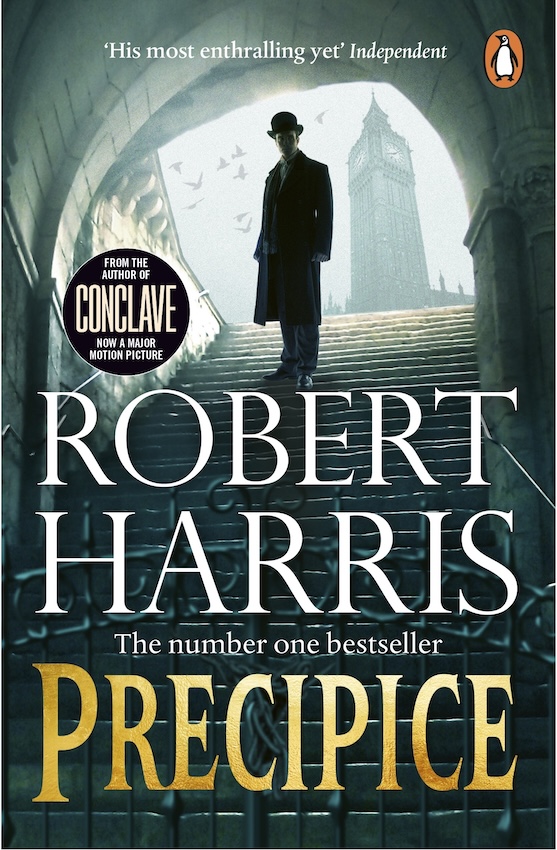
I’d not read a Robert Harris novel before, but was curious about the events Precipice describes – the indiscretion of a prime minister writing endless letters to his much younger mistress, revealing state secrets. The potential for said letters to get into the wrong hands as Britain tips into World War One.
In the author’s notes at the beginning and at the end of the book, you learn that all of the above events are quite well documented, historians have devoted entire books to the subject, and that the letters written by the prime minister as they appear in the book are authentic. My interest even more piqued, I happily plunged in.
The story begins describing the life of the Hon. Venetia Stanley, a member of a somewhat fast set known as the Coterie who live in London, enjoying the excess afforded to them by money and privilege, and amusing themselves in various daring ways. It’s the summer of 1914, and Venetia is expected to attend a boat party on the Thames, an invitation the PM, H.H Asquith begs her to cancel in favour of meeting him. He needs help with the Irish question, as he tells her in his letters. The boating trip ends in disaster, just as well Venetia cried off at the last minute, and we meet policeman, Paul Deemer.
Deemer, an invented character, is a nice contrast to the elevated world of the PM and Venetia. He’s just an ordinary sergeant at the Met, has a young brother rescued from various scrapes by a promising career in the army, while Paul having recently broken off an engagement, is not sure about his future. His parents are dead, and he’s a quiet, lonely sort, ideal for a hush-hush project with Special Branch.
Asquith writes to Venetia several times a day (postal deliveries numbered twelve a day in London at the time), the two meet at various social occasions, and go for a Friday “drive” together, where the PM shares with Venetia the burdens of his role, the decisions he is tussling with and often revealing copies of telegrams and other top secret documents. Venetia is intelligent, offers a sounding board and emotional encouragement. He’s like a politician who has made it to the top job, only to discover it’s a lot harder than he’d anticipated.
She liked him for his kindness, his cleverness, his fame and power, which he wore lightly. Her father had been a Liberal MP: she had grown up surrounded by talk of politics. Now she was probably the most well-informed woman in the country. And if she was honest, she also enjoyed the thrill of it – the secrecy, the illicitness, the risk.
In the background, as war is declared we meet lots of the key players, such as Lord Kitchener, Winston Churchill and and Lloyd George. I’ve never read such a clear account of how WWI began, nor how agonising it was for the British government to make the final decision to declare war on Germany. As the months pass, the huge confidence of those like Churchill is put to the test as troop losses start to take their toll on morale.
This is all quite fascinating, while Paul spends his days doing things he’s not comfortable about in his new role. Harris has done an amazing job in weaving in the letters with events they describe as they unfold. But anyone wanting a riveting spy novel might be disappointed. This is much more a story about three characters and their emotional journey as the world turns to chaos. And it’s well done, carrying with it a depth of research that makes everything that happens seem very real. I’ll certainly read another Robert Harris; Precipice is a four-star read from me.

 Judith McKinnon