Book Review: Exiles by Jane Harper – Aaron Falk is back in an atmospheric new mystery

I’ve read all of Jane Harper’s novels. It was possibly her first book, The Dry, that triggered a popular interest in Aussie Noir, giving Scandi Noir a run for its money. For me, it was Jane Harper that got me reading Australian mysteries and I imagine it was the same for many readers. There’s just something special about novels set in the outback.

Since The Dry we’ve had a second Aaron Falk novel – Force of Nature is soon to hit the big screen – and now, a long-awaited third. Exiles sees the Melbourne detective visiting friends in rural wine country for a christening. It’s a bitter-sweet time for Greg Raco’s family. While Aaron is going to be godfather to Raco’s baby boy, nobody can forget what happened at the same time a year ago. The Marralee Valley Annual Food and Wine Festival was on and it was here that Kim Gillespie disappeared, leaving her baby Zoe asleep in her pram.

Kim’s older daughter from her long-term relationship with Charlie Raco, Greg Raco’s winemaker brother, is desperate for answers. Now seventeen, she’s running a campaign, aided by Charlie and her good friend Joel, handing out flyers and canvassing potential eyewitnesses. Aaron, with all his detective smarts, somehow gets roped in.

And there’s another cold case – the hit-and-run death of Joel’s father at the Reservoir, a spot adjacent to the festival grounds, and it’s the Reservoir where Kim’s shoe was found. Is this a coincidence or are the two cases linked? Aaron has the added complication of meeting up with Gemma again, Joel’s mother – someone he’d met through Raco, and who he can’t quite forget.

Even in the gloom Falk could see it stretching out, vast and open in its centre, then twisting and curving to fill the turns and gullies that formed the banks. It was big. Bigger than he remembered. The opposite bank was just visible across the swathe of water, but he couldn’t see the westernmost edge, or the dam that lay somewhere to the east. The festival grounds felt far behind them, but Falk could hear a distant low thrum of music and crowd noise undercutting the stillness.

Emotions are high in this story with two teenagers having lost parents and not having any answers. Aaron’s a bit of a softy and is sympathetic. The story also hearkens back to the events from the school days of Kim and the Racos. Like the current batch of kids from the local high school, the opening night of the wine and food festival was when there was a big party in the woods near the Reservoir, something local cop, Sergeant Dwyer would love to shut down.

There’s a lot going on in each of the characters’ lives, and we slowly get a picture of a community, of complicated loyalties among old friends, old grudges and a fair bit more besides. We haven’t got a dry, scarily hot landscape. But the stunning countryside surrounding the grim spectre of the Reservoir and all its secrets makes for another atmospheric setting.

Add some superb writing, and a twist in the story I didn’t see coming and I’m happy to say that Jane Harper has done it again. Exiles is another cracking read and is satisfying on several levels. I’ve also got a feeling we might see Aaron Falk again – I hope so; he’s a complex and interesting detective. Exiles gets four and a half out of five from me.

Book Review: The Last Party by Clare Mackintosh – a new promising new detective series in a moody North Wales setting

I saw Clare Mackintosh’s name connected with fellow suspense/mystery author Lisa Jewell, and being a fan of Jewell, decided she should be worth a shot. Like Jewell, Mackintosh has written a bunch of twisty mysteries, but The Last Party is the first in a series featuring Welsh detective Ffion Morgan. I like being in at the start of a promising crime series, and was soon glad I’d picked this up.

The mystery starts with the discovery of a dead body by swimmers braving a New Year’s dip. We’re in the remote village of Cwm Coed on the shore of a lake which borders England. Across the water is a luxury resort called The Shore, built by a couple of investors as holiday homes for the wealthy. These incomers don’t support the village shops, they zip around the lake on jet skies and are just generally obnoxious. So it isn’t surprising that the corpse turns out to be one of the investors, a Rhys Lloyd.

With a name like that you’d assume the victim’s Welsh. And he is – a local made good in the sense he’s become a successful star of stage and screen, and knows how to turn on the charm. His mother still owns the hardware store in the village, and it was his father’s land that he and his partner Jonny Charlton have turned into The Shore. Their New Year’s Eve party was supposed to bring everybody together and appease the villagers, but it all ends in murder. The story soon throws up a fair few suspects – it turns out Rhys is struggling to pay off creditors and his charm hides a darker persona.

DC Ffion Morgan is on the spot – she’s local, still living with her mother and sister in Cwm Coed, but for all that she’s something of a lone ranger. She drives an old Triumph at tearaway speeds over the winding rural roads and has a burning secret. She’s also shocked to discover that her one-night stand from the night before is the English cop assigned to assist on the case.

DC Leo Bradey is an intelligent and promising police officer from Cheshire, with a whole lot of baggage. His ex-wife is going out of her way to exclude Leo from being a parent to their young son, whom he adores, and his boss makes him the butt of all his tasteless jokes. Working with Ffion doesn’t get off to a great start either, but they slowly form a team. They soon discover that hardly anybody doesn’t have a motive for killing Rhys Lloyd.

The Last Party is a much better than average murder mystery. Clare Mackintosh is a former police officer herself so the story has a ring of authenticity. However, there’s a lot more than police work here. Family dynamics, old scores and the effects of burying damaging secrets all add to a character-driven, atmospheric read, the evocative setting adding a ton of interest.

As well as the dangers of the lake, there’s snow to contend with and the story builds to a life-and-death climax that has you on the edge of your seat. This is helped by a plot that switches back and forwards in time and between characters, mostly Leo and Ffion but also the key players and suspects. I was fair racing through the chapters to see what happened next. And then there are the twists.

For a diverting crime read, The Last Party doesn’t put a foot wrong and introduces a fabulous pair of detectives I’ll be happy to meet again. I’ll happily give it four stars. A Game of Lies, the next Ffion Morgan mystery, is due to be released later this year.

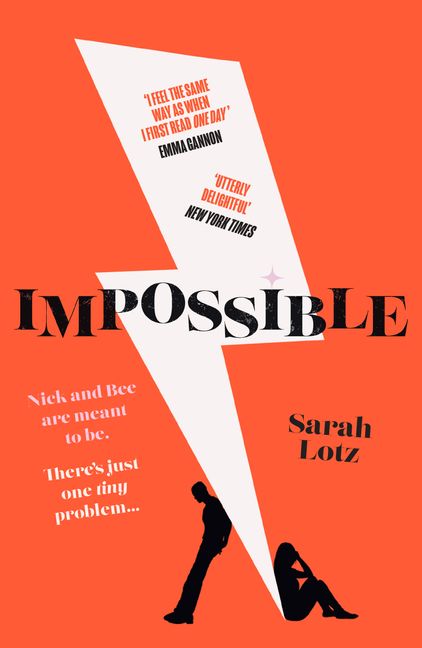
Book Review: Impossible by Sarah Lotz – an original and quirky fantasy-romance

I have to confess I nearly didn’t finish Sarah Lotz’s recent novel, Impossible (also marketed as The Impossible Us). The novel is largely email correspondence between two characters who meet accidentally when Nick sends a grumpy message to a customer who owes him money, and it somehow ends up in Bee’s (Rebecca’s) inbox. Bee’s dinner with a Tinder date isn’t going well and she distracts herself with flippant email banter with Nick.

The story of their romance is told largely in emails because, for mysterious reasons, the two seem doomed never to meet in person. At first they are separated by a train ride – Nick’s in Leeds; Bee in London. When they do decide to meet they discover they belong in alternate realities – how many versions of the world there are, they have no idea. But in Nick’s dimension the world has made huge inroads to solve climate change as well as some obvious political differences; Bee’s dimension is the world as we know it.

Being stranded in different versions of the world makes no sense to either of them, but Nick comes across an organisation called the Berenstains who have had dealings with this anomaly. Berenstains member Geoffrey provides some light relief, tasked with keeping an eye on Nick, and staking him out like someone from a comedy-spy movie. There are rules about the situation, in particular, no meddling with the versions of people you know from a reality that’s different from your own.

Nick and Bee are all set to break this rule, Bee hunting out the Nick in her reality, who happens to be a famous author. This is galling for the original Nick, who is a literary hack, ghost writing for authors with limited talent. Meanwhile Nick seeks out the version of Bee in his reality, a Becca with a child, the wife of a powerful businessman, which is equally perplexing. She has given up her fashion design career for a family, quite unlike Bee, who has a wedding dress make-over business. Bee worries that Becca is unfulfilled and could be in a controlling relationship.

The story lurches from one complication to another as Nick and Bee set out to overcome their cross-dimensional problem to find happiness. There are plenty of humorous scenes and weird and wonderful characters – Tweedy, the elderly County type, showing Nick how to use a gun; Magda and Jonas, Bee’s elderly neighbours who epitomise lifelong devotion as a couple; Erika, Nick’s no-nonsense Nordic landlady – among others.

And even if it did at first remind me of the movies You’ve Got Mail crossed with The Lake House, the story is still original and cleverly put together. And yet in the middle it seemed to drag for me. I think it was all those emails. I’ve read epistolary novels before and enjoyed them. But here there’s a lot of bad language, which I find tiresome, and the banter which Bee and Nick find so amusing wasn’t particularly amusing for me. I began not to care particularly whether Bee and Nick found happiness as I didn’t like them very much – it’s probably a generational thing. Two thirds through I was so desperate for some elegantly crafted writing I took a breather with some Jane Austen before going back in.

But I did go back in, because it is impossible not to want to know what happens in the end. And Sarah Lotz ties it all up well. She’s a seasoned screenwriter who obviously knows about plotting and this is her seventh novel. I can imagine Impossible would adapt well to the screen. Would I recommend it? Yes, probably, but with some reservations. It gets a fairly generous 3 stars from me.

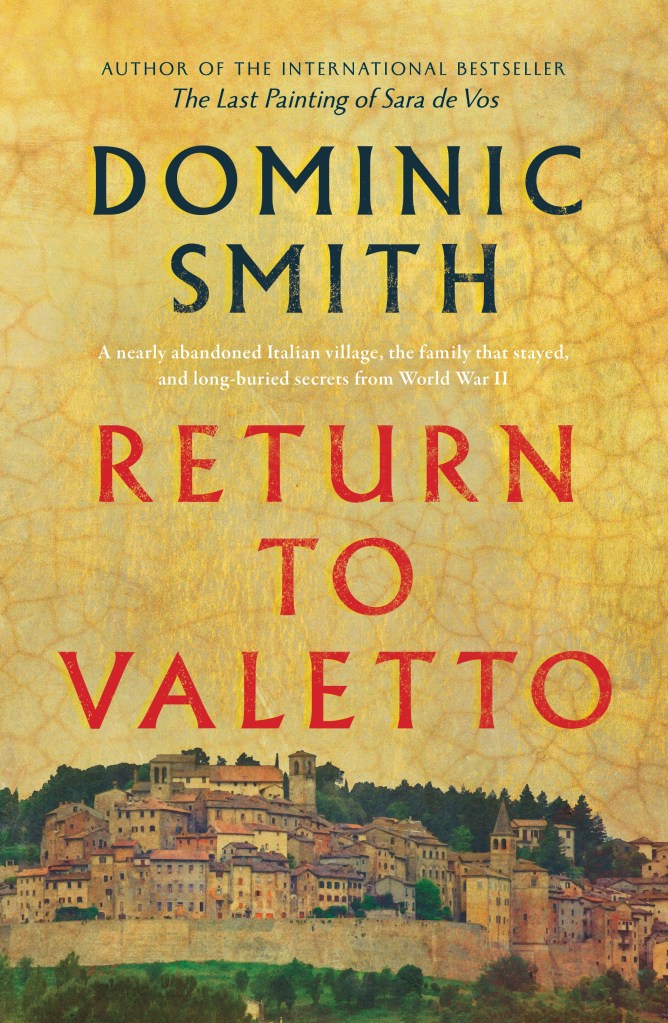
Book Review: Return to Valetto by Dominic Smith – back to Italy with a gorgeous evocation of place and atmosphere

Well, yes I know this book is about a lot more than its setting. There’s a man’s lingering grief for his late wife. A family of elderly women and a secret they never got to grips with from World War II. There’s some parent-child dynamics and a potential love affair. And all of it comes together in a captivating story that maybe takes a little while to get going, but once you get in, has you nicely hooked.

But when I look back on this book in months and maybe even years to come, I know it will be the setting that I’ll think about first. Valetto is Dominic Smith’s invented town in Umbria, which sits on a pedestal of volcanic rock. Much of the old town has fallen down into surrounding valleys, a 1971 earthquake urging many of its inhabitants to relocate. It has become a kind turreted and terracotta island, connected to the surrounding landscape by a footbridge.

Hugh is an American historian who specialises in the study of abandoned towns – there’s hundreds of them dotted around Italy and what better place to begin than Valetto, the childhood home of his mother and where even today his grandmother and three aunts still live. The Serafino women, all widows, are a big chunk of the population which has dwindled to just 10. In a few weeks it is to be his grandmother’s 100th birthday and a party has been planned.

A spanner in the works is the woman who has taken possession of Hugh’s cottage on the Serafino property, supposedly given to her mother for services rendered when Hugh’s grandfather, Aldo, was a resistance fighter during the war. Elissa Tomassi is adamant that the cottage is legally hers, just as Hugh’s aunts are convinced she’s a squatter with no legal tenure. Hugh is sure there can be a way to keep everyone happy and is caught in the middle. But he has to get to the bottom of what happened during the war and discovers not one but two family mysteries to solve.

The past will take Hugh back to Elissa’s home town in the north of Italy to find out what Aldo did in the closing years of the war. He’ll also discover a link between his mother and the Elissa’s that is a trickier memory to unlock and will reveal a crime that has been swept under the carpet. The story builds to a powerful and moving conclusion that has you glued to the final chapters as past deeds are dealt with.

What could be done with the wreckage of the past? As a historian I’d always believed that studying the past could reveal hidden meanings and patterns, that motifs lurked in the underbrush, but now I saw the neap tide of history washing up flotsam on an empty beach.

I enjoyed Return to Valetto enormously, not only for the setting which seems to be a big part of every scene. The late autumn mist across the valley that comes and goes and adds even more mystery. The large old villa that is the Serafino home with its cavernous rooms and crumbling frescoes. There’s the old family restaurant established by his grandmother, where you can see abandoned place settings and dusty menus from a night in 1971. (Oh, did I forget to mention this books is also a hymn to Italian regional cuisine?)

And the characters are a joy. The three aunts, each with their own peculiar ways and at times difficult interactions with each other. I have a particular fondness for books about aunts, going back to P G Wodehouse’s Bertie Wooster stories, and here Iris, Rose and Violet are brilliant. The grandmother with her iron determination to host an unforgettable birthday celebration with an ever-growing guest list and a despairing cook. Both Hugh and Elissa have daughters that make an appearance, so it’s an inter-generational tale as well.

I can’t help feeling Dominic Smith had a wonderful time researching and writing this book as his love for history, particularly social history, as well as all things Italian shines through. This is the second novel by this author I have read and recall that Bright and Distant Shores was one of my top reads for the year it came out. I’ve heard lots of good things about The Last Painting of Sarah de Vos as well. Return to Valetto gets the full five stars from me.

By the way, the fictional town of Valetto is inspired by Civita di Bagnoregio in Lazio – in case you want to visit, either in person or via the Internet.

Book Review: Early Morning Riser by Katherine Heiny – a warm-hearted story filled with quirky characters

I’d heard a lot of recommendations for this book and picking it up was happily expecting a fairly light, cheerful read. And in many ways it is. What makes Early Morning Riser particularly worth reading is the warm humour that runs through the story, and the character of Jane who is a bit of a battler.

Jane teaches a Grade 2 class in the small town of Boyne City, where everyone knows everyone. Maybe it’s the size of the town but it’s astonishing for Jane to discover her new boyfriend, Duncan, seems to have slept with most of the local women. And then there’s her mother. Fortunately Mom lives a three hour drive away, because she’s such a negative person, never stopping to think first before speaking her mind. Dating Duncan also seems to mean the presence of Aggie, Duncan’s ex-wife, who is at all the social get-togethers the new couple are invited to.

It’s easy for Jane to feel a little jealous of Aggie, and this niggles its way through a lot of the book, which takes place over seventeen years. Aggie has a lush, peachy beauty, is the most amazing cook and knows all about what’s going on in the town due to her job in real estate. So even though she has been divorced from Duncan for ten years and is happily married to Gary, a dull, grey, unsociable man, it still galls Jane when Aggie is on the scene. She’s also a reminder that Duncan and marriage just don’t go together.

“Does Gary have to come too?” 
“You know as well as I do that Gary doesn’t like to be alone after dark,” Duncan said. “He says the toilet whispers.” 

As well as Jane’s good friend Frieda – an endlessly positive, mandolin-playing woman destined, it seems, to be forever single – there’s Jimmy. Much of what happens in the story involves Jimmy. Around Duncan’s age, Jimmy still lives with his elderly mother and hasn’t the IQ to manage life on his own. He turns up to work at Duncan’s wood-turning workshop but is there more for company than usefulness. Jane feels remorse for events that leave Jimmy on his own and much of the ensuing decisions she makes are to do with her guilt and making amends.

The story meanders through the years and the ins and outs of Jane’s and Duncan’s relationship. It’s a quiet little read about small-town life and the reasoning behind people’s big decisions and all the little messes they get themselves into. I loved the humour and found myself chuckling as I read. Heiny does kids really well and Jane’s interactions with her class are hilarious.

The natural, warm-hearted writing, the quirky characters as well as Heinz’s understanding of what makes people tick reminded me a little of Anne Tyler’s books – so of course I was going to enjoy this. Though I was occasionally put off by the little bits of popular wisdom doled out as Jane makes this or that realisation. Early Morning Riser was a pleasant break from some more serious reading and gets three and a half out five stars from me.


Book Review: The Marriage Portrait by Maggie O’Farrell – a tense and evocative story from the Italian Renaissance

This novel is inspired by the Robert Browning poem ‘My Last Duchess’ as well as the historical figure of Lucrezia, Duchess of Ferrara, who met an untimely death at the age of sixteen, supposedly murdered by her husband. I hadn’t known anything of the real duchess, but remember reading the poem in English Lit classes at uni and not realising it at the time that the duchess described had died so young.

It’s a shocking story in anybody’s book – Browning’s Dramatic Lyrics or this one, and so I demurred while The Marriage Portrait sat on my bedside table, distracting myself with every other book until, with nothing much else to read I finally picked it up. I shouldn’t have worried, having enjoyed Maggie O’Farrell’s books enormously in the past and it was only a page or two before I was engrossed in the story, as well as in awe at the writing.

Lucrezia is a difficult child, the least favourite it seems in her family, and as she grows she seems a thin little thing, quite unlike her lively, dark-haired older sisters. She’s smart though, sitting in a corner where the children are taught their lessons, but learning much faster the Latin and Greek, the history and geography than her siblings. Her real talent is art, although she could be a master spy the way she sneaks around the palace, listening at doors.

When her older sister Maria suddenly dies before her wedding can take place, Lucrezia is promised to Maria’s fiancé instead, to unite the grand houses of Medici and Ferrara, even though Lucrezia is only thirteen. She’s a spirited child, who likes her freedom, but also cherishes the safety of her home – her life has been a sheltered one. So at the time of her wedding a couple of years later, she is ill prepared to be the docile wife of a powerful ruler.

The gown rustles and slides around her, speaking a glossolalia all of its own, the silk moving against the rougher nap of the underskirts, the bone supports of the bodice straining and squealing against their coverings, the cuffs scuffing and chafing the skin of her wrists, the stiffened collar hooking and nibbling at her nape, the hip supports creaking like the rigging of a ship. It is a symphony, an orchestra of fabrics, and Lucrezia would like to cover her ears, but she cannot.

O’Farrell makes Lucrezia interesting, believable and vividly real, a complex character, as is her new husband Alfonso, who is on the surface so charming and solicitous, but also desperate for the heir that will secure his position. The book begins with Alfonso whisking Lucrezia off to a hunting lodge, away from the prying eyes of his palace, and where Lucrezia feels he is to do away with her. She has seen this other side to him before – the merciless capacity for violence, the lack of forgiveness. Will Lucrezia succumb and give in or will she fight back for her survival?

Sixteenth century Italy is brought to life – a time of a flowering of the arts which are lushly shown here in paintings, architecture and music. The intense richness of the language, vividly present tense, mirrors the gorgeousness of this Renaissance world. Yet this is also a time when well-born young women are just pawns on the chessboard of power to be married off by their fathers. Like Lucrezia they may have little idea of the politics around them or what will be expected of them.

This makes the novel a tense and gripping read as the story bounces between the hunting-lodge present where the moments tick away until Alfonso will act against his duchess, and the back-story that fills in Lucrezia’s life and how she has come to be in this predicament. It all seems so much more vivid because of the way O’Farrell writes – the intensity of Lucrezia’s feelings, the undercurrents that pass between characters, as well as the sensory details – the feel of fabric on skin, Lucrezia’s painterly eye that sees every colour and shade, the shock of seeing mountains for the first time, the descriptions of the music Alfonso gets lost in.

The Marriage Plot is a book that delivers on every level, giving you a glimpse into the past, an edge-of-the-seat story, as well as gorgeous writing. It isn’t surprising it’s been selected for the Women’s Prize for Fiction longest – I’ll be eager to see if it makes the shortlist, announced on 26 April. It will also be interesting to see what O’Farrell comes up with next. This book gets a full five stars from me.

Book Review: Miss Austen by Gill Hornby – the story of the famous writer’s sister

When Jane Austen died, she left thousands of letters sent to family and friends, of which many were destroyed by her sister, Cassandra. This is the Miss Austen of Gill Hornby’s novel. The story begins with the elderly Cassandra visiting the vicarage where her long-dead fiancé grew up, the home of her very dear and also departed friend Eliza.

Jane and Cassandra both wrote to Eliza, and Cassandra is sure there must be a cache of letters somewhere, full of heartfelt disclosures and secrets, as well as (knowing Jane) waspish comments about other family and acquaintances. It is imperative that Cassandra finds these before they are made public. Cassandra was the carer and confidante of Jane in life, and now, twenty years after her sister’s death, she wants to preserve her good name and not allow Jane to be the subject of speculation and gossip.

And so here she is at the vicarage where as a young woman, she farewelled her beloved Tom on a voyage to the Caribbean, a chance for him to win a living from his patron and secure the means for he and Cassandra to marry. Memories come flooding back and the story dips back in time to those early years and the promises she made to Tom before his departure.

Meanwhile Eliza’s daughter Isabella is rattling around in the vicarage with her grim but loyal servant Dinah, her father the vicar having recently died. Isabella has the job of finding somewhere else to live as well as packing up all the chattels and furnishings that have been a part of her life since childhood. But Cassandra is appalled to see that Isabella doesn’t seem to know how to begin, obviously so ground down by years with an autocratic and belittling father she has a complete lack of initiative.

So we have two story threads here: Cassandra’s efforts to encourage Isabella to find a house with her other spinster sisters – for what could be more pleasant than to live with sisters?; and the early years of Cassandra’s own life with her beloved Jane as revealed by the letters she finds.

I listened to Miss Austen as an audiobook read by Juliet Stevenson and if there is a Juliet Stevenson fan club out there, I should probably become a member because her reading is utterly superb. She brings to life the characters so well along with the nuances of tone in the writing, the conversations and voices of Jane and Cassandra, plus all the peripheral characters ,to recreate the Austen sisters’ world.

There are multiple characters – the girls had five brothers, plus friends and new acquaintances, which echo some of the themes and interactions from Jane Austen’s novels. Gill Hornby has done a really good job with this, and while there are many novels out there that pay homage to Jane Austen, mostly through further stories about some of her much-loved characters, this book about Cassandra is one of the better ones I’ve come across.

Of course we can’t expect a raft of happy endings here. Jane Austen didn’t live long, and the Austens struggled to find a permanent home after their father died. Neither Jane nor Cassandra ever married and there seems to have been both grief and a sense of missed opportunities over this. And yet, Hornby sneaks in a rather charming and amusing ending to the story, casting the truculent Dinah in a whole new light. Cassandra herself is wonderful company and as an elderly unmarried woman, a believable and refreshing heroine. Miss Austen is a four out of five read from me.

Reading the Classics: Olivia Manning’s The Balkan Trilogy Part 1 – The Great Fortune

This round of the Classics Club Spin sent me off to Romania, 1939, for the first of six books that are based on Manning’s own experiences, and which are combined together as her Fortunes of War series. I have only read the first book: The Great Fortune , which is a decent, meaty read for a number of reasons.

The story begins with a train journey. Newley weds, Guy and Harriet Pringle are on their way to Bucharest in Romania. Guy teaches English at a Bucharest university as part of a cultural programme sponsored by the British government. He’s met Harriet during the summer vacation and married her before bringing her to the Balkans just as Germany invades Poland.

So when the Pringles arrive at their hotel, Harriet is confronted not only by persistent beggars, many of them deformed from birth to help their earning potential, but also an influx of Polish refugees. Harriet and Guy are temporarily staying here until they can find a flat, because Guy has always tended to couch surf among his wide and varied set of acquaintances. He’s a popular young man who thrives on interacting with others, talking literature and politics into the small hours.

Guy’s also a devotee of Marxism which he sees as a potential solution in a country where the peasants are struggling under a powerful elite. Romania has a strong economy with plentiful resources, among them a highly productive agricultural sector. But with a war starting up, much of this produce is exported and the ensuing hike in the cost of living puts a terrible strain on the poorest. Meanwhile the Pringles hob-nob with assorted academics and civil servants at various plush restaurants.

As Harriet passed between the tables with Clarence, there was a little murmur of comment: first that she should make this public appearance with someone other than her husband, then the common complaint that English teachers – they were all regarded as ‘teachers’ – could afford to come to a restaurant of this class. In Rumania a teacher was one of the lowest-paid members of the lower-middle class, earning perhaps four thousand lei a month. Here was proof that the English teachers were not teachers at all but, as everyone suspected, spies.

We get another view of Bucharest society through the eyes of Prince Yakimov, also newly arrived, who has fallen on hard times. It isn’t clear quite how he comes to be in Bucharest, except that he needs to make his remittance last a bit longer and the city seems cheap. He hasn’t a clue how to earn a living. Yakimov is technically British, his father having escaped Russia at the time of revolution, but now drifts from hotel to hotel living on credit. His finely tailored clothes, his name and good manners soon have him invited to parties given by the aristocracy, in the hope they can fleece him at cards.

But mostly this is Harriet’s story. The poor girl has to get used to sharing Guy, not only with his many friends, but also with Sophie, who’d hoped to marry Guy herself, and therefore acquire a British passport. Other characters include gloomy Clarence, Guy’s colleague, who soon takes an interest in Harriet, and Guy’s boss, Inchcape, who has been put in charge of British propaganda for the Balkans. The story bubbles along full of lively conversations on the political situation, the locals as well as relationships and anything else – often very lifelike and stimulating dialogue.

Olivia Manning has masterfully recreated a time and place in a way that seems very vivid – she was similarly married to a British academic at a Bucharest university, and this shows in her descriptions of the people of the city, its buildings and parks, its cafés and restaurants. You really feel you are there with Harriet and you suffer with her all the anxiety of fitting in and waiting for Guy to come home. All the while, events are taking a turn for the worse with the outbreak of war. She worries she will never be able to return to England, that Hitler will invade Britain, that Hitler will invade Romania.

Running through the book is a wonderful cast of characters, and a smattering of dry humour. Harriet is one of those quiet observers who doesn’t suffer fools gladly, but is often stuck with odd company and not much to do. Scenes with Yakimov offer a mix of hilarity and desperation. The story is set over four parts but comes together nicely towards a strong conclusion, with Guy deciding to produce a Shakespeare play. This brings out the best and worst in the members of the cast, all taken from his friends and colleagues.

I really enjoyed The Great Fortune, although it wasn’t a book to rush through, requiring lots of concentration to keep up with who was who. But I still hope to read more in the series, including Manning’s follow-up books that make up The Levant Trilogy which describes the Pringles’ life in Egypt as the war rages on. Manning also wrote a number of stand-alone novels that could also be well worth checking out – she’s a terrific writer. The Good Fortune gets four stars from me.

Recent Releases – Seven Promising New Books to Look Out For

New authors as well as some old favourites make the list of newly released books I’m eager to get my hands on.

Willowman by Inga Simpson takes you to the world of cricket and the art of the batmaker. I don’t read a lot of books about sport – in fact I’m not sure I can name a single one – but this one caught my eye. We’ve got a gifted young batter, Todd Harrow, and the special bat made for him by traditional batmaker, Alan Reader. The story seems to be about more than just cricket, though, with some interesting personal journeys, and there’s loads of high praise from the critics, the Sydney Morning Herald scoring it a six.

Prettier if She Smiled More is the new book by Toni Jordan. I loved her last book, Dinner with the Schnabels, and made a note to myself to read Jordan’s backlist. But here she is with a new book before I got started. This is another Australian novel, and follows the fortunes of Kylie, who thinks she has the perfect life, until she has to move home to care for her mother following an accident. Returning to her childhood home gives her pause for thought. I love a book that makes you laugh and cry, and this one’s sure to fit the bill.

One of Those Mothers by Megan Nicol Reed brings me a little closer to home with a novel set in my old Auckland stamping ground. It’s a look at middle class angst and the effects of a terrible secret on a small group of families in the same neighbourhood. The author has used this fodder in her popular newspaper columns over the years, so I can see she’s become a bit of an expert on parental anxiety, guilt and how friendships are impacted by rumour and unease. The book’s already harnessing some great reviews so it’s definitely one for the list.

I am drawn by the premise of The Wakes by Dianne Yarwood, and possibly also the cover. It’s about relationships with two of its main characters recently breaking up with their partners. When Louisa persuades her new neighbour Clare to join her funeral catering business, they meet Chris who is an emergency doctor attending the funerals of both patients and friends. There’s pathos but also humour, as well as reflections on the things that really matter in life. The Wakes is a debut novel from another Australian author and has sparked a lot of interest. I am fairly sure I will love this.

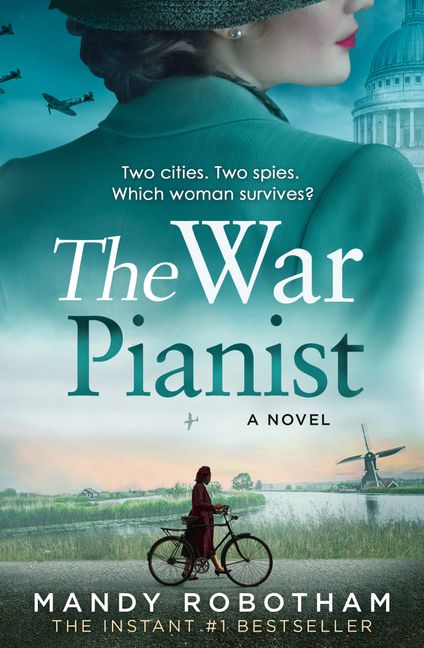
The War Pianist by Mandy Robotham
Moving to the Northern Hemisphere, I spotted Mandy Robotham has a new wartime novel out. I thoroughly enjoyed The Resistance Girl, which I listened to as an audiobook. It had just the right blend of action, tension and light relief and taught me a lot about World War II in Norway. With The War Pianist one main character is Marnie Fern, who gets involved in resistance work when her grandfather is killed in the London blitz. He was helping the Dutch resistance as a war pianist, which was a kind of code for radio operator. Things get tense as the Nazis close in on Marnie and her fellow ‘pianist’ in Amsterdam, Corrie Bakker, on the other end of the wire. This one’s sure to be a page-turner.

The Shadows of London by Andrew Taylor
Time to catch up with one of my favourite mystery series, with the release of the latest of the Fires of London novels by acclaimed historical fiction author, Andrew Taylor. We’ve another rollicking read featuring James Marlow, a civil servant who has become a kind of ‘useful pair of hands’ for the court of Charles II. He always seems to find himself struggling between factions at court and finding unpalatable truths about the murders he investigates. Never far away is Cat Hakesby, the architect who in this book is on the spot when a body is found in one of the almshouses she is restoring. I love the glimpses of the King Taylor slips in, the thrills and tension, as well as James’s relationship problems with spiky Cat, a woman ahead of her time.

The Last Remains by Elly Griffiths
This is book number 15 in Griffiths’s series featuring DI Harry Nelson and forensic archaeologist Dr Ruth Galloway. I love the characters who almost feel like friends, and in this book their pal Cathbad, a Druid and former tutor at Ruth’s university, is implicated in a murder when bones are unearthed by builders renovating a café. Cathbad disappears – is he on the run or is he in danger? Neolithic flint mines add a touch of archaeological interest and the ongoing issues around Nelson and Ruth’s relationship are sure to keep the plot bubbling along.

Book Review: The Bookseller of Inverness by S G MacLean – a stunning Scottish thriller of intrigue and revenge

It’s hard for me not to feel a lump in my throat when reading a book that describes so vividly the events around the Jacobite uprisings that aimed to put a Stuart back on the throne. The butchery and barbarism of the government forces at the Battle of Culloden, the subsequent hunting down of Jacobites through Scotland and the harsh penalties enacted on those that were captured, including the ‘traitor’s death’, are hard to read about without feeling, well, rather cross.

With The Bookseller of Inverness, S G Maclean brings this history to life. It’s a murder mystery set in the Highland city of Inverness, the bookseller of the title, Iain MacGillivray, a veteran of Culloden who has somehow survived, though scarred both physically and mentally. He’s a brooding man of thirty-four, silent and dour as he runs his shop and lending library, coming to life a little at dances where he’s a popular fiddler.

Iain’s world is turned upside down and he is hauled out of his melancholy when several events happen in rapid succession. A stranger is found murdered in his bookshop – he’d previously been fossicking for a book he was desperate to find. And we have the return to Scotland of Iain’s father, Hector, who if found by the authorities will surely face death for his connection to Bonnie Prince Charlie, the Young Pretender.

On his desk lay a dirk like the one he had once habitually carried, before the bearing of arms or the wearing of tartan had been forbidden to Highlanders. Tied to the hilt of his knife, though, was a white silk rosette. Iain’s heart began to quicken. It was the white cockade, as worn in his own blue bonnet and in that of practically every other soldier of the prince’s army in the ’45. The white cockade, the most recognisable of all the Jacobite symbols, on the hilt of the knife that had been used to cut the throat of the man sitting dead in his locked bookshop.

Hector tells Iain about The Book of Forbidden Names, which has coded messages revealing traitors to the Jacobite cause. These are not just people who have sided with the government, but those who have ratted on the prince’s followers leading to their capture. Both sides would give their eye teeth for this book, including the victim found in Iain’s shop. Iain thinks he knows where another copy of the book might be, and soon more bodies turn up. It seems there is a killer out there with revenge in mind.

The novel is a brilliant murder mystery/thriller, but it is also an evocative imagining of Inverness in the 1750s, and boasts a wonderful cast of characters. There are the Grandes Dames, the elderly women who gather in Iain’s grandmother’s parlour who add a lighter tone to the story with their gossip; Mairi Farquharson, Iain’s grandmother rules the roost and is fearless in her standing up to English soldiers; Donald Mòr, Iain’s oddball bookbinder, is a master craftsman but spends most of the weekend either drunk or in the cells; the mysterious Ishbel MacLeod, the confectioner and her adopted son Tormod who hangs out with Donald.

Iain’s father Hector is a marvellous invention, a risk-taker and flirt, who in his sixties shows no signs of slowing down. Iain has a difficult time reining him in. There are some nasty English soldiers garrisoned at the town to collect rents and supposedly manage any Jacobite stirrings, but there are good army officers too.

MacLean has done loads of research and adds a lengthy bibliography at the end of the book. Here she explains also about the divisions within the Scots, those for or against the Jacobite cause, those who changed sides and those clans who were divided. Like all good historical fiction, her novel makes you want to read more about what really happened.

The background to the novel may sound a little grim, but The Bookseller of Inverness is a rollicking adventure laced with dry Scottish humour. There’s a bit of romance and the storyline has plenty of interesting twists. Iain is a bit of a hot-headed blunderer, not your Poirot kind of sleuth, and gets himself into some odd corners, but with people like his crazy bookbinder, Donald Mòr, at hand, he manages to get away with it. Underneath his terse manner lies a fierce loyalty to his family.

It would be terrific to think we might join Iain again for another mystery and some more Scottish history, but this book seems to be a stand-alone novel. And the ending leaves things nicely tied up too. But we can live in hope. I enjoyed it so much I’m giving it five stars, and can’t wait to read some more from S G MacLean.