Book Review: All Among the Barley by Melissa Harrison – a compelling historical novel set in rural England

I’ve heard so much to recommend this novel and the setting of 1930s Suffolk also was appealing. It’s the story of Edith Mather who is fourteen during the summer of 1934 and everything’s gearing up towards harvest time. Her parents are tenant farmers with the help of John, who survived the battlefields of WWI, and Doble, their old farm hand. Edith’s brother Frank helps too and at seventeen is courting a local girl, his future mapped out for him. Older sister Mary is already married and has a baby, so Edith’s future seems set to follow in a similar direction. Alf Rose on a neighbouring farm already has his eye on Edie.

Then Connie FitzAllen arrives on the scene, visiting farms to research the old rural ways, with plans to write a book – her articles appearing in journals as Sketches from English Rural Life. Her fear is that farming traditions might be lost as mechanisation becomes widespread, farmers’ wives buy bread from the bakery instead of making their own and the conveniences of canned goods change the way people prepare meals. Connie takes a shine to Edith, who shows her round the village, and helps the visitor any way she can. To be fair, Connie lends a hand with the harvest, but what is her secret agenda?

Sketches from English Rural Life –

There is surely no better repast than country dishes, innocent of the fashions of the modern age. They may not be refined, but here there is good, wholesome food such as may be found on every English farm where butter is churned by hand, cheese is made, and bread is daily baked.

The story is told through Edith’s eyes and she’s an engaging narrator. She’s intelligent – her old teacher would have liked to see her study further, giving her exercise books to encourage her to write. But Edith’s needed on the farm. There’s all that laundry every Monday, and the chickens to care for as well as all the work to help bring in the harvest. It seems everyone has Edith’s time organised for her, including the incomer, Connie. No wonder she’s getting into a bit of a state.

But then all the characters are interestingly complex. Edith’s father seems to be under pressure – making the farm pay isn’t easy. There’s the depression after all, and he’s one of those typical men of his time who bottles up his feelings, resulting in sudden rages. Edith’s mother suffered as a girl as her mother was considered a bit of a witch. Connie is also complex, with her intense fondness for both Edith and her mother, her ability to charm even the stolid menfolk with her talk of politics and new ideas, though not at the expense of rural traditions, of course.

And then there’s the countryside. Harrison describes it in lush detail that makes you feel you are there, not just the flora and fauna as she sees it, but how it changes with the seasons, or even as day turns to night. She has a very distinctive voice and it doesn’t surprise me that her website describes her both a “novelist and nature writer”.

Our barley was well along now, flaxen from a distance and with the beards tipping over almost as we watched. The wheat, too, was ripening: the stalks were still-blue-green, but the tops of the ears were fading to a greenish-yellow, a tint that would become richer and spread down the ears as they fattened to finally gild the stalks and leaves. Then the sound of the cornfields would alter: dry, they would susurrate, whispering to Father and John that it was nearly time. The glory of the farm then, just before harvest: acres of gold like bullion, strewn with the sapphires of cornflowers and the garnets of corn poppies and watched over from on high by larks.

But in this idyllic setting there are darker dramas afoot, a hint that one war has past leaving its scars on people, while we are aware of another just around the corner. The characters meanwhile have their own more immediate issues creating so much strain that things seem set to boil over. This causes enough tension to sweep the reader along towards an ending you might not quite be prepared for. It’s a great historical read – a combination of characters you can feel for, great writing and a brilliant recreation of time and place. I can see why All Among the Barley has been so well reviewed. I can’t think of anything I didn’t like about so it’s another five star read from me.

Book Review: The Reindeer Hunters by Lars Mytting – the second book in an gripping historical trilogy

It can be tricky reviewing the middle book in a trilogy without giving away key events from the previous book. I read the first book earlier in the year and was captivated by the story of a small town in remote Norway, the ill-fated love-triangle, and the legend of the conjoined twin sisters and the church bells made in their honour.

So when The Reindeer Hunters came out, I was eager to pick up where the story left off. I will do my best not to throw out any spoilers, but if you want to read a spell-binding historical series, ignore this post just in case and get cracking with The Bell in the Lake. (Also, as I might have mentioned before, DO NOT read the publisher’s blurb for The Reindeer Hunters if you haven’t yet read The Bell in the Lake as it contains a jaw-dropping spoiler!)

In The Reindeer Hunters, the story has moved on a couple of decades to 1903 and Pastor Kai Schweigaard has become well attuned to the ways of his parish. He has quite a few regrets over events of the previous book but is a kindly man and wise. He formerly struggled to deal with local superstitions, but of late has been obsessed with finding the Hekne weave. This is a tapestry created by the twin Hekne sisters in the early 1600s, hidden away because of its unpopular Doomsday theme and said to foretell the fate of the last village pastor. It is one thing he can do for the woman he loved and lost, particularly as he has fallen out with her son.

Jehans Hekne lives on a small holding, working the land of his tyrant of an uncle to whom he has promised a reindeer. To do this he must set out on forays in the wilderness with his 1848 chamber charger rifle. He lives a simple life but dreams of a better one, or at least a better gun, when he meets another hunter, Victor Harrison, a well-healed Englishman. The two lay claim to having shot the same reindeer, but good-humouredly strike up a bargain: Victor gets his trophy and Jehans the means to get a new gun. A connection sparks between the two men who are oddly similar in spite of the differences of class and nationality.

The story weaves between the three characters with the legend of the bell in the lake hovering in the background. As the story goes, the bell can only be raised from its watery home by two Hekne brothers with no siblings born between them. But how can such myths still survive at a time when change is coming to this forgotten valley? There’s talk of rail opening up the country, and Jehans, who owes his education to the pastor, can’t help thinking about the possibilities of electricity. Victor is mesmerised by flight.

The Reindeer Hunters is another brilliant read. I thought it might be one of those middle-of-a-trilogy books that languishes from the need to fill in a chunk of plot between the promising beginning of the first book before things crank up to a heart-pounding finale in the third. But if anything, I like this book better than the first. It seems to strike a good balance between big events and the development of its characters.

As the story rolled on towards the end, I couldn’t put it down, quite desperate to know how things would turn out for Kai, Jehans and Victor. If things are going to crank up from here in the last book, I’m definitely going to need a cup of tea and lie down afterwards. If you love historical fiction, this trilogy really is a must-read. The Reindeer Hunters gets a rare five stars from me.

Book Review: The Place on Dalhousie by Melina Marchetta – a warm-hearted novel about finding family where you least expect it

I picked this book up as it was recommended by a librarian, my final task in the Turn Up the Heat winter reading challenge at the library. The Place on Dalhousie came out in 2019, and I am reminded a little of the first book I read by Marchetta – Looking for Alibrandi, published in 1992 – with its strong Australian sense of place and memorable characters.

In the recent book we have three main characters flung together by circumstances trying to make the best of things. Rosie Genarro is a care-giver in rural Queensland when she meets Jimmy in the middle of a natural disaster. He’s part of the rescue team when Rosie has to get her recalcitrant elderly client out of her home before floods destroy it. Two years later she’s back in Sydney with a baby, living in her parents’ house. Only her parents are both dead – Rosie’s still mourning her father – and she’s in a stand-off with her stepmother, Martha, over who owns the house. Jimmy is nowhere to be seen.

Martha is also still grieving Seb, who according to Rosie, she married far too soon after the death of her mother. Martha has a high-pressure job, and is desperate for some leave. She’s also a prickly, difficult woman, and sharing her home with her step-daughter and her unsettled baby is ramping up her stress levels. Somehow she gets dragged into a netball team with her old schoolmates, coached by a faded footy star and former schoolgirl crush, the once more single brother of one of her mates.

When Jimmy finds his long-lost phone, he discovers he’s also a father. He travels to Sydney to meet his son and perhaps to make things right with Rosie. It’s not all plain sailing, though. He’s working in the mining industry in Perth, bunking in with friends on the weeks he’s rostered off. Rosie is distrustful and it will take a lot to win her over. Both are very young and have dreams of a new career path – Rosie as a midwife; Jimmy as a paramedic. But study is expensive and so is renting a place in Sydney. They are really up against it.

As I said, Marchetta is really strong on characters. I loved Martha’s netball mates, and the awkward friendships Rosie makes with the two other misfits from a mother’s coffee group. Even the house – the place on Dalhousie – has a personality. It epitomises all the family love that has gone into turning it from a the rundown ‘worst house in the street’ to something special. No wonder neither Martha or Rosie want to part with it. The story builds to a brilliant ending with a couple of nice twists.

Marchetta is a dab-hand with smart, funny dialogue, capturing the characters and also the voices of Australians of European descent, particularly the Italians. Martha’s of German descent so there’s that too. You get a great sense of place, whether it’s rural Queensland or suburban Sydney. Now that I’ve read her first book and much more recently her latest, I’m wondering why I haven’t read anything in between. I’m giving this book a four out of five.

Book Review: The Twyford Code by Janice Hallett – a new puzzle from an inventive mystery writer

I was impressed by Hallett’s debut novel, The Appeal, which was written in text messages, emails and similar correspondence – an epistolary novel for our time. More interestingly it invited the reader to solve the mystery and figure out whodunit. And now Hallett’s done it again with her second book, The Twyford Code, only this time the story is written for the most part in transcripts of audio files from a phone.

Steven Smith has just been released from prison after a lengthy stretch for a crime that is not revealed until towards the end. We learn he was a career criminal, working for an established family of crims. They’d looked after him when he was teenager, feeding him, clothing him and showing him the trade. He’d dropped out of school at fourteen after something went terribly wrong on a school trip involving the disappearance of a favourite teacher, Miss Isles. Steven can’t help blaming himself.

Nearly forty years ago, Steven found a book on a bus travelling to school, and showed Miss Isles, who read it to the class. These are the kids who are in reading recovery, the ones with dyslexia and other learning difficulties, but Miss Isles knows how to inspire them. The book with echoes of Enid Blyton’s Famous Five stories, is written by Edith Twyford, much discredited in recent years, her books a tad racist and paternalistic for modern times. But the story captivates the class and Miss Isles who says there are clues in the book to missing gold secreted away during World War II. Twyford and her husband were spies and Steven’s book is full of code-like annotations. Can Miss Isles and the class solve the puzzle?

Steven is hazy about what happened on the school trip to Twynford’s cottage, and the disappearance of his teacher. So he tracks down his classmates in the hope of filling in the gaps. The audio files are his way of documenting his findings – he is hampered by his limited literacy – and they are addressed to Maxine, his probation officer. The technology captures his way of speaking exactly, his London accent, so that Miss Isles becomes ‘missiles’; must have translates to ‘mustard’ and so on. In a way this takes a bit of getting used to, but it also adds personality.

Among the recorded dialogue, the diary entries, and so on there’s still plenty of action. It seems danger lurks and where there’s gold there’s always someone who will do anything to get it. We are slowly filled in on Steven’s past, his criminal history and his family. But mostly this is a clever and engaging mystery. You get caught up in trying to figure out what is real and what’s just Steven’s imagination – he’s a classic unreliable narrator, worldly-wise in some ways, naive in others.

The Twyford Code is a brilliantly planned and executed puzzle, but I did at times tire of Steven’s company. This is perhaps a limitation of telling the story in this way. I also struggled to keep all the facts straight, but perhaps I wasn’t meant to. The twists and revelations make for a clever and appealing ending, enough to save the book for me. I’m giving it a four out of five while wondering whatever will Janice Hallett think of next?

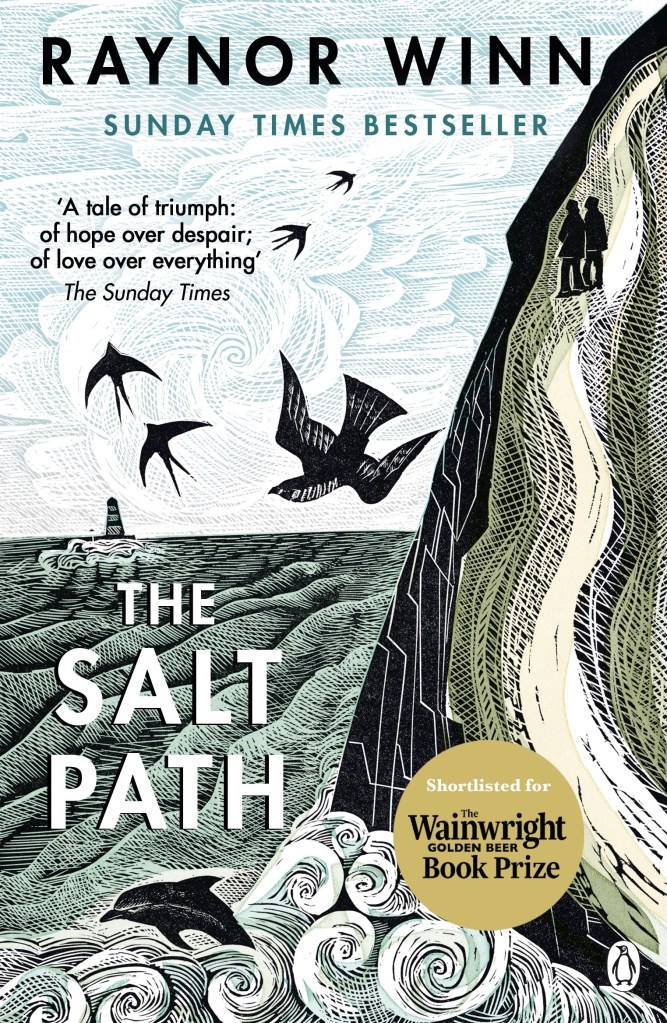
Book Review: The Salt Path by Raynor Winn – an inspiring memoir about the healing power of nature

I don’t read a lot of non-fiction but every so often a book comes along that just captures my interest. I’d had this one on my reading list for some time, but what gave me the kick-start I needed was that one of the challenges in our library’s Turn Up the Heat reading programme asks you to read a biography or memoir.

The Salt Path is the story of a couple in middle age who are at a period in their lives when everything has just turned to custard. They’ve lost their home of twenty years which as a farm and accommodation business was also their income. Around the same time Moth, the author’s husband, is diagnosed with a debilitating terminal illness.

With few options and nowhere to live, other than the kind of emergency housing that could be utterly soul destroying, the pair buy a tent on E-bay, load up a couple of backpacks (rucksacks if you’re British) and set off on the Salt Path. This is a six hundred and thirty miles coastal walk around the south west corner of England from Minehead to Pool. You can’t be homeless if you’re hiking, can you?

But from the outset, Moth and Raynor are doing it tough. They have only a few hundred pounds to their name, and by the time they are walking the path, rely on a small dribble of cash turning up in their bank account from welfare. This barely pays for their food, often noodles and chocolate, or tuna and rice when they feel flush. They scrounge hot water at cafés for tea. You would think that the strain of the walk and lack of good nutrition might make Moth sicker, but it doesn’t. In fact he gets fitter and becomes almost pain-free.

In the pink half-light of dawn, the holes were everywhere. Fresh droppings piled up under the flysheet of the tent and as I undid the zip tens of rabbits hopped only feet away. I could have just reached out and taken one to put straight in the pot. Instead we made tea. Moth found a hairy wine gum in his pocket, so we cut that in half.

Raynor Winn chronicles the people they meet: the other walkers, often with much better equipment, but usually friendly; the people who turn up their noses at their unwashed shabbiness; and the other homeless people, not usually walking but eking out an existence in the towns. It’s quite an insightful look at the homeless problem in UK – how easy it is to drop out of the system, the difficulty of finding affordable accommodation, especially in rural communities where holiday lets drive up the rent astronomically.

The other thing Winn does really well is describe the wild environment of the coastal path. Not just the wildlife she encounters, the plants and the sea, but what it’s like to be amongst it all. Her writing is amazing. You’d think she’d been writing all her life but this would seem to be her first book. Winn’s story is heartfelt, immediate and real. Not surprisingly, The Salt Path was short-listed for the Costa Biography Award and a Wainwright Prize.

“It’s touched you, it’s written all over you: you’ve felt the hand of nature. It won’t ever leave you now; you’re salted…”

But more than that, The Salt Path is also the story of a marriage, of a couple’s devotion to each other and their determination to find a way forward. I found it both an emotional read and an inspiring one. Maybe it’s time to dust off the backpack and the hiking boots once more to remind myself why walking in the wilderness, for all the sore feet, the ache of the pack on your shoulders and the slogs uphill on uneven terrain can be so uplifting. Or maybe I’ll just read Winn’s sequel, The Wild Silence. The Salt Path gets a four and a half out of five from me.

Crime Fiction Catch-Up – some cosy and not-so-cosy Brit-crime reads

I always seem to like a bit of crime fiction during the winter. Here’s a look at a few of the mysteries I’ve enjoyed over recent weeks.

A Game of Fear by Charles Todd
This is the latest Inspector Rutledge novel where our haunted, war-veteran is sent to Essex in search of a case that looks quite hopeless. A murder is reported but there’s no body and the man recognised as the murderer has been dead for years. Nobody at Scotland Yard expects Rutledge to find anything worth investigating, but the witness, Lady Benton, has connections. What he finds is a twisty crime plus a brutal killer on the loose. We have another terrific setting – the salt flats of Walmer, and a manor house built around the ruins of old abbey. There’s the remains of an old airfield from the WWI and somehow everything ties in with the men who served there, many of whom didn’t come back. If you think the Air Force in World War Two was a dangerous lark, then imagine the era of bi-planes and the Red Baron. It’s another cracking read from Charles Todd, loaded with atmosphere and interesting historical background.

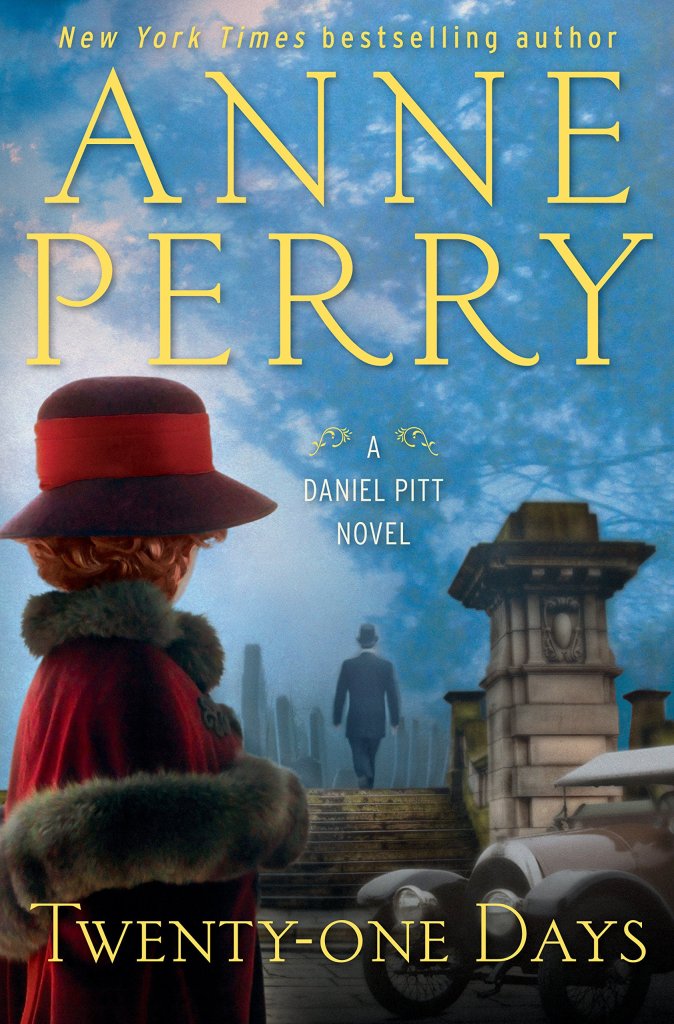
Twenty-one Days by Anne Perry
Anne Perry is best known for her William Monk and Thomas Pitt series set in Victorian England which have been going for a few decades now. They’re good meaty crime reads with a Dickensian feel in the way she recreates the period. This first in a series introduces Thomas Pitt’s barrister son Daniel as the new sleuth, here attempting to save a man from the gallows who’s been found guilty of murdering his wife. He’s hard to defend being an unpleasant character and a scandal-mongering biographer. His latest book looks set to stir up trouble for the secret service, including Daniel’s father, Sir Thomas Pitt. Some interesting points raised about the difference between justice and the law, while the setting of 1910 gives Daniel a chance to take an interest in forensic science, with the help of his head-of-chambers’ daughter. She’d studied at university, but women at that time couldn’t receive a degree, even if they had done all the work. Typical. The story has plenty of twists and introduces some terrific characters we can enjoy getting to know in the subsequent books. There’s already another four.

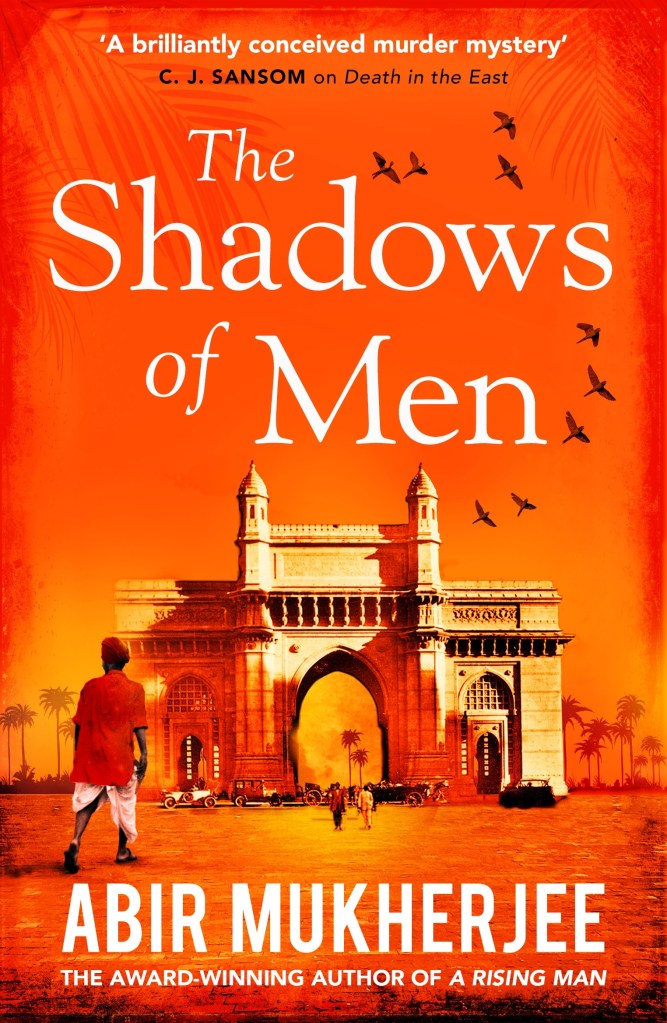
The Shadows of Men by Abir Mukherjee
This series set in 1920s Calcutta just keeps getting better. The new book is told from alternating points of view between policeman Sam Wyndham and his Sergeant Banerjee. The story begins when Banerjee is tasked with a secret mission that lands him on a murder charge. He’s been arrested over the death of a Hindu theologian, when all he was doing was trying to make it look like an accident so that a religious feud doesn’t erupt. With Banerjee on the run, Wyndham must help clear his name and find the killer while religious factions from both Hindu and Muslim groups threaten to throw the country into a permanent state of riot. There’s lots of action and nail-biting moments, but in the background the tinder-box politics of life in India under the British is a fascinating setting. The characters are complex and interesting and the storytelling witty and perceptive. More, please.

The Darkest Evening by Ann Cleeves
This recent Vera Stanhope mystery is set in the dark days of winter when Vera, driving home in the snow, finds she has missed her turning only to discover a car with an unattended baby. She takes the child to the nearest house, which just happens to be the Stanhope family mansion and while she’s there, trying to discover what’s happened, a body is discovered. Of course. There’s a dinner party in full swing and Vera has to rub shoulders with the family she’s fallen out with while looking scruffy as always. But she gets to prove her worth, solving the crime and not taking any nonsense from anyone. I love the way she attempts to jolly along Holly, her ambitious DC, and make allowances for Joe, whose family make demands. There’s a nail-biting finish where the killer nearly takes Vera out of action, but happily there’s another book on the way with her name on the cover. The Rising Tide is out shortly.

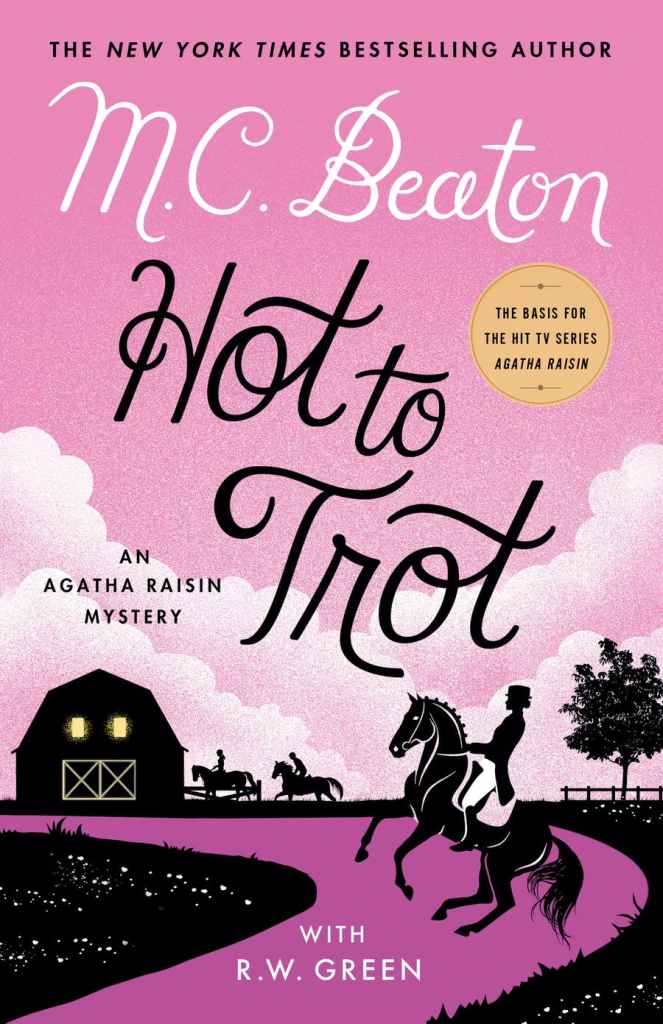
Hot to Trot by M C Beaton
When M C Beaton died a short while ago, we might have thought that would be it for Agatha Raisin. But no, a good friend of Beaton (R W Green) has been entrusted with her story ideas and so Agatha is back again. Here she makes a spectacle of herself at the wedding of her old flame and lord of the manor, Charles Fraith. He’s marrying horsey socialite Mary Brown-Field, but after a fight with Agatha at a masked ball, Mary is found murdered. Agatha has to work hard to convince the police she had nothing to do with it, as well as trying to clear Charles’s name. It’s just as well she’s got other fish to fry romantically and that she and Charles are just good friends. This means he can cough up with her fee, as her private detective agency is buzzing with cases and she’s got staff to pay. The story takes us into the high-stakes world of show-jumping and dressage comps where Mary had rubbed a few people up the wrong way. I particularly enjoyed the audio-book version of this novel, read by the incomparable Penelope Keith. Magic!

Book Review: Remarkably Bright Creatures by Shelby Van Pelt – a heart-warming debut that will have you cheering

I had no idea what to expect with this novel, which includes among its three main narrators an octopus. Marcellus the GPO (great Pacific octopus) inhabits a tank at an aquarium where he has a good view of humanity as it comes to peer at him. He may be missing sea life in the raw, but he’s learnt a lot about people, their weird sense of humour, their ugly eating habits, their lack of perspicacity. He hasn’t a lot of respect for the human race as a whole, but forges a bond with Tova, the seventy-year-old cleaner who each evening wipes the smears from the glass of his enclosure and at one point rescues him from disaster.

Tova is at a crossroads. She has been recently widowed but still rattles around in the house her Swedish father built, which is full of memories. The loss of her son at the age of eighteen is something she’s learnt to live with, if only she could understand what happened on the night he disappeared. Her friends think it’s time for her to find somewhere smaller, but maybe it’s time to think about a retirement home. After all there’s no one to take care of her when she gets too old to manage herself. However, the chatty Scot, Ethan, who runs the local store would be very sorry to see her go.

Meanwhile, hundreds of kilometres away, in California, Cameron is in a bad way. At thirty, he can’t seem to hold down a job, his Jeep has been repossessed and he seems to be running out of chances with his girlfriend. He’s bitter and resentful, still smarting since his mother abandoned him when he was nine. When his Auntie Jeanne gives him a box of his mother’s things, a lack of options has him heading north to Washington State in search of his father. With luck he’s the wealthy property developer Simon Brinks and Cameron can touch him for year’s of child support.

Over the course of the novel, all four characters’ stories collide and Cameron, Ethan, Tova and even Marcellus will help each other get to the truth. It isn’t difficult to guess what’s going on and the author uses dramatic irony to keep the reader turning the pages. You want to shout at the characters, especially Cameron, who has a lot of growing up to do, but also Tova, telling them not to be so hasty, or have another look at that clue. Marcellus is in the same boat as us, figuring things out long before the humans do, but then octopuses are remarkably bright creatures.

In an odd way Marcellus is the hero of the tory, and how Van Pelt makes this work is really charming. He’s a talented escapologist – just why are so many sea cucumbers disappearing? wonders his keeper – and a collector of glittering trifles. But time is not on his side and this adds to the tension.

Remarkably Bright Creatures is an altogether heart-warming read, well put-together with some interesting facts about sea creatures sprinkled through the story. I loved the North-West Pacific coastal setting, a fitting place for an aquarium, and the nosy but kindly locals. I’ll be looking out for Van Pelt’s next book. This one gets a four out of five from me.

Book Review: The Narrow Land by Christine Dwyer Hickey – an atmospheric historical drama and the perfect ‘quiet’ read

I recently came upon a post on Twitter asking readers to name their favourite ‘quiet’ books.. Among the recommendations were lots of my favourites and quite a few more I’d not heard of. Marilynne Robinson’s Gilead was there, and Barbara Pym, as well as Anne Tyler and Elizabeth von Arnim’s Enchanted April. And I thought, yes these are the authors that I read again and again. Now I can add The Narrow Land to the list – a book about the small dramas of people thrown together on Cape Cod during the summer of 1950.

Among the cast of characters is Ed Hopper. He’s the much-loved American painter who produced similarly quiet pictures of people and cars and architecture, the most famous of which is probably Nighthawks, showing late-night customers at a city diner. Ed and his wife Jo live in New York with a holiday house at Cape Cod. They make an odd couple, he’s very tall, quiet, solemn even, while she’s short, emotional and talkative. When we meet them they are in their sixties. Ed has the artist’s version of writer’s block; Jo anxiously quizzing him about possible subject matter, while regretting the sacrifice of her own artistic ambitions to further Ed’s career.

We also meet Michael, the ten-year-old German orphan adopted by a kindly New York couple after their own son’s death. He is sent for two weeks’ holiday with the Kaplans, a well-to-do family who support the charity that has rescued orphans like Michael. Mrs Kaplan is a Lady Bountiful type of character who is renting a large house on the cape with her daughter, Katherine, who is ill, and her glamorous daughter-in-law, the widow of Mrs K’s only son. As well as enjoying the benefits of a holiday by the sea, Michael will be company for Mrs K’s grandson, Richie.

Michael has plenty of demons – memories of the horrors of his war, the loss of his nationality, his language, but also the fear that his new parents won’t want him back – they are moving house and expecting another child. Then there’s fitting in with the tony Kaplans, knowing what to say and do. Richie, soon to be despatched to a new boarding school is chatty and excessively well-mannered, but also suffering the loss of his father.

When Jo tries to shoo the Kaplan’s from the beach in front of the Hoppers’ house, what begins as a seemingly awful social gaffe becomes the catalyst that throws the two households together. Everyone’s intrigued to meet Ed, who cringes at the thought of social engagements. But it’s the two lost and lonely boys who seem to connect with the artist and his wife. While Jo tries to make up with the Kaplans for her earlier bad manners, Ed roams around looking at buildings, their windows and doorways, sketching, walking and thinking. There’s a woman too whose image he can’t quite shake and feels he’s seen her somewhere around here before.

The Narrow Land is a slow burn of a read, with chapters named after some of the planets in Holst’s famous suite, a record loved by both Ed and Katherine. Stars are aligning, perhaps. Little by little, we get to know the characters and they are all written with immense sympathy though each have their faults. Against this, the wider story of the middle twentieth century and an America rebuilding after the war, while a new war in Korea is on the horizon. The characters are also battling it out – Ed and Jo bicker and walk out on each other, Michael and Richie don’t get along either. Only Katherine can soothe the troubled waters it seems, but she’s got her own battle on her hands.

In the background you have the Cape Cod summer, the wind riffling through the long grass, the boats on the water, the long, languid evenings. Did I mention this is also the perfect winter read? I particularly enjoyed the insight you get into Ed Hopper’s paintings, his artist’s eye, his struggles to find the right subject matter. Visual images, music and lingering scents of cigarettes and cologne add to the immediacy of the book, often seen through Michael’s point of view, the perfect impressionable young narrator.

The Narrow Land is an accomplished and spell-binding drama, easily a five out of five from me. It’s also the 2020 recipient of the Walter Scott Prize for historical fiction, and as such qualifies for one of the challenges in our library’s Turn Up the Heat winter reading programme: Read a Prize Winning Book. Put this ‘quiet’ novel on your to-read list.

Book Review: Convenience Store Woman by Sayaka Murata – an unforgettable character and a thought-provoking story

I picked up Convenience Store Woman for another challenge in our library’s Turn Up the Heat reading programme (see previous post). This challenge requires you to read a book in translation. I could have picked any number of nail-biting, atmospheric Scandi-noir mysteries, but opted for a Japanese novel instead. And this one’s been on my radar for a while.

The narrator, Keiko Furukura, isn’t like anybody else she knows. She has no idea how to fit in and this is apparent early as a young child. Her parents and sister worry about her – she has no friends – because she just can’t seem to pick up the norms of social interaction. Strangely, when Keiko is a university student, she is rescued by the opening of a convenience store. She applies for a job and soon she’s learning how to greet customers, what to say to invite them to buy, how to mirror the appropriate facial expressions to be good at making sales. The store’s training regime leaves no room for the randomness of individual personalities.

At that moment, for the first time ever, I felt I’d become a part in the machine in society. I’ve been reborn, I thought.

But now, eighteen years later, Keiko’s still at the convenience store, doing a job normally filled by immigrants, students and transients looking for a stop-gap position before moving on. She’s had several managers including Mrs Izumi, a woman of the same age. It’s OK to have a job in a convenience store if you’re married with children, it seems.

Keiko checks out the brands of Mrs Izumi’s shoes and discovers where she shops so that she can buy similar clothing. She copies the slang she learns from other co-workers to sound more natural. This comes in handy as recently she’s been meeting up with some old classmates. But even though she’s learnt to parrot socially acceptable phrases and dress stylishly, her women friends still nag her about her job and not having a husband. The pressure to change forces Keiko to do something drastic.

Convenience Store Woman is a clever social commentary, almost an anthropological study of the conventions surrounding human behaviour, seen through the eyes of someone outside the norm. It is at times very funny, capturing the excruciating awkwardness of Keiko who would probably not arouse so much concern if she had a ‘proper’ job. She could just be a likeable eccentric – even though it is her shop job that has given her a place in the scheme of things. It makes you realise how society depends on everyone doing things a particular way, which is also a little disturbing.

Convenience Store Woman is a quick read, partly because it’s a small book, but also because it has you racing through the pages to see what happens next. And it’s so entertaining. Keiko is such a brilliant character, more interesting than likeable, but she’s someone you want to cheer for. The book is the English debut for Sayaka Murata who has written many books and won the Akutagawa Prize, Japan’s premier literary award. Her next book in translation, Earthlings, also looks well worth checking out too. Convenience Store Woman gets four out of five from me.

Book Review: The Country Girls by Edna O’Brien – an Irish classic perfect for a library reading challenge

Our public library is running a winter reading programme called Turn Up the Heat. There’s a kind of bingo card of different reading challenges, and every time you log a completed challenge, you go into the draw for prizes. So much fun! One of the challenges is to read a book published in the year you were born. In spite of thinking there’d be hardly anything published in a year so long ago, I quickly found three books to choose from I was happy to read.

The Adventures of the Christmas Pudding, a Hercule Poirot mystery by Agatha Christie, is a book I’ve read before, probably more than once, and I have a copy on my bookshelf. But I felt this one lacked the element of challenge I was quite looking for. Casanova’s Chinese Restaurant is one of the books in Anthony Powell’s ‘A Dance to the Music of Time’ series of twelve books. I’ve been meaning to reread them for a while now, but as the one from my birth year is number five in the series, I demurred. Then I happened upon The Country Girls by Edna O’Brien. A book I’ve always meant to read, and not too long. Perfect.

I was quickly caught up in the story of fourteen-year-old Caithleen, who is worried about the return of her father, missing for days if not weeks with the money he was meant to use on paying bills. We’re on a farm near Limerick, and the father has a terrible temper, and a tendency to go on benders, returning home to beat his wife. This sounds kind of morose, but in spite of the dreariness of life in a small village, Caithleen is a charming narrator. She’s naive, but friendly and kindly. She has a terrible hoodlum of a friend, Baba (Bridget), and the two get up to all sorts.

Cait is romantic in nature, and in spite of a family tragedy, dreams her way through life, yearning after Mr Gentleman, the name given to the Frenchman with an unpronounceable name who lives in a nearby manor house with his wife. Baba just wants to have fun, sometimes at Cait’s expense. Baba is dark, dainty and pretty, which makes tall, red-headed and eventually ‘Rubenesque’ Cait feel inferior. They have a challenging relationship, but kind-hearted Cait remains loyal through all Baba puts her through.

The book is divided roughly into three parts, the first with the girls still at the local school, and Cait’s family situation disintegrates to the point where Baba’s parents feel obliged to take her in. The second has them at a convent school, where Cait shines academically, and Baba gets them into trouble. In the third section, the two escape to Dublin where Baba is sent to a secretarial college and Cait to work in a grocery store. They live for their nights out on the town, Baba urging Cait on to have fun, while Cait writes letters home to Mr Gentleman.

Edna O’Brien writes in a way that is both amusing and entertaining, but also puts you in the time and place. 1960s Dublin is full of all kinds of traps for young girls; the sexism is horrific, so you can’t help admiring Baba’s mother who is worldly wise and does what she feels like, even hiding the chicken dinner from her husband in her wardrobe so there is more for her. It’s a bit like an Irish Nancy Mitford novel – loads of fun, mad characters and brilliant social commentary, but lurking beneath it all a layer of darkness. You can’t help feeling that with the 1960s ready to get going, there will be more choice for young Irish women, but you’ll have to read the next book (The Lonely Girl) to find out.

I’ve always enjoyed classic literature – it’s such a dilemma whether to read the next hot new release or a book that’s remained in print for decades or more. So it’s good to mix them up. I’ve enjoyed a lot of more recent Irish literature, so I appreciated The Country Girls as a book that made an impact at its publication, inspiring the generations of Irish writers, particularly female ones, that followed. Apparently The Country Girls trilogy was so shocking at the time, it was banned and even denounced from the pulpit. Another challenge in Turn Up the Heat is to read a biography – I might be tempted to give O’Brien’s, A Country Girl, a try.