Book Review: The Essex Serpent by Sarah Perry – a vivid historical novel where science, religion and superstition collide

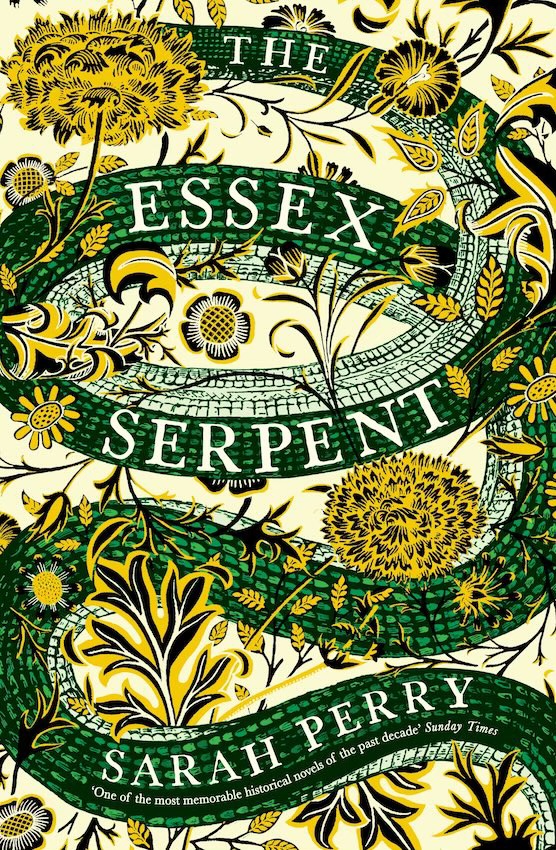
The Essex Serpent was singled out for a raft of awards when it came out in 2016, even winning a couple. Now it’s showing on Apple TV with a brilliant cast including Claire Danes and Tom Hiddleston. I’m not sure why I didn’t pick up the book when it was released, because having read it now, I realise it’s just my kind of book

The story is set in the 1890s, a time of scientific discovery and medical advancement. Cora Seaborne’s bullying husband has recently died, and she finds not so much grieving, but discovering freedom in her new circumstances. Fascinated by science, particularly palaeontology, she is excited to hear reports of an “Essex serpent” and decides to head off to Colchester, accompanied by her companion/servant Martha and young son, Francis. She takes long walks in a man’s coat, releases her hair and becomes increasingly her own person.

Will and Cora clash in many ways, Cora determined that there is a possibility that a beast from the dinosaur era may have survived against the odds; Will’s more practical mind believing there’s a more rational explanation. He sees no reason why religion cannot accommodate modern science, while Cora cannot see how he can think logically and still have faith. The two are drawn to each other, in spite of an odd first meeting over the rescue of a sheep.

Other characters are equally interesting. There’s Cora’s friend, Dr Luke Garrett, who she refers to as the “imp”, the young doctor who attended her late husband, and who is patently in love with her. Luke is desperate to try new kinds of surgery and to make his mark on the medical world, his wealthy friend Spencer, tagging along. Martha has strong socialist views, and in spite of impoverished upbringing, has read Marx, attending lectures on social change and gets involved in housing reform. There are children who get caught up in all the Essex madness, as well as World’s End resident, old Cracknell with his ongoing campaign against moles.

There are further story threads involving Luke’s chance at heart surgery and the life he saves, and Spencer’s opportunity to impress Martha. With so much going on in the novel, the sub-plots highlighting the plight of the poor, and it’s very individualistic characters, the book reminded me a little of a Dickens novel. The writing is well-crafted and evocative, whether we’re in the slums of London, or the salt marshes of Essex. The different story threads pull strongly towards a dramatic finish, and you are desperate to see what happens next. I loved it – the audiobook version read by Juanita McMahon, was superb – and I shall certainly be reading everything else by Sarah Perry. The Essex Serpent is a five-star read from me.

Book Review: Every City Is Every Other City by John McFetridge – a quirky Canadian update of the classic gumshoe mystery

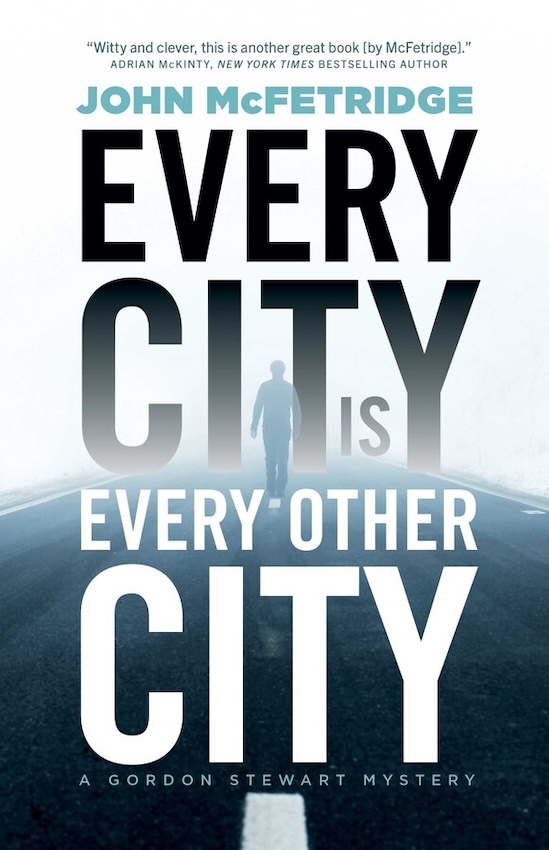
Taking a punt on an author you’ve never heard of before can bring up some nice surprises. The title of this crime novel made me curious and I was soon happily ensconced in this e-audiobook about a part-time private investigator.

Gordon Stewart makes much of his name – you can read it either way, he says. A first name that could be a surname or vice versa. Mostly though, he’s just Gord, a location scout for the movie industry. This work means he’s got an eye for detail, and is good at sniffing things out – useful skills in a private investigator which is something he does when the movie work is quiet.

Lana, a work colleague, talks Gord into finding out what happened to her Uncle Kevin, an out-of-work electrician who has left his wife and gone off in his truck with his rifle. Finding the truck on a back road near the woods, police have written off the disappearance as suicide. He may have been depressed but Lana’s aunt is adamant Kevin’s still alive and wants to know where he is.

There’s also the story of the surveillance job Gord takes on for OBC (Old Boys Club) Security Inc – a case that has similarities to the Harvey Weinstein sexual assault case. Gord’s not keen, but Teddy at OBC can help with official records to help find Uncle Kevin so Gord feels obligated. This gets awkward when Ethel, the actress he has started seeing, discovers which side OBC is working for and decides to do some sleuthing on her own.

Every City Is Every Other City is a different kind of crime novel – maybe it’s the laid-back Canadian humour, or perhaps it’s the blend of PI sleuthing with glimpses of the less glamorous side of movie-making. Key elements of the story concern issues of the day – feminism and the Me-Too movement, for instance, as well as men’s mental health and the importance of work. McFetridge is very smart with dialogue, and his characters are nicely ordinary but interesting at the same time. The plot simmers along quietly, packing in enough tension to keep you turning the pages, with an ending that is both witty and heart-warming.

There’s also a lot of interesting detail about the entertainment industry. I love the way Gord knows just the right locations for somewhere in Ontario that can look like a New York street corner or a small town in America. Ethel’s an improv performer which comes in handy later when she’s trying to pretend she has a good reason to be somewhere she shouldn’t. Her world is also quite fascinating.

Ethel’s quite a character, the bright-spark extrovert opposite Gord’s low key personality. Both are quite appealing in their own way and their relationship adds another story thread. Even Gord’s dad is quirky in the way a man who has lost his wife a long time ago might be – fixing up his house rather than replacing anything, so that it looks mired in the 1980s, which delights Ethel.

Having characters that are fun to hang out with is always a plus, while I particularly liked the reading of this e-audiobook. This is courtesy of Tim Campbell, who takes you nicely into Gord’s head with a flat, gum-shoe kind of monotone that reminded me a little of old movies, and contrasting this well with Ethel’s more lively delivery and that of other characters. I stumbled upon this audiobook quite by accident and it made me realise I haven’t read a lot of Canadian literature in a while – something I’m keen to remedy, as I’d enjoyed it in the past. Every City Is Every Other City is a four-star read from me.

Book Review: Confessions by Catherine Airey – a compelling story of three generations of Irish women, their secrets and their choices

Rather than following Cora’s fresh start in Ireland, the story switches back to describe two sisters growing up and struggling with the sudden loss of their father. Their mother takes to her bed and the sisters, Maire and Roísín, do their best. Maire is a brilliant artist but has mental health issues. Fortunately there’s Michael who adores her and is like a brother to Roísín. We’re also with Maire when she earns a scholarship to New York and her struggles to fit in with a narrative shift told interestingly in the second person.

Almost like a character in itself is the big old mansion outside the village, once a stately home, that has become a refuge for women seeking an alternative lifestyle. Known as The Screamers, it offers a new chance first to Maire, and later the home for Roísín and the returning young Cora. It is where Cora’s daughter, Lyca, digs into the past and finds some long buried secrets.

On the walk home from midnight mass you go inside a phone box. Shutting yourself in reminds you of being inside the confessional booth back home. Your first confession, when you wanted to tell Father Peter about Jesus winking at you from the cross over the altar. Your mother had told you that this was a false image, that you were imaging things. But it didn’t feel fair to count this as a sin when you weren’t the one doing the winking. Instead, said you sometimes wished your sister was dead. This seemed to satisfy the priest, who sent you off to pray the rosary.

In Confessions we have the repeated themes of girls growing up without a father, teen pregnancies, too much freedom or too much restraint. These young women are all smart enough to do well in a world that accepts them for who they are, but it’s going to take more recent generations – Cora, and then Lyca – for that to happen, and a more modern Ireland. But it’s the long buried secrets that keep the reader on their toes to the end. How will they disturb the fragile memories Cora in particular has of her parents?

And the writing is wonderful, finely tuned to each character and allowing them to tell their story, vivid and at times very intense. The setting of New York in particular is an interesting highlight – it comes through as a walker’s city, shown from the ground up, as well as a place of surprising vistas when seen from a high-rise building. The contrast with a small Irish town couldn’t be more stark – the closed-in feel of the early interiors, then Screamers with its warren of rooms.

This is a well put-together story, the threads of the different characters carefully woven in and, at the same time, written from the heart. I was glad to receive this advance reader copy thanks to Netgalley, in return for an honest review. Confessions is due for release late January and a four-and-a-half star read from me.

Book Review: The Radio Hour by Victoria Purman – a feel-good story taking you behind the scenes of a 1950s radio drama

I was instantly charmed by The Radio Hour and soon drawn into the world of its main character, Martha Berry. About to turn 50, Martha’s been working at ABC, the big, state-owned Australian broadcasting corporation, for decades and knows all the ins and outs of radio production.

Shunted from department to department, Martha’s always been there when another secretary has left to get married – there are no married women at ABC. She’s sensible, pragmatic and knowledgeable – everything her new boss isn’t. That’s Quentin Quinn, fresh-faced and twenty-something, on his first ever radio serial, As the Sun Sets.

Radio dramas of this kind were popular entertainment for those at home – often a break in the housewife’s busy day, the stories and characters adored equally. But waiting in the wings is a threat to this happy status quo – television. Quinn is soon out of his depth. He’d much rather be writing an action show with cops and robbers, not a soap following the lives of a butcher, his wife and daughter and the people who step into the shop.

Quinn starts the day late, spends long lunches out drinking and leaves early, while the first airing of As the Sun Sets looms closer and there’s still no script. What’s Martha supposed to do? A fond reader of the classics, Martha knows a thing or two about storylines and characters, to say nothing of the things that women at home worry about. She’s well liked by her mother’s friends and joins their conversations on the verandah when she returns from work. And then there’s April, May and June, the three young secretaries she befriends at ABC. She lends an ear to their worries and they welcome her advice.

Martha’s led a quiet life at home with her widowed mother and has never pushed herself forward for anything. But once’s she’s helped select the cast and booked the recording studio, she can’t let the show down. Before you know it Martha is writing for As the Sun Sets, pretending to an increasingly drunk-on-the-job Quinn that the scripts are all his work – she’s just typing them up.

On the surface The Radio Hour is a light, feel-good read, and it captures so well the 1950s era and values. But the casual misogyny dished out on a daily basis to the female staff, the sexist management structure and the predatory behaviour of some of the men towards the young women in their midst will make your blood boil. How Martha and her female colleagues fight back gives the story something to cheer about, but you know it’s going to be a long haul.

Victoria Purman has obviously done some homework and references real people as background figures, such as, Gwen Meredith, a well-known writer of radio drama and role model for Martha, and the ‘had enough’ character, Joyce Wiggins is inspired by real-life producer Joyce Belfrage. The author even worked at ABC in her early career as a journalist, though quite some time after the events of her novel. This all shines through in a story that brims with authenticity and interesting radio production detail.

I enjoyed The Radio Hour immensely. I loved Martha and her friends and will certainly look out for more by this author – she’s got quite a backlist of historical fiction. I received a complimentary copy of this book. Opinions expressed in this review are completely my own. The Radio Hour is a four-star read from me.

Book Review: Death at the Sign of the Rook by Kate Atkinson – more fun and games with the latest Jackson Brodie mystery

I have to admit to being a Jackson Brodie fan since we met the beleaguered private investigator in the first book, Case Histories. I’ve read them more than once as well as enjoying immensely the TV adaptations starring Jason Isaacs. So here we are, five years since the last one (Big Sky), with another in the series – something I wasn’t really expecting, and you can imagine my delight.

Atkinson has a habit of not really continuing where she left off in the last book. Instead we seem to catch up with Jackson some years later, or with a completely different set of circumstances. Sometimes he’s flush and others he’s down on his luck. In Death at the Sign the Rook, Jackson is living with his girlfriend, Tatiana, and has had enough income from his PI work to buy himself a lovely big Land Rover Defender. His new case involves the theft of what looks like a Renaissance painting – a portrait of a Woman with a Weasel, which until recently hung on the bedroom wall, out of reach of prying eyes, of an elderly lady who has recently died.

It seems Dorothy Padgett’s carer Melanie Hope has taken it, and just disappeared without notice, leaving only an old mystery novel: Hark! Hark! The Dogs Do Bark by Nancy Styles. Dorothy’s daughter Hazel and her son Ian want Jackson to track Melanie down rather than calling the police – the painting may have some dodgy provenance. We get Jackson’s usual internal sizing up of the situation with Dorothy’s grasping offspring, squabbling over their mother’s possessions.

The story weaves in and out of Jackson’s investigation, bringing in several other main characters, beginning with Lady Milton over at her cash-strapped stately home, Burton Makepeace. LM has similarly lost a valuable painting, this one a Turner, at the same time as her companionable housekeeper Sophie disappeared. She is struggling to keep control of things while her eldest son Piers is trying to turn the big house into a hotel complete with staged murder mystery evenings. She’s an impossible character to like with her old-world thinking and arrant snobbery, but you can’t help feeling a bit sorry for her.

There’s also the boring vicar, Simon Cate, who has had a complete loss of faith, but battles on regardless, a fondness for animals, his only saving grace. And then there’s Ben, ex-military and a bit sorry for himself having lost a leg on his last tour, while missing his mates in the Army. He’s living with his sister, and learning to look after bees. We also meet Reggie Chase again – you’ll remember her from previous books – now a Yorkshire police detective.

These threads all slowly weave the characters into a plot involving a blizzard, a murderer on the run who’s armed and dangerous, and a murder mystery evening at Burton Makepeace. Somehow all of the characters end up there – we’re given a hint of what’s to come in a kind of prologue – and Jackson’s going to feel glad he bought the Defender. As usual it isn’t always the crooks that are the baddies, or not all of them anyway, and Jackson may or may not err on the wrong side of the law.

Atkinson is a master of creating a tantalising story with plenty of humour and surprise twists. However, I did feel this story took a while to get going. We get stuck for chunks of narrative with Simon the vicar, and Lady Milton, both of whom can be a bit tiresome. But once the story gets going, there’s plenty to enjoy and the ending’s a cracker. Not the best Jackson Brodie, but still worth reading. A three-and-a-half star read from me.

Book Review: House of Glass by Susan Fletcher – a chillingly gothic novel with an extraordinary heroine

I was so taken with Susan Fletcher’s recent novel, The Night in Question, that I thought I’d try one of her earlier books. I picked up House of Glass, a historical mystery novel which oozes creepy house atmosphere.

We start off in London at the turn of the twentieth century, where we first meet Clara as a child, unable to leave her house. She has osteogenesis imperfecta, a kind of brittle bone disease, which means the slightest stumble or fall can cause a broken bone. The doctor thinks it best if she doesn’t go outside until she has grown up – or as grown up as she ever will be.

Clara is well cared for – there are endless books to read, and her mother, Charlotte, and her stepfather love her. Charlotte is a suffragette who left India as a young woman in disgrace and has made a marriage of convenience to Patrick. At the age of eighteen, Clara is able to explore the world with care, but the early death of Charlotte leaves her devastated. She finds herself at Kew Gardens in winter, befriended by one of the gardeners, and is slowly restored to herself by learning about the plants.

The story takes us to Shadowbrook, a once stately home with impressive gardens, where Clara takes on a short-term job – to oversee the establishment of a glass house of tropical plants, delivered from Kew. The new owner of Shadowbrook, a Mr Fox, is rarely at home, so Clara is left to get on with the glass house. But there are ghostly occurrences in the house – footsteps upstairs, where none of the staff or Clara are allowed to venture; flowers that are torn to shreds in the vases; things moved around. The housekeeper talks of paintings thrown from the walls, books flung from the shelves – which explains the bareness in many of the rooms.

Clara is a young woman who has immersed herself in science and doesn’t believe in ghosts. Even so she can’t help but be curious about the Pettigrew family that once lived at Shadowbrook, the stories of wild and cruel behaviour that have made them hated in the village. But the more questions she asks, the more suspicious the locals are of Clara, with her long, pale and untamed hair, her stoop and walking stick, her strange-coloured eyes. She begins to feel as much an outsider as the mysterious Veronique Pettigrew, whose ghost supposedly haunts Shadowbrook.

I had a curious sense of being watched; throughout the garden, I felt it. It was as though I had entered a part of it – the orchard, the lime bower – at the very moment that someone else had risen and left; I felt any metal chair might retain that person’s heat. It was an unsettling notion. I chastised myself for it – it was foolishness – yet I also looked down the lines of hedges. On the croquet lawn, I turned a slow, complete circle to see it all.

House of Glass is a novel that works on many levels. It reminded me of Wilkie Collins’ The Woman in White, with its mix of suspense and mystery. There’s atmosphere by the truckload in the house and the gardens, both evocatively described. Many of the characters seem to be harbouring secrets, some of them quite devastating as the story emerges, and there are a few twists before you get to the end.

My body was discoloured, marked. I was perhaps, more bruised than I had ever been; mauve and dark red and yellow in places. I examined the bruises one by one. I tried to remember the cause of each – a branch or a door frame, my own touch – and once, I might have minded such injuries. But now I saw those bruises as proof that I was living. I was no longer watching life from a London window, my hands on the glass; I was a part of it.

And then there’s the conjuring up of England on the brink of war – it’s 1914, the summer that Clara comes to Shadowbrook – so you’re constantly aware that the futures of the young gardeners and other characters are hanging in the balance. The place of women, not only the suffragettes, but any woman wanting to make a life of her own, to live the way she wants to is a theme that is depicted in the characters of Clara, Charlotte and in the story of Veronique.

House of Glass is a terrific read for anyone who loves a good historical mystery, or enjoys an atmospheric setting, particularly the way an English country house can be almost a character in itself. The characters are interesting more than likeable, while the plot has plenty to get you rushing through the final chapters. Throw in some nicely crafted writing and there’s plenty here to enjoy – it’s a four-star read from me.

Book Review: The Long Water by Stef Penney – an enthralling Nordic mystery with dark echoes from the past

I’m always excited to see a new novel by Stef Penney. Her new novel, The Long Water, takes its name from a river in a rugged part of Norway within the Arctic Circle, where there’s a string of lakes and rivers, guarded by “mountains that rise out of the water like teeth”. It’s a remote area that once fostered mining, but with most mines now closed, the economy is now more reliant on tourism.

In the town of Fauske, senior high school students are enjoying “russ”, a kind of spring break, taking part in dares, general mayhem and partying all night before the hard work of exams begins. In the middle of this, a popular boy goes missing. Daniel was one of a group of friends who called themselves the Hellraisers and who are admired by everyone for their general coolness. A police search that goes on for days and then weeks yields not the missing boy, but a body in a mine that dates back to 1968, when the mine was closed.

The story draws you in through the eyes of several characters beginning with Svea, an elderly woman living on the outskirts of town with her dog who likes to keep to herself. Her one good friend is Odd Emil, a widower who is also Daniel’s grandfather. Svea has fallen out with her daughter, but is in contact with a granddaughter, Elin, who lives with her father, a rather conservative vicar. Now sixteen, Elin has just come out as gender fluid which at first perplexes her father, but fortunately Svea lends a sympathetic ear.

As well as being a mystery, this is also the story of Svea’s family and ongoing damage from their horrific upbringing. Svea has become strong in spite of this – the father she never knew was a German soldier stationed in Norway during the war, and her mother’s one true love. Her violent drunk of a stepfather taunted her with her doubtful parentage, but at least she had the love of her two sisters.

Elin worries that her being neurodiverse is what drove her mother away, but Svea thinks it’s more likely that her daughter has been troubled by her family’s mental health problems, in particular, an alcoholic grandmother and a fey aunt who disappeared some years ago.

The story also follows Benny, Elin’s friend who gets inadvertently caught up as a witness to events on the night of Daniel’s disappearance, while doing something he probably shouldn’t. And then there’s Daniel’s teacher, Marylen, who has a troubled home life and a secret attraction to Elin’s father. They are all interesting characters, well-drawn, who throw different lights onto the central mystery.

So there’s plenty of story threads. How the town deals with the disappearance of Daniel, as well as the discovery of a body pushes the plot along nicely. Elin and Svea can’t help but ask questions while hints of what happened decades ago make you whip through the pages. On top of which, Fauske is such an interesting place for a reader to visit – Stef Penney is brilliant at creating evocative settings – and you have the feeling that there are darker undercurrents that need to be brought to light, particularly around misogyny and prejudice.

While all the characters are easy to sympathise with, Svea is a particularly brilliant creation. She’s crusty and plain-spoken, loves her dog but has secrets too. Her story is slowly revealed, while we wonder if it isn’t too late for her to find peace with the past, reconnection with her family, even love. Stef Penney, who wrote the Costa Award winning: The Tenderness of Wolves, is always worth waiting for and her new book didn’t disappoint. The Long Water is a four and a half star read from me.

Book Review: Mr Campion’s Christmas by Mike Ripley – a fun, seasonal read with both thrills and period charm

Mike Ripley is the author of the Fitzroy Maclean Angel crime series featuring an enigmatic bandleader as its sleuth. Then about ten years ago he picked up where Margery Allingham left off and has written another twelve novels in her Albert Campion series. I feel as if I’m rather late to the party having never read any of the Campion books, which Allingham began way back in 1929, a kind of spoof, supposedly, of Dorothy Sayers’ Lord Peter Wimsey novels.

Having just read Mr Campion’s Christmas I feel I have a bit of catching up to do. The story begins with a bus journey from London, leaving the Victoria Coach Station a couple of days after Christmas. It’s 1962, a year that went down in history not only for the Cuban Missile Crisis, but also a severe season of blizzards that particularly rocked East Anglia. The coach is heading for Walsingham, a Norfolk village famous for its shrines and as such a destination for pilgrims.

Walsingham is also near an RAF airbase, so there are three genial American airman on board, as well as a small collection of odd characters: Hereward Henderson, a history buff and general bore, Miss Pounder, a reserved middle-aged woman, Reverend Breck who is planning to retire in Walsingham, and Fred De Vries, a Dutch art dealer who guards his luggage with his life. It’s a nerve-wracking journey for Graham Fisk, the driver, as snow turns to blizzard, so he’s only too happy to hand over the driving to one of the airmen. But even Oscar can’t keep the bus straight in such horrific conditions and the coach collides with one of the gate posts of a country house named Carterers.

Yes, it’s the home of Albert Campion, his wife Lady Amanda and their son Rupert, just home from his first term at a University in America. The three are hunkering down as the snow falls, along with Campion’s side-kick Magersfontein Lugg, a large man with a few rough edges. The hot meals keep coming thanks to Mrs Thursby, the housekeeper, and the family have also rescued Lloyd Thursby, Mrs Thursby’s deaf father-in-law who has a passion for watching westerns on the TV.

Suddenly the Campions are playing hosts to the stranded coach party and sleeping arrangements have to be sorted. But what starts out as Yule-tide hospitality turns into a hostage situation plus a murder, and it’s a return to the old days for Campion and Lugg who must save the day. It’s a classic kind of thriller, made entertaining and fresh by the quirky characters of the household as well as those from the coach. Most of this group seem to be harbouring a secret, just to make things complicated.

Of course the telephone loses connection so there’s no chance of rescue, and the Campions must rescue themselves, although help comes from an unexpected quarter. Lady Amanda is a modern woman, with a career in the aeronautical industry, and also gets to show her mettle. Just as all seems lost, Campion devises an oddball plan that is very entertaining as well as reasonably nail-biting. Campion hides his skill at handling tricky situations behind a facade of batty eccentricity, that’s a little P G Wodehouse, while his brain is in overdrive looking for windows of opportunity. There are codewords and his number one weapon, the size and heft of Lugg, is eventually deployed.

Bubbling through it all is a steady stream of wit, humorous incidents and smart writing that makes this update of an old favourite nicely readable for a modern audience. But you’re still happily in 1962 and the classic crime writing of this era – the perfect light, diverting escapade for Christmas. Mr Campion’s Christmas is a four-star read from me.

Book Review: The Bookshop Detectives: Dead Girl Gone by Gareth Ward and Louise Ward – a humorous take on the bookshop mystery, packed with local colour

I went to an author talk recently at which authors Gareth and Louise Ward described how they came to write a book together set in the New Zealand village of Havelock North where they live and where they own a bookshop. The Bookshop Detectives: Dead Girl Gone is a delightful cosy mystery and part of the humour for me, anyway – and this is a very funny book – comes from the way the main characters, Garth and Eloise Sherlock, owners of Sherlock Tomes, are seemingly versions of the authors and their world.

In real life, Gareth and Louise were also, once upon a time, coppers back in the UK, or Blighty as they call it. And they do have a large dog with a sensitive personality who is often at the shop – I’ve been there a few times, so I know. The world of these booksellers just seems made for a cosy mystery series, doesn’t it? At the talk I was amused to learn that the dog, Stevie, was a more prominent character in the first drafts, until the editor cut out large chunks with “too much Stevie” scrawled in the margin. So for lovers of mysteries where pets save the day and solve the murder, this doesn’t quite happen, although I am happy to say, Stevie does play a pivotal role in things.

The story revolves around a cold case, the disappearance of schoolgirl, Tracey Jervis, decades before. A bright student with a talent for poetry, Tracey left home, heading for the circus, and was never seen again. There were rumours of her being caught in a clinch with a teacher, but the work she did helping a politician with his campaign seems to have thrown up more questions. As well as being politically ambitious, Franklin White is a property developer, with an arrogance that makes him easy to loathe. And then there’s Tracey’s controlling father; and what about the ex-boyfriend?

Meryl is an artist, as she’s told us often, although I’ve never seen any of her work in Havelock North’s galleries or that other purveyor of fine art, the local coffee shop. She barges past me pulling a granny trolley, which she is far too young to be using. ‘What other calendars have you got?’ she asks, seeming indifferent to the fact that I haven’t set up for the day, or even yet switched the lights on.
Despite having been ordered from the reps in February, the main drop of calendars hasn’t arrived yet. They get later each year and the shipping issues we’ve had thanks to Covid have only made matters worse. ‘They’re in a box up at the counter,’ I tell Meryl. ‘We’ve just had a couple of the smaller suppliers so far.’ I grab two piles of magazines banded with plastic strips from outside the door and hurry after her.
‘What about “Nice Jewish Guys”?’
When we first opened the shop, and didn’t know what we were doing, we got an eclectic mix of calendars of which perhaps the most bizarre was ‘Nice Jewish Guys’. We put a photo of Eloise swooning over it up on Facebook as a bit of a giggle and sold all four copies the same day. Ever since it has been a firm seller every year, though the calendar rep told us we’re the only retailer in New Zealand that stocks it.

Garth and Eloise had never heard of Tracey Jarvis until a mysterious package is delivered to the shop with a copy of a book inside – See You in September, by real-life local author, Charity Norman. The book has been annotated with a message – a call to action to reinvestigate Tracey’s disappearance, and on the package is a reference to Eloise’s old police badge number, which was hardly something anyone local would know. The couple can’t help wondering if there’s a link to a nasty criminal Eloise had helped put away years ago and who casts a lingering shadow.

Other story threads are woven in, the most notable being the decision of one of the world’s best-selling authors to launch her latest book at Sherlock Tomes, a colossal and mind-boggling event that has to be kept under wraps. Then there’s the flower pilferer that is pinching flowers from the shop’s window box as well as the menace provided by some thuggish gang members who try to put a stop to the Tracey Jarvis investigation.

Everything comes together neatly, the plot building to a simmering conclusion full of surprises and fair dose of action. But while the book lives up to it’s ‘cosy mystery’ label, it’s also a view into the enchanting world of bookshops and the people who visit, its quirky and loveable staff, and the curious characters who inhabit the village. Dead Girl Gone is the first in a series, with a second book already in the pipeline to look out for. Can’t wait! This one’s a four-star read from me.

Book Review: The Vanishing Act of Esme Lennox by Maggie O’Farrell – a disturbing story about family secrets and the spectre of madness

I’ve had this book on my bedside table for what seems like forever – a ‘just in case’ sort of book for when I’d run out of anything else that begged me to pick it up. I knew it would be good – Maggie O’Farrell is always good, but the subject matter sounded sobering.

The Vanishing Act of Esme Lennox follows an Edinburgh family. Iris receives a letter from a solicitor about a relative she didn’t know she had, the sister of her grandmother, about to be released from care. Esme Lennox has been in a mental hospital for sixty odd years and now needs to be rehoused. Her name has been put down for a rest home, but there’s not a bed available for some weeks. Can Iris look after her in the meantime?

Iris assumes Esme must be unsafe, or unable to care for herself, or both, and with a shop to run and a busy life, is not confident she can take her aunt on. Her initial impulse is to agree to a temporary solution in a hostel. She collects Esme, a woman in her seventies, but the hostel is unwelcoming, peopled with drug addicts and volatile personalities. What can she do but put Esme up in her spare room and explore other options.

In the meantime we get Iris’s story – her close bond with step-brother Alex; the father who died young; her mother in Brisbane; her affair with a married man. Her little shop selling gorgeous pre-loved clothes and accessories. But the bulk of story is about Esme – her childhood in India with an older sister and baby brother. Her quirky personality, her stuffy, unloving parents and the terrible tragedy before the family’s return to Edinburgh. Esme is bright and rebellious, not sensible and manageable like her sister, Kitty. We follow her growing up and the events that tip her over the edge.

Iris waits for Esme to open the door but nothing happens. She puts her hand on the doorknob and turns it slowly. ‘Good morning,’ she says, as she does so, hoping she sounds more upbeat than she feels. She has no idea what she will see behind the door.
Esme is standing in the middle of the room. She is fully dressed, her hair brushed and neatly clipped to one side. She is wearing her coat, for some reason, buttoned up to the neck. There is an armchair next to her and Iris realises that she must have been pushing it across the floor. The expression on her face, Iris is astonished to see, is one of absolute, abject terror. She is looking at her, Iris thinks, as if she is expecting Iris to strike her.

It’s not a happy story, not at all, but it casts a light on the way women with mental health problems, or even if they were just a bit unruly, could be sent away to asylums. All was needed was a determined, usually male relative, and the signing off a doctor. Maggie O’Farrell imagines how a young woman like Iris would feel on discovering that her grandmother had a sister she’d never mentioned, and that that sister had been never been out of her mental facility for sixty years. Just how do you deal with that?

The two discover more about each other as secrets emerge, and in facing up to the truth, Iris also faces up to the truth of her own life, in particular her own relationships. It’s a compelling read and I was not in the least disappointed, in spite of the tragedy of Esme’s situation, as the story surges on to an attention-grabbing finale. I was hooked – I am always hooked with Maggie O’Farrell. I’m not sure if it’s her crisp writing style, or her immensely interesting and empathetically drawn characters, but her books are just so satisfying. As is this one. The Vanishing Act of Esme Lennox is a five star read from me.