Reading the Classics: Olivia Manning’s The Balkan Trilogy Part 1 – The Great Fortune

This round of the Classics Club Spin sent me off to Romania, 1939, for the first of six books that are based on Manning’s own experiences, and which are combined together as her Fortunes of War series. I have only read the first book: The Great Fortune , which is a decent, meaty read for a number of reasons.

The story begins with a train journey. Newley weds, Guy and Harriet Pringle are on their way to Bucharest in Romania. Guy teaches English at a Bucharest university as part of a cultural programme sponsored by the British government. He’s met Harriet during the summer vacation and married her before bringing her to the Balkans just as Germany invades Poland.

So when the Pringles arrive at their hotel, Harriet is confronted not only by persistent beggars, many of them deformed from birth to help their earning potential, but also an influx of Polish refugees. Harriet and Guy are temporarily staying here until they can find a flat, because Guy has always tended to couch surf among his wide and varied set of acquaintances. He’s a popular young man who thrives on interacting with others, talking literature and politics into the small hours.

Guy’s also a devotee of Marxism which he sees as a potential solution in a country where the peasants are struggling under a powerful elite. Romania has a strong economy with plentiful resources, among them a highly productive agricultural sector. But with a war starting up, much of this produce is exported and the ensuing hike in the cost of living puts a terrible strain on the poorest. Meanwhile the Pringles hob-nob with assorted academics and civil servants at various plush restaurants.

As Harriet passed between the tables with Clarence, there was a little murmur of comment: first that she should make this public appearance with someone other than her husband, then the common complaint that English teachers – they were all regarded as ‘teachers’ – could afford to come to a restaurant of this class. In Rumania a teacher was one of the lowest-paid members of the lower-middle class, earning perhaps four thousand lei a month. Here was proof that the English teachers were not teachers at all but, as everyone suspected, spies.

We get another view of Bucharest society through the eyes of Prince Yakimov, also newly arrived, who has fallen on hard times. It isn’t clear quite how he comes to be in Bucharest, except that he needs to make his remittance last a bit longer and the city seems cheap. He hasn’t a clue how to earn a living. Yakimov is technically British, his father having escaped Russia at the time of revolution, but now drifts from hotel to hotel living on credit. His finely tailored clothes, his name and good manners soon have him invited to parties given by the aristocracy, in the hope they can fleece him at cards.

But mostly this is Harriet’s story. The poor girl has to get used to sharing Guy, not only with his many friends, but also with Sophie, who’d hoped to marry Guy herself, and therefore acquire a British passport. Other characters include gloomy Clarence, Guy’s colleague, who soon takes an interest in Harriet, and Guy’s boss, Inchcape, who has been put in charge of British propaganda for the Balkans. The story bubbles along full of lively conversations on the political situation, the locals as well as relationships and anything else – often very lifelike and stimulating dialogue.

Olivia Manning has masterfully recreated a time and place in a way that seems very vivid – she was similarly married to a British academic at a Bucharest university, and this shows in her descriptions of the people of the city, its buildings and parks, its cafés and restaurants. You really feel you are there with Harriet and you suffer with her all the anxiety of fitting in and waiting for Guy to come home. All the while, events are taking a turn for the worse with the outbreak of war. She worries she will never be able to return to England, that Hitler will invade Britain, that Hitler will invade Romania.

Running through the book is a wonderful cast of characters, and a smattering of dry humour. Harriet is one of those quiet observers who doesn’t suffer fools gladly, but is often stuck with odd company and not much to do. Scenes with Yakimov offer a mix of hilarity and desperation. The story is set over four parts but comes together nicely towards a strong conclusion, with Guy deciding to produce a Shakespeare play. This brings out the best and worst in the members of the cast, all taken from his friends and colleagues.

I really enjoyed The Great Fortune, although it wasn’t a book to rush through, requiring lots of concentration to keep up with who was who. But I still hope to read more in the series, including Manning’s follow-up books that make up The Levant Trilogy which describes the Pringles’ life in Egypt as the war rages on. Manning also wrote a number of stand-alone novels that could also be well worth checking out – she’s a terrific writer. The Good Fortune gets four stars from me.

Book Review: The Bookseller of Inverness by S G MacLean – a stunning Scottish thriller of intrigue and revenge

It’s hard for me not to feel a lump in my throat when reading a book that describes so vividly the events around the Jacobite uprisings that aimed to put a Stuart back on the throne. The butchery and barbarism of the government forces at the Battle of Culloden, the subsequent hunting down of Jacobites through Scotland and the harsh penalties enacted on those that were captured, including the ‘traitor’s death’, are hard to read about without feeling, well, rather cross.

With The Bookseller of Inverness, S G Maclean brings this history to life. It’s a murder mystery set in the Highland city of Inverness, the bookseller of the title, Iain MacGillivray, a veteran of Culloden who has somehow survived, though scarred both physically and mentally. He’s a brooding man of thirty-four, silent and dour as he runs his shop and lending library, coming to life a little at dances where he’s a popular fiddler.

Iain’s world is turned upside down and he is hauled out of his melancholy when several events happen in rapid succession. A stranger is found murdered in his bookshop – he’d previously been fossicking for a book he was desperate to find. And we have the return to Scotland of Iain’s father, Hector, who if found by the authorities will surely face death for his connection to Bonnie Prince Charlie, the Young Pretender.

On his desk lay a dirk like the one he had once habitually carried, before the bearing of arms or the wearing of tartan had been forbidden to Highlanders. Tied to the hilt of his knife, though, was a white silk rosette. Iain’s heart began to quicken. It was the white cockade, as worn in his own blue bonnet and in that of practically every other soldier of the prince’s army in the ’45. The white cockade, the most recognisable of all the Jacobite symbols, on the hilt of the knife that had been used to cut the throat of the man sitting dead in his locked bookshop.

Hector tells Iain about The Book of Forbidden Names, which has coded messages revealing traitors to the Jacobite cause. These are not just people who have sided with the government, but those who have ratted on the prince’s followers leading to their capture. Both sides would give their eye teeth for this book, including the victim found in Iain’s shop. Iain thinks he knows where another copy of the book might be, and soon more bodies turn up. It seems there is a killer out there with revenge in mind.

The novel is a brilliant murder mystery/thriller, but it is also an evocative imagining of Inverness in the 1750s, and boasts a wonderful cast of characters. There are the Grandes Dames, the elderly women who gather in Iain’s grandmother’s parlour who add a lighter tone to the story with their gossip; Mairi Farquharson, Iain’s grandmother rules the roost and is fearless in her standing up to English soldiers; Donald Mòr, Iain’s oddball bookbinder, is a master craftsman but spends most of the weekend either drunk or in the cells; the mysterious Ishbel MacLeod, the confectioner and her adopted son Tormod who hangs out with Donald.

Iain’s father Hector is a marvellous invention, a risk-taker and flirt, who in his sixties shows no signs of slowing down. Iain has a difficult time reining him in. There are some nasty English soldiers garrisoned at the town to collect rents and supposedly manage any Jacobite stirrings, but there are good army officers too.

MacLean has done loads of research and adds a lengthy bibliography at the end of the book. Here she explains also about the divisions within the Scots, those for or against the Jacobite cause, those who changed sides and those clans who were divided. Like all good historical fiction, her novel makes you want to read more about what really happened.

The background to the novel may sound a little grim, but The Bookseller of Inverness is a rollicking adventure laced with dry Scottish humour. There’s a bit of romance and the storyline has plenty of interesting twists. Iain is a bit of a hot-headed blunderer, not your Poirot kind of sleuth, and gets himself into some odd corners, but with people like his crazy bookbinder, Donald Mòr, at hand, he manages to get away with it. Underneath his terse manner lies a fierce loyalty to his family.

It would be terrific to think we might join Iain again for another mystery and some more Scottish history, but this book seems to be a stand-alone novel. And the ending leaves things nicely tied up too. But we can live in hope. I enjoyed it so much I’m giving it five stars, and can’t wait to read some more from S G MacLean.

Book Review: The Lincoln Highway by Amor Towles – the rocky road to adulthood in 1950s America

The latest novel from Amor Towles, author of A Gentleman in Moscow which I simply adored, is quite a different kind of book. Perhaps Towles needed a change from setting a novel almost entirely within the confines of a hotel – albeit a fairly grand one.

This time he’s taken us on a kind of road trip. And instead of a man of experience and taste as our main character, we’ve got several friends around eighteen years old, young men who met at Salina, a correctional facility for youth. It’s 1954 America – a conservative period full of opportunity. But these are lost boys, lacking parental love and guidance, having to overcome a misstep on their path to adulthood if they have a chance of making a life for themselves. We see them as they set out to do this in different and at times conflicting ways.

First up is Emmett, whose father died while he was away, leaving a farm in hock to the bank, awaiting a mortgagee sale. His younger brother, Billy, only eight, has been cared for by the neighbours, a farmer and his kindly, maternal daughter Sally. She has a soft spot for Emmett, but can only show this by cleaning the boys’ house and bringing them lovingly cooked meals. Otherwise, she’s usually giving Emmett a piece of her mind or stony silences.

After Emmett has been returned to his family home by the warden, Duchess and Woolly, two escapees from Salina, surprise Emmett, having stowed away in the trunk of the warden’s car. Duchess has been worried about sensitive, childlike Woolly, who has been struggling. So Duchess, an impulsive charmer, has taken matters into his own hands, seen an opportunity to save his friend, and get his hands on enough money to set them all up in life.

Sensible Emmett is appalled, having promised to take Billy to California in search of their mother and build a new life with the small stash of savings his father has left him. So many side-trips, diversions and interruptions hamper Emmett’s best of intentions and the four of them end up heading for New York one way or another.

Billy’s one consolation all the time he has been missing his mother, his brother’s time in Salina, his father’s passing and the loss of their home, has been a compendium of epic journeys by the heroes of literature – Achilles, Jason and Theseus for example – one for every letter of the alphabet. That and a handful of postcards written by the boys’ mother showing her progress west. And the best way to get there according to Billy is the Lincoln Highway.

I learned a lot of interesting things in this book. How to ride the empty cargo wagons on a freight train while avoiding being clocked by the guards. A trick with a cork and an empty wine bottle. How if you plan to stowaway in the trunk of a car, put teaspoon in your pocket so you can pop the lid when you want to get out.

The funny thing about a picture, thought Woolly, the funny thing about a picture is that while it knows everything that’s happened up until the moment it’s been taken, it knows absotively nothing about what will happen next. And yet, once the picture has been framed and hung on a wall, what you see when you look at it closely are all the things that were about to happen. All the un-things. The things that were unanticipated. And unintended. And unreversible.

Echoes of Billy’s compendium appear among the characters – not only the journey the boys take to New York, but in the helpful cargo train rider, Ulysses, who rescues Billy from a thief posing as a preacher. As you can see the novel has a picaresque quality about it, and that reminds you of stories like Don Quixote and Candide with the varied people the boys meet, the kind and the duplicitous, and the continued reversals of fortune.

And then you have the allusions to the tragic heroes like Macbeth who have a fatal flaw that can so easily lead them into disaster. Each of the boys has his own character fault that led him astray and on to Salina, and which they each must master if they want to avoid disaster. So the characters are affected not only by external events of fate or coincidence, but by those of their own making, their desires and needs.

There is so much going on in The Lincoln Highway I am sure I need to read it again to get the most of it. But again, Towles is such a delightful writer that every sentence is a joy. Situations that have the reader sighing an “Oh, no!” are nicely balanced with humorous ones and the story is paced and developed perfectly to its conclusion. I possibly didn’t like it quite as much as A Gentleman in Moscow, but it’s still a four and a half read from me, and I can’t wait to see what Towles comes up with next.

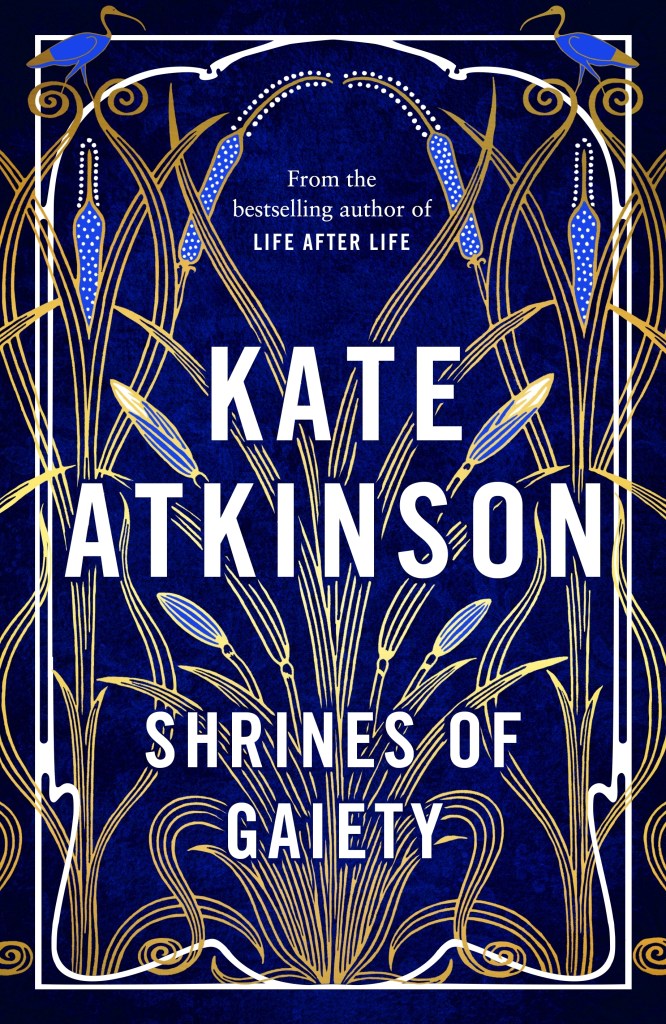
Book Review: Shrines of Gaiety by Kate Atkinson – a story from flapper era set in London’s seedy Soho

I find it so easy to slip into a Kate Atkinson novel, whatever the storyline, because the writing is just so smart. In Shrines of Gaiety, the main focus of the story is the goings-on of a family of nightclub owners in 1920s London, overseen by the matriarch, Nellie Coker. A Scottish woman widowed young and with a family to support, she’s done a few dodgy things to make her fortune, intent not only on supporting her children, but advancing them in society.

We meet Nellie as she’s leaving after a short stint in Holloway, the London prison for women. One of her nightclubs had been raided and liquor found being sold on the premises. Usually she gets a tip-off from a policeman – Inspector Maddox from Bow Street police station – but not this time. Is Maddox still loyal? There’s someone else sniffing around – a gangland boss who’s keen to get his hands on a set of nightclubs and settle an old score.

Observing Nellie leaving Holloway is Chief Inspector Frobisher, the detective tasked with cleaning up Soho’s nightlife and the rot that has set in at Bow Street. With him is Gwendolen, a librarian from York who is on the hunt for two young girls who have run away to London to go on the stage. London has a habit of swallowing up young women and a few have been turning up dead, fished out of the Thames.

Gwendolen is an interesting character as she has the fortitude of someone who has nursed during the recent war, but post-war life has been a little tame, living in genteel poverty with her listless mother. When her mother dies, she discovers an inheritance which gives her the freedom to travel to London, where she can explore a new life. The missing girls set her off on a mission. Both Frobisher and Nellie Coker offer Gwendolen interesting opportunities.

As well as following Frobisher’s policing, and Gwendolen’s snooping, we meet the younger Cokers: eldest son Niven, who is battle hardened from the war, unflappable and smart. His sister Edith is Nellie’s natural successor, practical, though not as pretty as her sisters. But something has unhinged Edith lately. With their Cambridge education, Betty and Shirley are primed to marry into the aristocracy, though they also lend a hand with the clubs. Younger son Ramsay is rather effete and an easy victim of anyone trying to get at Nellie, but nevertheless has literary aspirations. Young Kitty at eleven suffers from neglect and is largely uneducated while no-one notices that she’s also in danger.

‘Give Mr Frazzini a box of chocolates, will you?’ Nellie said to Betty.

Nellie sold the boxes for fifteen shillings each but bought them wholesale from somewhere in the north for a shilling a box, all prettied up with ribbons (a penny each) by soldiers disabled in the war. The dance hostesses made a great fuss of persuading their partners to buy the boxes for them and then, after a few chocolates had been eaten, the boxes made their way back to the storeroom they’d come from and were refilled, ribbons adjusted, and sent out to be sold again.

The narrative bounces around all of them, as well as Freda and Florence, the two missing girls, creating a giddy plot that will keep you on your toes. I’ve heard this book described as Dickensian, and I suppose it is with its varied cast of characters, and the way the criminal element rubs shoulders with the law, the sudden reversals of fortune – there’s even a gang of women pickpockets. The story paints a picture of the mad excesses of the 1920s, the jazz and the flappers, the endless partying as everyone tries to forget the recent war.

I enjoyed this book enormously because the writing is lively and amusing and you really can’t guess what will happen next. The situation looks dire for the stray women caught up in the seamy side of Soho, but even those with money can lose everything on the turn of a card. Help and goodness are in short supply but come from unexpected quarters. I chuckled my way through the book at some points; nervous for particular characters at others. At the end of the book, Atkinson gives potted histories of what happens next to all the major players, which may please or annoy some readers I confess to being a little annoyed but it’s still a four out of five stars read from me.

Book Review: Ariadne by Jennifer Saint – an enthralling read based on Greek mythology

Since Madeline Miller’s hugely successful novel, The Song of Achilles, published in 2011, fiction based on ancient myths, has been popping up, almost spawning a whole new genre. Miller continues to write terrific books like this – I can’t recommend Circe enough – and acclaimed author Pat Barker has veered away from her 20th century war fiction to produce two novels (so far) about the women of Troy. Ariadne is the first novel by Greek myth enthusiast, Jennifer Saint. 

I have long been fascinated by the story of the Minotaur and how Theseus defeated it with the help of King Minos’s daughter, Ariadne. If you recall, the Minotaur was a monster, half bull and half human, with a voracious appetite for human flesh, sequestered in a labyrinth devised by Daedalus, a kind of Leonardo of his day. In the novel, Minos, King of Crete, was becoming unpopular with his people for feeding miscreants to the beast, but happily found another food supply: a tribute from Athens, which Minos had brought to its knees in battle. 

So every year, seven young men and seven young women, teenagers really, would be shipped from Athens then flung into the labyrinth for the Minotaur to hunt down in the dark and well, you can imagine the rest. Theseus, long estranged from his father, the King of Athens, returns to find his city in mourning for the new harvest about to take place and volunteers as one of the selected victims. He’s keen on vanquishing monsters and thinks he can outwit the Minotaur, if only he can find his way in and out of the labyrinth. Ariadne, drawn by his princely bearing and general good looks, offers to help.

Such an exciting story, but that is barely the half of it. Jennifer Saint weaves a yarn around Ariadne and what happens next. How Theseus left her on the island of Naxos, instead of taking her back to Athens as his bride. It is also the story of Phaedra, Ariadne’s thirteen year old sister, similarly smitten with Theseus. While Ariadne is rescued by Dionysus, the god of wine and good times, Phaedra becomes a bargaining chip between the kingdom of Crete and Athens.

The women in this story are rarely able to steer the path of their own lives, caught up in the political aims of the powerful men around them. So even though Ariadne and Phaedra are the grandchildren of the sun god Helios, and as such have remarkable beauty, they are victims of circumstances again and again. Meanwhile the gods, particularly Zeus, and his bitter and jealous wife Hera, toy with the mortals of the story, and even lesser gods like Dionysus.

The gods do not know love, because they cannot imagine an end to anything they enjoy. Their passions do not burn brightly as a mortal’s passions do, because they can have whatever they desire for the rest of eternity. How could they cherish or treasure anything? Nothing to them is more than a passing amusement, and when they have done with it, there will be another.

It all makes for a gripping retelling of the myth, adding character to the main players – the motives and desires, weaknesses and blindness to the truth. In other novels, you often shout at the characters, ‘Oh, no! Don’t do that!’ Or even ‘Look out, behind you!’ But here, it wouldn’t matter how aware the characters were, the gods are always out to get them, pawns in their constant one-upmanship with other gods.

While there is much tragedy to the story, the novel is still very entertaining, creating an imaginary world that is a joy to the senses, whether it is Dionysus’s island with its maenads and feasts, or the opulent world of the palaces in Crete or Athens. We even get a chance to check out Hades.

Ariadne is well worth picking up, a welcome addition to a growing sub-genre of mythical retellings, with four out of five stars from me. Saint’s second book, Elektra is definitely on my must-read list. Another book by Saint, Atalanta, is due for release later this year, while I’ve also got my eye on Ithaca by Claire North. So much to enjoy.

Book Review: Mother’s Boy by Patrick Gale – an imagined life of Cornwall’s favourite poet

I’ve read a ton of novels by Patrick Gale – I love his writing for its warmth, perception and the characters. They’re always shown with all their flaws, and yet they make for oddly likeable company. Gale reveals what makes them them interesting and ordinary at the same time.

Like Charles Causley, Cornwall’s favourite poet – the subject of the latest Gale book, Mother’s Boy. The story takes us back to the early part of the twentieth century, and the courtship of Causley’s parents, both of them working in service: Laura as a maid in a small household and Charlie who drives a pony and trap for a local doctor. They marry while World War I is getting up steam and see little of each other for years. Charles is born in 1917, his father shipped home eventually, but with TB.

The story clips along through the years, with chapters about Charles’s early life as a boy in Launceston while his father is still alive, school life and his knack for language, a talent for the piano and his discovery of poetry. There are two unlikely friendships, the butcher’s boy who once bullied him and Ginger, the annoying boy who followed him around and listened outside as Charles practised on the piano. His mother’s thrill to find Charles a safe job at a desk; Charles’s disappointment that he won’t be continuing his education.

Then another war, and Charles’s acceptance into the navy as a coder. There are several chapters that progress the war, and Charles’s romantic connection with two men. Each chapter shows a new discovery or aspect of the war through key events or changes to Charles’s life, the novel finishing a few years after the war.

Parallel to Charles’s story is Laura’s, working away at her little laundry business, her days ruled by the weather and the rigid timetable required to get it all done. Her love for Charles is a constant. Fortunately for Laura, the ache of missing Charles while he is away at war is tempered by the evacuees she takes on, the Americans setting up bases around the town and later the prisoners of war who inhabit one base once the soldiers have headed across to France.. So we get an interesting glimpse of the war at home.

And while she suffered, Charles was either out at his play-reading group or rehearsing with his dance band or drinking beer with friends, or else he was shut in his room, stabbing away at his typewriter or listening intently to the radio, as often not to some programme about the international situation and politics, which made her head spin if she tried to follow it, and telling her to knit more quietly.

The two main characters are so nicely drawn, so empathetic, that you feel you know them well. Charles is refined and educated, a lover of good theatre and literature, his working class mother often bemused by the things he says. The story ambles along through the years with sudden events that make you really feel for mother and son; some happy moments but also the tragedies that you’d expect because of the war.

You get a strong sense of what it was like to be born different, both artistic as well as gay in a time and place when such things were problematic; and yet Charles manages to be true to himself in a way that works for him. But at what cost? The story pulls you along, each chapter adding something new on both an intimate scale as well as within the wider world. I thought I’d close the book and think, yes that was an interesting read and very true to its subject matter. And then wham! The final scene, in its quiet living room setting, quite blew me away. There was a lump in my throat. There were tears.

Patrick Gale’s novels often have a way of creeping up behind you, leaving you a little stunned, but in a nice way. His author’s notes reveal that Causely was often asked why he hadn’t written a full memoir, not just the few autobiographical fragments that remained after his death in 2003. Causley’s reply was that it was all there in the poems. The poem Angel Hill, quoted in full at the end of the book, could be a case in point and ties in beautifully with Gale’s novel, particularly that final scene.

Mother’s Boy is a stand-out novel by an accomplished writer whose work never disappoints. If you like this book, it is worth checking out the author’s notes on his website wihich add detail and some interesting photos. You can tell that Charles Causley has become close to his heart, and Laura too. I love books where you feel the author has poured his heart into a story. I feel this is the case here and why it gets a five out of five from me.

Book Review: Small Things Like These by Claire Keegan – a moving Christmas story, perfectly told

Expectations were high when I picked up Small Things Like These. After all it is a very small book – a novella really – and still it made last year’s Booker shortlist. I expected a small piece of perfection, and in many ways it is.

Set during the weeks before Christmas in a small Irish town, we are with Bill Furlong, a coal merchant as he makes his deliveries and plans his holiday with his family – a wife and five daughters. It’s a cold winter, and Bill draws our attention to the poverty of those around him who can’t afford their coal bill. He sees a boy gathering sticks by the roadside and gives him the change from his pockets, even though he has little enough to spare. You would think this is the 1950s, or earlier, but it is 1985.

Up on the hill, the convent looms over the town, and it is here that the better-off send their laundry, the nuns running a well-respected business. While delivering coal there Bill stumbles upon something he shouldn’t have seen, which as the father of daughters, leaves him troubled and absent-minded with his family. As the days pass Bill must decide if he will turn a blind eye to what goes on at the convent, as surely everyone else does, or step in and do a good deed.

People could be good, Furlong reminded himself, as he drove back to town; it was a matter of learning how to manage and balance the give-and-take in a way that let you get on with others as well as your own. But as soon as the thought came to him, he knew the thought itself was privileged and wondered why he hadn’t given the sweets and other things he’d been gifted at some of the houses to the less well-off he had met in others. Always, Christmas brought out the best and the worst in people.

This is the perfect Christmas story, quietly telling and moving about an ordinary man’s battle to do the right thing without thinking about the consequences. Bill himself is an interesting character, having been raised in the home of a wealthy woman, where his mother was housekeeper. He never knew who his father was and was bullied about it at school. He has had to work hard from the ground up to become the owner of his own coal business. But its viability relies on a fair bit of forelock tugging and respect towards the powerful, particularly the church.

Small Things Like These is an engaging story from the start and manages to convey a lot within its pages. There is nothing to spare, no mucking about with subplots or extra scenes added for colour. It is no longer or shorter than it has to be and doesn’t try to be particularly artistic or modern. It reminded me a little of those old stories by writers like O’Henry that let the story do the talking and pack a big emotional punch.

Some background information about the Irish convent laundries makes for sobering reading at the back of the book, but really Keegan has said it all with her story. A masterclass in storytelling and a five out of five from me.

Book Review: Haven by Emma Donoghue – a novel about the dark side of devotion and selfless obedience

Every time I pick up a novel by Emma Donoghue, I am amazed by the variety of subject matter as well as the deftness of the storytelling. Haven is her latest book and follows a band of three monks who set out with a few provisions to establish a monastery on an island off the south-west coast of Ireland.

Donoghue takes us back to the seventh century when Arrt, a priest visiting a monastery, has a vision calling him to take with him two monks to set up a retreat on an island. God has shown him which monks to take: Cormac, an elderly, battle scarred monk and the teenage boy Trian. Arrt is a scholar and has a charismatic way about him, so he soon convinces the two to throw in their lot with him, even though they each seem an unlikely choice for such a mission. Feeling chosen gives Cormac a new lease of life and for Trian, sent away from the world by his parents, it also seems a blessing.

For Arrt, the dream is everything and God must have a special purpose for the three. They set out on a perilous journey by boat down the river Shannon and out into the Atlantic Ocean. They fetch up at a rocky outcrop, the Skellig, inhabited by a mass of shrieking seabirds, but for people as inhospitable a place as you could imagine. The island is all steep pinnacles with very few flat areas and very little soil, the single tree an ancient rowan, barely clutching onto life. It is here they are to build a chapel, with only the barest of necessities and as Trian soon finds out, dedicate themselves to copying out the scripture.

So. In open ocean, drifting blind now, and with no way to stop moving through the dark. It is Artt who’s brought them to this extremity, and it’s too late for doubt. ‘Never mind. We won’t founder,’ he assures them. ‘We travel in the palm of God’s hand.’

Trian discovers an interest in observing the birds and the natural world around him. He is tasked with finding food, fishing as well as capturing the tame auks and puffins that are to be a large part of their diet. He is always hungry and earns the pity of Cormac, who lacking physical agility has the knowledge they need to start a garden and build their chapel.

Arrt is a hard task master, always finding fault, even with himself, convinced that this is all God’s will, however difficult things get. He always has as piece of scripture to justify his decisions. How the men are affected by illness, the demands of changing seasons and Arrt’s excessive piety creates a tense read. The characters of the three monks couldn’t be more different and each in his own way is battling demons and at times each other. I found myself drawn into the book, in spite of the grimness of the story – the battle for survival, the demands of faith, the merciless slaughter of wildlife.

Haven is inspired by Skellig Michael, where monks at this time did in fact set up monasteries, building beehive-like structures using the hard slate of the island. It’s also the setting for a scene in the Star Wars movie: “The Force Awakens”. Delving online you can’t help but be amazed by the island and its history and you can see how Donoghue might have imagined this story. It has stuck with me days after I finished the book and I’m sure it will linger in my mind for some time to come. I listened to Haven as an e-audiobook, superbly read by Aidan Kelly – it’s a four star read from me.

Book Review: Vinegar Girl by Anne Tyler – a delightful read inspired by Shakespeare

A few years ago the publishing house Hogarth, commissioned some well-known authors to write retellings of some of Shakespeare’s plays in novel form. Jo Nesbo did Macbeth, Gillian Flynn Hamlet and Margaret Atwood The Tempest – among others. Vinegar Girl is Anne Tyler’s retelling of The Taming of a Shrew. This play sounds somewhat old-fashioned today with its story of a ‘difficult’ young woman softening into an obedient wife. Even the word ‘shrew’ is a hard term to swallow – is there even a male equivalent?

Tyler manages this by allowing Kate Battista, the heroine of her story, to remain a forthright and no-nonsense kind of person until the end. She meets her match in Pyotr, her father’s research assistant, but being Polish, he’s used to women like Kate, in fact he much prefers them. With his limited English, it’s easy to understand what Kate says because she doesn’t bother with the niceties. In Pyotr, Tyler has created the one man who will accept Kate as she is. So not tamed – not at all. The story then hinges around Kate coming on board with her father’s idea of an arranged marriage.

Tact, restraint, diplomacy. What was the difference between tact and diplomacy? Maybe “tact” referred to saying things politely while “diplomacy” meant not saying things at all. Except, wouldn’t “restraint” cover that? Wouldn’t “restraint” cover all three?”

At twenty-nine, Kate is still living at home, working in a kindergarten, where she’s often in trouble for being too blunt with parents, but the children adore her. Her mother long dead, it was mostly left to Kate to help bring up her much younger sister, Bunny, who at fifteen is everything Kate isn’t. Bunny is flirty, charming, and ditsy, but that doesn’t stop her from being a little cunning. Kate dropped out of college when she fell out with her professor. But she’s obviously smart. Maybe even as smart as her academic father, Dr Battista, who is hoping soon to make a breakthrough in his research.

The problem for Dr Battista is that Pyotr needs a green card to stay in the States, his three year working visa about to expire. Pyotr is a brilliant scientist and without him, their work on autoimmune disorders would flounder. But if Pyotr were to marry an American, the green card would be no problem. So the morning when her father asks to bring her his forgotten lunch, left at home in the kitchen, is a surprise for Kate. Even though Dr Battista often forgets his lunch, he usually doesn’t worry, because he hardly ever knows it’s lunchtime. He just carries on working. Of course, it’s just an opportunity for Pyotr to meet Kate. Kate is soon suspicious and then appalled.

“Well, in my country they say that you can catch more flies with honey than with vinegar.”

“Yes, they would,” Pyotr said mysteriously. He had been walking a couple of steps ahead of Kate, but now he dropped back and, without any warning, slung an arm around her shoulders and pulled her close to his side. “But why you would want to catch flies, hah? Answer me that, vinegar girl.” 

The story is told from Kate’s point of view, and while she’s prickly and a bit odd at times, she soon gets under your skin. Tyler is always brilliant with odd-ball characters, quirky families and people who are not society’s shining stars. And I love her for this. An assortment of support characters – an attractive fellow teacher, the drop-out next door that is supposedly tutoring Bunny in Spanish, uncles and an aunt – add colour as well as complicate the plot, which builds nicely to a dramatic and hilarious climax. I’m sure Shakespeare would have approved.

Vinegar Girl is a quick, light read but so delightful and fun it really brightened my day – it only takes a day to read it. The novel may not have the complexity or the heft of some of Tyler’s more acclaimed novels, but it’s still a lovely little story and well worth picking up. I am so glad I did – it’s a four star read from me.

Book Review: The Homes by J B Mylet – a gripping Scottish orphanage mystery

At the back of the book, J B Mylet explains how he was inspired to write this novel by his mother’s own experiences as a child in an institution very like the one in The Homes. As a young girl she thought all children were brought up in similar set-ups: a cluster of houses in a purpose-built of village with twenty or thirty children per cottage with ‘house parents’ and a cook to feed them all. She didn’t realise that most children grew up with their biological families.

And at first it’s the same for Lesley, sharing a room with five other girls, including her best friend, Jonesy, all about the same age. But now she’s twelve, she knows better. She at least gets regular visits from her grandmother, who though kindly, is unable to care for Lesley, and neither can her mother who visits a few times a year. Lesley is bitter about her mother and finds it difficult to believe her when her mother says she’s hoping to bring her home to live with her one day. Jonesy is there is because the state has considered her mother an unsuitable parent.

There are other rooms in Lesley’s house with more girls of different ages and in charge are the Patersons, a childless couple who do their best. But Mr Paterson is not above taking his belt to the girls, in fact it’s expected. Jonesy gets it more than most. She’s just so lively and unstoppable. And everyone is terrified of the Superintendent, Mr Gordon. Jonesy’s non-stop chatter is a foil to Lesley’s quieter intelligence. Meanwhile Lesley escapes into her studies, one of the few children who bus to a local school.

Fears of punishments and schoolyard bullies all fade into the background when an older girl, Jane Denton, goes missing, her murdered body found some days later. When another girl disappears, Jonesy determines to find out who the murderer is, while Lesley acts as a sounding board and is dragged into Jonesy’s sleuthing, throwing the girls into danger. What follows is a fairly classic mystery with plenty of secrets and hidden motives.

And while this is entertaining, it is the characters of the girls, especially Lesley’s narrative voice, sensitive and smart but also easily led down blind alleys, that make the story interesting. That and the strikingly original setting. It’s difficult to forget that these are vulnerable children who deserve so much better. Fortunately not all the adults are unsympathetic. Eadie is the kindly therapist who listens and offers advice; there’s a friendly detective and Lesley gets help just in the nick of time from an unexpected quarter.

The Homes makes for a compelling story, part mystery, part social commentary, that will have you riveted until the last page. But the story behind the story is just as interesting. I wonder what Mylet will come up with next. This book gets a four out of five from me.