Book Review: The Unquiet Grave by Dervla McTiernan – a pacy new Cormac Reilly crime thriller

I’ll read anything by Dervla McTiernan, so was happy to put my hand up for her new book in the police Sergeant Cormac Reilly series, The Unquiet Grave, when it was offered by Netgalley. This is the fourth mystery featuring Reilly, and I’ve always found him an interesting character – unrelenting yet sensitive, logical but also good at reading people. He always seems to be up against it, whether it’s relationship problems, pressure to close a case early or issues with colleagues. Or all three – which is what we have here.

In previous books, Reilly has struggled to fit in, returning to Galway after years in the force in Dublin. A stickler for doing things by the book, he’s been a whistle blower, which is why, in the new book, he’s being headhunted to run a team investigating police malpractice – not a job to earn him popularity. While he’s mulling this over, he and his sidekick, Constable Peter Fisher, are called to a body discovered in a bog. Fitted out to look like a ritual killing, of the kind discovered in ancient burials, the presence of underwear suggests otherwise.

The body turns out to be that of a polarising head teacher at the local school – Thaddeus Grey, who disappeared two years ago. Found on the outskirts of town near his house, Grey expected high standards of the students, and it turns out, was a bit of a bully. Cormac soon narrows his focus to three students who particularly bore the brunt of Grey’s unpleasantness. But when another body is found in similar circumstances, his bosses and the press are jumping on the idea that it’s a serial killer. Cormac soon has a battle on his hands to bring the actual killer or killers to justice.

Meanwhile, Cormac’s ex-girlfriend, Emma, now married and expecting a child, is desperately worried about her husband Finn who has gone missing in Paris. The French police give her the brush off as he’s not a French citizen and she gets the feeling everyone thinks she’s a hysterical female, whose husband suddenly has cold feet about being a family man. Finn was a cyber security expert in the forces until recently, so Cormac pulls a few strings with an old army mate and gets things going with a police investigation. But nobody’s optimistic.

There’s a further plot thread involving a computer tech. wizard planning a fraud against the lottery company he works for. How all these story threads come together is a masterpiece of crime mystery plotting and keeps the story humming along. What makes it particularly interesting are the moral dilemmas faced by Cormac and Peter as they try to find justice for those caught up in crime, as well as problems in their personal lives.

These issues add layers of complexity that give the story a bit more heft. There’s danger too, with some pacy, edge-of-the-seat moments. Add the relentless Galway weather – it’s either freezing or raining or both, and we’ve got the atmospheric settings I’ve come to expect from McTiernan, who takes us to Paris, London, Dublin as well as some boggy rural corners.

All in all I wasn’t disappointed with The Unquiet Grave and it was great to check in with Cormac Reilly again – I do hope there will be more in the series. I really enjoyed the e-audiobook edition of the novel, published by HarperAudio and read by Aoife McMahon, who captured the personalities of all the characters, which were many and varied. With a publishing date of 30 April, The Unquiet Grave is a four-star read from me.

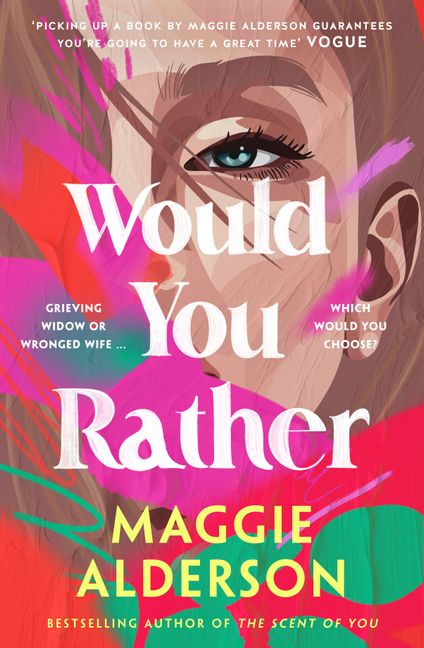
Book Review: Would You Rather by Maggie Alderson – a beach read about a grieving widow with a grievance

I picked up this book for a light holiday read, intrigued about the story of a woman coping with loss and redefining her life in order to move on. In this case, we’ve got Sophie who has two terrible things happen to her in one day. First Matt, her husband of thirty years, tells her he’s not going to move house with her after all, but stay on in London with his mistress. She’ll be off to their new house in Hastings on her own! And then Matt gets hit by a truck while riding his bicycle and killed.

Suddenly Sophie is an angry wronged wife and a grieving widow all at once. Thank goodness she has the support of her friend Rey, who helps her adjust to her new life, and she soon makes friends with her new neighbours: Agata in her nineties and Olive who calls a spade a spade, both of them widows too. Also among the huge cast of characters are Sophie’s sons, Jack who lives in Australia and Beau, the spitting image of his dad and just as big a hit with the ladies. Beau has also inherited his father’s talent as an artist, making his own brand of jewellery and working as a waiter to pay the bills.

Would You Rather follows Sophie’s story as she gets on with life, her work as a food stylist, and the questions she suppresses about the ‘other woman’. We also follow Beau who has overheard something at the funeral which has him digging into his father’s past. When he gets a rude awakening from girls he’s treated badly, he’s also on a learning curve. Then there’s Juliet, the mistress, a successful jewellery designer. She’s mother of little Cassady when we meet her, and is determined to live life according to her own terms.

These stories are all set to intersect in a fairly predictable way, although the characters have so much going on in their lives there’s lots to keep the reader interested. Sophie decides to keep Matt’s devastating decision to herself, which is difficult when his brothers and their wives are still a part of her world. There were five Crommelin brothers, all it seems larger than life and in their own way full of charm.

The story carries the reader through the dilemmas faced by its three main characters with lots of colour thanks to its attractive settings: seaside Hastings and elegant parts of London with its art auctions, jewellery stores and fabulous parties. I must say I got a little sick of all the parties. There’s plenty of wine and descriptions of sumptuous food too as you might expect with several characters who are terrific cooks and another who is a winemaker.

I did feel sorry for Sophie though. How is someone supposed to grieve or turn their life around when having to keep their chin up at parties? While there were plenty of lessons learnt and positive hopes for fresh starts, ultimately I couldn’t help finding these characters, with the descriptions of their lavish homes and lifestyles, all a little bit shallow. So while I am often up for a feel-good, second-chances story, this novel was disappointing. I’m still not sure why the book is called Would You Rather, but it’s a two-and-a-half star read from me.

Book Review: The Life Cycle of the Common Octopus by Emma Knight – an perceptive coming-of-age novel set in Edinburgh

I had no idea what to expect from this novel. Neither the title nor the cover gives a lot away, but I was soon caught up in the story of a young girl embarking on student life in Edinburgh. Pen and bestie Alice are from Toronto, and although neither wish to cramp the other’s style, they are there for each other as each explores opportunities as first year students together. They become friends with Jo, whose family have a country house they can decamp to, and whose brother, Fergus is soon attracted to Pen. All three girls, particularly Alice, are gorgeous in their own way.

Alice wants student life to be about experiences as much as study. She’s also hoping to land a role in a play and then, if that goes well, a part in an Edinburgh Festival production. She’s larger than life, a bit of a party animal and open to a dalliance with a lecturer – just another box to tick off. Pen, on the other hand, is quieter, more studious and intellectual. Studying in Edinburgh gives her a chance to connect with an old friend of her father’s, a famous author of mystery novels, Lord Elliot Lennox.

Pen wants to be a journalist, so talking to a writer makes sense. But she’s also digging around for reasons behind her parents’ divorce. Why did her father fall out with his best friend, a friend remembered with her middle name? Was there something between him and Lennox’s wife, Christina? Pen writes to Lennox asking to visit him in his stately home, and finds herself welcomed into the family by his wife Christina. She strikes up a friendship with George, a niece with a young baby, and is soon smitten by older son Sasha. But often while she’s there, Elliot Lennox stays in his study, only surfacing for meals.

She and Pen had been friends since well before they had discovered the need to construct an outer shell, like that of an invertebrate animal, to protect the soft inner substance of the self. Childhood friendships often lose their hold at that point, when one sees that the person one loved has learned to disguise herself and will no longer be reachable, or at least not often. What made Alice feel certain, as Pen helped herself to the roll of toilet paper on her desk to wipe her nose, that this friendship could take them through every stage of their lives, cushioning them against the bone-crushing loneliness of being human, was that they did not have to pretend with each other. Silently, she vowed to remember this.

So we have a couple of story threads: Pen’s student life on campus and her growing interest in Elliot Lennox and his family. There’s also her own family issues, too, and secrets from the past. The writing is nicely turned, and thoughtful. But Pen is an introspective sort, so we get a lot of introspection. Lots of Pen making herself miserable about the Lennox family, and what they all think of her, and about Sasha in particular. Just as well Alice is busy getting into strife and dealing with the fallout. This helps give the plot a bit of action.

Emma Knight is insightful on student life, that age when there’s so much to explore and experiment with. Both girls get things wrong, and help each other to move on. But there’s also an underlying thread about parenthood, particularly the demands on mothers, the difficulty of being your true self when there are others depending on you. Christina is a case in point, running a huge estate and keeping everything ticking over so her husband can write books. And she’s a mother on top of that. Which is where the octopus analogy comes in, in case you’re wondering.

This is a book you have to be patient with, it nearly lost me about half way through, but enough happened to keep me curious – particularly about what happened all those years ago and with whom. And the honed writing helps too. I wish I had been at eighteen as clever as Pen with the smart delivery of opinions, which even sparks Elliot Lennox’s approval. But it does make for a somewhat wordy novel, at times. I think Emma Knight is an author to watch, though, and will happily seek out her next book.

I read an advanced reading copy of The Life Cycle of the Common Octopus, courtesy of Netgalley. The book is due for release in bookshops on 10 April and it is a three-and-a-half-star read from me.

Book Review: Murder Before Evensong by Rev. Richard Coles – an ecclesiastical cosy that takes you back to the ’80s

The cosy mystery genre is as varied as any, and some are definitely better than others. I am always on the lookout for the feel of Agatha Christie’s Miss Marple stories when I pick one up, so this one with its classic English village setting seemed promising. Murder Before Evensong introduces us to the parish of Champton, a village with a lord of the manor, Lord Bernard de Floures of Champton House, and a rectory, the home of our sleuth, Rev. Daniel Clement.

When Daniel suggests the installation of toilets at St Mary’s during a church service, he couldn’t possibly have imagined the fallout. A posse of flower ladies are appalled that the space required will mean the loss of the back pews. Daniel is reluctant to back down, but soon has his hands full with other matters. There’s the arrival of his actor brother Theo doing background research for a new role as a TV vicar in a ‘gentle comedy’. He wants to follow Daniel around to get a sense of what he does.

Then there’s the annual open day at Champton House, with the whole village mucking in, managing the door, running guided tours, serving tea. But the day ends in tragedy, with Daniel discovering Bernard’s cousin Anthony Bowness, who’d been archiving the family’s papers, dead in a back pew of St Mary’s. Anthony, a troubled man, often came here to pray, which is where Daniel’s naughty dachshunds come upon the body, stabbed in the neck by a pair of secateurs. What secrets had Anthony uncovered? And who knew how to kill so effectively, picking the exact spot for the carotid artery?

There are more murders before the last page, and multiple suspects. Nathan, the de Floures odd-job man, has a shady past, and the grandfather he lives with an even shadier one. And no one knows what to make of Bernard’s younger son, Alex, with his wild enthusiasms for art installations and his unsuitable friends. Other characters seem to be hiding secrets, and the village’s role in the war can’t be discounted either.

The story is well plotted, adding enough interest to keep the reader guessing and turning the pages. But the steady humour of the writing and the interplay between a host of quirky village characters lift this cosy above the average. Author, the Reverend Richard Coles, obviously knows well the life of an Anglican priest, and as a former member of the band the Communards, seems keen to evoke the 1980s here – Cagney and Lacey on the telly, Wham on the radio. But in a village like this, you feel it could be any time, that things don’t change a lot.

Daniel is a thoughtful, always considerate rector, at times struggling with the demands of those around him – not just his parishioners. His perceptive but interfering mother Audrey has to be constantly held in check, as do the two dachsunds, Cosmo and Hilda. The tiny general store and post-office is often the scene of gossipy councils of war between the anti-toilet brigade which contrasts nicely with scenes at the old-fashioned rectory and the palatial Champton House.

The writing is terrific too. Coles blends in Biblical and other ecclesiastical references to add authenticity without overburdening the story, which is generally lively and full of wit. I chuckled my way through, not particularly caring whodunit, as I was enjoying the journey so much. I’ll definitely be keen to continue with this series – the fourth is out later this year, so there’s a few to catch up with. Murder Before Evensong is a four-star read from me.

Book Review: Three Days in June by Anne Tyler – a charming novella about marriage, laced with humour and insight

If I had to choose a favourite author, (heavens, what a decision!), Anne Tyler would definitely be on my shortlist. I’ve been reading and rereading her for decades. So picking up her latest book, Three Days in June, I was instantly in my happy place, absorbed in a seemingly ordinary story about ordinary people, and which was unsurprisingly fascinating.

This time we’ve got Gail, who is sixty-one, an assistant school principal who’s about to lose her job. So she’s not happy about that. She leaves work in a huff and then finds her ex-husband, Max, on the doorstep with a cat from the shelter he helps out at. Max is visiting for their daughter’s wedding the following day, but can’t stay with Debbie because her fiancé Kenneth is allergic to cats. Gail isn’t happy about this sudden imposition either, and no way is she about to adopt a cat. No, thank you!

The cat soon settles in, and so does Max, and the former couple get caught up in the wedding arrangements – the wedding rehearsal, shopping for clothes and so on. But the hint of an indiscretion on Kenneth’s part has Gail worried that Debbie is making a huge mistake. She should know. The story flips back in time to the events that eventually led to Gail’s and Max’s divorce.

The clock gathered itself together with a whirring of gears and struck a series of blurry notes. Nine o’clock, I was thinking; but no, it turned out to be ten. I’d been sitting there in a sort of stupor, evidently. I stood up and hung my purse in the closet, but then outside the window I saw some movement on the other side of the curtain, some dark and ponderous shape laboring up my front walk. I tweaked the curtain aside half an inch. Max, for God’s sake. Max with a duffel bag slung over one shoulder, and a bulky square suitcase dangling from his left hand.

Anne Tyler packs a lot into this little book. We get a good deal of character development and insight into the family. There’s the usual gentle humour, which is always a plus, and the characters are wonderful. I instantly warmed to Max, also a teacher, working in a school where he doesn’t earn a lot and rents the same flat he’s lived in for years. He’s a scruffy, gentle bear of a man who doesn’t get in a flap. Early on you feel he’s a good fit for Gail, who’s a bit uptight and pernickety and not so good with people.

There’s also Debbie, a lively, determined kind of girl who doesn’t shirk from speaking her mind. There’s also Gail’s mother, who’s rather amusing in her little digs at her daughter, plus the well-to-do and at times hoity-toity in-laws. The way the different family members bounce off each other is very realistic but also delightfully entertaining.

Three Days in June is classic Anne Tyler – a lovely, warm-hearted read that charms from the first page to the last. I couldn’t help thinking it would make a nice little film, a cut above many wedding movies, that’s for sure. If you’re feeling in the mood for an uplifting read it’s well worth picking up. And check out Tyler’s backlist – she’s had a host of book award nominations, winning a Pulitzer for Breathing Lessons. Three Days in June is a four star read from me.

Book Review: The Bee Sting by Paul Murray – a riveting novel about a family in strife

This is a superbly clever book that seemed to me particularly clever in that its cleverness isn’t at first all that obvious. One thing obvious about The Bee Sting is that it is very long. I don’t often go for long books. They have to have instant readability for me to want to persevere, because of the reading time involved. But once I embarked on this story of a family going through a tough time in small-town Ireland, I just couldn’t stop, because the writing is just so lively, character-driven and, at times, funny.

The story moves between the four points of view of Cass and PJ, teenage children of Dickie and Imelda. Dickie has taken on the family business built up by his father, a car dealership that has, until the recent economic downturn, been a reliable money maker. So much so that the family are among the most well-to-do around town. But now times are tough and Dickie doesn’t know how to fix it. Instead he’s spending his days in the woods with his weird mate Victor, building a bunker in case of an apocalypse.

Dickie was always the smarter son, but less successful with people than his famous footy-playing brother Frank. Everyone remembers Frank, not just for his flair on the sports field, but because of his charm and good-looks. His sudden death a couple of decades before in a car accident only made him seem more of a hero. At the time he was all set to marry Imelda. Dickie with his lack of social finesse and looks that were nothing to write home about seemed like a consolation prize.

Over the course of the book, we discover how Imelda came to marry Dickie instead, as well as both their back stories, Imelda’s coming from a family of ne’er do wells, a violent father with criminal tendencies. Imelda is astonishingly beautiful, which is how she caught Frank’s eye. Marrying Dickie so young and having children soon after, she’s never had a job, but is a brilliant shopper. As money troubles start to bite, she’s in a permanent fury, cross with Dickie and selling off anything she can online to keep at least some money coming in.

Meanwhile Cass has reached that age when everything – her family and life in a town where everyone knows everyone’s business – has become utterly impossible. With her best friend Elaine, she’s plotting to leave as soon as she can. Trinity College in Dublin beckons, but can she keep her studies up enough to pass her A levels when Elaine hauls her off to all kinds of pubs and clubs while they should be studying?

PJ is also having a tough time. His parents aren’t there for him, Cass is eternally cross with him and he’s not socially adept either, parroting facts he’s discovered supplied by his active and curious brain. With the failing of his father’s business, all the town knows about it so school can be hard. He loses himself in violent computer games, leading him to an online friendship. But is that new friend as genuine as he pretends to be?

I hadn’t expected to care for these four characters as much as I did. But Paul Murray takes you right inside their heads, revealing their secrets. In the background we’ve got a support cast of interesting support characters, among them dodgy opportunist Big Mike, Imelda’s great aunt Rose who can see the future, and Ryszard, the handsome charmer and baddie of the story.

While the novel carries you along entertainingly enough, there is a clever plotting that takes the book to the next level. There are very long chapters that build things up, and then very short ones that ramp up the tension. There’s clever stuff with the prose too, the personalities of the main characters reflected in the style. Imelda’s point of view, for instance, is written without punctuation, perhaps an echo of her fierce and furious way of thinking and speaking. There are no quotation marks for speech either, but somehow you soon get used to it and wonder, why do we ever have them in the first place?

Then there’s the ending. I wasn’t going to mention that as I’m still thinking about it, but WOW. Enough said. I’m certainly glad to have read The Bee Sting, even if it was very long, and yes, I’ll look out for more books by Paul Murray, for the writing alone. The Bee Sting is five star read from me.

Book Review: Clear by Carys Davies – a spare, impeccably written novel set during the Highland Clearances

The Walter Scott Prize for historical fiction is always on my calendar, with its longlist of brilliant new titles. Among this year’s list was this little book by Carys Davies, and being set for the most part on a remote Scottish island, it immediately caught my eye.

Clear takes us back to 1843, the tail-end of the Highland Clearances, when small holdings made way for sheep, their tenants forced onto unproductive land, emigrating to the colonies or finding other ways to make a living where they could. It’s also the time when Presbyterian ministers signed the Deed of Demission to separate from the Church of Scotland so that congregations could have more say in who they accepted as ministers. These rebel ministers were an evangelical bunch, forming the Free Church of Scotland, which left many of them without a living, at least in the short term.

Among them is one John Ferguson, a main character from this story. He’s a somewhat dour man who aims to set up his own church, but desperately needs funds to get going. So he accepts help from his brother in law, who finds him short-term employment for a land-owner. This Mr Lowrie has recently converted his land to sheep-farming but has one offshore island still requiring the eviction of its single inhabitant. John makes the arduous boat trip beyond Sheltand to a small island where he’s to persuade the man to leave with him in a month’s time, but immediately things do not go well.

In the meantime, we meet John’s wife Mary, a sensible sort of woman who has come late in life to marriage. Now in her forties, she has learnt to manage and think for herself. So in spite of a decent payout, she can see the pitfalls of this project. The islander may not be happy about being thrown off his holding; John may not be able to express the landlord’s decision in a way the islander, a speaker of a rare dialect, can understand. And John is in the meantime cut off from any transport out for a whole month.

The third main character in all this is Ivar, the island’s solitary inhabitant, a man attuned to the harsh nature of living so far north, with no one but his animals to talk to, but who suits his situation so well. He’s been on his own for twenty years, the visits from his landlord’s factor becoming fewer and further-between. How is he going to react to an interloper on his island?

Carys Davies creates a terrific story from these characters, their miscommunications and their solutions to unexpected problems. How the two men come to reach an understanding is a large part of the story, building to an intense and somewhat surprising ending. Like the best in this kind of fiction, it brings history to life through the experiences of well-rounded characters. At only 150 pages it’s a short book, but you feel you have lost yourself in this world, the island setting, as well as the backstories of our main characters – all in carefully honed prose.

I can see why this book has made the Walter Scott Prize longlist. It captures perfectly a time and place, as well as creating a nail-biting read. It’s also well-researched. Carys Davies has incorporated some of Ivar’s vanishing language, evocative and interesting words for the environment she describes. Such a lot for such a small book. While it’s nice to have a long immersive read when you pick up a historical novel, sometimes a short book is a breath of fresh air. I loved Clear – easily a five-star read from me.

Book Review: Tell Me Everything by Elizabeth Strout – a welcome return to the world of Bob Burgess

The Burgess Boys was the first novel by Elizabeth Strout I ever read. I was soon a fan of Strout’s particular way of storytelling, never missing a book since and catching up with Olive Kitteridge, Lucy Barton and co, the small towns of Amgash Illinois, or as with this book, Crosby, Maine.

But I never forgot the wonderful character of Bob Burgess, the self-deprecating legal-aid lawyer, working the cases that don’t bring in a fat pay-cheque. He’s got plenty of history with his well-to-do, more confident brother, Jim – another lawyer and winner of a famous case people still talk about.

In Tell Me Everything, we catch up with Bob, who in the previous Lucy Barton book (Lucy by the Sea) has become Lucy’s friend. They take walks most days together, Bob having a furtive cigarette. Our other Elizabeth Strout character of note, Olive Kitteridge also enters the plot, having a story she wants to share with Lucy. Bob brings Lucy to visit the elderly Olive in her care facility, and Olive immediately detects that Bob is in love with Lucy. This is awkward, as Bob is married to Margaret, a church minister, and Lucy has settled in Crosby with her ex-husband William.

Lucy is a famous author, though a quietly unassuming one. Olive finds her a bit mousey but the two soon get along well, sharing stories of ordinary folk. They’re often rather sad stories, but the two feel they are worthy of sharing, as being otherwise undocumented lives. I feel this is Elizabeth Strout’s goal too – to write about ordinary folk, their burdens and their hopes, their failures and secrets, as well as the talents they don’t know they have. Some are more ordinary than others.

When elderly Gloria Beach goes missing from Shirley Falls, suspicion lands on her son Matthew, a strange, shy, reclusive man who has always lived with his mother. Bob finds himself reluctantly agreeing to defend Matthew against what seems to be an imminent charge of murder. Again, what is on the surface hides a grim set of family secrets, “lives of quiet desperation” indeed. So Bob has a lot going on with the legal case and his feelings for Lucy. A terrible illness in his brother’s family throws more light onto his relationship with Jim and events from the past.

Poor old Bob. He’s such a nice guy but gets caught up in everyone else’s troubles. He’s what Lucy calls a “sin-eater” – he seems more ministerial than his wife, Margaret, who he’s beginning to have some doubts about. On top of everything else, Margaret is having a difficult time with a partitioner.

I rattled through Tell Me Everything, particularly interested in the murder case and wanting to find out what had happened. But there’s nothing sensational here, it’s all very much like real life, another tragedy in an already tragic family. How Bob spots what happened and deals with it reveals an astuteness that is easily hidden within his seeming ordinariness.

Tell Me Everything is another terrific addition to the canon of novels about characters I have come to care about. They’re so realistic with their good points and bad, but Olive, Lucy and Bob are all people who take an interest in the lives of others, even people they hardly know. The stories of these people that come to the surface are often somewhat bleak, heartbreaking even, but they’re nonetheless fascinating. Tell Me Everything‘s a four-and-a-half-star read from me.

Book Review: The Twins by L V Matthews – a twisty psychological thriller with dark family secrets

This novel is the sort of psychological thriller that has you hooked from the beginning. Yes, it’s about twins, and I know there have been so many stories about twins, you often feel you’ve heard them all before. But that didn’t stop me picking this one up and getting immersed in the story of Margot and Cora.

For twins, the two couldn’t be more different. Margot is quiet and responsible, a dedicated nanny to a well-to-do London family. She has a comfortable life and makes sure everything is as it should be for her young charges. It’s a twenty-four seven kind of gig, but you get the feeling Margot is creating a warm and loving environment because that seems to have been absent in her own childhood.

Cora on the other hand lives in a cramped flat across town with a flatmate, and the two are complete hedonists, living on the edge, while Cora will stop at nothing to get that big break as dancer. She’s confident, a bit crass, breezy and somewhat heartless. Glimpses of her at school, a decade before, reveal she’d been in with the in-crowd, while Margot lingered in the background, friendless and the butt of jokes.

The Twins begins with a mishap during a family holiday on a yacht which sees Margot lose the medication that keeps her anxiety at bay, and slowly memories start to creep back. These are events from her late teens, when something terrible happened involving the death of the twins’ younger sister Annie. Desperate to know more, Margot toys with the idea of seeing a therapist, an idea that Cora vehemently opposes. What is the secret that Cora wants to keep from Margot?

The story flips between the two sisters as we watch Margot attempt to reclaim the past, questioning her grandmother, in a care-home, her own memory now patchy. She trawls the internet to find the one person who might help her – Cora’s high-school boyfriend and Margot’s secret crush. Meanwhile Cora trains for a role in a dance performance that echoes parts of their story.

As more and more shadowy secrets rise to the forefront of Margot’s mind, you can’t help but feel for her and worry that when she finds out the truth it will be worse than not-knowing. She’s a much more sympathetic character than Cora, who seems like the dark to Margot’s light. Besides which, Margot’s grip on her life seems more and more rickety. This really racks up the tension.

Altogether, this is a nicely escapist read that keeps you hooked. However there was one point at which I wanted to throw the book across the room – a twist that I wasn’t expecting, not at all. I wasn’t even sure I wanted to finish the book after that. But I’m glad I did. It all comes together quite well and it makes the book seem rather more psychologically interesting than it might have been.

So if you like a good twisty, suspenseful read, this one’s worth persevering with, even if it is about twins. There is a really nasty character who makes a good villain; and the story plays with the fickleness of memory and the effects of trauma to create an interesting psychological situation. The plot really keeps you on your toes as a reader, so The Twins definitely does the job. A four-star read from me.

Book Review: The Mischief Makers by Elisabeth Gifford – an imagining of the life and creativity of Daphne du Maurier

As a girl, I remember being given a number of Daphne du Maurier’s books and enjoying them immensely – particularly Rebecca and The Scapegoat. There were adaptations of her novels and stories that appeared on TV – I’ve seen several versions of Rebecca, and then there was Hitchcock’s The Birds. I read her darker, spookier short stories too. She always struck me as a master storyteller and remarkably original for her time.

Elisabeth Gifford explores what made du Maurier tick in her new novel The Mischief Makers – how she got her inspiration as well as her family life, before and after marriage. It also describes the encouragement she got from J M Barrie, her Uncle Jim, the author of Peter Pan and guardian to her five cousins, the Llewelyn Davies boys.

I’m not sure how Elisabeth Gifford managed to write such a nicely concise and well put together story because there must have been such a lot left on the cutting room floor. The du Mauriers and J M Barrie are all such fascinating people. As a young girl Daphne was often at the theatre, her father, Gerald du Maurier, one of the outstanding theatre actors of his time. It was during a run of Barrie’s The Admirable Crichton that her parents had met, her mother starring opposite Gerald. Daphne’s grandfather was the author of Trilby and creator of the character Svengali, the evil mesmerist whose name lives on.

Daphne married Major Frederick (Tommy) Browning, himself an interesting man, a career soldier who set up the first British Airborne Division that was instrumental in the defeat of Germany during WWII. Knighted for his war work, Daphne became known as Lady Browning, although the strain the war put on their marriage was one they struggled to recover from. And of course Daphne’s immersion into her work as a writer, her determination to live quietly in Cornwall, which at times cut herself off from her husband, even, at times, her children.

But it’s the stories of her cousins, the Davies boys, and their recollections of their guardian that is really interesting. Peter as an older man is constantly engrossed in letters and memorabilia, trying to make sense of his childhood, whether or not they were simply used by Barrie, and the tragic death of his brother Michael as a young man. Was Barrie somehow at fault?

Daphne sees similarities between Barrie and herself, as writers stepping into imaginary worlds, discovering their characters in the people they meet, as well as in themselves. She even seems to feel Rebecca watching her, a somewhat disturbing presence. This insight into the mind of Daphne the writer is illuminating and fascinating. You also get a strong sense of what people went through in the last century with two world wars, and the social changes that followed, as seen through Daphne’s eyes.

The Mischief Makers is quite a tour de force, a brilliant read, particularly for a life-long Daphne du Maurier fan like me. The writing is pared back and straight-forward, mostly written from inside Daphne’s head, but with some extra chapters slipped in from earlier family experiences, the results of Peter’s research. It all comes together to create an overall picture of a very complex woman and her world. I wonder if we’ll see the book among those long-listed for the Women’s Prize for Fiction this year. It’s a five-star read from me.