Book Review: Back Trouble by Clare Chambers – an oldie but a goodie from a favourite author

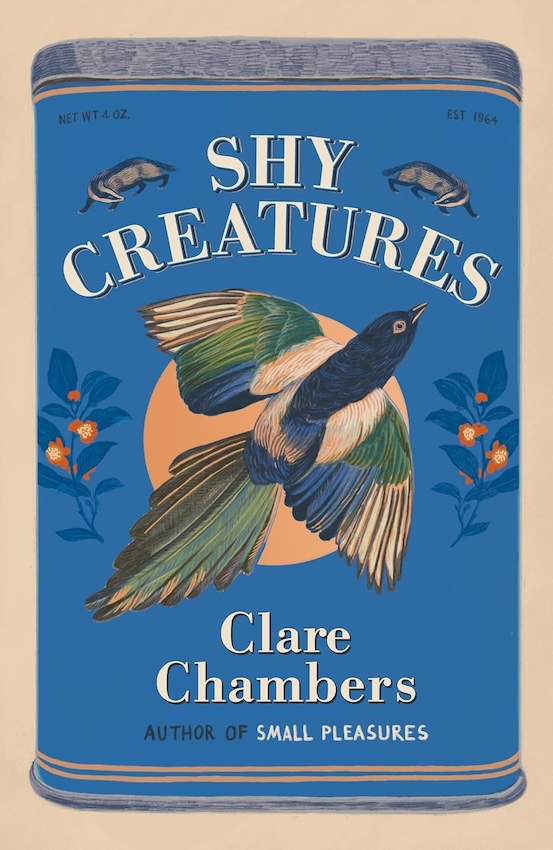
If you enjoyed Clare Chambers’s last book, Small Pleasures, as much as I did, you’ll be pleased to know her new book, Shy Creatures, is out soon. I’ve always loved this author’s particular way with empathy and humour, so when I found an earlier book by Chambers at a second-hand bookshop, I was delighted, in spite of having read it years before.

Back Trouble, first published in 1994, is about Philip, who is about to turn forty, and his life for the most part seems to have gone to custard. We first catch up with him at an awkward family New Year’s celebration. His insurance broker brother Raymond is over from Canada with a new batch of photos of his children, recounting their successes (the football and the gymnastics), while Philip has never felt less like celebrating. With the failure of his publishing company he is in debt up to his eyeballs and the love of his life having gone home to New Zealand, life couldn’t get any worse, could it?

A cold chip from an overflowing municipal bin sends Philip head over tail and the ensuing back injury leaves him bedridden. There’s nothing to do but to fish out the notebook and pens from under his bed and begin to write the story of his childhood – a New Year’s challenge flung out by Raymond, to be completed in three months – just a thousand words a day – no probs. We are reminded that this is the 1990s and the Internet is in its infancy, although probably a more modern-day Philip wouldn’t be diverted by technology as he’d be out of data anyway – he’s that strapped for cash.

The kitchen was the first room to be tackled. One of the men from the building site had given Dad and industrial-sized drum of bottle green paint from the batch which his brother, who worked for the Council, had been using to paint the park railings. Cost was Dad’s only criterion in selecting materials. This meant garish rolls of wallpaper from the bargain bucket outside the DIY shop, the top six inches of every roll faded by the sun, and brushes which moulted into the paint. He had an idiosyncratic way of decorating. Being both nervous and impatient he didn’t believe in preparing surfaces, always fearing that something terrible might be lurking beneath a layer of bubbly paper or flaking paint. So instead of stripping paintwork, or even washing it, he would set straight to work, brushing gloss over old gloss, dust, mould and even, in one instance, a dead spider which lay preserved like a Pompeian relic in its shell of green paint.

Philip is such a self-deprecating narrator – he has no illusions about where he’s at as he approaches forty – and his story is warmly humorous as it rattles along to a nicely surprising ending. There are some poignant moments too, particularly in Philip’s childhood, with adults not behaving as they ought to and the weight of knowledge that falls on a young boy growing up. It is easy to blame Philip’s careless yet penny-pinching father, but other adults also turn out to be unreliable or even predatory.

Odd allusions to Great Expectations add an interesting twist. There are a raft of curious characters, quirky, helpful or otherwise, which may be another nod to Dickens, particularly the scene at Philip’s grandmother’s house – the blind matriarch and hoarder of useless furniture, including four unplayable pianos, terrifying in her fierceness; the black-toothed Auntie Florrie smoking her woodbines; Punnet the obese black labrador. It’s like stepping back in time.

For a small book, Clare Chambers packs quite a lot in and it’s hugely entertaining. I know she can always be relied upon for an original and big-hearted read so I am so looking forward to Shy Creatures, released on Amazon at the end of the month. Back Trouble is a four-star read from me.

Book Review: The Night Whistler by Greg Woodland – a new cop in a small town that’s simmering with secrets

Readers of these posts will know that Aussie Noir is one of my favourite sub-genres. Having recently read Greg Woodland’s debut crime novel, I am pleased to have discovered what looks like a promising new series. The Night Whistler has all that readers have come to enjoy about Aussie Noir: an evocative, rural Australian setting; small town secrets; and a cop that’s up against it. Set in the 1960s, the story evocatively conjures up the era – the music, the social order plus the edgy restlessness of a long, hot summer.

Mick Goodenough (pronounced like “no-good” backwards, as opposed to “good enough”) has been sent to Moorabool, a smug little town that’s something of a culture shock. A former Sydney detective, he’s been busted down to the rank of Probationary Constable after a case went horribly wrong. Falling foul of his superiors and with a drinking problem that has cost him his marriage, Mick has hit rock bottom but, fortunately, it seems, you can’t keep a good cop down.

The narrative alternates between Mick’s story and that of twelve-year-old Hal, similarly a new kid in town, along with little brother Evan. The two boys are investigating a creek near their house when they come across the body of a mutilated dog. The boys are understandably upset, but go on to give the animal something of a burial, little knowing that the dog is one of a string of such killings that the police won’t take seriously. That is until Mick Goodenough recognises the traits of a perpetrator that will likely take a more serious turn. When the dead dog turns out to be Mick’s, it only spurs him on.

While there’s a killer just getting up steam, Mick is having to deal with arrogant Sergeant Bradley who is wary of Mick’s city cop ways, and lords it over his team. This includes a fellow Probationary Constable who sucks up to Bradley and world-weary Senior Constable Bligh, who becomes an unexpected ally. Meanwhile Mick is desperate to see his teenage daughter again, if only his ex-wife will agree to send her down on the train.

Hal’s father is the bright new spark at Prime Foods, which is why the family have moved to Moorabool. He’s got a fancy new car and wandering eyes. At the Prime Foods Christmas Picnic, we see a microcosm of the town, the braying and overbearing Mayor Dianne Curio, and her bombastic husband, as well as the racism carelessly handed out to Jenna, a young Aboriginal woman who is friendly to Hal and his mother.

Finding the dead dog sets Hal on a mission to uncover the killer – he’s been reading Sherlock Holmes. He gets a hand from young Allie, an Aboriginal girl who teases him relentlessly but shows him how to fish for yabbies in the creek. The two make a great pairing, but obviously they are soon going to be out of their depth. Worse still, Hal’s mother begins getting nuisance calls from someone whistling “Are you lonesome tonight” and making threats. Sergeant Bradley ignores her call for help, even when Mick suggests this isn’t just a snowdropper.

Greg Woodland quickly creates a simmering sense of menace as the story builds towards a gripping ending. But there’s also plenty of banter between Hal and his brother and with Ally, between the kids and their parents and other adults that adds some humour and light relief. Then there’s all the pressure on Mick: the pressure not to probe too much in a town where it pays not to ask too many questions.

For a debut novel, The Night Whistler is expertly constructed, the characters well drawn and interesting, while bringing the setting, both time and place, to life. But we shouldn’t be surprised. Greg Woodward is an experienced screenwriter with a bunch of award-winning films under his belt. The second book featuring Hal and Mick, The Carnival Is Over, is already on my ever-growing list of must-reads. The Night Whistler, excellently narrated by Nic English in audiobook format, is a four-star read from me.

Book Review: Rules of Civility by Amor Towles – a story of love, friendship and making the right connections in 1930s New York

If I had a list of authors who can make a laundry list sound interesting, Amor Towles would surely be near the top of it. (If anyone has already curated a list like that, I’d love to see it – just saying.) Rules of Civility is Towles’s first novel and the writing is just as good as the later books that have made his name: A Gentleman in Moscow and The Lincoln Highway. There’s the same nuanced prose, the characters that seem to breathe on the page, the originality of the storyline.

In this novel we’re in New York City, mostly over a year that begins on New Year’s Eve 1937. Twenty-somethings Katherine Kontent and her roommate, Eve Ross, are out to celebrate, finding themselves in a lacklustre nightclub, where complicated jazz solos make it kind of interesting. Here they stumble upon Tinker Grey, a slightly older, impeccably dressed and very handsome young man.

The three strike up a friendship that pulls them all in different directions. Both girls are drawn to Tinker, but he’s just so enigmatic, it’s hard to tell if either can win his heart. In the meantime they just hang out together, enjoying the vibe they create as a small group of friends. An accident pushes a guilt-ridden Tinker towards Eve, and Katherine shrugs off her disappointment and gets on with life.

It is Katherine’s voice who narrates the story and we follow her progress from a typing pool, to a publishing house and then the competitive world of a society magazine. She’s sharp, witty and hard working, but then she needs to be – she’s rubbing shoulders with an Ivy League-educated elite, while she herself is from fairly humble beginnings. Everything she has she’s had to earn herself. In the background Tinker and Eve waft in and out of her life, while other relationships come and go.

The book is peopled with lively, colourful New Yorkers – the drinking buddies Katherine makes through the girls she works with; well-heeled and influential friends and acquaintances of Tinker’s; the raw, working class guys who hang out with Tinker’s artist brother. Katherine has a gift for fitting in and adding to whichever group she meets and in this way is the perfect narrator.

In front of the boardinghouse Tinker was standing beside a Mercedes coupé as silver as mercury. If all the girls at Mrs. Martingale’s saved a year’s pay, we couldn’t have afforded one.
Fran Pacelli, the five-foot-nine City College dropout from North Jersey who lived down the hall, whistled like a hard hat appreciating the hem of a skirt. Eve and I went down the steps.
Tinker was obviously in a good mood. He gave Eve a kiss on the cheek and a You look terrific. When he turned to me, he smiled and gave my hand a squeeze. He didn’t offer me the kiss or the compliment, but Eve was watching and she could tell that she was the one who’d been short-changed.

A lot happens in just one year, and you can’t help thinking that for many in 1938, times were tough. But not among the glittering social set of New York. The story builds to some surprising revelations, particularly about Tinker but also about others who pass through Katherine’s orbit, the main action of the story bookended by her visit to a photographic exhibition decades later and a kind of catch-up with what has happened in the meantime.

It all makes for a satisfying read: the brilliantly rendered view of 1930s New York, the story of a woman determined to make her own way, the glorious writing. Rules of Civility is just as good as the other books by Amor Towles, and I look forward to his collection of short stories, Table for Two, as well as whatever else he’s got in the pipeline. I know they’ll all be five-star reads, just like this one.

Book Review: The Library by Bella Osborne – a feel-good read about an unlikely friendship and a library in trouble

A public library can be one of those places that offer a respite from the anxieties of everyday life. And while they’re not the silently bookish places they used to be, hosting community groups, classes and story times, they can still be a place of refuge in a way a shopping mall just isn’t. Bella Osborne has taken this idea to create a story around two lonely people and a friendship that develops at the library.

Maggie is seventy-two, a widow who runs a small holding on the outskirts of town. It’s a lonely life but she fills it with her love for her livestock, yoga and books. Her membership of a book group that meets every Saturday is the highlight of her week. Sixteen-year-old Tom is struggling to keep everything together at home where he lives with an alcoholic father. It’s a battle to make ends meet, and his dad wants him to give up school to join him at the factory – they could use the extra wages. But Tom has his sights on a better life, and Farah, a cute girl, if only she’d look his way.

Tom has as an odd idea that Farah uses the library and visits on the pretext of choosing some romance books for his mother. Soon he’s lugging home a pile of books he has no intention of reading. Maggie gets mugged outside the library on her way to her bus-stop and Tom helps her to her feet. Over time an unlikely friendship forms and Tom discovers the wonders of reading, farm life and finally has someone supportive in his life. Maggie has a glimpse of what having a family of her own might have looked like and feels less alone.

They sat side by side on the cool metal seats and waited for the bus. ‘I think this week’s book club read will be more up my street.’
He was looking about. He seemed to have lost interest in her. She got the book out anyway and showed it to him.
The Fault in Our Stars.’ He nodded. ‘You might like it,’ she said. He nodded again before realising his mistake.
‘Nah. Doubt it.’ Tom looked away.
‘It’s okay, Tom. The others don’t know and I won’t be telling them.’
‘Know what?’ He pulled his shoulders back and stared her down.
‘That it’s you reading the books and not your mum.’
His shoulders sagged with every word, until he was back to his rounded-shoulder posture. ‘How’d you know?’
‘The way you read the blurbs before choosing the books. The conversation about Me Before You.’ She gave a shrug. ‘I’m a bit like a dog with a bone when something doesn’t add up.’
He turned to look up the road for the bus, as if willing it to arrive, but there was ages yet. ‘Well done, Miss Marple.’

When the town council announces plans to shut their library down, Maggie reignites the feisty young woman she was in the sixties, demonstrating at marches, holding placards and making a nuisance of herself. She ropes in young Tom and her book club pals, but it’s an uphill battle when the library door-count has probably been dropping for decades. But as the Joni Mitchell song goes: “you don’t know what you’ve got till it’s gone” and a library is more than just books, it can be the heart of a community.

You can guess how the story will pan out, but there are a few surprises along the way. Maggie is hiding a secret, and so is Tom’s dad. Meanwhile Tom’s issues with his father add complexity as he faces extra pressure when he needs to focus on study if he has any hope of university. But it’s the humour in the odd little mishaps and misunderstandings that makes this a fun read. Maggie and Tom’s friendship is not always plain sailing so there’s some tension there too. Plus, there are puppies.

The Library is a light but engaging read, and anyone who has a fondness for libraries will relate to the characters and their campaign. There’s plenty of book talk too, especially when Tom, with nothing better to do, discovers that romantic fiction is a whole lot better than he expected. This is a warm, feel-good sort of story, cheering and heartfelt and a four-star read from me.

Book Review: The Librarianist by Patrick DeWitt – a quirky and heartfelt novel with a memorably unmemorable main character

Working in a library, of course I was drawn to this book, with its cover showing an old-fashioned library book date-slip. But what the heck is a librarianist? How did that one slip past me, of all people? I just had to find out.

Bob Comet is the librarianist of the title, an everyman kind of character who has always lived for books. Maybe that’s what librarianist means. He is described as “not unhappy” and seventy-one years of age, a solitary man who fills his days with simple pleasures, such as reading, cooking, and walking.

We catch up with Bob in 2005 when he rescues an elderly woman he bumps into at a 7-Eleven, where he’s gone for coffee. The young cashier doesn’t know what to do with her; she’s been staring at the chilled drinks fridge for getting on for an hour. Bob reads a label attached to her clothing and discovers her name is Chip. He manages to get her home to a care facility and before you know it he’s a volunteer, expanding his world and getting to know the residents.

A coincidence at the care facility occurs that shocks Bob and propels the story back to Bob’s youth. We’re back in the 1940s and 50s when Bob’s love of books begins. You get the impression that it is books that rescue Bob from the reality of the hurly-burly of school, his life at home with a mother that doesn’t understand him, and his general aloneness. He becomes a librarian, and takes on his mother’s house when she dies. You imagine a quiet, solitary, bookish life for Bob, and he does too. And then he meets Connie.

The book describes his relationship with Connie, similarly a person who doesn’t fit in but for quite different reasons. There’s also his sudden friendship with Ethan, who turns up at the library carpark one day, too afraid to go back to his apartment across the road, and the angry policeman inside it. Bob’s life has suddenly a friend and some romance in it – until suddenly it doesn’t.

Why read at all? Why does anyone do it in the first place? Why do I? There is the element of escape, which is real enough—that’s a real-enough comfort. But also we read as a way to come to grips with the randomness of our being alive. To read a book by an observant, sympathetic mind is to see the human landscape in all its odd detail, and the reader says to him or herself, Yes, that’s how it is, only I didn’t know it to describe it. There’s a fraternity achieved, then: we are not alone. Sometimes an author’s voice is familiar to us from the first page, first paragraph, even if the author lived in another country, in another century.” Bob held up his stack of Russians. “How can you account for this familiarity? I do believe that, at our best, there is a link connecting us.

But before we catch up with Bob in 2006 again, where the story left off, there’s an odd chunk of the novel that takes us back to 1945 and an eleven-year-old Bob running away from home. Where he gets to and the people he meets makes for an entertaining enough interlude, full of memorable characters, but I couldn’t help asking myself what it was all about. I couldn’t help wondering why it didn’t seem to have an impact on the Bob we meet later, who returns home eventually, remarkably unchanged. Years later, however, he sometimes wistfully dreams about the seaside hotel that took him in for four days..

The Librarianist might not follow the usual rules for novel plotting in some ways, and the ending is perhaps a little odd, too. But it’s a diverting read, and you can’t help getting to like Bob and the people we meet as seen through his eyes. Patrick DeWitt’s prose is delightful, witty, wry and perceptive, bringing Bob and his times to life.

The novel reminded me a little of some of Anne Tyler’s earlier fiction with its characters that don’t fit in, and the events that pull them out of their lethargy or solitary habits. I’ve always got time for a novel like this, particularly if it’s as nicely written as this one. I’ll pick up another DeWitt novel sometime, I’m sure. The Librarianist is a four-star read from me.

Book Review: Pachinko by Jin Min Lee – an immersive family saga of a Korean family over generations

I’d heard so many recommendations for this novel, and spotting it was available to watch as a TV series, decided I needed to read the book first – and I’m so glad I did. Pachinko is such a memorable novel, taking you into a world I had little knowledge of – a Korean family through the generations and their attempts to survive Japanese invasion of their homeland, a world war and making a new life in Japan.

The main character through it all is Sunja, who lives with her mother in their boarding house in an island fishing village. There is an obvious presence of the Japanese – harvests taken to Japan, rules that must be obeyed and any hint of insurrection severely punished. Times are hard, but the women do well enough until Sunja finds herself pregnant at sixteen to handsome trader, Koh Hansu. Sunja looks likely to suffer a terrible disgrace but rescue comes from an unlikely direction.

Baek Isak arrives ill with tuberculosis, looking for shelter, seemingly on death’s door. Sunja and her mother nurse him back to health, saving his life. But Isak is a good man, a young missionary who is passing through on his way to a church in Osaka. He suggests marriage would be good for both him and Sunja. She will travel with him to a new life in Japan.

In Osaka, Koreans struggle to make a living, and few landlords will rent them houses, so they live in a kind of shanty town of cobbled together dwellings. It’s a culture shock, but Isak’s brother Yoseb and sister-in-law Kyunghee are so welcoming, Sunja slowly imagines a future where there is both family and love. The story follows Sunja and Isak, and the generations that follow, through at times terrible hardship as World War II takes hold and life becomes even tougher. In spite of what happens, Sunja shows grit and determination to give her sons, Noa and Mozasu, a better life.

The story takes its name from Pachinko parlours, a form of gambling that is tolerated in Japan, a bit like a penny arcade where there are rows of slot machines. Perhaps this is a metaphor for the story in the way that characters are at the mercy of fortune, struggling to take hold of their own destiny in a country where there is so much discrimination. Women too, both Japanese and Korean, are also assigned roles that are hard to break out of. The story takes you up until the late 1980s – before K-pop and fusion cuisine, which have made Korean culture popular in the west.

There was consolation: The people you loved, they were always there with you, she had learned. Sometimes, she could be in front of a train kiosk or the window of a bookstore, and she could feel Noa’s small hand when he was a boy, and she would close her eyes and think of his sweet grassy smell and remember that he had always tried his best. At those moments, it was good to be alone to hold on to him.

And yet it is the Pachinko business that gives the younger generations of Sunja’s family a chance to build a future, perhaps even a small fortune. Before that, Sunja and Khyungee sold home-made kimchi and sweets to help put food on the table – a hard-scrabble life, but which forges a bond between the women.

This is an at times harrowing story, and you can’t help feeling for the characters and what they’re up against. There are world events taking place in the background that impact on them, as well as changes in culture and the way people live that give the story a sense of scope. It’s all fascinating, moving and riveting while Sunja is a character you won’t ever forget. It’s one of those both beautiful and sad books that stay with you, and a five-star read from me.

Elektra by Jennifer Saint – a retelling of the Sophocles tragedy for a modern audience

These retellings of stories from Ancient Greek classics can be oddly compelling. The latest to hit my bedside table is Jennifer Saint’s Elektra, a new version of the tragedy by Sophocles. If you haven’t met her before, the eponymous heroine is the youngest daughter of Agamemnon and Clytemnestra. You’ll remember Agamemnon as the leader of the Greek fleet that waged war on Troy – the thousand ships that sought revenge on Paris for making off with Helen – the world’s most beautiful woman, and also Agamemnon’s sister-in-law.

The story starts off with Helen choosing her husband. All the suitors have gathered at the court of her father, the king of Sparta, where she chooses the adoring Menelaus, a second son who will let her stay in Sparta to help rule her father’s kingdom. At the same choosing party is Helen’s sister Clytemnestra. She is impressed by the two brothers from the House of Atreus, particularly the powerful energy emanating from Menelaus’s brother, Agamemnon. After the marriage of Helen, the brothers set sail for the home they have lost to the uncle who’d murdered their father, and with the Spartan fleet behind them, enact vengeance.

It is this house that Clytemnestra marries into, and discovers the terrible curse on the House of Atreaus, one that just won’t leave them alone. It involves murder of innocents, fratricide and revenge – an on-going intergenerational battle for the throne. Things may have settled down after Agamemnon took back his kingdom – if only Paris hadn’t stolen Helen and spirited her away to Troy. You know how it goes.

Jennifer Saint tells the story from the point of view of three women: Clytemnestra, her daughter Elektra and Cassandra, a daughter of Trojan King Priam. Clytemnestra witnesses her husband sacrifice their eldest daughter Iphigenia so that the gods will grant him a wind to take his fleet to Troy. In her grief, she vows to kill Agamemnon on his return, but that’s another ten years away, and her grim decision takes over her life.

Elektra is a child when her father sails off to vanquish the Trojans, and misses him terribly. She is fierce, loyal and ignored by her mother. Clytemnestra’s intentions will set in motion a vengeance of her own. In Cassandra we have the story from the Trojan point of view. Badly treated by Apollo, Cassandra is cursed with a gift to predict the future, but to have her warnings disbelieved. Everyone therefore thinks she is mad – even when she predicts the fall of Troy and sees what’s hidden in the Trojan horse. Taken as a war prize by Agamemnon himself, her story will connect with that of Clytemnestra.

It surprises me just how readable and compelling this novel is given the content. Jennifer Saint does a brilliant job of envisaging the war, the plotting and scheming, the cruel indifference of the gods. One terrible deed just seems to lead to the next, and the characters have few redeeming features. So much bitterness and fury. All three women are trying to make a stand in some way, to determine their future, to make changes – difficult in a world run by power-hungry men and unreliable gods. Humming in the background is the question: if we leave one evil deed unpunished, do we not show contempt for the victim, for human kind and also for the gods?

The ending is brutal, but allows for a small glimmer of hope that the curse has finally come to an end – but who knows? Perhaps that’s another story. Elektra is another excellent addition to the genre, well-researched, intense and atmospheric. A terrific read for anyone who wants to immerse themselves in classical legends – four-stars from me.

Book Review: Gilead by Marilynne Robinson – a love letter from a father to his son and a wonderful contemplation on life itself

In Gilead, John Ames is writing a memoir for his son, a small boy of seven, intended for him to read later, long after his father has gone. Ames, well into his seventies, has a weak heart and fears leaving his boy to grow up without a father. So he wants to write it all down – from his own childhood and his life as the son and grandson of preachers to what’s going on around him in the present. We get bits of history – the Civil War and the Underground Railroad, World War I, the Spanish Flu, and the Great Depression, and how all these events impacted on ordinary folk in small towns like Gilead.

While he’s telling his story, Ames is irritated by the return of Jack, the black sheep son of his good friend Rev. Robert Boughton. Unlike Ames, whose first wife died in childbirth along with their daughter, Boughton has a large family, most of whom live some distance away. Jack, in spite of his chequered history, seems a favourite of his father’s, while Ames is constantly censuring himself for harbouring an ongoing dislike for the younger man, which of course isn’t very Christian of him.

Ideas about what it is to lead a good life in the way God intends us to blend with stories about the characters, their pasts and particularly their problems. Jack’s story is heart-rending, and there’s more about him in the two other Gilead novels: Home and Jack, which I will get to, I’m sure. But what is particularly moving in this book is the tone of the writing, the voice of John Ames. You get such immense love in the way Ames is writing to his son coupled with the sadness that he won’t see him grow up. But with that is also the joy of someone who notices the wonder in simple things.

There’s a shimmer on a child’s hair, in the sunlight. There are rainbow colours in it, tiny, soft beams of just the same colours you can see in the dew sometimes. They’re in the petals of flowers, and they’re on a child’s skin. Your hair is straight and dark, and your skin is very fair. I suppose you’re not prettier than most children. You’re just a nice-looking boy, a bit slight, well scrubbed and well mannered. All that is fine, but it’s your existence I love you for, mainly. Existence seems to me now the most remarkable thing that could ever be imagined. I’m about to put on imperishability. In an instant, in the twinkling of an eye.
The twinkling of an eye. That is the most wonderful expression. I’ve thought from time to time it was the best thing in life, that little incandescence you see in people when the charm of a thing strikes them, or the humor of it. ‘The light of the eyes rejoiceth the heart.’ That’s a fact.

I find myself getting teary-eyed just thinking about Gilead, and the character of John Ames, the heart-felt thoughts of a humble man. You do get quite a bit of religious contemplation, with Biblical references and ideas for sermons, which might not suit every reader. But it’s more wise than preachy and fills out the character of our storyteller. I read this as an audiobook, superbly narrated by Tim Jerome – it was as if John Ames was talking to me in the same room – but I’m glad to have a physical copy to flip through too. Gilead is a beautiful book, which won a number of awards, including a Pulitzer Prize – a modern classic and a five-star read from me.

Book Review: The Hazelbourne Ladies Motorcycle and Flying Club by Helen Simonson – a fun historical read set in post WWI England

I’d really enjoyed both of Helen Simonson’s earlier books, Major Pettigrew’s Last Stand and The Summer Before the War, so was looking forward to her new book. And it’s a treat. Peppered with a cast of interesting characters, the story follows Constance Haverhill, who has recently lost her mother to the Spanish Flu. She has been taken pity on – and by that we mean made use of – by her mother’s old school friend, Lady Mercer. Constance is to accompany Lady Mercer’s mother to the seaside for an extended stay as a lady’s companion.

As you can guess, it’s just after World War I and Britain is both reeling from the devastation of losing so many soldiers, as well as celebrating peace. Women who have had to step up and take jobs formerly held by men are returning to traditionally female work, struggling to make ends meet on widows pensions, or depending on relatives.

Constance had made herself useful in the Mercer household managing the farm accounts – she’s a farmer’s daughter, after all – and has also trained as a bookkeeper. But with nowhere to go except her brother’s farm, her unpaid accounting work for the Mercers no longer required, Constance sees her short visit to Hazelbourne as a chance to evaluate her options. Fortunately, the elderly lady, Mrs Fog, is kindly and appreciative, allowing Constance plenty of time off to see the sights.

At the Meredith Hotel Constance is unable to have a table on her own as an unaccompanied young woman, as is Poppy Wirrall, who has just blown in on her motorcycle and is unsuitably attired. The two girls bond over a loaned skirt and before you know it, Constance is swept up into Poppy’s world. Poppy is a fan of motorcycles – she was a courier at the front – and has collaborated with some other women friends to set up a motorcycle and sidecar taxi service. One of the crew, Iris, is a keen motorcycle racer, but it’s hard breaking into a field dominated by men.

“I say, is there any chance you would help me?” said the girl, jumping up and extending a slightly oil-stained hand. “I’m Poppy Wirrall. I’ve been out all day on the motorcycle and damn it all if I didn’t leave my bag behind at home. My mother is still out visiting and the powers that be here have decided that after four years of war and pestilence they should still have the vapours over a woman having tea in trousers.”

Pippa’s family have decamped to the hotel while Mrs Wirrall is spending the family fortunes lavishly renovating their stately home. Brother Harris is an amputee, bitter at being treated like an invalid and desperate to fly bi-planes again. Several characters face difficulties in being seen for who they are, not just what they are. So Harris is expected to be an invalid, and his sister to marry, rather than run around on motorcycles. There’s also hotel waiter Klaus, a naturalised Englishman, but no one can see past his German origins. Class rears its ugly head as Constance knows only too well.

There is an element of Pride and Prejudice in the way Constance and Harris interact in the early parts of the book. Harris is haughty to protect himself from ridicule, and is bitter at seeing so many of his fellow pilots killed in the war. Constance, ever the poor cousin, bridles at his rudeness. But Harris at least is not a snob like the Mercers, and knows the value of people who have a good heart.

Everything comes together in a plot that simmers with exciting events – motorcycle races and aerobatic displays, dances and weddings, romances and disasters. Not everyone gets a happy ever after, but there’s hope and fresh starts aplenty as characters face challenges and rise to the occasion. The Hazelbourne Ladies Motorcycle and Flying Club is a charming story, nicely recreating the post WWI period in an English seaside setting – a light, fun read with moments that make you want to cry or cheer. A four-star read from me.

Book Review: Absolutely and Forever by Rose Tremain – a short and bitter-sweet novel about lost love and finding your way

I was warned that this book was somewhat melancholy, and in a way it is. Absolutely and Forever is about first love, specifically Marianne Clifford’s falling in love at fifteen with handsome and clever Simon Hurst. It is a love she just can’t seem to get over, and years after Simon has disappeared from her life, she still thinks about him in a yearning kind of way.

This might make Marianne appear somewhat daft. But don’t be put off; every moment we spend with her is entertaining. Tremain has written a dryly witty, self-aware character, born at time when a good marriage was often considered life’s ultimate goal for any young woman. We’re thrown into the late 1950s; Bill Haley and the Comets is on every party’s turntable and parents are eyeing up young men with prospects for their daughters. Particularly middle class parents in the Home Counties.

Absolutely and Forever made the shortlist of the Walter Scott Prize for Historical Fiction and although it didn’t win, you can see why it was noticed. Tremain captures the period so well, and through Marianne’s eyes we see how the times, they are a changing. At school, Marianne’s best friend is brave, outspoken Petronella who goes on to university to study sociology and spends the entire book urging Marianne to forget Simon and discover what she’s good at. You can tell Marianne’s smart, but this lesson takes a while for her to master.

On certain days, particularly when I was in the typewriter room of the college and fifteen typewriters were clattering and pinging and the carriages were being shunted left to right, left to right, and the wall clock was clicking away time, measuring our typing speeds, I felt my mind disintegrating. I thought, I’m in a madhouse; life has brought me here, to an asylum of a kind. It wasn’t the old and wondrous Love Asylum, it was now the Grief Asylum, where my heart was being shunted back and forth, back and forth, inside a chamber of despair.

The story takes Marianne through many ups and downs, including tragedy, and a surprise ending. Both turn out to be oddly liberating for our MC. So, yes, there is enough of a story here to keep you reading. But it’s the language that really had me hooked. At one point, Hugo, the man who falls for Marianne enough to put up with her melancholy, says the one thing he really loves about her is that he never knows what she’s going to come out with next. Tremain gives Marrianne’s narrative plenty of charm and flavour.

You can’t help thinking, thank goodness for the Swinging Sixties and women’s lib. For if they hadn’t come along would girls still be growing up pinning all their hopes of happiness on a man and forgetting they have a brain? Absolutely and Forever is a welcome reminder, and at a mere 180 odd pages a nicely-crafted, diversion you can read in a day. A four-and-a-half star read from me.