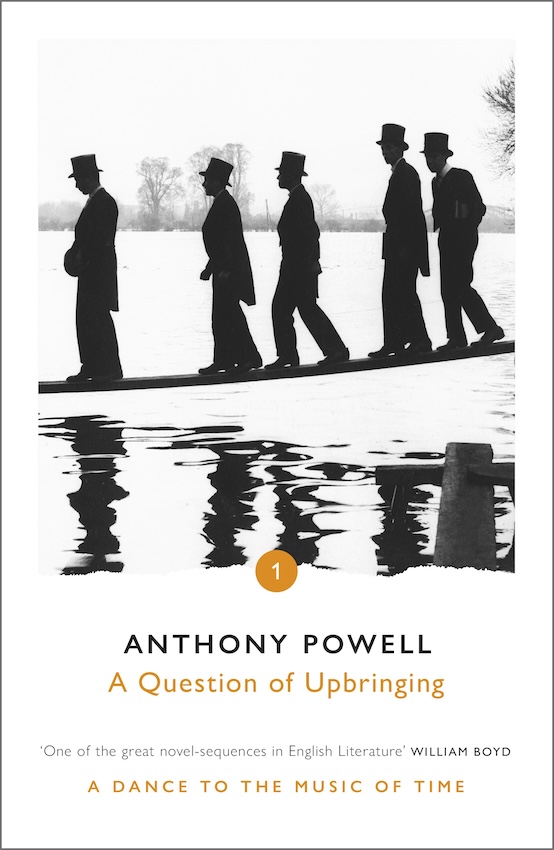
Book Review: A Question of Upbringing by Anthony Powell – a wryly intelligent evocation of growing up in early 20th century England

For some time I’ve been meaning to reread Anthony Powell’s A Dance to the Music of Time – the author’s career-defining sequence of twelve novels. And rather than crack on and make a start, I dropped the first book, A Question of Upbringing, into my list for the Classic Club’s Spin challenge. And at last, up it popped, so I got to work.

And you do have to work a little at the prose, the language is so rich, the sentences long and often convoluted. But there is a wry humour never far from the surface and the attention required is more than rewarded. I chuckled my way through much of the book as it describes the late teens of the main character, Nicholas Jenkins.

Nicholas is at his public school when we first meet him – he’s been down to the shops for some sausages to cook over the fire with his friends, Charles Stringham and Peter Templer. These boys all take different paths to Nicholas, who goes on to university, and they drift in and out of each other’s lives, along with another boy, Kenneth Widmerpool, who is unpopular and often made fun of. To be fair Nicholas feels uncomfortable about this – Widmerpool lives in much more straightened circumstances, with just a widowed mother who obviously dotes on her son. But that doesn’t mean he’s in any way likeable.

The story is told in several sections beginning with Nicholas’s last year or so at school. There’s a visit to Peter Templer’s home where he meets his friend’s quirky family and in particular Peter’s sister Jean, with whom he’s quite smitten. There follows a sojourn in France to help Nicholas improve his French before university. Here Nicholas comes across Widmerpool, of all people, who insists on speaking to him only in French, while Nicholas is a trying to make some headway with a girl.

Stringham was bending forward a little, talking hard. Templer had managed to get his pipe back into his pocket, or was concealing it in his hand, because, when I reached the level of the field, it had disappeared: although the rank, musty odour of the shag which he was affecting at that period swept from time to time through the warm air, indicating that the tobacco was still alight in the neighbourhood. Le Bas had in his had a small blue book. It was open. I saw from the type face that it contained verse. His hat hung from the top of his walking stick, which he had thrust into the ground, and his bald head was sweating a bit on top. He crouched there in the manner of a large animal – some beast alien to the English countryside, a yak or sea lion – taking its ease: marring, as Stringham said later, the beauty of the summer afternoon.

The final chunk of the book brings Nicholas to Oxford where he meets other interesting people at the tea parties of a professor known as Sillery. Stringham and Templar also reappear but the friendships they once had seem now under strain. Further amusing characters make appearances, such as the disapproving house-master, Le Bas, and Nicholas’s Uncle Giles, the family black sheep, who is of no fixed abode and constantly short of funds.

Not a lot happens that is extraordinary on any kind of grand scale, though there are some amusing incidents. This is not like many coming-of-age novels where a disturbing event makes a young person grow up in a hurry. Powell seems to be capturing something more realistic – what it’s like when you’re at an impressionable age and trying to make sense of the interactions of people around you, of how to decide what you want to do with your life, and with whom you want to spend it.

A Question of Upbringing is really all about the characters, of class and how much you can be yourself in a world where things are done a particular way. Nicholas is just beginning to find out, but he’s a great observer of others and you know you can expect more of this in the books that follow. This novel is set in the early 1920s, so as he matures there will be political and social changes going on around him, and even a war.

I hope I don’t wait so long to read the next in the series, A Buyer’s Market, as Powell is really worth spending time with. If you want a slower, more measured read, which captures a period of English life, these novels are quite brilliant. A classic kind of read in every sense.

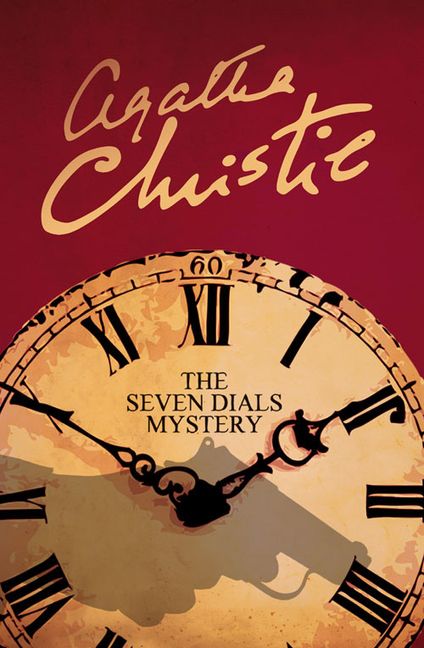
Book Review: The Seven Dials Mystery by Agatha Christie – a Golden Age thriller soon to be adapted by Netflix

I was intrigued to learn that Netflix had picked up The Seven Dials Mystery for the small screen and not remembering a lot about it, hunted it out among my collection of dusty old Agatha Christie paperbacks. First published in the 1920s, the opening scenes make it sound a little like a P G Wodehouse novel.

We’re in an English country mansion known as Chimneys which has been rented out for the summer by a wealthy industrialist, Sir Oswald Coote, and his wife Lady Coote. For some reason there are a bunch of young people staying that don’t seem to be anything to do with the Cootes, a typical Wodehouse type of house party.

When Gerry Wade becomes increasingly tardy about coming down for breakfast, much to Lady Coote’s growing discomfort, Jimmy Thesiger and his friends decide to teach him a lesson. They go into town to buy a collection of alarm clocks. The plan is to sneak them into his room to rouse him the next morning at the ungodly hour of 6:30. Only even that doesn’t seem to work, particularly when it is discovered that Gerry, far from sleeping through the cacophony of eight alarm clocks going off, is dead.

Chimneys is the home of Lord Caterham and his daughter Lady Eileen (Bundle) Brent. Bundle is also the heroine of a previous book, The Secret of Chimneys, and is always on the go in her Hispano-Suiza. Being a fearless young woman with time on her hands, she is easily bored. Before long Jimmy teams up with Bundle to solve the crime. Unlike his friends who have jobs in London, Jimmy’s a man of leisure; his valet Stevens has the same aplomb and consideration for Jimmy’s every comfort you might expect of Jeeves.

Bundle made a grimace.
“Why need people die in my room?” she asked with some indignation.
“That’s just what I’ve been saying,” said Lord Caterham, in triumph. “Inconsiderate. Everybody’s damned inconsiderate nowadays.”
“Not that I mind,” said Bundle valiantly. “Why should I?”
“I should,” said her father. “I should mind very much. I should dream things, you know – spectral hands and clanking chains.”
“Well,” said Bundle. “Great Aunt Louisa died in your bed. I wonder you don’t see her spook hovering over you.”
“I do sometimes,” said Lord Caterham, shuddering. “Especially after lobster.”
“Well, thank heaven I’m not superstitious,” declared Bundle.

Bundle’s and Jimmy’s friend Bill Eversleigh works in the Foreign Office, as did the victim, Gerry Wade. A second victim directs the investigation to Seven Dials, once a seedy part of London, now the name of a nefarious night-club and headquarters of a sinister sounding gang. With a second murder victim it is easy to assume it’s all something to do with a spy network of sorts, and the pace cranks up as our amateur sleuths team up with Gerry Wade’s step-sister, who’s a lot sharper than she looks, and follow clue after clue.

But Agatha Christie is a master of surprises, and there will be more than one shock for the reader before the end of the book. Of course, the killer is unmasked, in typical Christie style, and in spite of references to hangman’s nooses, there’s also a touch of romance in the air.

The Seven Dials Mystery really immerses the reader in a very different era of crime fiction and for some a book like this will seem terribly old fashioned. But with the huge array of cosy mysteries on the market, many set in similar periods, you can see why the Queen of Crime’s books are still big sellers. They are a lovely kind of escapism and the dialogue is full of fun, lending itself well to screen adaptations. And then there’s the settings, the costumes, that car! I shall look forward to the Netflix adaptation – in the right hands the story should come to life beautifully. This book scores three and a half stars from me.

Book Review: Body of Lies by Sarah Bailey – a riveting crime novel packed with surprises

I’d given up hope of another Detective Gemma Woodstock novel so was ecstatic to see this one come out earlier this year. If we’re talking Aussie Noir detectives, I might have to put Woodstock ahead of Jane Harper’s Aaron Falk (The Dry; Forces of Nature; Exiles), Woodstock scoring points for instinct, putting two and two together, feistiness and courage. If only she could get her life together.

But in Body of Lies, it seems Woodstock is at last doing well on the home-front. She has recently returned to her hometown of Smithson – she’d escaped it after the first book, lived dangerously for a time in Melbourne, but with a new relationship going well, she has come back to her old job. Gemma wants to be a good mother to her son, and has a new baby, but with the help of Mac, the man best pal Candy says is a saint, it all looks fairly promising.

Gemma’s still on maternity leave – Scarlett is just nine-months old – when she becomes caught up in a crime. Her dad’s had a health scare, so Gemma is at the hospital when the lights go out and a body is stolen from the morgue. But even before that, we’d had a white-knuckle scene with a car being chased off the road – the somewhat inebriated witness says it’s murder and so do the forensics. A murder and a stolen body before page 20!

Gemma is like a bloodhound, her detective nose is twitching and she wants in on the case. Jonesy, her old boss, is keen to have her help, as they’re short-staffed. But she’ll have to answer to DS Everett who finds Gemma pushy and inclined to do her own thing. Gemma finds Everett lacking in imagination and reluctant to share information. They’re going to have to work as a team but for a chunk of the book that seems unlikely to happen.

I’m halfway through Monday’s points when I smell Everett, a woody cologne that doesn’t fit with the musty aroma of the office. He stands in the doorway in an expensive suit, and not for the first time I wonder what led him to leave Melbourne and take a role in Smithson. It’s rare that a senior detective relocates to a small town mid-career. Smithson has become more of a drawcard in recent years, but in my experience, city cops only give up their plum metro roles when a problematic personality is being off-loaded or – like in my situation – when someone wants a fresh start due to personal reasons.

The body stolen from the morgue has yet to be identified, and that is surprisingly difficult in a town where everybody knows everybody. Before long the plot is complicated by the discovery of a newborn baby in a park by the lake, and then there’s another murder. Are the crimes all connected? Meanwhile Gemma is making a hash of juggling work and home life. Mac is busy on his own cases, and Gemma can’t help feeling there’s something he’s not telling her.

I always enjoy Gemma Woodstock as she’s such a determined police officer, as well as a thorn in the side to those in authority. She takes a lot of risks and stirs up a lot more trouble for herself, so you know that she’s going to put herself in harm’s way at least a couple of times before the end of the book. And so it is here, the plot racing away with some revelations you would never guess at and a thrilling, action-packed ending. Her relationships with new colleagues take some surprising and interesting turns too, making for a well-rounded and satisfying storyline.

This will probably be the final book in the series, which is perhaps a shame, although it would be nice for Gemma if life settled down a little for once. I’ve enjoyed her way of thinking, her banter with Candy the journalist and the avuncular Jonesy. But I’m sure Sarah Bailey has more exciting stories up her sleeve; perhaps she has a new detective waiting in the wings. Body of Lies is a four-star read from me.

Book Review: You Are Here by David Nicholls – a witty, feel-good read about hiking and the human heart

I’d seen a bit of David Nicholls on the small screen – the movie of One Day and the TV adaptation of Us – but You Are Here is the first time I’ve actually read a David Nicholls novel. And having just turned the last page, I realise now what I’ve been missing. Because, You Are Here is simply wonderful. The writing, the humour, the characters and the emotions. They’re all there in a perfect package – all that you could want in a book.

The story’s narration alternates between two people: Marnie, a long time single and thirty-eight, who works as a freelance editor from her rented flat in London; and Michael, a recently-separated geography teacher from York. Both are a bit sad and lonely. Marnie has been bruised by her marriage to overbearing, unfaithful Neil, and now that her friends all seem to be married, mostly with kids, she’s dropped out of the loop, doesn’t see anyone, often stays in her flat for days on end. Michael has not recovered from his wife leaving him or from an assault which left him with bouts of PTSD and feeling a coward.

So it’s up to mutual friend Cleo to fix them both up with someone, if only she can drag Marnie north for a hike – a chunk of the Coast to Coast Walk, which Michael, a committed walker, is keen to complete, preferably alone for as much as possible. Michael does a lot of walking as he hates going home. Cleo brings along her thirteen-year-old son as well as gorgeous Conrad, a pharmacist also from London, she’s hoping to set Marnie up with. A pity Tessa couldn’t make it – she loves doing triathlons so would suit Michael well with his love of the outdoors.

But he must not teach. He would be travelling with adults who had no need or desire to learn about drumlins and moraines. The train ticked and hummed, then began to crawl, rattling past sooty Victorian buildings, warehouses, and the new light industry at the edge of town, the sky widening like a cinema screen, opening on to farm and woodland. Seated diagonally across the aisle, the woman with the poorly fitted rucksack was typing noisily but without a table, so that the laptop kept slipping down her new trousers towards her new boots. What was so important that it should take precedence over the view? She was certainly making a big show of it, tutting and blowing up her fringe. It was a nice face, amused and amusing, with a city haircut (was it a ‘bob’? He wanted to call it a ‘bob’) and more make-up than you’d expect on a walker, sometimes rolling her eyes or clapping her hand to her flushed cheek at the words on the screen. He noticed that she was perspiring slightly. Noticed, too, that he’d stopped looking at the view.

But things don’t go as planned for Cleo, and it’s just as well, when soon the weather conspires to leave just Michael and Marnie on the walk, Conrad with no wet weather gear, and Cleo’s son missing his friends. Michael might have hoped Marnie would pike out too, but she’s invested so much in outdoor gear for the trip, and has packed three nice dresses and 12 pairs of knickers, so it seems absurd not to tag along for another day at least.

The two make an awkward couple at first, struggling through the rain and having hiked a number of New Zealand’s ‘great walks’ for the most part in the rain, I really felt for them. But it’s the grit that makes the pearl, and if they can get along enough, who knows what might happen. As a reader, you soon realise the two are better suited than Michael would be with Tessa or Marnie would be with Conrad – Michael is what Cleo describes as wry, and seems to get Marnie’s sense of humour, the jokes no one else seems to notice.

This is a delightful read – I steamed through it – the writing is just so polished but not in a way that makes you think it’s polished. The dialogue is lively and funny – you can tell this will make another lovely movie. But underneath, Nicholls is aware that he’s dealing with two people who have stuff to deal with. He shows a fine understanding of the workings of the human heart and while there is a lot that has you laughing out loud, there are also moments that make you sigh or clutch your chest.

As I said before, this is a perfect book, with two engaging characters you are happy to spend time with, even on a hill walk in the rain. There is a lot of scenery, which is described as much as it needs to be but not so much that it intrudes. I enjoyed the B&Bs and hotels with their themed rooms – one naming its rooms for freshwater fish (Michael finds himself in Chubb). So you get the experience of the walk without having to put on hiking boots. All in all David Nicholls doesn’t put a hiking booted-foot wrong. You Are Here is a five-star read from me.

Book Review: The Politician by Tim Sullivan – a quirky detective and a pacy, intricately-plotted crime story

Tim Sullivan is an accomplished screenwriter and director who has turned his talents to a crime fiction series featuring an autistic detective. DS George Cross works for the Serious Crime Unit in Bristol, his sometimes difficult manner with his colleagues tolerated because of his impressive case clearing rate. Paired with DS Josie Ottey, a single mother of teenagers and a more empathetic officer, the two make a balanced team, Ottey often schooling Cross in better ways to manage people, whether colleagues – like eager young Alice MacKenzie and their blustering senior officer DCI Carson – or the recently bereaved.

In The Politician we’ve got a murder that looks like a home invasion gone wrong. Peggy Frampton was a former mayor, now a kind of online agony aunt, who has been found murdered in her own home, her bedroom ransacked. Her husband, a well-known local barrister was in London at the time, but the investigation soon throws up cracks in their marriage.

Cross immediately discovers clues that throw doubt on the likelihood of a panicked burglar having committed the crime and delves into Peggy’s ongoing dispute with a property developer and his plans for a heritage building. And what about all that angry invective hurled at her online regarding her often blunt advice? It seems that although she had a lot of popular support as mayor, she has also made a lot of enemies. But it will take forever to sift through all the online messages, and in spite of a large team pulled in to work the case, it takes Cross and Ottey a while to make any headway.

‘DS Cross,’ he announced customarily, holding up his warrant card for all to see as he marched into the mortuary the next morning.
‘Clare Hawkins, pathologist,’ came the reply, scalpel held high as a further mark of identification, should there be any doubt.
‘I know who you are,’ he retorted, surprised.
‘Likewise.’
‘Likewise, what?’
‘I know who you are.’
‘I’m required to identify myself.’
‘Every time you come here? Says who?’
This had him stumped. The truth was he wasn’t sure who required it in these circumstances, or even if it were required at all. It had just become part of his routine. So he changed the subject as quickly and in as businesslike a manner as possible.
‘Have you ascertained a cause of death?’

While we are served a nicely-paced plot, reading The Politician is also about the journey as every interview, team briefing and exploration of new evidence throws Cross in a new situation to be himself. This is always entertaining as he rubs people up the wrong way, or responds to sayings, metaphors and euphemisms as if they are factual statements. Sullivan puts his screenwriting skills to good effect with some excellent and often hilarious dialogue.

But the storyline is also richly layered, with a subplot describing Cross’s relationship with his parents – his elderly father with his new passion for model railways, and the mother who left when Cross was a young child. She has recently reappeared in his life, but the mystery of her leaving is another puzzle for Cross to put together. For either mystery, it will be Cross’s ability to analyse facts objectively and without bias that will lead him to the truth.

Sullivan has come up with a brilliant character in George Cross who is both quirky and fascinating. How his mind works, how he pieces facts together and uses all the help available to him, from spreadsheets – a lot of his previous career was in Fraud – to people with specialist knowledge, show him to be a brilliant detective. His endless patience in the interview room always seems to pay off too.

The Politician is my second DS Cross audiobook – The Patient is also an excellent read; both narrated by Finlay Robertson who does a stunning job of bringing Cross, Ottey and co. to life. I have enjoyed them so much that this is now a ‘must-read’ series for me. I am fortunate that so far there are another four books, with more in the offing. The Politician is a four-and-a-half star read from me.

Book Review: The Good Liars by Anita Frank – a haunting novel where old sins cast long shadows

It is interesting how claustrophobic a large country house can seem in a nicely gothic suspense novel like this. In spite of extensive grounds and views that take in woods and a river, the country house at the heart of Anita Frank’s latest novel, The Good Liars, is taut with post-war misery, its inhabitants hemmed in by events of the past.

We catch up with the Stilwell family in 1920. There’s Maurice Stilwell, who is mentally damaged by his time in the trenches. He lives at the atmospherically named Darkacre Hall with his beautiful and somewhat petulant wife, Ida, and his younger brother Leonard. There’s also Maurice’s great friend, Victor, manly and debonair, who was once in love with Ida, but with Maurice’s family money, was always going to be the losing suitor.

Unlike Maurice, Leonard is sound of mind, but a physical wreck, and this is why Sarah is taken on as his nurse, a great relief to Ida, as it has been nigh on impossible to find staff willing to stay at Darkacre Hall. It is soon clear that Ida has earned the hatred of the locals because of her actions in the early stages of the war, handing out white feathers to young men who needn’t have signed up, either because of their age or occupation. Many felt compelled to enlist and some lost their lives.

It’s a chilly, gloomy house, that Sarah has come to but being a good sort, she soon mucks in, not only helping Leonard but taking on a lot of the housekeeping. You can’t help wondering if she’s too good to be true, but she’s kindly and observant which helps the story along.

Sarah is beginning to find the dark wood that dominates the Hall horribly oppressive. The incessant panelling and ancient furniture greedily absorb all glimmers of light. Everything around her appears drab and morose. Even the silverware on the table – the candlesticks, the cruet set, the cutlery – is tarnished, and though the electric lights of the low-hanging brass candelabra above them are lit, two of the bulbs have blown, meaning that, beyond the immediate table, the features of the room are concealed in dense shadow, in which anyone – or anything – might lurk without fear of detection. She finds it a most unsettling thought.

Into this setting comes a police inspector who is looking into a cold case – the disappearance of a teenage boy in the summer of 1914. There’s been a letter apparently, and new information to suggest the boy was in the Darkacre Hall grounds when he went missing. A Sergeant Verity is sent to ask further questions, and this throws the household into a spin. Maurice becomes agitated, and Leonard even more miserable.

The reader is soon aware that there are secrets everyone is hiding, events from before and during the war that have never been accounted for. While everyone else quivers and frets, Victor, the man of action, makes a bold decision. Meanwhile Sarah has a sense that there is a ghostly presence at the Hall, which adds to the atmosphere. Can the aptly named Verity get to the bottom of things?

Anita Frank builds tension expertly, switching the point of view between characters who huddle in corners, or take drastic steps. As well as a major weather event that keeps everyone even more housebound, there are one or two surprises you probably won’t see coming. And while you get caught up in the story, desperate to know how it plays out, you’re treated to some excellent writing too.

While this may not be the cheeriest novel – the dark events of a terrible war haunt every moment for the characters, in more ways than one – it is all put together really well. I will be happy to look out for more by Anita Frank – The Good Liars is a four-star read from me.

Book Review: Trespasses by Louise Kennedy – a novel about love and war, and crossing the line

I had previously picked Trespasses up a couple of times but moved onto something else. I knew I wanted to read it, but I kept thinking it could never be as good as Milkman by Anna Burns, which is similarly set in Northern Ireland. Then I downloaded it as an audiobook and am so glad I persevered.

Trespasses is set in a town on the outskirts of Belfast in 1975, so we’re well into the time of the Troubles, with sectarian violence a common phenomenon. Cushla is a young school teacher at a Catholic school who moonlights at her family’s pub. It is here that she meets Michael Agnew, an older, married man, also a barrister as well as being a Protestant. So many red flags.

The two begin an affair and Michael introduces Cushla to some of his friends who are learning to speak “Irish” and Cushla being fairly fluent agrees to help teach them. All the while she is self-conscious among these people – that she stands out for her youth, for being a Catholic. But Cushla keeps Michael a secret from her family, her alcoholic mother, her brother who runs the pub. It would only infuriate Eamonn and bring disrepute on them all. She would most certainly lose her teaching position.

Cushla is the story’s narrator, and her voice has that resigned self-awareness of her predicament, not just the affair, but of the difficulties of being hopeful in a country torn apart by violence. Where at any moment, British security forces might descend on a social gathering looking for Republican insurgents, or stop cars at a roadblock and cause their owners varying kinds of inconvenience. To say nothing of car bombs and random shootings and other acts of violence.

Another thread to the story is Cushla’s world as a teacher and her looking out for young Davy McGeown, one of her pupils. His home life is a constant struggle, with a parent from each side, an out of work father and neighbours who make their life hell. Through it all, Davy is bright and cheery and Cushla is drawn to help the McGeowns, in spite of the disapproval of others.

Before lessons they did The News. Cushla hated doing The News, but the headmaster insisted. He said it encouraged the children to be aware of the world around them. Cushla thought they already knew too much about the world around them. Davy stood up, always the first to volunteer. His red jumper was dark with damp at the shoulders and neckline.
There was as bomb in Belfast, he said.
He says that every day, said Jonathan, who sat beside him.
Well, today he’s right. Thank you Davy, said Cushla.
Jonathan got to his feet. It wasn’t in Belfast, he said. A booby-trap bomb that was intended for a British Army foot patrol exploded prematurely, killing two boys near the border. They died instantly.
Booby trap. Incendiary device. Gelignite. Nitroglycerine. Petrol bomb. Rubber bullets. Saracen. Internment. The Special Powers Act. Vanguard. The vocabulary of a seven-year-old child now.

The two story threads will eventually become entangled and the reader has a sense of impending doom. Well, there’s always impending doom in any novel set during the Troubles, isn’t there? It’s a bit like Chekov’s gun. And Cushla seems to take such a lot of risks. You can’t help but admire her for her determination to do what’s right by people. Michael too, with his sympathies for young men pulled in by the security forces on flimsy evidence, his attempts to help them. They are both crossing the line and some sort of reckoning seems inevitable.

This is an engrossing read with vivid and memorable characters. The banter between Cushla and her alcoholic and sentimental mother, her brother who’s trying to save the pub, the old codgers who never miss a session there, the kids at the school. The dialogue is terrific, and really comes alive as narrated by Brid Brennan who reads Davy particularly well. I’m glad I rediscovered Trespasses – the book was shortlisted for a bunch of awards, including The Women’s Prize for Fiction, and it’s easy to see why. It’s a four-star read from me..

Book Review: Hello Beautiful by Ann Napolitano – an engaging story about sisters and finding your family

I seemed to miss the Little Women references when I picked up Ann Napolitano’s latest novel, Hello Beautiful. Maybe I was distracted by all the basketball, but I was about three quarters of the way through when the penny dropped and it all made a lot more sense. Until then, I was wondering where it was all going as it just seems to be a nice story about a family, about love and loss, lies and betrayal, all nestling among the intriguingly varied personalities of the Padavano sisters.

None the less, this was an easy book to get lost in. The story bounces between several characters and over several decades as the Padavano girls grow up and make lives for themselves. They are a close Italian American family living in Chicago with their parents, a couple who married out of necessity – with Julia on the way – and struggle with a marriage that is broken. Into all this comes William, himself from a broken family, with parents who have never healed from the loss of his older sister, who have never been able to love him instead.

William’s character is both sad and compelling. He’s been rescued by basketball, and his height gives him a terrific advantage on the court, as well as a scholarship to study in a new town and leave his loveless childhood behind. Julia Padavano discovers him at one of her classes and somehow persuades him into a possible future as a History professor, and as her husband. Her family gives William the warmth and security he’s lacked all his life.

Willam knew all the players except the freshmen, and once or twice after finishing his sandwich he let the guys convince him to take a few shots from the corner. He knew his knee couldn’t take pivoting or even jogging from one spot to the other, so he stood still and drilled one long shot after another while his former teammates hooted with pleasure. When the ball swished through the net, William’s breathing slowed to normal, and he could pretend that he still inhabited a recognisable life.
With the basketball in his hands, he could forget that his father-in-law had dropped dead, his sister-in-law slept on his couch, and every time he saw his wife he was startled.

We also have Sylvie, Julia’s closest sister. Unlike Julia, Sylvie fails to push herself towards college, instead immersing herself in novels and helping out at the library where she kisses random boys among the shelves. Her dream is to find one, intense true love, and until then isn’t interested in dating. At home, her mother spends her life in the garden, growing saleable produce, her father quoting Walt Whitman and drinking too much. There are also the twin sisters: artistic Cecelia and nurturing Emeline.

The future seems settled for Julia and William, when a series of events upset the applecart and cracks appear in the extended family. Then, as so often happens, life goes on around the cracks, characters settle in and hunker down until another earth-shattering event brings the past back into focus and there is potential for a reckoning, and for healing.

I am glad that I didn’t spend a lot of time trying to figure out which sister was Meg or Jo, Beth or Amy, as it wouldn’t have done me any good as things turned out. It doesn’t really matter in the grand scheme of things. But this was a nice read, if a not particularly compelling one. It is a story where emotions run high, either expressed outwardly, or contained and mulled over or contained and ignored.The characters of the sisters and particularly William, are all easy to engage with, and interesting.

There are themes around mental health – how do you get over a childhood that is missing love? And about finding your place in life as a young person, of being accepted for who you are. I found quite a lot to like but the story did lag a little around the middle – the stretched-out timeline doesn’t help. Fortunately it all picks up near the end with the hope of at least one reconciliation and some impetus from the younger generation. I’ll be interested to check out another novel by Ann Napolitano. Hello Beautiful is a solid three-star read from me.

Book Review: After the Funeral – a short story collection that’s as compelling as any novel

I rarely seem to pick up short story collections these days. There are always so many brilliant new novels coming out all the time, and you get used to the way the plot teasingly unfolds with the longer form, the unrolling of scenes and the character development. But sometimes a short story is just such a wonderful thing. A small, complete entertainment. It can say a lot too.

And that’s what you get with Tessa Hadley’s latest collection, After the Funeral. These twelve stories are for the most part family stories, delving into the reactions and emotions when something happens that upsets the applecart in relationships, between siblings, between parents and daughters and with couples. The subtle undercurrents of the class system are also there. Things are suitable or not suitable, or plainly ludicrous in a particular milieu.

Several stories have children dealing with parents acting alarmingly. The title story has two daughters whose world changes after the sudden death of their father, leaving their beautiful mother, who is something of an airhead, to provide for her family. It’s the 1970s and women didn’t necessarily equip themselves with career prospects back then. A family connection soon sets her up with a job in the office of a dentist. Of course the dentist falls in love with her. In “Cecilia Awakened”, Hadley perfectly captures that feeling you have when you discover as Ceclia does at fifteen, what an embarrassment family holidays, and in particular, parents, can be.

Many of the stories have their roots in the last decades of the twentieth century, while others dip back into the past from the present day. In “The Bunty Club”, three sisters return to the family home when their mother is dying in hospital. They are such different characters, and in a few deft paragraphs, Hadley vividly describes their characters as older women, bookish Pippa, capable Gillian and glamorous Serena – what drives them apart and what can bring them together again.

— Bathroom’s empty! Gillian said. — You should get in before Serena embarks on any aromatherapy. I wish she’d wash the bath out when she’s finished.
— She’s up already, Pippa said. — Look! Worshipping in the garden.
Gillian came to stand beside her. They were spying, and meant to say something dry and funny about their sister, taking advantage of watching her unseen: dancing in the long grass, flitting like a sprite in her black cotton tiered skirt and satiny top – which she’d most likely got from a charity shop, because she was solemn about waste and recycling.

“Funny Little Snake” is set in hippy era London, and is a heart-breaking story of middle-class neglect of a young child, and the woman who attempts to rescue her. In fact there isn’t a lot of good parenting on offer in the collection – distant or missing fathers, mothers wrapt up in their own lives, families recreating themselves after loss or divorce. Tessa Hadley’s writing is too crisp and sharp for the stories to seem downbeat; interesting developments make them crackle with energy.

I’d already enjoyed an earlier novel, The Past, by Tessa Hadley, which was another brilliant look at a family and shares some of the themes on display here so I was expecting to enjoy this collection. I read these stories one after another, but a collection like this could happily sit on the bedside table, ready to be dipped into again and again. But they are so moreish, I dare you not to keep reading until they’re all finished. After the Funeral gets four and a half stars from me.

Book Review: Cutters End by Margaret Hickey – a gripping new Aussie Noir series with a troubled cop

It’s hard not to pick up a book with a cover showing a dry Aussie outback setting. Those small towns in the rural backwaters of Australia just seem to seethe with all kinds of tension. Broken hearts and lost dreams, the struggle with a harsh environment wearing people down, young people abandoning home for the cities. You can’t help wondering if the author will be the next Jane Harper (author of The Dry).

With Cutters End, we’re in opal mining country, an industry on its last legs, the kind of place you pass through on the Stuart Highway heading north to Alice Springs. It’s also the place where a local hero and father met an unexplained death, discovered trapped beneath his vehicle and apparently burned to death. Back in 1990 this was explained as an accident at the inquest, but Suzanne Miller, a TV host with a flagging career, says it’s time for a reinvestigation. Michael Denby saved her and her mother from floodwaters when she was a small child and he deserves better.

DS Mark Ariti, similarly with a flagging career, is on leave when his superior officer discovers that he knew one of the witnesses at the time – one Ingrid Mathers who Mark dated at high school. Mark’s bumped up to Acting Inspector and sent to re-interview Ingrid and to see if he can jog her memory about the days around New Year 1990 when she was hitchhiking with her friend Joanne. But Ingrid’s not very forthcoming, although the reader has the inkling that she’s got a secret or two.

Mark catches up with Joanne, now living the high life in Sydney, similarly reticent. Why don’t the two women talk to each other any more? More clues pull Mark back to Cutters End, and the Mendamo Roadhouse, once owned by creepy Gerald, where Ingrid hitched a ride with somebody called Ron or Don. He bounces ideas off his new sidekick, DC Jagdeep Kaur, and picks up gossip at the three rather disappointing pubs in Cutters End.

Finally, Cutters End. The Stuart Highway a blade cutting through the centre of town, railway line alongside it like a rival sibling. Two main streets, a petrol station, the town hall, council offices, a supermarket, dingy motel, a primary school and, in the back streets, houses with sad facades and secret interiors.
The opal mining boom was bust, had been for decades, and although the welcome sign read ‘Cutters End, a town on the move!’ Mark doubted it. This town, like many across the country, had the look of a dying dog waiting to be shot. But still, he knew too well that dogs don’t die easy – those pleading eyes, that sense of loyalty and long history. The faded pride of what they once were.

When the woman at the service station where you get the best coffee in town tells Mark to find out about the two missing girls, the story goes in an interesting new direction. More than a couple of young women seem to have disappeared from the area, all of them hitching a ride and chancing their luck with whoever picks them up. Did they just move on and then take off overseas without letting anyone know? Build a better life? Or is there a more sinister explanation?

The story is peppered with interesting local characters: John Baber, the kindly ex-school teacher turned van driver who local businesses rely on for deliveries; mentally damaged Foobie who takes inappropriate pictures of people and becomes a source of useful information; Sergeant Darryl Wickman, the town’s long-serving police officer who has a way with the townspeople and a wise-cracking relationship with Jagdeep.

But it’s the undercurrent of evil so typical in these stories that has you on edge. The ugly circumstances of Denby’s death, the casual misogyny and disregard for vulnerable young women, the tight-lipped attitudes of the locals. Mark is struggling to make headway in all directions, either with his case or in his marriage, and like so many cops in these sorts of novels, never seems able to say the right thing.

There are evocative reminders of the time, not only the terrible haircuts and ugly sweaters, but also the real-life backpacker murders in New South Wales and the serial killer Ivan Milat. These crimes happened around the same time that our fictional Denby was killed. They conjure up all kinds of thoughts and feelings around how we protect our young people from predatory behaviour, about violence against women and whether anything much has changed for the better.

Cutters End is the first in a series about troubled cop, Mark Ariti. It’s a terrific read if you enjoy authors like Jane Harper, Garry Disher, Chris Hammer and Sarah Bailey, and a welcome addition to the genre. There are a couple more to look forward to (Stone Town and Broken Bay) with The Creeper out later this year. Can’t wait. Cutters End is a four star read from me.