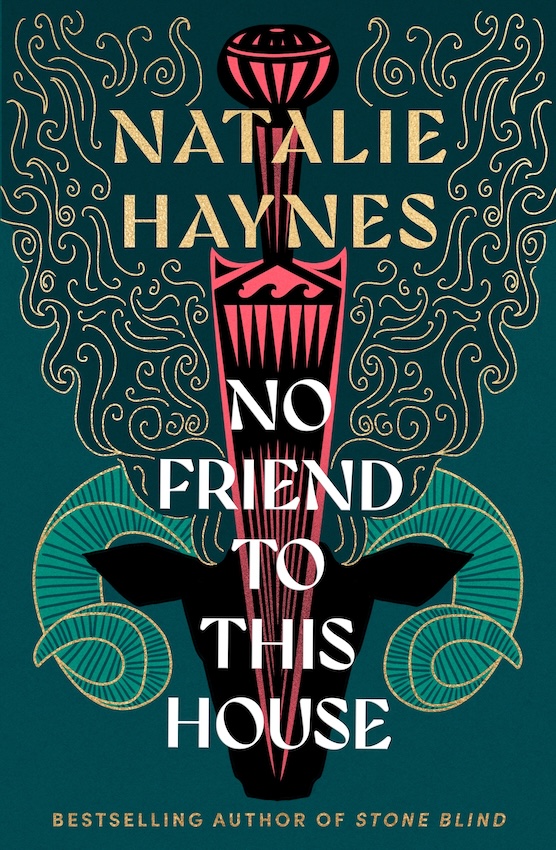
Book Review: Stone Blind by Natalie Haynes – an imaginative recreation of the Greek myth of Medusa

Since Madeline Miller’s Song of Achilles, it seems there’s been a growing number of authors turning to classical mythology for inspiration. And it’s no wonder, because the stories of the Ancient Greeks and others are just so engaging.

A cluster have concentrated on the battle of Troy and Odysseus’s subsequent wanderings, while here we have Natalie Haynes’s narrative around the famously hated Gorgon, Medusa. She deserved to have her head cut off, right, turning all those mortals to stone with a single glance? In slaying her, Perseus was a great hero, wasn’t he?

Maybe not. Stone Blind takes us back to Medusa’s birth and her arrival on a rocky shore to be cared for by her Gorgon sisters, Sthenno and Euryale. These two are tusked creatures with snakes for hair, powerful claws and wings that make them swift in the air after their prey. But Medusa is a mortal baby they need to learn how to care for. She has a human form apart from tiny wings and can’t chew carcasses and crunch bones. The sisters keep sheep to feed the baby milk, and learn to make bread.

The three make a loving family, and Medusa grows into a beautiful girl, who attracts the interest of Poseidon, god of the sea. Meanwhile, in another kingdom, a beautiful princess is kept in a dungeon by her father. It is told that Danae will bear a son who will kill King Acrisius, so the king isn’t taking any chances. But what can he do against Zeus, king of the Olympian gods, who breaks into Danae’s cell as a shower of gold. The offspring of this encounter will be Perseus, and how he survives to fulfil his destiny is an interesting strand to this story.

And in the kingdom of Ethiopia there’s the story of Andromeda, another beautiful princess, but without a brother to take over her father’s kingdom is doomed to marry her uncle to secure the royal line. These poor women are pawns in the hands of powerful men; while around humankind and their struggles are the constant machinations of the gods. They’re either like Poseidon and Zeus, raping pretty girls, or they’re bored youngsters like Athene, causing trouble, or perpetually angry like Zeus’s wife Hera, exacting revenge for every slight.

The snakes were patient at first, because they knew no other life. But they longed for heat and light. The cave bored them and they wouldn’t pretend otherwise. They belonged to Medusa and she belonged to them, and they sighed and seethed until she accepted that she could not hide away from the light they craved.

The likelihood of a happy ending for anyone with beauty or an enviable talent seems slim in this world. The ancient Greeks must have suffered many a natural disaster to have come up with such a collection of angry and self-serving gods seeking retribution in so many convoluted ways. And yet they are devoted to them, building elegant temples and beautiful statues, making sacrifices to ward off disaster.

And is a monster always evil? Is there ever such a thing as a good monster? Because what happens when a good person becomes a monster?

Natalie Haynes brings this interplay between gods and mortals beautifully to life, weaving in all the different strands that interconnect the stories. She makes use of the classical Greek chorus which creates some interesting narrative voices: Panopeia the sea nymphs; Elaia, the olive trees; even Herpeta, Medusa’s snakes. There are a lot of plot strands to keep track of and quick switches between them, so the reader has to keep their wits about them. Fortunately, there’s a list of characters at the beginning which I referred to many a time.

The story is an old one, but in Stone Blind it’s very fresh with some deeper meditations on what makes a hero and what makes a monster. I embarked on the novel wondering how I would feel about the character of Medusa, thinking it would be difficult to follow an anti-hero’s journey to her messy end. But Haynes handles it well, creating empathy, and the story never flags. I’m glad I picked this one up and am keen to read more mythological retellings, and more by Haynes. Stone Blind was long-listed for this year’s Women’s Prize for Fiction and gets four stars from me.

Book Review: Ariadne by Jennifer Saint – an enthralling read based on Greek mythology

Since Madeline Miller’s hugely successful novel, The Song of Achilles, published in 2011, fiction based on ancient myths, has been popping up, almost spawning a whole new genre. Miller continues to write terrific books like this – I can’t recommend Circe enough – and acclaimed author Pat Barker has veered away from her 20th century war fiction to produce two novels (so far) about the women of Troy. Ariadne is the first novel by Greek myth enthusiast, Jennifer Saint. 

I have long been fascinated by the story of the Minotaur and how Theseus defeated it with the help of King Minos’s daughter, Ariadne. If you recall, the Minotaur was a monster, half bull and half human, with a voracious appetite for human flesh, sequestered in a labyrinth devised by Daedalus, a kind of Leonardo of his day. In the novel, Minos, King of Crete, was becoming unpopular with his people for feeding miscreants to the beast, but happily found another food supply: a tribute from Athens, which Minos had brought to its knees in battle. 

So every year, seven young men and seven young women, teenagers really, would be shipped from Athens then flung into the labyrinth for the Minotaur to hunt down in the dark and well, you can imagine the rest. Theseus, long estranged from his father, the King of Athens, returns to find his city in mourning for the new harvest about to take place and volunteers as one of the selected victims. He’s keen on vanquishing monsters and thinks he can outwit the Minotaur, if only he can find his way in and out of the labyrinth. Ariadne, drawn by his princely bearing and general good looks, offers to help.

Such an exciting story, but that is barely the half of it. Jennifer Saint weaves a yarn around Ariadne and what happens next. How Theseus left her on the island of Naxos, instead of taking her back to Athens as his bride. It is also the story of Phaedra, Ariadne’s thirteen year old sister, similarly smitten with Theseus. While Ariadne is rescued by Dionysus, the god of wine and good times, Phaedra becomes a bargaining chip between the kingdom of Crete and Athens.

The women in this story are rarely able to steer the path of their own lives, caught up in the political aims of the powerful men around them. So even though Ariadne and Phaedra are the grandchildren of the sun god Helios, and as such have remarkable beauty, they are victims of circumstances again and again. Meanwhile the gods, particularly Zeus, and his bitter and jealous wife Hera, toy with the mortals of the story, and even lesser gods like Dionysus.

The gods do not know love, because they cannot imagine an end to anything they enjoy. Their passions do not burn brightly as a mortal’s passions do, because they can have whatever they desire for the rest of eternity. How could they cherish or treasure anything? Nothing to them is more than a passing amusement, and when they have done with it, there will be another.

It all makes for a gripping retelling of the myth, adding character to the main players – the motives and desires, weaknesses and blindness to the truth. In other novels, you often shout at the characters, ‘Oh, no! Don’t do that!’ Or even ‘Look out, behind you!’ But here, it wouldn’t matter how aware the characters were, the gods are always out to get them, pawns in their constant one-upmanship with other gods.

While there is much tragedy to the story, the novel is still very entertaining, creating an imaginary world that is a joy to the senses, whether it is Dionysus’s island with its maenads and feasts, or the opulent world of the palaces in Crete or Athens. We even get a chance to check out Hades.

Ariadne is well worth picking up, a welcome addition to a growing sub-genre of mythical retellings, with four out of five stars from me. Saint’s second book, Elektra is definitely on my must-read list. Another book by Saint, Atalanta, is due for release later this year, while I’ve also got my eye on Ithaca by Claire North. So much to enjoy.