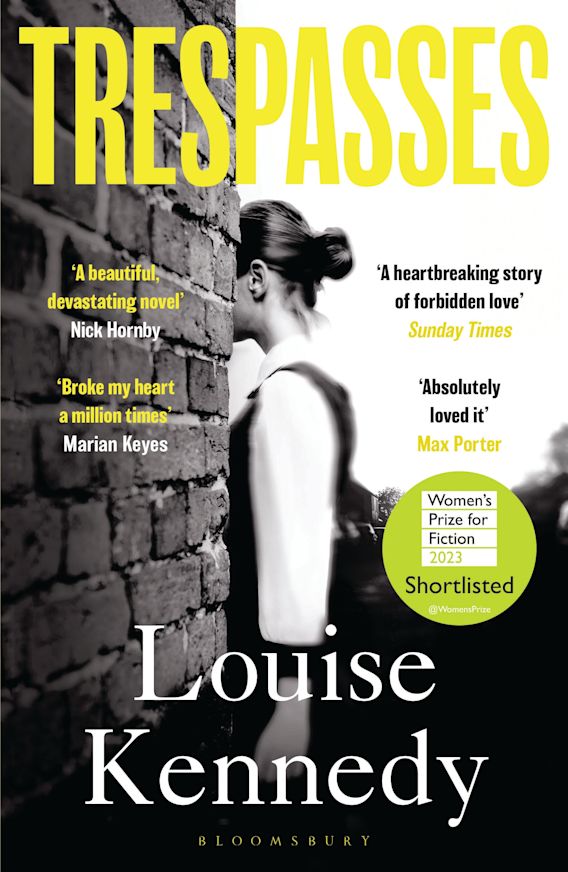
Book Review: Trespasses by Louise Kennedy – a novel about love and war, and crossing the line

I had previously picked Trespasses up a couple of times but moved onto something else. I knew I wanted to read it, but I kept thinking it could never be as good as Milkman by Anna Burns, which is similarly set in Northern Ireland. Then I downloaded it as an audiobook and am so glad I persevered.

Trespasses is set in a town on the outskirts of Belfast in 1975, so we’re well into the time of the Troubles, with sectarian violence a common phenomenon. Cushla is a young school teacher at a Catholic school who moonlights at her family’s pub. It is here that she meets Michael Agnew, an older, married man, also a barrister as well as being a Protestant. So many red flags.

The two begin an affair and Michael introduces Cushla to some of his friends who are learning to speak “Irish” and Cushla being fairly fluent agrees to help teach them. All the while she is self-conscious among these people – that she stands out for her youth, for being a Catholic. But Cushla keeps Michael a secret from her family, her alcoholic mother, her brother who runs the pub. It would only infuriate Eamonn and bring disrepute on them all. She would most certainly lose her teaching position.

Cushla is the story’s narrator, and her voice has that resigned self-awareness of her predicament, not just the affair, but of the difficulties of being hopeful in a country torn apart by violence. Where at any moment, British security forces might descend on a social gathering looking for Republican insurgents, or stop cars at a roadblock and cause their owners varying kinds of inconvenience. To say nothing of car bombs and random shootings and other acts of violence.

Another thread to the story is Cushla’s world as a teacher and her looking out for young Davy McGeown, one of her pupils. His home life is a constant struggle, with a parent from each side, an out of work father and neighbours who make their life hell. Through it all, Davy is bright and cheery and Cushla is drawn to help the McGeowns, in spite of the disapproval of others.

Before lessons they did The News. Cushla hated doing The News, but the headmaster insisted. He said it encouraged the children to be aware of the world around them. Cushla thought they already knew too much about the world around them. Davy stood up, always the first to volunteer. His red jumper was dark with damp at the shoulders and neckline.
There was as bomb in Belfast, he said.
He says that every day, said Jonathan, who sat beside him.
Well, today he’s right. Thank you Davy, said Cushla.
Jonathan got to his feet. It wasn’t in Belfast, he said. A booby-trap bomb that was intended for a British Army foot patrol exploded prematurely, killing two boys near the border. They died instantly.
Booby trap. Incendiary device. Gelignite. Nitroglycerine. Petrol bomb. Rubber bullets. Saracen. Internment. The Special Powers Act. Vanguard. The vocabulary of a seven-year-old child now.

The two story threads will eventually become entangled and the reader has a sense of impending doom. Well, there’s always impending doom in any novel set during the Troubles, isn’t there? It’s a bit like Chekov’s gun. And Cushla seems to take such a lot of risks. You can’t help but admire her for her determination to do what’s right by people. Michael too, with his sympathies for young men pulled in by the security forces on flimsy evidence, his attempts to help them. They are both crossing the line and some sort of reckoning seems inevitable.

This is an engrossing read with vivid and memorable characters. The banter between Cushla and her alcoholic and sentimental mother, her brother who’s trying to save the pub, the old codgers who never miss a session there, the kids at the school. The dialogue is terrific, and really comes alive as narrated by Brid Brennan who reads Davy particularly well. I’m glad I rediscovered Trespasses – the book was shortlisted for a bunch of awards, including The Women’s Prize for Fiction, and it’s easy to see why. It’s a four-star read from me..

Book Review: Home Stretch by Graham Norton

I listened to Home Stretch as an audiobook, and this is a terrific option in this case as the book is read by the author. Graham Norton has a warm and vivid reading style – he has the kind of voice that sounds friendly and the humour never seems all that far away, even when the plot takes a serious turn. Which it does quite often.

The story concerns young Connor, who is caught up with a bunch of local teenagers on the eve of a wedding, tagging along on a trip to the beach. He’s the son of a publican in one of those tiny Irish coastal towns where everybody knows everybody and there’s no hiding any secrets, or so we might suppose. When the car crashes and three are killed, including the bride and groom, another girl left fighting for her life, Connor carries the shame of being the driver responsible.

After the court case, Connor is sent to Liverpool to work for a cousin’s building business and sets out to forget his family, his town and all that has gone on before. But Connor has another secret – he is gay – something he has never been able to mention to his family; this is 1987 after all. When fate conspires to send Connor to London and later to the US, it seems like he can never go home.

The story weaves between Connor’s and that of his sister, Ellen, rescued from shame by Connor’s fellow crash survivor, Martin, the doctor’s son. Martin seems to be the white knight, dazzling Ellen with thoughts of new beginnings. Things don’t quite turn out for Ellen as she may have hoped, and eventually the past will come back and secrets will emerge. Can Connor ever make his way home again and find acceptance in his family?

The story switches between viewpoints and jumps through the decades to the time of the referendum that voted for legalising gay marriage in Ireland. Even Connor’s dad put up a ‘vote yes’ poster in the pub, so the book mirrors changes in society as well as several dawning realisations among the main characters. I felt this was perhaps a more personal story from this author, and it is easy to imagine Norton weaving in some of his own experiences and insight about the gay scene and the shifts in public perception over time.

My only reservation was that sometimes we seem to be fairly galloping through the years and I could happily have stayed awhile longer here and there. But at least this keeps the reader hooked on the story, wondering if Connor will ever make it home to face the past. The book is told with very real feeling and any parent will relate to the fear of never seeing their child again. Norton has such a deep empathy for his characters, even the ones we are not supposed to like are not painted entirely black – there is understanding for them as well.

I loved the dialogue which is very real and lively – Norton having a keen ear for the way people express their personalities in speech. And then there’s the humour, just twinkling away in the background, caught in the banter of characters’ interactions, the way they perceive themselves, the foolishness of youth, the misunderstandings. Home Stretch is a heartfelt and entertaining read, and I thoroughly recommend the audiobook version and Graham Norton’s splendid performance. A three and a half out of five read from me.

Book Review: Silent Voices by Ann Cleeves

I wasn’t going to read the Vera Stanhope novels by Ann Cleeves – they’d been so good on television, and surely I’d know all the endings. I’d forgotten that it doesn’t really matter when it’s good writing and the characters are interesting, which is most certainly the case here. And in the end I couldn’t remember this story after all.

Silent Voices begins when a body is discovered at a leisure centre. Chief Inspector Vera Stanhope doesn’t spend a lot of time at her gym, and there’s no way she’d let on to her sergeant, Joe Ashworth, that she even has a membership. But when she discovers a murder victim, strangled in the sauna room, she has to call it in. Nobody recognises the attractive, middle-aged woman in the sauna, but the wallet in her locker leads Vera to a cottage in a coastal village and the victim’s eighteen-year-old daughter.

Hannah has no idea why anyone would want to murder her mother, Jenny Lister, a social worker who seems to be in every way a good, kind person. It is fortunate that Hannah has her fiancé, Simon, nearby to stay with her, as she has no other family. But ex-social worker Connie is shocked to discover Jenny had lived in the same village. Both had worked closely together until Connie made an error of judgement and a young child was drowned in the bath by his mother. Connie lost her career and has always thought Susan sold her down the river.

Cleeves brings in a number of other connected characters: the smooth-talking alternative therapist who works at the leisure centre; Danny the student who cleans there at night; Simon’s snooty mother Veronica who for some reason has made Connie’s life a misery. It is a rich and diverting plot, peopled with a cast who each have axes to grind, or complicated pasts.

And that doesn’t include the police. Vera Stanhope, is a wonderful creation with her distrust of social workers and anyone who is too obviously nice; her jealousy of Joe’s time and family commitments – she’s altogether lacking in family herself. There’s smart and ambitious Holly and sad-sack Charlie who is only just holding it together – fortunately Vera knows what he’s good at and leaves him to it.

Meanwhile, there is the sense of a storm brewing, reflected in the wild, coastal weather of Northumberland, which adds a ton of atmosphere. The story illustrates so well that anybody can have a dark episode in their history that might just lead them to murder. It’s what this kind of crime fiction is all about and Cleeves pulls it all together really well to create a satisfying read building to a superb ending.

I listened to this as an audio book and loved the gentle and nuanced reading by Janine Birkett. I think the Geordie accent could become a favourite. Four out of five from me.

Lockdown Listening 1: I Found You by Lisa Jewell

Lisa Jewell writes a good page-turner, often combining psychological drama, secrets and vulnerable characters. I Found You begins when sole parent Alice Lake finds a man on the beach below her house in the fictional seaside town of Ridinghouse Bay. Alice is prone to poor decision-making, often taking in waifs and strays and has three children by three different fathers, none of whom were Mr Right – mostly patently Mr Wrong.

She is one of those scary women the locals don’t like much – a Londoner (this is Yorkshire), she’s loud, her children often late for school and then there are all the dogs. When she finds Frank (they have to call him something) sitting on the beach in the rain, she ignores the misgivings of others and gives him a room – just for the night – sure his memory loss is just a temporary thing.

The story flips to that of Lily Monrose, whose husband hasn’t come home from work. You can usually set your watch by him. And what happened to all the adoring texts he sends when he’s on the train from London to their flat in Surrey? He seems to have vanished into thin air. When she goes to the police, Lily doesn’t get a lot of interest – she’s from Kiev, and she and Carl have only been married a few weeks after a whirlwind romance. Lily knows so little about his background and things look bad when Carl’s passport turns out to be false.

The plot also flips back in time to 1993 and a family summer holiday. Gray is seventeen and suddenly aware of how his sister, Kirsty, a lanky fifteen year old, seems to other men. When posh Mark takes an interest in them, Gray’s family are charmed, but Mark’s attraction to Kirsty sets their holiday on a course for disaster.

I Found You is told in short chapters, switching between these three perspectives, slowly filling in the gaps, as glimpses of Frank’s memory begin to appear. Each chapter ends in a cliff-hanger, so you keep reading as more secrets are revealed. The characters are varied and well-rounded, and Alice, who is oddly optimistic for someone struggling with a lot of difficulties, is an engaging heroine. Memory loss in fiction can so easily seem a convenient and even hackneyed plot device, but Jewell makes it believable here. As usual, she is a safe pair of hands for an escapist read.

I listened to the novel as an audiobook and really enjoyed the rendition by Antonia Beamish, who managed a wide range of voices and accents with aplomb. A four out of five read from me.

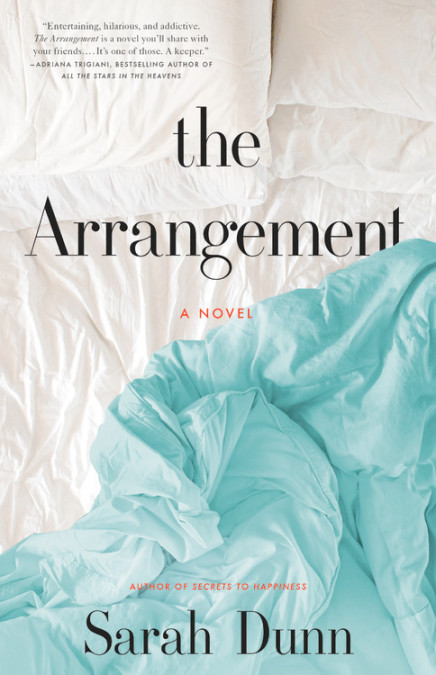
Audio Review: The Arrangement by Sarah Dunn

The Arrangement follows the lives of happily married but struggling Owen and Lucy, two New Yorkers who have moved out of the city to small-town Beekman. Here they have become ensconced in the local community – helping out at the school, fundraising, barbecues with friends, and gossip. They have a son, Wyatt, who’s on the autistic spectrum and that means Lucy is always tired and it’s hard to find a caregiver for a bit of respite.

When friends over for dinner, and quite a bit of wine, reveal they are planning an open marriage, Owen and Lucy balk at the thought. Somehow the idea festers and the couple agree to give the concept a trial of six months. Something to nip any wandering thoughts in the bud and make them a stronger, happier couple, right? What could possibly go wrong?

Here’s what I liked about the book:

  • The novel is very funny. It captures all the silliness of modern life – the keeping up with the Joneses, the guilt trips over daft things, the pretensions and fads.
  • The characters of Owen and Lucy are very believable and likeable. Their relationship seems strong. But the result of the ‘arrangement’ is that Owen behaves like a young bloke having a final fling/s while Lucy runs the risk of falling in love with someone else. Well, what do you know?
  • There are some very funny supporting characters: Izzy, Owen’s bat-shit crazy girlfriend who becomes more and more demanding; Sunny Bang, Lucy’s tell-it-like-is Korean friend who finds Lucy a ‘partner’; the billionaire with the trophy wife who forgot to have her sign a pre-nup; the hefty beekeeper who sat on a small dog while on a date – an event which caused him to vanish and change his life entirely.
  • There are some hilarious scenes: such as when Owen is caught depositing Izzy’s used plastic bags at the supermarket recycling bin by a sanctimonious neighbour and has to pretend they are his; a blessing of the animals at church when a dog monsters one of Wyatt’s chickens and the llamas bolt into the churchyard.
  • The natural dialogue and its snappy New York ring.

“I think it’s a huge myth that women can’t have meaningless sex,” said Victoria. “You should see these millennials in my office. All they do is have sex, all the time. The girls, the guys. They’re not worried about getting AIDS or getting pregnant or being called a slut. They’re all vociferously opposed to slut-shaming in any form.”

“Slut-shaming?” Owen asked, rotating the cheese plate and slicing off a hunk of Jasper Hill cheddar.

“Yeah,” said Victoria. “It’s a thing.”

  • The reader Ellen Archer has done an amazing job of giving life to all the characters and making them sound different without sounding ridiculous. Men and women alike. I really loved her Sunny Bang. I am not sure I would have enjoyed the novel nearly so much if it wasn’t for Archer’s performance. I imagine if I read the book in print form, I would be looking at a three-star read, maybe three-and-a-half; as an audio-book, it happily earns an extra star. Another reason to give audiobooks a go.

The Charm of Being Read To

y648 (1)Recently I discovered audiobooks. I had previously discounted them because of time. Someone reading to me out loud means the story will take so much longer. And that’s still true. But then again, what’s the rush?

Our library is running a winter reading challenge for adults called Turn Up the Heat. One of the challenges is to read a book in a format you wouldn’t normally choose, and having read loads of print books, ebooks and even a few graphic novels, I thought I’d bite the bullet and opt for an audiobook. I downloaded a Charles Todd mystery from the library website onto my phone (which was fairly painless using the Libby app) plugged in my earbuds and off I went. Literally.

I went off for a walk, I went off to hang out the washing, I went off to prune the roses, and I went off to clean the kitchen and the bathroom. I accomplished such a lot over the weekend and ‘read’ a book at the same time. This was a revelation. Continue reading “The Charm of Being Read To”