Book Review: Shadows of Winter Robins by Louise Wolhuter – a tense, dark, twisty story full of family secrets

Shadows of Winter Robins is psychological suspense with a big emphasis on the psychological. Our main character, Winter Robins, is in therapy for something she did that was at best misjudged, at worst a chargeable offence. The therapist encourages Winter to dig deep, and soon we’re transported to a council house in Harrogate, 1994, and Winter’s childhood. There’s a twin brother Four (he’s the fourth in his line to take the name Lewis), and loving parents, Nancy and Lew. But when Nancy dies, Lew falls apart, and though she tries, Gran is just too old to manage.

Lew writes to Nancy’s family in Western Australia and an uncle they’ve never met arrives to bring Winter and Four home with him. Although the children quickly enjoy time with their uncle, who has the nickname Dog, it’s a heart-breaking wrench, but the possibility of an idyllic childhood is obvious. Grandfather Harry is a successful artist and lives with their grandmother on the coast, off the beaten track. So there’s the beach to enjoy and fresh air and good food. Such a change from England. There’s also the housekeeper’s boy, Gabe, the same age as Winter, who is friendly too.

But there’s a darkness to Harry – he has a temper and is domineering, and rarely kind to the children, or his wife. His housekeeper is obviously more than a housekeeper and so there’s tension, while Dog is always in and out of trouble. Terrible things happen here, and the freedom the children enjoy is tempered by a loss of innocence.

The story follows Winter’s time at the beach house, before being sent to live with an aunt to attend school. These scenes weave in and out with the sessions two decades or so later with her therapist, as well as the discovery of what really happened at the beach house. Why did Dog have to leave in such a hurry? And why did the police arrive soon after? There’s an abundance of secrets and twists before you turn the last page and some shocking revelations, going back to the time Robins’s mother escaped to Europe with her best friend, Jan.

Louise Wolhuter has written a chilling but also gripping story that keeps you guessing until the end. There seem to be endless secrets that turn what we know on its head, again and again. It’s well written, too, with evocative prose, complex characterisation and an emotional pull. Underpinning the story is the notion of nature versus nurture, as Robin can’t help but worry about the kind of family she has been brought to live with, a family that can be cruel and morally dubious. The possibility of violence never seems far away.

Shadows of Winter Robins is a very clever thriller, but you might need a more cheerful read afterwards, as it left me with a chill down my spine. Even so I’ll be interested to see what the author comes up next. This one’s a four-star-read from me.

Book Review: Stone Town by Margaret Hickey – atmospheric outback noir and a new case for our troubled cop

This book is the second of Hickey’s books featuring Detective Senior Sergeant Mark Ariti, whose life was going nowhere in the first book, Cutter’s End, until he was rescued by a case that took him back to where he lived as a boy. Now he’s living in his late mother’s house in Booralama and has taken charge of the local police station with a wider region of small towns to look after. This is rural Australia, north of Adelaide, and Mark soon has a new case, bringing us to the small town of the title.

Mark is called out on a night of torrential rain. Three teenagers have discovered a body on land that was once mined for gold, now popular with bird-watchers. But what was Aidan Sleeth doing, wandering about at night, some distance from home. A property developer, he’d been buying up land to turn what was a haven for wildlife into sections for new homes and making enemies along the way. Which might be why he’s been shot in the head, execution style.

As it often goes in these country towns, no one wants to talk about it. The teenagers are too upset, their families protective. The neighbours are reluctant to get involved. Whether Mark likes it or not, two detectives are sent from Adelaide to help with the case, both in their own ways arrogant, the senior detective taking over his office, the junior detective making brash comments that jar. And they’re more worried about a missing officer than the murder they’re supposed to be investigating.

Detective Sergeant Natalie Whitstead has been doing surveillance work on the wife of an organised crime boss, Tony Scopelliti, currently serving a sentence in prison. When her car is discovered near Stone Town, Mark can only assume she’s dead, her body thrown down a mineshaft. Brief chapters in italic type would suggest otherwise, making the reader feel like a child calling out at a Punch ‘n Judy show, “she’s over here” and hoping the police will find her in time.

Of course the two cases will at some point converge, and Mark, an experienced and sensible officer, will show up the Adelaide cops, who turn out to be more complex characters than first assumed. If that isn’t enough, his old mate Superintendent Conti has warned Mark that there’s a leak to suggest one of his new colleagues is getting information back to Scopelliti. Can Mark keep an ear out?

So Mark has a lot on his plate. To make things more interesting, he’s going through a few personal issues: missing his kids since his divorce, grief for his late mother, as well as that feeling you have when you’re over fifty and back at your childhood home – a sense that life has passed you by. As a reader you can’t but like the guy but also you worry about him.

What I really liked about the story was the way Hickey captures rural life, particularly the old allegiances among people who have grown up in an area and unfortunately for some, know all their secrets. Wherever Mark goes, people fondly remember his mother, a woman who was close friends with fellow members the Country Women’s Association, who to many seem to have a strong say on how things are done. Mark’s interactions with these women and other crusty characters, particularly at the pub, often add to the gentle humour that runs through the story.

I thoroughly enjoyed Stone Town, and will definitely be keen to check in with Senior Sergeant Ariti again. Hickey has written three in the series as well as a couple of stand-alone titles. If you’ve enjoyed other Aussie Rural Noir authors such as Jane Harper, Garry Disher and Sarah Bailey, Margaret Hickey is well worth giving a try. Stone Town is a four-star read from me.

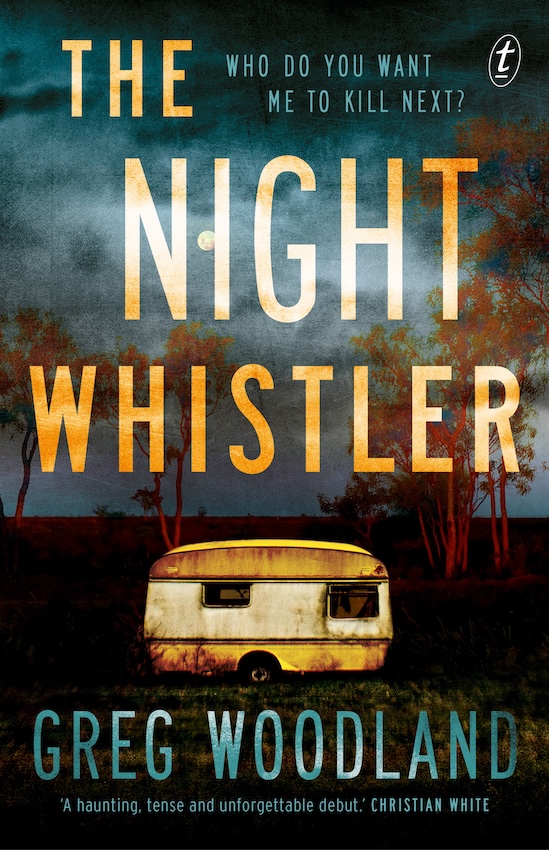
Book Review: The Night Whistler by Greg Woodland – a new cop in a small town that’s simmering with secrets

Readers of these posts will know that Aussie Noir is one of my favourite sub-genres. Having recently read Greg Woodland’s debut crime novel, I am pleased to have discovered what looks like a promising new series. The Night Whistler has all that readers have come to enjoy about Aussie Noir: an evocative, rural Australian setting; small town secrets; and a cop that’s up against it. Set in the 1960s, the story evocatively conjures up the era – the music, the social order plus the edgy restlessness of a long, hot summer.

Mick Goodenough (pronounced like “no-good” backwards, as opposed to “good enough”) has been sent to Moorabool, a smug little town that’s something of a culture shock. A former Sydney detective, he’s been busted down to the rank of Probationary Constable after a case went horribly wrong. Falling foul of his superiors and with a drinking problem that has cost him his marriage, Mick has hit rock bottom but, fortunately, it seems, you can’t keep a good cop down.

The narrative alternates between Mick’s story and that of twelve-year-old Hal, similarly a new kid in town, along with little brother Evan. The two boys are investigating a creek near their house when they come across the body of a mutilated dog. The boys are understandably upset, but go on to give the animal something of a burial, little knowing that the dog is one of a string of such killings that the police won’t take seriously. That is until Mick Goodenough recognises the traits of a perpetrator that will likely take a more serious turn. When the dead dog turns out to be Mick’s, it only spurs him on.

While there’s a killer just getting up steam, Mick is having to deal with arrogant Sergeant Bradley who is wary of Mick’s city cop ways, and lords it over his team. This includes a fellow Probationary Constable who sucks up to Bradley and world-weary Senior Constable Bligh, who becomes an unexpected ally. Meanwhile Mick is desperate to see his teenage daughter again, if only his ex-wife will agree to send her down on the train.

Hal’s father is the bright new spark at Prime Foods, which is why the family have moved to Moorabool. He’s got a fancy new car and wandering eyes. At the Prime Foods Christmas Picnic, we see a microcosm of the town, the braying and overbearing Mayor Dianne Curio, and her bombastic husband, as well as the racism carelessly handed out to Jenna, a young Aboriginal woman who is friendly to Hal and his mother.

Finding the dead dog sets Hal on a mission to uncover the killer – he’s been reading Sherlock Holmes. He gets a hand from young Allie, an Aboriginal girl who teases him relentlessly but shows him how to fish for yabbies in the creek. The two make a great pairing, but obviously they are soon going to be out of their depth. Worse still, Hal’s mother begins getting nuisance calls from someone whistling “Are you lonesome tonight” and making threats. Sergeant Bradley ignores her call for help, even when Mick suggests this isn’t just a snowdropper.

Greg Woodland quickly creates a simmering sense of menace as the story builds towards a gripping ending. But there’s also plenty of banter between Hal and his brother and with Ally, between the kids and their parents and other adults that adds some humour and light relief. Then there’s all the pressure on Mick: the pressure not to probe too much in a town where it pays not to ask too many questions.

For a debut novel, The Night Whistler is expertly constructed, the characters well drawn and interesting, while bringing the setting, both time and place, to life. But we shouldn’t be surprised. Greg Woodward is an experienced screenwriter with a bunch of award-winning films under his belt. The second book featuring Hal and Mick, The Carnival Is Over, is already on my ever-growing list of must-reads. The Night Whistler, excellently narrated by Nic English in audiobook format, is a four-star read from me.

Book Review: Body of Lies by Sarah Bailey – a riveting crime novel packed with surprises

I’d given up hope of another Detective Gemma Woodstock novel so was ecstatic to see this one come out earlier this year. If we’re talking Aussie Noir detectives, I might have to put Woodstock ahead of Jane Harper’s Aaron Falk (The Dry; Forces of Nature; Exiles), Woodstock scoring points for instinct, putting two and two together, feistiness and courage. If only she could get her life together.

But in Body of Lies, it seems Woodstock is at last doing well on the home-front. She has recently returned to her hometown of Smithson – she’d escaped it after the first book, lived dangerously for a time in Melbourne, but with a new relationship going well, she has come back to her old job. Gemma wants to be a good mother to her son, and has a new baby, but with the help of Mac, the man best pal Candy says is a saint, it all looks fairly promising.

Gemma’s still on maternity leave – Scarlett is just nine-months old – when she becomes caught up in a crime. Her dad’s had a health scare, so Gemma is at the hospital when the lights go out and a body is stolen from the morgue. But even before that, we’d had a white-knuckle scene with a car being chased off the road – the somewhat inebriated witness says it’s murder and so do the forensics. A murder and a stolen body before page 20!

Gemma is like a bloodhound, her detective nose is twitching and she wants in on the case. Jonesy, her old boss, is keen to have her help, as they’re short-staffed. But she’ll have to answer to DS Everett who finds Gemma pushy and inclined to do her own thing. Gemma finds Everett lacking in imagination and reluctant to share information. They’re going to have to work as a team but for a chunk of the book that seems unlikely to happen.

I’m halfway through Monday’s points when I smell Everett, a woody cologne that doesn’t fit with the musty aroma of the office. He stands in the doorway in an expensive suit, and not for the first time I wonder what led him to leave Melbourne and take a role in Smithson. It’s rare that a senior detective relocates to a small town mid-career. Smithson has become more of a drawcard in recent years, but in my experience, city cops only give up their plum metro roles when a problematic personality is being off-loaded or – like in my situation – when someone wants a fresh start due to personal reasons.

The body stolen from the morgue has yet to be identified, and that is surprisingly difficult in a town where everybody knows everybody. Before long the plot is complicated by the discovery of a newborn baby in a park by the lake, and then there’s another murder. Are the crimes all connected? Meanwhile Gemma is making a hash of juggling work and home life. Mac is busy on his own cases, and Gemma can’t help feeling there’s something he’s not telling her.

I always enjoy Gemma Woodstock as she’s such a determined police officer, as well as a thorn in the side to those in authority. She takes a lot of risks and stirs up a lot more trouble for herself, so you know that she’s going to put herself in harm’s way at least a couple of times before the end of the book. And so it is here, the plot racing away with some revelations you would never guess at and a thrilling, action-packed ending. Her relationships with new colleagues take some surprising and interesting turns too, making for a well-rounded and satisfying storyline.

This will probably be the final book in the series, which is perhaps a shame, although it would be nice for Gemma if life settled down a little for once. I’ve enjoyed her way of thinking, her banter with Candy the journalist and the avuncular Jonesy. But I’m sure Sarah Bailey has more exciting stories up her sleeve; perhaps she has a new detective waiting in the wings. Body of Lies is a four-star read from me.

Book Review: Cutters End by Margaret Hickey – a gripping new Aussie Noir series with a troubled cop

It’s hard not to pick up a book with a cover showing a dry Aussie outback setting. Those small towns in the rural backwaters of Australia just seem to seethe with all kinds of tension. Broken hearts and lost dreams, the struggle with a harsh environment wearing people down, young people abandoning home for the cities. You can’t help wondering if the author will be the next Jane Harper (author of The Dry).

With Cutters End, we’re in opal mining country, an industry on its last legs, the kind of place you pass through on the Stuart Highway heading north to Alice Springs. It’s also the place where a local hero and father met an unexplained death, discovered trapped beneath his vehicle and apparently burned to death. Back in 1990 this was explained as an accident at the inquest, but Suzanne Miller, a TV host with a flagging career, says it’s time for a reinvestigation. Michael Denby saved her and her mother from floodwaters when she was a small child and he deserves better.

DS Mark Ariti, similarly with a flagging career, is on leave when his superior officer discovers that he knew one of the witnesses at the time – one Ingrid Mathers who Mark dated at high school. Mark’s bumped up to Acting Inspector and sent to re-interview Ingrid and to see if he can jog her memory about the days around New Year 1990 when she was hitchhiking with her friend Joanne. But Ingrid’s not very forthcoming, although the reader has the inkling that she’s got a secret or two.

Mark catches up with Joanne, now living the high life in Sydney, similarly reticent. Why don’t the two women talk to each other any more? More clues pull Mark back to Cutters End, and the Mendamo Roadhouse, once owned by creepy Gerald, where Ingrid hitched a ride with somebody called Ron or Don. He bounces ideas off his new sidekick, DC Jagdeep Kaur, and picks up gossip at the three rather disappointing pubs in Cutters End.

Finally, Cutters End. The Stuart Highway a blade cutting through the centre of town, railway line alongside it like a rival sibling. Two main streets, a petrol station, the town hall, council offices, a supermarket, dingy motel, a primary school and, in the back streets, houses with sad facades and secret interiors.
The opal mining boom was bust, had been for decades, and although the welcome sign read ‘Cutters End, a town on the move!’ Mark doubted it. This town, like many across the country, had the look of a dying dog waiting to be shot. But still, he knew too well that dogs don’t die easy – those pleading eyes, that sense of loyalty and long history. The faded pride of what they once were.

When the woman at the service station where you get the best coffee in town tells Mark to find out about the two missing girls, the story goes in an interesting new direction. More than a couple of young women seem to have disappeared from the area, all of them hitching a ride and chancing their luck with whoever picks them up. Did they just move on and then take off overseas without letting anyone know? Build a better life? Or is there a more sinister explanation?

The story is peppered with interesting local characters: John Baber, the kindly ex-school teacher turned van driver who local businesses rely on for deliveries; mentally damaged Foobie who takes inappropriate pictures of people and becomes a source of useful information; Sergeant Darryl Wickman, the town’s long-serving police officer who has a way with the townspeople and a wise-cracking relationship with Jagdeep.

But it’s the undercurrent of evil so typical in these stories that has you on edge. The ugly circumstances of Denby’s death, the casual misogyny and disregard for vulnerable young women, the tight-lipped attitudes of the locals. Mark is struggling to make headway in all directions, either with his case or in his marriage, and like so many cops in these sorts of novels, never seems able to say the right thing.

There are evocative reminders of the time, not only the terrible haircuts and ugly sweaters, but also the real-life backpacker murders in New South Wales and the serial killer Ivan Milat. These crimes happened around the same time that our fictional Denby was killed. They conjure up all kinds of thoughts and feelings around how we protect our young people from predatory behaviour, about violence against women and whether anything much has changed for the better.

Cutters End is the first in a series about troubled cop, Mark Ariti. It’s a terrific read if you enjoy authors like Jane Harper, Garry Disher, Chris Hammer and Sarah Bailey, and a welcome addition to the genre. There are a couple more to look forward to (Stone Town and Broken Bay) with The Creeper out later this year. Can’t wait. Cutters End is a four star read from me.

Book Review: Exiles by Jane Harper – Aaron Falk is back in an atmospheric new mystery

I’ve read all of Jane Harper’s novels. It was possibly her first book, The Dry, that triggered a popular interest in Aussie Noir, giving Scandi Noir a run for its money. For me, it was Jane Harper that got me reading Australian mysteries and I imagine it was the same for many readers. There’s just something special about novels set in the outback.

Since The Dry we’ve had a second Aaron Falk novel – Force of Nature is soon to hit the big screen – and now, a long-awaited third. Exiles sees the Melbourne detective visiting friends in rural wine country for a christening. It’s a bitter-sweet time for Greg Raco’s family. While Aaron is going to be godfather to Raco’s baby boy, nobody can forget what happened at the same time a year ago. The Marralee Valley Annual Food and Wine Festival was on and it was here that Kim Gillespie disappeared, leaving her baby Zoe asleep in her pram.

Kim’s older daughter from her long-term relationship with Charlie Raco, Greg Raco’s winemaker brother, is desperate for answers. Now seventeen, she’s running a campaign, aided by Charlie and her good friend Joel, handing out flyers and canvassing potential eyewitnesses. Aaron, with all his detective smarts, somehow gets roped in.

And there’s another cold case – the hit-and-run death of Joel’s father at the Reservoir, a spot adjacent to the festival grounds, and it’s the Reservoir where Kim’s shoe was found. Is this a coincidence or are the two cases linked? Aaron has the added complication of meeting up with Gemma again, Joel’s mother – someone he’d met through Raco, and who he can’t quite forget.

Even in the gloom Falk could see it stretching out, vast and open in its centre, then twisting and curving to fill the turns and gullies that formed the banks. It was big. Bigger than he remembered. The opposite bank was just visible across the swathe of water, but he couldn’t see the westernmost edge, or the dam that lay somewhere to the east. The festival grounds felt far behind them, but Falk could hear a distant low thrum of music and crowd noise undercutting the stillness.

Emotions are high in this story with two teenagers having lost parents and not having any answers. Aaron’s a bit of a softy and is sympathetic. The story also hearkens back to the events from the school days of Kim and the Racos. Like the current batch of kids from the local high school, the opening night of the wine and food festival was when there was a big party in the woods near the Reservoir, something local cop, Sergeant Dwyer would love to shut down.

There’s a lot going on in each of the characters’ lives, and we slowly get a picture of a community, of complicated loyalties among old friends, old grudges and a fair bit more besides. We haven’t got a dry, scarily hot landscape. But the stunning countryside surrounding the grim spectre of the Reservoir and all its secrets makes for another atmospheric setting.

Add some superb writing, and a twist in the story I didn’t see coming and I’m happy to say that Jane Harper has done it again. Exiles is another cracking read and is satisfying on several levels. I’ve also got a feeling we might see Aaron Falk again – I hope so; he’s a complex and interesting detective. Exiles gets four and a half out of five from me.

Book Review: The Way It Is Now by Garry Disher – old crimes surface in Aussie Noir mystery

I remember when Jane Harper’s stunning novel The Dry hit the shelves and suddenly we all wanted to read more Australian crime, or Aussie Noir as we soon called it. And all the while it seems Australian author Garry Disher has been producing reliably readable and award winning crime thrillers for years. I’d heard of him of course, but this I am ashamed to admit is the first Garry Disher novel I’ve read. At the end of which I could only shake my head and ask myself, what took me so long?

The Way It Is Now is Disher’s latest stand-alone novel. It’s about Charlie Deravin, a police officer on disciplinary leave who has nothing better to do or anywhere else to go but the old family beach house on Menlo Beach. While there’s plenty of surfing and Christmas to think of – his daughter’s visit is something to look forward to – there are reminders of the past at every turn.

The son of a cop, Charlie grew up in a society where the friends who came to family barbecues were other cops. And some of them are still around. But the most haunting thing for Charlie is the disappearance of his mother when he was a rookie policeman part of the team looking for a boy missing from a school camp. Assumed drowned, the child disappeared the same day as Charlie’s mother, a high school teacher who’d just popped home unexpectedly. Her car was found abandoned with evidence of a struggle. Newly separated, many people pointed the finger at Charlie’s dad.

The story weaves Charlie’s memories of the past with his ongoing relationship with his brother who hasn’t spoken to his father since, and his father now ailing but still receiving poison pen letters. There’s also the case Charlie has been suspended from, which caused him to fall out with his boss, but also brought a new love into his life. Anna was a whistle-blower in a case of jury tampering and someone’s trying to silence her. So nothing’s going well for Charlie. As Charlie uncovers the past, two dead bodies are found at a construction site and the police see even more links to Charlie’s dad. But Charlie has seen the toll the unsolved mystery has taken on his father and believes in his innocence. The book becomes a race to prove his innocence while the old man begins to fade.

While the plot is complex and interesting enough, humming along with plenty of suspense, Disher really excels with his characters. Charlie is likeable enough but flawed – the disappearance of his mother niggling in his mind for twenty years. This has put a strain on his marriage to say nothing of his work in Vice. There’re the old-school cops that he bumps onto at the beach, particularly Mark Valente who was like a second father to young Charlie and epitomises the old-boys club of local cops. Minor characters are no less interesting

While Valente seems a benign presence, he evokes a sense of not rocking the boat and keeping the past in its place. Charlie’s brother Liam loathes the man for his homophobic attitudes. Misogeny also lurks throughout the book – his mother’s nervousness around her lodger, the nasty rape case that was Charlie’s downfall, the attitudes to police wives. Disher brings it all to life in a way that seems authentic and adds a tone of menace.

I enjoyed The Way It Is Now as an audiobook, which was superbly read by Henry Nixon and made me feel I was at the beach on Australia’s Victoria coast. Disher evokes the Australian landscape well, so I’m going to see where else he takes me. This books gets a four out of five from me.

Book Review: Resurrection Bay by Emma Viskic – introducing an unforgettable new sleuth

After such a run of historical novels, I was more than ready for a good, meaty mystery and what better than some Aussie Noir. I’d been meaning to pick up the first in this series for a while because I’d read good things and the idea of a hearing-impaired private investigator sparked my interest. Calum Zelic has been profoundly deaf since a childhood illness. Now in his thirties, he’s divorced and running a private investigation company. Mostly it’s small stuff, like the case he’s got now: the theft of cigarettes in bulk from a warehouse.

Caleb is interesting because he pretends he can hear just as well as anybody else, picking up what he can from lip reading, and signing with the people who know him better. And although Caleb has a talent for reading people through their body language, it’s just as well his trusty side-kick, tough-talking ex-cop, Frankie, is there to pick up anything he’s missed. The two create some terrific dialogue as they are always sparring with each other.

When his childhood friend, Gary, is murdered in an unspeakably violent way, Caleb is both grieving and flung into danger. Gary, a policeman, has been helping Caleb with his case – maybe it’s more than just cigarettes going in and out of that warehouse. Before his death he sent Caleb a text warning him about a man named Scott. Next thing you know, Frankie has gone missing, Caleb’s running for his life and turns to Kat, his ex-wife for help. The two hide out in Resurrection Bay, Gary and Caleb’s childhood home.

In Resurrection Bay we get snippets of Caleb’s childhood, and meet Anton, Caleb’s dodgy brother, who has done time for drug-related crime. Anton says he’s turned his life around, but can you ever trust an addict? We have some interesting dynamics between the two brothers, while Caleb still carries a torch for Kat. So with the case and all, he’s a bundle of conflicting emotions.

Viskic has created a pacy crime thriller but what kept me turning the pages was the smart dialogue and quirky characters. Caleb is constantly on the receiving end of a pasting, but somehow manages to keep going. He plays a cat and mouse game in several nail-biting scenes, and unable to rely on sounds, uses his remaining senses tuned up to the max. This makes for some very dramatic moments all the while propelling Caleb to a gritty showdown and a few twisty surprises.

My only gripe was that the ending just seemed to be a little too much – the violence and the twists. A little over-egging of the pudding perhaps. Although this is probably not uncommon in this genre and the book has garnered a bunch of awards. Overall, Resurrection Bay is a great start to a new series, and I will be happy to check out the next books because Caleb is such a brilliant creation. I even developed a hankering to learn sign language. This book gets a four out of five from me.

Book Review: The Van Apfel Girls Are Gone by Felicity McLean

Felicity McLean’s debut novel novel has been described as The Virgin Suicides meets Picnic at Hanging Rock. Set in small town Australia, the book is told in two time frames, and begins when Tikka Molloy returns home to reconnect with her sister Laura who isn’t well. She can’t stop thinking, had they did the right thing twenty years ago when their friends, the three Van Apfel sisters vanished. She looks back on that sweltering summer when she was eleven and the events that led up to their disappearance.

Tikka is a great child narrator – she reminds me a little bit of Scout from To Kill a Mockingbird, if we’re thinking of book comparisons here. She’s smart and imaginative and comes from a loving family. At the corner of their street live the Van Apfels and Tikka and Laura spend a lot of time there as the family has a pool. The Van Apfels attend a fundamentalist church – their dad, though outwardly genial, is particularly strict and this causes tension with his wayward thirteen-year-old daughter Cordelia.

There’s a lot of Tikka trying to make sense of her world and understand what’s going on with the grown-ups, and the tension that seems to lurk at the Van Apfels. There’s a new teacher, Mr Avery, who has a mysterious past that may have included a stint in prison – as rumour has it. So along with the simmering heat there is plenty of simmering tension as the school plans its big, Showstopper concert at an outdoor amphitheatre, for which Tikka has written her own skit and where events build to a climax.

In true Aussie Noir style, the landscape plays a big part in this novel. The mangroves around a brackish estuary create a sinister backdrop (Tikka complains of an unpleasant smell); the empty landscape beyond; the heat bouncing off the tarmac. It all adds to the mood and tension of the book. And there is a hint of the unreliable narrator about Tikka. How accurate are her memories from childhood? Even now as an adult she still can’t help looking for Cordelia (Cordie) at railway stations, at busy intersections, her blonde head just disappearing around corners, failing to stop when called. The Van Apfel girls may have disappeared that summer, but a part of Tikka seems to have been lost as well.

The Van Apfel Girls Are Gone is an impressive debut, a character driven mystery that is also quite the page-turner. There is plenty of humour with the way McLean re-imagines childhood, the rivalry between sisters and between classmates, the rumours and the secrets, the superiority of the older kids. This balances out the sadness of what happens and the feeling of lost innocence which runs through the story. Not a long book, McLean’s novel is well worth picking up, and heralds a promising new author to look out for. A four out of five read from me.

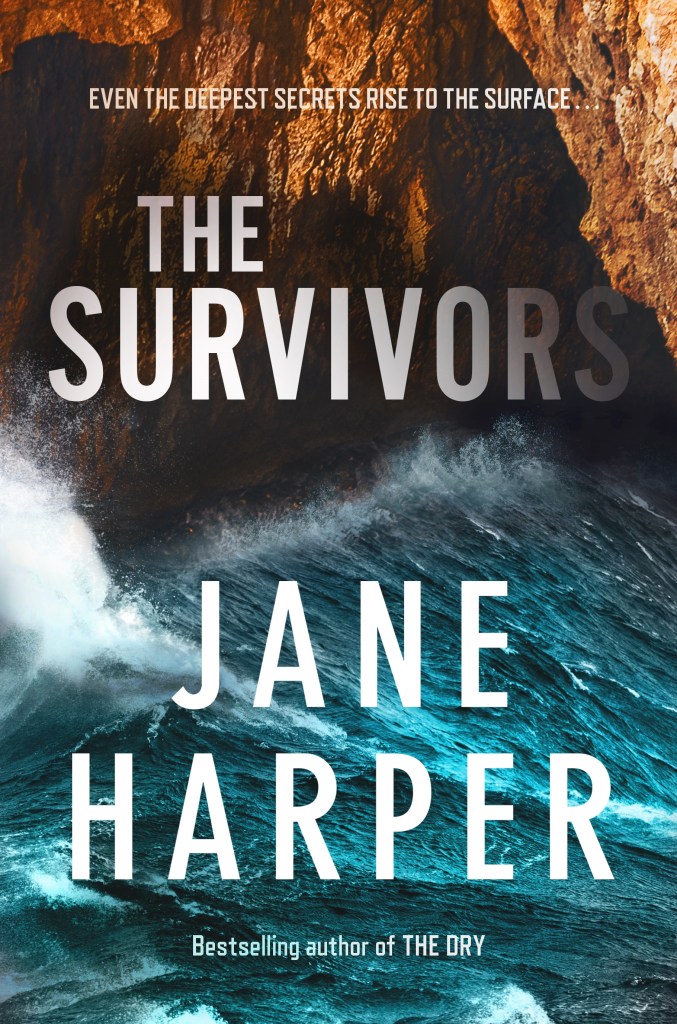
Book Review: The Survivors by Jane Harper

It’s hard not to be disappointed that the new Jane Harper isn’t set in the outback like The Dry and The Lost Man. She uses the relentless heat and harsh environment of that setting in a way that adds suspense and atmosphere by the bucketload. The Survivors sweeps us off to Tasmania and a coast that has seen scores of shipwrecks with tides that can catch out the unwary. A different environment, but still there’s that sense of danger.

Though for most of the inhabitants of Evelyn Bay it’s just the place they call home and where many make enough of an income from the tourists that visit every summer. It’s the place where Kieran grew up, but he’s made a new life in Sydney with Mia, who knew Kieran at school. The couple have returned with a baby in tow to their childhood home to help Kieran’s parents pack up and move to a nearby town. Kieran’s dad has dementia. The family are still haunted by a tragic event that took the life of Kieran’s brother, Finn, and almost Kieran too, for which he feels survivor’s guilt and more.

But this was a dozen or so years ago, and Kieran has a family, a new life, plenty to be getting on with. Another death, a murder no less, threatens to drag the earlier tragedy back into everyone’s thoughts. For at the same time that Finn and his friend had been attempting to rescue Kieran, Gabby, a fourteen year old girl and Mia’s best friend, disappeared, her backpack washed up days later. When Bronte, a young waitress, is found murdered on the beach, questions arise about why the death of Gabby wasn’t investigated properly all those years ago.

Harper really understands how to work small-town prejudices, the tendency to make connections where there are none, to leap to conclusions. The emotions run high in this book, particularly around Kieran and his family, but also on the appearance of Bronte’s parents. You can’t help but feel a parent’s anguish of losing a child. Then there’s all the guilt Kieran feels for the events that led to the earlier tragedy, particularly as he remembers the laddish behaviour, the sexism and one-upmanship he and his mates indulged in. One can’t help hoping he’s a better man now.

The Survivors is another brilliant read by Jane Harper – it doesn’t really matter where she sets her books, because it’s the characters and the way we connect with them that really drives the plot. And living in a country with treacherous coastlines everywhere you look, it was easy for me to visualise the setting and imagine the danger. And yet…. I just love the buzz of reading about the outback and I’m kind of hoping to return there with the next Jane Harper. Still, this one scores and easy four out of five from me.