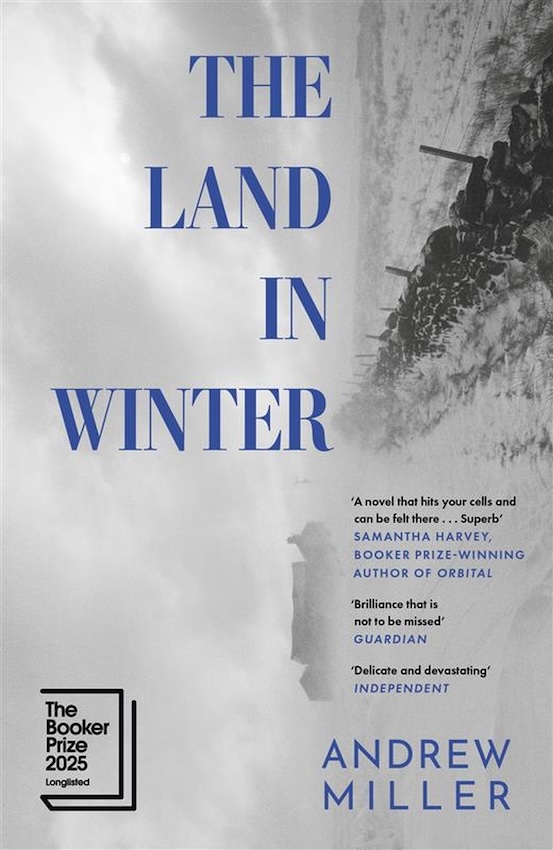
It’s always nice to see a novelist you admire long-listed for a Booker Prize. The Land in Winter has been on my radar for a while, since it won the Walter Scott Prize, and also because Miller’s an author I always look out for. So I was excited when I finally got my hands on a copy. And it didn’t take me long to become engrossed in this story of two couples who live in a village near Bristol and their struggles through the particularly cold winter of 1962-3, known as The Big Freeze.
There’s Bill and Rita on the farm – both new to farming and finding their way. Bill has big dreams for his land, as well as the kind of private school accent that doesn’t win him much respect among the farming community. Rita grew up too fast, with a father in a nearby asylum due to his experiences during the war. She has a veneer of glamour from her time working in a nightclub and fills her days reading sci-fi novels – so not farmer’s wife material. They are expecting their first child.
In a cottage nearby, Irene is also pregnant, her husband Eric a doctor at the local practice as well as visiting the asylum, where a young man has just taken his life. Eric has to deal with that and the pressure of his job, while having an affair he doesn’t know how to end. Irene meanwhile is trying to be the perfect wife but her middle class upbringing is sometimes at odds with Eric’s humbler beginnings, and the two seem to have different ideals.
Miller takes four characters who are each battling problems or being quietly miserable and then throws a tough winter at them. The narrative switches between them so we are right inside their heads as we watch them get things wrong and try to do better. They are so sensitively drawn that you can’t help but feel for each of them, caught as they are at a time when the war is still a raw memory and the future about to change. The class system is ready for a shake-up and feminism still emerging, but none of it can come fast enough for our characters.
In the kitchen, the cat jumped off the table where it had been licking out the inside of last night’s spaghetti pan. There was no obvious alarm in its jumping; it was not fleeing, merely taking up a more fortified position under the table. Next to the saucepan was the egg basket. She had not washed the eggs, she had not washed the pan.
On the floor by the Rayburn was a mug, a cushion, a book. He picked up the book and the mug, placed the mug in the sink and examined the book. That she liked to read, he had thought of as something that made up a little for the difference in their education. But Venus Plus X? And the rest she came back with from the library van, flying saucers on the covers, astronauts, red planets. He had suggested other things to her. She might, for instance, like Virginia Woolf. He had known girls at university who adored Virginia Wool and probably wanted to be her. Did the van have any Virginia Woolf? And she had given him a look, wide-eyed, not overly friendly, then turned to the cat to ask, ‘Does the van have any Virginia Woolf?’
A budding friendship between the women is viewed with suspicion by their husbands, but is never-the-less a godsend, opening up connection and different viewpoints for the two. There’s small-town gossip which only makes Rita and Eric separately more self-conscious. The period comes to life with some of the trashy horror and sci-fi movies of the day and music (dancing to the Mashed Potato; listening to Acker Bilk). There’s a brilliant chapter where Irene and Eric host a Boxing Day party – one of the best party scenes I’ve read – all that alcohol making people reveal themselves.
And then there’s the relentless cold. Nobody dies of hyperthermia or endures frostbite, but you can’t help feeling it’s not impossible as you read. So this is a novel best read somewhere warm. The story is carefully plotted and builds to a climax for each character with truths revealed that have to be dealt with, to find a way through.
You might think it sounds a little bleak, but I loved The Land in Winter because any time spent reading Miller means enjoying his wonderful writing. Every so often you hit a sentence you want to read again because it’s a fine and wonderful thing. It’s an altogether brilliant read and well worth the award nominations that have come its way. A five-star read from me.







 Judith McKinnon