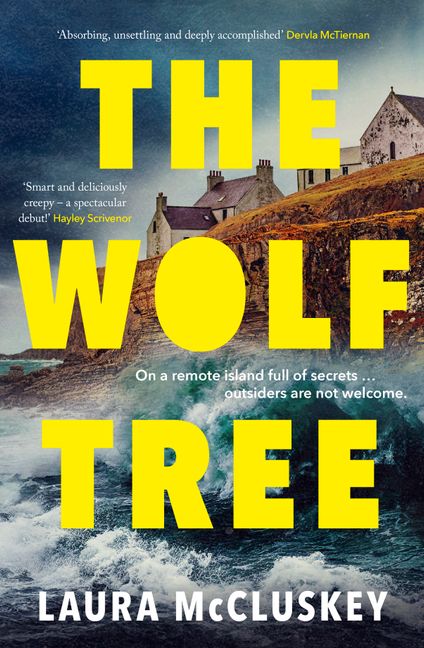
Book Review: The Wolf Tree by Laura McCluskey – a did he fall or was he pushed, Scottish Noir mystery

An island can provide just as much of a locked-room mystery as one in any building, particularly when it’s a remote island like Eilean Eadar, a wild and isolated spot off the West Coast of Scotland. In The Wolf Tree, we are in the shoes of DI Georgina (George) Lennox, who is just getting back to work after an attack that left her badly injured. This new case is supposed to be a box-ticking exercise, and she’s here along with her partner DI Richie Stewart to sign off on a probable suicide – a case to ease George back to work gently.

Of course, the reader knows that isn’t going to happen and things look problematic from the start. Even the boat crossing is wild and treacherous, the weather when they arrive, wet and freezing, the accommodation inconveniently at some distance from the little township. The two cops settle in, George doing her best to disguise from her older colleague and mentor her dependency on painkillers. The island has had to manage without a police presence, without a doctor, a school or social services of any kind for so long, so it isn’t surprising that the locals have learned to manage everything themselves. So they’re understandably reluctant to accept the interference of two cops from Glasgow.

Then there’s the case. Young Alan Ferguson, eighteen and busy applying for places at universities, had supposedly flung himself off the top of the island’s lighthouse. Alan was handsome and amiable, the only child of a widow, but she puts up a wall of animosity when George and Richie show up to ask questions. Hot on their tails, the priest arrives – a hearty, gregarious man, keen to help oil the wheels of the interview. The islanders, like Alan’s mother, are hostile towards mainlanders. It’s only the priest and the postmistress who are welcoming, or is that just nosiness?

Wariness towards incomers goes way back – the islanders had seen off the Protestant Reformation which turned the other western isles and much of Scotland. But Eadar is still staunchly Catholic. Or is it? What is the strange design that adorns the lintels of many of the houses, and why is George warned not to go anywhere near the woods. Pagan beliefs, mythology and superstition seem to hover on the fringes of everyday life. Then there’s the sound of howling wolves that disturbs George at night in a place where surely no wolves exist.

At twenty-eight, George is young to be a Detective Inspector, so it’s easy to imagine in her a tenacity her partner, eager to get back home with his family, seems to lack. It’s this tenacity that sees George asking awkward questions that Richie has to smooth over to avoid unpleasant confrontations. What will she have to do to earn the locals trust enough to talk to her? And what of the three lighthouse keepers who disappeared a hundred years ago? Can this mystery possibly have a connection to the death of Alan Ferguson?

It’s hard to determine which is more hostile and dangerous, the weather on Eadar or the people who live there. By the time we get to the end of the book, there are some stunning revelations and some spookily atmospheric scenes. George, in spite of terrible headaches, manages to think on her feet and probe the truth out of people in a case that will shock the whole community and mainlanders alike. She upsets Richie again and again with her disregard for her personal safety, and this looks unlikely to change anytime soon.

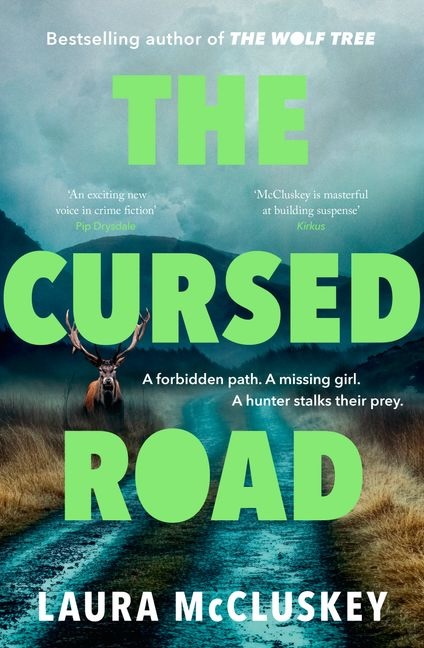
A first of a series, The Wolf Tree is a suspenseful and entertaining read, promising more tricky investigations for our two very different DIs. The Cursed Road is due for publication early next year. I particularly enjoyed the audiobook version of The Wolf Tree, which was read by Kirsty Cox. It’s a four-star read from me.

Book Review: The Names by Florence Knapp – a ‘sliding doors’ novel describing one character across three possible lives

I like a book that takes you on a different kind of journey, so that you don’t quite know what to expect next. You’re not always looking out for plot points, twists or turning points. The Names is the story of a baby boy, born to Cora and Gordon and the question of his name. His father insists he must be called Gordon, like him and his father before him, both doctors and both domineering men. But Cora would prefer Julian, an altogether gentler sounding name, while the baby’s older sister, Maia, thinks he should be Bear.

We get three different stories – one for Bear, another for Julian and the last for Gordon, showing the man he becomes, a new chapter for every seven years. But it’s also the story of Cora and the abuse she suffers at the hands of her husband. Each story offers a different set of outcomes, and the different effects this has on each of our core characters, Cora, Maia and Bear/Julian/Gordon.

It’s an interesting concept which keeps you hooked on the story, wondering what is going to happen next. I found I was enjoying one version of B/J/G more than another for one chapter, but this would be different in the next. To start with Bear wasn’t really all that interesting – he’s so confident, like his name, likeable and successful. But Florence Knapp makes sure there are interesting things that happen so that life isn’t always plain sailing.

Julian is damaged by what happens to him, and struggles to open up. He worries he’ll be like his father, that he has that same ability to hurt, and avoids relationships. Gordon is also damaged by his childhood and growing up, and learns things the hard way. He was difficult to read about to start with, but in the end I felt he was the most interesting of the three. You feel for all of them in different ways. Alongside the young man is his relationship with his sister, who is also going through some soul searching. What is it like to grow up with a parent who is capable of such violence? To what extent do you also inherit that gene?

But it was Cora who really has your sympathy. In one story, the author captures the manipulation, control and violence the elder Gordon inflicts on her, which makes for grim reading. The way it goes on through the years and how her husband shuts down her chances to live her own life, to be her own person. The hopelessness and acquiescence. I found I desperately wanted to stay with Cora’s story to see if she will make it out alive.

In the background there are other characters coming into the picture, as each starts to build their own life, and grows their family. There are some interesting descriptions of the work they do, particularly the work of silversmithing and archaeology. The Names would make great fodder for book groups and I will be interested to see what Florence Knapp writes next – a more traditionally plotted story, or something different again. The Names is an engaging debut and a four-star read from me.

Book Review: The Red Shore by William Shore – an atmospheric new mystery series set on the Devon coast

William Shaw’s a well-regarded author of detective fiction; you may already have come across his Breen & Tozer, and Alexandra Cupidi series. In The Red Shore we meet London detective, Eden Driscoll, who gets a phone call out of the blue from Devon and Cornwall Police informing him that his sister is missing and her son taken into care. His understanding boss tells Eden to take as much time as he needs to sort things out. Eden thinks he’ll be back in a day or two, he’s working on an important case after all.

Eden hasn’t seen his sister Apple in over a decade, not since he ran away from his family at the age of fifteen. He felt bad about leaving his mother with Apple when his father died. But parenting was never their strong point, Dad being an overbearing man, his mother acquiescing too readily with his ambitions for a nomadic hippy lifestyle. Because of all this, Eden has never wanted a family of his own, doesn’t see himself settling down at all, let alone being a dad. He cringes from the idea of being the guardian of his nine-year-old nephew, Finn, a boy he never knew existed.

All this is an interesting story in itself, but layered on top is the mystery of what has happened to Apple. Eden’s sister, was an experienced sailor who seems to have gone overboard from her boat, the Calliope. Even more unlikely is the idea that she would have locked Finn in the cabin. When Eden asks for a look at the boat, DS Mike Sweet is sceptical when Eden assumes the presence of two recently used wine glasses suggests another person may have been on board. Sweet’s a nice chap, but seems inclined to go for easy options – suicide or an accident being the most likely scenarios.

So tracing the Apple’s movements will take a different kind of investigating. Molly’s irritating but she’s the only one who takes Eden seriously. There’s also Bisi, the social worker who is hoping Eden will find it in himself to be a father to Finn. Uncle and nephew don’t hit it off at first, but as Eden makes more of an effort, the idea that he could parent the boy starts to be a possibility, just as the trouble he gets into over his investigations causes alarm bells to go off with social services. This creates some terrific tension and emotional pull for the story, which also weaves in scenes from Eden’s childhood.

On top of all this, you’ve got a fabulous setting. Apple’s cottage is right on the estuary of the seaside town of Teignmouth, with a living room that opens out onto a beach. You’ve got lots of boating going on, adventures at sea, and the special vibe seaside towns have, with busy cafés and pubs catering to tourists and weekenders. It all adds up to a very satisfying read, with a plot that has you racing through the pages as Eden’s discoveries take him towards increasing danger, not only personally, but also for Finn.

I was very happy to discover this book recently, a new series I imagine will appeal to readers of Ann Cleeves’s books. I can’t wait for the next book featuring Eden Driscoll to find out if he settles in to a new life on the Devon coast. The Burning Tide is due for release next July. The Red Shore is a four-star read from me.

Book Review: Death of a Stranger by John Pilkington – an entertaining historical mystery and the start of a promising new series

John Pilkington is an old hand when it comes to historical mysteries, with a number of series under his belt, among them the Thomas the Falconer series. Death of a Stranger takes us back to Elizabethan England in the first book featuring Matthew Cutler, a constable in the parish of Spitalfields. It’s 1594, when the murder of an Italian perfumer causes a need for answers, as well as anxiety among the other “strangers” or immigrants of the parish.

When a further threat against a French button maker occurs, the obvious conclusion is that someone is targeting the local “strangers”, either for being possible Papists or other reasons of their own. Matthew is fed assorted leads, a stonemason with a bitter nature since the loss of his daughter to the plague; a former acting friend of Matthew’s who had had a dispute with the perfumer. They’re all dead ends, but rather than dropping the matter as his employer, Alderman Skinner requests, Matthew determines to find justice for the dead man. Could someone be planting false clues?

What Matthew doesn’t yet know is how far his search for the truth will take him into the world of the movers and shakers of Elizabethan society, the perfumer having made house calls to favoured customers, some of them bored wives of powerful men. So there’s a lot to set the story going in interesting directions. Matthew hits wall after wall before he can convince his superiors that the case is worth pursuing.

As an investigator, Matthew is an interesting character. To begin with he’s educated, having fallen out with his magistrate father, and dropped out of his Cambridge studies after a year to become an actor. He lost his wife to the plague not long ago, and has two daughters in his care, his wife’s aunt living with them as housekeeper. He has come to the role of constable at the request of his gunmaker father-in-law.

As the story progresses, Matthew’s education and acting talent come in handy for questioning people of high public standing, an idea brought to him by Margaret Fisher, a comfortably off widow, friend and potential love interest. At first Matthew’s not convinced it’s a good idea – he’s used to being able to gain confessions from miscreants with the threat of the law and its grim punishments, but it’s a different story with the upper classes. I can imagine there will be plenty of potential for Matthew to don the clothes of Margaret’s late husband and the role of Sir Amos Gallett again in future books.

John Pilkington obviously knows his Elizabethan era well, for while Death of a Stranger is an entertaining story on its own, the period details make the story come alive. It was interesting to see a little of how humbler folk lived – so many historical novels concentrate on those at court – but I liked reading about the work of the gunsmith, the night watchman or the people at the local tavern, which doubles as a venue for the inquest.

Death of a Stranger is an enjoyable historical mystery, with John Pilkington writing in a style that sounds Elizabethan enough to add colour without being difficult for the modern reader. And Matthew Cutler is an engaging enough character for me to want to find out what he does next. I’ll certainly be on the look-out for the next book in the series. This first instalment is a four star read from me.

I read Death of a Stranger courtesy of Netgalley and Boldwood Books. The book is due for release on 14 November.

Book Review: Totally Fine by Nick Spalding – an entertaining comedy of manners with a touch of philosophy amid the humour

The main character in Nick Spalding’s new novel is Charlie King, who could be a really annoying person if he was in your life, if he wasn’t so well meaning. Obviously his girlfriend Annie sees this in him, as do his long-time buddies, Leo and Jack, but really, life with a Charlie King around would be exhausting.

Charlie makes his living planning events, all kinds of parties and marketing do’s for the middle classes. And he’s really good at it. The story begins with the birthday party he’s planned at a bowling alley for Annie’s young nephew, with a Jurassic Park theme, actors in costumes and fake dinosaurs, the works. A panic attack hits Charlie, triggered by an annoying song by the Black Eyed Peas – the same song that was on the radio when he had that car accident a while ago – something he’d never told Annie about. In fact he’s rather blotted it from his mind.

Doing his best to put the incident at the birthday party behind him, He gets back to work. But something isn’t right and he makes a big mistake at a gender-reveal party, which sees his business suddenly going south. Charlie decides the time out this offers is the perfect opportunity to confront his issues. But when he realises that his best mates Leo and Jack are also suffering from anxiety, Charlie decides they can all fix their problems together. Because that’s what Charlie does – fixes things up and makes everything perfect. If he can do that with events, he can do that with personal problems, right?

The story follows Charlie’s harrying his friends into different therapeutic options, from magic mushrooms, to navel-gazing in the wilderness. This creates plenty of amusing and visually interesting scenes. Throughout everything, he ignores Annie’s advice to consult a doctor, or his friend’s growing resentment. He seems unable to see what’s under his nose or understand his own problem. Why is he so afraid to see a doctor?

Totally Fine is an entertaining look at some of society’s ills – the pressure to perform, the endless distractions demanding our attention, the need to seem strong to the ones we love when inside we need help. Nothing really new but maybe ramped up here for the digital age. This is shown through one man’s problems, and as a professional tasked with providing his clients with the perfect social media opportunities, Charlie is the perfect protagonist for this. Perfectly imperfect, that is.

It’s a light, fun read, if you don’t mind a bit of schoolboy humour from time to time. It’s touch and go whether everything will turn out “totally fine” for Charlie and his friends, but you can bet there will be lessons learned. I read this after some darker novels, and it was a relaxing read that was just right. Nick Spalding is the author of around 20 books, mostly humorous fiction about modern life with his new book, Totally Fine, just released this week. I read it courtesy of Netgalley, and it’s a three-star read from me.

Book Review: The Land in Winter by Andrew Miller – a carefully crafted and moving historical novel

It’s always nice to see a novelist you admire long-listed for a Booker Prize. The Land in Winter has been on my radar for a while, since it won the Walter Scott Prize, and also because Miller’s an author I always look out for. So I was excited when I finally got my hands on a copy. And it didn’t take me long to become engrossed in this story of two couples who live in a village near Bristol and their struggles through the particularly cold winter of 1962-3, known as The Big Freeze.

There’s Bill and Rita on the farm – both new to farming and finding their way. Bill has big dreams for his land, as well as the kind of private school accent that doesn’t win him much respect among the farming community. Rita grew up too fast, with a father in a nearby asylum due to his experiences during the war. She has a veneer of glamour from her time working in a nightclub and fills her days reading sci-fi novels – so not farmer’s wife material. They are expecting their first child.

In a cottage nearby, Irene is also pregnant, her husband Eric a doctor at the local practice as well as visiting the asylum, where a young man has just taken his life. Eric has to deal with that and the pressure of his job, while having an affair he doesn’t know how to end. Irene meanwhile is trying to be the perfect wife but her middle class upbringing is sometimes at odds with Eric’s humbler beginnings, and the two seem to have different ideals.

Miller takes four characters who are each battling problems or being quietly miserable and then throws a tough winter at them. The narrative switches between them so we are right inside their heads as we watch them get things wrong and try to do better. They are so sensitively drawn that you can’t help but feel for each of them, caught as they are at a time when the war is still a raw memory and the future about to change. The class system is ready for a shake-up and feminism still emerging, but none of it can come fast enough for our characters.

A budding friendship between the women is viewed with suspicion by their husbands, but is never-the-less a godsend, opening up connection and different viewpoints for the two. There’s small-town gossip which only makes Rita and Eric separately more self-conscious. The period comes to life with some of the trashy horror and sci-fi movies of the day and music (dancing to the Mashed Potato; listening to Acker Bilk). There’s a brilliant chapter where Irene and Eric host a Boxing Day party – one of the best party scenes I’ve read – all that alcohol making people reveal themselves.

And then there’s the relentless cold. Nobody dies of hyperthermia or endures frostbite, but you can’t help feeling it’s not impossible as you read. So this is a novel best read somewhere warm. The story is carefully plotted and builds to a climax for each character with truths revealed that have to be dealt with, to find a way through.

You might think it sounds a little bleak, but I loved The Land in Winter because any time spent reading Miller means enjoying his wonderful writing. Every so often you hit a sentence you want to read again because it’s a fine and wonderful thing. It’s an altogether brilliant read and well worth the award nominations that have come its way. A five-star read from me.

Book Review: The List of Suspicious Things by Jennie Godfrey – a story about friendship, growing up and a small town’s dark secrets

The List of Suspicious Things is a debut novel which takes you back to 1979. Thatcher has just been elected PM and the Yorkshire Ripper is at large, killing young women, while the police have few clues to his identity. In Miv’s Yorkshire town the mills have closed down, so things are already tough, and likely to get tougher. At home, Miv’s mother never speaks, Auntie Jean delivers food to the table and terse comments, while her dad seems a bit lost.

When the family thinks a move down south might be a good idea, Miv is desperate. At twelve, she’s bright but a bit socially gauche, partly due to her home life, so her friendship with Sharon is too precious to lose. She’ll do anything to save it so decides to investigate and catch the Yorkshire Ripper. She buys a notebook and makes lists, and with Sharon’s help, begins to look for suspicious characters close to home.

As names are added to the list, the reader is introduced to the people of the town, beginning with Mr Bashir who runs the corner shop. He’s one of the nicest adults Miv knows but he has dark eyes and a moustache, so makes the list. There’s a truck driver from her father’s work, people she knows from church and a teacher among others. Other people in the community include Helen at the library – because where else do you go for information in 1979?

Of course, the girls don’t catch the Ripper, but their investigations uncover some of the darker elements going on in the town – the racism, the misogyny, the prejudice against those who are a bit different. Miv learns one or two secrets that are a bit close to home, and finds herself caught up in some of the fallout. She’s a girl who is left too much to her own devices, there’s just too much going on at home for consistent parenting. But then in 1979, kids were often left to find their own entertainment and the town is their playground.

Through Miv you also see the struggles of the adults in the story. Sometimes the narrative shifts to Austin, Miv’s dad; Helen; or Mr Bashir, who each have personal sadness and secrets. The setting – the late ’70s is well realised. Mr Bashir is always singing along to his favourite Elton John songs, jeans go from bellbottoms to stovepipes and Sharon buys a glittery lipgloss to try. And it’s also very Yorkshire, though not posh Yorkshire – the kids go ‘laiking about’ and at least one character’s house has an outdoor loo.

While overall I enjoyed the book, I did feel at times that it was rather overloaded with issues. So many dark things happen with a lot to fall on Miv’s small shoulders. Still, The List of Suspicious Things is a quirky and interesting novel, easy to get lost in. I was reminded of Joanna Cannon’s The Trouble with Goats and Sheep – another novel about two young girls investigating – in this case a neighbour’s disappearance – also set in the ’70s, and which is well worth checking out. The List of Suspicious Things is a three-star read from me.

Book Review: The Book of Guilt by Catherine Chidgey – an enthralling and haunting dystopian novel

It can be a bit nerve-wracking reviewing a book that has already had a lot of publicity and kudos. Even as you start to read it you know you are supposed to like it, but what if you don’t? Fortunately, The Book of Guilt soon drew me in with it’s 1979 English setting, although it’s not quite like how anyone would remember it.

Catherine Chidgey has reimagined the world as it might have been if England had signed a treaty with Germany in 1943, ending the war and continuing similar scientific experiments to those the Germans had been working on. We’ve got triplets, Vincent, Lawrence and William – 13 year olds who are the last boys living at Captain Scott house, a kind of children’s home. They follow a strict regime of activities and medication, overseen by their caregivers – Mother Morning, Mother Afternoon and Mother Night.

Along with taking daily medicine, their dreams are recorded in the Book of Dreams, and any misdemeanours noted in The Book of Guilt. Lessons are from The Book of Knowledge – a kind of old-school encyclopaedia. The house is shabby, toys are minimal, but then the boys don’t always feel well enough for a lot of physical activity. But once they have beaten “the Bug”, they are promised they will be sent to Margate, a child’s paradise, where they’ll meet up with their old friends again, and every day enjoy the amusement park, described in loving detail.

Soon our reader’s antennae are twitching, as we know this isn’t normal and the boys part of a grander scheme, pawns in some kind of experiment. There are visits by an avuncular Dr Roach, eagerly awaited, with his little dog Cynthia. The mothers are reluctant to share what’s really going on and shut down any questions with platitudes. And when the boys are at last allowed to visit the village, the locals are wary, hostile even.

The story is told largely from Vincent’s point of view, but interspersed is Nancy’s story, a girl about the same age, whose own family situation is unusual and plagued with secrecy. And then there’s The Minister of Loneliness, who is tasked with overseeing the closing of the boys’ home and others like it, and finding suitable families to take the remaining children. She is clearly uncomfortable about what she sees when she visits the boys at Captain Scott.

This is such an intense read, so haunting I could think of little else. And things get pretty dark, with new revelations and plot developments. At one point I had to take a break, so I read a crime novella about a wife murderer for a bit of light relief. But I did continue and I’m glad I did as it is such a compelling and thought-provoking story.

Chidgey is brilliant at detail and at times this was like a trip down memory lane with artifacts from everyday life circa 1979 appearing – leatherette furniture, the knick-knacks on display, Nancy’s Spirograph. You can feel the world through Vincent and Nancy, just as a young person might, all five senses vividly recounted. And the way children, no matter what circumstances they are living in, will sometimes burst into moments of imagination, or excitable play.

Ideas around power and what should be sanctioned for the greater good, of difference and prejudice and, of course, guilt trickle through the storyline. It all adds up to a top literary achievement and I can see why there’s a lot of talk about the novel. Crafted and intelligent, The Book of Guilt is a five-star read from me.

Book Review: The Party by Tessa Hadley – coming of age in postwar Britain

A new Tessa Hadley is always worth picking up, and this one is a novella, the perfect choice for when life’s a bit busy. The Party is set in the decade or so after World War II in Bristol, with two sisters who are desperate to enjoy their youth and experience life. It’s told from the perspective of seventeen-year-old Evelyn, in her first year studying French at university, where her older sister, Moira, studies art.

Moira knows some interesting people, particularly Bohemian Vincent who gets the story started by hosting a party at a dodgy pub down on the docks. It’s a rainy night and Evelyn changes in the ladies’ toilets into figure-hugging black, stashing away the more demure clothes she’d left home in. Moira isn’t expecting her sister to turn up, but introduces her to the people at her table, among them two older men who are appear sophisticated and well-off – handsome but offhand Paul, creepy and not handsome at all Sinden.

I love the way Hadley conjures up the discomfort of the scene – the miserable rain, the impractical shoes, the need to pee, the grotty pub. The things a young girl puts herself through for a bit of excitement. This party is the first of three chapters. The second takes us to the girls’ home life with their younger brother and parents – a father who disappears for long intervals and a tensely respectable mother. Here the girls have to pretend they were out with nice friends the night before, with no ‘drink’ taken.

The third chapter focuses on the other ‘party’ which the girls are pressured into attending at the mansion-like home of Paul’s family. Hadley highlights the naïveté of the girls, their powerless, and the predatory behaviour of Sinden, the older man. As you read, you see all the alarm bells that would have the girls’ mother up in arms. Also, the lack of happiness at the house – a sick brother, absent parents and the need for distraction.

While the storyline might seem dark and worrying, there’s such sharp wit in the writing and even a sense of adventure, particularly in the way it captures the exuberance of youth. The settings are varied and contrasting and seen through Evelyn’s eyes you can imagine being seventeen when everything can be a bit of a surprise, but you take it all at face value anyway, even if that means putting up with things you shouldn’t need to.

The Party is such a brilliant read, reminding me a little of Rose Tremain’s novel Absolutely and Forever. It’s only 115 pages long but packs a lot in. I’m beginning to be quite a fan of the novella. On the back cover, Kate Atkinson declares that Tessa Hadley is her favourite author, and well, I don’t blame her – Hadley is hard to beat. The Party is a five-star read from me.

Book Review: Hemlock Bay by Martin Edwards – a cosy mystery with plenty of Golden Age panache

I was in the mood for a cosy mystery and was intrigued by this new book by Martin Edwards, the fifth in a series about the investigations of Rachel Savernake, a young woman of private means with an interest in murder. Edwards has immaculate credentials, being something of an expert in Golden Age murder mysteries. He’s the President of the Detection Club, a group formed in 1930 by crime writers such as Agatha Christie and Dorothy L Sayers and where Knox Commandments are sacrosanct.

These are rules about what a crime novel must and mustn’t do – things like the murderer must appear early on in the story, the detective must declare any clues they discover as they discover them and also must not be the killer. Among others. Martin Edwards has also been awarded the Diamond Dagger for outstanding contribution to crime fiction, so I felt this book was definitely worth a shot.

As Hemlock Bay begins, we are soon reading the diary of Basil Palmer who is planning a murder in the North of England seaside resort of the title. He wants to dispose of the man responsible for his wife’s death – someone he has never met. Pushing him off a cliff seems a good idea. Around the same time, our amateur sleuth, Rachel, has just bought a painting, also of Hemlock Bay, by well-known Surrealist painter Virginia Penrhos, which shows, if you look carefully enough, someone lying dead at the bottom of a cliff.

Rachel lives in a large London house with her chauffeur Trueman, his wife Hetty, and Trueman’s sister Martha. Hetty cooks and Martha is a kind of companion-maid, but they all get on well, as equals almost – a kind of family of amateur sleuths. There’s some history here that you no doubt get more of in the earlier books, which I have yet to read. While this scenario does arouse the reader’s curiosity, it was perfectly fine to read Hemlock Bay as a standalone novel.

When London crime reporter Jacob Flint interviews a clairvoyant claiming to have had a vision of someone being pushed from a cliff at Hemlock Bay, he pays a call on Rachel. What he reveals sets them all off together for a summer stay at the seaside resort with the aim of preventing the murder. Flint has had some previous lucky breaks following Rachel’s nous for crime – also in the previous books – and this seems set to happen again here.

The story is peppered with many interesting characters – among them Sir Harold Jackson, who with wife Sadie, turned Hemlock Bay into a luxury resort; Virginia Penrhos, who is staying there in a lighthouse with her moody lover, Fion, and Louis Carson, schemer an all-round dodgy character and his charming wife Pearl. The perspective flips around among our sleuths and Basil’s diary, with a lot of time spent with Flint, who is energetic and determined, and also a bit in love with Rachel.

It all comes together with a twisty plot and a barrel of surprises at the end, as Rachel reveals who did what and why – a scene rather like many a Golden Age mystery, with all the suspects and witnesses gathered together, listening with baited breath. Martin Edwards has set the story up with clues peppered throughout for the careful reader, and these are listed in the Cluefinder at the back of the book – a popular trope from fifty years ago.

The result is a pleasurable read, a clever cosy mystery, with engaging characters, plenty of warmth and humour and smart writing. Everything you could want with a relaxing crime story. In the background is enough period detail – talks of the Slump (it’s 1930, so we know hard times are a coming), fashionable pastimes for the wealthy (including naturism) – to add enough colour without slowing down the plot. Hemlock Bay is a treat – a four-star read from me.