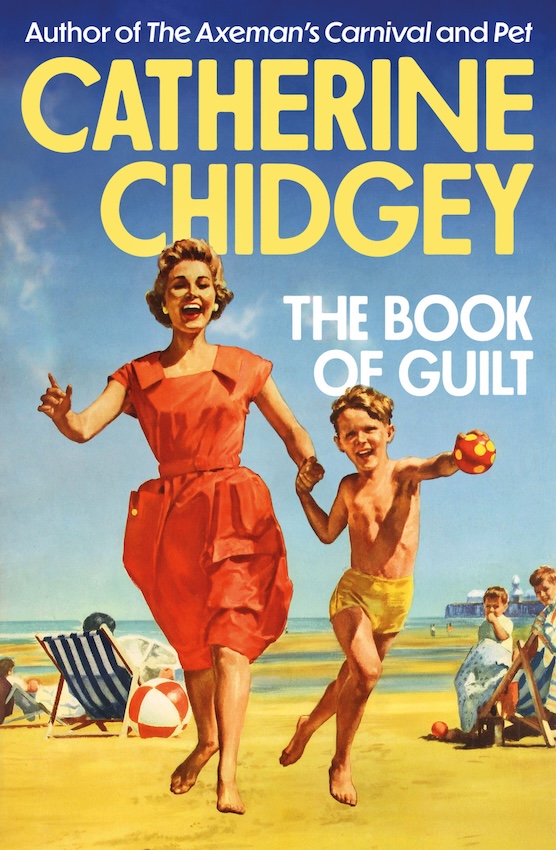
Book Review: The Book of Guilt by Catherine Chidgey – an enthralling and haunting dystopian novel

It can be a bit nerve-wracking reviewing a book that has already had a lot of publicity and kudos. Even as you start to read it you know you are supposed to like it, but what if you don’t? Fortunately, The Book of Guilt soon drew me in with it’s 1979 English setting, although it’s not quite like how anyone would remember it.

Catherine Chidgey has reimagined the world as it might have been if England had signed a treaty with Germany in 1943, ending the war and continuing similar scientific experiments to those the Germans had been working on. We’ve got triplets, Vincent, Lawrence and William – 13 year olds who are the last boys living at Captain Scott house, a kind of children’s home. They follow a strict regime of activities and medication, overseen by their caregivers – Mother Morning, Mother Afternoon and Mother Night.

Along with taking daily medicine, their dreams are recorded in the Book of Dreams, and any misdemeanours noted in The Book of Guilt. Lessons are from The Book of Knowledge – a kind of old-school encyclopaedia. The house is shabby, toys are minimal, but then the boys don’t always feel well enough for a lot of physical activity. But once they have beaten “the Bug”, they are promised they will be sent to Margate, a child’s paradise, where they’ll meet up with their old friends again, and every day enjoy the amusement park, described in loving detail.

Soon our reader’s antennae are twitching, as we know this isn’t normal and the boys part of a grander scheme, pawns in some kind of experiment. There are visits by an avuncular Dr Roach, eagerly awaited, with his little dog Cynthia. The mothers are reluctant to share what’s really going on and shut down any questions with platitudes. And when the boys are at last allowed to visit the village, the locals are wary, hostile even.

The story is told largely from Vincent’s point of view, but interspersed is Nancy’s story, a girl about the same age, whose own family situation is unusual and plagued with secrecy. And then there’s The Minister of Loneliness, who is tasked with overseeing the closing of the boys’ home and others like it, and finding suitable families to take the remaining children. She is clearly uncomfortable about what she sees when she visits the boys at Captain Scott.

This is such an intense read, so haunting I could think of little else. And things get pretty dark, with new revelations and plot developments. At one point I had to take a break, so I read a crime novella about a wife murderer for a bit of light relief. But I did continue and I’m glad I did as it is such a compelling and thought-provoking story.

Chidgey is brilliant at detail and at times this was like a trip down memory lane with artifacts from everyday life circa 1979 appearing – leatherette furniture, the knick-knacks on display, Nancy’s Spirograph. You can feel the world through Vincent and Nancy, just as a young person might, all five senses vividly recounted. And the way children, no matter what circumstances they are living in, will sometimes burst into moments of imagination, or excitable play.

Ideas around power and what should be sanctioned for the greater good, of difference and prejudice and, of course, guilt trickle through the storyline. It all adds up to a top literary achievement and I can see why there’s a lot of talk about the novel. Crafted and intelligent, The Book of Guilt is a five-star read from me.

Book Review: The Party by Tessa Hadley – coming of age in postwar Britain

A new Tessa Hadley is always worth picking up, and this one is a novella, the perfect choice for when life’s a bit busy. The Party is set in the decade or so after World War II in Bristol, with two sisters who are desperate to enjoy their youth and experience life. It’s told from the perspective of seventeen-year-old Evelyn, in her first year studying French at university, where her older sister, Moira, studies art.

Moira knows some interesting people, particularly Bohemian Vincent who gets the story started by hosting a party at a dodgy pub down on the docks. It’s a rainy night and Evelyn changes in the ladies’ toilets into figure-hugging black, stashing away the more demure clothes she’d left home in. Moira isn’t expecting her sister to turn up, but introduces her to the people at her table, among them two older men who are appear sophisticated and well-off – handsome but offhand Paul, creepy and not handsome at all Sinden.

I love the way Hadley conjures up the discomfort of the scene – the miserable rain, the impractical shoes, the need to pee, the grotty pub. The things a young girl puts herself through for a bit of excitement. This party is the first of three chapters. The second takes us to the girls’ home life with their younger brother and parents – a father who disappears for long intervals and a tensely respectable mother. Here the girls have to pretend they were out with nice friends the night before, with no ‘drink’ taken.

The third chapter focuses on the other ‘party’ which the girls are pressured into attending at the mansion-like home of Paul’s family. Hadley highlights the naïveté of the girls, their powerless, and the predatory behaviour of Sinden, the older man. As you read, you see all the alarm bells that would have the girls’ mother up in arms. Also, the lack of happiness at the house – a sick brother, absent parents and the need for distraction.

While the storyline might seem dark and worrying, there’s such sharp wit in the writing and even a sense of adventure, particularly in the way it captures the exuberance of youth. The settings are varied and contrasting and seen through Evelyn’s eyes you can imagine being seventeen when everything can be a bit of a surprise, but you take it all at face value anyway, even if that means putting up with things you shouldn’t need to.

The Party is such a brilliant read, reminding me a little of Rose Tremain’s novel Absolutely and Forever. It’s only 115 pages long but packs a lot in. I’m beginning to be quite a fan of the novella. On the back cover, Kate Atkinson declares that Tessa Hadley is her favourite author, and well, I don’t blame her – Hadley is hard to beat. The Party is a five-star read from me.

Book Review: Hemlock Bay by Martin Edwards – a cosy mystery with plenty of Golden Age panache

I was in the mood for a cosy mystery and was intrigued by this new book by Martin Edwards, the fifth in a series about the investigations of Rachel Savernake, a young woman of private means with an interest in murder. Edwards has immaculate credentials, being something of an expert in Golden Age murder mysteries. He’s the President of the Detection Club, a group formed in 1930 by crime writers such as Agatha Christie and Dorothy L Sayers and where Knox Commandments are sacrosanct.

These are rules about what a crime novel must and mustn’t do – things like the murderer must appear early on in the story, the detective must declare any clues they discover as they discover them and also must not be the killer. Among others. Martin Edwards has also been awarded the Diamond Dagger for outstanding contribution to crime fiction, so I felt this book was definitely worth a shot.

As Hemlock Bay begins, we are soon reading the diary of Basil Palmer who is planning a murder in the North of England seaside resort of the title. He wants to dispose of the man responsible for his wife’s death – someone he has never met. Pushing him off a cliff seems a good idea. Around the same time, our amateur sleuth, Rachel, has just bought a painting, also of Hemlock Bay, by well-known Surrealist painter Virginia Penrhos, which shows, if you look carefully enough, someone lying dead at the bottom of a cliff.

Rachel lives in a large London house with her chauffeur Trueman, his wife Hetty, and Trueman’s sister Martha. Hetty cooks and Martha is a kind of companion-maid, but they all get on well, as equals almost – a kind of family of amateur sleuths. There’s some history here that you no doubt get more of in the earlier books, which I have yet to read. While this scenario does arouse the reader’s curiosity, it was perfectly fine to read Hemlock Bay as a standalone novel.

When London crime reporter Jacob Flint interviews a clairvoyant claiming to have had a vision of someone being pushed from a cliff at Hemlock Bay, he pays a call on Rachel. What he reveals sets them all off together for a summer stay at the seaside resort with the aim of preventing the murder. Flint has had some previous lucky breaks following Rachel’s nous for crime – also in the previous books – and this seems set to happen again here.

The story is peppered with many interesting characters – among them Sir Harold Jackson, who with wife Sadie, turned Hemlock Bay into a luxury resort; Virginia Penrhos, who is staying there in a lighthouse with her moody lover, Fion, and Louis Carson, schemer an all-round dodgy character and his charming wife Pearl. The perspective flips around among our sleuths and Basil’s diary, with a lot of time spent with Flint, who is energetic and determined, and also a bit in love with Rachel.

It all comes together with a twisty plot and a barrel of surprises at the end, as Rachel reveals who did what and why – a scene rather like many a Golden Age mystery, with all the suspects and witnesses gathered together, listening with baited breath. Martin Edwards has set the story up with clues peppered throughout for the careful reader, and these are listed in the Cluefinder at the back of the book – a popular trope from fifty years ago.

The result is a pleasurable read, a clever cosy mystery, with engaging characters, plenty of warmth and humour and smart writing. Everything you could want with a relaxing crime story. In the background is enough period detail – talks of the Slump (it’s 1930, so we know hard times are a coming), fashionable pastimes for the wealthy (including naturism) – to add enough colour without slowing down the plot. Hemlock Bay is a treat – a four-star read from me.

Book Review: The Treasures by Harriet Evans – an immersive family saga and the first of a trilogy

I was happy to put my hand up for this Netgalley offering as I’ve enjoyed several Harriet Evans’ novels before. She often centres her novels around an atmospheric house (Keepsake in The Butterfly Summer; Vanes in The Beloved Girls; Fane Hall in The Stargazers), which I’ve always found appealing. A bit like Manderley in Daphne du Maurier’s Rebecca.

Early on in The Treasures we hear mention of a house called Sevenstones. I imagined a grand old English manor, full of secrets and mystery. In actual fact Sevenstones has more of a cottage feel, a country bold-hole where various members of the cast of characters arrive when they need a break. For some, including Tom Raven’s parents, it was a chance to take a break from the war – World War II that is – and where relationships were forged.

But we first meet Tom as a young boy, living in a two-room cottage with his much loved Dad in Scotland. At the age of nine, he is uprooted by his Aunt Jenny, leaving the simple life behind for more opportunities in London and public schooling, even though his aunt and Uncle Henry really have no idea about children or even running a house without staff. We’re in the 1950s, and there are bomb craters everywhere, and children from the upper classes aren’t to mix with the lower orders, or so Tom’s told.

There’s also another grander house in this book – Valhalla, the American home of the Kynastons. Alice is growing up as best she can, with a father battling demons and debts owed on his orchards. When he takes his life, it seems Alice and her mother are to lose their home on the grounds of Valhalla. Wilder Kynaston was a good family friend and offers them a lifeline, but there’s a price to pay.

We’re well into 1960s by now, and as Jack and Alice grow up on opposite sides of the Atlantic, another war has arrived, and with it the rise of the protest movement, women’s lib and the chance of new freedoms and ways of thinking. The novel takes you through these changes as our two young characters’ stories are set to intersect. But family secrets lurk, throwing roadblocks in their way.

Harriet Evans captures the time really well, and the dilemmas faced by young women like Alice who are trying to forge a new path for themselves, only to find they’re still chivvying for the boyfriends they tie themselves to. The men of the establishment still hold all the power, while choices for women remain limited. But there are others too, like the fathers of both Alice and Jack, who have been left haunted by the past, plagued by guilt or disappointment, also unable to be the people they want to be.

I was curious that the book starts with a modern day setting and a character, Emma, who doesn’t appear again, discovering the ‘treasures’ of the title. These are little mementos Alice has been given by her father on each of her birthdays. But I now see that this novel is the first of a trilogy – I’ll be intrigued to see how the story continues to fill in the gaps in the books that follow. The Treasures is a rich, immersive read with terrific characters you empathise with.

The Treasures is due for release on 12 June. It’s a four-star read from me.

Book Review: The British Booksellers by Kristy Cambron – a story from World War Two with its roots in the previous war

The devastation of Coventry by enemy aircraft during World War II is often described as the Forgotten Blitz. Coventry was targeted because of its munitions factories, but thousands of homes were also destroyed, hundreds of civilians killed and the Cathedral left in ruins..

Kristy Cambron uses this as a background for her novel The British Booksellers, but the story gets going before all that, even before World War I, when we meet two young people: fifteen-year-old Amos Darby the son of a tenant farmer, and twelve-year-old Charlotte Terrington, an earl’s daughter. They have played together for years, and are obviously soulmates, sharing a love of books, Charlotte also being keen on playing the cello, something she’s not allowed to do – it’s unladylike. So far, so Downton Abbey.

As they get older, their friendship deepens, but Charlotte is promised to local gentry, one Will Holt, who’s something of a lad, but determined to have his fair lady. With a war waiting in the wings, the First World War, that is, everything is accelerated and with miscommunications and nobody getting quite the life they had planned, a kind of bitterness settles on Amos’s and Charlotte’s relationship. Jump a couple of decades on, and here we have Charlotte and daughter Eden at their Coventry bookshop, still living at Holt Manor, while across the road Amos lives above his own bookshop, Waverley Novels. They have been not only business rivals but apparently feuding bookshop owners all this time.

But with another war on the go, things are set to be shaken up in more ways than one. The arrival of Jacob Cole, an American solicitor with claims on Eden’s inheritance adds another plot thread and there are suddenly land girls from London to settle in. But Holt Manor’s struggling to pay the bills, so they need all the help they can get. And then there’s the Bltiz.

Kristy Cambron writes a great story about love and war, and there’s a lot here to keep you turning the pages. The characters are complex, appealing and developed well. The scenes of war, of bombing and our characters thrown into the maelstrom of it all are exciting. I enjoyed the scenes with Amos more than all the girls mucking in together and comparing notes about clothes and how to cope without regular access to stockings. Personally, I’d be digging out the less glamorous Lisle stockings, as that manor house, the rain and mud sounded miserably cold.

This is a nice enough novel, but a picky reader might find the prose a little American sounding, the descriptions a little lengthy and over-egged. But the story is terrific and worth picking up for a diverting read that has you eager to find out what happens. The British Booksellers is a three-star read from me.

The Painter’s Daughters by Emily Howes – a stunning historical novel exploring the family of Thomas Gainsborough

I knew a little of the work of Thomas Gainsborough before I read this book, his striking portraits, the most famous of which is probably the Blue Boy, which frequently used to appear in tapestry kits. Such a pretty picture. But I remember looking at his portraits, marvelling at the light feathery brushstrokes, the use of colour, and how they seemed to capture the essence of the sitter. Then the way he might put them in a landscape setting rather than a fashionably lavish interior.

So it was interesting to learn that Gainsborough much preferred painting landscapes, was a great lover of the countryside near Ipswich where the book, The Painter’s Daughters begins. He wants his young girls to have a free and healthy country childhood just as he did. But his wife, Margaret, has other ideas. There’s no money in landscapes and the fashionable town of Bath is full of the kind of society that will want their portraits painted, and also where young Molly and Peggy might make a good marriage.

Emily Howes weaves a brilliant fiction around a well-researched collection of facts. Among them that Margaret was the illegitimate daughter of the Duke of Beaufort, although there also exists a document that suggests an even loftier parentage. Margaret knows about this and is desperate for the family to do well. She’s there in the background working on her husband’s accounts, calculating and chivvying.

Thomas is much more a bohemian character, carousing with friends, playing music and up all night. It’s a difficult household, so you can imagine how that might affect the young girls, particularly as early on, Molly appears to be mentally unstable. You would think fresh country air would be better than the sudden town environment in which young Molly and Peggy find themselves. In Bath they are kept inside, dressed in silks, the better to appear in the famous portraits painted by their father. These are his advertisements, as prominent visitors come to call.

The girls grow up, and Molly continues to be Molly, bright and seemingly well one minute, lost in a mental nightmare the next. Young Peggy adores her sister and promises to look after her, as she always has, trying to maintain a veneer of the normal in a polite society full of rules. Much of the narrative is from Peggy’s viewpoint, and she’s a constantly anxious child, watchful of her sister, but also desperate for the attention of her father.

Through the novel, is another story, that of Meg, Margaret’s mother, bullied by a brute of an innkeepr father. Meg slaves away, serving and cleaning, her life mapped out for her. When a German prince and his escort party descend on the inn, one of them dangerously ill from an infection, the men settle in until the invalid is fit to travel again. Meg catches the eye of the handsome heir to the throne.

The two stories, that of the sisters and Meg’s, make a rich contrast that brings 1700s England to life, warts and all. Both show a picture of the kinds of lives women led, with no power of their own, dependent on fathers and husbands for their livelihood. If they cannot make a good marriage, or keep their reputations intact, their futures are uncertain indeed.

This is such a satisfying read – fascinating with its descriptions of art and fashionable society, as well as the muck and mess of 18th century England. The struggle if you’re poor; the struggle to keep up appearances if you’re genteel. The book is full of images that stick in your mind from the feel of silk and lace and satin, to the stench of streets full of horse dung. A totally immersing story and so much my kind of book that it is, unsurprisingly, a five out of five read from me.

Book Review: Guilty by Definition by Susie Dent – an enthralling mystery for word lovers

How to head up a book’s chapters is a big decision for any fiction author. Do you give them enticing titles or apposite quotes, or just leave them numbered? Susie Dent begins each of the chapters in Guilty by Definition with an interesting word and a dictionary-style description. Some are really old, like “mathom, noun (Old English): a precious thing; a valuable gift”; others more recent, like the verb “broggle (seventeenth century): to poke with a pointed instrument”; and there’s one or two that are quite new, like “zugzwang, (twentieth century): the obligation to make a move, but every move is detrimental”.

The main characters in the novel are lexicographers, editors for the Clarendon English Dictionary, so words are their thing. Not just words and their meanings, but their history, their earliest known usage and how they have changed over time. This alone would have been quite interesting as the characters are all engaging, have secrets and things happening in their personal lives. The team of four are headed by Martha, whose sister Charlie was a PhD student who went missing a decade before. Martha had escaped to Germany for a decade and hasn’t been long home, slotting back into the house she grew up in with her widowed father.

Also working at Clarendon we have Alex, a stylish older woman with a penchant for nice things; Safiya, a lively young woman who shares a flat with others her age; and Simon, who misses family life since his divorce. Their boss is Jonathan, a Shakespearean expert who is television’s go-to commentator for all things to do with the bard. He has good looks and charm in spades, perfect for the media.

They’re all just puddling along, lost in the rarified world of words, when a cryptic letter, penned by someone calling themselves Chorus, has them reaching for their pencils to decipher its clues. The letter starts them off on a quest to investigate Charlie’s disappearance, something Martha feels very sensitive about, as you might expect. Charlie was the golden girl of the family, and with Martha’s mother now dead, her father is still apparently grieving all this time later.

Then there are the postcards. This Chorus seems to be sending them not just to the core group at Clarendon, but other witnesses they visit to ask about Charlie. Seemingly quotations from Shakespeare, some of them verge on “poison pen”. There are more letters, and some wonderful scenes as Martha and co. delve into archives, visit old acquaintances, and uncover some disturbing facts about Charlie. We see Oxford in all its glory – old ruins and scholarly institutions, May Day celebrations, cafés and watering holes, leafy parks ideal for cycling. I was often googling as I read for images so I could imagine the settings all the better.

It all adds up to a wonderful read, erudite and witty, but not without its darker moments, as you’d expect of a good whodunit. Which this is. If you love cryptic crosswords, this will be a delight, but there’s still plenty to enjoy without trying to figure out the clues. I am thrilled to see that Martha will be back next year in another mystery in the series – Death Writ Large, out next March. Guilty by Definition is a four-and-a-half star read from me.

Book Review: Would You Rather by Maggie Alderson – a beach read about a grieving widow with a grievance

I picked up this book for a light holiday read, intrigued about the story of a woman coping with loss and redefining her life in order to move on. In this case, we’ve got Sophie who has two terrible things happen to her in one day. First Matt, her husband of thirty years, tells her he’s not going to move house with her after all, but stay on in London with his mistress. She’ll be off to their new house in Hastings on her own! And then Matt gets hit by a truck while riding his bicycle and killed.

Suddenly Sophie is an angry wronged wife and a grieving widow all at once. Thank goodness she has the support of her friend Rey, who helps her adjust to her new life, and she soon makes friends with her new neighbours: Agata in her nineties and Olive who calls a spade a spade, both of them widows too. Also among the huge cast of characters are Sophie’s sons, Jack who lives in Australia and Beau, the spitting image of his dad and just as big a hit with the ladies. Beau has also inherited his father’s talent as an artist, making his own brand of jewellery and working as a waiter to pay the bills.

Would You Rather follows Sophie’s story as she gets on with life, her work as a food stylist, and the questions she suppresses about the ‘other woman’. We also follow Beau who has overheard something at the funeral which has him digging into his father’s past. When he gets a rude awakening from girls he’s treated badly, he’s also on a learning curve. Then there’s Juliet, the mistress, a successful jewellery designer. She’s mother of little Cassady when we meet her, and is determined to live life according to her own terms.

These stories are all set to intersect in a fairly predictable way, although the characters have so much going on in their lives there’s lots to keep the reader interested. Sophie decides to keep Matt’s devastating decision to herself, which is difficult when his brothers and their wives are still a part of her world. There were five Crommelin brothers, all it seems larger than life and in their own way full of charm.

The story carries the reader through the dilemmas faced by its three main characters with lots of colour thanks to its attractive settings: seaside Hastings and elegant parts of London with its art auctions, jewellery stores and fabulous parties. I must say I got a little sick of all the parties. There’s plenty of wine and descriptions of sumptuous food too as you might expect with several characters who are terrific cooks and another who is a winemaker.

I did feel sorry for Sophie though. How is someone supposed to grieve or turn their life around when having to keep their chin up at parties? While there were plenty of lessons learnt and positive hopes for fresh starts, ultimately I couldn’t help finding these characters, with the descriptions of their lavish homes and lifestyles, all a little bit shallow. So while I am often up for a feel-good, second-chances story, this novel was disappointing. I’m still not sure why the book is called Would You Rather, but it’s a two-and-a-half star read from me.

Book Review: Murder Before Evensong by Rev. Richard Coles – an ecclesiastical cosy that takes you back to the ’80s

The cosy mystery genre is as varied as any, and some are definitely better than others. I am always on the lookout for the feel of Agatha Christie’s Miss Marple stories when I pick one up, so this one with its classic English village setting seemed promising. Murder Before Evensong introduces us to the parish of Champton, a village with a lord of the manor, Lord Bernard de Floures of Champton House, and a rectory, the home of our sleuth, Rev. Daniel Clement.

When Daniel suggests the installation of toilets at St Mary’s during a church service, he couldn’t possibly have imagined the fallout. A posse of flower ladies are appalled that the space required will mean the loss of the back pews. Daniel is reluctant to back down, but soon has his hands full with other matters. There’s the arrival of his actor brother Theo doing background research for a new role as a TV vicar in a ‘gentle comedy’. He wants to follow Daniel around to get a sense of what he does.

Then there’s the annual open day at Champton House, with the whole village mucking in, managing the door, running guided tours, serving tea. But the day ends in tragedy, with Daniel discovering Bernard’s cousin Anthony Bowness, who’d been archiving the family’s papers, dead in a back pew of St Mary’s. Anthony, a troubled man, often came here to pray, which is where Daniel’s naughty dachshunds come upon the body, stabbed in the neck by a pair of secateurs. What secrets had Anthony uncovered? And who knew how to kill so effectively, picking the exact spot for the carotid artery?

There are more murders before the last page, and multiple suspects. Nathan, the de Floures odd-job man, has a shady past, and the grandfather he lives with an even shadier one. And no one knows what to make of Bernard’s younger son, Alex, with his wild enthusiasms for art installations and his unsuitable friends. Other characters seem to be hiding secrets, and the village’s role in the war can’t be discounted either.

The story is well plotted, adding enough interest to keep the reader guessing and turning the pages. But the steady humour of the writing and the interplay between a host of quirky village characters lift this cosy above the average. Author, the Reverend Richard Coles, obviously knows well the life of an Anglican priest, and as a former member of the band the Communards, seems keen to evoke the 1980s here – Cagney and Lacey on the telly, Wham on the radio. But in a village like this, you feel it could be any time, that things don’t change a lot.

Daniel is a thoughtful, always considerate rector, at times struggling with the demands of those around him – not just his parishioners. His perceptive but interfering mother Audrey has to be constantly held in check, as do the two dachsunds, Cosmo and Hilda. The tiny general store and post-office is often the scene of gossipy councils of war between the anti-toilet brigade which contrasts nicely with scenes at the old-fashioned rectory and the palatial Champton House.

The writing is terrific too. Coles blends in Biblical and other ecclesiastical references to add authenticity without overburdening the story, which is generally lively and full of wit. I chuckled my way through, not particularly caring whodunit, as I was enjoying the journey so much. I’ll definitely be keen to continue with this series – the fourth is out later this year, so there’s a few to catch up with. Murder Before Evensong is a four-star read from me.

Book Review: Clear by Carys Davies – a spare, impeccably written novel set during the Highland Clearances

The Walter Scott Prize for historical fiction is always on my calendar, with its longlist of brilliant new titles. Among this year’s list was this little book by Carys Davies, and being set for the most part on a remote Scottish island, it immediately caught my eye.

Clear takes us back to 1843, the tail-end of the Highland Clearances, when small holdings made way for sheep, their tenants forced onto unproductive land, emigrating to the colonies or finding other ways to make a living where they could. It’s also the time when Presbyterian ministers signed the Deed of Demission to separate from the Church of Scotland so that congregations could have more say in who they accepted as ministers. These rebel ministers were an evangelical bunch, forming the Free Church of Scotland, which left many of them without a living, at least in the short term.

Among them is one John Ferguson, a main character from this story. He’s a somewhat dour man who aims to set up his own church, but desperately needs funds to get going. So he accepts help from his brother in law, who finds him short-term employment for a land-owner. This Mr Lowrie has recently converted his land to sheep-farming but has one offshore island still requiring the eviction of its single inhabitant. John makes the arduous boat trip beyond Sheltand to a small island where he’s to persuade the man to leave with him in a month’s time, but immediately things do not go well.

In the meantime, we meet John’s wife Mary, a sensible sort of woman who has come late in life to marriage. Now in her forties, she has learnt to manage and think for herself. So in spite of a decent payout, she can see the pitfalls of this project. The islander may not be happy about being thrown off his holding; John may not be able to express the landlord’s decision in a way the islander, a speaker of a rare dialect, can understand. And John is in the meantime cut off from any transport out for a whole month.

The third main character in all this is Ivar, the island’s solitary inhabitant, a man attuned to the harsh nature of living so far north, with no one but his animals to talk to, but who suits his situation so well. He’s been on his own for twenty years, the visits from his landlord’s factor becoming fewer and further-between. How is he going to react to an interloper on his island?

Carys Davies creates a terrific story from these characters, their miscommunications and their solutions to unexpected problems. How the two men come to reach an understanding is a large part of the story, building to an intense and somewhat surprising ending. Like the best in this kind of fiction, it brings history to life through the experiences of well-rounded characters. At only 150 pages it’s a short book, but you feel you have lost yourself in this world, the island setting, as well as the backstories of our main characters – all in carefully honed prose.

I can see why this book has made the Walter Scott Prize longlist. It captures perfectly a time and place, as well as creating a nail-biting read. It’s also well-researched. Carys Davies has incorporated some of Ivar’s vanishing language, evocative and interesting words for the environment she describes. Such a lot for such a small book. While it’s nice to have a long immersive read when you pick up a historical novel, sometimes a short book is a breath of fresh air. I loved Clear – easily a five-star read from me.