Book Review: The Twins by L V Matthews – a twisty psychological thriller with dark family secrets

This novel is the sort of psychological thriller that has you hooked from the beginning. Yes, it’s about twins, and I know there have been so many stories about twins, you often feel you’ve heard them all before. But that didn’t stop me picking this one up and getting immersed in the story of Margot and Cora.

For twins, the two couldn’t be more different. Margot is quiet and responsible, a dedicated nanny to a well-to-do London family. She has a comfortable life and makes sure everything is as it should be for her young charges. It’s a twenty-four seven kind of gig, but you get the feeling Margot is creating a warm and loving environment because that seems to have been absent in her own childhood.

Cora on the other hand lives in a cramped flat across town with a flatmate, and the two are complete hedonists, living on the edge, while Cora will stop at nothing to get that big break as dancer. She’s confident, a bit crass, breezy and somewhat heartless. Glimpses of her at school, a decade before, reveal she’d been in with the in-crowd, while Margot lingered in the background, friendless and the butt of jokes.

The Twins begins with a mishap during a family holiday on a yacht which sees Margot lose the medication that keeps her anxiety at bay, and slowly memories start to creep back. These are events from her late teens, when something terrible happened involving the death of the twins’ younger sister Annie. Desperate to know more, Margot toys with the idea of seeing a therapist, an idea that Cora vehemently opposes. What is the secret that Cora wants to keep from Margot?

The story flips between the two sisters as we watch Margot attempt to reclaim the past, questioning her grandmother, in a care-home, her own memory now patchy. She trawls the internet to find the one person who might help her – Cora’s high-school boyfriend and Margot’s secret crush. Meanwhile Cora trains for a role in a dance performance that echoes parts of their story.

As more and more shadowy secrets rise to the forefront of Margot’s mind, you can’t help but feel for her and worry that when she finds out the truth it will be worse than not-knowing. She’s a much more sympathetic character than Cora, who seems like the dark to Margot’s light. Besides which, Margot’s grip on her life seems more and more rickety. This really racks up the tension.

Altogether, this is a nicely escapist read that keeps you hooked. However there was one point at which I wanted to throw the book across the room – a twist that I wasn’t expecting, not at all. I wasn’t even sure I wanted to finish the book after that. But I’m glad I did. It all comes together quite well and it makes the book seem rather more psychologically interesting than it might have been.

So if you like a good twisty, suspenseful read, this one’s worth persevering with, even if it is about twins. There is a really nasty character who makes a good villain; and the story plays with the fickleness of memory and the effects of trauma to create an interesting psychological situation. The plot really keeps you on your toes as a reader, so The Twins definitely does the job. A four-star read from me.

Book Review: The Mischief Makers by Elisabeth Gifford – an imagining of the life and creativity of Daphne du Maurier

As a girl, I remember being given a number of Daphne du Maurier’s books and enjoying them immensely – particularly Rebecca and The Scapegoat. There were adaptations of her novels and stories that appeared on TV – I’ve seen several versions of Rebecca, and then there was Hitchcock’s The Birds. I read her darker, spookier short stories too. She always struck me as a master storyteller and remarkably original for her time.

Elisabeth Gifford explores what made du Maurier tick in her new novel The Mischief Makers – how she got her inspiration as well as her family life, before and after marriage. It also describes the encouragement she got from J M Barrie, her Uncle Jim, the author of Peter Pan and guardian to her five cousins, the Llewelyn Davies boys.

I’m not sure how Elisabeth Gifford managed to write such a nicely concise and well put together story because there must have been such a lot left on the cutting room floor. The du Mauriers and J M Barrie are all such fascinating people. As a young girl Daphne was often at the theatre, her father, Gerald du Maurier, one of the outstanding theatre actors of his time. It was during a run of Barrie’s The Admirable Crichton that her parents had met, her mother starring opposite Gerald. Daphne’s grandfather was the author of Trilby and creator of the character Svengali, the evil mesmerist whose name lives on.

Daphne married Major Frederick (Tommy) Browning, himself an interesting man, a career soldier who set up the first British Airborne Division that was instrumental in the defeat of Germany during WWII. Knighted for his war work, Daphne became known as Lady Browning, although the strain the war put on their marriage was one they struggled to recover from. And of course Daphne’s immersion into her work as a writer, her determination to live quietly in Cornwall, which at times cut herself off from her husband, even, at times, her children.

But it’s the stories of her cousins, the Davies boys, and their recollections of their guardian that is really interesting. Peter as an older man is constantly engrossed in letters and memorabilia, trying to make sense of his childhood, whether or not they were simply used by Barrie, and the tragic death of his brother Michael as a young man. Was Barrie somehow at fault?

Daphne sees similarities between Barrie and herself, as writers stepping into imaginary worlds, discovering their characters in the people they meet, as well as in themselves. She even seems to feel Rebecca watching her, a somewhat disturbing presence. This insight into the mind of Daphne the writer is illuminating and fascinating. You also get a strong sense of what people went through in the last century with two world wars, and the social changes that followed, as seen through Daphne’s eyes.

The Mischief Makers is quite a tour de force, a brilliant read, particularly for a life-long Daphne du Maurier fan like me. The writing is pared back and straight-forward, mostly written from inside Daphne’s head, but with some extra chapters slipped in from earlier family experiences, the results of Peter’s research. It all comes together to create an overall picture of a very complex woman and her world. I wonder if we’ll see the book among those long-listed for the Women’s Prize for Fiction this year. It’s a five-star read from me.

Book Review: The Last Line by Stephen Ronson – a World War Two thriller with a home-front hero who’ll stop at nothing

I’m not really sure what to make of The Last Line, Stephen Ronson’s first book in a series following wartime hero John Cook. The cover promises that Cook is “the Jack Reacher of 1940s Britain”, and that would certainly seem to be true. But it took me a while to get used to a character like Cook in a WWII Suffolk setting.

After serving in the First World War, Cook had decided he wanted more action, and found it as a Commando in India. Once he got that out of his system, he got busy turning around a struggling family farm and buying up more land. When we meet him, Cook is just quietly minding his farm when a Spitfire crash lands in one of his fields, chased by a Messerschmitt, an interesting scene that reminds us that the war is dangerously close to British soil.

As a farmer, Cook needn’t rejoin his regiment, but you can’t keep a good man down and he plans to get back into the action as soon as possible. But the War Office has other ideas for him, and he’s instead asked to be part of an Auxiliary Unit, a resistance group designed to make things difficult for a German invasion, which after the fall of France now seems imminent. He meets a man named Bunny in a pub who tells him to find some people he can trust to lend helping hand, people who are prepared to give their lives in a ‘last line’ of defence, before the tanks roll their way on up to London.

And so we get to meet a few other determined sorts, among them young Eric, out poaching every night, Cyril with his hidden radio gear, and Lady Margaret who is struggling to save her estate from ruin, but has a stash of munitions ready to go. There’s some instant chemistry between LM and Cook, but before any romance can take place, our dashing hero has some local battles on his hands. The daughter of his accountant has been murdered – she’d been worried about a young evacuee and had been asking awkward questions.

These lead Cook to The Grange, a stately home also struggling to pay the bills, where he spots odd comings and goings involving trucks, a couple of young spivs who aren’t dressed for the country, and a padlocked barn. He puts his Commando knowledge to good use, how to make himself invisible as well as how to get answers out of people who think a sidearm makes them tough. They’re always in for a surprise as Cook will stop at nothing and knows how to kill with his bare hands.

It’s fair to say, however, that the malefactors are truely vile and get what they deserve. But as the death toll rose, I just couldn’t help wondering how Cook could get away with it all. Perhaps Bunny would pull a few strings. In the end I decided to just go with it and enjoy the story as a kind of boy’s own adventure for grown-ups.

The support characters are interesting and offer scope for development in the novels to come. I liked Lady Margaret, she’s not afraid to get her hands dirty, and the young evacuee, Frankie. He’s struggling to fit in, has obviously come from poverty, but Cook takes him on in an endearing way. I hope we get more from Mrs Cook, John’s mother, who seems a salt of the earth type, and has a lot to put up with.

The Last Line is a diverting read, with plenty of pace and a lively style that suits the period and the main character. The second book is already published (The Berlin Agent), and I’m interested enough in Cook & co. to find out what happens next. This one’s a three-star read from me.

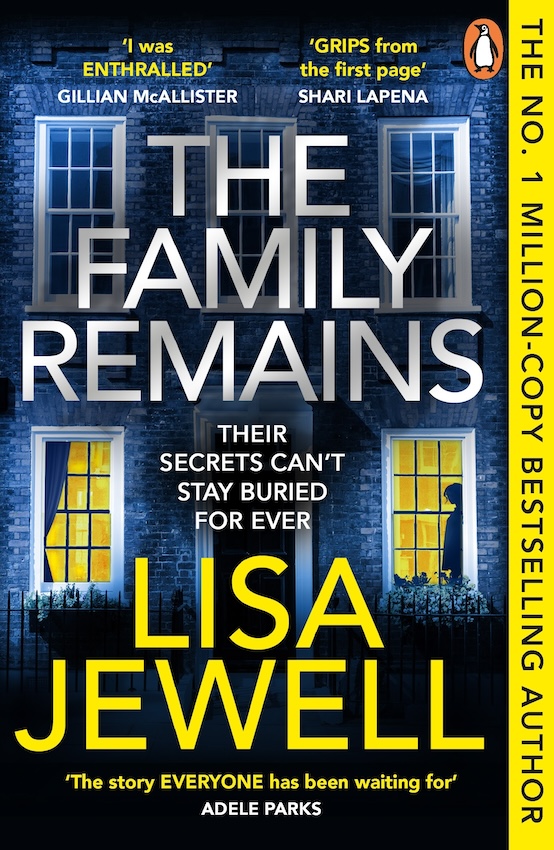
Book Review: The Family Remains by Lisa Jewell – a twisty, psychological thriller sequel that will have you hooked

The sequel, The Family Remains picks up the story of the younger generation, having been reunited in the first book and who are now trying to each build a future. This includes Libby Jones, the daughter Lucy had as a teenager, brought up by adoptive parents and who inherited the house in Chelsea. But the shadows of what went before still linger and there’s a sense that Henry and Lucy in particular are still looking over their shoulders.

When a bag of bones is found by mudlarkers on the riverbank, DI Samuel Owusu traces them back to the old Lamb residence and all the things that Henry and Lucy hoped would be forgotten about forever may now come to light. But Henry and then Lucy are on a quest to find Phin, Libby’s father, supposedly working in a safari park in Botswana, but who has high-tailed it, for some reason, to Chicago.

So while Henry and Lucy are hunting down Phin, DI Owusu is trying to piece together the life of Birdie Dunlop-Evers, a former member of a pop-group, reported missing in the 1990s. The story also works in the story of Rachel, a jewellery designer, who is told at the start of the book of the death of her estranged husband. We’re well aware of the particularly nasty type of guy Michael was – we met him in the earlier book when he was married to Lucy.

Golly, there’s a lot going on here, so never before was there a better reason to read the earlier book before the sequel. But somehow it all makes sense, and even if it’s a while since you read The Family Upstairs, you never feel completely bamboozled. Yes, you will have questions, loose ends and half-forgotten pieces of the overall puzzle. But Lisa Jewell will have you hooked, never the less, as I was.

I steamed through this novel in a couple of days, desperate to know if things would work out all right in the end. There’s always the sense that even though Henry and Lucy and even perhaps Phin, have been driven to do desperate and even quite bad things, they were very damaged children. We still feel for them, as well as Rachel, getting caught up in a relationship with a monster. It’s a twisty, original psychological thriller and as such a compelling read, but it’s very empathetic too.

And the characters are just so interesting. DI Owusu is a really nice guy, thoughtful, intelligent and sympathetic, which helps balance out the potential darkness and selfishness of Henry. Rachel’s story takes us into a character who has lived for the moment when it comes to relationships and suddenly in her thirties, feels it’s time to make a commitment. If only she hadn’t settled on Michael. But it’s Lucy I really enjoyed the most – she is so fragile on the one hand and yet has had to be strong and think on her feet for her children.

It is probably the characters and their unique situation that prompted so much demand from readers for the sequel that Lisa Jewell hadn’t planned to write. Which is probably why her books are so good, so moreish. Whenever I feel like a book to unwind with, she’s a top choice. If only I could make them last a day or two longer. This one’s a four-star read from me.

Book Review: Western Lane by Chetna Maroo – a beautiful imagining of a family’s grief through a child’s eyes

In some ways, Western Lane follows a well trodden path – a young person going through a difficult time, finding an outlet for their feelings through a sport, and then the promise of success. I’m sure I’ve seen a few movies like this, from the Karate Kid to Rocky. This time it’s squash, but the sport is really just something to give the plot a bit of structure, because overall this is a story about a family dealing with the loss of their mother.

Our narrator is Gopi, who is only eleven when her mother dies. She has two older sisters, Khush and Mona, who demonstrate their grief in different ways, while their Pa is patently struggling. His work is erratic – he’s an electrician and doesn’t always turn up when he says he will. His sister-in-law, the girls’ Aunt Ranjan is worried about them when the family visit their Pa’s brother in Edinburgh. Aunt Ranjan says he should consider giving one of the girls to her and Uncle Pavan to bring up.

Pavan and Ranjan have not been able to have children, are comfortably off, and are fond of the girls. Gopi, being the youngest, seems the likeliest candidate, but Pa can’t bear the thought of it. And imaging losing your mother at such a young age and then being uprooted from your home and family. So on their return to London, Pa and the girls deal with their problems by avoiding them. They hit the squash courts.

Of all the girls, it’s Gopi who has some talent and squash becomes a regular part of her routine. She meets Ged, who’s always at Western Lane because his mother works there. While Gopi plays squash with Ged, her Pa is becoming friendly with Ged’s mother. In the background the local Indian community are watching the family, eager to step in and offer advice, whether it’s appreciated or not. There’s pressure on the girls to do things right, as their mother would have done.

So there are a number of story threads in play, as well as glimpses of Indian culture, the food, the traditions which at times comfort, at others restricts. The reader very much gets a sense of Gopi, wth all that she is going through, what she’s feeling and the red flags. Can she be herself, be allowed to excel at squash as well as being a good daughter? There’s all the worry about her Pa, and her sisters, but she’s just so young. How can she have a normal childhood?

Western Lane is a lovely book, not very long, but nicely judged and the writing is gorgeous. I learnt a lot about squash, the feel of being on the court, the bounce of the speeding ball. It’s done in a way that makes it interesting for even a non-sports-minded person like me. The audiobook was superbly read by Maya Soroya and she really nails Gopi – a child struggling in a world that’s difficult to understand. The novel was shortlisted for the 2023 Booker Prize so I was curious to see why. It’s definitely worth picking up and I’ll be keen look out for more by this author. A four-and-a-half star read from me.


Book Review: Gabriel’s Moon by William Boyd – much more than your average spy novel

I’m always keen to read anything by William Boyd – his prose is crafted, his characters complex and there is always an interesting historical setting. And story-wise, you can never tell what’s going to happen next.

With Gabriel’s Moon we are in London, at least some of the time, in the early 1960s, and our complex protagonist this time is Gabriel Dax. He’s a travel writer at that time when travel writing was really popular, and at thirty, is already very successful.

The book opens with a prologue describing the house fire that killed his mother and when, as a six-year-old, Gabriel was lucky to escape with his life. Ever since, Gabriel has struggled to sleep – with nightmares of the fire plus troubling missing elements of his memory. He has sleeping pills, and not surprisingly he drinks a lot. A doctor recommends he see a therapist and these sessions lead him to investigate just what really happened that night.

Gabriel’s recent jaunt abroad has taken him to Léopoldville, and the newly independent Republic of the Congo. He takes an opportunity to interview the new prime minister, Patrice Lumumba, who wants to set the record straight. It seems his life is in danger, and there are names he wants recorded, should he be assassinated. This is way out of Gabriel’s usual sphere as a writer, but he does what he’s asked, making taped recordings of the interview.

But Gabriel’s work hasn’t always been just about travel. His brother Sefton, being something in the Foreign Office, has on occasion asked Gabriel to make deliveries for him to the Continent. When Faith Green, a secretive woman Gabriel has clocked reading his book on the plane home, contacts him with a commission of her own, his first instinct is to refuse. Faith works for MI6 and is something of a femme fatale. But the money’s good, and the trip to Spain tempting. Before you know it, Gabriel’s involved in more and more dangerous work for Faith and in spite of his niggling doubts, seems unable to refuse.

Gabriel’s an interesting character and not always likeable. You want to give him a good shake, tell him not to drink so much and get a grip on his life. There are sadly not many people he gets close enough to call friends. His girlfriend Lorraine hasn’t a clue about what is going on in his head, while he and his brother are somewhat distant having been brought up by different relatives after the death their mother. So there’s no one there to offer a reality check. How he handles the increasingly tricky situations he gets himself into sees a new Gabriel emerge.

Undercurrents of the political situation with the USSR, the Cuban Missile Crisis, as well as social politics of the time round the story out and the period really comes to life. There are glimpses of the ordinary, such as Gabriel’s ongoing battle with a savvy mouse in his flat; the pest-eradication advice from Tyrone, his streetwise locksmith. The book reminded me a little of A Bird in Winter by Louise Doughty – another really intelligent and nuanced spy novel with a main character on their own and battling for survival. This makes both books really engaging and gripping.

Then there are the settings. As well as Congo, there’s Warsaw and Cádiz, rural England and sixties London. If you’re after a satisfying, pacy but intelligent novel, Gabriel’s Moon might just do the trick. It’s a four-star read from me.

Book Review: The Impossible Thing by Belinda Bauer -a duel timeframe mystery from the cutthroat world of egg collecting

Belinda Bauer is a crime writer from Wales who frequently turns up in the crime fiction awards lists – winning a Gold Dagger for Blacklands, as well as the Theakston Old Peculier Crime Novel of the Year for Rubbernecker. I’ve always enjoyed her books, and would find it hard to pick a favourite, but Rubbernecker was, I recall, a cracker – following the story of a young autistic man and his determination to deal, in his own way, with the death of his father. In Rubbernecker, Patrick signs up for an anatomy class, where groups have to examine a corpse to determine cause of death. It’s his mother’s idea – a way to help him get over his obsession with dying. And this is how he gets tangled up in solving a murder.

It seems guillemots nest on cliffs, clustered in such tight proximity with each other that the mother bird lays a distinctive egg that will be easy to recognise among all the others. The colours are so varied, collectors would vie to obtain the most unusual. This is now quite illegal, but a hundred years or so ago, men would dangle on ropes over cliffs every nesting season to pick out eggs that they could sell. Which is how me meet our other main character, Celie Sheppard.

Celie is so different from her dark, robust looking siblings, her father disowns her and abandons the family to manage Medland Farm themselves. Her mother leaves baby Celie in the care of Robert, the “idiot” boy who helps on the farm in return for bed and board. Celie survives rather than thrives, and the two make an odd pair, both ignored by the other Sheppards. Egg collecting is a nice little earner at neighbouring farms but at Medland Farm there’s a rocky overhang making it impossible. Until skinny little Celie tells Robbie she can fit through a crack in the rock if he’ll hold her rope.

Celie’s story is one of ambition and trust, heroes and villains, love and also tragedy – particularly for the poor bird who gives up her very saleable egg every nesting season. You’re taken into the world of egg collecting – not just the perilous procedure involved, but also the greed and one-upmanship among the traders and collectors.

Nick and Patrick are also an unusual pair, but are oddly complimentary. Patrick is very smart but lacking in social awareness – something he realises and is working on. Nick isn’t all that bright but can be chatty and friendly. As even owning a rare, collectible egg is illegal, Nick refuses to get the police involved, so the two set about tracking down the stolen egg themselves. This will put them in the path of danger, as well as highlighting the motivations of egg obsessives, natural historians, wildlife custodians, and vigilantes.

The Impossible Thing is another cracking read from Bauer. I loved it, although the animal cruelty described is not for the squeamish. Bauer balances Celie’s more poignant story with the humour of Nick’s situation, his often at cross purposes dialogue with Patrick, their hare-brained schemes. There are some madcap action scenes, and the pace picks up to finish the story with a flourish.

This is also a very original novel, not only in its source material but with its two main characters, both outsiders, but both very likeable. And this makes it interesting. I am not sure if Bauer will bring Patrick back for another adventure, but I was delighted to meet him again and enjoyed his quirky smartness. The Impossible Thing is a four-star read from me.

The Impossible Thing will be released at the end of February. I read a proof copy of the book courtesy of Netgalley in return for an honest review.

Book Review: The Essex Serpent by Sarah Perry – a vivid historical novel where science, religion and superstition collide

The Essex Serpent was singled out for a raft of awards when it came out in 2016, even winning a couple. Now it’s showing on Apple TV with a brilliant cast including Claire Danes and Tom Hiddleston. I’m not sure why I didn’t pick up the book when it was released, because having read it now, I realise it’s just my kind of book

The story is set in the 1890s, a time of scientific discovery and medical advancement. Cora Seaborne’s bullying husband has recently died, and she finds not so much grieving, but discovering freedom in her new circumstances. Fascinated by science, particularly palaeontology, she is excited to hear reports of an “Essex serpent” and decides to head off to Colchester, accompanied by her companion/servant Martha and young son, Francis. She takes long walks in a man’s coat, releases her hair and becomes increasingly her own person.

Will and Cora clash in many ways, Cora determined that there is a possibility that a beast from the dinosaur era may have survived against the odds; Will’s more practical mind believing there’s a more rational explanation. He sees no reason why religion cannot accommodate modern science, while Cora cannot see how he can think logically and still have faith. The two are drawn to each other, in spite of an odd first meeting over the rescue of a sheep.

Other characters are equally interesting. There’s Cora’s friend, Dr Luke Garrett, who she refers to as the “imp”, the young doctor who attended her late husband, and who is patently in love with her. Luke is desperate to try new kinds of surgery and to make his mark on the medical world, his wealthy friend Spencer, tagging along. Martha has strong socialist views, and in spite of impoverished upbringing, has read Marx, attending lectures on social change and gets involved in housing reform. There are children who get caught up in all the Essex madness, as well as World’s End resident, old Cracknell with his ongoing campaign against moles.

There are further story threads involving Luke’s chance at heart surgery and the life he saves, and Spencer’s opportunity to impress Martha. With so much going on in the novel, the sub-plots highlighting the plight of the poor, and it’s very individualistic characters, the book reminded me a little of a Dickens novel. The writing is well-crafted and evocative, whether we’re in the slums of London, or the salt marshes of Essex. The different story threads pull strongly towards a dramatic finish, and you are desperate to see what happens next. I loved it – the audiobook version read by Juanita McMahon, was superb – and I shall certainly be reading everything else by Sarah Perry. The Essex Serpent is a five-star read from me.

Book Review: Death at the Sign of the Rook by Kate Atkinson – more fun and games with the latest Jackson Brodie mystery

I have to admit to being a Jackson Brodie fan since we met the beleaguered private investigator in the first book, Case Histories. I’ve read them more than once as well as enjoying immensely the TV adaptations starring Jason Isaacs. So here we are, five years since the last one (Big Sky), with another in the series – something I wasn’t really expecting, and you can imagine my delight.

Atkinson has a habit of not really continuing where she left off in the last book. Instead we seem to catch up with Jackson some years later, or with a completely different set of circumstances. Sometimes he’s flush and others he’s down on his luck. In Death at the Sign the Rook, Jackson is living with his girlfriend, Tatiana, and has had enough income from his PI work to buy himself a lovely big Land Rover Defender. His new case involves the theft of what looks like a Renaissance painting – a portrait of a Woman with a Weasel, which until recently hung on the bedroom wall, out of reach of prying eyes, of an elderly lady who has recently died.

It seems Dorothy Padgett’s carer Melanie Hope has taken it, and just disappeared without notice, leaving only an old mystery novel: Hark! Hark! The Dogs Do Bark by Nancy Styles. Dorothy’s daughter Hazel and her son Ian want Jackson to track Melanie down rather than calling the police – the painting may have some dodgy provenance. We get Jackson’s usual internal sizing up of the situation with Dorothy’s grasping offspring, squabbling over their mother’s possessions.

The story weaves in and out of Jackson’s investigation, bringing in several other main characters, beginning with Lady Milton over at her cash-strapped stately home, Burton Makepeace. LM has similarly lost a valuable painting, this one a Turner, at the same time as her companionable housekeeper Sophie disappeared. She is struggling to keep control of things while her eldest son Piers is trying to turn the big house into a hotel complete with staged murder mystery evenings. She’s an impossible character to like with her old-world thinking and arrant snobbery, but you can’t help feeling a bit sorry for her.

There’s also the boring vicar, Simon Cate, who has had a complete loss of faith, but battles on regardless, a fondness for animals, his only saving grace. And then there’s Ben, ex-military and a bit sorry for himself having lost a leg on his last tour, while missing his mates in the Army. He’s living with his sister, and learning to look after bees. We also meet Reggie Chase again – you’ll remember her from previous books – now a Yorkshire police detective.

These threads all slowly weave the characters into a plot involving a blizzard, a murderer on the run who’s armed and dangerous, and a murder mystery evening at Burton Makepeace. Somehow all of the characters end up there – we’re given a hint of what’s to come in a kind of prologue – and Jackson’s going to feel glad he bought the Defender. As usual it isn’t always the crooks that are the baddies, or not all of them anyway, and Jackson may or may not err on the wrong side of the law.

Atkinson is a master of creating a tantalising story with plenty of humour and surprise twists. However, I did feel this story took a while to get going. We get stuck for chunks of narrative with Simon the vicar, and Lady Milton, both of whom can be a bit tiresome. But once the story gets going, there’s plenty to enjoy and the ending’s a cracker. Not the best Jackson Brodie, but still worth reading. A three-and-a-half star read from me.

Book Review: House of Glass by Susan Fletcher – a chillingly gothic novel with an extraordinary heroine

I was so taken with Susan Fletcher’s recent novel, The Night in Question, that I thought I’d try one of her earlier books. I picked up House of Glass, a historical mystery novel which oozes creepy house atmosphere.

We start off in London at the turn of the twentieth century, where we first meet Clara as a child, unable to leave her house. She has osteogenesis imperfecta, a kind of brittle bone disease, which means the slightest stumble or fall can cause a broken bone. The doctor thinks it best if she doesn’t go outside until she has grown up – or as grown up as she ever will be.

Clara is well cared for – there are endless books to read, and her mother, Charlotte, and her stepfather love her. Charlotte is a suffragette who left India as a young woman in disgrace and has made a marriage of convenience to Patrick. At the age of eighteen, Clara is able to explore the world with care, but the early death of Charlotte leaves her devastated. She finds herself at Kew Gardens in winter, befriended by one of the gardeners, and is slowly restored to herself by learning about the plants.

The story takes us to Shadowbrook, a once stately home with impressive gardens, where Clara takes on a short-term job – to oversee the establishment of a glass house of tropical plants, delivered from Kew. The new owner of Shadowbrook, a Mr Fox, is rarely at home, so Clara is left to get on with the glass house. But there are ghostly occurrences in the house – footsteps upstairs, where none of the staff or Clara are allowed to venture; flowers that are torn to shreds in the vases; things moved around. The housekeeper talks of paintings thrown from the walls, books flung from the shelves – which explains the bareness in many of the rooms.

Clara is a young woman who has immersed herself in science and doesn’t believe in ghosts. Even so she can’t help but be curious about the Pettigrew family that once lived at Shadowbrook, the stories of wild and cruel behaviour that have made them hated in the village. But the more questions she asks, the more suspicious the locals are of Clara, with her long, pale and untamed hair, her stoop and walking stick, her strange-coloured eyes. She begins to feel as much an outsider as the mysterious Veronique Pettigrew, whose ghost supposedly haunts Shadowbrook.

I had a curious sense of being watched; throughout the garden, I felt it. It was as though I had entered a part of it – the orchard, the lime bower – at the very moment that someone else had risen and left; I felt any metal chair might retain that person’s heat. It was an unsettling notion. I chastised myself for it – it was foolishness – yet I also looked down the lines of hedges. On the croquet lawn, I turned a slow, complete circle to see it all.

House of Glass is a novel that works on many levels. It reminded me of Wilkie Collins’ The Woman in White, with its mix of suspense and mystery. There’s atmosphere by the truckload in the house and the gardens, both evocatively described. Many of the characters seem to be harbouring secrets, some of them quite devastating as the story emerges, and there are a few twists before you get to the end.

My body was discoloured, marked. I was perhaps, more bruised than I had ever been; mauve and dark red and yellow in places. I examined the bruises one by one. I tried to remember the cause of each – a branch or a door frame, my own touch – and once, I might have minded such injuries. But now I saw those bruises as proof that I was living. I was no longer watching life from a London window, my hands on the glass; I was a part of it.

And then there’s the conjuring up of England on the brink of war – it’s 1914, the summer that Clara comes to Shadowbrook – so you’re constantly aware that the futures of the young gardeners and other characters are hanging in the balance. The place of women, not only the suffragettes, but any woman wanting to make a life of her own, to live the way she wants to is a theme that is depicted in the characters of Clara, Charlotte and in the story of Veronique.

House of Glass is a terrific read for anyone who loves a good historical mystery, or enjoys an atmospheric setting, particularly the way an English country house can be almost a character in itself. The characters are interesting more than likeable, while the plot has plenty to get you rushing through the final chapters. Throw in some nicely crafted writing and there’s plenty here to enjoy – it’s a four-star read from me.