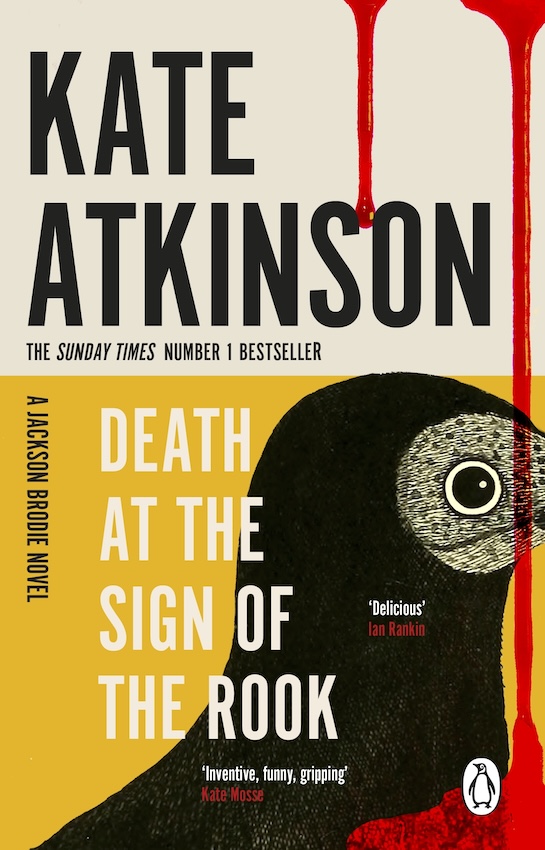
Book Review: Death at the Sign of the Rook by Kate Atkinson – more fun and games with the latest Jackson Brodie mystery

I have to admit to being a Jackson Brodie fan since we met the beleaguered private investigator in the first book, Case Histories. I’ve read them more than once as well as enjoying immensely the TV adaptations starring Jason Isaacs. So here we are, five years since the last one (Big Sky), with another in the series – something I wasn’t really expecting, and you can imagine my delight.

Atkinson has a habit of not really continuing where she left off in the last book. Instead we seem to catch up with Jackson some years later, or with a completely different set of circumstances. Sometimes he’s flush and others he’s down on his luck. In Death at the Sign the Rook, Jackson is living with his girlfriend, Tatiana, and has had enough income from his PI work to buy himself a lovely big Land Rover Defender. His new case involves the theft of what looks like a Renaissance painting – a portrait of a Woman with a Weasel, which until recently hung on the bedroom wall, out of reach of prying eyes, of an elderly lady who has recently died.

It seems Dorothy Padgett’s carer Melanie Hope has taken it, and just disappeared without notice, leaving only an old mystery novel: Hark! Hark! The Dogs Do Bark by Nancy Styles. Dorothy’s daughter Hazel and her son Ian want Jackson to track Melanie down rather than calling the police – the painting may have some dodgy provenance. We get Jackson’s usual internal sizing up of the situation with Dorothy’s grasping offspring, squabbling over their mother’s possessions.

The story weaves in and out of Jackson’s investigation, bringing in several other main characters, beginning with Lady Milton over at her cash-strapped stately home, Burton Makepeace. LM has similarly lost a valuable painting, this one a Turner, at the same time as her companionable housekeeper Sophie disappeared. She is struggling to keep control of things while her eldest son Piers is trying to turn the big house into a hotel complete with staged murder mystery evenings. She’s an impossible character to like with her old-world thinking and arrant snobbery, but you can’t help feeling a bit sorry for her.

There’s also the boring vicar, Simon Cate, who has had a complete loss of faith, but battles on regardless, a fondness for animals, his only saving grace. And then there’s Ben, ex-military and a bit sorry for himself having lost a leg on his last tour, while missing his mates in the Army. He’s living with his sister, and learning to look after bees. We also meet Reggie Chase again – you’ll remember her from previous books – now a Yorkshire police detective.

These threads all slowly weave the characters into a plot involving a blizzard, a murderer on the run who’s armed and dangerous, and a murder mystery evening at Burton Makepeace. Somehow all of the characters end up there – we’re given a hint of what’s to come in a kind of prologue – and Jackson’s going to feel glad he bought the Defender. As usual it isn’t always the crooks that are the baddies, or not all of them anyway, and Jackson may or may not err on the wrong side of the law.

Atkinson is a master of creating a tantalising story with plenty of humour and surprise twists. However, I did feel this story took a while to get going. We get stuck for chunks of narrative with Simon the vicar, and Lady Milton, both of whom can be a bit tiresome. But once the story gets going, there’s plenty to enjoy and the ending’s a cracker. Not the best Jackson Brodie, but still worth reading. A three-and-a-half star read from me.
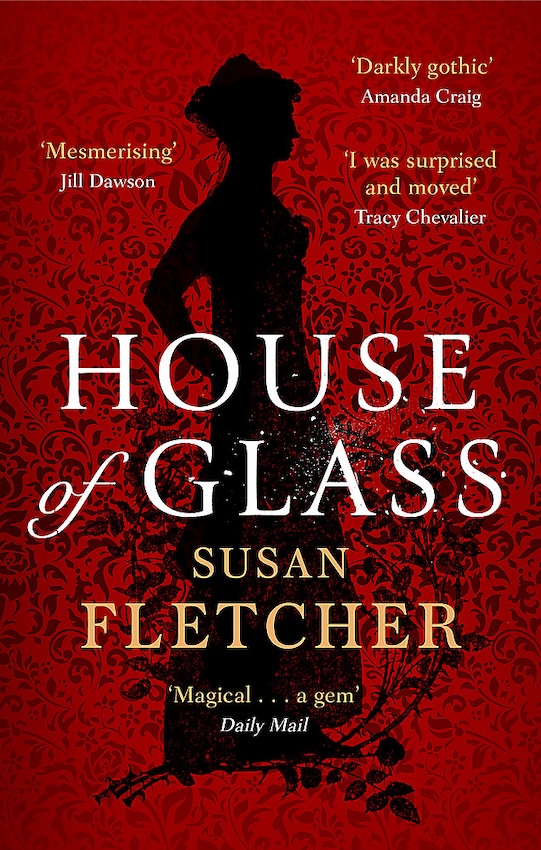
Book Review: House of Glass by Susan Fletcher – a chillingly gothic novel with an extraordinary heroine

I was so taken with Susan Fletcher’s recent novel, The Night in Question, that I thought I’d try one of her earlier books. I picked up House of Glass, a historical mystery novel which oozes creepy house atmosphere.

We start off in London at the turn of the twentieth century, where we first meet Clara as a child, unable to leave her house. She has osteogenesis imperfecta, a kind of brittle bone disease, which means the slightest stumble or fall can cause a broken bone. The doctor thinks it best if she doesn’t go outside until she has grown up – or as grown up as she ever will be.

Clara is well cared for – there are endless books to read, and her mother, Charlotte, and her stepfather love her. Charlotte is a suffragette who left India as a young woman in disgrace and has made a marriage of convenience to Patrick. At the age of eighteen, Clara is able to explore the world with care, but the early death of Charlotte leaves her devastated. She finds herself at Kew Gardens in winter, befriended by one of the gardeners, and is slowly restored to herself by learning about the plants.

The story takes us to Shadowbrook, a once stately home with impressive gardens, where Clara takes on a short-term job – to oversee the establishment of a glass house of tropical plants, delivered from Kew. The new owner of Shadowbrook, a Mr Fox, is rarely at home, so Clara is left to get on with the glass house. But there are ghostly occurrences in the house – footsteps upstairs, where none of the staff or Clara are allowed to venture; flowers that are torn to shreds in the vases; things moved around. The housekeeper talks of paintings thrown from the walls, books flung from the shelves – which explains the bareness in many of the rooms.

Clara is a young woman who has immersed herself in science and doesn’t believe in ghosts. Even so she can’t help but be curious about the Pettigrew family that once lived at Shadowbrook, the stories of wild and cruel behaviour that have made them hated in the village. But the more questions she asks, the more suspicious the locals are of Clara, with her long, pale and untamed hair, her stoop and walking stick, her strange-coloured eyes. She begins to feel as much an outsider as the mysterious Veronique Pettigrew, whose ghost supposedly haunts Shadowbrook.

I had a curious sense of being watched; throughout the garden, I felt it. It was as though I had entered a part of it – the orchard, the lime bower – at the very moment that someone else had risen and left; I felt any metal chair might retain that person’s heat. It was an unsettling notion. I chastised myself for it – it was foolishness – yet I also looked down the lines of hedges. On the croquet lawn, I turned a slow, complete circle to see it all.

House of Glass is a novel that works on many levels. It reminded me of Wilkie Collins’ The Woman in White, with its mix of suspense and mystery. There’s atmosphere by the truckload in the house and the gardens, both evocatively described. Many of the characters seem to be harbouring secrets, some of them quite devastating as the story emerges, and there are a few twists before you get to the end.

My body was discoloured, marked. I was perhaps, more bruised than I had ever been; mauve and dark red and yellow in places. I examined the bruises one by one. I tried to remember the cause of each – a branch or a door frame, my own touch – and once, I might have minded such injuries. But now I saw those bruises as proof that I was living. I was no longer watching life from a London window, my hands on the glass; I was a part of it.

And then there’s the conjuring up of England on the brink of war – it’s 1914, the summer that Clara comes to Shadowbrook – so you’re constantly aware that the futures of the young gardeners and other characters are hanging in the balance. The place of women, not only the suffragettes, but any woman wanting to make a life of her own, to live the way she wants to is a theme that is depicted in the characters of Clara, Charlotte and in the story of Veronique.

House of Glass is a terrific read for anyone who loves a good historical mystery, or enjoys an atmospheric setting, particularly the way an English country house can be almost a character in itself. The characters are interesting more than likeable, while the plot has plenty to get you rushing through the final chapters. Throw in some nicely crafted writing and there’s plenty here to enjoy – it’s a four-star read from me.

Book Review: Mr Campion’s Christmas by Mike Ripley – a fun, seasonal read with both thrills and period charm

Mike Ripley is the author of the Fitzroy Maclean Angel crime series featuring an enigmatic bandleader as its sleuth. Then about ten years ago he picked up where Margery Allingham left off and has written another twelve novels in her Albert Campion series. I feel as if I’m rather late to the party having never read any of the Campion books, which Allingham began way back in 1929, a kind of spoof, supposedly, of Dorothy Sayers’ Lord Peter Wimsey novels.

Having just read Mr Campion’s Christmas I feel I have a bit of catching up to do. The story begins with a bus journey from London, leaving the Victoria Coach Station a couple of days after Christmas. It’s 1962, a year that went down in history not only for the Cuban Missile Crisis, but also a severe season of blizzards that particularly rocked East Anglia. The coach is heading for Walsingham, a Norfolk village famous for its shrines and as such a destination for pilgrims.

Walsingham is also near an RAF airbase, so there are three genial American airman on board, as well as a small collection of odd characters: Hereward Henderson, a history buff and general bore, Miss Pounder, a reserved middle-aged woman, Reverend Breck who is planning to retire in Walsingham, and Fred De Vries, a Dutch art dealer who guards his luggage with his life. It’s a nerve-wracking journey for Graham Fisk, the driver, as snow turns to blizzard, so he’s only too happy to hand over the driving to one of the airmen. But even Oscar can’t keep the bus straight in such horrific conditions and the coach collides with one of the gate posts of a country house named Carterers.

Yes, it’s the home of Albert Campion, his wife Lady Amanda and their son Rupert, just home from his first term at a University in America. The three are hunkering down as the snow falls, along with Campion’s side-kick Magersfontein Lugg, a large man with a few rough edges. The hot meals keep coming thanks to Mrs Thursby, the housekeeper, and the family have also rescued Lloyd Thursby, Mrs Thursby’s deaf father-in-law who has a passion for watching westerns on the TV.

Suddenly the Campions are playing hosts to the stranded coach party and sleeping arrangements have to be sorted. But what starts out as Yule-tide hospitality turns into a hostage situation plus a murder, and it’s a return to the old days for Campion and Lugg who must save the day. It’s a classic kind of thriller, made entertaining and fresh by the quirky characters of the household as well as those from the coach. Most of this group seem to be harbouring a secret, just to make things complicated.

Of course the telephone loses connection so there’s no chance of rescue, and the Campions must rescue themselves, although help comes from an unexpected quarter. Lady Amanda is a modern woman, with a career in the aeronautical industry, and also gets to show her mettle. Just as all seems lost, Campion devises an oddball plan that is very entertaining as well as reasonably nail-biting. Campion hides his skill at handling tricky situations behind a facade of batty eccentricity, that’s a little P G Wodehouse, while his brain is in overdrive looking for windows of opportunity. There are codewords and his number one weapon, the size and heft of Lugg, is eventually deployed.

Bubbling through it all is a steady stream of wit, humorous incidents and smart writing that makes this update of an old favourite nicely readable for a modern audience. But you’re still happily in 1962 and the classic crime writing of this era – the perfect light, diverting escapade for Christmas. Mr Campion’s Christmas is a four-star read from me.

Book Review: The Night in Question by Susan Fletcher – a wheelchair-bound octogenarian on the trail of a killer

Novels set in assisted living facilities are becoming quite a trend. I love the way authors such as Joanna Nell and Richard Osman create active and determined elderly protagonists, giving them a new lease of life when everyone else seems to think they ought to be taking things easy.

And you can say that about The Night in Question, which is partly a murder mystery, but a lot more besides. I was soon happily engrossed in an engaging story, but also impressed by the beautifully crafted writing. Of course I should have known I was in safe hands when I saw a recommendation on the cover from Clare Chambers.

The Night in Question is told from the point of view of Florrie Butterfield, eighty-seven and because of a mishap with some mulled wine, has to get around in a wheelchair. She has a comfy flat in Babbington Hall, a former stately home now with various levels of care for the elderly. A cheery, friendly sort, her plump form swathed in pastels, Florrie doesn’t look all that sharp, but appearances can be deceptive. For when two events take place – the first resulting in a death, the second written off as an attempted suicide – Florrie is convinced that someone else is to blame.

Teaming up with Stanhope Jones, another resident she’s got to know chatting about Shakespeare near the compost heap, Florrie is determined to get to the bottom of it. The story will unmask events that are long past, a tragedy that can’t be forgotten or it seems forgiven. But in doing so, Florrie’s own personal tragedy begins to surface, an event that has dogged her since she was seventeen.

As Florrie and Stanhope hunt down clues, research online and interview the Babbington Hall staff and residents, we slowly learn Florrie’s past. Delving into an old cheese box full of mementoes, she remembers the people she has loved. These include her parents, Bobs her brother, best friend Pinky, who was as tall as Florrie was round, and the six men who each almost captured her heart.

Florrie opens her eyes. It feels a small, quiet thought; she merely notes it, at first – there it is – as if a bird has landed inside her, preens a little, settles and closes its wings. But she continues to stare in the darkness.
Can this be true? Is it possible? And she thinks, Yes – for no other reason than it feels easy and right. It feels to fit, just so – like a good shoe. And she remembers Sergeant Butterfield at the kitchen table, saying, ‘A good policeman will listen to this, Florrie’ – tapping his chest with his middle finger. This.
Pushed. She was pushed.

Bobs was the one who probably had the most influence on how Florrie would lead her life, returning from a tank regiment in World War II, badly burned. Always yearning to see the world, Bobs implores Florrie to travel for both of them and do everything they had planned as youngsters. So while Pinky married and had a family, Florrie answered adverts in the paper for jobs in France, then Africa. With each there’s a certain someone she remembers fondly. There’s more travel and more mementoes, new relationships – but no one she dares trust with the truth of her past.

We’ll have to wait until the present day crimes are solved before we find out what it was that happened to Florrie as a girl, the tragedy only Pinky and her great-aunt every knew about. In the meantime, Stanhope does the physical things Florrie can’t – the illicit searches and foraging in the recycling skip – while Florrie chats to people. The two become closer, and the reader can’t but wonder if one day Florrie will tell Stanhope her story.

The Night in Question is a brilliant read, well paced and peppered with terrific characters. Stanhope is charming, a quiet former Latin teacher with a gentle wit. There’s Magda, young and tattooed with a heartbreak of her own, and Reverend Joe with his massive beard, ACDC T-shirts and a tendency to let out the odd swear word during church services. There’s an interesting cast among the other residents, nosy ones and gossipy ones, people Florrie tries to avoid in the dining hall, and others she feels sorry for. It all adds to a rich and entertaining story.

In finishing the novel, I can’t help feeling I’ve discovered a wonderful new author. Susan Fletcher has written seven previous books so I’ll look forward to hunting through her backlist. Her first novel, Eve Green, won the Whitbread First Novel award, and there have been other award nominations. This one’s definitely a nicely fresh take on the rest-home murder mystery and I can’t wait to see what she does next. The Night in Question is a four-and-a-half star read from me.

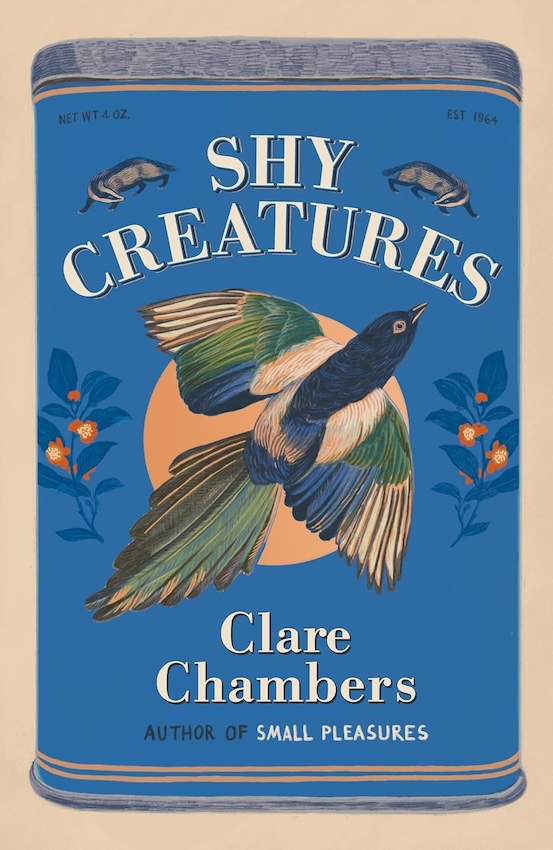
Book Review: Shy Creatures by Clare Chambers – a remarkable story, engrossing and heart-warming

I bought Shy Creatures as soon as it came out as an ebook, and unlike many previously purchased novels, it didn’t sit on my bedside table languishing while I was distracted by other books passing by. It beckoned to me and I was soon engrossed – and gosh, what a satisfying read it is.

Shy Creatures is set for the most part in 1964. Helen Hansford is an art therapist at Westbury Park, a facility for mental health patients. She has been having an affair with Gil Rudden, one of the doctors, which is complicated by his wife being a distant cousin of her mother’s. Gil has promised Helen that as soon as his children are old enough to leave home, he will divorce his wife and marry her. Helen accepts the status quo and muddles on with a less than satisfactory home life, a nagging mother, and a job where she doesn’t feel she makes a lot of difference.

For all that, Helen is passionate about her work and the way Westbury Park is run. The gates are always open, and while some therapy involves dulling the patients’s minds with drugs, doctors like Gil have more modern ideas, which is one of the reasons Helen fell for him. An incident at a nearby house leads Helen and Gil to discover a man who has been shut up indoors for at least ten years along with his only relative, a frail and elderly aunt.

William Tapping, now in his late thirties, has been found in a bad way, in a state of undress, a beard down to his stomach and apparently mute. The house is in a state of disrepair, filthy windows letting in no light, the garden a jungle. When social services intervene, William and his aunt are whisked away to Westbury Park. Here Aunt Louisa implores Helen to find a container hidden in the flour bin that no one else should see, but while she’s at the house, Helen also discovers some drawings in William’s room that display the work of a talented artist.

At the discovery of this cache, Helen’s pulse quickened and she felt a tingle of excitement. No one who had passed through the art therapy room during her residency had shown anything approaching this level of talent. Of all the professionals at Westbury Park, she was uniquely placed to help this hidden man emerge from his place of silence. Even Gil did not have her advantage.

The story follows Helen’s efforts to make a connection with William through art as well as her tracking down some old acquaintances – people he knew at school – in an attempt to find out more about him. We have the ups and downs of Helen’s relationships with Gil, as well as her family, particularly with a teenage niece who has a kind of breakdown. Woven into all of this is William’s story, going back steadily in time until we get to the day when his life changed dramatically, putting in place the kind of house arrest his family imposed on him.

It’s a fascinating story with Clare Chambers’s usual wit and brilliantly evoked characterisation – one of the things that puts her books on my must-read list. And it’s a sad story too, as we consider William’s wasted years. The author recreates the era of the sixties – the music and clothes as well as social attitudes to women, to the mentally frail. The limited choices for girls once they leave school – particularly if they want to please their mothers. We also have the war years, and the privations of rationing, the nightly fear of air raids.

If there’s a theme that often appears in books by this Clare Chambers, it is about finding a place in society when you’re not a natural fit. Many of her characters are on the quirky side and with William, we have someone who quite possibly never will find a suitable niche in the world – particularly a world like Britain in 1964. This, plus Helen’s relationship woes pulls you through the story, along with the eventual revelation of a terrible secret. It’s another brilliant read from Clare Chambers – I can’t recommend it enough – a five-star read from me.

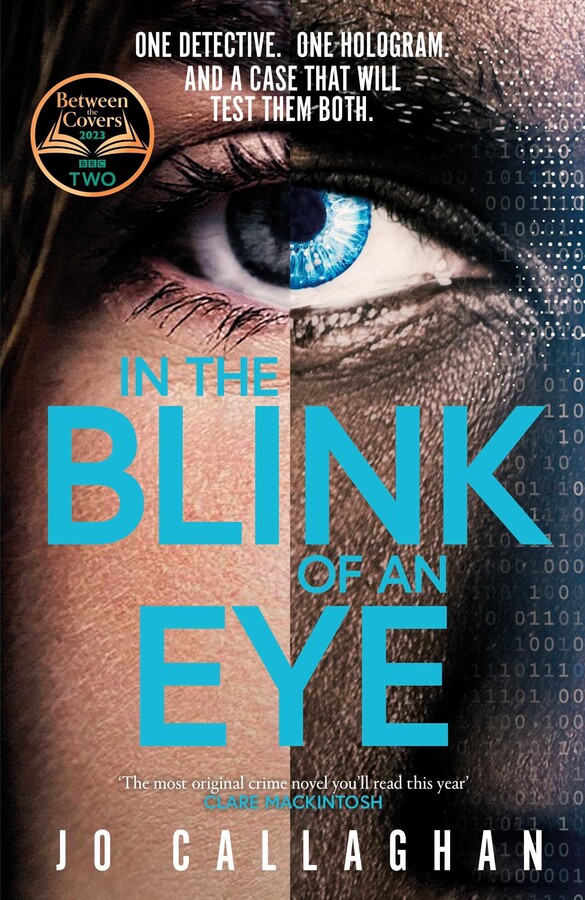
Book Review: In the Blink of an Eye by Jo Callaghan – a police pairing that breaks the mould

I always like to check out the Theakston’s Old Peculier Crime Novel of the Year awards – the shortlists are full of my favourite mystery authors (Elly Griffiths, Ruth Ware, Abir Mukherjee, and that’s just for starters). This year’s winner was Jo Callaghan’s debut novel, In the Blink of an Eye, which breaks new ground in that there’s a new police officer on the team, and it’s AI. The premise of this novel was just too good to ignore.

DCS Kat Frank has been away from the Warwickshire police on bereavement leave, and her husband’s death is still a bit raw. Her son, Cam, who has just completed his A Levels, has been having therapy, his anxiety over losing a second parent who has a dangerous job never far from his thoughts. So Kat has requested a safe option for her return to work, something less on the frontline. Her boss and mentor Chief Constable McLeish has a surprise in store. He’s signed Kat up to run a missing person’s cold case team that also will be trialling AIDEs (Artificially Intelligent Detecting Entities).

Kat is not happy. She’s an intuitive cop who follows her gut. You can’t solve cases with an algorithm, she declares. Meanwhile the scientist who has designed the AIDE, Professor Okonedo, with her own axe to grind, is sceptical of Kat’s skills and of the police in general. Reluctantly Kat agrees to the trial, taking on ambitious DI Rayan Hassan and shrinking violet, yet empathetic, DS Debbie Browne. Okonedo introduces AIDE Lock, a bracelet-type band that you can talk to like Siri, and which can whip up facts, statistics and probabilities in seconds. In holographic form, it’s remarkably like a person.

With hundreds of cold cases to chose from, Lock determines that recently missing young males will be more easily found. But Lock and Kat disagree over which. Kat’s preferred case is Tyrone Walters, a high-achieving young black man from a deprived area. Lock prefers Will Robinson, a young white male not much older from a wealthy home. According to Locke, statistics suggest the Robinson case would be easier to solve because he’s white. Kat is appalled as this racial bias and has a feeling that Tyrone has been a victim of foul play..

Ultimately, Hassan suggests the trial review both cases, and Professor Okonedo assures Kat that Lock can “perform the functions of many officers in just a fraction of the time”. This makes Kat only bristle more, but she reluctantly agrees. If only the team realised that what starts out as a test, a case chosen by statistics versus one chosen by gut feeling, will converge into a single case that is still active.

Picking up her briefcase, Kat paused at the door. She needed to leave her new team with something more motivational than her obvious irritation. ‘Remember, less than one per cent of missing people turn up dead, so we still have a good chance of finding both boys alive.’

‘Just to clarify, that figure represents one per cent of all the missing,’ said Lock’s voice from her wrist. ‘Only four per cent of adults are still missing one week after being reported, which is the category that Tyrone and Will fall within. So, in actual fact, there is a twenty-five percent chance that both boys are already dead.’

This really was an edge of the seat read, as woven into the narrative are scenes from the point of view of someone who has been kidnapped, drugged and immobilised. The clock is ticking and we can only hope that Kat and Lock will sort out their differences enough to solve the crime and save the missing lads. While Kat is learning how to manage Lock and use its obvious skills – downloading data, scanning social media for clues, extrapolating info, etc. – Lock is learning too. And it needs to, particularly with reading body language and developing social skills.

This makes the book really interesting as it takes time before Kat and Lock gel enough to be useful together. For a lot of the time they’re the angry cop and the irritatingly rational cop. Slowly, Kat’s team start to come into their own: Hassan in spite of his confident manner has a softer side and stuff going on at home, while Browne has a big problem to deal with, but fortunately Kat has enough patience to bring her out. Although mostly Kat is on edge, drinks too much and tends to fly off the handle.

It will be interesting to see how Kat and her officers, as well as Lock, evolve over the course of this series – there’s already a second book, Leave No Trace, plus a third to be published in April next year. Quite the feast. Whatever your thoughts on AI, In the Blink of an Eye illuminates it in real-world scenarios. Jo Callaghan has done a lot of research on the subject and how she imagines AI in a policing environment is fascinating. It’s a four-star read from me, and I can’t wait for the TV series. It would be a cracker.

Book Review: Back Trouble by Clare Chambers – an oldie but a goodie from a favourite author

If you enjoyed Clare Chambers’s last book, Small Pleasures, as much as I did, you’ll be pleased to know her new book, Shy Creatures, is out soon. I’ve always loved this author’s particular way with empathy and humour, so when I found an earlier book by Chambers at a second-hand bookshop, I was delighted, in spite of having read it years before.

Back Trouble, first published in 1994, is about Philip, who is about to turn forty, and his life for the most part seems to have gone to custard. We first catch up with him at an awkward family New Year’s celebration. His insurance broker brother Raymond is over from Canada with a new batch of photos of his children, recounting their successes (the football and the gymnastics), while Philip has never felt less like celebrating. With the failure of his publishing company he is in debt up to his eyeballs and the love of his life having gone home to New Zealand, life couldn’t get any worse, could it?

A cold chip from an overflowing municipal bin sends Philip head over tail and the ensuing back injury leaves him bedridden. There’s nothing to do but to fish out the notebook and pens from under his bed and begin to write the story of his childhood – a New Year’s challenge flung out by Raymond, to be completed in three months – just a thousand words a day – no probs. We are reminded that this is the 1990s and the Internet is in its infancy, although probably a more modern-day Philip wouldn’t be diverted by technology as he’d be out of data anyway – he’s that strapped for cash.

The kitchen was the first room to be tackled. One of the men from the building site had given Dad and industrial-sized drum of bottle green paint from the batch which his brother, who worked for the Council, had been using to paint the park railings. Cost was Dad’s only criterion in selecting materials. This meant garish rolls of wallpaper from the bargain bucket outside the DIY shop, the top six inches of every roll faded by the sun, and brushes which moulted into the paint. He had an idiosyncratic way of decorating. Being both nervous and impatient he didn’t believe in preparing surfaces, always fearing that something terrible might be lurking beneath a layer of bubbly paper or flaking paint. So instead of stripping paintwork, or even washing it, he would set straight to work, brushing gloss over old gloss, dust, mould and even, in one instance, a dead spider which lay preserved like a Pompeian relic in its shell of green paint.

Philip is such a self-deprecating narrator – he has no illusions about where he’s at as he approaches forty – and his story is warmly humorous as it rattles along to a nicely surprising ending. There are some poignant moments too, particularly in Philip’s childhood, with adults not behaving as they ought to and the weight of knowledge that falls on a young boy growing up. It is easy to blame Philip’s careless yet penny-pinching father, but other adults also turn out to be unreliable or even predatory.

Odd allusions to Great Expectations add an interesting twist. There are a raft of curious characters, quirky, helpful or otherwise, which may be another nod to Dickens, particularly the scene at Philip’s grandmother’s house – the blind matriarch and hoarder of useless furniture, including four unplayable pianos, terrifying in her fierceness; the black-toothed Auntie Florrie smoking her woodbines; Punnet the obese black labrador. It’s like stepping back in time.

For a small book, Clare Chambers packs quite a lot in and it’s hugely entertaining. I know she can always be relied upon for an original and big-hearted read so I am so looking forward to Shy Creatures, released on Amazon at the end of the month. Back Trouble is a four-star read from me.

Book Review: The Library by Bella Osborne – a feel-good read about an unlikely friendship and a library in trouble

A public library can be one of those places that offer a respite from the anxieties of everyday life. And while they’re not the silently bookish places they used to be, hosting community groups, classes and story times, they can still be a place of refuge in a way a shopping mall just isn’t. Bella Osborne has taken this idea to create a story around two lonely people and a friendship that develops at the library.

Maggie is seventy-two, a widow who runs a small holding on the outskirts of town. It’s a lonely life but she fills it with her love for her livestock, yoga and books. Her membership of a book group that meets every Saturday is the highlight of her week. Sixteen-year-old Tom is struggling to keep everything together at home where he lives with an alcoholic father. It’s a battle to make ends meet, and his dad wants him to give up school to join him at the factory – they could use the extra wages. But Tom has his sights on a better life, and Farah, a cute girl, if only she’d look his way.

Tom has as an odd idea that Farah uses the library and visits on the pretext of choosing some romance books for his mother. Soon he’s lugging home a pile of books he has no intention of reading. Maggie gets mugged outside the library on her way to her bus-stop and Tom helps her to her feet. Over time an unlikely friendship forms and Tom discovers the wonders of reading, farm life and finally has someone supportive in his life. Maggie has a glimpse of what having a family of her own might have looked like and feels less alone.

They sat side by side on the cool metal seats and waited for the bus. ‘I think this week’s book club read will be more up my street.’
He was looking about. He seemed to have lost interest in her. She got the book out anyway and showed it to him.
The Fault in Our Stars.’ He nodded. ‘You might like it,’ she said. He nodded again before realising his mistake.
‘Nah. Doubt it.’ Tom looked away.
‘It’s okay, Tom. The others don’t know and I won’t be telling them.’
‘Know what?’ He pulled his shoulders back and stared her down.
‘That it’s you reading the books and not your mum.’
His shoulders sagged with every word, until he was back to his rounded-shoulder posture. ‘How’d you know?’
‘The way you read the blurbs before choosing the books. The conversation about Me Before You.’ She gave a shrug. ‘I’m a bit like a dog with a bone when something doesn’t add up.’
He turned to look up the road for the bus, as if willing it to arrive, but there was ages yet. ‘Well done, Miss Marple.’

When the town council announces plans to shut their library down, Maggie reignites the feisty young woman she was in the sixties, demonstrating at marches, holding placards and making a nuisance of herself. She ropes in young Tom and her book club pals, but it’s an uphill battle when the library door-count has probably been dropping for decades. But as the Joni Mitchell song goes: “you don’t know what you’ve got till it’s gone” and a library is more than just books, it can be the heart of a community.

You can guess how the story will pan out, but there are a few surprises along the way. Maggie is hiding a secret, and so is Tom’s dad. Meanwhile Tom’s issues with his father add complexity as he faces extra pressure when he needs to focus on study if he has any hope of university. But it’s the humour in the odd little mishaps and misunderstandings that makes this a fun read. Maggie and Tom’s friendship is not always plain sailing so there’s some tension there too. Plus, there are puppies.

The Library is a light but engaging read, and anyone who has a fondness for libraries will relate to the characters and their campaign. There’s plenty of book talk too, especially when Tom, with nothing better to do, discovers that romantic fiction is a whole lot better than he expected. This is a warm, feel-good sort of story, cheering and heartfelt and a four-star read from me.

Book Review: The Hazelbourne Ladies Motorcycle and Flying Club by Helen Simonson – a fun historical read set in post WWI England

I’d really enjoyed both of Helen Simonson’s earlier books, Major Pettigrew’s Last Stand and The Summer Before the War, so was looking forward to her new book. And it’s a treat. Peppered with a cast of interesting characters, the story follows Constance Haverhill, who has recently lost her mother to the Spanish Flu. She has been taken pity on – and by that we mean made use of – by her mother’s old school friend, Lady Mercer. Constance is to accompany Lady Mercer’s mother to the seaside for an extended stay as a lady’s companion.

As you can guess, it’s just after World War I and Britain is both reeling from the devastation of losing so many soldiers, as well as celebrating peace. Women who have had to step up and take jobs formerly held by men are returning to traditionally female work, struggling to make ends meet on widows pensions, or depending on relatives.

Constance had made herself useful in the Mercer household managing the farm accounts – she’s a farmer’s daughter, after all – and has also trained as a bookkeeper. But with nowhere to go except her brother’s farm, her unpaid accounting work for the Mercers no longer required, Constance sees her short visit to Hazelbourne as a chance to evaluate her options. Fortunately, the elderly lady, Mrs Fog, is kindly and appreciative, allowing Constance plenty of time off to see the sights.

At the Meredith Hotel Constance is unable to have a table on her own as an unaccompanied young woman, as is Poppy Wirrall, who has just blown in on her motorcycle and is unsuitably attired. The two girls bond over a loaned skirt and before you know it, Constance is swept up into Poppy’s world. Poppy is a fan of motorcycles – she was a courier at the front – and has collaborated with some other women friends to set up a motorcycle and sidecar taxi service. One of the crew, Iris, is a keen motorcycle racer, but it’s hard breaking into a field dominated by men.

“I say, is there any chance you would help me?” said the girl, jumping up and extending a slightly oil-stained hand. “I’m Poppy Wirrall. I’ve been out all day on the motorcycle and damn it all if I didn’t leave my bag behind at home. My mother is still out visiting and the powers that be here have decided that after four years of war and pestilence they should still have the vapours over a woman having tea in trousers.”

Pippa’s family have decamped to the hotel while Mrs Wirrall is spending the family fortunes lavishly renovating their stately home. Brother Harris is an amputee, bitter at being treated like an invalid and desperate to fly bi-planes again. Several characters face difficulties in being seen for who they are, not just what they are. So Harris is expected to be an invalid, and his sister to marry, rather than run around on motorcycles. There’s also hotel waiter Klaus, a naturalised Englishman, but no one can see past his German origins. Class rears its ugly head as Constance knows only too well.

There is an element of Pride and Prejudice in the way Constance and Harris interact in the early parts of the book. Harris is haughty to protect himself from ridicule, and is bitter at seeing so many of his fellow pilots killed in the war. Constance, ever the poor cousin, bridles at his rudeness. But Harris at least is not a snob like the Mercers, and knows the value of people who have a good heart.

Everything comes together in a plot that simmers with exciting events – motorcycle races and aerobatic displays, dances and weddings, romances and disasters. Not everyone gets a happy ever after, but there’s hope and fresh starts aplenty as characters face challenges and rise to the occasion. The Hazelbourne Ladies Motorcycle and Flying Club is a charming story, nicely recreating the post WWI period in an English seaside setting – a light, fun read with moments that make you want to cry or cheer. A four-star read from me.

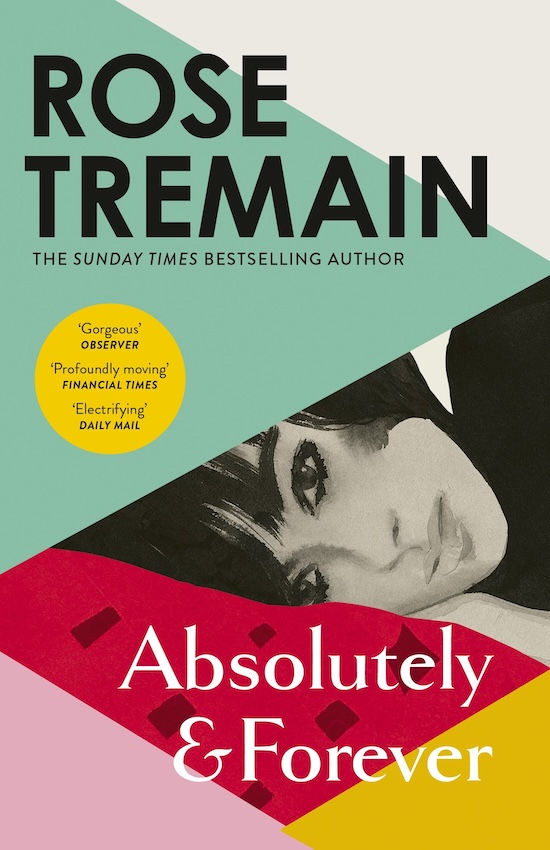
Book Review: Absolutely and Forever by Rose Tremain – a short and bitter-sweet novel about lost love and finding your way

I was warned that this book was somewhat melancholy, and in a way it is. Absolutely and Forever is about first love, specifically Marianne Clifford’s falling in love at fifteen with handsome and clever Simon Hurst. It is a love she just can’t seem to get over, and years after Simon has disappeared from her life, she still thinks about him in a yearning kind of way.

This might make Marianne appear somewhat daft. But don’t be put off; every moment we spend with her is entertaining. Tremain has written a dryly witty, self-aware character, born at time when a good marriage was often considered life’s ultimate goal for any young woman. We’re thrown into the late 1950s; Bill Haley and the Comets is on every party’s turntable and parents are eyeing up young men with prospects for their daughters. Particularly middle class parents in the Home Counties.

Absolutely and Forever made the shortlist of the Walter Scott Prize for Historical Fiction and although it didn’t win, you can see why it was noticed. Tremain captures the period so well, and through Marianne’s eyes we see how the times, they are a changing. At school, Marianne’s best friend is brave, outspoken Petronella who goes on to university to study sociology and spends the entire book urging Marianne to forget Simon and discover what she’s good at. You can tell Marianne’s smart, but this lesson takes a while for her to master.

On certain days, particularly when I was in the typewriter room of the college and fifteen typewriters were clattering and pinging and the carriages were being shunted left to right, left to right, and the wall clock was clicking away time, measuring our typing speeds, I felt my mind disintegrating. I thought, I’m in a madhouse; life has brought me here, to an asylum of a kind. It wasn’t the old and wondrous Love Asylum, it was now the Grief Asylum, where my heart was being shunted back and forth, back and forth, inside a chamber of despair.

The story takes Marianne through many ups and downs, including tragedy, and a surprise ending. Both turn out to be oddly liberating for our MC. So, yes, there is enough of a story here to keep you reading. But it’s the language that really had me hooked. At one point, Hugo, the man who falls for Marianne enough to put up with her melancholy, says the one thing he really loves about her is that he never knows what she’s going to come out with next. Tremain gives Marrianne’s narrative plenty of charm and flavour.

You can’t help thinking, thank goodness for the Swinging Sixties and women’s lib. For if they hadn’t come along would girls still be growing up pinning all their hopes of happiness on a man and forgetting they have a brain? Absolutely and Forever is a welcome reminder, and at a mere 180 odd pages a nicely-crafted, diversion you can read in a day. A four-and-a-half star read from me.