Book Review: Mr Campion’s Christmas by Mike Ripley – a fun, seasonal read with both thrills and period charm

Mike Ripley is the author of the Fitzroy Maclean Angel crime series featuring an enigmatic bandleader as its sleuth. Then about ten years ago he picked up where Margery Allingham left off and has written another twelve novels in her Albert Campion series. I feel as if I’m rather late to the party having never read any of the Campion books, which Allingham began way back in 1929, a kind of spoof, supposedly, of Dorothy Sayers’ Lord Peter Wimsey novels.

Having just read Mr Campion’s Christmas I feel I have a bit of catching up to do. The story begins with a bus journey from London, leaving the Victoria Coach Station a couple of days after Christmas. It’s 1962, a year that went down in history not only for the Cuban Missile Crisis, but also a severe season of blizzards that particularly rocked East Anglia. The coach is heading for Walsingham, a Norfolk village famous for its shrines and as such a destination for pilgrims.

Walsingham is also near an RAF airbase, so there are three genial American airman on board, as well as a small collection of odd characters: Hereward Henderson, a history buff and general bore, Miss Pounder, a reserved middle-aged woman, Reverend Breck who is planning to retire in Walsingham, and Fred De Vries, a Dutch art dealer who guards his luggage with his life. It’s a nerve-wracking journey for Graham Fisk, the driver, as snow turns to blizzard, so he’s only too happy to hand over the driving to one of the airmen. But even Oscar can’t keep the bus straight in such horrific conditions and the coach collides with one of the gate posts of a country house named Carterers.

Yes, it’s the home of Albert Campion, his wife Lady Amanda and their son Rupert, just home from his first term at a University in America. The three are hunkering down as the snow falls, along with Campion’s side-kick Magersfontein Lugg, a large man with a few rough edges. The hot meals keep coming thanks to Mrs Thursby, the housekeeper, and the family have also rescued Lloyd Thursby, Mrs Thursby’s deaf father-in-law who has a passion for watching westerns on the TV.

Suddenly the Campions are playing hosts to the stranded coach party and sleeping arrangements have to be sorted. But what starts out as Yule-tide hospitality turns into a hostage situation plus a murder, and it’s a return to the old days for Campion and Lugg who must save the day. It’s a classic kind of thriller, made entertaining and fresh by the quirky characters of the household as well as those from the coach. Most of this group seem to be harbouring a secret, just to make things complicated.

Of course the telephone loses connection so there’s no chance of rescue, and the Campions must rescue themselves, although help comes from an unexpected quarter. Lady Amanda is a modern woman, with a career in the aeronautical industry, and also gets to show her mettle. Just as all seems lost, Campion devises an oddball plan that is very entertaining as well as reasonably nail-biting. Campion hides his skill at handling tricky situations behind a facade of batty eccentricity, that’s a little P G Wodehouse, while his brain is in overdrive looking for windows of opportunity. There are codewords and his number one weapon, the size and heft of Lugg, is eventually deployed.

Bubbling through it all is a steady stream of wit, humorous incidents and smart writing that makes this update of an old favourite nicely readable for a modern audience. But you’re still happily in 1962 and the classic crime writing of this era – the perfect light, diverting escapade for Christmas. Mr Campion’s Christmas is a four-star read from me.

Book Review: Small Things Like These by Claire Keegan – a moving Christmas story, perfectly told

Expectations were high when I picked up Small Things Like These. After all it is a very small book – a novella really – and still it made last year’s Booker shortlist. I expected a small piece of perfection, and in many ways it is.

Set during the weeks before Christmas in a small Irish town, we are with Bill Furlong, a coal merchant as he makes his deliveries and plans his holiday with his family – a wife and five daughters. It’s a cold winter, and Bill draws our attention to the poverty of those around him who can’t afford their coal bill. He sees a boy gathering sticks by the roadside and gives him the change from his pockets, even though he has little enough to spare. You would think this is the 1950s, or earlier, but it is 1985.

Up on the hill, the convent looms over the town, and it is here that the better-off send their laundry, the nuns running a well-respected business. While delivering coal there Bill stumbles upon something he shouldn’t have seen, which as the father of daughters, leaves him troubled and absent-minded with his family. As the days pass Bill must decide if he will turn a blind eye to what goes on at the convent, as surely everyone else does, or step in and do a good deed.

People could be good, Furlong reminded himself, as he drove back to town; it was a matter of learning how to manage and balance the give-and-take in a way that let you get on with others as well as your own. But as soon as the thought came to him, he knew the thought itself was privileged and wondered why he hadn’t given the sweets and other things he’d been gifted at some of the houses to the less well-off he had met in others. Always, Christmas brought out the best and the worst in people.

This is the perfect Christmas story, quietly telling and moving about an ordinary man’s battle to do the right thing without thinking about the consequences. Bill himself is an interesting character, having been raised in the home of a wealthy woman, where his mother was housekeeper. He never knew who his father was and was bullied about it at school. He has had to work hard from the ground up to become the owner of his own coal business. But its viability relies on a fair bit of forelock tugging and respect towards the powerful, particularly the church.

Small Things Like These is an engaging story from the start and manages to convey a lot within its pages. There is nothing to spare, no mucking about with subplots or extra scenes added for colour. It is no longer or shorter than it has to be and doesn’t try to be particularly artistic or modern. It reminded me a little of those old stories by writers like O’Henry that let the story do the talking and pack a big emotional punch.

Some background information about the Irish convent laundries makes for sobering reading at the back of the book, but really Keegan has said it all with her story. A masterclass in storytelling and a five out of five from me.

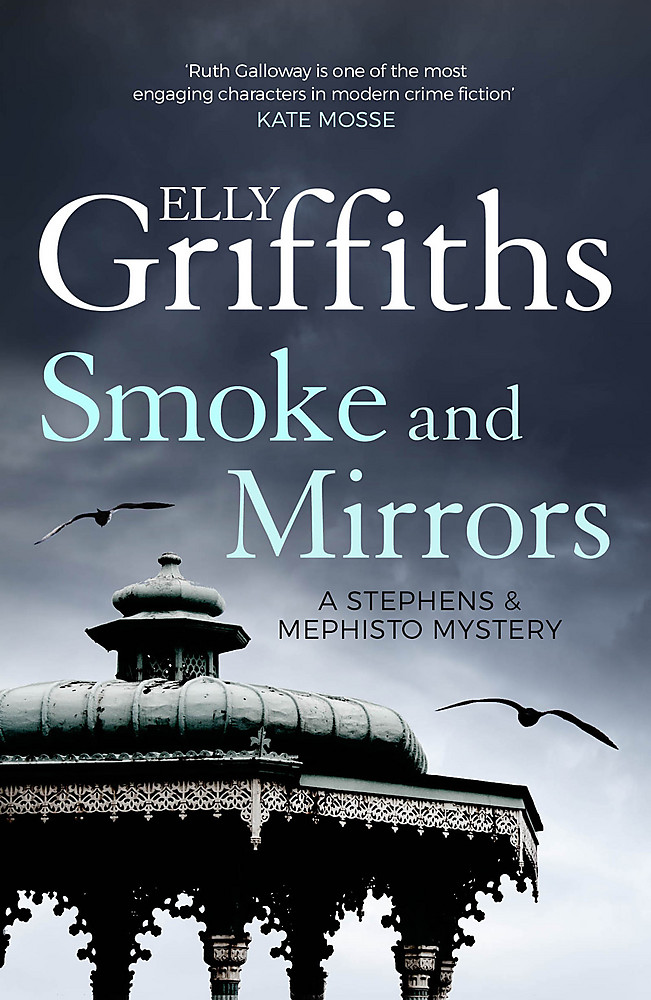
Christmas Reads 1: Smoke and Mirrors by Elly Griffiths

smokeSmoke and Mirrors is the second novel in Griffiths’ Stephens and Mephisto mystery series. I’ve read all her books in the Ruth Galloway / DI Nelson series and I enjoy them for their wit, great characterisation and intelligent plotting. But what I love about them is the archaeological background she brings into each story and the Norfolk history and prehistory that bubbles through.

I guess I shouldn’t be surprised by how much I enjoyed Smoke and Mirrors for once again, you’ve got the characterisation and an engaging plot to draw you in. Instead of Norfolk and archaeology, you’ve got 1950s Brighton, it’s just before Christmas and there’s a pantomime on at the Pavillion, when two small children go missing.

Leading the investigation is DI Edgar Stephens, only thirty-one and quickly promoted to this role because of the effects of the war on the police workforce. This causes some resentment from his boss, and means he has a lot to prove. He’s also smart, well-educated and reasonably cultured. Interesting, in other words. He’s got a team of two sergeants who couldn’t be more different, and who should be starring in Alladin at the Pavillion but his old mate Mephisto.  

Why you should read it:

  • Backstage goings-on are just as interesting as the performances with actors rewriting their lines to the despair of the playwright, theatrical rivalry and witty back-handers. Meanwhile there is a curious link between the current crime and the murder of a young pantomime actress thirty odd years ago.
  • Elly Griffiths has a knack for pulling you into the story. There’s a lot going on with an assortment of suspects, red-herrings aplenty and the high emotional quotient you get with crimes against children.
  • Young Annie, one of the victims, was writing a play based on a Grimms fairy-tale, and ramping up the grim quotient. This adds a sinister quality and keeps poor Edgar guessing – is there a clue to be found in Annie’s script?
  • Snow. It’s coming up to Christmas and there’s a ton of the stuff, hampering the investigation and causing both the police and the reader to expect the worst. 
  • Tension builds in a satisfying way towards a dramatic ending – just as it should. Four out of five from me.