Book Review: Hemlock Bay by Martin Edwards – a cosy mystery with plenty of Golden Age panache

I was in the mood for a cosy mystery and was intrigued by this new book by Martin Edwards, the fifth in a series about the investigations of Rachel Savernake, a young woman of private means with an interest in murder. Edwards has immaculate credentials, being something of an expert in Golden Age murder mysteries. He’s the President of the Detection Club, a group formed in 1930 by crime writers such as Agatha Christie and Dorothy L Sayers and where Knox Commandments are sacrosanct.

These are rules about what a crime novel must and mustn’t do – things like the murderer must appear early on in the story, the detective must declare any clues they discover as they discover them and also must not be the killer. Among others. Martin Edwards has also been awarded the Diamond Dagger for outstanding contribution to crime fiction, so I felt this book was definitely worth a shot.

As Hemlock Bay begins, we are soon reading the diary of Basil Palmer who is planning a murder in the North of England seaside resort of the title. He wants to dispose of the man responsible for his wife’s death – someone he has never met. Pushing him off a cliff seems a good idea. Around the same time, our amateur sleuth, Rachel, has just bought a painting, also of Hemlock Bay, by well-known Surrealist painter Virginia Penrhos, which shows, if you look carefully enough, someone lying dead at the bottom of a cliff.

Rachel lives in a large London house with her chauffeur Trueman, his wife Hetty, and Trueman’s sister Martha. Hetty cooks and Martha is a kind of companion-maid, but they all get on well, as equals almost – a kind of family of amateur sleuths. There’s some history here that you no doubt get more of in the earlier books, which I have yet to read. While this scenario does arouse the reader’s curiosity, it was perfectly fine to read Hemlock Bay as a standalone novel.

When London crime reporter Jacob Flint interviews a clairvoyant claiming to have had a vision of someone being pushed from a cliff at Hemlock Bay, he pays a call on Rachel. What he reveals sets them all off together for a summer stay at the seaside resort with the aim of preventing the murder. Flint has had some previous lucky breaks following Rachel’s nous for crime – also in the previous books – and this seems set to happen again here.

The story is peppered with many interesting characters – among them Sir Harold Jackson, who with wife Sadie, turned Hemlock Bay into a luxury resort; Virginia Penrhos, who is staying there in a lighthouse with her moody lover, Fion, and Louis Carson, schemer an all-round dodgy character and his charming wife Pearl. The perspective flips around among our sleuths and Basil’s diary, with a lot of time spent with Flint, who is energetic and determined, and also a bit in love with Rachel.

It all comes together with a twisty plot and a barrel of surprises at the end, as Rachel reveals who did what and why – a scene rather like many a Golden Age mystery, with all the suspects and witnesses gathered together, listening with baited breath. Martin Edwards has set the story up with clues peppered throughout for the careful reader, and these are listed in the Cluefinder at the back of the book – a popular trope from fifty years ago.

The result is a pleasurable read, a clever cosy mystery, with engaging characters, plenty of warmth and humour and smart writing. Everything you could want with a relaxing crime story. In the background is enough period detail – talks of the Slump (it’s 1930, so we know hard times are a coming), fashionable pastimes for the wealthy (including naturism) – to add enough colour without slowing down the plot. Hemlock Bay is a treat – a four-star read from me.

Book Review: Murder Before Evensong by Rev. Richard Coles – an ecclesiastical cosy that takes you back to the ’80s

The cosy mystery genre is as varied as any, and some are definitely better than others. I am always on the lookout for the feel of Agatha Christie’s Miss Marple stories when I pick one up, so this one with its classic English village setting seemed promising. Murder Before Evensong introduces us to the parish of Champton, a village with a lord of the manor, Lord Bernard de Floures of Champton House, and a rectory, the home of our sleuth, Rev. Daniel Clement.

When Daniel suggests the installation of toilets at St Mary’s during a church service, he couldn’t possibly have imagined the fallout. A posse of flower ladies are appalled that the space required will mean the loss of the back pews. Daniel is reluctant to back down, but soon has his hands full with other matters. There’s the arrival of his actor brother Theo doing background research for a new role as a TV vicar in a ‘gentle comedy’. He wants to follow Daniel around to get a sense of what he does.

Then there’s the annual open day at Champton House, with the whole village mucking in, managing the door, running guided tours, serving tea. But the day ends in tragedy, with Daniel discovering Bernard’s cousin Anthony Bowness, who’d been archiving the family’s papers, dead in a back pew of St Mary’s. Anthony, a troubled man, often came here to pray, which is where Daniel’s naughty dachshunds come upon the body, stabbed in the neck by a pair of secateurs. What secrets had Anthony uncovered? And who knew how to kill so effectively, picking the exact spot for the carotid artery?

There are more murders before the last page, and multiple suspects. Nathan, the de Floures odd-job man, has a shady past, and the grandfather he lives with an even shadier one. And no one knows what to make of Bernard’s younger son, Alex, with his wild enthusiasms for art installations and his unsuitable friends. Other characters seem to be hiding secrets, and the village’s role in the war can’t be discounted either.

The story is well plotted, adding enough interest to keep the reader guessing and turning the pages. But the steady humour of the writing and the interplay between a host of quirky village characters lift this cosy above the average. Author, the Reverend Richard Coles, obviously knows well the life of an Anglican priest, and as a former member of the band the Communards, seems keen to evoke the 1980s here – Cagney and Lacey on the telly, Wham on the radio. But in a village like this, you feel it could be any time, that things don’t change a lot.

Daniel is a thoughtful, always considerate rector, at times struggling with the demands of those around him – not just his parishioners. His perceptive but interfering mother Audrey has to be constantly held in check, as do the two dachsunds, Cosmo and Hilda. The tiny general store and post-office is often the scene of gossipy councils of war between the anti-toilet brigade which contrasts nicely with scenes at the old-fashioned rectory and the palatial Champton House.

The writing is terrific too. Coles blends in Biblical and other ecclesiastical references to add authenticity without overburdening the story, which is generally lively and full of wit. I chuckled my way through, not particularly caring whodunit, as I was enjoying the journey so much. I’ll definitely be keen to continue with this series – the fourth is out later this year, so there’s a few to catch up with. Murder Before Evensong is a four-star read from me.

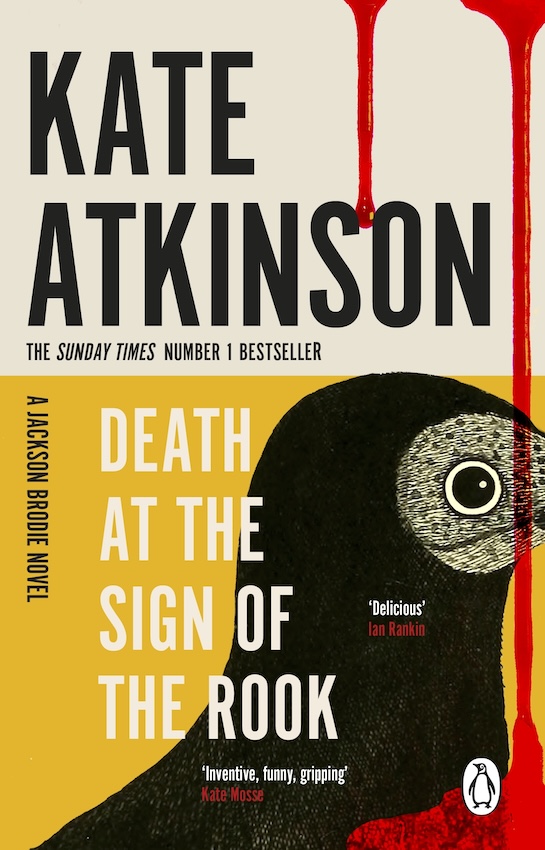
Book Review: Death at the Sign of the Rook by Kate Atkinson – more fun and games with the latest Jackson Brodie mystery

I have to admit to being a Jackson Brodie fan since we met the beleaguered private investigator in the first book, Case Histories. I’ve read them more than once as well as enjoying immensely the TV adaptations starring Jason Isaacs. So here we are, five years since the last one (Big Sky), with another in the series – something I wasn’t really expecting, and you can imagine my delight.

Atkinson has a habit of not really continuing where she left off in the last book. Instead we seem to catch up with Jackson some years later, or with a completely different set of circumstances. Sometimes he’s flush and others he’s down on his luck. In Death at the Sign the Rook, Jackson is living with his girlfriend, Tatiana, and has had enough income from his PI work to buy himself a lovely big Land Rover Defender. His new case involves the theft of what looks like a Renaissance painting – a portrait of a Woman with a Weasel, which until recently hung on the bedroom wall, out of reach of prying eyes, of an elderly lady who has recently died.

It seems Dorothy Padgett’s carer Melanie Hope has taken it, and just disappeared without notice, leaving only an old mystery novel: Hark! Hark! The Dogs Do Bark by Nancy Styles. Dorothy’s daughter Hazel and her son Ian want Jackson to track Melanie down rather than calling the police – the painting may have some dodgy provenance. We get Jackson’s usual internal sizing up of the situation with Dorothy’s grasping offspring, squabbling over their mother’s possessions.

The story weaves in and out of Jackson’s investigation, bringing in several other main characters, beginning with Lady Milton over at her cash-strapped stately home, Burton Makepeace. LM has similarly lost a valuable painting, this one a Turner, at the same time as her companionable housekeeper Sophie disappeared. She is struggling to keep control of things while her eldest son Piers is trying to turn the big house into a hotel complete with staged murder mystery evenings. She’s an impossible character to like with her old-world thinking and arrant snobbery, but you can’t help feeling a bit sorry for her.

There’s also the boring vicar, Simon Cate, who has had a complete loss of faith, but battles on regardless, a fondness for animals, his only saving grace. And then there’s Ben, ex-military and a bit sorry for himself having lost a leg on his last tour, while missing his mates in the Army. He’s living with his sister, and learning to look after bees. We also meet Reggie Chase again – you’ll remember her from previous books – now a Yorkshire police detective.

These threads all slowly weave the characters into a plot involving a blizzard, a murderer on the run who’s armed and dangerous, and a murder mystery evening at Burton Makepeace. Somehow all of the characters end up there – we’re given a hint of what’s to come in a kind of prologue – and Jackson’s going to feel glad he bought the Defender. As usual it isn’t always the crooks that are the baddies, or not all of them anyway, and Jackson may or may not err on the wrong side of the law.

Atkinson is a master of creating a tantalising story with plenty of humour and surprise twists. However, I did feel this story took a while to get going. We get stuck for chunks of narrative with Simon the vicar, and Lady Milton, both of whom can be a bit tiresome. But once the story gets going, there’s plenty to enjoy and the ending’s a cracker. Not the best Jackson Brodie, but still worth reading. A three-and-a-half star read from me.

Book Review: The Bookshop Detectives: Dead Girl Gone by Gareth Ward and Louise Ward – a humorous take on the bookshop mystery, packed with local colour

I went to an author talk recently at which authors Gareth and Louise Ward described how they came to write a book together set in the New Zealand village of Havelock North where they live and where they own a bookshop. The Bookshop Detectives: Dead Girl Gone is a delightful cosy mystery and part of the humour for me, anyway – and this is a very funny book – comes from the way the main characters, Garth and Eloise Sherlock, owners of Sherlock Tomes, are seemingly versions of the authors and their world.

In real life, Gareth and Louise were also, once upon a time, coppers back in the UK, or Blighty as they call it. And they do have a large dog with a sensitive personality who is often at the shop – I’ve been there a few times, so I know. The world of these booksellers just seems made for a cosy mystery series, doesn’t it? At the talk I was amused to learn that the dog, Stevie, was a more prominent character in the first drafts, until the editor cut out large chunks with “too much Stevie” scrawled in the margin. So for lovers of mysteries where pets save the day and solve the murder, this doesn’t quite happen, although I am happy to say, Stevie does play a pivotal role in things.

The story revolves around a cold case, the disappearance of schoolgirl, Tracey Jervis, decades before. A bright student with a talent for poetry, Tracey left home, heading for the circus, and was never seen again. There were rumours of her being caught in a clinch with a teacher, but the work she did helping a politician with his campaign seems to have thrown up more questions. As well as being politically ambitious, Franklin White is a property developer, with an arrogance that makes him easy to loathe. And then there’s Tracey’s controlling father; and what about the ex-boyfriend?

Meryl is an artist, as she’s told us often, although I’ve never seen any of her work in Havelock North’s galleries or that other purveyor of fine art, the local coffee shop. She barges past me pulling a granny trolley, which she is far too young to be using. ‘What other calendars have you got?’ she asks, seeming indifferent to the fact that I haven’t set up for the day, or even yet switched the lights on.
Despite having been ordered from the reps in February, the main drop of calendars hasn’t arrived yet. They get later each year and the shipping issues we’ve had thanks to Covid have only made matters worse. ‘They’re in a box up at the counter,’ I tell Meryl. ‘We’ve just had a couple of the smaller suppliers so far.’ I grab two piles of magazines banded with plastic strips from outside the door and hurry after her.
‘What about “Nice Jewish Guys”?’
When we first opened the shop, and didn’t know what we were doing, we got an eclectic mix of calendars of which perhaps the most bizarre was ‘Nice Jewish Guys’. We put a photo of Eloise swooning over it up on Facebook as a bit of a giggle and sold all four copies the same day. Ever since it has been a firm seller every year, though the calendar rep told us we’re the only retailer in New Zealand that stocks it.

Garth and Eloise had never heard of Tracey Jarvis until a mysterious package is delivered to the shop with a copy of a book inside – See You in September, by real-life local author, Charity Norman. The book has been annotated with a message – a call to action to reinvestigate Tracey’s disappearance, and on the package is a reference to Eloise’s old police badge number, which was hardly something anyone local would know. The couple can’t help wondering if there’s a link to a nasty criminal Eloise had helped put away years ago and who casts a lingering shadow.

Other story threads are woven in, the most notable being the decision of one of the world’s best-selling authors to launch her latest book at Sherlock Tomes, a colossal and mind-boggling event that has to be kept under wraps. Then there’s the flower pilferer that is pinching flowers from the shop’s window box as well as the menace provided by some thuggish gang members who try to put a stop to the Tracey Jarvis investigation.

Everything comes together neatly, the plot building to a simmering conclusion full of surprises and fair dose of action. But while the book lives up to it’s ‘cosy mystery’ label, it’s also a view into the enchanting world of bookshops and the people who visit, its quirky and loveable staff, and the curious characters who inhabit the village. Dead Girl Gone is the first in a series, with a second book already in the pipeline to look out for. Can’t wait! This one’s a four-star read from me.

Book Review: The Murder of Mr Wickham by Claudia Gray – a cosy mystery that brings back the characters of Jane Austen

You may have noticed there’s quite a collection of novels based on one or other of the six completed novels of Jane Austen. I have read a few and enjoyed them greatly. But Claudia Gray takes this genre to a new level with her delightful mystery, The Murder of Mr. Wickham.

Honestly, if anyone in Jane Austen’s ouevre deserved to be bumped off it is surely George Wickham. He’s that rascal that threatened to ruin Lydia Bennett in Pride and Prejudice, as well as spoiling the marriage prospects of her sisters. He’d almost ruined Darcy’s sister as well. In Claudia Gray’s novel, we catch up with Wickham at a house party, not at Pemberley, the seat of the Darcies, but at Donwell Abbey, the home of Mr Knightly and his wife, Emma, from that other Jane Austen novel.

Guests at the house party include Mr Knightly’s old friend Fitzwilliam Darcy, his wife Elizabeth and their son Jonathan, a handsome but socially awkward young man of around twenty. Then there’s cousin Edmund Bertram and his wife Fanny (from Mansfield Park) as well as the Wentworths, Frederick and Anne (from Persuasion) who were renting Emma’s childhood home when a staircase collapsed and urgent repairs required.

Also joining the guest-list are the Brandons, Colonel Brandon that is and his young wife Marianne (from Sense and Sensibility). That just leaves Northanger Abbey, which is represented by seventeen-year-old Juliet Tilney, the daughter of Henry Tilney and Catherine, now a novelist who Emma admires. Emma has taken a shine to Juliet and invited her so that the girl can see new people and a change of scenery. With Jonathan Darcy staying, here’s also a hint of Emma’s propensity to match-make.

So you can see that Claudia Gray has really pushed the boat at to draw on all six novels for inspiration and does a terrific job, throwing Austen’s characters together and seeing what happens.

There’s already a tense atmosphere as Mr Knightly is troubled by the financial losses his younger brother has incurred due to a venture masterminded by none other than George Wickham. The same venture has also caught out Captain Wentworth, losing him a chunk of the money that he won as prizes as a naval officer in the war with Napoleon. It was this money that enabled him to hold his head high against the snobbery of Anne’s family. But without it, he fears he’s let Anne down and they may need to return to sea.

Since Pride and Prejudice George Wickham has had a further twenty plus years to cause misery to the Darcies, and more crimes come out of the woodwork when the bounder turns up at Donwell Abbey to call in some debts. It’s the middle of a stormy night when the murder takes place, the guests all restless and anxious for various reasons.

The only two characters who don’t make the suspects list are young Juliet, who had never met the victim before her visit, and Jonathan Darcy, who spent the night calming his horse in the stables when the storm was at its most severe. They never would have thought of investigating the crime themselves if it hadn’t been for the magistrate of the district, Frank Churchill (remember him from Emma?), who assumes the killer must be among the Donwell staff, or passing “gypsies”. Juliet, in particular, is appalled at the idea of someone going to the gallows unjustly.

The two team up, secretly sharing their findings at midnight in the billiard room, and Jonathan finds it so much easier to talk to Juliet than he might have otherwise, now there’s something practical to talk about. The story has plenty of pace and builds to an unexpected resolution as more and more secrets are revealed. In the crucible of a murder investigation, relationships are tested and new understandings emerge.

I enjoyed The Murder of Mr. Wickham immensely, which has all the wit of an Austen novel, Claudia Gray bringing the characters to life beautifully. The good news is this is the first in what looks like a new series featuring Juliet and Jonathan as unlikely but very appealing sleuths. I’m giving it four and a half stars – the audiobook version is narrated with aplomb by Billie Fulford-Brown – and am keen to see what happens in The Late Mrs Willoughby, which is Book No. 2.