Lockdown Reading 3: The Scholar by Dervla McTiernan

The second book in McTiernan’s DS Cormac Reilly series takes us back to Galway and a case that threatens Reilly’s relationship with his partner Emma Sweeney, possibly even his career.

Emma works as a research scientist for Irish pharmaceutical giant Darcy Therapeutics on Galway University campus. When a young woman is killed in what at first appears as a hit and run at the university, Emma finds the body. Being so close to a prime witness, Cormac should step away from the case, but his fellow sergeant, Callie O’Halloran hasn’t had a weekend off in months and is desperate to go home. Cormac, finally allowed to move on from cold cases, steps in as SIO.

But things get more complicated when the ID card found in the victim’s pocket turns out to belong to Carline Darcy, an up-and-coming scientist and granddaughter to the drug company’s founder, John Darcy. Emma recognises the Stella McCartney cardigan the girl’s wearing too. Only Cormac discovers Carline alive and well in her fancy penthouse flat, unaware apparently of how the girl got the card or the cardie.

It takes a while to track down the victim, as no students seem to be missing. It’s only when a teenage boy calls into the police station worried that his sister hasn’t texted him in a few days, that Cormac finally gets a break. And so begins a tidy little mystery fully of secrets, subterfuge and professional jealousy, set in the high-stakes world of drug research.

Meanwhile the issues that dog Cormac’s career aren’t going anywhere, mostly around his relationship with Emma, a victim of an assault that left her battered and traumatised, as well as a murder suspect. Several in the police team feel that somehow Cormac managed to sweep Emma’s crime under the carpet, so when a murder happens on her doorstep, it is too easy to put Emma on the suspects list. And how can Cormac remain impartial as well as manage the sensitive issues around his relationship with Emma?

I love the way McTiernan slowly reveals back story through this series. The first book The Ruin was very much about Cormac, and an historic case that defines his early career and which comes back to haunt him. The Scholar brings in Emma’s history, creating layers of tension as Cormac has to deal with prejudice and bring in a killer before he kills again. It’s good character-driven crime writing, with engaging characterisation and an evocative setting. A solid four out of five from me.

Lockdown Reading 2: Dead in Devon by Stephanie Austin

I was inspired to grab a handful of murder mysteries to get me through lockdown, a time when you mightn’t feel like reading anything too demanding. Dead in Devon is the first in Austin’s series featuring Juno Browne, Domestic Goddess for hire (housework, dog-walking, and random odd jobs). We’re in cosy mystery territory here, so the heroine is a natural busy-body, primed to solve the murder.

The setting is the pretty Devon town of Ashburton, where everyone knows everyone else’s business. Titian-haired, twenty-something Juno has no family and makes a basic living with her bright yellow van. Old Nick has a dodgy reputation in the antique trade and wants Juno to work for him. When he’s murdered, Juno believes that those two Russian thugs she discovered putting the frighteners on Nick are the culprits.

The police, good cop Inspector Ford and bad cop DC (Cruella) DeVille, don’t have a lot to go on – Nick had obviously ripped off someone, and with his previous custodial history, had friends in low places. But Juno has become fond of the old fellow and can’t help investigating.

The traders Nick did deals with may offer clues and include Paul, a handsome furniture restorer, Albert (Piano-teeth) Evans and one of Juno’s cleaning clients, snooty Verbena Clarke. Then there are Nick’s estranged children, Helena and Richard, who accuse Juno of being a gold-digger. The cast of characters also includes Morris and Ricky, a gay couple who hire out costumes to drama companies around the country. They are the perfect confidantes for Juno and encourage her romantic efforts by helping her with outfits picked from famous plays and musicals. Even the dogs Juno walks have interesting personalities.

Austin adds plenty of pace balancing sequences of lively dialogue with action scenes so there’s plenty here to keep you amused. She has made much of her background in amateur theatre and knowledge of antiques to add colour to the story. My only quibble was that I more or less guessed the perpetrator, but it was all so entertaining I didn’t mind too much. Three and a half out of five from me.

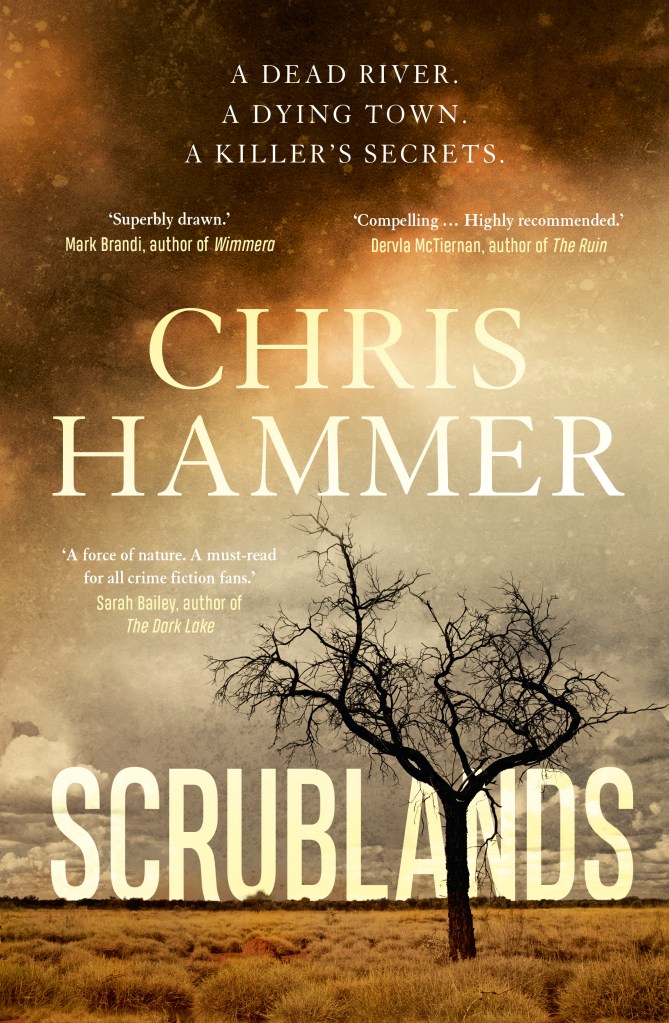
Book Review: Scrublands by Chris Hammer

Aussie Noir has become incredibly popular since The Dry by Jane Harper was published in 2016. Similarly drought and the high heat of summer, this time in outer New South Wales, is the setting for Hammer’s debut crime novel. Newspaper journalist Martin Scarsden visits Riversend, site of a mass killing, a year later to write an update on the town, a story previously covered by rival journo, D’Arcy Defoe.

Scarsden, once something of a lothario, suffers from PTSD following an incident when he was covering the Gaza Strip for his paper. His boss thinks this assignment will be a tonic – get him out of the office yet keep him busy. But Riversend is a depressed sort of place for recovery. The miserable Black Dog Motel lives up to its name; the town’s businesses are struggling and nobody’s very forthcoming – except for the young policeman, Robbie Haus Jones, the hero of the day.

Reverend Byron Swift was a good-looking, charismatic preacher, popular with the young and, with Jones, helped resurrect the youth centre, a Pied Piper figure it seems. So what made him open fire on his church steps, gunning down several men from the Bellington Anglers Club? Scarsden talks to the locals and gets a few more snippets out of Harley Snouch, the dero who says Swift was a pedophile. He takes coffee and comfort at the Oasis bookshop, run by drop-dead gorgeous, Mandalay Blonde – a what’s a beautiful girl like you doing in a place like this scenario.

Fortunately before you have too much time to wonder on the clunkiness of the love angle or the characters’ names, events start to hot up, literally. Martin becomes suddenly popular when he saves a teenager’s life and helps out with a bushfire. There are more murders, including a cold case involving two German backpackers. But Martin’s luck soon runs out as he tries to get his facts straight and more reporters and the police close in. People may be talking but everyone seems to have something to hide. Who can Martin trust?

Hammer manages a lot of plot threads in the novel, carefully reeling out backstory and tying them all together in the end. The pressure to file the story first and the mock camaraderie between the news teams add authenticity. I really enjoyed the lively, unmistakably Australian dialogue which spins the plot along nicely making Scrublands an entertaining read. And in the background there’s that oppressive, drought-stricken landscape.

Hammer earned a best new crime novel Dagger Award for Scrublands and it’s easy to see why. It’s an interesting story given weight by the way it deals with bigger things like evil and redemption. But I found the character of Mandalay Blonde (that surely should be a Bond heroine) and her relationship with Martin didn’t work for me. This one gets a three.

Book Review: The Stranger Diaries by Elly Griffiths

For some time I’ve been a fan of Elly Griffiths’ crime series featuring forensic archaeologist Ruth Galloway and DCI Harry Nelson. Griffiths does a great job of creating interesting plots around the watery in-between places of Norfolk, with all the ancient and not-so-ancient history of the setting. She also does terrific characters and has an engaging style that is hard not to like. Her Stephens and Mephisto series is equally well crafted, so I knew I would be in safe hands with the standalone novel The Stranger Diaries.

The story takes place in a small English town where Clare Cassidy teaches English at the local comprehensive school and where her daughter is a student. The old part of the school was once the house of Victorian ghost story writer, R M Holland, and in her spare time Clare is writing a book about his life and the questions around his wife whose ghost still haunts the school.

Clare’s a single mum and has built a pleasantly quiet life with a few friends, until one of them ends up dead. Fellow English teacher Ella has been discovered stabbed to death in her home and the police think it was someone she knew. Clare deals with this in her usual way, by confiding in her diary, but gets an unpleasant surprise when someone starts adding eery messages in spiky Italic writing.

The story is narrated by Clare, her daughter Georgie and also DS Habinder Kaur. Clare is a fairly intangible character (other characters find her cool) and lost in the world of Holland and his famous story ‘The Stranger’ (which is cleverly told in chunks throughout the book), seems to find reality hard to grasp. This makes her the perfect protagonist for things to happen to.

Harbinder is everything Clare is not: gutsy, to the point, and as an ex-pupil of the school, has plenty of interesting stories of her time there. She also lives at home with her parents (and her mum’s wonderful cooking) and dodges the issue of telling them she’s gay by throwing herself into her work. But this case has got her stumped.

The story builds to a thrilling ending as the killer looms ever closer and the cops eventually catch up. As usual Griffiths creates an atmospheric setting, with the haunted Holland house plus Halloween, while her short-story, ‘The Stranger’, would have done M R James proud. I wonder if he was an inspiration for the novel. My only grouch is I found Clare a wishy-washy sort of character; thank goodness for the determined DS Kaur and wilful young Georgie, who give the narration some balance. The supernatural is evoked without seeming ridiculous (ghosts and witchcraft) while DS Kaur grounds us in the real world. This is a light, entertaining read: three and a half out of five from me.

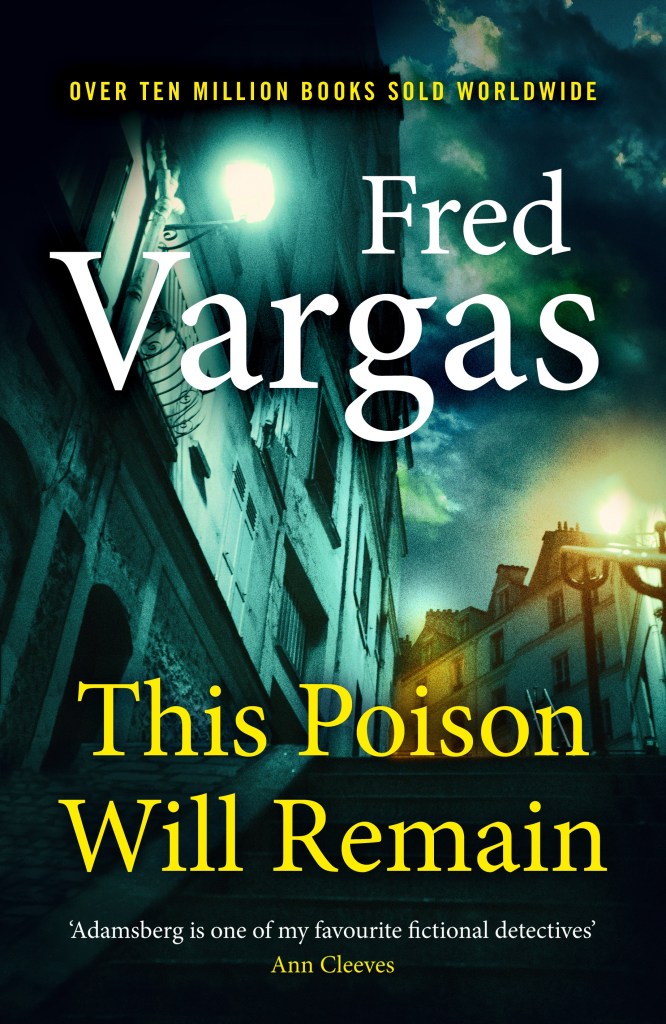
Book Review: This Poison Will Remain by Fred Vargas

Fred Vargas writes a beguiling and often unusual mystery novel. Her series featuring Commissaire Adamsberg and the Serious Crimes Bureau is immensely entertaining for the weird and wonderful storylines and oddball criminals – usually serial killers of some kind with motives beyond the everyday. The latest book – This Poison Will Remain – involves a type of murder no one believes to be anything other blood-poisoning following a spider bite. In Nimes three old men suffer septicaemia and die, but they were old, right? Could happen to anyone, right?

Jean Baptiste Adamsberg, with his nose for the uncanny, thinks otherwise. But he’s going to have a tough time convincing his team to agree with him. Particularly Commandant Danglard, his second in command and former friend. Danglard, in his impeccable English tailoring has become a formidable opponent and with his gift with words and sharp intellect, he soon has the others thinking Adamsberg has lost the plot. This is a new Danglard. In previous books we see him sipping wine on the job and bemoaning his problematic home-life.

You soon realise that this is not your usual police station. There’s Mercadet whose narcolepsy interrupts his police work daily, so he has a cushiony corner in a quiet office where he can catnap. Maternal Helene Froissy keeps a cupboardful of snacks at the ready and helps Adamsberg look after a family of blackbirds who have nested in the courtyard. Amazonian Violette Retancourt is ‘worth ten men’ and is devoted to Snowball the cat who sleeps on top of the photocopier no one uses but is always on to keep it warm. Voisenet would rather be an ichthyologist and stinks out the office with the head of a moray eel he plans to study. Veyrenc hails from the same corner of the Pyrenees as Adamsberg. With his black-and-ginger striped hair, the result of bullies trying to scalp him as a boy, he bursts into clunky Alexandrine verse at every opportunity.

It is Veyrenc whom Adamsberg first turns to for help in solving the mystery of the spider bites, secretly at first. It emerges that two of the victims lived at the same orphanage and were part of a gang who tormented the other boys, hiding recluse spiders in their clothing. In those days before readily available antibiotics, some of their victims endured terrible injuries. If someone was out for revenge, it would be fitting to kill them with spider venom from the same kind of spider, but such spiders are rare and you would need dozens to produce enough poison. And how on earth would you milk the spider venom anyway?

It seems an impossible puzzle, so it isn’t surprising Adamsberg and Veyrenc adjourn to a nearby café, called La Garbure, after the traditional cabbage soup from the Pyrenees, to discuss the case. This is something else I love about the series. Reminiscent of novels by Simenon, Fred Vargas conjures up Paris through Adamsberg’s walks by the Seine, and scenes set in cafés and restaurants. Veyrenc has a bit of thing for La Garbure’s proprietress and the two send each other glances across the room without quite catching each other’s eye.

Like the best crime fiction, the story is very much character driven, but Vargas has plenty of surprises in store for the reader to keep you turning the pages. Adamsberg has the challenge not only of solving the most perplexing of crimes, one that will take him back to the memory of a terrible event from his childhood, but he must also win back the loyalty of his team. Themes around child abuse, mental illness, isolation and the history of religious hermits give the story plenty of depth.

This Poison Will Remain is an excellent read, with a superb English translation that maintains the spirit of the author’s unique, lively and very French style. A four star read from me.

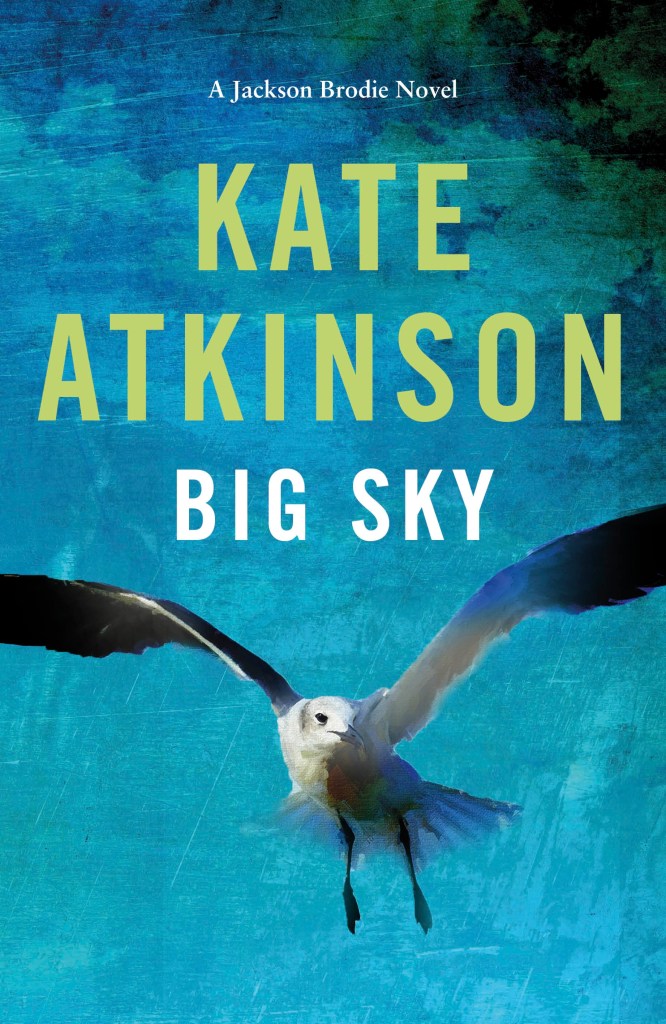
Review: Big Sky by Kate Atkinson

Jackson Brodie is back, still working as a private investigator, mostly divorce and missing persons cases, and still trying to save people. He’s nudging sixty, still single, though with Julia’s voice constantly in his head reminding him of his shortcomings, you’d think they were an old married couple.

We catch up with him back in Yorkshire, keeping an eye on his son, Nathan, who is fourteen and riveted to the screen on his phone. Brodie uses their time together to attempt fatherly education in things like British history, good manners and a lot more Nathan patently isn’t interested in.

Running parallel to this story is that of Vince, left by his wife and recently made redundant, but still keeping up appearances on the golf course with sort-of friends, Tommy, who owns a transport company, a gorgeous home and trophy wife, Crystal; and Andy, a smooth and savvy BandB owner and Tommy’s partner in crime. Vince’s life is set to implode as his wife is taking him to the cleaners.

Another story thread is told through the eyes of Crystal, who has literally come up through the gutter, a past she hides from everyone, especially Tommy. She has the care of their wee daughter Candy and Tommy’s teenage son Harry (whose mother mysteriously fell off a cliff) and a house she keeps immaculate. But someone is following her in a silver sedan. She hires Jackson to discover just who.

Also on the scene is Reggie (remember her from When Will There Be Good News?), now a police detective working on an old pedophile-ring case, with fellow officer, Ronnie. They’re meant to be tying up a few loose ends but suddenly there’s a murder with an odd connection to our golfing buddies and the sex trafficking of migrant women promised good jobs in Britain.

There’s a lot of very unpleasant crime here but Atkinson, as always, lightens the load on the reader with humour and lively characterisation. Not that she shies away from the facts. We have Crystal’s troubled past to remind us of the evils of what happens when sex and money go hand in hand, a past that is all set to come back to haunt her. And while it’s great to see Reggie again and spend time with Jackson, Crystal is a wonderful invention the reader will cheer for.

I’ve enjoyed my foray into the world of Brodie again and Big Sky didn’t disappoint. Incidentally, it works fine as a standalone novel if you haven’t read the previous books, or forgotten what they were about. A solid four out of five from me.

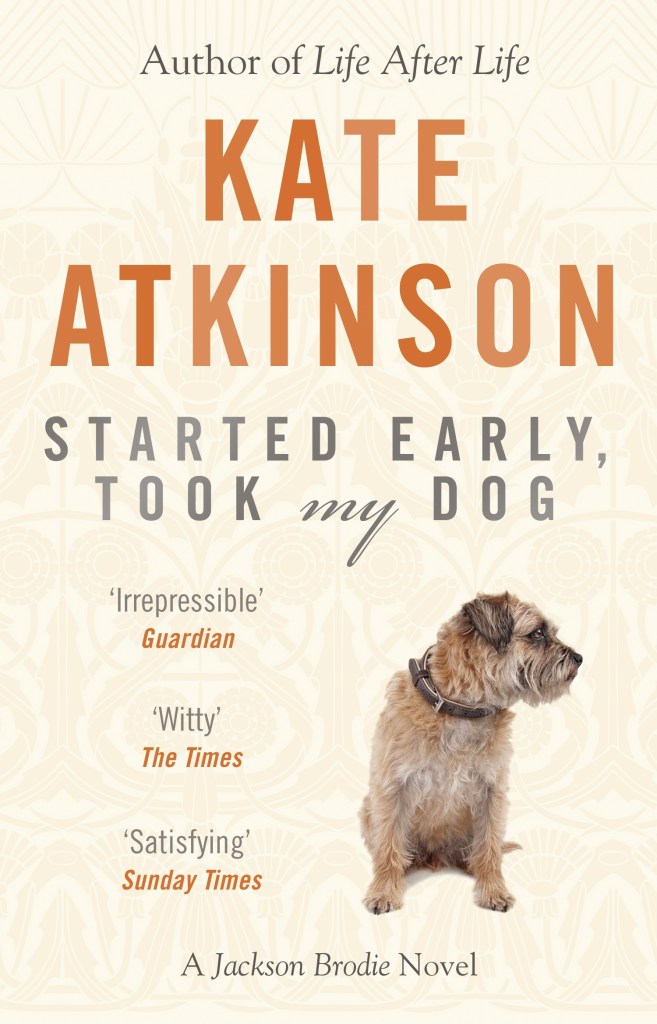
Started Early, Took My Dog – the penultimate Brodie

Kate Atkinson’s Jackson Brodie novels, while involving crime, mysteries, disappearances and detectives, don’t follow the typical plot-lines of many crime novels. This makes the series unique and charming, depending on interesting and believable characters caught up in a variety of moral dilemmas to push the plot along.

Started Early, Took My Dog gets off to a rip-roaring start when ex-police Superintendent Tracy Waterhouse, large, unmarried and believing herself unloveable, buys a child. She’s seen so many mistreated children that confronted with a drug-raddled prostitute abusing a little girl in a Leeds shopping mall, Tracey hands over a wad of cash for the child as the woman hops on a bus.

And why not? the reader thinks. Tracey has worked hard, has a nice house and plenty of love to give. The event has Tracey looking over her shoulder as Jackson Brodie arrives in Leeds to look for the birth family of a woman whose adoptive parents took her to New Zealand as a wee tot. The case has odd connections to the death of a prostitute years before when Tracey was a young PC. Jackson, incidentally, has acquired a dog in a similar but more violent manner to Tracy’s acquiring a daughter. This involves a fair bit of sneaking about with the dog in a backpack as Jackson enters and leaves his hotel.

Julia is on the scene again, playing the part of a pathologist in the tv crime drama, Collier, along with ageing actress Tilly, who just happened to witness the events in the shopping mall. As the various stories of the different characters converge, overlap and entangle, Atkinson brings everything to a brilliant ending with a bunch of surprises to keep the average whodunit fan happy.

Perhaps Started Early, Took My Dog is in this sense a more traditional crime novel than others in the series. And Atkinson’s characters are so refreshingly real, their behaviour so surprising yet understandable, you can’t help but become caught up in their worlds. ‘Oh, no, don’t do that!’ you want to yell at Tracy, at Jackson. So yes, there’s plenty of tension too. There are also themes to do with parenthood, abuse of power, of women of the law.

But what I always remember fondly about these books is the humour, which is so often down to the smart prose and the ongoing battle between Julia and Jackson. Another brilliant and very entertaining read; easily a four out of five from me.

Review: The Beautiful Mystery by Louise Penny

Another tick in the box for my progress through the marvellous Chief Inspector Gamache books by Louise Penny. Like many in the series, The Beautiful Mystery begins when a murder takes place in a remote area, and the Quebec Sûreté are called in to investigate. Usually it’s the hard-to-find village of Three Pines, but this time it’s an isolated monastery.

Gamache and side-kick Inspector Beauvoir take a plane then a fishing boat to the abbey of Saint Gilbert-Entre-les-Loups (St Gilbert among the Wolves), situated on the far side of a lake surrounded by wilderness. The Abbey’s prior and choirmaster, Frère Mathieu, has been found in the Abbot’s private garden, with his head bashed in. Clutched to his chest is a document on vellum bearing the arcane notation of a Gregorian chant.

As the police officers piece together the events of the morning and interview the twenty-four resident monks, they discover that Frère Mathieu wasn’t an easy man to get on with. A schism has appeared between the brothers following the release of a music CD two years before which shot the Gilbertines to fame and saved the order from bankruptcy. While half of the brothers supported their choirmaster, half felt the recording compromised the integrity of the order’s silent vows. Was this enough to cause someone to kill the prior?

Things are just getting interesting when a seaplane arrives the following day bearing the head of the Sûreté, Superintendent Francoeur. Has the Super come all this way just to deliver the post mortem report, or does he have another agenda? Events from previous books come back to haunt both Gamache and Beauvoir, with Francoeur at his smug and devious best, surely the wolf among the fold.

The two storylines merge together to create a satisfying crime novel, with plenty of interesting digressions that enrich the story. I enjoyed learning about the art of Gregorian Chant and the early methods of recording the music using neumes – extraordinarily, this becomes crucial to Gamache figuring out the crime. You just have to hand it to Penny – she is brilliant at coming up with original and quirky story-lines.

Events are left up in the air with the continuing subplot and I can’t wait to get my hands on the next book in the series to see what happens next. It’s no wonder Louise Penny has done so well with the series – four out of five from me.

Brodie No. 3: When Will There Be Good News?

For much of Kate Atkinson’s third novel in the wonderful Jackson Brodie series, our rugged hero is more like a victim than the white knight of earlier books. In the beginning of When Will There Be Good News?, we catch up with Jackson stalking the child he thinks might be his son. He manages to steal a hair from little Nathan’s head, ready for DNA testing.

Accidentally taking a train bound for Edinburgh instead of London and his love-nest with new wife, Tessa, Brodie is caught up in a train accident and badly injured. His life is saved by first-aid performed by the real hero of the story, sixteen-year-old Reggie, a little battler who is adjusting to living on her own since her mother’s sudden death on holiday.

Reggie is a terrific character. Her brother is a ne’er-do-well who always brings trouble. So she soldiers on alone, her meagre existence brightened by her job as nanny for Dr Joanne Hunter (Call me Jo) and baby Gabriel. Reggie is quite devoted to Dr H and Gabriel, but when the two disappear, Reggie suspects foul play, in spite of the husband’s assurances that everything is fine and his wife is just visiting a sick relative. So why did she not change out of her working clothes? And why is her car in the garage? And worst of all, why didn’t she pack the baby’s favourite comforter, the scrap of cloth he is never without.

Also in the mix is DCI Louise Monroe who is seeking the murderer of three people at a family party, his estranged wife and children now hiding in a safe house and in terror for their lives. Like Jackson, Louise is also newly married – to a wonderfully understanding surgeon she has no idea how to love. Instead of returning to her love-nest, Louise sits in her car outside the safe house, watching and tetchy.

Each character is on a trajectory that crashes into that of the other characters and eventually Brodie rouses himself from his hospital bed to save the day in his own unconventional way. It’s a brilliant ending on so many levels and events of Brodie’s past make interesting connections to the main plot-line.

Which is what I love so much about these novels. As well as the quirky characters, the witty dialogue, the snappy storytelling and the intriguing plots, Atkinson brings together divergent characters who often in more ways than one, have something in common. As Jackson says, ‘a coincidence is just an explanation waiting to happen.’ But maybe it’s also something to do with the human condition, and is why these are a grade or two above your standard crime novel. Four and a half out five from me.

Review: The Ruin by Dervla McTiernan

Set mostly in Galway, McTiernan’s debut crime novel, The Ruin, introduces Detective Sergeant Cormac Reilly, freshly arrived after a lengthy stint with the anti-terrorist mob in Dublin. He has good reason to make Galway his home – his partner, Emma, has a top-notch research job in Galway and with a more settled, peaceful Ireland – this is 2013 – it was time to look for a new career direction.

Only taking on a bunch of cold cases isn’t quite as challenging or adrenaline charged as what he’s used to. And why he does get the feeling that his colleagues are all whispering behind his back? Just as well his old friend from police school, Danny, is on the team or he’d feel well and truly isolated.

The past keeps creeping back as well. Twenty years ago, Cormac was a rookie cop, called out on a miserable night to a decrepit manor house in the middle of nowhere to rescue two children. Their addict mother is dead from an overdose, the children, five-year-old Jack and fifteen-year-old Maude, look malnourished and cold. His squad car radio is broken so Cormac can only pile them into the back seat and take them to the hospital. The scene makes a compelling opening to the novel, and you just can’t wait to find out what has happened to the three of them in the intervening years.

Flicking forward to 2013, a suspected suicide turns out to be the same Jack, now a twenty-five-year-old engineer, with a stable relationship and a baby on the way. Had the past found a way of catching up with him too?

The Ruin is a solid detective story, with engaging characters and a ton of secrets ready to be revealed. There is plenty of action to keep you engaged, with an edge-of-the-seat ending that has you biting your nails. Cormac is a good cop, without the bad habits or lurking darkness that so often beleaguers fictional sleuths. Yet McTiernan makes him interesting. As well as settling into a new job and discovering who he can trust and who he can’t, Cormac has a new relationship. There are hints around how me met Emma during a previous investigation which are yet to be revealed.

The next book, The Scholar, is already out, and with another due to appear in March, the series is off to a flying start. I shall definitely be stopping by to see how Cormac is getting on. Three and a half out of five from me.