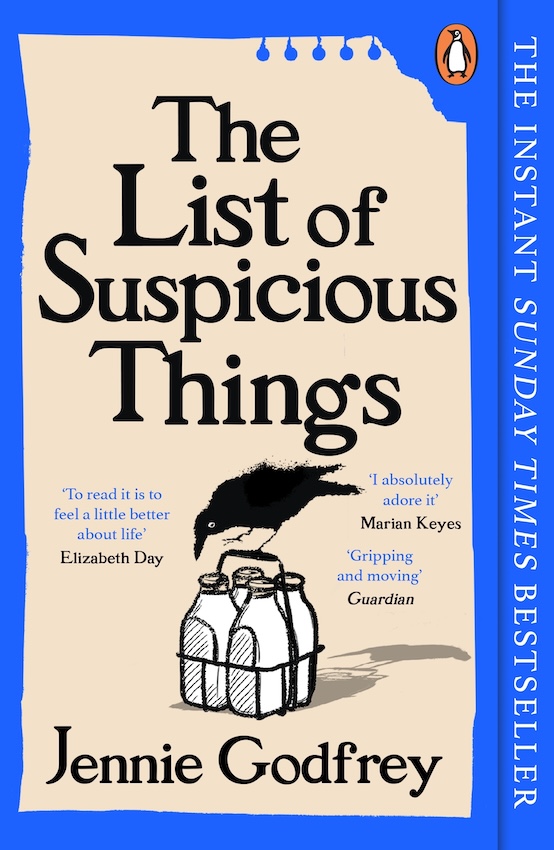
Book Review: The List of Suspicious Things by Jennie Godfrey – a story about friendship, growing up and a small town’s dark secrets

The List of Suspicious Things is a debut novel which takes you back to 1979. Thatcher has just been elected PM and the Yorkshire Ripper is at large, killing young women, while the police have few clues to his identity. In Miv’s Yorkshire town the mills have closed down, so things are already tough, and likely to get tougher. At home, Miv’s mother never speaks, Auntie Jean delivers food to the table and terse comments, while her dad seems a bit lost.

When the family thinks a move down south might be a good idea, Miv is desperate. At twelve, she’s bright but a bit socially gauche, partly due to her home life, so her friendship with Sharon is too precious to lose. She’ll do anything to save it so decides to investigate and catch the Yorkshire Ripper. She buys a notebook and makes lists, and with Sharon’s help, begins to look for suspicious characters close to home.

As names are added to the list, the reader is introduced to the people of the town, beginning with Mr Bashir who runs the corner shop. He’s one of the nicest adults Miv knows but he has dark eyes and a moustache, so makes the list. There’s a truck driver from her father’s work, people she knows from church and a teacher among others. Other people in the community include Helen at the library – because where else do you go for information in 1979?

Of course, the girls don’t catch the Ripper, but their investigations uncover some of the darker elements going on in the town – the racism, the misogyny, the prejudice against those who are a bit different. Miv learns one or two secrets that are a bit close to home, and finds herself caught up in some of the fallout. She’s a girl who is left too much to her own devices, there’s just too much going on at home for consistent parenting. But then in 1979, kids were often left to find their own entertainment and the town is their playground.

Through Miv you also see the struggles of the adults in the story. Sometimes the narrative shifts to Austin, Miv’s dad; Helen; or Mr Bashir, who each have personal sadness and secrets. The setting – the late ’70s is well realised. Mr Bashir is always singing along to his favourite Elton John songs, jeans go from bellbottoms to stovepipes and Sharon buys a glittery lipgloss to try. And it’s also very Yorkshire, though not posh Yorkshire – the kids go ‘laiking about’ and at least one character’s house has an outdoor loo.

While overall I enjoyed the book, I did feel at times that it was rather overloaded with issues. So many dark things happen with a lot to fall on Miv’s small shoulders. Still, The List of Suspicious Things is a quirky and interesting novel, easy to get lost in. I was reminded of Joanna Cannon’s The Trouble with Goats and Sheep – another novel about two young girls investigating – in this case a neighbour’s disappearance – also set in the ’70s, and which is well worth checking out. The List of Suspicious Things is a three-star read from me.

Book Review: The Night in Question by Susan Fletcher – a wheelchair-bound octogenarian on the trail of a killer

Novels set in assisted living facilities are becoming quite a trend. I love the way authors such as Joanna Nell and Richard Osman create active and determined elderly protagonists, giving them a new lease of life when everyone else seems to think they ought to be taking things easy.

And you can say that about The Night in Question, which is partly a murder mystery, but a lot more besides. I was soon happily engrossed in an engaging story, but also impressed by the beautifully crafted writing. Of course I should have known I was in safe hands when I saw a recommendation on the cover from Clare Chambers.

The Night in Question is told from the point of view of Florrie Butterfield, eighty-seven and because of a mishap with some mulled wine, has to get around in a wheelchair. She has a comfy flat in Babbington Hall, a former stately home now with various levels of care for the elderly. A cheery, friendly sort, her plump form swathed in pastels, Florrie doesn’t look all that sharp, but appearances can be deceptive. For when two events take place – the first resulting in a death, the second written off as an attempted suicide – Florrie is convinced that someone else is to blame.

Teaming up with Stanhope Jones, another resident she’s got to know chatting about Shakespeare near the compost heap, Florrie is determined to get to the bottom of it. The story will unmask events that are long past, a tragedy that can’t be forgotten or it seems forgiven. But in doing so, Florrie’s own personal tragedy begins to surface, an event that has dogged her since she was seventeen.

As Florrie and Stanhope hunt down clues, research online and interview the Babbington Hall staff and residents, we slowly learn Florrie’s past. Delving into an old cheese box full of mementoes, she remembers the people she has loved. These include her parents, Bobs her brother, best friend Pinky, who was as tall as Florrie was round, and the six men who each almost captured her heart.

Florrie opens her eyes. It feels a small, quiet thought; she merely notes it, at first – there it is – as if a bird has landed inside her, preens a little, settles and closes its wings. But she continues to stare in the darkness.
Can this be true? Is it possible? And she thinks, Yes – for no other reason than it feels easy and right. It feels to fit, just so – like a good shoe. And she remembers Sergeant Butterfield at the kitchen table, saying, ‘A good policeman will listen to this, Florrie’ – tapping his chest with his middle finger. This.
Pushed. She was pushed.

Bobs was the one who probably had the most influence on how Florrie would lead her life, returning from a tank regiment in World War II, badly burned. Always yearning to see the world, Bobs implores Florrie to travel for both of them and do everything they had planned as youngsters. So while Pinky married and had a family, Florrie answered adverts in the paper for jobs in France, then Africa. With each there’s a certain someone she remembers fondly. There’s more travel and more mementoes, new relationships – but no one she dares trust with the truth of her past.

We’ll have to wait until the present day crimes are solved before we find out what it was that happened to Florrie as a girl, the tragedy only Pinky and her great-aunt every knew about. In the meantime, Stanhope does the physical things Florrie can’t – the illicit searches and foraging in the recycling skip – while Florrie chats to people. The two become closer, and the reader can’t but wonder if one day Florrie will tell Stanhope her story.

The Night in Question is a brilliant read, well paced and peppered with terrific characters. Stanhope is charming, a quiet former Latin teacher with a gentle wit. There’s Magda, young and tattooed with a heartbreak of her own, and Reverend Joe with his massive beard, ACDC T-shirts and a tendency to let out the odd swear word during church services. There’s an interesting cast among the other residents, nosy ones and gossipy ones, people Florrie tries to avoid in the dining hall, and others she feels sorry for. It all adds to a rich and entertaining story.

In finishing the novel, I can’t help feeling I’ve discovered a wonderful new author. Susan Fletcher has written seven previous books so I’ll look forward to hunting through her backlist. Her first novel, Eve Green, won the Whitbread First Novel award, and there have been other award nominations. This one’s definitely a nicely fresh take on the rest-home murder mystery and I can’t wait to see what she does next. The Night in Question is a four-and-a-half star read from me.

Book Review: Welcome to the Hyunam-Dong Bookshop by Huang Bo-Reum – a novel about new beginnings, friendship and reading

There seems to be a never ending supply of novels set around bookshops and libraries. Many are about a lot of other stuff as well, such as relationships, social issues and even war. Welcome to the Hyunam-Dong Bookshop is set in Seoul and as such promised a different kind of read. It follows the story of Yeongju who has turned the corner on an unsatisfactory phase in her life in order to fulfil a dream – to open her own bookshop. I’m sure many readers can relate to that idea.

It is here that Yeongju slowly comes out of her shell. She has to learn not only about business side of things, but she’s going to have to talk to people. This is difficult for someone who has a lingering sense of sadness – it’s a while before the reader discovers why. To start with her bookshop is a kind of haven – she can read when there are no customers or think about new stock or write her blog.

Then there are the connections she makes through coffee. I must say I like the idea of bookshops where there’s coffee and comfy chairs to sit and enjoy it. Yeongju finds she can’t do everything and employs Minjun as barrista. He has felt like a failure after his promising university education didn’t lead to a great career. But he finds his feet in his love for good coffee, enjoying meeting up with Yoengju’s coffee roaster friend Jimi who runs Goat Beans.

Other characters appear, including Jungsuh who just sits and knits, wondering how often she needs to buy a coffee to be allowed to stay. There’s Mincheol, a boy whose mother wants him to find something to get passionate about, hopefully books, and Seungwoo, the author who arrives to give a talk on writing. They’re all characters who are dealing with life, happiness or the lack of it, and finding their way. Running through it all are references to books, and the philosophical conversations they inspire.

Yeongju was usually a pragmatic person but when she was deeply engrossed in a story, she was like a person trying to grasp at moving clouds. Minjun found the juxtaposition interesting, as if she had one eye on reality while the other gazed at some faraway dreamland. Just the other day, she’d asked him another question about life.
‘Do you think there’s any meaning to life?’
‘Huh?’
‘I don’t think there is.’ Her proclamation was met with silence. ‘That’s why people try to make sense of their own. In the end, everyone’s life is different, according to the meaning they find.’
‘…I see.’
‘But I don’t think I can find it.’
‘Find what?’
‘Meaning. Where can you find meaning? In love? Friendship, books, bookshops? It’s not easy.’

Welcome to the Hyunam-Dong Bookshop is a charming, gentle story – one that won’t keep you up at night, but will quietly amuse and give you something to think about. I enjoy the odd book about people’s workplaces, and this book delivers on that, not only the bookshop, but the coffee roasting business, as well as the rat-race of people’s previous careers. It’s a fitting book for the time, with Covid lockdowns having shown us other ways to work and possibly also to think about what’s really important in life.

For the most part this was an interesting read, but for me the plot seemed to lag a little. The indecisiveness of the characters could be somewhat frustrating. Another minor issue I had was with the dialogue – I sometimes had to work to figure out who was speaking. This may well be because in Korean there are indicators such as word endings to show gender, that we don’t have in English – and which didn’t come through in the translation. Or maybe it was just me.

On the other hand, in spite of finding the book a bit slow at times, I have been left thinking about some of the ideas it presents. I am certainly glad to have read it. Welcome to the Hyunam-Dong Bookshop is a three-star read from me.

Book Review: The Library by Bella Osborne – a feel-good read about an unlikely friendship and a library in trouble

A public library can be one of those places that offer a respite from the anxieties of everyday life. And while they’re not the silently bookish places they used to be, hosting community groups, classes and story times, they can still be a place of refuge in a way a shopping mall just isn’t. Bella Osborne has taken this idea to create a story around two lonely people and a friendship that develops at the library.

Maggie is seventy-two, a widow who runs a small holding on the outskirts of town. It’s a lonely life but she fills it with her love for her livestock, yoga and books. Her membership of a book group that meets every Saturday is the highlight of her week. Sixteen-year-old Tom is struggling to keep everything together at home where he lives with an alcoholic father. It’s a battle to make ends meet, and his dad wants him to give up school to join him at the factory – they could use the extra wages. But Tom has his sights on a better life, and Farah, a cute girl, if only she’d look his way.

Tom has as an odd idea that Farah uses the library and visits on the pretext of choosing some romance books for his mother. Soon he’s lugging home a pile of books he has no intention of reading. Maggie gets mugged outside the library on her way to her bus-stop and Tom helps her to her feet. Over time an unlikely friendship forms and Tom discovers the wonders of reading, farm life and finally has someone supportive in his life. Maggie has a glimpse of what having a family of her own might have looked like and feels less alone.

They sat side by side on the cool metal seats and waited for the bus. ‘I think this week’s book club read will be more up my street.’
He was looking about. He seemed to have lost interest in her. She got the book out anyway and showed it to him.
The Fault in Our Stars.’ He nodded. ‘You might like it,’ she said. He nodded again before realising his mistake.
‘Nah. Doubt it.’ Tom looked away.
‘It’s okay, Tom. The others don’t know and I won’t be telling them.’
‘Know what?’ He pulled his shoulders back and stared her down.
‘That it’s you reading the books and not your mum.’
His shoulders sagged with every word, until he was back to his rounded-shoulder posture. ‘How’d you know?’
‘The way you read the blurbs before choosing the books. The conversation about Me Before You.’ She gave a shrug. ‘I’m a bit like a dog with a bone when something doesn’t add up.’
He turned to look up the road for the bus, as if willing it to arrive, but there was ages yet. ‘Well done, Miss Marple.’

When the town council announces plans to shut their library down, Maggie reignites the feisty young woman she was in the sixties, demonstrating at marches, holding placards and making a nuisance of herself. She ropes in young Tom and her book club pals, but it’s an uphill battle when the library door-count has probably been dropping for decades. But as the Joni Mitchell song goes: “you don’t know what you’ve got till it’s gone” and a library is more than just books, it can be the heart of a community.

You can guess how the story will pan out, but there are a few surprises along the way. Maggie is hiding a secret, and so is Tom’s dad. Meanwhile Tom’s issues with his father add complexity as he faces extra pressure when he needs to focus on study if he has any hope of university. But it’s the humour in the odd little mishaps and misunderstandings that makes this a fun read. Maggie and Tom’s friendship is not always plain sailing so there’s some tension there too. Plus, there are puppies.

The Library is a light but engaging read, and anyone who has a fondness for libraries will relate to the characters and their campaign. There’s plenty of book talk too, especially when Tom, with nothing better to do, discovers that romantic fiction is a whole lot better than he expected. This is a warm, feel-good sort of story, cheering and heartfelt and a four-star read from me.

Book Review: The Librarianist by Patrick DeWitt – a quirky and heartfelt novel with a memorably unmemorable main character

Working in a library, of course I was drawn to this book, with its cover showing an old-fashioned library book date-slip. But what the heck is a librarianist? How did that one slip past me, of all people? I just had to find out.

Bob Comet is the librarianist of the title, an everyman kind of character who has always lived for books. Maybe that’s what librarianist means. He is described as “not unhappy” and seventy-one years of age, a solitary man who fills his days with simple pleasures, such as reading, cooking, and walking.

We catch up with Bob in 2005 when he rescues an elderly woman he bumps into at a 7-Eleven, where he’s gone for coffee. The young cashier doesn’t know what to do with her; she’s been staring at the chilled drinks fridge for getting on for an hour. Bob reads a label attached to her clothing and discovers her name is Chip. He manages to get her home to a care facility and before you know it he’s a volunteer, expanding his world and getting to know the residents.

A coincidence at the care facility occurs that shocks Bob and propels the story back to Bob’s youth. We’re back in the 1940s and 50s when Bob’s love of books begins. You get the impression that it is books that rescue Bob from the reality of the hurly-burly of school, his life at home with a mother that doesn’t understand him, and his general aloneness. He becomes a librarian, and takes on his mother’s house when she dies. You imagine a quiet, solitary, bookish life for Bob, and he does too. And then he meets Connie.

The book describes his relationship with Connie, similarly a person who doesn’t fit in but for quite different reasons. There’s also his sudden friendship with Ethan, who turns up at the library carpark one day, too afraid to go back to his apartment across the road, and the angry policeman inside it. Bob’s life has suddenly a friend and some romance in it – until suddenly it doesn’t.

Why read at all? Why does anyone do it in the first place? Why do I? There is the element of escape, which is real enough—that’s a real-enough comfort. But also we read as a way to come to grips with the randomness of our being alive. To read a book by an observant, sympathetic mind is to see the human landscape in all its odd detail, and the reader says to him or herself, Yes, that’s how it is, only I didn’t know it to describe it. There’s a fraternity achieved, then: we are not alone. Sometimes an author’s voice is familiar to us from the first page, first paragraph, even if the author lived in another country, in another century.” Bob held up his stack of Russians. “How can you account for this familiarity? I do believe that, at our best, there is a link connecting us.

But before we catch up with Bob in 2006 again, where the story left off, there’s an odd chunk of the novel that takes us back to 1945 and an eleven-year-old Bob running away from home. Where he gets to and the people he meets makes for an entertaining enough interlude, full of memorable characters, but I couldn’t help asking myself what it was all about. I couldn’t help wondering why it didn’t seem to have an impact on the Bob we meet later, who returns home eventually, remarkably unchanged. Years later, however, he sometimes wistfully dreams about the seaside hotel that took him in for four days..

The Librarianist might not follow the usual rules for novel plotting in some ways, and the ending is perhaps a little odd, too. But it’s a diverting read, and you can’t help getting to like Bob and the people we meet as seen through his eyes. Patrick DeWitt’s prose is delightful, witty, wry and perceptive, bringing Bob and his times to life.

The novel reminded me a little of some of Anne Tyler’s earlier fiction with its characters that don’t fit in, and the events that pull them out of their lethargy or solitary habits. I’ve always got time for a novel like this, particularly if it’s as nicely written as this one. I’ll pick up another DeWitt novel sometime, I’m sure. The Librarianist is a four-star read from me.

Book Review: The Hazelbourne Ladies Motorcycle and Flying Club by Helen Simonson – a fun historical read set in post WWI England

I’d really enjoyed both of Helen Simonson’s earlier books, Major Pettigrew’s Last Stand and The Summer Before the War, so was looking forward to her new book. And it’s a treat. Peppered with a cast of interesting characters, the story follows Constance Haverhill, who has recently lost her mother to the Spanish Flu. She has been taken pity on – and by that we mean made use of – by her mother’s old school friend, Lady Mercer. Constance is to accompany Lady Mercer’s mother to the seaside for an extended stay as a lady’s companion.

As you can guess, it’s just after World War I and Britain is both reeling from the devastation of losing so many soldiers, as well as celebrating peace. Women who have had to step up and take jobs formerly held by men are returning to traditionally female work, struggling to make ends meet on widows pensions, or depending on relatives.

Constance had made herself useful in the Mercer household managing the farm accounts – she’s a farmer’s daughter, after all – and has also trained as a bookkeeper. But with nowhere to go except her brother’s farm, her unpaid accounting work for the Mercers no longer required, Constance sees her short visit to Hazelbourne as a chance to evaluate her options. Fortunately, the elderly lady, Mrs Fog, is kindly and appreciative, allowing Constance plenty of time off to see the sights.

At the Meredith Hotel Constance is unable to have a table on her own as an unaccompanied young woman, as is Poppy Wirrall, who has just blown in on her motorcycle and is unsuitably attired. The two girls bond over a loaned skirt and before you know it, Constance is swept up into Poppy’s world. Poppy is a fan of motorcycles – she was a courier at the front – and has collaborated with some other women friends to set up a motorcycle and sidecar taxi service. One of the crew, Iris, is a keen motorcycle racer, but it’s hard breaking into a field dominated by men.

“I say, is there any chance you would help me?” said the girl, jumping up and extending a slightly oil-stained hand. “I’m Poppy Wirrall. I’ve been out all day on the motorcycle and damn it all if I didn’t leave my bag behind at home. My mother is still out visiting and the powers that be here have decided that after four years of war and pestilence they should still have the vapours over a woman having tea in trousers.”

Pippa’s family have decamped to the hotel while Mrs Wirrall is spending the family fortunes lavishly renovating their stately home. Brother Harris is an amputee, bitter at being treated like an invalid and desperate to fly bi-planes again. Several characters face difficulties in being seen for who they are, not just what they are. So Harris is expected to be an invalid, and his sister to marry, rather than run around on motorcycles. There’s also hotel waiter Klaus, a naturalised Englishman, but no one can see past his German origins. Class rears its ugly head as Constance knows only too well.

There is an element of Pride and Prejudice in the way Constance and Harris interact in the early parts of the book. Harris is haughty to protect himself from ridicule, and is bitter at seeing so many of his fellow pilots killed in the war. Constance, ever the poor cousin, bridles at his rudeness. But Harris at least is not a snob like the Mercers, and knows the value of people who have a good heart.

Everything comes together in a plot that simmers with exciting events – motorcycle races and aerobatic displays, dances and weddings, romances and disasters. Not everyone gets a happy ever after, but there’s hope and fresh starts aplenty as characters face challenges and rise to the occasion. The Hazelbourne Ladies Motorcycle and Flying Club is a charming story, nicely recreating the post WWI period in an English seaside setting – a light, fun read with moments that make you want to cry or cheer. A four-star read from me.

Book Review: The Wakes by Dianne Yarwood – a thoughtful, contemporary read about life, death and catering

So we’re back in ‘feel-good fiction’ territory with a novel mostly about Clare, whose husband has had a kind of conniption and decided to leave their marriage. She becomes unhinged by this and takes some long service leave, and this coincides with her meeting a new neighbour, Louisa, who has plans for a catering business centred on funerals. Clare is persuaded to help out – she’s always been a dab hand in the kitchen and her chicken sandwiches are to die for – ha, ha!

Louisa is a larger-than-life character – tall and funny as well as kind. She’s soon in and out of Clare’s kitchen when Clare needs a friend. An accident that has left her face bruised and her front teeth chipped has confined Clare to her home. We find out that Louisa’s bouncy, chatty manner hides a secret heartache.

The story flips to Chris and his own marriage break-up – a relationship that has turned sour when he and his wife found they were unable to conceive. He thinks back to his relationship with Beth when he was in London – was she his one great love? He determines to find out if she is still in Australia – he has a box of her things he’d like to return. Chris is also no stranger to death, being an ER doctor, and it is this that brings about his first meeting with Clare at the caterers’ very first wake.

Clare worked at a very fast pace. It wasn’t until people began streaming through the doors that Louisa admitted how uncomfortable she felt around crowds. Somehow, stupidly, she’d thought mourners would be different. Quieter, less of a strain on her sensibilities. But not so. The opposite, really – all those families. She disappeared into the kitchen as the room filled up. I’ll hold the fort in there, she said with a look of concern and apology. And so Clare moved around the room in something approaching a run: she hovered by groups, raced off to the kitchen, came back, checked on what people had, offered plates and darted off again.

The Wakes makes you aware of the idea that “in the midst of life we are in death” in that it is the passing of loved ones and the proximity of death that makes the characters feel aware of the wonders of life. That we only have one and we must seize the day. But there’s also a lot about the complexities of friendship. Chris’s great friend is Max, who is dying; there are other friends – particularly Paul, who was also in London during the Beth era.

Paul has his own chapters, too, and his role in the story is important as a catalyst for what happens. Paul’s a kind of counterpart for Louisa in that he’s always quick with the ready wit and can rattle off a vast selection of pop culture references at any given opportunity. But Paul’s life is an empty shell. We are not really supposed to like. him – he works in advertising – but I couldn’t help feeling sorry for him. Chris, as an ER doctor, is obviously more worthy.

Perhaps it was these moral undertones that put me off the book a little. That and the funerals. It is difficult to balance the weight of grief with that of the hopeful resolutions that we wish for the characters. Sometimes it just got a bit too much. Or was it just that I liked the more light-hearted scenes better? Perhaps if I’d just lost someone dear to me, I’d have found the book more relatable. The Wakes is a three-star read from me.

Book Review: The Country Girls by Edna O’Brien – an Irish classic perfect for a library reading challenge

Our public library is running a winter reading programme called Turn Up the Heat. There’s a kind of bingo card of different reading challenges, and every time you log a completed challenge, you go into the draw for prizes. So much fun! One of the challenges is to read a book published in the year you were born. In spite of thinking there’d be hardly anything published in a year so long ago, I quickly found three books to choose from I was happy to read.

The Adventures of the Christmas Pudding, a Hercule Poirot mystery by Agatha Christie, is a book I’ve read before, probably more than once, and I have a copy on my bookshelf. But I felt this one lacked the element of challenge I was quite looking for. Casanova’s Chinese Restaurant is one of the books in Anthony Powell’s ‘A Dance to the Music of Time’ series of twelve books. I’ve been meaning to reread them for a while now, but as the one from my birth year is number five in the series, I demurred. Then I happened upon The Country Girls by Edna O’Brien. A book I’ve always meant to read, and not too long. Perfect.

I was quickly caught up in the story of fourteen-year-old Caithleen, who is worried about the return of her father, missing for days if not weeks with the money he was meant to use on paying bills. We’re on a farm near Limerick, and the father has a terrible temper, and a tendency to go on benders, returning home to beat his wife. This sounds kind of morose, but in spite of the dreariness of life in a small village, Caithleen is a charming narrator. She’s naive, but friendly and kindly. She has a terrible hoodlum of a friend, Baba (Bridget), and the two get up to all sorts.

Cait is romantic in nature, and in spite of a family tragedy, dreams her way through life, yearning after Mr Gentleman, the name given to the Frenchman with an unpronounceable name who lives in a nearby manor house with his wife. Baba just wants to have fun, sometimes at Cait’s expense. Baba is dark, dainty and pretty, which makes tall, red-headed and eventually ‘Rubenesque’ Cait feel inferior. They have a challenging relationship, but kind-hearted Cait remains loyal through all Baba puts her through.

The book is divided roughly into three parts, the first with the girls still at the local school, and Cait’s family situation disintegrates to the point where Baba’s parents feel obliged to take her in. The second has them at a convent school, where Cait shines academically, and Baba gets them into trouble. In the third section, the two escape to Dublin where Baba is sent to a secretarial college and Cait to work in a grocery store. They live for their nights out on the town, Baba urging Cait on to have fun, while Cait writes letters home to Mr Gentleman.

Edna O’Brien writes in a way that is both amusing and entertaining, but also puts you in the time and place. 1960s Dublin is full of all kinds of traps for young girls; the sexism is horrific, so you can’t help admiring Baba’s mother who is worldly wise and does what she feels like, even hiding the chicken dinner from her husband in her wardrobe so there is more for her. It’s a bit like an Irish Nancy Mitford novel – loads of fun, mad characters and brilliant social commentary, but lurking beneath it all a layer of darkness. You can’t help feeling that with the 1960s ready to get going, there will be more choice for young Irish women, but you’ll have to read the next book (The Lonely Girl) to find out.

I’ve always enjoyed classic literature – it’s such a dilemma whether to read the next hot new release or a book that’s remained in print for decades or more. So it’s good to mix them up. I’ve enjoyed a lot of more recent Irish literature, so I appreciated The Country Girls as a book that made an impact at its publication, inspiring the generations of Irish writers, particularly female ones, that followed. Apparently The Country Girls trilogy was so shocking at the time, it was banned and even denounced from the pulpit. Another challenge in Turn Up the Heat is to read a biography – I might be tempted to give O’Brien’s, A Country Girl, a try.

Miss Benson’s Beetle by Rachel Joyce – a hymn to friendship and to the resourcefulness of women in a man’s world

I’m often drawn to the scenarios described on the backs of Rachel Joyce’s books. But not really enjoying The Unlikely Pilgrimage of Harold Fry half as much as everybody else seemed to, I haven’t read any further. But looking for an audiobook, I came across Miss Benson’s Beetle and seeing it was read by the truly splendid Juliet Stephenson, I couldn’t resist. Soon I was immersed in the story, set in the early 1950s London, where dowdy, middle-aged schoolteacher Margery Benson has an epiphany.

It doesn’t take much to tip a schoolteacher over the edge, and imagine being a home science teacher in the rationing years, poorly paid and a hopeless cook. She struggles to maintain engagement in a class of sniggering girls. When one student draws a cruel caricature of her, Margery can bear it no longer. She steals a pair of brand new lacrosse boots belonging to the deputy head and decides to embark on a long dreamt-of adventure: to travel to New Caledonia in search of a gold beetle. She had seen it mentioned in her late father’s beetle book, but it has yet to be collected, named and sent to the Natural History Museum.

Margery needs an assistant and advertises. Of the three who reply, the only possible contender does a reference check on Margery and changes her mind. Mrs Pretty can’t write a letter that makes sense; the disagreeable Mr Mundic wants to take over as expedition leader, ready with a gun to fight off savages – clearly he has a screw loose. At the last minute, desperate for anybody really, Marjory writes offering the position to Enid Pretty.

At the train station, the two take a while to recognise each other as Enid is dressed in a tight pink suit, a ridiculous hat and dainty sandals decorated with pompoms. And why does she clasp her red valise as if her life depends on it? Margery is dressed in an ancient shabby suit, the lacrosse boots and a pith helmet. Somehow they make their connection to the ship that will take them to Australia, in spite of Enid not having a passport.

The two make an odd couple, Edith, a former cocktail waitress seems to be running away from something, constantly looking over her shoulder as if she’s being followed. But she has the streetwise knack of acquiring by fair means or foul anything they might need. If only she would stop talking. An array of difficulties – sea sickness, lost luggage, a tropical cyclone and so much more – forges an unexpected friendship. Yet things aren’t quite so simple as finding a beetle and setting off for home again.

The story is full of madcap scenes, some poignant revelations and life-or-death challenges as both women slowly open up about their past lives and the things they are afraid of. There’s also quite a lot about beetles – Margery has become quite the expert. I also enjoyed some of the minor characters, particularly the British wives who are stuck in New Caledonia because their husbands are there on business or as diplomats.

Bubbling through it all is a wry humour. I came away feeling the book was a wonderful hymn to friendship, and to women surviving in a man’s world, a world that in the shadows of World War II is shown to capable of horrific cruelty. And I was quite right about Juliet Stephenson – her reading is superb, bringing to life the two main characters hilariously. I am sure the novel is a brilliant read in print, but I do recommend the audiobook too. Miss Benson’s Beetle earns a four out of five from me.

Book Review: The Weekend by Charlotte Wood

This is such a different sort of novel from Wood’s earlier work, The Natural Way of Things, which was a dystopian novel with an underlying tone of menace. I thought it was a stunning read and was happy to hear she had a new book out. The Weekend is a more character driven novel, told with wit and insight, following three women in their seventies who have lost their former glory, are bitter or desperate – is it too late to recover, recharge and reinvent themselves?

The women are old friends who are missing the fourth of their circle, Sylvie, who has recently died. They gather at Sylvie’s beach house just on Christmas to clean it and clear out the junk, ready to sell. First there’s Jude – she’s the bossy one who likes things done properly. She’s worked in a fashionable restaurant, makes a terrific pavlova, and has been the mistress of a wealthy married man for decades. After the house clear-out, she and David will steal a precious few days together. Jude is the first to arrive, but where are the other two? So typical of them to let her down.

We catch up with Wendy, who has car trouble, sweltering as she waits for the breakdown service – we’re in Australia and Christmas is in summer. Adding to her discomfort is her ancient dog, Finn, seventeen, blind, deaf and incontinent – a raft of conditions that make him constantly fretful. If only Wendy would listen to her daughter and have the dog put down. But Finn has been her consolation ever since her husband passed away. It’s hard to imagine Wendy is an academic of some repute who has written books on feminism that have been received with widespread critical acclaim.

Then there’s Adele, an actress who keeps missing the train, facing a bunch of problems including imminent homelessness, and a lack of available stage roles which is galling for someone who dazzled with her Blanche DuBois, Mother Courage, Lady Macbeth – so many brilliant performances. Then there’s the lack of cash – at least she’s well turned out, her figure still good for her age, her stunning breasts still shapely, her recent pedicure money well-spent.

Most often when Adele was exposed, or shamed, she turned for courage to the moment every actor knew: the moment on stage, entirely yours, waiting in the pitch-dark before the lights came up, the most powerful privacy a person could have. The fear drained away and adrenaline replaced it, and you were ready on your mark, in the darkness….In that moment of taut, pure potential, everything, everyone, was yours.

Jude doesn’t expect a lot from Adele, but has made a list none the less and the three crack on, each imagining the past, their petty grievances, their fears and insecurities. They don’t seem to be getting along at all – was it only Sylvie who kept them all connected?

The Weekend is a wonderful story about friendship and the odd ties that bind it, the feelings that threaten to break it, told in brilliant, witty prose. I hadn’t expected to like it as much as I did, but found myself drawn into a story about three women in the autumn years of their lives – a time when there may not be many more chances for new horizons, but still, who knows? There is just enough plot to keep things bubbling along, with some revelations towards the end that bring things to a head.

I loved the way Wood creates physical discomfort that mirrors the discomfort of the characters’ interactions: the rusty inclinator – a lift-like contrivance that clunks its passengers up to the house; a drenching storm; Wendy’s uncomfortable sandals; Adele caught out needing a pee at the beach with no facilities in sight; anything to do with the dog, Finn. And clearing out a house you have all those years of accumulated junk – the flotsam and jetsam that make a life – now decaying and useless.

It all adds up to a brilliant read, which reminded me a little of Jane Gardam, another writer who has created some brilliant older characters (see Old Filth trilogy), or maybe it was the similar wry tone. The Weekend earned Wood a spot on the Stella Prize shortlist and I will be keeping her on my radar, eager to see what she comes up with next. A four and a half out of five read from me.