Book Review: The Silence In Between by Josie Ferguson – a remarkable historical novel about a family divided by the Berlin Wall

I’ve read quite a few books about World War II from the Allies’ point of view – the families caught up in the war, on either side of the Channel, the people who helped Jewish children escape at risk of their lives and the SOE recruits dropped behind enemy lines to help the Resistance or lead downed Allied airmen out of occupied territory. Loads about Bletchley Park too. But I haven’t come across nearly so many about what it was like from the German perspective.

While The Silence In Between describes what happens to ordinary people in East Berlin when the Wall went up, it also dips back to follow the lives of a mother and daughter during the war and the terrible treatment they received at the hands of Soviet forces in 1945. Events of both periods are firmly linked.

The book opens in 1961 with the Wall. Lisette has just had a baby, and while she is ready to take little Axel home, the hospital want to keep him in for a bit longer. She goes home to fetch some things for him and to spend the night with her husband and daughter, and that’s when the Wall goes up. Overnight, Lisette and Axel are separated. The situation is made more poignant by Lisette’s admission to herself that she loves Axel more than her daughter, teenage Elly. As the days and weeks pass with no means of contacting the hospital or any news of Axel, Lisette sinks into despair, losing her speech.

Elly’s life goes from carefree outings with friends to trying to manage her mother. She decides the only way to save her family is to bring Axel back herself. The Wall is patrolled by armed Soviet officers sent over from the USSR, ordered to shoot anyone attempting to cross the border. By chance Elly meets the one soldier who doesn’t shoot. She has a gift for hearing music in other people, and the music the soldier Andrei has tells her she can trust him. In the background is the awareness that there are people watching and reporting back, a spy in every apartment block. Secrecy is of the essence.

The story follows Elly’s plan to cross to West Berlin, which is told from Elly’s perspective, interwoven with Lisette’s narrative of her survival in Berlin during WWII. Lisette witnesses many terrible events, the barely acknowledged rounding up of the Jews; the pressure from nosy neighbour, Frau Weber, to meet her nephew, a Nazi officer; the lack of food; the fear of bombing, which becomes a reality as the war progresses. We learn why she never bonds with Elly, her worries for Julius, the boy she loves, fighting on the Eastern Front in a war he doesn’t agree with.

Throughout the book is music. Lisette is an accomplished pianist and gives lessons to a young girl who becomes like a sister. Elly has her own kind of musical synasthesia and a keyboard in her bedroom, which she loves to play, but for reasons she doesn’t understand, it only upsets her mother. If you check out Josie Ferguson’s website, there are pieces of music you can listen to that relate to some of the characters, composed by the author’s brother.

The Silence in Between is a gripping novel, beautifully written that had me constantly on edge. On the one hand I couldn’t wait to see what happened next, while also being almost too anxious to find out. I almost broke my rule about not reading the back of the book to see how it ended. But the book is much more than its story, and gives a good picture of what life was like on either side of the Wall, and the lot of women in Berlin during the war. Some of this makes for grim reading.

The Silence in Between is a brilliant debut, well-researched and gripping, offering a different view of the war as well as Berlin in 1961. Well recommended, it’s a five-star read from me.

Book Review: Ghost Wedding by David Park- characters in two time-frames at a place where the past seeps into the present

This is one of those books that makes me say to myself, I must read more by this author. David Park is such a sensitive writer, his characters so subtly drawn, the storytelling original and thought-provoking.

Ghost Wedding takes us to a country manor near Belfast, now a wedding venue which Alex and Ellie are visiting. It’s the kind of place you have to book a year in advance, but Ellie has her heart set on it. So when the manager suggests that the newly refurbished boathouse might be available in time for their wedding, Alex agrees – anything to make Ellie happy.

Alex has all kinds of doubts, mostly because of guilt. For something that happened with his friends some time ago, for the way his father runs the family business and his own inability to please him. And then there’s his unhappy childhood and his mother’s mental health. How can Alex ever be worthy of Ellie? And why do they have to make such a big thing of getting married – the perfect wedding, the venue, the dress, the cake and everything else?

Alex is a good guy with regrets in the present day storyline that runs through the book, just as George Allenby does in the storyline that takes place a hundred years before. He’s the junior architect in charge of the construction of a lake and boathouse at the substantial home of the Remingtons. It’s back-breaking work and the digging out of mud during rainy weather only reminds George of his wartime experiences, in particular the comrades he lost at the Somme. He sees them from time to time when they shouldn’t really be there.

When the weather prevents his usual return home to Belfast one evening, George accepts the Remington’s offer of a bed for the night. Dinner is awkward between Mr Remington and his son Edward, who too young for the war, has done nothing with his life – another son who has disappointed his father. There’s also an attraction across the divisions of class when George meets Cora, one of the maids who work for the Remingtons – something George is ill-equipped to deal with.

The story switches between the two time-frames, and while there are ghosts of a sort, this isn’t really a ghost story, in the traditional sense, as the images of the dead tend to be connected with the feelings of our main characters, of their sense of the past. There’s sadness and inevitability about what happens, although there’s hope as well. It’s a beautifully crafted novel, David Park capturing the missteps between characters and their struggles to communicate, so they remain locked in their feelings of doubt and misery.

There’s a lot about class in the book – old money versus new money, the morality of making money, particularly that tied up with property, in both storylines. And the way the war not only tainted its survivors, but also made them somehow more worthy, not that they can ever talk about it. Secrets bubble away and not all are revealed, however troubling they may be. It all adds up to a layered and satisfying novel, as I would expect from David Park. Ghost Wedding is a four and a half star read from me.

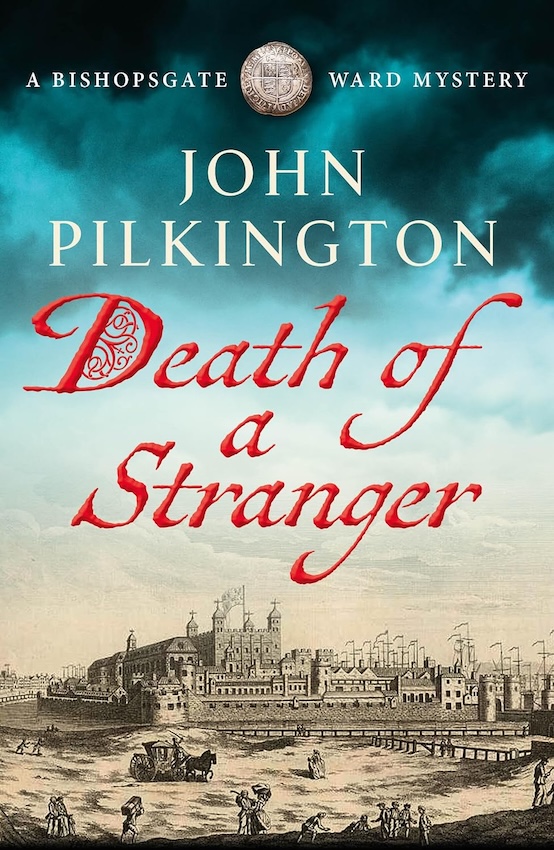
Book Review: Death of a Stranger by John Pilkington – an entertaining historical mystery and the start of a promising new series

John Pilkington is an old hand when it comes to historical mysteries, with a number of series under his belt, among them the Thomas the Falconer series. Death of a Stranger takes us back to Elizabethan England in the first book featuring Matthew Cutler, a constable in the parish of Spitalfields. It’s 1594, when the murder of an Italian perfumer causes a need for answers, as well as anxiety among the other “strangers” or immigrants of the parish.

When a further threat against a French button maker occurs, the obvious conclusion is that someone is targeting the local “strangers”, either for being possible Papists or other reasons of their own. Matthew is fed assorted leads, a stonemason with a bitter nature since the loss of his daughter to the plague; a former acting friend of Matthew’s who had had a dispute with the perfumer. They’re all dead ends, but rather than dropping the matter as his employer, Alderman Skinner requests, Matthew determines to find justice for the dead man. Could someone be planting false clues?

What Matthew doesn’t yet know is how far his search for the truth will take him into the world of the movers and shakers of Elizabethan society, the perfumer having made house calls to favoured customers, some of them bored wives of powerful men. So there’s a lot to set the story going in interesting directions. Matthew hits wall after wall before he can convince his superiors that the case is worth pursuing.

As an investigator, Matthew is an interesting character. To begin with he’s educated, having fallen out with his magistrate father, and dropped out of his Cambridge studies after a year to become an actor. He lost his wife to the plague not long ago, and has two daughters in his care, his wife’s aunt living with them as housekeeper. He has come to the role of constable at the request of his gunmaker father-in-law.

As the story progresses, Matthew’s education and acting talent come in handy for questioning people of high public standing, an idea brought to him by Margaret Fisher, a comfortably off widow, friend and potential love interest. At first Matthew’s not convinced it’s a good idea – he’s used to being able to gain confessions from miscreants with the threat of the law and its grim punishments, but it’s a different story with the upper classes. I can imagine there will be plenty of potential for Matthew to don the clothes of Margaret’s late husband and the role of Sir Amos Gallett again in future books.

John Pilkington obviously knows his Elizabethan era well, for while Death of a Stranger is an entertaining story on its own, the period details make the story come alive. It was interesting to see a little of how humbler folk lived – so many historical novels concentrate on those at court – but I liked reading about the work of the gunsmith, the night watchman or the people at the local tavern, which doubles as a venue for the inquest.

Death of a Stranger is an enjoyable historical mystery, with John Pilkington writing in a style that sounds Elizabethan enough to add colour without being difficult for the modern reader. And Matthew Cutler is an engaging enough character for me to want to find out what he does next. I’ll certainly be on the look-out for the next book in the series. This first instalment is a four star read from me.

I read Death of a Stranger courtesy of Netgalley and Boldwood Books. The book is due for release on 14 November.

Book Review: The Night of the Scourge by Lars Mytting – the stunning conclusion to an epic trilogy

I was worried that I would have forgotten too much about the previous books in Mytting’s Sister Bells trilogy by the time the third book arrived. Should I have reread the previous two (The Bell in the Lake and The Reindeer Hunters) before setting out on the ominously titled The Night of the Scourge? In the end, it didn’t seem to matter, although I did think I would happily sit down and read them all again one day, one after the other, for this is one of those series that could become a firm favourite..

The setting of the trilogy is for the most part the tiny Norwegian settlement of Butangen, beginning with the first book in 1880 or so, when Kai Schweigaard arrives as a young pastor. He has to battle suspicion from the locals and a determination to remember the old ways, including pagan ideas and myths. This is particularly so for the magic accorded the Sister Bells, the two bells in the tower of the old stave church he takes over. There is the story of the Hekne weave, an almost magical tapestry completed by conjoined twins three hundred years before, while Kai feels himself drawn towards Astrid Hekne, their descendant.

The second book follows the next generation, with another set of Hekne twins, and a world war. The Night of the Scourge brings us up to the 1930s and another war and a new generation of Heknes, the family who still farm the same land nearby, and are prominent in their community with their dairy and general store. Running through all three books is the character of Kai Schweigaard, still the priest, and still grappling with his faith, his connection to the Heknes and the magic of the bells. There’s also his own guilt over losing the old stave church, which was removed to Dresden in book one.

With the rise of Nazism, there is new interest in Aryan connections between Norway and Germany, and their joint mythology. So much so that when the Germans invade Norway, the remaining Sister Bell is requisitioned to join its pair in Dresden. Kai sees an opportunity to step up and redeem himself. And throughout the story he can’t forget the prediction he has seen in the Hekne Weave that seems to predict his own death.

The novel describes the hardships the Butangen people face under the occupation, as well as schisms in the community – those siding with the Germans as well as those secretly doing what they can to resist and undermine the occupiers. The story switches between characters, but mostly it’s about Kai and Astrid, the young granddaughter of the Astrid that Kai fell in love with, a young woman of courage and intelligence. She’s not the sort to take the occupation lying down and gets herself involved in dangerous situations, which keep you on the edge of your seat.

Not that this is a pacy read. It evolves gently, filling in more details, including ones about the original Hekne twins and another time of persecution, with the witch hunts of the 1600s. The seasons change, there’s lots of snow, and a ton of atmosphere. Kai is a contemplative man in his eighties, so time spent with him is more about parish matters, politics and trying to handle the occupiers in a way that keeps everyone, and the remaining bell, safe. Still, we are conscious that we are heading towards his end, however that may turn out.

There is so much to get lost in, including shifts of setting to Germany and Scotland, as well as interesting details about technology and historical events. You can tell Mytting has done a ton of research, and that he also has an interest in the making of guns, particularly hunting rifles, something that pops up in his earlier book, The Sixteen Trees of the Somme. Everything comes together brilliantly, a hefty 520 pages that never flags for a moment. I loved, as I knew I would, and already miss the characters I’ve got to know and care for. I do hope Mytting has more books in the pipeline – everything I’ve read by him so far has been a treat. This book’s a five-star read from me.

Book Review: The Predicament by William Boyd – a return to the complicated world of a reluctant spy

This is the second novel of a planned trilogy which began with Gabriel’s Moon – the story of travel writer Gabriel Dax whose little trips abroad researching locations to write about have become conveniently put to use by MI6. We’re in 1960s Britain, so there’s the Cold War going on, JFK’s the president of America, and as always, there’s a difficult political problem somewhere in the world for MI6 to poke its nose into.

Gabriel has never wanted to be a spy. He’s a successful writer, publishing popular books that earn him a respectable living. When we catch up with him at the start of The Predicament, his MI5 handler, Faith Green, who Gabriel’s a little bit in love with, has got him acting as a double agent, meeting up with a Russian counterpart and accepting bribes in return for information. He’s not happy about this, but the money has helped him buy a country cottage where he can forget about the shadier side of his life and pretend he’s just a writer.

With another couple of chapters in his Rivers book to write, Gabriel is sent off to Guatemala to interview a presidential hopeful in a country plagued by unrest. He’s posing as a writer again, so again it’s convenient for MI6, but nothing quite goes to plan and Gabriel can’t help feeling he’s not being fed enough information. This doesn’t stop him from making acute observations, particularly about potential CIA involvement.

The Guatemala sojourn is interesting in that it describes the way political interests of American businesses and the Mafia hold sway. You also get the benefit of Gabriel’s expertise as a travel writer in the descriptions of the setting. But before long he’s off again, to West Berlin this time, where JFK is about to make his famous “Berliner” speech and an assassination plot has been hinted at. So we really are in the thick of the period, of history being made, with Gabriel a bit-part player.

Through all this, Gabriel is emerging as quite a good spy even if he is reluctant to get his hands dirty. He’s observant, can think on his feet, and thanks to Faith Green and her cohorts at “the Institute”, has learned not to take everything at face value. He’s even getting quite good at self-defence. But Gabriel is also self-aware and constantly examining his feelings, not only about the spy business, but also about himself as a man. When it comes to women, he can’t help feel that he should be looking elsewhere, but Faith Green seems to have him on a string.

Pulling off the second book in a trilogy can be tricky, but William Boyd has made The Predicament work at least as well as Gabriel’s Moon, with plenty of tension, some exciting action scenes, and Boyd’s wonderfully crafted prose to enjoy. There are some amusing more worldly characters who contrast nicely with Gabriel’s sensitive writerly persona – such as Ulsterman Sergeant Major Begg who teaches him self-defence and his old lock-picking mate Tyrone who does the odd “no questions asked” job for Gabriel from time to time.

As, Gabriel gets so much better at being a competent agent, you can only wonder if this will be his lot in life. We’ll have to wait until Book 3 to find out. I have a feeling Boyd will ramp things up even more and bring out some excellent twists. I can’t wait. The Predicament is a four-star read from me.

The Predicament is due for publication on 4 September – I read an advance copy courtesy of Netgalley.

Book Review: The Land in Winter by Andrew Miller – a carefully crafted and moving historical novel

It’s always nice to see a novelist you admire long-listed for a Booker Prize. The Land in Winter has been on my radar for a while, since it won the Walter Scott Prize, and also because Miller’s an author I always look out for. So I was excited when I finally got my hands on a copy. And it didn’t take me long to become engrossed in this story of two couples who live in a village near Bristol and their struggles through the particularly cold winter of 1962-3, known as The Big Freeze.

There’s Bill and Rita on the farm – both new to farming and finding their way. Bill has big dreams for his land, as well as the kind of private school accent that doesn’t win him much respect among the farming community. Rita grew up too fast, with a father in a nearby asylum due to his experiences during the war. She has a veneer of glamour from her time working in a nightclub and fills her days reading sci-fi novels – so not farmer’s wife material. They are expecting their first child.

In a cottage nearby, Irene is also pregnant, her husband Eric a doctor at the local practice as well as visiting the asylum, where a young man has just taken his life. Eric has to deal with that and the pressure of his job, while having an affair he doesn’t know how to end. Irene meanwhile is trying to be the perfect wife but her middle class upbringing is sometimes at odds with Eric’s humbler beginnings, and the two seem to have different ideals.

Miller takes four characters who are each battling problems or being quietly miserable and then throws a tough winter at them. The narrative switches between them so we are right inside their heads as we watch them get things wrong and try to do better. They are so sensitively drawn that you can’t help but feel for each of them, caught as they are at a time when the war is still a raw memory and the future about to change. The class system is ready for a shake-up and feminism still emerging, but none of it can come fast enough for our characters.

A budding friendship between the women is viewed with suspicion by their husbands, but is never-the-less a godsend, opening up connection and different viewpoints for the two. There’s small-town gossip which only makes Rita and Eric separately more self-conscious. The period comes to life with some of the trashy horror and sci-fi movies of the day and music (dancing to the Mashed Potato; listening to Acker Bilk). There’s a brilliant chapter where Irene and Eric host a Boxing Day party – one of the best party scenes I’ve read – all that alcohol making people reveal themselves.

And then there’s the relentless cold. Nobody dies of hyperthermia or endures frostbite, but you can’t help feeling it’s not impossible as you read. So this is a novel best read somewhere warm. The story is carefully plotted and builds to a climax for each character with truths revealed that have to be dealt with, to find a way through.

You might think it sounds a little bleak, but I loved The Land in Winter because any time spent reading Miller means enjoying his wonderful writing. Every so often you hit a sentence you want to read again because it’s a fine and wonderful thing. It’s an altogether brilliant read and well worth the award nominations that have come its way. A five-star read from me.

Book Review: Fonseca by Jessica Francis Kane – a novel of Penelope Fitzgerald’s sojourn in Mexica

In her new book, Jessica Francis Kane takes several months from the life of Penelope Fitzgerald and weaves them into the kind of novel Penelope Fitzgerald might have written herself. As you may recall, Penelope Fitzgerald is the author The Bookshop, which was made into a movie, and Offshore, which won the Booker Prize – and a lot more.

Fonseca charts a time in Fitzgerald’s life when she had two small children and another on the way. She and her husband Desmond were living beyond their means, editing a literary magazine which was yet to make their fortune, and hampered by Desmond’s drinking problem. We’re in that post-war period, the early 1950s, and the war has taken its toll on Desmond, and so the two are keen to make a go of their literary review. But the bank manager has his concerns, and the family is likely to lose their home.

Penelope learns of a couple of elderly women sitting on the proceeds of a silver mine in Mexico, former friends of her late mother’s, when one contacts Fitzgerald with the news that they have nobody to leave their money to. Why doesn’t she send her boy Valpy to stay for a while to see how they get on? It’s a long journey by sea and bus and things are different from what they expect when they arrive.

The women expect an older boy and they don’t expect Fitzgerald to have tagged along. Fitzgerald discovers there are other people hovering, dropping in for evening drinks each night, who hope to get something too. There’s a lot of drinking, and the nights are cold. Penelope sleeps on a couch so her son can have the bed, and there’s no chair with the desk where she hopes to work. Somehow she and Valpy manage to stay three months as Christmas approaches and the weather becomes colder than what they have packed for.

Jessica Francis Kane brings to life this quirky household – the tricky old women, the staff who can be difficult to communicate with. Over time, Penelope explores the area, meets people – mostly, but not only, expats – and learns about local customs. Valpy is a bright boy for his age and delightful. There are misunderstandings and superstitions that put a spanner in the works of Penelope’s best intentions.

Apart from the possibility of money, the time away gives Penelope time to consider her marriage, particularly when another potential heir arrives, “the Delaney”, who is charming, adding another strand to the story. You also get the feeling that she might be incubating the stories that will later make her name.

Jessica Francis Kane has obviously done more than simply research Penelope Fitzgerald’s life and the period she spent in Mexico. You get the feeling that she has lived with and loved Fitzgerald’s literature for a long time. Probably no one else could have written this book. I suddenly want to read and reread more by Fitzgerald. Altogether, Fonseca is a brilliant read – clever, well written and with fascinating characters. A five-star read from me.

I received Fonseca as a reader’s copy from Netgally. The book is due to be released on 12 August.

Book Review: The Treasures by Harriet Evans – an immersive family saga and the first of a trilogy

I was happy to put my hand up for this Netgalley offering as I’ve enjoyed several Harriet Evans’ novels before. She often centres her novels around an atmospheric house (Keepsake in The Butterfly Summer; Vanes in The Beloved Girls; Fane Hall in The Stargazers), which I’ve always found appealing. A bit like Manderley in Daphne du Maurier’s Rebecca.

Early on in The Treasures we hear mention of a house called Sevenstones. I imagined a grand old English manor, full of secrets and mystery. In actual fact Sevenstones has more of a cottage feel, a country bold-hole where various members of the cast of characters arrive when they need a break. For some, including Tom Raven’s parents, it was a chance to take a break from the war – World War II that is – and where relationships were forged.

But we first meet Tom as a young boy, living in a two-room cottage with his much loved Dad in Scotland. At the age of nine, he is uprooted by his Aunt Jenny, leaving the simple life behind for more opportunities in London and public schooling, even though his aunt and Uncle Henry really have no idea about children or even running a house without staff. We’re in the 1950s, and there are bomb craters everywhere, and children from the upper classes aren’t to mix with the lower orders, or so Tom’s told.

There’s also another grander house in this book – Valhalla, the American home of the Kynastons. Alice is growing up as best she can, with a father battling demons and debts owed on his orchards. When he takes his life, it seems Alice and her mother are to lose their home on the grounds of Valhalla. Wilder Kynaston was a good family friend and offers them a lifeline, but there’s a price to pay.

We’re well into 1960s by now, and as Jack and Alice grow up on opposite sides of the Atlantic, another war has arrived, and with it the rise of the protest movement, women’s lib and the chance of new freedoms and ways of thinking. The novel takes you through these changes as our two young characters’ stories are set to intersect. But family secrets lurk, throwing roadblocks in their way.

Harriet Evans captures the time really well, and the dilemmas faced by young women like Alice who are trying to forge a new path for themselves, only to find they’re still chivvying for the boyfriends they tie themselves to. The men of the establishment still hold all the power, while choices for women remain limited. But there are others too, like the fathers of both Alice and Jack, who have been left haunted by the past, plagued by guilt or disappointment, also unable to be the people they want to be.

I was curious that the book starts with a modern day setting and a character, Emma, who doesn’t appear again, discovering the ‘treasures’ of the title. These are little mementos Alice has been given by her father on each of her birthdays. But I now see that this novel is the first of a trilogy – I’ll be intrigued to see how the story continues to fill in the gaps in the books that follow. The Treasures is a rich, immersive read with terrific characters you empathise with.

The Treasures is due for release on 12 June. It’s a four-star read from me.

Book Review: The British Booksellers by Kristy Cambron – a story from World War Two with its roots in the previous war

The devastation of Coventry by enemy aircraft during World War II is often described as the Forgotten Blitz. Coventry was targeted because of its munitions factories, but thousands of homes were also destroyed, hundreds of civilians killed and the Cathedral left in ruins..

Kristy Cambron uses this as a background for her novel The British Booksellers, but the story gets going before all that, even before World War I, when we meet two young people: fifteen-year-old Amos Darby the son of a tenant farmer, and twelve-year-old Charlotte Terrington, an earl’s daughter. They have played together for years, and are obviously soulmates, sharing a love of books, Charlotte also being keen on playing the cello, something she’s not allowed to do – it’s unladylike. So far, so Downton Abbey.

As they get older, their friendship deepens, but Charlotte is promised to local gentry, one Will Holt, who’s something of a lad, but determined to have his fair lady. With a war waiting in the wings, the First World War, that is, everything is accelerated and with miscommunications and nobody getting quite the life they had planned, a kind of bitterness settles on Amos’s and Charlotte’s relationship. Jump a couple of decades on, and here we have Charlotte and daughter Eden at their Coventry bookshop, still living at Holt Manor, while across the road Amos lives above his own bookshop, Waverley Novels. They have been not only business rivals but apparently feuding bookshop owners all this time.

But with another war on the go, things are set to be shaken up in more ways than one. The arrival of Jacob Cole, an American solicitor with claims on Eden’s inheritance adds another plot thread and there are suddenly land girls from London to settle in. But Holt Manor’s struggling to pay the bills, so they need all the help they can get. And then there’s the Bltiz.

Kristy Cambron writes a great story about love and war, and there’s a lot here to keep you turning the pages. The characters are complex, appealing and developed well. The scenes of war, of bombing and our characters thrown into the maelstrom of it all are exciting. I enjoyed the scenes with Amos more than all the girls mucking in together and comparing notes about clothes and how to cope without regular access to stockings. Personally, I’d be digging out the less glamorous Lisle stockings, as that manor house, the rain and mud sounded miserably cold.

This is a nice enough novel, but a picky reader might find the prose a little American sounding, the descriptions a little lengthy and over-egged. But the story is terrific and worth picking up for a diverting read that has you eager to find out what happens. The British Booksellers is a three-star read from me.

The Painter’s Daughters by Emily Howes – a stunning historical novel exploring the family of Thomas Gainsborough

I knew a little of the work of Thomas Gainsborough before I read this book, his striking portraits, the most famous of which is probably the Blue Boy, which frequently used to appear in tapestry kits. Such a pretty picture. But I remember looking at his portraits, marvelling at the light feathery brushstrokes, the use of colour, and how they seemed to capture the essence of the sitter. Then the way he might put them in a landscape setting rather than a fashionably lavish interior.

So it was interesting to learn that Gainsborough much preferred painting landscapes, was a great lover of the countryside near Ipswich where the book, The Painter’s Daughters begins. He wants his young girls to have a free and healthy country childhood just as he did. But his wife, Margaret, has other ideas. There’s no money in landscapes and the fashionable town of Bath is full of the kind of society that will want their portraits painted, and also where young Molly and Peggy might make a good marriage.

Emily Howes weaves a brilliant fiction around a well-researched collection of facts. Among them that Margaret was the illegitimate daughter of the Duke of Beaufort, although there also exists a document that suggests an even loftier parentage. Margaret knows about this and is desperate for the family to do well. She’s there in the background working on her husband’s accounts, calculating and chivvying.

Thomas is much more a bohemian character, carousing with friends, playing music and up all night. It’s a difficult household, so you can imagine how that might affect the young girls, particularly as early on, Molly appears to be mentally unstable. You would think fresh country air would be better than the sudden town environment in which young Molly and Peggy find themselves. In Bath they are kept inside, dressed in silks, the better to appear in the famous portraits painted by their father. These are his advertisements, as prominent visitors come to call.

The girls grow up, and Molly continues to be Molly, bright and seemingly well one minute, lost in a mental nightmare the next. Young Peggy adores her sister and promises to look after her, as she always has, trying to maintain a veneer of the normal in a polite society full of rules. Much of the narrative is from Peggy’s viewpoint, and she’s a constantly anxious child, watchful of her sister, but also desperate for the attention of her father.

Through the novel, is another story, that of Meg, Margaret’s mother, bullied by a brute of an innkeepr father. Meg slaves away, serving and cleaning, her life mapped out for her. When a German prince and his escort party descend on the inn, one of them dangerously ill from an infection, the men settle in until the invalid is fit to travel again. Meg catches the eye of the handsome heir to the throne.

The two stories, that of the sisters and Meg’s, make a rich contrast that brings 1700s England to life, warts and all. Both show a picture of the kinds of lives women led, with no power of their own, dependent on fathers and husbands for their livelihood. If they cannot make a good marriage, or keep their reputations intact, their futures are uncertain indeed.

This is such a satisfying read – fascinating with its descriptions of art and fashionable society, as well as the muck and mess of 18th century England. The struggle if you’re poor; the struggle to keep up appearances if you’re genteel. The book is full of images that stick in your mind from the feel of silk and lace and satin, to the stench of streets full of horse dung. A totally immersing story and so much my kind of book that it is, unsurprisingly, a five out of five read from me.