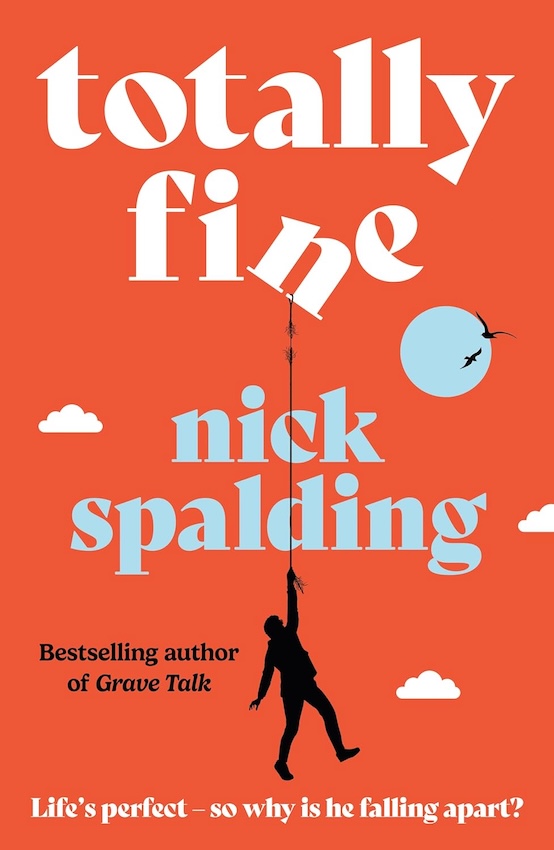
Book Review: Totally Fine by Nick Spalding – an entertaining comedy of manners with a touch of philosophy amid the humour

The main character in Nick Spalding’s new novel is Charlie King, who could be a really annoying person if he was in your life, if he wasn’t so well meaning. Obviously his girlfriend Annie sees this in him, as do his long-time buddies, Leo and Jack, but really, life with a Charlie King around would be exhausting.

Charlie makes his living planning events, all kinds of parties and marketing do’s for the middle classes. And he’s really good at it. The story begins with the birthday party he’s planned at a bowling alley for Annie’s young nephew, with a Jurassic Park theme, actors in costumes and fake dinosaurs, the works. A panic attack hits Charlie, triggered by an annoying song by the Black Eyed Peas – the same song that was on the radio when he had that car accident a while ago – something he’d never told Annie about. In fact he’s rather blotted it from his mind.

Doing his best to put the incident at the birthday party behind him, He gets back to work. But something isn’t right and he makes a big mistake at a gender-reveal party, which sees his business suddenly going south. Charlie decides the time out this offers is the perfect opportunity to confront his issues. But when he realises that his best mates Leo and Jack are also suffering from anxiety, Charlie decides they can all fix their problems together. Because that’s what Charlie does – fixes things up and makes everything perfect. If he can do that with events, he can do that with personal problems, right?

The story follows Charlie’s harrying his friends into different therapeutic options, from magic mushrooms, to navel-gazing in the wilderness. This creates plenty of amusing and visually interesting scenes. Throughout everything, he ignores Annie’s advice to consult a doctor, or his friend’s growing resentment. He seems unable to see what’s under his nose or understand his own problem. Why is he so afraid to see a doctor?

Totally Fine is an entertaining look at some of society’s ills – the pressure to perform, the endless distractions demanding our attention, the need to seem strong to the ones we love when inside we need help. Nothing really new but maybe ramped up here for the digital age. This is shown through one man’s problems, and as a professional tasked with providing his clients with the perfect social media opportunities, Charlie is the perfect protagonist for this. Perfectly imperfect, that is.

It’s a light, fun read, if you don’t mind a bit of schoolboy humour from time to time. It’s touch and go whether everything will turn out “totally fine” for Charlie and his friends, but you can bet there will be lessons learned. I read this after some darker novels, and it was a relaxing read that was just right. Nick Spalding is the author of around 20 books, mostly humorous fiction about modern life with his new book, Totally Fine, just released this week. I read it courtesy of Netgalley, and it’s a three-star read from me.

Book Review: Palace of the Drowned by Christine Mangan – a taut and atmospheric psychological drama

I’d heard so many good things about Christine Mangan’s books and now I probably want to read them all. Palace of the Drowned is set in 1966, and follows author Frances Croy (Frankie) who has had a difficult year. Once fêted for her work, her last book received a terrible review and, perhaps foolishly, she took it to heart. Fuelled by alcohol, Frankie behaved badly, and events spiralled out of control. In an effort to put it all behind her and have a good rest, she follows her best friend Jack’s advice and heads to Venice where Jack’s family own half a palazzo.

It’s late spring, Venice is cool but devoid of tourists, which is a blessing. But there are odd sounds in the palazzo – Frankie feels she is being watched, and the housekeeper is unfriendly to the point of hostility. As someone who has had a recent spell in ‘hospital’, Frankie’s easily unnerved. Venice is full of things that are hard to pin down – the watery light, the way it’s so easy to get lost in the labyrinthine alleyways, and Frankie not being a traveller by nature, becomes rattled, struggling to communicate.

Frankie is already fragile when a young woman, Gilly, accosts her, claiming to have met her before and then insists on meeting up for coffee and for drinks. Gilly is a huge fan of Frankie’s work and just won’t leave Frankie alone. She’s both annoying but also oddly charming. The story follows Frankie’s attempts to write again, her increasing unease, as well as Jack and her husband Leonard’s arrival. The couple are cautious around Frankie, walking on eggshells around her while Gilly gets more brazen.

Tension builds, coming to a head with a terrible weather event. The flood of 4 November caused a huge amount of damage to Venice and Christine Mangan uses this as a high point in the drama of the plot. There is so much water, not just in Venice, but also later in London where there’s not surprisingly a lot of rain. On the topic of liquids, the characters seem to drink a lot too, meals avoided, or have baths. Nothing seems solid.

The characters are brilliantly rendered. Harold, her friendly but pushy publisher, the pesky Gilly, and Frankie herself, who would probably have been fine if she hadn’t seen so much as an air raid warden during the war, or lost her parents suddenly to a pointless accident. People around her are both supportive, but also lose patience with her, much like I felt as a reader. You want so much to like Frankie, but she’s so much her own worst enemy – although sometimes it seems there’s a bit of competition for that honour. Who can she really trust? And people are so fickle towards creatives, aren’t they? Loving them one day, descrying them the next.

This is such a well-put-together novel, unsettling and intense. The audio-book version is excellently read by Emily Pennanant-Rea. Even the cover of Palace of the Drowned is evocative and perfect. There are, so far, two more novels by Christine Mangan – Tangerine and The Continental Affair – both now on my to-read list. The Palace of the Drowned is a four-and-a-half star read from me.

Book Review: The Vanishing Act of Esme Lennox by Maggie O’Farrell – a disturbing story about family secrets and the spectre of madness

I’ve had this book on my bedside table for what seems like forever – a ‘just in case’ sort of book for when I’d run out of anything else that begged me to pick it up. I knew it would be good – Maggie O’Farrell is always good, but the subject matter sounded sobering.

The Vanishing Act of Esme Lennox follows an Edinburgh family. Iris receives a letter from a solicitor about a relative she didn’t know she had, the sister of her grandmother, about to be released from care. Esme Lennox has been in a mental hospital for sixty odd years and now needs to be rehoused. Her name has been put down for a rest home, but there’s not a bed available for some weeks. Can Iris look after her in the meantime?

Iris assumes Esme must be unsafe, or unable to care for herself, or both, and with a shop to run and a busy life, is not confident she can take her aunt on. Her initial impulse is to agree to a temporary solution in a hostel. She collects Esme, a woman in her seventies, but the hostel is unwelcoming, peopled with drug addicts and volatile personalities. What can she do but put Esme up in her spare room and explore other options.

In the meantime we get Iris’s story – her close bond with step-brother Alex; the father who died young; her mother in Brisbane; her affair with a married man. Her little shop selling gorgeous pre-loved clothes and accessories. But the bulk of story is about Esme – her childhood in India with an older sister and baby brother. Her quirky personality, her stuffy, unloving parents and the terrible tragedy before the family’s return to Edinburgh. Esme is bright and rebellious, not sensible and manageable like her sister, Kitty. We follow her growing up and the events that tip her over the edge.

Iris waits for Esme to open the door but nothing happens. She puts her hand on the doorknob and turns it slowly. ‘Good morning,’ she says, as she does so, hoping she sounds more upbeat than she feels. She has no idea what she will see behind the door.
Esme is standing in the middle of the room. She is fully dressed, her hair brushed and neatly clipped to one side. She is wearing her coat, for some reason, buttoned up to the neck. There is an armchair next to her and Iris realises that she must have been pushing it across the floor. The expression on her face, Iris is astonished to see, is one of absolute, abject terror. She is looking at her, Iris thinks, as if she is expecting Iris to strike her.

It’s not a happy story, not at all, but it casts a light on the way women with mental health problems, or even if they were just a bit unruly, could be sent away to asylums. All was needed was a determined, usually male relative, and the signing off a doctor. Maggie O’Farrell imagines how a young woman like Iris would feel on discovering that her grandmother had a sister she’d never mentioned, and that that sister had been never been out of her mental facility for sixty years. Just how do you deal with that?

The two discover more about each other as secrets emerge, and in facing up to the truth, Iris also faces up to the truth of her own life, in particular her own relationships. It’s a compelling read and I was not in the least disappointed, in spite of the tragedy of Esme’s situation, as the story surges on to an attention-grabbing finale. I was hooked – I am always hooked with Maggie O’Farrell. I’m not sure if it’s her crisp writing style, or her immensely interesting and empathetically drawn characters, but her books are just so satisfying. As is this one. The Vanishing Act of Esme Lennox is a five star read from me.

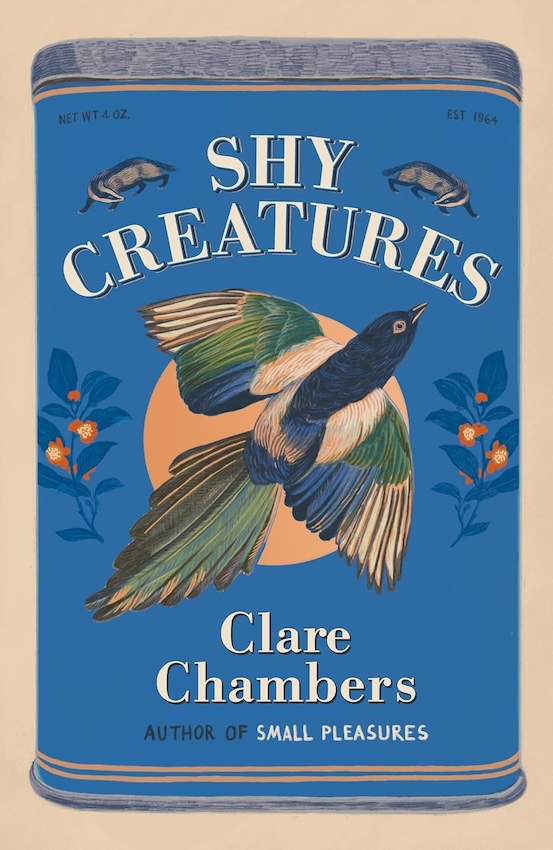
Book Review: Shy Creatures by Clare Chambers – a remarkable story, engrossing and heart-warming

I bought Shy Creatures as soon as it came out as an ebook, and unlike many previously purchased novels, it didn’t sit on my bedside table languishing while I was distracted by other books passing by. It beckoned to me and I was soon engrossed – and gosh, what a satisfying read it is.

Shy Creatures is set for the most part in 1964. Helen Hansford is an art therapist at Westbury Park, a facility for mental health patients. She has been having an affair with Gil Rudden, one of the doctors, which is complicated by his wife being a distant cousin of her mother’s. Gil has promised Helen that as soon as his children are old enough to leave home, he will divorce his wife and marry her. Helen accepts the status quo and muddles on with a less than satisfactory home life, a nagging mother, and a job where she doesn’t feel she makes a lot of difference.

For all that, Helen is passionate about her work and the way Westbury Park is run. The gates are always open, and while some therapy involves dulling the patients’s minds with drugs, doctors like Gil have more modern ideas, which is one of the reasons Helen fell for him. An incident at a nearby house leads Helen and Gil to discover a man who has been shut up indoors for at least ten years along with his only relative, a frail and elderly aunt.

William Tapping, now in his late thirties, has been found in a bad way, in a state of undress, a beard down to his stomach and apparently mute. The house is in a state of disrepair, filthy windows letting in no light, the garden a jungle. When social services intervene, William and his aunt are whisked away to Westbury Park. Here Aunt Louisa implores Helen to find a container hidden in the flour bin that no one else should see, but while she’s at the house, Helen also discovers some drawings in William’s room that display the work of a talented artist.

At the discovery of this cache, Helen’s pulse quickened and she felt a tingle of excitement. No one who had passed through the art therapy room during her residency had shown anything approaching this level of talent. Of all the professionals at Westbury Park, she was uniquely placed to help this hidden man emerge from his place of silence. Even Gil did not have her advantage.

The story follows Helen’s efforts to make a connection with William through art as well as her tracking down some old acquaintances – people he knew at school – in an attempt to find out more about him. We have the ups and downs of Helen’s relationships with Gil, as well as her family, particularly with a teenage niece who has a kind of breakdown. Woven into all of this is William’s story, going back steadily in time until we get to the day when his life changed dramatically, putting in place the kind of house arrest his family imposed on him.

It’s a fascinating story with Clare Chambers’s usual wit and brilliantly evoked characterisation – one of the things that puts her books on my must-read list. And it’s a sad story too, as we consider William’s wasted years. The author recreates the era of the sixties – the music and clothes as well as social attitudes to women, to the mentally frail. The limited choices for girls once they leave school – particularly if they want to please their mothers. We also have the war years, and the privations of rationing, the nightly fear of air raids.

If there’s a theme that often appears in books by this Clare Chambers, it is about finding a place in society when you’re not a natural fit. Many of her characters are on the quirky side and with William, we have someone who quite possibly never will find a suitable niche in the world – particularly a world like Britain in 1964. This, plus Helen’s relationship woes pulls you through the story, along with the eventual revelation of a terrible secret. It’s another brilliant read from Clare Chambers – I can’t recommend it enough – a five-star read from me.

Book Review: Hello Beautiful by Ann Napolitano – an engaging story about sisters and finding your family

I seemed to miss the Little Women references when I picked up Ann Napolitano’s latest novel, Hello Beautiful. Maybe I was distracted by all the basketball, but I was about three quarters of the way through when the penny dropped and it all made a lot more sense. Until then, I was wondering where it was all going as it just seems to be a nice story about a family, about love and loss, lies and betrayal, all nestling among the intriguingly varied personalities of the Padavano sisters.

None the less, this was an easy book to get lost in. The story bounces between several characters and over several decades as the Padavano girls grow up and make lives for themselves. They are a close Italian American family living in Chicago with their parents, a couple who married out of necessity – with Julia on the way – and struggle with a marriage that is broken. Into all this comes William, himself from a broken family, with parents who have never healed from the loss of his older sister, who have never been able to love him instead.

William’s character is both sad and compelling. He’s been rescued by basketball, and his height gives him a terrific advantage on the court, as well as a scholarship to study in a new town and leave his loveless childhood behind. Julia Padavano discovers him at one of her classes and somehow persuades him into a possible future as a History professor, and as her husband. Her family gives William the warmth and security he’s lacked all his life.

Willam knew all the players except the freshmen, and once or twice after finishing his sandwich he let the guys convince him to take a few shots from the corner. He knew his knee couldn’t take pivoting or even jogging from one spot to the other, so he stood still and drilled one long shot after another while his former teammates hooted with pleasure. When the ball swished through the net, William’s breathing slowed to normal, and he could pretend that he still inhabited a recognisable life.
With the basketball in his hands, he could forget that his father-in-law had dropped dead, his sister-in-law slept on his couch, and every time he saw his wife he was startled.

We also have Sylvie, Julia’s closest sister. Unlike Julia, Sylvie fails to push herself towards college, instead immersing herself in novels and helping out at the library where she kisses random boys among the shelves. Her dream is to find one, intense true love, and until then isn’t interested in dating. At home, her mother spends her life in the garden, growing saleable produce, her father quoting Walt Whitman and drinking too much. There are also the twin sisters: artistic Cecelia and nurturing Emeline.

The future seems settled for Julia and William, when a series of events upset the applecart and cracks appear in the extended family. Then, as so often happens, life goes on around the cracks, characters settle in and hunker down until another earth-shattering event brings the past back into focus and there is potential for a reckoning, and for healing.

I am glad that I didn’t spend a lot of time trying to figure out which sister was Meg or Jo, Beth or Amy, as it wouldn’t have done me any good as things turned out. It doesn’t really matter in the grand scheme of things. But this was a nice read, if a not particularly compelling one. It is a story where emotions run high, either expressed outwardly, or contained and mulled over or contained and ignored.The characters of the sisters and particularly William, are all easy to engage with, and interesting.

There are themes around mental health – how do you get over a childhood that is missing love? And about finding your place in life as a young person, of being accepted for who you are. I found quite a lot to like but the story did lag a little around the middle – the stretched-out timeline doesn’t help. Fortunately it all picks up near the end with the hope of at least one reconciliation and some impetus from the younger generation. I’ll be interested to check out another novel by Ann Napolitano. Hello Beautiful is a solid three-star read from me.

Book Review: Wildflowers by Peggy Frew: a haunting, witty and compassionate story about sisters

You can be forgiven for wondering what you’ve got yourself into a few pages in with Wildflowers. The narrator, Nina, is clearly not coping and while she’s brilliant at bringing you into the story, the vivd way her world is brought to the page through all the senses, she seems bent on self-destruction. You can’t help asking yourself, how will she make it through the next three hundred odd pages. Peggy Frew has created a brilliant character study of someone at the end of her rope.

In the past month, Nina has boxed up all her clothes, her curtains, her cooking utensils and anything useful, apart from the frypan and spatula she uses to fry her evening egg, eaten out of the pan. She gets her outfit for the day not from her wardrobe but from bags of donated clothing outside a charity shop, raided under cover of darkness. Nothing fits properly and yet she manages to hold down her admin job at the hospital, the staff cafeteria providing left-overs nicked from newly vacated tables

Her Dunlop Volleys flapped a bit. They were better with the Explorers; Archie McNamara’s socks were too thin. Under the tracksuit pants the seam of the satin shorty things seemed intent on bisecting her, and the lace on the too-tight bra was irritating the skin near her armpits.

What has brought Nina to this? The book flips back to the past to describe the events of Nina’s life and in particular her relationships with her sisters, Meg and Amber. Elder sister Meg was always the sensible one, chastising her laid-back parents over how they allow little sister Amber to run wild. Amber is dazzling, gloriously pretty but also with a charisma that is perfect for the stage and she’s soon a child actor in a film. What happens here eventually drives Amber to drug addiction.

Nina is the smart one, but she’s also a ditherer, uncertain what to do with her life. While Meg chooses her study path and makes a go of it, Nina finds student life daunting, blazing through her studies but strangled by shyness. She doesn’t know how to be.

The tremulous romanticism by which she’d been so strongly affected upon first leaving her family – which she’d always felt, but which in the lonesome splendour of her cobwebbed room and with the aid of her poetry classes had crystalised from a homely, unexplained presence into something not unlike a calling – this had not receded. It was melancholy, that’s exactly what it was: a sadness that was exquisite. She was kind of addicted to it. And she found that she couldn’t – simply could not – reveal this aspect of herself to anyone.

She drifts through unsatisfying relationships with men, a habit that continues well into her adult years. While she’s smart, Nina’s not so good at life so it’s not surprising she leaves the Amber problem to her mother and to Meg – until, that is, after years of Amber problems, Meg enlists Nina’s help in a last ditch attempt to cure their little sister.

The novel is threaded through with humour – I love the description of Nina pretending to listen to Meg’s hectoring voice on the phone while cleaning the grout on the bathroom tiles with baking soda, only to discover she’s out of white vinegar and furtively googling whether or not balsamic would work instead. Not everyone enjoys this odd mix of despair with wit – Meg Mason’s utterly splendid Sorrow and Bliss seemed to polarise readers – but for me it it works a treat.

Throw in some lovely, evocative writing – whether describing the rainforest retreat where the girls try to cure Amber, student flats or city scapes, Frew brings Nina’s world to life. This makes her story seem very real and adds to the huge compassion we feel for her as readers. I love this sort of book, and can happily add Peggy Frew’s name to a list I’m gathering of Australian authors, which include Charlotte Wood and Toni Jordan, as well as New Zealand born Meg Mason, who I’m keen to read again. Wildflowers gets a full five stars from me.

Book Review: Meredith, Alone by Claire Alexander: a compelling story about a life spent indoors

It takes some skill to turn the life of an agoraphobic person into an interesting novel. But I was soon hooked by the story of Meredith who hasn’t left her house in 1214 days – that’s three years and three months. Something has happened to Meredith to leave her traumatised and solitary, something which has cut her off from her mother and sister Fiona, once her closest pal. The story weaves in the past with the present as we follow Meredith’s struggles to get out into the world again.

Meredith has made her home a haven with restful colours and orders everything she needs online. She works online as a freelance writer so she really has no need to go anywhere. It just shows you how easy it is to cut yourself off from the outside world if want to. She has her cat, Fred, and her best friend Sadie calls in regularly with her two young children so although the book is called Meredith, Alone, she still has people in her court.

Meredith has support from a group online, StrengthInNumbers, where she makes friends with Celeste and talks to a counsellor, Diane, who conducts regular online sessions. We catch up with Meredith when she has a new visitor – Paul, from Holding Hands. He drops in on Thursdays to make sure Meredith is OK. Paul has his own struggles, and is in between careers. The two become friends over jigsaw puzzles.

I have my fingers on the door handle. Diane and I decided that I would count backwards from twenty. When I reach five, I’ll open the door. By the count of one, I’ll have both feet on my front doorstep. I’ll take five steps down my path, then I’ll go back inside.
It feels good to have a plan.

The book charts Meredith’s attempts to leave her house, which spurs the book onwards, day by day. It also dives back into the past to reveal Meredith’s terrible childhood and the event that drove her indoors. It takes a while for the reader to get all the information you need for her situation to make sense. Without a varied setting, the plot relies on Meredith’s story to drive it along, the slow revelations and your eagerness for her recovery. And it works.

Meredith is good company – smart and for all that’s going on in her life, she keeps herself busy to avoid drowning in the miseries of her plight. The novel has a lot to say about all the pain people hide away from each other, the things that derail marriages and cut family ties. How you cover it up and carry on as best you can. Until you just can’t. But the book never feels weighed down by all this.

Reading Meredith, Alone so soon after Paper Cup, which I thought utterly brilliant, was probably not such a good idea. Both are connected by Glasgow and have main characters with mental health issues and who have broken off from their families. But these novels are very different in feel and Meredith, Alone has very little to suggest its wider setting, apart from the odd reference to Irn Bro. It’s no fault of this novel if it comes off as second best – it’s still a great read and Meredith a great character. It will make you think. So it’s a four out of five read from me.

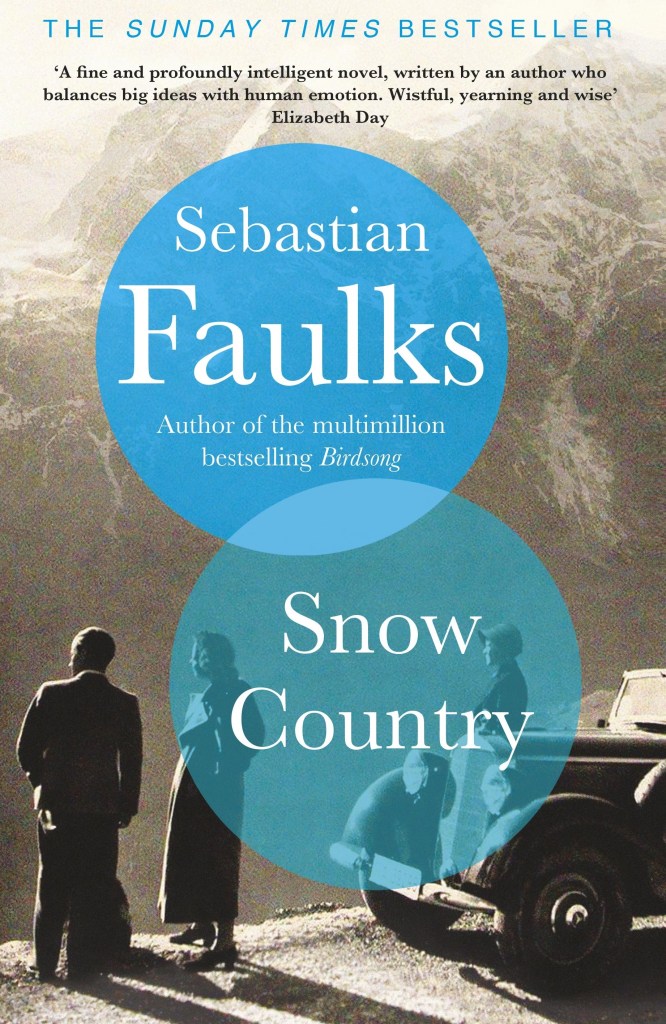
Book Review: Snow Country by Sebastian Faulks – a stunning historical read with a strong emotional pull

Sebastian Faulks regularly delivers an engrossing read, beautifully written and meticulously researched, often about some interesting aspect of history. The history never takes over the story – it’s always about the characters – but it gives you a very well imagined stage upon which the characters reveal themselves.

Snow Country is the second book in a trilogy, the first of which, Human Traces, completely passed me by. Published in 2005, Human Traces is about two friends, one English, one French, both fascinated by the workings of the mind. They go into psychiatry together, develop an asylum in Austria. Of course, Austria is where Freud worked, Vienna the birthplace of psychoanalysis. But Europe is about to be torn apart by the First World War.

Picking up Snow Country, it doesn’t matter at all if you haven’t read the first book – Faulks fills you in with everything you need to know, through the eyes of its two main characters. Anton escapes his bourgeois upbringing and his parents’ plan for him to take over his father’s sausage empire to study philosophy in Vienna. He starts submitting articles to newspapers, with an eye to becoming a journalist. Here he meets Delphine, a piano teacher, older and more sophisticated than Anton, but perhaps her charm lies in the secrets she hides. World War One intervenes and the two are separated, leaving Anton at sea emotionally as well as traumatised by his experiences at the front.

Lena couldn’t be more different from Delphine. Barely literate, she’s the child of an alcoholic mother who scrapes a living doing menial work and occasional prostitution. But Lena has the determination to make something of herself and sets her sights on Rudolph a law student who finds her a job for a respectable clothing merchandiser. Through Lena and Rudolph we get a snapshot of the political situation in Vienna post-war as the Nazi regime comes to power in Germany. While Rudolph is a politically active idealist, Lena lives for the moment, is open-hearted and spontaneous.

The stories of Lena and Anton eventually converge at an asylum by a lake, the Schloss Seeblick where Lena, escaping Vienna, takes a job, and where Anton is to research an article. The setting is oddly calming for both of them and drives each of them to dare to plan a different future. Anton has thoughtful conversations with Martha, the daughter of one of the asylum’s founders, now a trained psychotherapist.

…I have come to have a low view of the human creature, the male in particular. He seems to be a deformed animal.’
‘What do you mean?’
‘We are obsessive,’ Anton said. ‘We appear to have bigger brains than other creatures, but we behave in a way that’s contrary to our own interests. These harmful passions that drive us mad with love or with the need to slaughter one another. We don’t seem very well … evolved.’

As you might expect, Faulks takes the reader to some interesting places, such as the building of the Panama Canal, a huge undertaking that risks the lives of its labour force daily. Anton covers the story for a newspaper, as well as a murder trial in Paris. There’s a strong emotional pull too – both Lena and Anton are in their own ways broken hearted, suffering tragedy or loss. It’s a very moving book, as well as historically interesting, and gives you a lot to think about.

Snow Country isn’t the kind of book you race through to see what happens. The writing is such a joy it is worth taking your time over it. But you can’t help wondering how much of what is going on here is a set-up for the third book. I envisage World War II will have a part to play. In the meantime I am curious to check out Human Traces, and hope we don’t have to wait another decade or two before Book Three. This one gets a four and a. half out of five from me.

Book Review: Sorrow and Bliss by Meg Mason

This novel is a very intimate look at someone’s mental illness, which could in itself drive the reader into a depressed state if it weren’t for the scintillating prose which is a times laugh-out-loud funny. Martha Friel is turning forty at the beginning of the book, her marriage crumbling around her, as she looks back at her life to pinpoint the moments of significance to try and make sense of it all.

She is the child of eccentric parents. Her mother is a sculptor of minor significance who drinks a lot and drives her father, a poet who cannot quite bring himself to publish a long awaited collection, to leave them. You could say the apple doesn’t fall far from the tree when you look at Martha and her mother, who is difficult and at times cruel. But her father always returns, shutting himself away in his study among his books and poetic thoughts. Martha has a sister, Ingrid, who manages to lead a more balanced life, marrying Hamish and producing unplanned-for children with alarming regularity.

Then there is Aunt Winsome and Uncle Rowland who live in Belgravia and have funded Martha’s parents’ house and the girls’ schooling because being an unpublished poet and a sculptor of minor significance is no way to support a family. There are cousins, Nicholas, Oliver and Jessamine, as well as Oliver’s friend Patrick who’s father lives in Hong Kong and who has nowhere else to go at Christmas. As well as the closeness between the two sisters, much of the story is that of Patrick and Martha’s relationship.

That is what life was, and how it continued for three years after that. The ratios changing on their own, broken, completely fine, a holiday, a leaking pipe, new sheets, happy birthday, a technician between nine and three, a bird flew into the window, I want to die, please, I can’t breathe, I think it’s a lunch thing, I love you, I can’t do this any more, both of us thinking it would be like this forever.

Martha’s terrible rages, her problems with sounding normal at work or at parties, her unreliability, her snarky remarks, make her difficult to get on with and yet she inspires great affection from those who make the effort. She’s smart and shows odd moments of empathy.

The reason I had gone to London was for Peregrine’s funeral.
He had fallen down the central staircase at the Wallace Collection and died when he struck his head on a marble newel post at the bottom. One of his daughters gave the eulogy and looked earnest when she said it was exactly how he would have wanted to go. I wept, realising how much I loved him, that he was my truest friend, and that his daughter was right. If it hadn’t been him, Peregrine would have been acutely jealous of anyone who got to die dramatically, in public, surrounded by gilt furniture.

And while we get to see what Martha’s unspecified condition looks like, and the difficulties of getting appropriate medical help, the novel also gives thought to what makes people happy, the simple things often that people take for granted. Maybe it’s only when life is at its darkest, that you get to really understand this. I loved the characters in particular. Martha’s family are individually either odd or difficult, but they are all interesting and have their redeeming points. Patrick has his own sorrows – his lack of family, his struggles with his problematic love for Martha.

Meg Mason writes with such flair and understanding I surprised myself with how much I enjoyed Sorrow and Bliss. It is one of those funny/sad books, which can be entertaining and profound in equal measure. Mason is a New Zealand born author who lives in Sydney and this is her first book published in Britain. It is easily one my favourite reads for the year and really deserves its five out five from me.