Book Review: The Wolf Tree by Laura McCluskey – a did he fall or was he pushed, Scottish Noir mystery

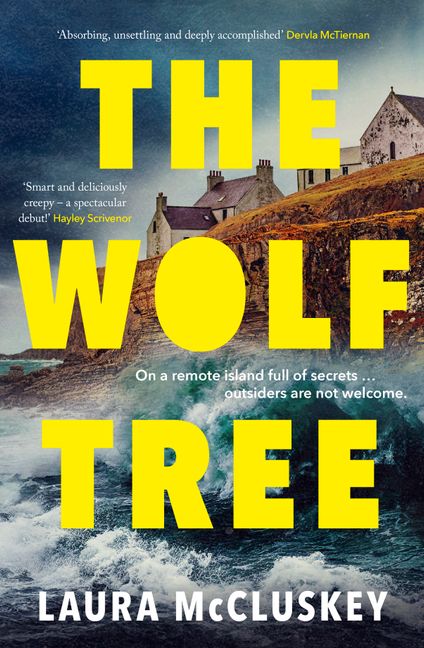
An island can provide just as much of a locked-room mystery as one in any building, particularly when it’s a remote island like Eilean Eadar, a wild and isolated spot off the West Coast of Scotland. In The Wolf Tree, we are in the shoes of DI Georgina (George) Lennox, who is just getting back to work after an attack that left her badly injured. This new case is supposed to be a box-ticking exercise, and she’s here along with her partner DI Richie Stewart to sign off on a probable suicide – a case to ease George back to work gently.

Of course, the reader knows that isn’t going to happen and things look problematic from the start. Even the boat crossing is wild and treacherous, the weather when they arrive, wet and freezing, the accommodation inconveniently at some distance from the little township. The two cops settle in, George doing her best to disguise from her older colleague and mentor her dependency on painkillers. The island has had to manage without a police presence, without a doctor, a school or social services of any kind for so long, so it isn’t surprising that the locals have learned to manage everything themselves. So they’re understandably reluctant to accept the interference of two cops from Glasgow.

Then there’s the case. Young Alan Ferguson, eighteen and busy applying for places at universities, had supposedly flung himself off the top of the island’s lighthouse. Alan was handsome and amiable, the only child of a widow, but she puts up a wall of animosity when George and Richie show up to ask questions. Hot on their tails, the priest arrives – a hearty, gregarious man, keen to help oil the wheels of the interview. The islanders, like Alan’s mother, are hostile towards mainlanders. It’s only the priest and the postmistress who are welcoming, or is that just nosiness?

Wariness towards incomers goes way back – the islanders had seen off the Protestant Reformation which turned the other western isles and much of Scotland. But Eadar is still staunchly Catholic. Or is it? What is the strange design that adorns the lintels of many of the houses, and why is George warned not to go anywhere near the woods. Pagan beliefs, mythology and superstition seem to hover on the fringes of everyday life. Then there’s the sound of howling wolves that disturbs George at night in a place where surely no wolves exist.

At twenty-eight, George is young to be a Detective Inspector, so it’s easy to imagine in her a tenacity her partner, eager to get back home with his family, seems to lack. It’s this tenacity that sees George asking awkward questions that Richie has to smooth over to avoid unpleasant confrontations. What will she have to do to earn the locals trust enough to talk to her? And what of the three lighthouse keepers who disappeared a hundred years ago? Can this mystery possibly have a connection to the death of Alan Ferguson?

It’s hard to determine which is more hostile and dangerous, the weather on Eadar or the people who live there. By the time we get to the end of the book, there are some stunning revelations and some spookily atmospheric scenes. George, in spite of terrible headaches, manages to think on her feet and probe the truth out of people in a case that will shock the whole community and mainlanders alike. She upsets Richie again and again with her disregard for her personal safety, and this looks unlikely to change anytime soon.

A first of a series, The Wolf Tree is a suspenseful and entertaining read, promising more tricky investigations for our two very different DIs. The Cursed Road is due for publication early next year. I particularly enjoyed the audiobook version of The Wolf Tree, which was read by Kirsty Cox. It’s a four-star read from me.

Book Review: The Red Shore by William Shore – an atmospheric new mystery series set on the Devon coast

William Shaw’s a well-regarded author of detective fiction; you may already have come across his Breen & Tozer, and Alexandra Cupidi series. In The Red Shore we meet London detective, Eden Driscoll, who gets a phone call out of the blue from Devon and Cornwall Police informing him that his sister is missing and her son taken into care. His understanding boss tells Eden to take as much time as he needs to sort things out. Eden thinks he’ll be back in a day or two, he’s working on an important case after all.

Eden hasn’t seen his sister Apple in over a decade, not since he ran away from his family at the age of fifteen. He felt bad about leaving his mother with Apple when his father died. But parenting was never their strong point, Dad being an overbearing man, his mother acquiescing too readily with his ambitions for a nomadic hippy lifestyle. Because of all this, Eden has never wanted a family of his own, doesn’t see himself settling down at all, let alone being a dad. He cringes from the idea of being the guardian of his nine-year-old nephew, Finn, a boy he never knew existed.

All this is an interesting story in itself, but layered on top is the mystery of what has happened to Apple. Eden’s sister, was an experienced sailor who seems to have gone overboard from her boat, the Calliope. Even more unlikely is the idea that she would have locked Finn in the cabin. When Eden asks for a look at the boat, DS Mike Sweet is sceptical when Eden assumes the presence of two recently used wine glasses suggests another person may have been on board. Sweet’s a nice chap, but seems inclined to go for easy options – suicide or an accident being the most likely scenarios.

So tracing the Apple’s movements will take a different kind of investigating. Molly’s irritating but she’s the only one who takes Eden seriously. There’s also Bisi, the social worker who is hoping Eden will find it in himself to be a father to Finn. Uncle and nephew don’t hit it off at first, but as Eden makes more of an effort, the idea that he could parent the boy starts to be a possibility, just as the trouble he gets into over his investigations causes alarm bells to go off with social services. This creates some terrific tension and emotional pull for the story, which also weaves in scenes from Eden’s childhood.

On top of all this, you’ve got a fabulous setting. Apple’s cottage is right on the estuary of the seaside town of Teignmouth, with a living room that opens out onto a beach. You’ve got lots of boating going on, adventures at sea, and the special vibe seaside towns have, with busy cafés and pubs catering to tourists and weekenders. It all adds up to a very satisfying read, with a plot that has you racing through the pages as Eden’s discoveries take him towards increasing danger, not only personally, but also for Finn.

I was very happy to discover this book recently, a new series I imagine will appeal to readers of Ann Cleeves’s books. I can’t wait for the next book featuring Eden Driscoll to find out if he settles in to a new life on the Devon coast. The Burning Tide is due for release next July. The Red Shore is a four-star read from me.

Book Review: Death of a Stranger by John Pilkington – an entertaining historical mystery and the start of a promising new series

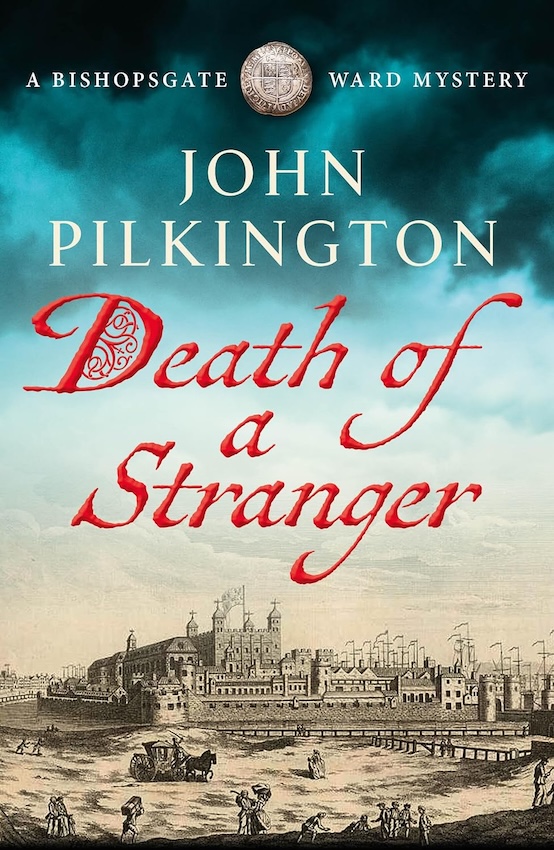
John Pilkington is an old hand when it comes to historical mysteries, with a number of series under his belt, among them the Thomas the Falconer series. Death of a Stranger takes us back to Elizabethan England in the first book featuring Matthew Cutler, a constable in the parish of Spitalfields. It’s 1594, when the murder of an Italian perfumer causes a need for answers, as well as anxiety among the other “strangers” or immigrants of the parish.

When a further threat against a French button maker occurs, the obvious conclusion is that someone is targeting the local “strangers”, either for being possible Papists or other reasons of their own. Matthew is fed assorted leads, a stonemason with a bitter nature since the loss of his daughter to the plague; a former acting friend of Matthew’s who had had a dispute with the perfumer. They’re all dead ends, but rather than dropping the matter as his employer, Alderman Skinner requests, Matthew determines to find justice for the dead man. Could someone be planting false clues?

What Matthew doesn’t yet know is how far his search for the truth will take him into the world of the movers and shakers of Elizabethan society, the perfumer having made house calls to favoured customers, some of them bored wives of powerful men. So there’s a lot to set the story going in interesting directions. Matthew hits wall after wall before he can convince his superiors that the case is worth pursuing.

As an investigator, Matthew is an interesting character. To begin with he’s educated, having fallen out with his magistrate father, and dropped out of his Cambridge studies after a year to become an actor. He lost his wife to the plague not long ago, and has two daughters in his care, his wife’s aunt living with them as housekeeper. He has come to the role of constable at the request of his gunmaker father-in-law.

As the story progresses, Matthew’s education and acting talent come in handy for questioning people of high public standing, an idea brought to him by Margaret Fisher, a comfortably off widow, friend and potential love interest. At first Matthew’s not convinced it’s a good idea – he’s used to being able to gain confessions from miscreants with the threat of the law and its grim punishments, but it’s a different story with the upper classes. I can imagine there will be plenty of potential for Matthew to don the clothes of Margaret’s late husband and the role of Sir Amos Gallett again in future books.

John Pilkington obviously knows his Elizabethan era well, for while Death of a Stranger is an entertaining story on its own, the period details make the story come alive. It was interesting to see a little of how humbler folk lived – so many historical novels concentrate on those at court – but I liked reading about the work of the gunsmith, the night watchman or the people at the local tavern, which doubles as a venue for the inquest.

Death of a Stranger is an enjoyable historical mystery, with John Pilkington writing in a style that sounds Elizabethan enough to add colour without being difficult for the modern reader. And Matthew Cutler is an engaging enough character for me to want to find out what he does next. I’ll certainly be on the look-out for the next book in the series. This first instalment is a four star read from me.

I read Death of a Stranger courtesy of Netgalley and Boldwood Books. The book is due for release on 14 November.

Book Review: The Sanatorium by Sarah Pearse – a gripping mystery-thriller set in the Swiss Alps

I like a good thriller set in an environment which hampers the investigation. There are plenty set in Scotland, but The Sanatorium might be the first I’ve read set in the Swiss Alps.

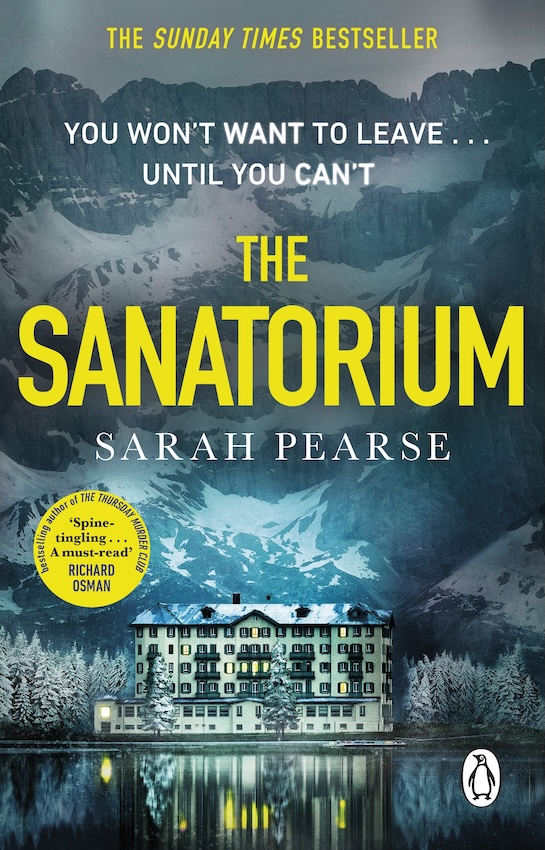
It’s January, so winter is well established, when Elin and her boyfriend, Will, arrive at a swanky hotel that was a former sanatorium for tuberculosis patients. They are there to help her brother celebrate his engagement to Laure, who works at the hotel, but before the other invitees arrive, the weather worsens, with avalanche warnings threatening the only road out.

Which is one problem. When Laure goes missing Elin starts digging. She’s a cop on extended leave after losing her mother to cancer and a particularly horrific case that left her traumatised. Elin’s also worried about her brother Isaac and has a score to settle. He was there when their young brother died, and because of their constant rivalry, of Isaac’s endless need to prove himself, Elin has often wondered if Isaac was being honest in his account of what happened all those years ago. So there’s that.

When weather conditions deteriorate to such an extent, the call goes out to evacuate the hotel, a body is found in the pool. Now that the last bus out has gone, the police can’t get in, so Elin is asked by the hotel owner, Lucas, to help. Despite her ongoing anxiety – she has panic attacks and flashbacks – Elin has to step up. She has been ignoring her boss’s frequent emails asking when she’s coming back to work, and trying not to think about Will’s wanting to make their relationship more permanent. So she’s got a lot going on in her personal life, too.

But the reader knows this is going to be Elin’s chance to prove her worth, without the support of her team, with a killer somewhere in the hotel, a missing woman and a dead body. The weather batters and threatens and the remaining guests and staff are unsettled. There’s also the mystery hovering in the background of what happened to Daniel, the hotel’s architect, who disappeared a couple of years before.

And then there’s the hotel itself. An austere architectural monstrosity, ground-breaking to some, like Will, who being an architect, is impressed. But Elin finds it unnerving. So much glass, and windows that don’t let you ignore the weather outside. But it’s the building’s former purpose that is really chilling. Laure shows Elin a storeroom before she disappears, which still houses some grim-looking equipment. Even the artwork that graces the hotel walls is a stark reminder that many people came here with incurable illnesses.

So there’s an awful lot here to build tension, inside the hotel and out, with Elin’s inner struggles and the case to worry about. I started this novel as an audiobook which is really well-performed by Gemma Whelan, who has to do French and German accents and pulls off the characterisation with aplomb. But it was such an engrossing story, I wanted to get my hands on a physical copy as well. I galloped through it all and found it overall a pretty good escapist read – four stars – with the promise of two more mysteries in the Elin Warner series to look forward to.

Book Review: Palace of the Drowned by Christine Mangan – a taut and atmospheric psychological drama

I’d heard so many good things about Christine Mangan’s books and now I probably want to read them all. Palace of the Drowned is set in 1966, and follows author Frances Croy (Frankie) who has had a difficult year. Once fêted for her work, her last book received a terrible review and, perhaps foolishly, she took it to heart. Fuelled by alcohol, Frankie behaved badly, and events spiralled out of control. In an effort to put it all behind her and have a good rest, she follows her best friend Jack’s advice and heads to Venice where Jack’s family own half a palazzo.

It’s late spring, Venice is cool but devoid of tourists, which is a blessing. But there are odd sounds in the palazzo – Frankie feels she is being watched, and the housekeeper is unfriendly to the point of hostility. As someone who has had a recent spell in ‘hospital’, Frankie’s easily unnerved. Venice is full of things that are hard to pin down – the watery light, the way it’s so easy to get lost in the labyrinthine alleyways, and Frankie not being a traveller by nature, becomes rattled, struggling to communicate.

Frankie is already fragile when a young woman, Gilly, accosts her, claiming to have met her before and then insists on meeting up for coffee and for drinks. Gilly is a huge fan of Frankie’s work and just won’t leave Frankie alone. She’s both annoying but also oddly charming. The story follows Frankie’s attempts to write again, her increasing unease, as well as Jack and her husband Leonard’s arrival. The couple are cautious around Frankie, walking on eggshells around her while Gilly gets more brazen.

Tension builds, coming to a head with a terrible weather event. The flood of 4 November caused a huge amount of damage to Venice and Christine Mangan uses this as a high point in the drama of the plot. There is so much water, not just in Venice, but also later in London where there’s not surprisingly a lot of rain. On the topic of liquids, the characters seem to drink a lot too, meals avoided, or have baths. Nothing seems solid.

The characters are brilliantly rendered. Harold, her friendly but pushy publisher, the pesky Gilly, and Frankie herself, who would probably have been fine if she hadn’t seen so much as an air raid warden during the war, or lost her parents suddenly to a pointless accident. People around her are both supportive, but also lose patience with her, much like I felt as a reader. You want so much to like Frankie, but she’s so much her own worst enemy – although sometimes it seems there’s a bit of competition for that honour. Who can she really trust? And people are so fickle towards creatives, aren’t they? Loving them one day, descrying them the next.

This is such a well-put-together novel, unsettling and intense. The audio-book version is excellently read by Emily Pennanant-Rea. Even the cover of Palace of the Drowned is evocative and perfect. There are, so far, two more novels by Christine Mangan – Tangerine and The Continental Affair – both now on my to-read list. The Palace of the Drowned is a four-and-a-half star read from me.
Book Review: Shadows of Winter Robins by Louise Wolhuter – a tense, dark, twisty story full of family secrets

Shadows of Winter Robins is psychological suspense with a big emphasis on the psychological. Our main character, Winter Robins, is in therapy for something she did that was at best misjudged, at worst a chargeable offence. The therapist encourages Winter to dig deep, and soon we’re transported to a council house in Harrogate, 1994, and Winter’s childhood. There’s a twin brother Four (he’s the fourth in his line to take the name Lewis), and loving parents, Nancy and Lew. But when Nancy dies, Lew falls apart, and though she tries, Gran is just too old to manage.

Lew writes to Nancy’s family in Western Australia and an uncle they’ve never met arrives to bring Winter and Four home with him. Although the children quickly enjoy time with their uncle, who has the nickname Dog, it’s a heart-breaking wrench, but the possibility of an idyllic childhood is obvious. Grandfather Harry is a successful artist and lives with their grandmother on the coast, off the beaten track. So there’s the beach to enjoy and fresh air and good food. Such a change from England. There’s also the housekeeper’s boy, Gabe, the same age as Winter, who is friendly too.

But there’s a darkness to Harry – he has a temper and is domineering, and rarely kind to the children, or his wife. His housekeeper is obviously more than a housekeeper and so there’s tension, while Dog is always in and out of trouble. Terrible things happen here, and the freedom the children enjoy is tempered by a loss of innocence.

The story follows Winter’s time at the beach house, before being sent to live with an aunt to attend school. These scenes weave in and out with the sessions two decades or so later with her therapist, as well as the discovery of what really happened at the beach house. Why did Dog have to leave in such a hurry? And why did the police arrive soon after? There’s an abundance of secrets and twists before you turn the last page and some shocking revelations, going back to the time Robins’s mother escaped to Europe with her best friend, Jan.

Louise Wolhuter has written a chilling but also gripping story that keeps you guessing until the end. There seem to be endless secrets that turn what we know on its head, again and again. It’s well written, too, with evocative prose, complex characterisation and an emotional pull. Underpinning the story is the notion of nature versus nurture, as Robin can’t help but worry about the kind of family she has been brought to live with, a family that can be cruel and morally dubious. The possibility of violence never seems far away.

Shadows of Winter Robins is a very clever thriller, but you might need a more cheerful read afterwards, as it left me with a chill down my spine. Even so I’ll be interested to see what the author comes up next. This one’s a four-star-read from me.

Book Review: We Solve Murders by Richard Osman – a very funny crime caper and first of a series

I came somewhat late to The Thursday Murder Club party, only picking the book up when a movie starring Helen Mirren and other big names was in the wind. It was such a fun read, I was keen to get my hands on the first of Richard Osman’s new series:, We Solve Murders. And I’m glad I did.

The story begins with Amy Wheeler, a private security officer – a body guard no less. Her current job is looking after world-famous author Rosie D’Antonio at her home on a remote island off the South Carolina coast. It should be a cinch, lots of relaxing by the pool and better than decent meals served by an ex-Navy Seal turned chef. But someone wants to kill Amy, and before you know it, she’s on the run with Rosie, who has her own plane, which comes in handy.

Next thing, the scene switches to the more hum-drum world of Amy’s father-in-law, Steve – an ex-copper turned private investigator. Living in a quiet English village in the New Forest, where ponies wander the streets as if they own the place, which they kind of do, his cases are no more tricky than missing pets and minor misdemeanours. He has mates at the pub and never misses Quiz Night, but still desperately misses Debbie, his late wife.

Amy and Steve are good pals, Amy on the phone to her father-in-law most days with her encouraging banter. So when she needs help, Steve’s the person she turns to. There follows a very complicated plot, involving money laundering, social media influencers trying to hit the big time, and the growing reality that Amy can’t trust anyone – except Rosie and Steve, that is.

The three make an odd team – Amy thrives on adrenaline and has passed her employer Jeff’s psychopath test with flying colours – Jeff’s criteria when hiring security staff. Rosie is all glamour, seemingly ageless, drinks everyone under the table and has an eye for the men. She’s quite keen on Steve, but he’s still devoted to Debbie and the quiet life. He also hates planes in spite being inveigled into joining an investigation that will take them to Dubai, via St Lucia and Ireland.

While there is a well-plotted mystery to keep you turning the pages and keep you guessing, for me the book was more about the characters and how they bounce off each other. Steve in particular has a stream of consciousness that is very funny, his ex-copper-like observations on a Cictaphone for seemingly ordinary things, his way of summing people up. But Steve, like pretty much everyone here, if full of surprises, even at times surprising himself.

This isn’t probably the book for you if you like to analyse every clue and figure it all out yourself through logic and deduction. But do pick it up if you’d like a lively, fun read to while away a wet weekend. There’s plenty of excitement – shootings, fights, helicopter, jet and jet-boat rides, and killers – plenty of those too. I imagine this would make another terrific movie or TV series – it’s full of visually interesting and unpredictable scenes, interesting characters and great dialogue. I loved it and will be keen for the next in the series. We Solve Murders is a four-star read from me.

Book Review: The God of the Woods by Liz Moore – a stunning thriller about family secrets and lost children in the wilderness

I found myself unable to put down this mystery-thriller set at a summer camp in the Adirondacks during the 1970s. The God of the Woods begins when thirteen-year-old Barbara goes missing towards the end of camp. Barbara’s parents, fragile Alice and autocratic Peter, are part of the wealthy Van Laar dynasty who own the camp and pay the staff who run it. They thought camp would be a good idea for Barbara as she’s been showing concerning behaviour at school and dresses like a punk.

Fourteen years before, the Van Laar’s son Bear also went missing, thought murdered by a local man who seemed to have a strange obsession with the boy. His grief stricken parents idolised Bear, who was by all accounts a popular and cheerful boy, his death something Alice could never get over. Unfortunately the suspect was never tried in court as he died suddenly – the case closed, leaving questions unanswered.

When a search is organised to find Barbara, young state trooper Judyta Luptack is determined to do her darnedest not just at finding Barbara, but in also discovering what happened to Bear, whose body has never been recovered. She suspects the Van Laars are hiding something. There’s also the recent escape of a serial killer from prison, who had been in the area when Bear disappeared. Could he have taken Barbara too?

The story dips back and forth through time, to when Alice first met Peter Van Laar, and her struggles to be seen as a person worthy of more than producing a Van Laar heir. The story is told from various perspectives, including Louise, one of the young staff running the camp who is hiding a secret. There’s also Tracy, the awkward girl who became Barabara’s friend, sent to camp following her parents’ divorce.

The story, weaving its way through these characters’ lives, and the suddenly changing timeline takes a bit of getting used to. I found myself having to really concentrate to keep up. But the sudden revelations, the cliff-hanger chapter endings and the issues each character carries with them, to say nothing of fears for the young Van Laars, keeps you on the edge of your seat as you read.

Class, power and money seem to be at the centre of things with the Van Laars and their wealthy friends, their alcohol-fuelled parties and casual disregard for the locals, their determination to keep their good name – all of which makes them unlikable. Although you can’t but help feel sorry for Alice. Other families have problems too – Judyta’s conservative Polish family are reluctant to let her live away from home, which means a long commute every day. Louise is worried about her alcoholic mother and her inability to properly care for her twelve year old brother. There’s also TJ, who has taken on the burden of running the camp, trying to fill her highly-regarded father’s shoes.

The God of the Woods is very much a literary thriller – it is so well put together, its characters all so interesting and complex, the natural wilderness setting, so peaceful one minute, full of danger the next, an evocative backdrop. The 1970s era gives us a glimpse of changing attitudes, but there’s still the paternalist misogyny lingering in the police force and wider society. It all gives you a lot to think about as you whip through the pages to find out what has really happened. It’s a brilliant mystery and a four and a half-star read from me.

Book Review: The List of Suspicious Things by Jennie Godfrey – a story about friendship, growing up and a small town’s dark secrets

The List of Suspicious Things is a debut novel which takes you back to 1979. Thatcher has just been elected PM and the Yorkshire Ripper is at large, killing young women, while the police have few clues to his identity. In Miv’s Yorkshire town the mills have closed down, so things are already tough, and likely to get tougher. At home, Miv’s mother never speaks, Auntie Jean delivers food to the table and terse comments, while her dad seems a bit lost.

When the family thinks a move down south might be a good idea, Miv is desperate. At twelve, she’s bright but a bit socially gauche, partly due to her home life, so her friendship with Sharon is too precious to lose. She’ll do anything to save it so decides to investigate and catch the Yorkshire Ripper. She buys a notebook and makes lists, and with Sharon’s help, begins to look for suspicious characters close to home.

As names are added to the list, the reader is introduced to the people of the town, beginning with Mr Bashir who runs the corner shop. He’s one of the nicest adults Miv knows but he has dark eyes and a moustache, so makes the list. There’s a truck driver from her father’s work, people she knows from church and a teacher among others. Other people in the community include Helen at the library – because where else do you go for information in 1979?

Of course, the girls don’t catch the Ripper, but their investigations uncover some of the darker elements going on in the town – the racism, the misogyny, the prejudice against those who are a bit different. Miv learns one or two secrets that are a bit close to home, and finds herself caught up in some of the fallout. She’s a girl who is left too much to her own devices, there’s just too much going on at home for consistent parenting. But then in 1979, kids were often left to find their own entertainment and the town is their playground.

Through Miv you also see the struggles of the adults in the story. Sometimes the narrative shifts to Austin, Miv’s dad; Helen; or Mr Bashir, who each have personal sadness and secrets. The setting – the late ’70s is well realised. Mr Bashir is always singing along to his favourite Elton John songs, jeans go from bellbottoms to stovepipes and Sharon buys a glittery lipgloss to try. And it’s also very Yorkshire, though not posh Yorkshire – the kids go ‘laiking about’ and at least one character’s house has an outdoor loo.

While overall I enjoyed the book, I did feel at times that it was rather overloaded with issues. So many dark things happen with a lot to fall on Miv’s small shoulders. Still, The List of Suspicious Things is a quirky and interesting novel, easy to get lost in. I was reminded of Joanna Cannon’s The Trouble with Goats and Sheep – another novel about two young girls investigating – in this case a neighbour’s disappearance – also set in the ’70s, and which is well worth checking out. The List of Suspicious Things is a three-star read from me.

Book Review: Still Life by Val McDermid – a layered cold case mystery with lots to keep you interested

I’d long known Val McDermid to be one of the top Scottish crime writers, ever since Wire in the Blood showed on our TV screens in the 2000s. While I enjoyed the characters, I’d never really taken to the books as I’m not such a fan of plots about serial killers. But the stories were always complex and the characters engaging. Then I came upon Still Life, a mystery in the Karen Pirie series.

Karen is a DCI from Fife working in a Historic Cases unit. When a body is found by fishermen in the Firth of Forth, Karen is called to investigate due to the dead man’s connection to a politically sensitive missing person’s case she’d had a hand in years before. Karen is a little reluctant as the local police have just started their investigations but is given no choice by her snooty boss “the Dog Biscuit” with Sergeant Daisy Mortimer as her back-up. Daisy is with the original team and with her French degree will be particularly useful when their case takes them to Paris..

This is an engrossing mystery not least because of the interesting characters. Victim James Auld had absconded when the police began to finger him for his brother’s presumed death, although the body of Ian Auld was never found. Ian was a high-level civil servant in the Scotland Office when he disappeared.

There’s a connection to art theft and a well-known Scottish artist who painted unique collage styled portraits of the rich and powerful, lost to suicide around a decade before. And throw in the fact that James had a seven-year stint in the Foreign Legion, and was a talented jazz musician and you start to feel a real interest in the victim. So many strands to investigate and very few clues.

‘He couldn’t have fallen and hit his head on the way in? There’s plenty of rocks along that part of the Fife coast.’
‘The injury’s too regular for that. If you pressed me, I’d be inclined towards a baseball bat or a steel pipe.’
‘So, homicide.’
The professor gave a sharp sigh. ‘You know it’s not my job to make that judgement.’
‘I wasn’t asking, Jenny.’ He softened his words with a bashful smile, then turned to DS Mortimer. ‘The passport?’
She spotted the evidence bags on the side counter and picked up the two relevant ones. ‘It’s a French passport. Issued just over two years ago to a Paul Allard. Like the prof said, he’s forty-nine. His driving licence was issued in Paris at the same time – ‘
‘What? Exactly the same time?’
‘Same date. That’s weird, isn’t it? I mean, nobody has a passport and a driving licence issued on the same date, do they?’

Meanwhile Karen’s Historic Cases sidekick, Jason Murray (the Mint), is left carrying on with the case of a three-year-old body found in a camper van parked in a garage. And if that’s not enough to keep the story humming along, Karen is also upset when the man who killed the love of her life is released from prison. A woman of strong emotions and fierce actions, her grief bubbles to the surface again, threatening to overwhelm a promising new relationship.

But in the end, it’s Karen’s intelligence that shines through. She’s an impressive tactician, works hard and is brilliant in the interview room. The story allows Jason and Daisy to show their strengths too in very different ways, with Daisy a new recruit for more in the series.

If you enjoy character-driven police procedurals, this is a great read with lively prose full of Scottish vernacular. This didn’t hamper my understanding of what was going on, but added an appealing touch of local colour. I broke my rule about reading a series in order – Still Life is number six in the Karen Pirie series – but it didn’t seem to matter; it worked fine as a standalone novel. I’ll be checking in with Karen again and definitely trying some other Val McDermid mysteries. She’s definitely reliable for a satisfying read. Still Life earns a comfortable four stars..