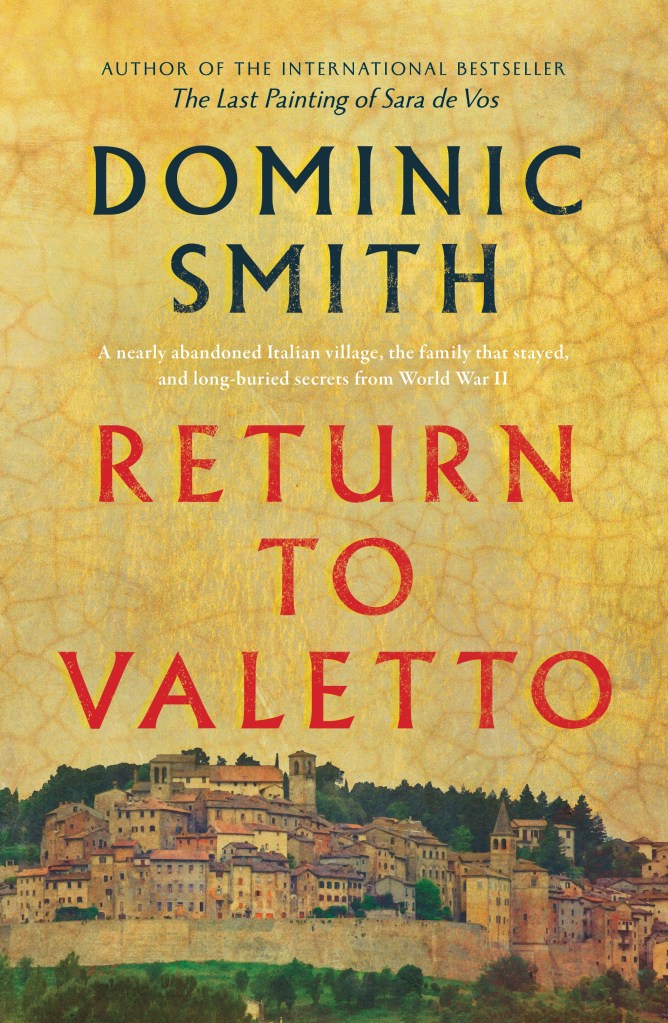
Book Review: Return to Valetto by Dominic Smith – back to Italy with a gorgeous evocation of place and atmosphere

Well, yes I know this book is about a lot more than its setting. There’s a man’s lingering grief for his late wife. A family of elderly women and a secret they never got to grips with from World War II. There’s some parent-child dynamics and a potential love affair. And all of it comes together in a captivating story that maybe takes a little while to get going, but once you get in, has you nicely hooked.

But when I look back on this book in months and maybe even years to come, I know it will be the setting that I’ll think about first. Valetto is Dominic Smith’s invented town in Umbria, which sits on a pedestal of volcanic rock. Much of the old town has fallen down into surrounding valleys, a 1971 earthquake urging many of its inhabitants to relocate. It has become a kind turreted and terracotta island, connected to the surrounding landscape by a footbridge.

Hugh is an American historian who specialises in the study of abandoned towns – there’s hundreds of them dotted around Italy and what better place to begin than Valetto, the childhood home of his mother and where even today his grandmother and three aunts still live. The Serafino women, all widows, are a big chunk of the population which has dwindled to just 10. In a few weeks it is to be his grandmother’s 100th birthday and a party has been planned.

A spanner in the works is the woman who has taken possession of Hugh’s cottage on the Serafino property, supposedly given to her mother for services rendered when Hugh’s grandfather, Aldo, was a resistance fighter during the war. Elissa Tomassi is adamant that the cottage is legally hers, just as Hugh’s aunts are convinced she’s a squatter with no legal tenure. Hugh is sure there can be a way to keep everyone happy and is caught in the middle. But he has to get to the bottom of what happened during the war and discovers not one but two family mysteries to solve.

The past will take Hugh back to Elissa’s home town in the north of Italy to find out what Aldo did in the closing years of the war. He’ll also discover a link between his mother and the Elissa’s that is a trickier memory to unlock and will reveal a crime that has been swept under the carpet. The story builds to a powerful and moving conclusion that has you glued to the final chapters as past deeds are dealt with.

What could be done with the wreckage of the past? As a historian I’d always believed that studying the past could reveal hidden meanings and patterns, that motifs lurked in the underbrush, but now I saw the neap tide of history washing up flotsam on an empty beach.

I enjoyed Return to Valetto enormously, not only for the setting which seems to be a big part of every scene. The late autumn mist across the valley that comes and goes and adds even more mystery. The large old villa that is the Serafino home with its cavernous rooms and crumbling frescoes. There’s the old family restaurant established by his grandmother, where you can see abandoned place settings and dusty menus from a night in 1971. (Oh, did I forget to mention this books is also a hymn to Italian regional cuisine?)

And the characters are a joy. The three aunts, each with their own peculiar ways and at times difficult interactions with each other. I have a particular fondness for books about aunts, going back to P G Wodehouse’s Bertie Wooster stories, and here Iris, Rose and Violet are brilliant. The grandmother with her iron determination to host an unforgettable birthday celebration with an ever-growing guest list and a despairing cook. Both Hugh and Elissa have daughters that make an appearance, so it’s an inter-generational tale as well.

I can’t help feeling Dominic Smith had a wonderful time researching and writing this book as his love for history, particularly social history, as well as all things Italian shines through. This is the second novel by this author I have read and recall that Bright and Distant Shores was one of my top reads for the year it came out. I’ve heard lots of good things about The Last Painting of Sarah de Vos as well. Return to Valetto gets the full five stars from me.

By the way, the fictional town of Valetto is inspired by Civita di Bagnoregio in Lazio – in case you want to visit, either in person or via the Internet.

Book Review: The Bookseller of Inverness by S G MacLean – a stunning Scottish thriller of intrigue and revenge

It’s hard for me not to feel a lump in my throat when reading a book that describes so vividly the events around the Jacobite uprisings that aimed to put a Stuart back on the throne. The butchery and barbarism of the government forces at the Battle of Culloden, the subsequent hunting down of Jacobites through Scotland and the harsh penalties enacted on those that were captured, including the ‘traitor’s death’, are hard to read about without feeling, well, rather cross.

With The Bookseller of Inverness, S G Maclean brings this history to life. It’s a murder mystery set in the Highland city of Inverness, the bookseller of the title, Iain MacGillivray, a veteran of Culloden who has somehow survived, though scarred both physically and mentally. He’s a brooding man of thirty-four, silent and dour as he runs his shop and lending library, coming to life a little at dances where he’s a popular fiddler.

Iain’s world is turned upside down and he is hauled out of his melancholy when several events happen in rapid succession. A stranger is found murdered in his bookshop – he’d previously been fossicking for a book he was desperate to find. And we have the return to Scotland of Iain’s father, Hector, who if found by the authorities will surely face death for his connection to Bonnie Prince Charlie, the Young Pretender.

On his desk lay a dirk like the one he had once habitually carried, before the bearing of arms or the wearing of tartan had been forbidden to Highlanders. Tied to the hilt of his knife, though, was a white silk rosette. Iain’s heart began to quicken. It was the white cockade, as worn in his own blue bonnet and in that of practically every other soldier of the prince’s army in the ’45. The white cockade, the most recognisable of all the Jacobite symbols, on the hilt of the knife that had been used to cut the throat of the man sitting dead in his locked bookshop.

Hector tells Iain about The Book of Forbidden Names, which has coded messages revealing traitors to the Jacobite cause. These are not just people who have sided with the government, but those who have ratted on the prince’s followers leading to their capture. Both sides would give their eye teeth for this book, including the victim found in Iain’s shop. Iain thinks he knows where another copy of the book might be, and soon more bodies turn up. It seems there is a killer out there with revenge in mind.

The novel is a brilliant murder mystery/thriller, but it is also an evocative imagining of Inverness in the 1750s, and boasts a wonderful cast of characters. There are the Grandes Dames, the elderly women who gather in Iain’s grandmother’s parlour who add a lighter tone to the story with their gossip; Mairi Farquharson, Iain’s grandmother rules the roost and is fearless in her standing up to English soldiers; Donald Mòr, Iain’s oddball bookbinder, is a master craftsman but spends most of the weekend either drunk or in the cells; the mysterious Ishbel MacLeod, the confectioner and her adopted son Tormod who hangs out with Donald.

Iain’s father Hector is a marvellous invention, a risk-taker and flirt, who in his sixties shows no signs of slowing down. Iain has a difficult time reining him in. There are some nasty English soldiers garrisoned at the town to collect rents and supposedly manage any Jacobite stirrings, but there are good army officers too.

MacLean has done loads of research and adds a lengthy bibliography at the end of the book. Here she explains also about the divisions within the Scots, those for or against the Jacobite cause, those who changed sides and those clans who were divided. Like all good historical fiction, her novel makes you want to read more about what really happened.

The background to the novel may sound a little grim, but The Bookseller of Inverness is a rollicking adventure laced with dry Scottish humour. There’s a bit of romance and the storyline has plenty of interesting twists. Iain is a bit of a hot-headed blunderer, not your Poirot kind of sleuth, and gets himself into some odd corners, but with people like his crazy bookbinder, Donald Mòr, at hand, he manages to get away with it. Underneath his terse manner lies a fierce loyalty to his family.

It would be terrific to think we might join Iain again for another mystery and some more Scottish history, but this book seems to be a stand-alone novel. And the ending leaves things nicely tied up too. But we can live in hope. I enjoyed it so much I’m giving it five stars, and can’t wait to read some more from S G MacLean.

Book Review: Shrines of Gaiety by Kate Atkinson – a story from flapper era set in London’s seedy Soho

I find it so easy to slip into a Kate Atkinson novel, whatever the storyline, because the writing is just so smart. In Shrines of Gaiety, the main focus of the story is the goings-on of a family of nightclub owners in 1920s London, overseen by the matriarch, Nellie Coker. A Scottish woman widowed young and with a family to support, she’s done a few dodgy things to make her fortune, intent not only on supporting her children, but advancing them in society.

We meet Nellie as she’s leaving after a short stint in Holloway, the London prison for women. One of her nightclubs had been raided and liquor found being sold on the premises. Usually she gets a tip-off from a policeman – Inspector Maddox from Bow Street police station – but not this time. Is Maddox still loyal? There’s someone else sniffing around – a gangland boss who’s keen to get his hands on a set of nightclubs and settle an old score.

Observing Nellie leaving Holloway is Chief Inspector Frobisher, the detective tasked with cleaning up Soho’s nightlife and the rot that has set in at Bow Street. With him is Gwendolen, a librarian from York who is on the hunt for two young girls who have run away to London to go on the stage. London has a habit of swallowing up young women and a few have been turning up dead, fished out of the Thames.

Gwendolen is an interesting character as she has the fortitude of someone who has nursed during the recent war, but post-war life has been a little tame, living in genteel poverty with her listless mother. When her mother dies, she discovers an inheritance which gives her the freedom to travel to London, where she can explore a new life. The missing girls set her off on a mission. Both Frobisher and Nellie Coker offer Gwendolen interesting opportunities.

As well as following Frobisher’s policing, and Gwendolen’s snooping, we meet the younger Cokers: eldest son Niven, who is battle hardened from the war, unflappable and smart. His sister Edith is Nellie’s natural successor, practical, though not as pretty as her sisters. But something has unhinged Edith lately. With their Cambridge education, Betty and Shirley are primed to marry into the aristocracy, though they also lend a hand with the clubs. Younger son Ramsay is rather effete and an easy victim of anyone trying to get at Nellie, but nevertheless has literary aspirations. Young Kitty at eleven suffers from neglect and is largely uneducated while no-one notices that she’s also in danger.

‘Give Mr Frazzini a box of chocolates, will you?’ Nellie said to Betty.

Nellie sold the boxes for fifteen shillings each but bought them wholesale from somewhere in the north for a shilling a box, all prettied up with ribbons (a penny each) by soldiers disabled in the war. The dance hostesses made a great fuss of persuading their partners to buy the boxes for them and then, after a few chocolates had been eaten, the boxes made their way back to the storeroom they’d come from and were refilled, ribbons adjusted, and sent out to be sold again.

The narrative bounces around all of them, as well as Freda and Florence, the two missing girls, creating a giddy plot that will keep you on your toes. I’ve heard this book described as Dickensian, and I suppose it is with its varied cast of characters, and the way the criminal element rubs shoulders with the law, the sudden reversals of fortune – there’s even a gang of women pickpockets. The story paints a picture of the mad excesses of the 1920s, the jazz and the flappers, the endless partying as everyone tries to forget the recent war.

I enjoyed this book enormously because the writing is lively and amusing and you really can’t guess what will happen next. The situation looks dire for the stray women caught up in the seamy side of Soho, but even those with money can lose everything on the turn of a card. Help and goodness are in short supply but come from unexpected quarters. I chuckled my way through the book at some points; nervous for particular characters at others. At the end of the book, Atkinson gives potted histories of what happens next to all the major players, which may please or annoy some readers I confess to being a little annoyed but it’s still a four out of five stars read from me.

Book Review: The Homes by J B Mylet – a gripping Scottish orphanage mystery

At the back of the book, J B Mylet explains how he was inspired to write this novel by his mother’s own experiences as a child in an institution very like the one in The Homes. As a young girl she thought all children were brought up in similar set-ups: a cluster of houses in a purpose-built of village with twenty or thirty children per cottage with ‘house parents’ and a cook to feed them all. She didn’t realise that most children grew up with their biological families.

And at first it’s the same for Lesley, sharing a room with five other girls, including her best friend, Jonesy, all about the same age. But now she’s twelve, she knows better. She at least gets regular visits from her grandmother, who though kindly, is unable to care for Lesley, and neither can her mother who visits a few times a year. Lesley is bitter about her mother and finds it difficult to believe her when her mother says she’s hoping to bring her home to live with her one day. Jonesy is there is because the state has considered her mother an unsuitable parent.

There are other rooms in Lesley’s house with more girls of different ages and in charge are the Patersons, a childless couple who do their best. But Mr Paterson is not above taking his belt to the girls, in fact it’s expected. Jonesy gets it more than most. She’s just so lively and unstoppable. And everyone is terrified of the Superintendent, Mr Gordon. Jonesy’s non-stop chatter is a foil to Lesley’s quieter intelligence. Meanwhile Lesley escapes into her studies, one of the few children who bus to a local school.

Fears of punishments and schoolyard bullies all fade into the background when an older girl, Jane Denton, goes missing, her murdered body found some days later. When another girl disappears, Jonesy determines to find out who the murderer is, while Lesley acts as a sounding board and is dragged into Jonesy’s sleuthing, throwing the girls into danger. What follows is a fairly classic mystery with plenty of secrets and hidden motives.

And while this is entertaining, it is the characters of the girls, especially Lesley’s narrative voice, sensitive and smart but also easily led down blind alleys, that make the story interesting. That and the strikingly original setting. It’s difficult to forget that these are vulnerable children who deserve so much better. Fortunately not all the adults are unsympathetic. Eadie is the kindly therapist who listens and offers advice; there’s a friendly detective and Lesley gets help just in the nick of time from an unexpected quarter.

The Homes makes for a compelling story, part mystery, part social commentary, that will have you riveted until the last page. But the story behind the story is just as interesting. I wonder what Mylet will come up with next. This book gets a four out of five from me.

Book Review: Where the Crawdads Sing by Delia Owens – a mystery that brings a marshy wilderness to life

I may be the last person I know to read this novel, but with the movie causing a lot of chat – both positive and negative, I thought it was about time.

Where the Crawdads Sing is one of those novels that sweeps you away. You can’t help but get lost in the world of Kya, abandoned by her family, by anyone she takes a shine to, but just gets on with the hand she’s dealt. The story starts in the early 1950s when Kya’s six, living with her family in a shack among marshes on the North Carolina coast. Her father’s a violent drunk with PTSD from his war service and has fallen out with his own once-grand family as well as his in-laws.

Kya’s mother is the first to leave and you struggle to understand how she could walk out on her family, particularly young Kya. But she’s a victim of so much abuse, it’s all she can do to get herself to safety. Soon Kya’s brothers and sisters leave too – they’re just old enough to make a life for themselves, but it’s a shame no one thought about their little sister. Meanwhile Kya, who teaches herself how to cook and keep herself alive, avoids the worst of her father’s mood swings, until he too leaves.

Kya has avoided school. Her single day in the classroom a rude awakening to prejudice and bullying. Still just a kid, she has learnt to navigate the marshes in her dad’s old boat. She discovers that the elderly black man who sells fuel, also sells fresh mussels so Kya finds a way to support herself. Thank goodness for old Jumpin’ and his kindly wife who look out for Kya, offering used clothing and affection.

And thank goodness for Tate, the boy a few years older, who teaches Kya to read and write. This opens doors for Kya and she is obviously very smart, soon recording the wildlife in her marsh not just with her collections of feathers and shells, the self-taught watercolours, but now with written descriptions too. But Tate is off to university and his life is set to take him in a different direction.

The story jumps forwards to 1969 with a murder investigation when the body of popular motor mechanic Chase Andrews is found at the bottom of a defunct fire tower. Did he fall or was he pushed? Sherriff Ed Jackson finds no fingerprints and enough to suggest foul play and soon his attention turns to the Marsh Girl. The old prejudices against Kya have never left and she becomes an easy scapegoat.

The murder investigation propels the story along, while weaving in Kya’s backstory, her growing up and her relationships with two young men. This is interesting enough, but what really makes the book special is the way Delia Owens brings the marsh to life – the watery passageways, the plants that grow there and the wildlife. This is described vividly in Kya’s distinctive voice which helps you see the world through her eyes.

“Crawdads” is an engrossing read and the character of young Kya as she learns to make a life for herself both heartbreaking and fascinating. The court case against Kya is gripping too, although I did find the plot lagged a little in the middle. And I couldn’t help thinking of Hardy’s Tess of the D’Urbervilles, which kind of skewed my reading of this novel. Perhaps this earlier work was an inspiration for Owen’s book or it may have just been me. I guess it’s true that every reader reads a different book. “Crawdads” gets three and a half out of five stars from me.

Book Review: The Way It Is Now by Garry Disher – old crimes surface in Aussie Noir mystery

I remember when Jane Harper’s stunning novel The Dry hit the shelves and suddenly we all wanted to read more Australian crime, or Aussie Noir as we soon called it. And all the while it seems Australian author Garry Disher has been producing reliably readable and award winning crime thrillers for years. I’d heard of him of course, but this I am ashamed to admit is the first Garry Disher novel I’ve read. At the end of which I could only shake my head and ask myself, what took me so long?

The Way It Is Now is Disher’s latest stand-alone novel. It’s about Charlie Deravin, a police officer on disciplinary leave who has nothing better to do or anywhere else to go but the old family beach house on Menlo Beach. While there’s plenty of surfing and Christmas to think of – his daughter’s visit is something to look forward to – there are reminders of the past at every turn.

The son of a cop, Charlie grew up in a society where the friends who came to family barbecues were other cops. And some of them are still around. But the most haunting thing for Charlie is the disappearance of his mother when he was a rookie policeman part of the team looking for a boy missing from a school camp. Assumed drowned, the child disappeared the same day as Charlie’s mother, a high school teacher who’d just popped home unexpectedly. Her car was found abandoned with evidence of a struggle. Newly separated, many people pointed the finger at Charlie’s dad.

The story weaves Charlie’s memories of the past with his ongoing relationship with his brother who hasn’t spoken to his father since, and his father now ailing but still receiving poison pen letters. There’s also the case Charlie has been suspended from, which caused him to fall out with his boss, but also brought a new love into his life. Anna was a whistle-blower in a case of jury tampering and someone’s trying to silence her. So nothing’s going well for Charlie. As Charlie uncovers the past, two dead bodies are found at a construction site and the police see even more links to Charlie’s dad. But Charlie has seen the toll the unsolved mystery has taken on his father and believes in his innocence. The book becomes a race to prove his innocence while the old man begins to fade.

While the plot is complex and interesting enough, humming along with plenty of suspense, Disher really excels with his characters. Charlie is likeable enough but flawed – the disappearance of his mother niggling in his mind for twenty years. This has put a strain on his marriage to say nothing of his work in Vice. There’re the old-school cops that he bumps onto at the beach, particularly Mark Valente who was like a second father to young Charlie and epitomises the old-boys club of local cops. Minor characters are no less interesting

While Valente seems a benign presence, he evokes a sense of not rocking the boat and keeping the past in its place. Charlie’s brother Liam loathes the man for his homophobic attitudes. Misogeny also lurks throughout the book – his mother’s nervousness around her lodger, the nasty rape case that was Charlie’s downfall, the attitudes to police wives. Disher brings it all to life in a way that seems authentic and adds a tone of menace.

I enjoyed The Way It Is Now as an audiobook, which was superbly read by Henry Nixon and made me feel I was at the beach on Australia’s Victoria coast. Disher evokes the Australian landscape well, so I’m going to see where else he takes me. This books gets a four out of five from me.

Book Review: The Driftwood Girls by Mark Douglas-Home – a twisty mystery involving fiction’s favourite oceanographer

I’d almost forgotten how much I’d enjoyed the previous ‘sea detective’ mysteries and so this book almost slipped under my radar. It’s been a while since The Malice of Waves, Douglas-Home’s previous novel about his beleaguered oceanographer sleuth. Cal McGill runs a small business out of his Edinburgh flat, mapping ocean currents for clients who are missing things – often loved ones – lost at sea. He has pictures of flotsam and jetsam on a pinboard that dominates his living/working space, some of them rather grisly. So yes, he’s an odd sort.

It’s not unusual for him to find himself in a tight spot and at the start of The Driftwood Girls everything seems to be going wrong. After talking to an elderly man who looked set to jump from a bridge, the news media have labelled him as the bad guy when the old fellow disappears. Clients have dropped him like a hot potato and he’s almost out of cash. Then he learns that his old uni friend Alex is dying and is called to make good a promise to bury him in the middle of Alex’s favourite lake, which being illegal, will have to be done post-burial and under cover of darkness.

Out of the blue, Cal is contacted by Kate Tolmie, desperate to find her sister Flora who left a mysterious note with Cal’s name on it. Twenty-years before Kate and Flora’s mother disappeared off the coast of France when she was due to return to her family via ferry. The disappearance was big news at the time but no clues have ever come to light. Kate also hopes Cal can find out what happened to her mother, and there’s a personal connection too. Flora was Alex’s fiancée.

The story switches to Texel, an island holiday spot in the Netherlands, where the body of a young English girl lost at sea washed up, also twenty-three years ago. Here her old school-mate Sarah has made her home, guilt-ridden for not being a better friend. Of course, only Cal can make the connection. And what’s the connection to the death of a beggar at an Edinburgh train station, stabbed in an adjacent alley. All clues point to Kate Tolmie being the killer but DS Helen Jamieson isn’t so sure.

Helen is the other great thing about these books. She, like Cal, is an awkward character, not getting on with her colleagues because of her need to examine all the facts to ensure the right person is put away. Imagine that! Her IQ is off the chart and she’s got a massive crush on Cal. The two have become friends over several cases, but Cal is a terrible person to be friends with as he disappears for months at a time and doesn’t keep in touch.

Friendship is a recurring theme throughout the book – the awkward friendship between Cal and Helen, Cal’s sporadic memories of time spent with Alex, and their friend Olaf. There’s Sarah and her elegant French neighbour, as well as her memories of lost friend Ruth. Friendship has its obligations which can cause strain as much as it enriches people and we can see that here. Then there are all those secrets. Cal is in for a few surprises about the old pals he lost touch with and it is fortunate that Helen is investigating as she helps connect the dots.

This is a lovely twisty read with some really evocative coastal settings that add a ton of atmosphere. You get enough of the science of oceanography for it to add interest without weighing the story down. Mark Douglas-Home deftly weaves together all the plot threads – and there are a few of them – in a way that keeps you up reading to see what happens. All in all it’s a very satisfying mystery, but I hope we won’t have to wait too long before Cal’s next investigation. A four out of five read from me.

Book Review: The Winter Guest by W C Ryan – a ghostly murder-thriller amid the Irish troubles

The Winter Guest is my second W C Ryan novel, both books featuring ghosts, or at least characters who are able to see them. This isn’t a genre that normally grabs my interest, but Ryan makes the ghosts not too ghoulish, sometimes helpful and doesn’t let them take over the plot.

Tom Harkin is an intelligence officer for the IRA. It’s 1921 and Tom has been asked down to the funeral of former fiancée, Maud Prendeville, who’s been killed in a rebel ambush outside her home. Maud lived at Kilcolgan House, the run-down home of Lord Kilcolgan, her father. The family had not fared well during the WWI, losing Arthur, Maud’s brother. So there’s that.

And then Maud got caught up in the Easter Rising of 1916, siding with the rebels, which is unusual considering her family background, i.e., Anglo-Irish landed gentry and Anglican. After a narrow escape, she’s supposedly lead a quiet life, having sometime before broken off her engagement with Tom who she’d met at university. Gosh, she’s an interesting victim – it’s almost a shame we didn’t get to meet her properly, before the killer got her.

Maud had been at a card party at her uncle’s, Sir John Prendeville, and had unexpectedly decided not to stay the night – it’s dangerous to be out after dark, as violence erupts in so many ways. Not just the rebels, either. She gets a lift with District Inspector James Teevan, who is also dropping home Maud’s guest, family friend, Harry Cartwright. All three are discovered shot dead, but the IRA rebels swear they left Maud concussed, but still alive.

The elderly couple living at the gatehouse heard a shot go off a few minutes after the original shoot-out. So Tom’s been asked to put his intelligence officer hat on while he’s staying with the Prendevilles for the funeral to find out who murdered Maud. His cover as usual is that he’s an insurance assessor, evaluating a future claim on Maud’s estate.

This is a mystery where it doesn’t matter quite so much whodunit, as whose side they’re on and what secrets they’re hiding. As you read you have to get your head around the politics of the time. Since the Rising the British Army have come down hard on rebel activity, bolstering the local police force (The Royal Irish Constabulary, or RIC) with the Black and Tans recruited from ex-British solders, as well as Auxiliaries, a counter-insurgency unit. In charge of the local Auxies is Major Abercrombie, a shoot first, ask questions later sort of guy. Abercrombie was meant to have been in the car when it was ambushed.

And then there are the ghosts. Tom Harkin, still suffering from PTSD from his time in the war, feels a presence helping him avoid soldiers during curfew. He sees ghosts of men he knows are dead. It’s a shock to meet Sean Driscoll from his old regiment. He thought Driscoll had been killed in the same mortar attack that had wiped out many of his fellow soldiers. But somehow Driscoll survived and now he works for the Prendevilles. There’s a Prendeville ghost too, who Maud’s brother spots just before the ambush, seen only when a Prendeville is going to die.

The Winter Guest is more than an atmospheric country-house mystery – although there’s a ton of atmosphere in Kilcolgan House, with its failing masonry and lingering dead. It’s also a terrific snapshot of a time in history and the pressures of martial law, which seems to bring out the worst in many, and the best in a few. On top of that, Ryan rollicks up the tension as Tom Harkin slowly puts together what happened and why, leading to a nail-biting showdown at the end.

Tom unravels layers and motives, going back in time, plus a bunch of secrets that keep the reader guessing. I wouldn’t mind another mystery for Tom Harkin to solve – he’s an interesting and appealing character. But then I really liked Kate Cartwright from A House of Ghosts too. The author has written some historical fiction as William Ryan, but as W C Ryan, ghosts seem to be the connecting theme, rather than a regular sleuth. It’s an original idea and in Ryan’s skilled hands works really well. I’ll definitely be back for more. The Winter Guest is a four star read from me.

Book Review: The Headmaster’s Wife by Thomas Christopher Greene – a riveting story, artfully crafted

I’d heard a few recommendations of this 2014 novel set in a New England school. You get to the middle and suddenly you can’t put it down, people told me. And yes, in a way, that was true.

The Headmaster’s Wife is the story of a marriage in trouble, set in the enclave of a small private prep school, a claustrophobic world where privacy and personal freedom can be in short supply. Tradition holds sway at Lancaster, an exclusive boarding school for wealthy students aiming for Ivy League universities. A few scholarships bring in students from poorer backgrounds, such as Betsy Pappas, a brilliant student from a small town north of Lancaster, the product of hippy parents, and Russell Hurley, a plumber’s son who is there because he’s so good at sport.

Not so, Arthur Winthrop. He’s the son of a Lancaster headmaster, and the grandson of a Lancaster headmaster, and carrying on in the same family tradition (a good literature degree from Yale and a teaching career), is now the headmaster of the title. We catch up with Arthur at the start of the book when he’s lost his way. Walking through Central Park in the snow, he has some sort of mental breakdown, removes his clothes, before finding himself in police custody and requested to explain his behaviour.

The story flips back to his obsession with a student, Betsy Pappas, who is not only attractive, but really gets Russian literature. Meanwhile his wife plays a lot of tennis, or spends time in their son’s room, missing Ethan who has disappointed his father by joining the army instead of going to Yale. The succession of Winthrops as Lancaster headmasters will likely end with Arthur.

And she thinks perhaps that is what love is: letting someone else see that part of you that shatters like glass… They will grow old together, broken together, and as long as they both don’t completely shatter at the same time, they might find a way to pick each other off the ground.

While the Headmaster’s Wife is about the Winthrops and their marriage, there’s also a mystery/suspense element that keeps you hooked. Communication problems, suppressed feelings as well as power and its abuse hover in the background. I was also reminded of that often quoted line from Philip Larkin’s poem, “This Be the Verse”. You know the one.

To say more would spoil one or two surprises that give the book the impetus that keeps you reading. The story structure is original, and you can’t help but admire the clever storytelling, the fine writing, but the book will tug at your heartstrings too. I was glad of the recommendation to pick this up, as it’s a quiet, unassuming looking book that would have otherwise escaped my radar. The Headmaster’s Wife scores a four out of five from me.

Book Review: Black Rabbit Hall by Eve Chase – secrets and lies in an evocative Cornish setting

I love these novels set in old English country houses, specially when family secrets, heartbreak and mystery are added to the mix. Old houses can add a Gothic quality, as it is with Black Rabbit Hall, although that’s not the house’s real name. Pencraw’s a dilapidated mansion on the Cornish coast, subject to storms and heady summer heat and it’s the home to the Alton family when they’re not in London.

The young Altons are a blessed with loving parents – beautiful Nancy who hails from New York, and Hugo who is struggling to maintain the old house, with its leaky roof and unreliable floorboards. The couple are devoted to each other, and adore their kids: little Kitty, nature-loving Barney, fifteen-year-old Toby and his twin sister Amber who narrates most of the story. Their world comes crumbling down when Nancy dies suddenly in a riding accident, and the children become more wild and unkempt.

Amber does her best to fill in as a mother figure to the two younger children while Toby acts more weirdly than ever. He has a fixation with what to do if civilisation comes to an end – it’s 1968 and the Cold War and the nuclear arms race are all go. He’s a survivalist but not in a good way and argues constantly with his father. It doesn’t come as a surprise when Hugo invites an old flame to visit but it’s a shock when she arrives with her seventeen-year-old son, Lucien. Caroline is the opposite of their warm, spontaneous mother, but she’s got money and might just save Black Rabbit Hall.

The story flips between Amber’s narration and Lorna’s some thirty odd years later. Lorna and her fiancé Jon are looking for a wedding venue, and Amber has a distant memory of visiting Black Rabbit Hall as a child with her mother. There is an emotional pull here for Lorna as her mother has recently died, lacing the memory with nostalgia. Finding the house almost defeats them, but it’s also a shock when they get there and it seems the Hall is not quite ready for hosting weddings, despite what the website says.

Jon and Amber look set to fall out over the Hall, Amber still excited about finding the perfect setting for the wedding, Jon more realistic having noticed the general state of disrepair. Then there is the lack of staff, the house inhabited by the frail and elderly Mrs Alton and Dill, her flustered general factotum. Amber is talked into visiting for a weekend to help make up her mind – no pressure! What she experiences when she’s at the Hall is more about disturbing distant memories and uncovering family secrets that giving the place a trial run. What is it about Black Rabbit Hall that seems to prod deep into her consciousness?

The story slowly comes together as we go back through the years to fill in the gaps as the Alton children have to deal with family upheaval while still grieving for Nancy. Lorna also teases out hints from the past which make her doubt her future with Jon. In each narrative there is a gathering storm and sense of impending doom, which has you galloping through the book to find out what happens. It all comes to a startling and intense ending but there is resolution as well.

For me the book had hints of Daphne du Maurier, not only with the Cornish setting, but with the cruel, Mrs Danvers-like malefactor and the Gothic qualities of the house. Chase also does a great job with the family dynamics, particularly the way she writes about siblings and the intense connections between the twins, the pressure on the older sister to keep things together and the difficulty for her to be her own person.

Black Rabbit Hall is the perfect read if you like old country house mysteries and evocative settings. The characters are easy to empathise with, honestly they break your heart, and there is an interesting dichotomy between long summer days where nothing seems to happen and events hurtling characters into rash behaviour. This is my second Eve Chase novel – I’d previously enjoyed The Wilding Sisters – and it didn’t disappoint. I’ll be heading back for more. Black Rabbit Hall (which incidentally won the Saint Maur en Poche prize for best foreign fiction) gets a four out of five from me.