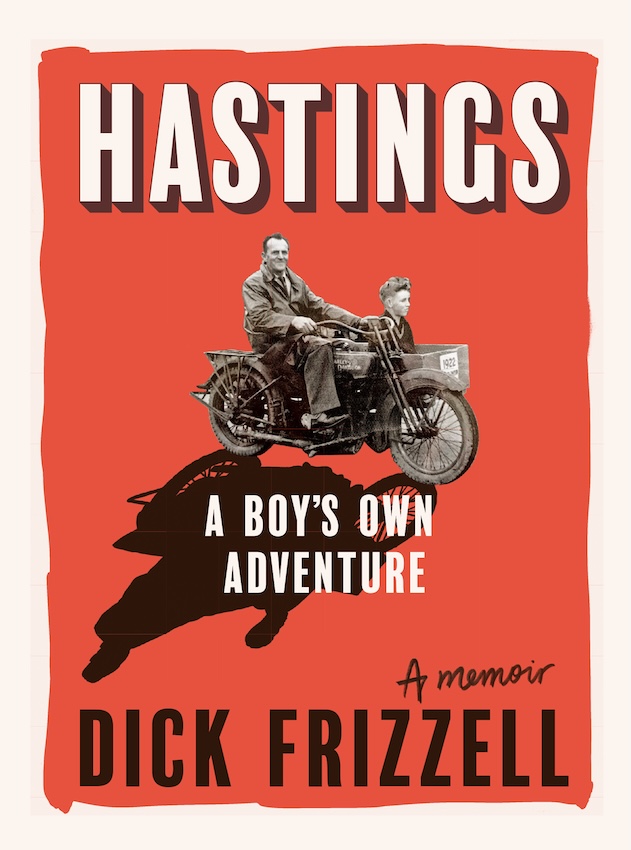
Book Review: Hastings: a boy’s own adventure by Dick Frizzell – an entertaining memoir of growing up in 1950s provincial New Zealand

Gosh life in the 1950s could be dangerous. Kids jumping on bikes and disappearing for the day, nobody really knowing where they were, mowing the lawns with bare feet, impromptu caving adventures under a mountain known as The Peak. Somehow the author managed to survive childhood to write this entertaining memoir about growing up in his home town of Hastings – that’s Hastings, Hawke’s Bay, New Zealand – not the one in England or any of the other Hastings around the world.

Dick Frizzell is one of New Zealand’s most instantly recognisable artists – his paintings, that is. When you read this book, you’ll discover that not only did he win an art prize at his high school, but an English prize as well. As a writer, he has a chatty style, the kind that you can imagine him using to tell a funny anecdote over a beer. It’s also very descriptive, with many original and quirky turns of phrase that help you imagine what things look like. The visual artist coming out in his prose.

Although I missed the 1950s entirely, my quite a bit older siblings would tell similar tales from their childhood and a similar picture of New Zealand would emerge. This book begins with Dick’s early years, and the arrival of a whole bunch of sisters, his parents’ concern that he needed a brother and the sudden arrival (and departure) of Ray. The book is full of characters, beginning with his parents – his engineering father’s ability to build and fix, and to get through large amounts of beer during a rabbit hunting excursion. Or his mother’s love of entertaining, her cottage art and determinedly sunny nature.

These characters – neighbours and kids from school, elderly aunts and teachers – emerge in the stories, which are often wild and whacky tales, capturing the young Richard as an innocent at large. The decision of Dick and his mates to test the saying ‘like shooting fish in a barrel’, which of course meant ‘borrowing’ a gun and fish; the unusual ‘mates’ he makes in hospital on a men’s ward following a burst appendix; joining a theatre troupe performing South Pacific as a call boy and painting on tattoos.

Such a busy time, and all through it a nostalgic look at how we lived. New products at the corner shop, like the arrival of the first popsicles (marketed as TT2s), driving his mother’s 1936 Austin Sherborne, saving up to buy Beano, Phantom and Uncle Scrooge comics, teenagers with motorcycles at the milk bar. Through it all lots of drawing and art, the future painter starting to develop. It all seems so innocent now.

Did the outside world impinge at all on any of it? As a kid, I remember being very aware that my older brother could get drafted into the Vietnam War, that there was a nuclear arms race, pollution and not enough food for countries in Africa, George Harrison singing about Bangladesh. I remember getting really worried before I even got to high school. It was a different time, I guess.

Hastings: a boy’s own adventure is a fun read though. I chuckled my was through the thirty stories, some of them quite hair-raising. A trip down memory lane, or your parents’ memory lane. It’s the kind of book you can pick up and put down as each story is a separate vignette, which makes a nice bedside read, or gift, I should think. The first in a series of planned memoirs, Hastings: a boy’s own adventure is a four-star read from me,

Book Review: The Bookshop Detectives: Dead Girl Gone by Gareth Ward and Louise Ward – a humorous take on the bookshop mystery, packed with local colour

I went to an author talk recently at which authors Gareth and Louise Ward described how they came to write a book together set in the New Zealand village of Havelock North where they live and where they own a bookshop. The Bookshop Detectives: Dead Girl Gone is a delightful cosy mystery and part of the humour for me, anyway – and this is a very funny book – comes from the way the main characters, Garth and Eloise Sherlock, owners of Sherlock Tomes, are seemingly versions of the authors and their world.

In real life, Gareth and Louise were also, once upon a time, coppers back in the UK, or Blighty as they call it. And they do have a large dog with a sensitive personality who is often at the shop – I’ve been there a few times, so I know. The world of these booksellers just seems made for a cosy mystery series, doesn’t it? At the talk I was amused to learn that the dog, Stevie, was a more prominent character in the first drafts, until the editor cut out large chunks with “too much Stevie” scrawled in the margin. So for lovers of mysteries where pets save the day and solve the murder, this doesn’t quite happen, although I am happy to say, Stevie does play a pivotal role in things.

The story revolves around a cold case, the disappearance of schoolgirl, Tracey Jervis, decades before. A bright student with a talent for poetry, Tracey left home, heading for the circus, and was never seen again. There were rumours of her being caught in a clinch with a teacher, but the work she did helping a politician with his campaign seems to have thrown up more questions. As well as being politically ambitious, Franklin White is a property developer, with an arrogance that makes him easy to loathe. And then there’s Tracey’s controlling father; and what about the ex-boyfriend?

Meryl is an artist, as she’s told us often, although I’ve never seen any of her work in Havelock North’s galleries or that other purveyor of fine art, the local coffee shop. She barges past me pulling a granny trolley, which she is far too young to be using. ‘What other calendars have you got?’ she asks, seeming indifferent to the fact that I haven’t set up for the day, or even yet switched the lights on.
Despite having been ordered from the reps in February, the main drop of calendars hasn’t arrived yet. They get later each year and the shipping issues we’ve had thanks to Covid have only made matters worse. ‘They’re in a box up at the counter,’ I tell Meryl. ‘We’ve just had a couple of the smaller suppliers so far.’ I grab two piles of magazines banded with plastic strips from outside the door and hurry after her.
‘What about “Nice Jewish Guys”?’
When we first opened the shop, and didn’t know what we were doing, we got an eclectic mix of calendars of which perhaps the most bizarre was ‘Nice Jewish Guys’. We put a photo of Eloise swooning over it up on Facebook as a bit of a giggle and sold all four copies the same day. Ever since it has been a firm seller every year, though the calendar rep told us we’re the only retailer in New Zealand that stocks it.

Garth and Eloise had never heard of Tracey Jarvis until a mysterious package is delivered to the shop with a copy of a book inside – See You in September, by real-life local author, Charity Norman. The book has been annotated with a message – a call to action to reinvestigate Tracey’s disappearance, and on the package is a reference to Eloise’s old police badge number, which was hardly something anyone local would know. The couple can’t help wondering if there’s a link to a nasty criminal Eloise had helped put away years ago and who casts a lingering shadow.

Other story threads are woven in, the most notable being the decision of one of the world’s best-selling authors to launch her latest book at Sherlock Tomes, a colossal and mind-boggling event that has to be kept under wraps. Then there’s the flower pilferer that is pinching flowers from the shop’s window box as well as the menace provided by some thuggish gang members who try to put a stop to the Tracey Jarvis investigation.

Everything comes together neatly, the plot building to a simmering conclusion full of surprises and fair dose of action. But while the book lives up to it’s ‘cosy mystery’ label, it’s also a view into the enchanting world of bookshops and the people who visit, its quirky and loveable staff, and the curious characters who inhabit the village. Dead Girl Gone is the first in a series, with a second book already in the pipeline to look out for. Can’t wait! This one’s a four-star read from me.

Book Review: All Day at the Movies by Fiona Kidman – a carefully observed story of siblings through the decades

In All Day at the Movies, Fiona Kidman has devised the perfect protagonist to chronicle the story of a family amid the wider social changes of her time. Belinda is a film-maker, known for her sharp eye for detail. Her story is a struggle for survival, for love and for a career, but it’s also one of those sins of the father’s stories too. The events around her arrival in the world are horrific and tragic.

Kidman takes us back to the post-war years, with war-widow Irene, striking out for a new beginning in an attempt to provide a better life for her young daughter, Jessie. Leaving Wellington and the industrial dispute that has put her father off work and caused unbearable tension at home, the two have settled on the tobacco-growing town of Motueka. They have basic housing, a kind of worker’s shack, while Irene does hard physical toil in the fields. Kidman highlights the lack of choices open to Irene, a former librarian, who settles for marriage to the creepy foreman, Jock Pawson.

“There was that girl Iris who wrote books and had babies when she wasn’t married and her life was just all sorrow, mental hospitals and … but her mother couldn’t bring herself to say the word suicide. In the end, dead, anyway. Irene’s mother had known Mrs Wilkinson, the mother of Iris, although she called herself something else, and it had been a terrible thing for her to have to lose a daughter to books. And, Irene’s mother had said, she hoped that Irene wasn’t thinking of writing books. It brought disgrace on a family.”

The story flips forward through the decades, each chapter like a short story in the chronicles of the Pawsons. We’re with young Belinda after her mother’s death and her banishment to live with a grim, sanctimonious aunt, her younger siblings, Grant and Janice left to the mercies of an unloving stepmother and a predatory father. The three siblings each take a turn with the narrative, as they try to make their way in life.

And in spite of an unplanned pregnancy, Belinda finds both love and a career, although there is still much that troubles her. We are in the midst of social change in New Zealand, with events around social justice and women’s rights a part of the wider story. As Belinda attempts to be a good wife and mother to her children, while building a career – thank God for dependable Seth at home – what has become of Janice and Grant?

They’re all walking some dark path, Belinda thinks. The marches have brought out the best and the worst in them all. ‘Are we really marching because black people in South Africa are oppressed by white people?’ she asks Nick. ‘Or are we doing it for ourselves because we have stuff and things and good lives and we feel bad about it?’

Belinda is an interesting character – one of the era when women were encouraged to ‘have it all’, but this also means being pulled in so many directions at once. Grant also seems set on a path that will see him succeed in life, if he can get past the terrible events of his upbringing. He has ambitions of becoming a pilot, and there’s a brilliant scene with four fairly refined elderly women having lunch, and the dramatic effects their actions that day have on Grant’s life to come. Meanwhile Janice seems to have one struggle after another. All three seem to belong to such different worlds – can they ever reconnect?

Fiona Kidman writes with such honesty and naturalness, you are brought into the lives of these characters in a way that seems very real, and so the tragic events that happen hit hard. But there is a wry humour too as she shows the foibles of people, their awkward interactions, their obsessions.

All Day at the Movies is just one novel among a long list of novels that have made Fiona Kidman a household name in New Zealand. As well as a winner of many literary prizes, she’s now Dame Fiona Kidman, and even the recipient of the French Legion of Honour. This book may seem just the story of a family, but probably only Fiona Kidman could write a book like this. Like Belinda she has that telling eye for the detail that captures so much more. It’s a five-star read from me.

Book Review: Mrs Jewell and the wreck of the General Grant by Cristina Sanders – a haunting tale of shipwreck and survival

Who isn’t fascinated by survival stories? I mean look at all those Survivor series on TV. But Survivor doesn’t dump its contestants in a locality like the Auckland Islands – windswept and rugged, and at 360 km south of New Zealand, inhospitable to say the least. In her latest book, Cristina Sanders explores the true story of one of New Zealand’s most intriguing shipwrecks and the fate of the fifteen survivors who washed ashore there.

In 1866, the General Grant was sailing from Australia to Britain, carrying assorted cargo including a quantity of gold as well as some of the miners who had worked for it. Among them, Joseph Jewell, is planning to use his bundle of nuggets to buy a holding in Devon and build a future. He is recently married and his young wife Mary, the Mrs Jewell of the title, the only female survivor. But before we get to that, the novel describes Mary making friends with the other families on board, the wives and their children, while Joseph works his passage as a seaman.

This sets the scene for the terrible events of the shipwreck as the General Grant is driven irrevocably towards cliffs and sucked into a cave which cripples the ship and causes it to sink. If it hadn’t been dark, if there wasn’t such a swell, the lifeboats might have been launched in time to save more of those onboard. Cristina Sanders brings the horror of the situation to life and you’re there with Mary as she is pushed overboard by Joseph and dragged into one of the lifeboats, while around her the women and children she’d got to know are lost at sea.

It’s almost a relief when the ‘lucky’ fifteen make land. But now the real work begins – the fight for survival. With very little food salvaged and biting cold, the fifteen not only battle the elements to stay alive, but also despair and pessimism. And Mary, the only woman, as well as young and attractive, feels the horror of her situation, particularly as her husband, hampered by depression, withdraws from her, leaving her to the predatory glances and overtures of the miner, Bill Scott.

Mrs Grant and the wreck of the General Grant is unflinching in its retelling of what might have happened, based on a load of research and a few letters recovered from survivors. The book includes a picture of the Grants in their hand-stitched sealskin clothing – the seals are vital for food as well. It’s either seal meat or shellfish and the energy expended to stalk, kill, butcher and cook the unappetising mammals is all there for the reader. Over the year and a half the survivors remain on their island, they get quite proficient at feeding themselves, building huts and expand their diet. But Mary can’t help wondering, will they ever be rescued?

We had all been living so long in such danger that our group fermented in a broth of obligations and duties and cares as we got through each day. All the tensions, each disappointment simmered; we lived so bound to each other and slept all packed together every night.

You get some intense scenes – the battle to start their first fire with a handful of matches and damp kindling will have you chewing your knuckles. And the book explores the way leadership shifts as the old hierarchies seem no longer relevant. Mr Brown, the first mate, struggles to stay sane and it’s the miner James Teer, Mary’s lifeboat rescuer, who helps them pull together. The characters of the survivors are reflected in the way they each respond to events large and small, while the thought of all that gold lost on the ship taunts them.

Mary is a well-rounded character and engaging narrator, dealing with a multitude of situations and emotions, as well as expressing a watchfulness around the motives of the others. The writing is brilliant – evocative and immediate, and brings the situation to life beautifully. Its a great story and there are scenes here I shall never forget. Mrs Jewell and the wreck of the General Grant gets a four out of five from me.

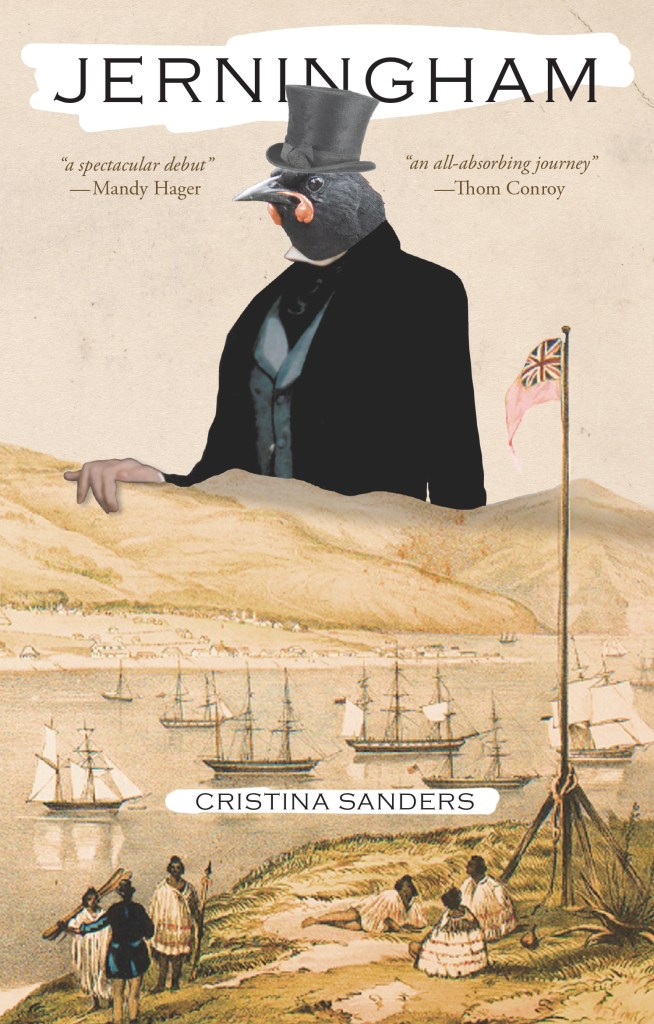
Book Review: Jerningham by Cristina Sanders

Cristina Sanders has done an immense amount of research to recreate the first years of colonial settlement in Wellington with her debut novel, Jerningham. Starting off in 1839, the story follows newly arrived Arthur Lugg, an imaginary character, through whose eyes we meet a bunch of the key players in the colony, particularly Colonial William Wakefield and his loose cannon of a nephew, Jerningham Wakefield. They’re the down-under representatives of the New Zealand Company, which sold land that wasn’t exactly theirs to sell. So it’s up to the colonel and his nephew to make it happen.

There are a number of story threads here which help to build a picture of what it was like for the early settlers arriving in a promising new colony, expecting a plot of land on which to start their new life. We all know the story: how Maori were given items ranging from nails to guns to blankets for land – but was the land to be shared or bought outright? And then the ships came, bringing wave upon wave of hopeful new settlers ready to roll up their sleeves and rebuild England’s green and pleasant land.

The story follows the difficult relationship between the Wakefields and Governor Hobson who was pushing through the Treaty of Waitangi, to events building up to the Wairau Affray several years later. Arthur Lugg, first working for Colonel Wakefield as a procurement officer, is a witness to it all as well as a friend and minder to Jerningham who it seems can charm Lugg into anything.

There are some wonderfully evocative scenes as the two travel to Wanganui (as it was spelt then); the river, the bush and the friendly local Maori are all described in detail. Jerningham has his own mini empire, trading with whalers and Maori alike. There’s lots of wine, women and song wherever Jerningham (still barely 20) holes up.

I enjoyed meeting Charles Heaphy – I’ve always loved his stylised watercolours of the country he explored – who becomes a particular friend of Lugg’s. Meanwhile Arthur has his own personal trials, disappointment in love, losing his thumb and almost his life, a struggle with his own personal demons. Somewhat naïve, he fails to see how much he is manipulated by Jerningham.

And behind the scenes the machinations of the New Zealand Company, the governor and the treaty – much of it on morally and legally shaky ground. We get our fair share of earthquakes too.

At the heart of the story is Jerningham, the charmer; a young man of immense talent, if only he could use it wisely. He’s a wild boy but also has the knack for seeing the country as it is, falling into easy friendships with Maori, even daring to sit down to korero (talk) with the powerful chief Te Rauparaha.

Cristina Sanders tells it with plenty of factual detail and colour – what it’s like living in a raupo whare, the basic food (lots of pork and potatoes), a storm at sea, encountering Maori and their way of life for the first time. The workings of the men with power, the greed and the determination. It all makes for a fascinating read for anyone interested in the early years of New Zealand, colonisation or issues of empire. It reminds me why I love historical fiction so much – you can learn a lot about a period and place all wrapped up in a darn good story. It’s an impressive debut and well recommended – a four star read from me.