Book Review: The Silence In Between by Josie Ferguson – a remarkable historical novel about a family divided by the Berlin Wall

I’ve read quite a few books about World War II from the Allies’ point of view – the families caught up in the war, on either side of the Channel, the people who helped Jewish children escape at risk of their lives and the SOE recruits dropped behind enemy lines to help the Resistance or lead downed Allied airmen out of occupied territory. Loads about Bletchley Park too. But I haven’t come across nearly so many about what it was like from the German perspective.

While The Silence In Between describes what happens to ordinary people in East Berlin when the Wall went up, it also dips back to follow the lives of a mother and daughter during the war and the terrible treatment they received at the hands of Soviet forces in 1945. Events of both periods are firmly linked.

The book opens in 1961 with the Wall. Lisette has just had a baby, and while she is ready to take little Axel home, the hospital want to keep him in for a bit longer. She goes home to fetch some things for him and to spend the night with her husband and daughter, and that’s when the Wall goes up. Overnight, Lisette and Axel are separated. The situation is made more poignant by Lisette’s admission to herself that she loves Axel more than her daughter, teenage Elly. As the days and weeks pass with no means of contacting the hospital or any news of Axel, Lisette sinks into despair, losing her speech.

Elly’s life goes from carefree outings with friends to trying to manage her mother. She decides the only way to save her family is to bring Axel back herself. The Wall is patrolled by armed Soviet officers sent over from the USSR, ordered to shoot anyone attempting to cross the border. By chance Elly meets the one soldier who doesn’t shoot. She has a gift for hearing music in other people, and the music the soldier Andrei has tells her she can trust him. In the background is the awareness that there are people watching and reporting back, a spy in every apartment block. Secrecy is of the essence.

The story follows Elly’s plan to cross to West Berlin, which is told from Elly’s perspective, interwoven with Lisette’s narrative of her survival in Berlin during WWII. Lisette witnesses many terrible events, the barely acknowledged rounding up of the Jews; the pressure from nosy neighbour, Frau Weber, to meet her nephew, a Nazi officer; the lack of food; the fear of bombing, which becomes a reality as the war progresses. We learn why she never bonds with Elly, her worries for Julius, the boy she loves, fighting on the Eastern Front in a war he doesn’t agree with.

Throughout the book is music. Lisette is an accomplished pianist and gives lessons to a young girl who becomes like a sister. Elly has her own kind of musical synasthesia and a keyboard in her bedroom, which she loves to play, but for reasons she doesn’t understand, it only upsets her mother. If you check out Josie Ferguson’s website, there are pieces of music you can listen to that relate to some of the characters, composed by the author’s brother.

The Silence in Between is a gripping novel, beautifully written that had me constantly on edge. On the one hand I couldn’t wait to see what happened next, while also being almost too anxious to find out. I almost broke my rule about not reading the back of the book to see how it ended. But the book is much more than its story, and gives a good picture of what life was like on either side of the Wall, and the lot of women in Berlin during the war. Some of this makes for grim reading.

The Silence in Between is a brilliant debut, well-researched and gripping, offering a different view of the war as well as Berlin in 1961. Well recommended, it’s a five-star read from me.

Book Review: The Night of the Scourge by Lars Mytting – the stunning conclusion to an epic trilogy

I was worried that I would have forgotten too much about the previous books in Mytting’s Sister Bells trilogy by the time the third book arrived. Should I have reread the previous two (The Bell in the Lake and The Reindeer Hunters) before setting out on the ominously titled The Night of the Scourge? In the end, it didn’t seem to matter, although I did think I would happily sit down and read them all again one day, one after the other, for this is one of those series that could become a firm favourite..

The setting of the trilogy is for the most part the tiny Norwegian settlement of Butangen, beginning with the first book in 1880 or so, when Kai Schweigaard arrives as a young pastor. He has to battle suspicion from the locals and a determination to remember the old ways, including pagan ideas and myths. This is particularly so for the magic accorded the Sister Bells, the two bells in the tower of the old stave church he takes over. There is the story of the Hekne weave, an almost magical tapestry completed by conjoined twins three hundred years before, while Kai feels himself drawn towards Astrid Hekne, their descendant.

The second book follows the next generation, with another set of Hekne twins, and a world war. The Night of the Scourge brings us up to the 1930s and another war and a new generation of Heknes, the family who still farm the same land nearby, and are prominent in their community with their dairy and general store. Running through all three books is the character of Kai Schweigaard, still the priest, and still grappling with his faith, his connection to the Heknes and the magic of the bells. There’s also his own guilt over losing the old stave church, which was removed to Dresden in book one.

With the rise of Nazism, there is new interest in Aryan connections between Norway and Germany, and their joint mythology. So much so that when the Germans invade Norway, the remaining Sister Bell is requisitioned to join its pair in Dresden. Kai sees an opportunity to step up and redeem himself. And throughout the story he can’t forget the prediction he has seen in the Hekne Weave that seems to predict his own death.

The novel describes the hardships the Butangen people face under the occupation, as well as schisms in the community – those siding with the Germans as well as those secretly doing what they can to resist and undermine the occupiers. The story switches between characters, but mostly it’s about Kai and Astrid, the young granddaughter of the Astrid that Kai fell in love with, a young woman of courage and intelligence. She’s not the sort to take the occupation lying down and gets herself involved in dangerous situations, which keep you on the edge of your seat.

Not that this is a pacy read. It evolves gently, filling in more details, including ones about the original Hekne twins and another time of persecution, with the witch hunts of the 1600s. The seasons change, there’s lots of snow, and a ton of atmosphere. Kai is a contemplative man in his eighties, so time spent with him is more about parish matters, politics and trying to handle the occupiers in a way that keeps everyone, and the remaining bell, safe. Still, we are conscious that we are heading towards his end, however that may turn out.

There is so much to get lost in, including shifts of setting to Germany and Scotland, as well as interesting details about technology and historical events. You can tell Mytting has done a ton of research, and that he also has an interest in the making of guns, particularly hunting rifles, something that pops up in his earlier book, The Sixteen Trees of the Somme. Everything comes together brilliantly, a hefty 520 pages that never flags for a moment. I loved, as I knew I would, and already miss the characters I’ve got to know and care for. I do hope Mytting has more books in the pipeline – everything I’ve read by him so far has been a treat. This book’s a five-star read from me.

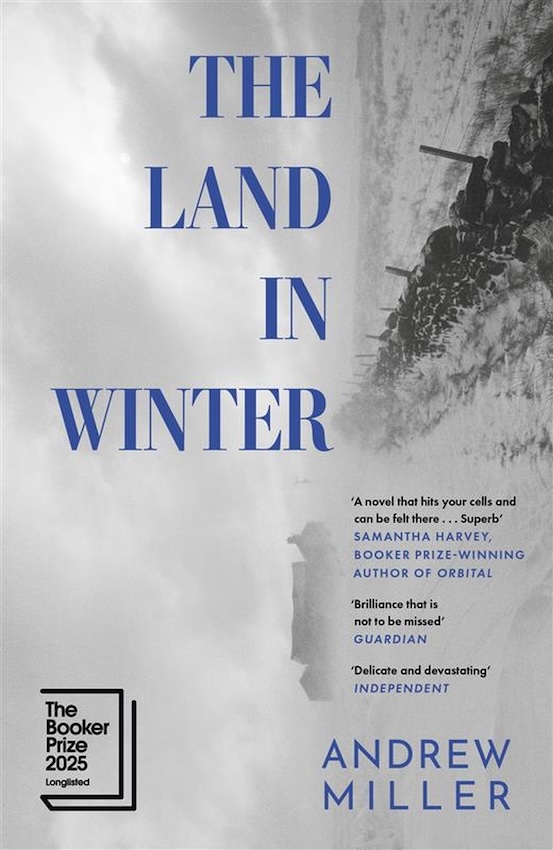
Book Review: The Land in Winter by Andrew Miller – a carefully crafted and moving historical novel

It’s always nice to see a novelist you admire long-listed for a Booker Prize. The Land in Winter has been on my radar for a while, since it won the Walter Scott Prize, and also because Miller’s an author I always look out for. So I was excited when I finally got my hands on a copy. And it didn’t take me long to become engrossed in this story of two couples who live in a village near Bristol and their struggles through the particularly cold winter of 1962-3, known as The Big Freeze.

There’s Bill and Rita on the farm – both new to farming and finding their way. Bill has big dreams for his land, as well as the kind of private school accent that doesn’t win him much respect among the farming community. Rita grew up too fast, with a father in a nearby asylum due to his experiences during the war. She has a veneer of glamour from her time working in a nightclub and fills her days reading sci-fi novels – so not farmer’s wife material. They are expecting their first child.

In a cottage nearby, Irene is also pregnant, her husband Eric a doctor at the local practice as well as visiting the asylum, where a young man has just taken his life. Eric has to deal with that and the pressure of his job, while having an affair he doesn’t know how to end. Irene meanwhile is trying to be the perfect wife but her middle class upbringing is sometimes at odds with Eric’s humbler beginnings, and the two seem to have different ideals.

Miller takes four characters who are each battling problems or being quietly miserable and then throws a tough winter at them. The narrative switches between them so we are right inside their heads as we watch them get things wrong and try to do better. They are so sensitively drawn that you can’t help but feel for each of them, caught as they are at a time when the war is still a raw memory and the future about to change. The class system is ready for a shake-up and feminism still emerging, but none of it can come fast enough for our characters.

A budding friendship between the women is viewed with suspicion by their husbands, but is never-the-less a godsend, opening up connection and different viewpoints for the two. There’s small-town gossip which only makes Rita and Eric separately more self-conscious. The period comes to life with some of the trashy horror and sci-fi movies of the day and music (dancing to the Mashed Potato; listening to Acker Bilk). There’s a brilliant chapter where Irene and Eric host a Boxing Day party – one of the best party scenes I’ve read – all that alcohol making people reveal themselves.

And then there’s the relentless cold. Nobody dies of hyperthermia or endures frostbite, but you can’t help feeling it’s not impossible as you read. So this is a novel best read somewhere warm. The story is carefully plotted and builds to a climax for each character with truths revealed that have to be dealt with, to find a way through.

You might think it sounds a little bleak, but I loved The Land in Winter because any time spent reading Miller means enjoying his wonderful writing. Every so often you hit a sentence you want to read again because it’s a fine and wonderful thing. It’s an altogether brilliant read and well worth the award nominations that have come its way. A five-star read from me.

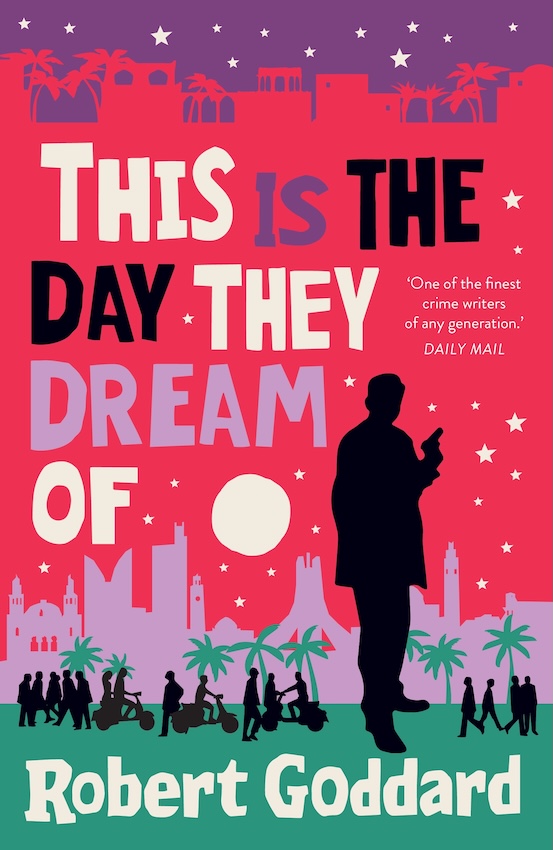
Book Review: This Is the Day They Dream Of by Robert Goddard – Superintendent Taleb returns in this endlessly entertaining thriller

Robert Goddard’s crime novels seem to be going from strength to strength. I’ve been enjoying his Umiko Wada mysteries about an unlikely Tokyo private investigator (The Fine Art of Invisible Detection and The Fine Art of Uncanny Prediction). Goddard seems to be alternating Wada mysteries with his thrillers set in Algeria featuring his jaded policeman, Superintendent Mouloud Taleb.

This Is the Day They Dream Of is the second story to throw Taleb into a much bigger problem than any retirement-age cop should have to deal with by himself. Taleb was widowed and lost his daughter in a terrorist attack during the 1990s, the décennie noir or ‘dark decade’ of instability and violence in Algeria’s history. Since then work and a high cigarette consumption have kept him going. Plus a strong sense of what is right in a system determined to hide the truth and protect the powerful.

The story begins with Taleb being ‘volunteered’ by his boss, Director Bouras, to be part of a panel on a current affairs TV programme. He’s to give a policeman’s point of view of the events of the décennie noir, now that thirty years have passed. He’s been instructed not to say anything controversial, but somehow he lets slip that the assassination of President Boudiaf may have had something to do with the Secret Service, when he’s egged on by a determined freelance journalist.

Just who really killed the President is the least of Taleb’s worries when he’s sent off to France to negotiate the release of a hostage – none other than the son of General Mokrani, the boss of the Secret Service at the time of the assassination. Taleb finds himself in a country villa also hosting hush-hush negotiations between Algerian and French parties, and the Secret Service agents on site to see they aren’t disturbed aren’t happy with Taleb.

Fortunately for Taleb he’s got an ally in the Secret Service, non other than fit, uncompromising, motorbike-riding Agent Souad Hidouchi. The two made an odd-couple pairing in the previous book (This Is the Night They Come for You) which makes this story all the more entertaining. Hidouchi is just as much for finding out the truth as Taleb, but goes about it differently. She gives her own boss, a vain and self-serving career man, cause for concern, often going off the radar and disobeying orders. But for how long will she be able to get away with it?

The story brings to light horrific events in Algerian recent history, the ongoing effects of the colonial past under France, as well as corruption past and present, and a whole new conspiracy that seems weirdly plausible. Goddard is a mastermind at keeping a bunch of story threads going, weaving them together seamlessly, with an assortment of interesting characters in support. The plotting is superb, and I couldn’t put the book down, making the most of a wet weekend to whizz through the chapters.

I do hope we’ll see Taleb and Hidouchi again (and Umiko Wada) for more tautly plotted mystery-thrillers. The Guardian quote on the book cover states that Goddard is “the world’s greatest storyteller” and I really can’t disagree – in this genre at least. This Is the Day They Dream Of is a five-star read from me.

Book Review: Tenderfoot by Toni Jordan – a coming-of-age novel set in the world of greyhound racing

There has been a lot about the greyhound racing industry in the news lately, with information coming to light over the cruelty towards the dogs, the frequent euthanising of young animals. This novel couldn’t be more timely but I didn’t need a lot of prompting to pick it up, having immensely enjoyed Toni Jordan’s previous novels, Dinner with the Schnabels and Prettier if She Smiled More.

Tenderfoot by Toni Jordan, is a coming-of-age novel about 12-year-old Andie. Set in 1970s Queensland, Andie narrates the story, decades later, of the year her parents marriage ended and she lost her dad, and with him the four greyhounds that made up his business.

Andie loves those dogs, especially Tippy, but they are not pets. We are introduced to the nefarious world of greyhound racing, gambling and addiction. Jordan keeps what really happens to the dogs off centre stage, which is fortunate, so we never really know the specifics of what happens to Shep, Crumbs, Sally and Tippy who used to live in the basement – the how and the when. Anyone who has a fondness for dogs might still find this sobering reading, so be warned.

Through it all Andie is a brilliant character, determined to win back her dad, her friends and her dog, solve the mystery of what happened to Macavity, her former bestie’s cat. All this despite her difficult mother, Mum’s shady boyfriend Steve, and a world that seems to block her ambitions at every turn. Andie is a determined battler with an eternal optimism that she can make everything normal again.

Jordan balances the seriousness of what happens – a promising child of parents who constantly let her down, the greyhound and gambling business, the adults with their own demons – with humour that comes from children interacting with adults who aren’t as adult as they should be. The characters come to life through dialogue, something the author does really well – the caustic remarks and endless criticism from Andie’s Mum, the sly innuendo that bounces between her and Steve, the playground politics that Andie struggles with.

Jordan recreates the 1970s, down to the choice of sweets available at the corner store. You also get a scorching Queensland climate for plenty of atmosphere and a poor neighbourhood where gambling is for some the only hope. It all comes together well for a thought-provoking and moving read – five stars from me. I read the novel courtesy of Netgalley. Tenderfoot is due for release on 26 August.

Book Review: Fonseca by Jessica Francis Kane – a novel of Penelope Fitzgerald’s sojourn in Mexica

In her new book, Jessica Francis Kane takes several months from the life of Penelope Fitzgerald and weaves them into the kind of novel Penelope Fitzgerald might have written herself. As you may recall, Penelope Fitzgerald is the author The Bookshop, which was made into a movie, and Offshore, which won the Booker Prize – and a lot more.

Fonseca charts a time in Fitzgerald’s life when she had two small children and another on the way. She and her husband Desmond were living beyond their means, editing a literary magazine which was yet to make their fortune, and hampered by Desmond’s drinking problem. We’re in that post-war period, the early 1950s, and the war has taken its toll on Desmond, and so the two are keen to make a go of their literary review. But the bank manager has his concerns, and the family is likely to lose their home.

Penelope learns of a couple of elderly women sitting on the proceeds of a silver mine in Mexico, former friends of her late mother’s, when one contacts Fitzgerald with the news that they have nobody to leave their money to. Why doesn’t she send her boy Valpy to stay for a while to see how they get on? It’s a long journey by sea and bus and things are different from what they expect when they arrive.

The women expect an older boy and they don’t expect Fitzgerald to have tagged along. Fitzgerald discovers there are other people hovering, dropping in for evening drinks each night, who hope to get something too. There’s a lot of drinking, and the nights are cold. Penelope sleeps on a couch so her son can have the bed, and there’s no chair with the desk where she hopes to work. Somehow she and Valpy manage to stay three months as Christmas approaches and the weather becomes colder than what they have packed for.

Jessica Francis Kane brings to life this quirky household – the tricky old women, the staff who can be difficult to communicate with. Over time, Penelope explores the area, meets people – mostly, but not only, expats – and learns about local customs. Valpy is a bright boy for his age and delightful. There are misunderstandings and superstitions that put a spanner in the works of Penelope’s best intentions.

Apart from the possibility of money, the time away gives Penelope time to consider her marriage, particularly when another potential heir arrives, “the Delaney”, who is charming, adding another strand to the story. You also get the feeling that she might be incubating the stories that will later make her name.

Jessica Francis Kane has obviously done more than simply research Penelope Fitzgerald’s life and the period she spent in Mexico. You get the feeling that she has lived with and loved Fitzgerald’s literature for a long time. Probably no one else could have written this book. I suddenly want to read and reread more by Fitzgerald. Altogether, Fonseca is a brilliant read – clever, well written and with fascinating characters. A five-star read from me.

I received Fonseca as a reader’s copy from Netgally. The book is due to be released on 12 August.

Book Review: Nesting by Roisín O’Donnell – a heart-stopping novel about a woman trying to leave her marriage and start again

This book reads more like a thriller than a slice-of-life contemporary novel. Nesting is about Ciara Fay who decides to leave her husband. She makes the sudden decision to grab the clothes off the line, bundles her children into her car and takes off, not knowing where she’s going. Her husband Ryan, upstairs in the shower, is completely oblivious.

Ciara has very little money. Ryan managed their finances, only giving her a bit of housekeeping money in cash and expecting her to account for it all. All the same, she has saved enough to tide them over for a few days. But with two girls under five, it’s going to be tough, even before she discovers she is pregnant again. The only reason she is putting herself through this is because she is so scared of her husband.

Ciara does everything right – she keeps Ryan informed about needing a break to keep everything above board. She doesn’t want to lose her girls. Her family – a mother and sister – are both in England and she can’t leave Ireland with her girls without their father’s permission.

When she finds a place in social housing, you get a lot of insight into the soul-destroying situation this can be. The lack of space – one hotel room for a family – and minimal cooking facilities. People hide rice cookers in their rooms, but there’s the threat they could be kicked out if discovered. They mustn’t use the lifts, it’s off-putting for the other guests, so they have to sneak up the back stairs. Even so, there’s a sense of community here and Ciara makes friends.

All the while, there are incessant text messages from Ryan which are like a battering ram, either declarations of love or hostile accusations, but always intense. Ciara is always on edge, her husband’s voice constantly in her head, dominating her thoughts. She doesn’t realise how bad it is until she talks to other people.

The story follows Ciara’s desperation to find a home, to find work, to make a new life for herself and Ryan’s ability to always crank things up another gear through lies and deception. So it isn’t surprising there is that thriller level of suspense. So often did I have my heart in my mouth, wondering if Ciara and the children would ever be safe. And it’s right down to the wire in the last chapters. Such an emotional roller-coaster of a read.

Through it all there’s imagery of birds. There are the young crow chicks Ryan finds in an abandoned nest on a building site and decides the girls can help him nurture. Another ploy. But other images too. It’s a beautifully written and crafted book. I enjoyed the audiobook, read by Louisa Harland. Even so, Nesting is so tense, so vivid, I could only listen to a little at a time. But gosh, what a great story. A five-star read from me.

Book Review: The Book of Guilt by Catherine Chidgey – an enthralling and haunting dystopian novel

It can be a bit nerve-wracking reviewing a book that has already had a lot of publicity and kudos. Even as you start to read it you know you are supposed to like it, but what if you don’t? Fortunately, The Book of Guilt soon drew me in with it’s 1979 English setting, although it’s not quite like how anyone would remember it.

Catherine Chidgey has reimagined the world as it might have been if England had signed a treaty with Germany in 1943, ending the war and continuing similar scientific experiments to those the Germans had been working on. We’ve got triplets, Vincent, Lawrence and William – 13 year olds who are the last boys living at Captain Scott house, a kind of children’s home. They follow a strict regime of activities and medication, overseen by their caregivers – Mother Morning, Mother Afternoon and Mother Night.

Along with taking daily medicine, their dreams are recorded in the Book of Dreams, and any misdemeanours noted in The Book of Guilt. Lessons are from The Book of Knowledge – a kind of old-school encyclopaedia. The house is shabby, toys are minimal, but then the boys don’t always feel well enough for a lot of physical activity. But once they have beaten “the Bug”, they are promised they will be sent to Margate, a child’s paradise, where they’ll meet up with their old friends again, and every day enjoy the amusement park, described in loving detail.

Soon our reader’s antennae are twitching, as we know this isn’t normal and the boys part of a grander scheme, pawns in some kind of experiment. There are visits by an avuncular Dr Roach, eagerly awaited, with his little dog Cynthia. The mothers are reluctant to share what’s really going on and shut down any questions with platitudes. And when the boys are at last allowed to visit the village, the locals are wary, hostile even.

The story is told largely from Vincent’s point of view, but interspersed is Nancy’s story, a girl about the same age, whose own family situation is unusual and plagued with secrecy. And then there’s The Minister of Loneliness, who is tasked with overseeing the closing of the boys’ home and others like it, and finding suitable families to take the remaining children. She is clearly uncomfortable about what she sees when she visits the boys at Captain Scott.

This is such an intense read, so haunting I could think of little else. And things get pretty dark, with new revelations and plot developments. At one point I had to take a break, so I read a crime novella about a wife murderer for a bit of light relief. But I did continue and I’m glad I did as it is such a compelling and thought-provoking story.

Chidgey is brilliant at detail and at times this was like a trip down memory lane with artifacts from everyday life circa 1979 appearing – leatherette furniture, the knick-knacks on display, Nancy’s Spirograph. You can feel the world through Vincent and Nancy, just as a young person might, all five senses vividly recounted. And the way children, no matter what circumstances they are living in, will sometimes burst into moments of imagination, or excitable play.

Ideas around power and what should be sanctioned for the greater good, of difference and prejudice and, of course, guilt trickle through the storyline. It all adds up to a top literary achievement and I can see why there’s a lot of talk about the novel. Crafted and intelligent, The Book of Guilt is a five-star read from me.

Book Review: The Party by Tessa Hadley – coming of age in postwar Britain

A new Tessa Hadley is always worth picking up, and this one is a novella, the perfect choice for when life’s a bit busy. The Party is set in the decade or so after World War II in Bristol, with two sisters who are desperate to enjoy their youth and experience life. It’s told from the perspective of seventeen-year-old Evelyn, in her first year studying French at university, where her older sister, Moira, studies art.

Moira knows some interesting people, particularly Bohemian Vincent who gets the story started by hosting a party at a dodgy pub down on the docks. It’s a rainy night and Evelyn changes in the ladies’ toilets into figure-hugging black, stashing away the more demure clothes she’d left home in. Moira isn’t expecting her sister to turn up, but introduces her to the people at her table, among them two older men who are appear sophisticated and well-off – handsome but offhand Paul, creepy and not handsome at all Sinden.

I love the way Hadley conjures up the discomfort of the scene – the miserable rain, the impractical shoes, the need to pee, the grotty pub. The things a young girl puts herself through for a bit of excitement. This party is the first of three chapters. The second takes us to the girls’ home life with their younger brother and parents – a father who disappears for long intervals and a tensely respectable mother. Here the girls have to pretend they were out with nice friends the night before, with no ‘drink’ taken.

The third chapter focuses on the other ‘party’ which the girls are pressured into attending at the mansion-like home of Paul’s family. Hadley highlights the naïveté of the girls, their powerless, and the predatory behaviour of Sinden, the older man. As you read, you see all the alarm bells that would have the girls’ mother up in arms. Also, the lack of happiness at the house – a sick brother, absent parents and the need for distraction.

While the storyline might seem dark and worrying, there’s such sharp wit in the writing and even a sense of adventure, particularly in the way it captures the exuberance of youth. The settings are varied and contrasting and seen through Evelyn’s eyes you can imagine being seventeen when everything can be a bit of a surprise, but you take it all at face value anyway, even if that means putting up with things you shouldn’t need to.

The Party is such a brilliant read, reminding me a little of Rose Tremain’s novel Absolutely and Forever. It’s only 115 pages long but packs a lot in. I’m beginning to be quite a fan of the novella. On the back cover, Kate Atkinson declares that Tessa Hadley is her favourite author, and well, I don’t blame her – Hadley is hard to beat. The Party is a five-star read from me.

Book Review: The Coast Road by Alan Murrin – a novel about marriage and the price of non-conformity set in small town Ireland

I was impressed by this debut novel, which reminded me of fiction by other Irish authors I’ve enjoyed in the past, such as Anne Enright and Claire Keegan.

The Coast Road is set in a small coastal town in Donegal in the 1990s, a year or two before divorce became legal in Ireland. The story describes the awful predicaments people, and particularly women, could find themselves in while stuck in loveless marriages. It does this through three main characters.

Colette Crowley has escaped her loveless marriage to Shaun determined to live her life on her own terms. She’s a published poet but has done the unthinkable in running off to Dublin to live with a married man. Finding no joy in that relationship, she has come back to be closer to her younger children. But Shaun won’t let her see her kids, and it’s easy to drown her sorrows in booze.

When Colette rents a holiday cottage we meet Dolores Mullen, who is pregnant with her fourth child and all too aware that her husband sleeps with other women. She knows it could be dangerous to rent the cottage up the path from her home to Collette, but with another baby on the way, the Mullens need the money.

And then there’s Izzy, who is married to James Keaveney, a politician and a bully. Not allowed to work, Izzy fills her home with expensive china ornaments and does evening classes. The only brightness in her day are the chats she has with their priest, Father Brian. She knows Collette because her youngest son is friends with the youngest Crowley boy, but gets more friendly with her when she signs up for Collette’s creative writing class.

The three women are all deeply unhappy, and certainly unfulfilled while local opinion, the establishment and gossip all work against any idea of their standing up for themselves. In the background the political machine plays out, as a change in the divorce law is debated. But how this might help these women is yet to be seen, as Colette becomes more unstable, Izzy more angry and Dolores more anxious. The story slowly builds up to a breaking point that has you biting your nails.

As a male author Alan Murrin has done a great job at making these female characters believable, capturing not just their lives, but their voices and inner thoughts in a realistic way. And also their situation in a small town, where men have the power and nobody helps out if there is any sense of non-conformity. The writing is real, at times humorous, particularly through Izzy’s lens, the bigger situations balanced nicely with the minutiae of everyday life. It all adds up to an amazing story and reminded me a little of Claire Keegan’s Small Things Like These with characters needing to find courage to do the right thing against the tide of opinion.

Alan Murrin has won a couple of awards for this debut novel and I’ll be keen to see what he writes next. I enjoyed this as an audiobook and it was a superb read, narrated by Jessica Regan, who does a terrific job with all the characters. The Coast Road is another wee Irish gem and highly recommended – a five-star read from me.