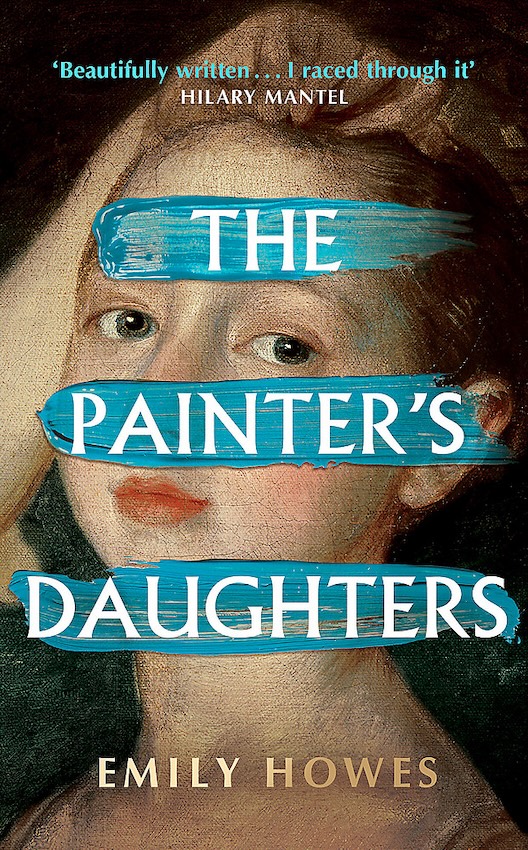
The Painter’s Daughters by Emily Howes – a stunning historical novel exploring the family of Thomas Gainsborough

I knew a little of the work of Thomas Gainsborough before I read this book, his striking portraits, the most famous of which is probably the Blue Boy, which frequently used to appear in tapestry kits. Such a pretty picture. But I remember looking at his portraits, marvelling at the light feathery brushstrokes, the use of colour, and how they seemed to capture the essence of the sitter. Then the way he might put them in a landscape setting rather than a fashionably lavish interior.

So it was interesting to learn that Gainsborough much preferred painting landscapes, was a great lover of the countryside near Ipswich where the book, The Painter’s Daughters begins. He wants his young girls to have a free and healthy country childhood just as he did. But his wife, Margaret, has other ideas. There’s no money in landscapes and the fashionable town of Bath is full of the kind of society that will want their portraits painted, and also where young Molly and Peggy might make a good marriage.

Emily Howes weaves a brilliant fiction around a well-researched collection of facts. Among them that Margaret was the illegitimate daughter of the Duke of Beaufort, although there also exists a document that suggests an even loftier parentage. Margaret knows about this and is desperate for the family to do well. She’s there in the background working on her husband’s accounts, calculating and chivvying.

Thomas is much more a bohemian character, carousing with friends, playing music and up all night. It’s a difficult household, so you can imagine how that might affect the young girls, particularly as early on, Molly appears to be mentally unstable. You would think fresh country air would be better than the sudden town environment in which young Molly and Peggy find themselves. In Bath they are kept inside, dressed in silks, the better to appear in the famous portraits painted by their father. These are his advertisements, as prominent visitors come to call.

The girls grow up, and Molly continues to be Molly, bright and seemingly well one minute, lost in a mental nightmare the next. Young Peggy adores her sister and promises to look after her, as she always has, trying to maintain a veneer of the normal in a polite society full of rules. Much of the narrative is from Peggy’s viewpoint, and she’s a constantly anxious child, watchful of her sister, but also desperate for the attention of her father.

Through the novel, is another story, that of Meg, Margaret’s mother, bullied by a brute of an innkeepr father. Meg slaves away, serving and cleaning, her life mapped out for her. When a German prince and his escort party descend on the inn, one of them dangerously ill from an infection, the men settle in until the invalid is fit to travel again. Meg catches the eye of the handsome heir to the throne.

The two stories, that of the sisters and Meg’s, make a rich contrast that brings 1700s England to life, warts and all. Both show a picture of the kinds of lives women led, with no power of their own, dependent on fathers and husbands for their livelihood. If they cannot make a good marriage, or keep their reputations intact, their futures are uncertain indeed.

This is such a satisfying read – fascinating with its descriptions of art and fashionable society, as well as the muck and mess of 18th century England. The struggle if you’re poor; the struggle to keep up appearances if you’re genteel. The book is full of images that stick in your mind from the feel of silk and lace and satin, to the stench of streets full of horse dung. A totally immersing story and so much my kind of book that it is, unsurprisingly, a five out of five read from me.

Book Review: Three Days in June by Anne Tyler – a charming novella about marriage, laced with humour and insight

If I had to choose a favourite author, (heavens, what a decision!), Anne Tyler would definitely be on my shortlist. I’ve been reading and rereading her for decades. So picking up her latest book, Three Days in June, I was instantly in my happy place, absorbed in a seemingly ordinary story about ordinary people, and which was unsurprisingly fascinating.

This time we’ve got Gail, who is sixty-one, an assistant school principal who’s about to lose her job. So she’s not happy about that. She leaves work in a huff and then finds her ex-husband, Max, on the doorstep with a cat from the shelter he helps out at. Max is visiting for their daughter’s wedding the following day, but can’t stay with Debbie because her fiancé Kenneth is allergic to cats. Gail isn’t happy about this sudden imposition either, and no way is she about to adopt a cat. No, thank you!

The cat soon settles in, and so does Max, and the former couple get caught up in the wedding arrangements – the wedding rehearsal, shopping for clothes and so on. But the hint of an indiscretion on Kenneth’s part has Gail worried that Debbie is making a huge mistake. She should know. The story flips back in time to the events that eventually led to Gail’s and Max’s divorce.

The clock gathered itself together with a whirring of gears and struck a series of blurry notes. Nine o’clock, I was thinking; but no, it turned out to be ten. I’d been sitting there in a sort of stupor, evidently. I stood up and hung my purse in the closet, but then outside the window I saw some movement on the other side of the curtain, some dark and ponderous shape laboring up my front walk. I tweaked the curtain aside half an inch. Max, for God’s sake. Max with a duffel bag slung over one shoulder, and a bulky square suitcase dangling from his left hand.

Anne Tyler packs a lot into this little book. We get a good deal of character development and insight into the family. There’s the usual gentle humour, which is always a plus, and the characters are wonderful. I instantly warmed to Max, also a teacher, working in a school where he doesn’t earn a lot and rents the same flat he’s lived in for years. He’s a scruffy, gentle bear of a man who doesn’t get in a flap. Early on you feel he’s a good fit for Gail, who’s a bit uptight and pernickety and not so good with people.

There’s also Debbie, a lively, determined kind of girl who doesn’t shirk from speaking her mind. There’s also Gail’s mother, who’s rather amusing in her little digs at her daughter, plus the well-to-do and at times hoity-toity in-laws. The way the different family members bounce off each other is very realistic but also delightfully entertaining.

Three Days in June is classic Anne Tyler – a lovely, warm-hearted read that charms from the first page to the last. I couldn’t help thinking it would make a nice little film, a cut above many wedding movies, that’s for sure. If you’re feeling in the mood for an uplifting read it’s well worth picking up. And check out Tyler’s backlist – she’s had a host of book award nominations, winning a Pulitzer for Breathing Lessons. Three Days in June is a four star read from me.

Book Review: The Bee Sting by Paul Murray – a riveting novel about a family in strife

This is a superbly clever book that seemed to me particularly clever in that its cleverness isn’t at first all that obvious. One thing obvious about The Bee Sting is that it is very long. I don’t often go for long books. They have to have instant readability for me to want to persevere, because of the reading time involved. But once I embarked on this story of a family going through a tough time in small-town Ireland, I just couldn’t stop, because the writing is just so lively, character-driven and, at times, funny.

The story moves between the four points of view of Cass and PJ, teenage children of Dickie and Imelda. Dickie has taken on the family business built up by his father, a car dealership that has, until the recent economic downturn, been a reliable money maker. So much so that the family are among the most well-to-do around town. But now times are tough and Dickie doesn’t know how to fix it. Instead he’s spending his days in the woods with his weird mate Victor, building a bunker in case of an apocalypse.

Dickie was always the smarter son, but less successful with people than his famous footy-playing brother Frank. Everyone remembers Frank, not just for his flair on the sports field, but because of his charm and good-looks. His sudden death a couple of decades before in a car accident only made him seem more of a hero. At the time he was all set to marry Imelda. Dickie with his lack of social finesse and looks that were nothing to write home about seemed like a consolation prize.

Over the course of the book, we discover how Imelda came to marry Dickie instead, as well as both their back stories, Imelda’s coming from a family of ne’er do wells, a violent father with criminal tendencies. Imelda is astonishingly beautiful, which is how she caught Frank’s eye. Marrying Dickie so young and having children soon after, she’s never had a job, but is a brilliant shopper. As money troubles start to bite, she’s in a permanent fury, cross with Dickie and selling off anything she can online to keep at least some money coming in.

Meanwhile Cass has reached that age when everything – her family and life in a town where everyone knows everyone’s business – has become utterly impossible. With her best friend Elaine, she’s plotting to leave as soon as she can. Trinity College in Dublin beckons, but can she keep her studies up enough to pass her A levels when Elaine hauls her off to all kinds of pubs and clubs while they should be studying?

PJ is also having a tough time. His parents aren’t there for him, Cass is eternally cross with him and he’s not socially adept either, parroting facts he’s discovered supplied by his active and curious brain. With the failing of his father’s business, all the town knows about it so school can be hard. He loses himself in violent computer games, leading him to an online friendship. But is that new friend as genuine as he pretends to be?

I hadn’t expected to care for these four characters as much as I did. But Paul Murray takes you right inside their heads, revealing their secrets. In the background we’ve got a support cast of interesting support characters, among them dodgy opportunist Big Mike, Imelda’s great aunt Rose who can see the future, and Ryszard, the handsome charmer and baddie of the story.

While the novel carries you along entertainingly enough, there is a clever plotting that takes the book to the next level. There are very long chapters that build things up, and then very short ones that ramp up the tension. There’s clever stuff with the prose too, the personalities of the main characters reflected in the style. Imelda’s point of view, for instance, is written without punctuation, perhaps an echo of her fierce and furious way of thinking and speaking. There are no quotation marks for speech either, but somehow you soon get used to it and wonder, why do we ever have them in the first place?

Then there’s the ending. I wasn’t going to mention that as I’m still thinking about it, but WOW. Enough said. I’m certainly glad to have read The Bee Sting, even if it was very long, and yes, I’ll look out for more books by Paul Murray, for the writing alone. The Bee Sting is five star read from me.

Book Review: Clear by Carys Davies – a spare, impeccably written novel set during the Highland Clearances

The Walter Scott Prize for historical fiction is always on my calendar, with its longlist of brilliant new titles. Among this year’s list was this little book by Carys Davies, and being set for the most part on a remote Scottish island, it immediately caught my eye.

Clear takes us back to 1843, the tail-end of the Highland Clearances, when small holdings made way for sheep, their tenants forced onto unproductive land, emigrating to the colonies or finding other ways to make a living where they could. It’s also the time when Presbyterian ministers signed the Deed of Demission to separate from the Church of Scotland so that congregations could have more say in who they accepted as ministers. These rebel ministers were an evangelical bunch, forming the Free Church of Scotland, which left many of them without a living, at least in the short term.

Among them is one John Ferguson, a main character from this story. He’s a somewhat dour man who aims to set up his own church, but desperately needs funds to get going. So he accepts help from his brother in law, who finds him short-term employment for a land-owner. This Mr Lowrie has recently converted his land to sheep-farming but has one offshore island still requiring the eviction of its single inhabitant. John makes the arduous boat trip beyond Sheltand to a small island where he’s to persuade the man to leave with him in a month’s time, but immediately things do not go well.

In the meantime, we meet John’s wife Mary, a sensible sort of woman who has come late in life to marriage. Now in her forties, she has learnt to manage and think for herself. So in spite of a decent payout, she can see the pitfalls of this project. The islander may not be happy about being thrown off his holding; John may not be able to express the landlord’s decision in a way the islander, a speaker of a rare dialect, can understand. And John is in the meantime cut off from any transport out for a whole month.

The third main character in all this is Ivar, the island’s solitary inhabitant, a man attuned to the harsh nature of living so far north, with no one but his animals to talk to, but who suits his situation so well. He’s been on his own for twenty years, the visits from his landlord’s factor becoming fewer and further-between. How is he going to react to an interloper on his island?

Carys Davies creates a terrific story from these characters, their miscommunications and their solutions to unexpected problems. How the two men come to reach an understanding is a large part of the story, building to an intense and somewhat surprising ending. Like the best in this kind of fiction, it brings history to life through the experiences of well-rounded characters. At only 150 pages it’s a short book, but you feel you have lost yourself in this world, the island setting, as well as the backstories of our main characters – all in carefully honed prose.

I can see why this book has made the Walter Scott Prize longlist. It captures perfectly a time and place, as well as creating a nail-biting read. It’s also well-researched. Carys Davies has incorporated some of Ivar’s vanishing language, evocative and interesting words for the environment she describes. Such a lot for such a small book. While it’s nice to have a long immersive read when you pick up a historical novel, sometimes a short book is a breath of fresh air. I loved Clear – easily a five-star read from me.

Book Review: The Mischief Makers by Elisabeth Gifford – an imagining of the life and creativity of Daphne du Maurier

As a girl, I remember being given a number of Daphne du Maurier’s books and enjoying them immensely – particularly Rebecca and The Scapegoat. There were adaptations of her novels and stories that appeared on TV – I’ve seen several versions of Rebecca, and then there was Hitchcock’s The Birds. I read her darker, spookier short stories too. She always struck me as a master storyteller and remarkably original for her time.

Elisabeth Gifford explores what made du Maurier tick in her new novel The Mischief Makers – how she got her inspiration as well as her family life, before and after marriage. It also describes the encouragement she got from J M Barrie, her Uncle Jim, the author of Peter Pan and guardian to her five cousins, the Llewelyn Davies boys.

I’m not sure how Elisabeth Gifford managed to write such a nicely concise and well put together story because there must have been such a lot left on the cutting room floor. The du Mauriers and J M Barrie are all such fascinating people. As a young girl Daphne was often at the theatre, her father, Gerald du Maurier, one of the outstanding theatre actors of his time. It was during a run of Barrie’s The Admirable Crichton that her parents had met, her mother starring opposite Gerald. Daphne’s grandfather was the author of Trilby and creator of the character Svengali, the evil mesmerist whose name lives on.

Daphne married Major Frederick (Tommy) Browning, himself an interesting man, a career soldier who set up the first British Airborne Division that was instrumental in the defeat of Germany during WWII. Knighted for his war work, Daphne became known as Lady Browning, although the strain the war put on their marriage was one they struggled to recover from. And of course Daphne’s immersion into her work as a writer, her determination to live quietly in Cornwall, which at times cut herself off from her husband, even, at times, her children.

But it’s the stories of her cousins, the Davies boys, and their recollections of their guardian that is really interesting. Peter as an older man is constantly engrossed in letters and memorabilia, trying to make sense of his childhood, whether or not they were simply used by Barrie, and the tragic death of his brother Michael as a young man. Was Barrie somehow at fault?

Daphne sees similarities between Barrie and herself, as writers stepping into imaginary worlds, discovering their characters in the people they meet, as well as in themselves. She even seems to feel Rebecca watching her, a somewhat disturbing presence. This insight into the mind of Daphne the writer is illuminating and fascinating. You also get a strong sense of what people went through in the last century with two world wars, and the social changes that followed, as seen through Daphne’s eyes.

The Mischief Makers is quite a tour de force, a brilliant read, particularly for a life-long Daphne du Maurier fan like me. The writing is pared back and straight-forward, mostly written from inside Daphne’s head, but with some extra chapters slipped in from earlier family experiences, the results of Peter’s research. It all comes together to create an overall picture of a very complex woman and her world. I wonder if we’ll see the book among those long-listed for the Women’s Prize for Fiction this year. It’s a five-star read from me.

Reading Challenge: Classics Club Spin #40

It’s that time again. Time for a new spin challenge from the team at The Classics Club. A list of twenty titles, numbered, and in a few days, The Classics Club will send me the number of the title I’m to read.

I would be happy with pretty much any of the books listed. I’m keen to continue my reading of Anthony Burgess, or revisit old favourites like the Austen. I read a lot of Iris Murdoch many years ago, so it would be interesting to see how she reads for me today. Though many here are books I’ve never read, so they’ll be interesting and fresh. Anyway, here’s the list:

1. A Buyer’s Market by Anthony Burgess
2. The Death of the Heart by Elizabeth Bowen
3. Frankenstein by Mary Shelley
4. The Mill on the Floss by George Eliot
5. The Secret Garden by Frances Hodgson Burnett
6. The Forsyth Saga by John Galsworthy
7. A Tree Grows in Brooklyn by Betty Smith
8. The Sea, The Sea by Iris Murdoch
9. The Razor’s Edge by W Somerset Maugham
10. Memoirs of a Fox-Hunting Man by Sigfried Sassoon
11. Elizabeth and Her German Garden by Elizabeth Von Arnim
12. The House on the Strand by Daphne du Maurier
13. Jacob’s Room by Virginia Woolf
14. The Happy Foreigner by Enid Bagnold
15. A Game of Hide and Seek by Elizabeth Taylor
16. The Group by Mary McCarthy
17. Pride and Prejudice by Jane Austen
18. Bliss and Other Stories by Katherine Mansfield
19. The Man in the Queue by Josephine Tey
20. Moon Tiger by Penelope Lively

Book Review: The Essex Serpent by Sarah Perry – a vivid historical novel where science, religion and superstition collide

The Essex Serpent was singled out for a raft of awards when it came out in 2016, even winning a couple. Now it’s showing on Apple TV with a brilliant cast including Claire Danes and Tom Hiddleston. I’m not sure why I didn’t pick up the book when it was released, because having read it now, I realise it’s just my kind of book

The story is set in the 1890s, a time of scientific discovery and medical advancement. Cora Seaborne’s bullying husband has recently died, and she finds not so much grieving, but discovering freedom in her new circumstances. Fascinated by science, particularly palaeontology, she is excited to hear reports of an “Essex serpent” and decides to head off to Colchester, accompanied by her companion/servant Martha and young son, Francis. She takes long walks in a man’s coat, releases her hair and becomes increasingly her own person.

Will and Cora clash in many ways, Cora determined that there is a possibility that a beast from the dinosaur era may have survived against the odds; Will’s more practical mind believing there’s a more rational explanation. He sees no reason why religion cannot accommodate modern science, while Cora cannot see how he can think logically and still have faith. The two are drawn to each other, in spite of an odd first meeting over the rescue of a sheep.

Other characters are equally interesting. There’s Cora’s friend, Dr Luke Garrett, who she refers to as the “imp”, the young doctor who attended her late husband, and who is patently in love with her. Luke is desperate to try new kinds of surgery and to make his mark on the medical world, his wealthy friend Spencer, tagging along. Martha has strong socialist views, and in spite of impoverished upbringing, has read Marx, attending lectures on social change and gets involved in housing reform. There are children who get caught up in all the Essex madness, as well as World’s End resident, old Cracknell with his ongoing campaign against moles.

There are further story threads involving Luke’s chance at heart surgery and the life he saves, and Spencer’s opportunity to impress Martha. With so much going on in the novel, the sub-plots highlighting the plight of the poor, and it’s very individualistic characters, the book reminded me a little of a Dickens novel. The writing is well-crafted and evocative, whether we’re in the slums of London, or the salt marshes of Essex. The different story threads pull strongly towards a dramatic finish, and you are desperate to see what happens next. I loved it – the audiobook version read by Juanita McMahon, was superb – and I shall certainly be reading everything else by Sarah Perry. The Essex Serpent is a five-star read from me.

Book Review: Shy Creatures by Clare Chambers – a remarkable story, engrossing and heart-warming

I bought Shy Creatures as soon as it came out as an ebook, and unlike many previously purchased novels, it didn’t sit on my bedside table languishing while I was distracted by other books passing by. It beckoned to me and I was soon engrossed – and gosh, what a satisfying read it is.

Shy Creatures is set for the most part in 1964. Helen Hansford is an art therapist at Westbury Park, a facility for mental health patients. She has been having an affair with Gil Rudden, one of the doctors, which is complicated by his wife being a distant cousin of her mother’s. Gil has promised Helen that as soon as his children are old enough to leave home, he will divorce his wife and marry her. Helen accepts the status quo and muddles on with a less than satisfactory home life, a nagging mother, and a job where she doesn’t feel she makes a lot of difference.

For all that, Helen is passionate about her work and the way Westbury Park is run. The gates are always open, and while some therapy involves dulling the patients’s minds with drugs, doctors like Gil have more modern ideas, which is one of the reasons Helen fell for him. An incident at a nearby house leads Helen and Gil to discover a man who has been shut up indoors for at least ten years along with his only relative, a frail and elderly aunt.

William Tapping, now in his late thirties, has been found in a bad way, in a state of undress, a beard down to his stomach and apparently mute. The house is in a state of disrepair, filthy windows letting in no light, the garden a jungle. When social services intervene, William and his aunt are whisked away to Westbury Park. Here Aunt Louisa implores Helen to find a container hidden in the flour bin that no one else should see, but while she’s at the house, Helen also discovers some drawings in William’s room that display the work of a talented artist.

At the discovery of this cache, Helen’s pulse quickened and she felt a tingle of excitement. No one who had passed through the art therapy room during her residency had shown anything approaching this level of talent. Of all the professionals at Westbury Park, she was uniquely placed to help this hidden man emerge from his place of silence. Even Gil did not have her advantage.

The story follows Helen’s efforts to make a connection with William through art as well as her tracking down some old acquaintances – people he knew at school – in an attempt to find out more about him. We have the ups and downs of Helen’s relationships with Gil, as well as her family, particularly with a teenage niece who has a kind of breakdown. Woven into all of this is William’s story, going back steadily in time until we get to the day when his life changed dramatically, putting in place the kind of house arrest his family imposed on him.

It’s a fascinating story with Clare Chambers’s usual wit and brilliantly evoked characterisation – one of the things that puts her books on my must-read list. And it’s a sad story too, as we consider William’s wasted years. The author recreates the era of the sixties – the music and clothes as well as social attitudes to women, to the mentally frail. The limited choices for girls once they leave school – particularly if they want to please their mothers. We also have the war years, and the privations of rationing, the nightly fear of air raids.

If there’s a theme that often appears in books by this Clare Chambers, it is about finding a place in society when you’re not a natural fit. Many of her characters are on the quirky side and with William, we have someone who quite possibly never will find a suitable niche in the world – particularly a world like Britain in 1964. This, plus Helen’s relationship woes pulls you through the story, along with the eventual revelation of a terrible secret. It’s another brilliant read from Clare Chambers – I can’t recommend it enough – a five-star read from me.

Book Review: Rules of Civility by Amor Towles – a story of love, friendship and making the right connections in 1930s New York

If I had a list of authors who can make a laundry list sound interesting, Amor Towles would surely be near the top of it. (If anyone has already curated a list like that, I’d love to see it – just saying.) Rules of Civility is Towles’s first novel and the writing is just as good as the later books that have made his name: A Gentleman in Moscow and The Lincoln Highway. There’s the same nuanced prose, the characters that seem to breathe on the page, the originality of the storyline.

In this novel we’re in New York City, mostly over a year that begins on New Year’s Eve 1937. Twenty-somethings Katherine Kontent and her roommate, Eve Ross, are out to celebrate, finding themselves in a lacklustre nightclub, where complicated jazz solos make it kind of interesting. Here they stumble upon Tinker Grey, a slightly older, impeccably dressed and very handsome young man.

The three strike up a friendship that pulls them all in different directions. Both girls are drawn to Tinker, but he’s just so enigmatic, it’s hard to tell if either can win his heart. In the meantime they just hang out together, enjoying the vibe they create as a small group of friends. An accident pushes a guilt-ridden Tinker towards Eve, and Katherine shrugs off her disappointment and gets on with life.

It is Katherine’s voice who narrates the story and we follow her progress from a typing pool, to a publishing house and then the competitive world of a society magazine. She’s sharp, witty and hard working, but then she needs to be – she’s rubbing shoulders with an Ivy League-educated elite, while she herself is from fairly humble beginnings. Everything she has she’s had to earn herself. In the background Tinker and Eve waft in and out of her life, while other relationships come and go.

The book is peopled with lively, colourful New Yorkers – the drinking buddies Katherine makes through the girls she works with; well-heeled and influential friends and acquaintances of Tinker’s; the raw, working class guys who hang out with Tinker’s artist brother. Katherine has a gift for fitting in and adding to whichever group she meets and in this way is the perfect narrator.

In front of the boardinghouse Tinker was standing beside a Mercedes coupé as silver as mercury. If all the girls at Mrs. Martingale’s saved a year’s pay, we couldn’t have afforded one.
Fran Pacelli, the five-foot-nine City College dropout from North Jersey who lived down the hall, whistled like a hard hat appreciating the hem of a skirt. Eve and I went down the steps.
Tinker was obviously in a good mood. He gave Eve a kiss on the cheek and a You look terrific. When he turned to me, he smiled and gave my hand a squeeze. He didn’t offer me the kiss or the compliment, but Eve was watching and she could tell that she was the one who’d been short-changed.

A lot happens in just one year, and you can’t help thinking that for many in 1938, times were tough. But not among the glittering social set of New York. The story builds to some surprising revelations, particularly about Tinker but also about others who pass through Katherine’s orbit, the main action of the story bookended by her visit to a photographic exhibition decades later and a kind of catch-up with what has happened in the meantime.

It all makes for a satisfying read: the brilliantly rendered view of 1930s New York, the story of a woman determined to make her own way, the glorious writing. Rules of Civility is just as good as the other books by Amor Towles, and I look forward to his collection of short stories, Table for Two, as well as whatever else he’s got in the pipeline. I know they’ll all be five-star reads, just like this one.

Book Review: Pachinko by Jin Min Lee – an immersive family saga of a Korean family over generations

I’d heard so many recommendations for this novel, and spotting it was available to watch as a TV series, decided I needed to read the book first – and I’m so glad I did. Pachinko is such a memorable novel, taking you into a world I had little knowledge of – a Korean family through the generations and their attempts to survive Japanese invasion of their homeland, a world war and making a new life in Japan.

The main character through it all is Sunja, who lives with her mother in their boarding house in an island fishing village. There is an obvious presence of the Japanese – harvests taken to Japan, rules that must be obeyed and any hint of insurrection severely punished. Times are hard, but the women do well enough until Sunja finds herself pregnant at sixteen to handsome trader, Koh Hansu. Sunja looks likely to suffer a terrible disgrace but rescue comes from an unlikely direction.

Baek Isak arrives ill with tuberculosis, looking for shelter, seemingly on death’s door. Sunja and her mother nurse him back to health, saving his life. But Isak is a good man, a young missionary who is passing through on his way to a church in Osaka. He suggests marriage would be good for both him and Sunja. She will travel with him to a new life in Japan.

In Osaka, Koreans struggle to make a living, and few landlords will rent them houses, so they live in a kind of shanty town of cobbled together dwellings. It’s a culture shock, but Isak’s brother Yoseb and sister-in-law Kyunghee are so welcoming, Sunja slowly imagines a future where there is both family and love. The story follows Sunja and Isak, and the generations that follow, through at times terrible hardship as World War II takes hold and life becomes even tougher. In spite of what happens, Sunja shows grit and determination to give her sons, Noa and Mozasu, a better life.

The story takes its name from Pachinko parlours, a form of gambling that is tolerated in Japan, a bit like a penny arcade where there are rows of slot machines. Perhaps this is a metaphor for the story in the way that characters are at the mercy of fortune, struggling to take hold of their own destiny in a country where there is so much discrimination. Women too, both Japanese and Korean, are also assigned roles that are hard to break out of. The story takes you up until the late 1980s – before K-pop and fusion cuisine, which have made Korean culture popular in the west.

There was consolation: The people you loved, they were always there with you, she had learned. Sometimes, she could be in front of a train kiosk or the window of a bookstore, and she could feel Noa’s small hand when he was a boy, and she would close her eyes and think of his sweet grassy smell and remember that he had always tried his best. At those moments, it was good to be alone to hold on to him.

And yet it is the Pachinko business that gives the younger generations of Sunja’s family a chance to build a future, perhaps even a small fortune. Before that, Sunja and Khyungee sold home-made kimchi and sweets to help put food on the table – a hard-scrabble life, but which forges a bond between the women.

This is an at times harrowing story, and you can’t help feeling for the characters and what they’re up against. There are world events taking place in the background that impact on them, as well as changes in culture and the way people live that give the story a sense of scope. It’s all fascinating, moving and riveting while Sunja is a character you won’t ever forget. It’s one of those both beautiful and sad books that stay with you, and a five-star read from me.