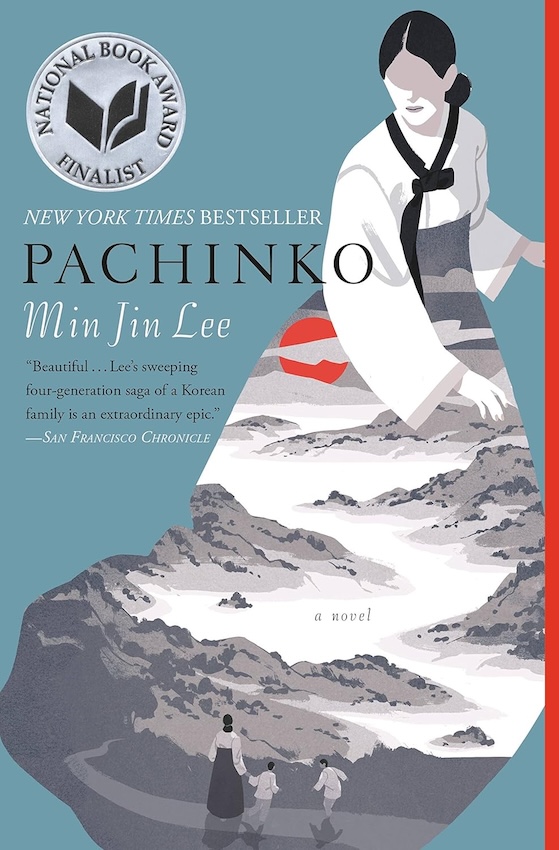
Book Review: Pachinko by Jin Min Lee – an immersive family saga of a Korean family over generations

I’d heard so many recommendations for this novel, and spotting it was available to watch as a TV series, decided I needed to read the book first – and I’m so glad I did. Pachinko is such a memorable novel, taking you into a world I had little knowledge of – a Korean family through the generations and their attempts to survive Japanese invasion of their homeland, a world war and making a new life in Japan.

The main character through it all is Sunja, who lives with her mother in their boarding house in an island fishing village. There is an obvious presence of the Japanese – harvests taken to Japan, rules that must be obeyed and any hint of insurrection severely punished. Times are hard, but the women do well enough until Sunja finds herself pregnant at sixteen to handsome trader, Koh Hansu. Sunja looks likely to suffer a terrible disgrace but rescue comes from an unlikely direction.

Baek Isak arrives ill with tuberculosis, looking for shelter, seemingly on death’s door. Sunja and her mother nurse him back to health, saving his life. But Isak is a good man, a young missionary who is passing through on his way to a church in Osaka. He suggests marriage would be good for both him and Sunja. She will travel with him to a new life in Japan.

In Osaka, Koreans struggle to make a living, and few landlords will rent them houses, so they live in a kind of shanty town of cobbled together dwellings. It’s a culture shock, but Isak’s brother Yoseb and sister-in-law Kyunghee are so welcoming, Sunja slowly imagines a future where there is both family and love. The story follows Sunja and Isak, and the generations that follow, through at times terrible hardship as World War II takes hold and life becomes even tougher. In spite of what happens, Sunja shows grit and determination to give her sons, Noa and Mozasu, a better life.

The story takes its name from Pachinko parlours, a form of gambling that is tolerated in Japan, a bit like a penny arcade where there are rows of slot machines. Perhaps this is a metaphor for the story in the way that characters are at the mercy of fortune, struggling to take hold of their own destiny in a country where there is so much discrimination. Women too, both Japanese and Korean, are also assigned roles that are hard to break out of. The story takes you up until the late 1980s – before K-pop and fusion cuisine, which have made Korean culture popular in the west.

There was consolation: The people you loved, they were always there with you, she had learned. Sometimes, she could be in front of a train kiosk or the window of a bookstore, and she could feel Noa’s small hand when he was a boy, and she would close her eyes and think of his sweet grassy smell and remember that he had always tried his best. At those moments, it was good to be alone to hold on to him.

And yet it is the Pachinko business that gives the younger generations of Sunja’s family a chance to build a future, perhaps even a small fortune. Before that, Sunja and Khyungee sold home-made kimchi and sweets to help put food on the table – a hard-scrabble life, but which forges a bond between the women.

This is an at times harrowing story, and you can’t help feeling for the characters and what they’re up against. There are world events taking place in the background that impact on them, as well as changes in culture and the way people live that give the story a sense of scope. It’s all fascinating, moving and riveting while Sunja is a character you won’t ever forget. It’s one of those both beautiful and sad books that stay with you, and a five-star read from me.

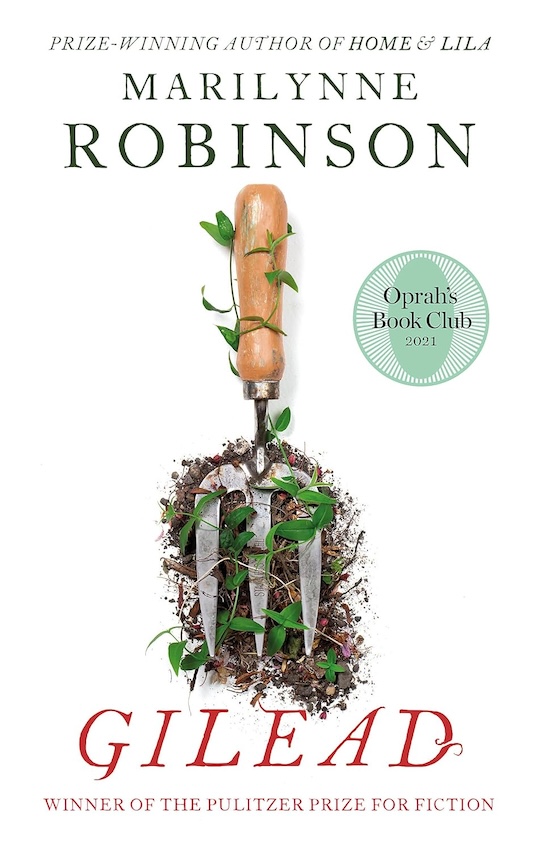
Book Review: Gilead by Marilynne Robinson – a love letter from a father to his son and a wonderful contemplation on life itself

In Gilead, John Ames is writing a memoir for his son, a small boy of seven, intended for him to read later, long after his father has gone. Ames, well into his seventies, has a weak heart and fears leaving his boy to grow up without a father. So he wants to write it all down – from his own childhood and his life as the son and grandson of preachers to what’s going on around him in the present. We get bits of history – the Civil War and the Underground Railroad, World War I, the Spanish Flu, and the Great Depression, and how all these events impacted on ordinary folk in small towns like Gilead.

While he’s telling his story, Ames is irritated by the return of Jack, the black sheep son of his good friend Rev. Robert Boughton. Unlike Ames, whose first wife died in childbirth along with their daughter, Boughton has a large family, most of whom live some distance away. Jack, in spite of his chequered history, seems a favourite of his father’s, while Ames is constantly censuring himself for harbouring an ongoing dislike for the younger man, which of course isn’t very Christian of him.

Ideas about what it is to lead a good life in the way God intends us to blend with stories about the characters, their pasts and particularly their problems. Jack’s story is heart-rending, and there’s more about him in the two other Gilead novels: Home and Jack, which I will get to, I’m sure. But what is particularly moving in this book is the tone of the writing, the voice of John Ames. You get such immense love in the way Ames is writing to his son coupled with the sadness that he won’t see him grow up. But with that is also the joy of someone who notices the wonder in simple things.

There’s a shimmer on a child’s hair, in the sunlight. There are rainbow colours in it, tiny, soft beams of just the same colours you can see in the dew sometimes. They’re in the petals of flowers, and they’re on a child’s skin. Your hair is straight and dark, and your skin is very fair. I suppose you’re not prettier than most children. You’re just a nice-looking boy, a bit slight, well scrubbed and well mannered. All that is fine, but it’s your existence I love you for, mainly. Existence seems to me now the most remarkable thing that could ever be imagined. I’m about to put on imperishability. In an instant, in the twinkling of an eye.
The twinkling of an eye. That is the most wonderful expression. I’ve thought from time to time it was the best thing in life, that little incandescence you see in people when the charm of a thing strikes them, or the humor of it. ‘The light of the eyes rejoiceth the heart.’ That’s a fact.

I find myself getting teary-eyed just thinking about Gilead, and the character of John Ames, the heart-felt thoughts of a humble man. You do get quite a bit of religious contemplation, with Biblical references and ideas for sermons, which might not suit every reader. But it’s more wise than preachy and fills out the character of our storyteller. I read this as an audiobook, superbly narrated by Tim Jerome – it was as if John Ames was talking to me in the same room – but I’m glad to have a physical copy to flip through too. Gilead is a beautiful book, which won a number of awards, including a Pulitzer Prize – a modern classic and a five-star read from me.

Book Review: You Are Here by David Nicholls – a witty, feel-good read about hiking and the human heart

I’d seen a bit of David Nicholls on the small screen – the movie of One Day and the TV adaptation of Us – but You Are Here is the first time I’ve actually read a David Nicholls novel. And having just turned the last page, I realise now what I’ve been missing. Because, You Are Here is simply wonderful. The writing, the humour, the characters and the emotions. They’re all there in a perfect package – all that you could want in a book.

The story’s narration alternates between two people: Marnie, a long time single and thirty-eight, who works as a freelance editor from her rented flat in London; and Michael, a recently-separated geography teacher from York. Both are a bit sad and lonely. Marnie has been bruised by her marriage to overbearing, unfaithful Neil, and now that her friends all seem to be married, mostly with kids, she’s dropped out of the loop, doesn’t see anyone, often stays in her flat for days on end. Michael has not recovered from his wife leaving him or from an assault which left him with bouts of PTSD and feeling a coward.

So it’s up to mutual friend Cleo to fix them both up with someone, if only she can drag Marnie north for a hike – a chunk of the Coast to Coast Walk, which Michael, a committed walker, is keen to complete, preferably alone for as much as possible. Michael does a lot of walking as he hates going home. Cleo brings along her thirteen-year-old son as well as gorgeous Conrad, a pharmacist also from London, she’s hoping to set Marnie up with. A pity Tessa couldn’t make it – she loves doing triathlons so would suit Michael well with his love of the outdoors.

But he must not teach. He would be travelling with adults who had no need or desire to learn about drumlins and moraines. The train ticked and hummed, then began to crawl, rattling past sooty Victorian buildings, warehouses, and the new light industry at the edge of town, the sky widening like a cinema screen, opening on to farm and woodland. Seated diagonally across the aisle, the woman with the poorly fitted rucksack was typing noisily but without a table, so that the laptop kept slipping down her new trousers towards her new boots. What was so important that it should take precedence over the view? She was certainly making a big show of it, tutting and blowing up her fringe. It was a nice face, amused and amusing, with a city haircut (was it a ‘bob’? He wanted to call it a ‘bob’) and more make-up than you’d expect on a walker, sometimes rolling her eyes or clapping her hand to her flushed cheek at the words on the screen. He noticed that she was perspiring slightly. Noticed, too, that he’d stopped looking at the view.

But things don’t go as planned for Cleo, and it’s just as well, when soon the weather conspires to leave just Michael and Marnie on the walk, Conrad with no wet weather gear, and Cleo’s son missing his friends. Michael might have hoped Marnie would pike out too, but she’s invested so much in outdoor gear for the trip, and has packed three nice dresses and 12 pairs of knickers, so it seems absurd not to tag along for another day at least.

The two make an awkward couple at first, struggling through the rain and having hiked a number of New Zealand’s ‘great walks’ for the most part in the rain, I really felt for them. But it’s the grit that makes the pearl, and if they can get along enough, who knows what might happen. As a reader, you soon realise the two are better suited than Michael would be with Tessa or Marnie would be with Conrad – Michael is what Cleo describes as wry, and seems to get Marnie’s sense of humour, the jokes no one else seems to notice.

This is a delightful read – I steamed through it – the writing is just so polished but not in a way that makes you think it’s polished. The dialogue is lively and funny – you can tell this will make another lovely movie. But underneath, Nicholls is aware that he’s dealing with two people who have stuff to deal with. He shows a fine understanding of the workings of the human heart and while there is a lot that has you laughing out loud, there are also moments that make you sigh or clutch your chest.

As I said before, this is a perfect book, with two engaging characters you are happy to spend time with, even on a hill walk in the rain. There is a lot of scenery, which is described as much as it needs to be but not so much that it intrudes. I enjoyed the B&Bs and hotels with their themed rooms – one naming its rooms for freshwater fish (Michael finds himself in Chubb). So you get the experience of the walk without having to put on hiking boots. All in all David Nicholls doesn’t put a hiking booted-foot wrong. You Are Here is a five-star read from me.

Book Review: All Day at the Movies by Fiona Kidman – a carefully observed story of siblings through the decades

In All Day at the Movies, Fiona Kidman has devised the perfect protagonist to chronicle the story of a family amid the wider social changes of her time. Belinda is a film-maker, known for her sharp eye for detail. Her story is a struggle for survival, for love and for a career, but it’s also one of those sins of the father’s stories too. The events around her arrival in the world are horrific and tragic.

Kidman takes us back to the post-war years, with war-widow Irene, striking out for a new beginning in an attempt to provide a better life for her young daughter, Jessie. Leaving Wellington and the industrial dispute that has put her father off work and caused unbearable tension at home, the two have settled on the tobacco-growing town of Motueka. They have basic housing, a kind of worker’s shack, while Irene does hard physical toil in the fields. Kidman highlights the lack of choices open to Irene, a former librarian, who settles for marriage to the creepy foreman, Jock Pawson.

“There was that girl Iris who wrote books and had babies when she wasn’t married and her life was just all sorrow, mental hospitals and … but her mother couldn’t bring herself to say the word suicide. In the end, dead, anyway. Irene’s mother had known Mrs Wilkinson, the mother of Iris, although she called herself something else, and it had been a terrible thing for her to have to lose a daughter to books. And, Irene’s mother had said, she hoped that Irene wasn’t thinking of writing books. It brought disgrace on a family.”

The story flips forward through the decades, each chapter like a short story in the chronicles of the Pawsons. We’re with young Belinda after her mother’s death and her banishment to live with a grim, sanctimonious aunt, her younger siblings, Grant and Janice left to the mercies of an unloving stepmother and a predatory father. The three siblings each take a turn with the narrative, as they try to make their way in life.

And in spite of an unplanned pregnancy, Belinda finds both love and a career, although there is still much that troubles her. We are in the midst of social change in New Zealand, with events around social justice and women’s rights a part of the wider story. As Belinda attempts to be a good wife and mother to her children, while building a career – thank God for dependable Seth at home – what has become of Janice and Grant?

They’re all walking some dark path, Belinda thinks. The marches have brought out the best and the worst in them all. ‘Are we really marching because black people in South Africa are oppressed by white people?’ she asks Nick. ‘Or are we doing it for ourselves because we have stuff and things and good lives and we feel bad about it?’

Belinda is an interesting character – one of the era when women were encouraged to ‘have it all’, but this also means being pulled in so many directions at once. Grant also seems set on a path that will see him succeed in life, if he can get past the terrible events of his upbringing. He has ambitions of becoming a pilot, and there’s a brilliant scene with four fairly refined elderly women having lunch, and the dramatic effects their actions that day have on Grant’s life to come. Meanwhile Janice seems to have one struggle after another. All three seem to belong to such different worlds – can they ever reconnect?

Fiona Kidman writes with such honesty and naturalness, you are brought into the lives of these characters in a way that seems very real, and so the tragic events that happen hit hard. But there is a wry humour too as she shows the foibles of people, their awkward interactions, their obsessions.

All Day at the Movies is just one novel among a long list of novels that have made Fiona Kidman a household name in New Zealand. As well as a winner of many literary prizes, she’s now Dame Fiona Kidman, and even the recipient of the French Legion of Honour. This book may seem just the story of a family, but probably only Fiona Kidman could write a book like this. Like Belinda she has that telling eye for the detail that captures so much more. It’s a five-star read from me.

Book Review: The House of Doors by Tan Twan Eng – an enthralling novel about love, duty and writerly inspiration

This book was long-listed for last year’s Booker Prize, but it was the imagining of the life of W Somerset Maugham that caught my eye. At one time Maugham was a prolific and hugely successful author, often setting his books in the exotic locations he visited. The stories are peppered with unhappy marriages and scandals, and here he probably drew on his own experiences. Dozens of movies have been based on the stories, the latest I have come across being The Painted Veil starring Edward Norton and Naomi Watts (2006).

His light may have faded in the last few decades, but Tan Twan Eng has brought Maugham to life again as one of two main characters in The House of Doors, set largely in Penang, Malaysia. It’s 1921 and Lesley, the wife of Robert Hamlyn, an old friend of the writer’s, is reluctantly hosting Maugham and his secretary/lover Gerald for an extended stay. Maugham, or Willie, as he’s called here, is at the height of his popularity, but poor investments have left him in a tight spot and desperate for material for new stories. Over the days that follow, Lesley reveals her own story from a decade before.

Lesley’s story takes us back to a visit by Sun Yat Sen, Chinese revolutionary and leader of the Kuomintang (Chinese Nationalist Party), in Penang to raise funds to overthrow a despotic Chinese dynasty. Lesley gets caught up in the cause, a distraction from problems with her marriage. In the meantime her best friend Ethel Proudlock has been charged with murder for shooting an expat engineer. Both stories suggest an uncomfortable relationship between men and women, as well as between the British rule with its wider expat community and the local Chinese and indigenous populations. (The Proudlock affair inspired Maugham’s story “The Letter”, which was made into a movie starring Bette Davis.)

Lesley is an interesting character as being born and raised in Penang she speaks one or two local languages and makes an effort to understand both worlds. So she’s the best person to show Maugham around, but takes a while to warm to the writer, feeling a little unhappy with him when she makes sense of his relationship with handsome and somewhat dissipated young Gerald. With Maugham you have insight into the mind of a writer, a man with his own share of disillusionment and regret.

The silence around us, the very weave of the night itself, felt denser. Even the waves outside, fraying away the margins of land since the beginning of the world, seemed to have stilled into stone. In the hallway the weighted heart of the grandfather clock went on beating, as indifferent as an aged monk thumbing his prayer beads on their long and infinite loop.
‘Where does a story begin, Willie?’ I asked.
For a while he did not say anything. Then he shifted in his chair. ‘Where does a wave on the ocean begin?’ he said. ‘Where does it form a welt on the skin of the sea, to swell and expand and rush towards the shore?’
‘I want to tell you a story, Willie,’ I said. Yes, I thought to myself. Tell him your story. Let him write it. Let the whole world know.
The music I had just played seemed to go on unspooling in the air between us, this song that had no beginning and no ending; the song of time itself.

The novel is a story within a story, bookended again by Lesley receiving a parcel in Africa many years later. You get a sense of a carefully constructed narrative and it all works beautifully, keeping the reader guessing and enthralled. Tan Twan Eng creates a superbly atmospheric setting enhanced by gorgeous writing. There’s a love story here, more than one perhaps, but it is also an ode to Penang in the way the characters experience the lush tropical setting, the sea that seems to brim with a life of its own, the history and culture.

The House of Doors is a beautiful novel, and at only 300 pages, carries a lot of story for its word-count. It’s quite an emotional read too – love and regret, nostalgia for a place and times past. So it really packs a wallop. I loved it and want to read everything by this author, though I see I shall have to be patient as this is only his third book – his first The Gift of Rain coming out in 2007, with a big gap between his second book, The Garden of Evening Mists from 2011 and The House of Doors, from last year. Whatever the wait, it will be worth it, I’m sure. This one’s a five-star read from me.

Book Review: The Lie of the Land by Amanda Craig – a cracking novel of rural England, the plight of the middle classes, with a mystery thrown in

Sometimes when you pick up a novel, you just instantly know you are in good hands. I felt like this about The Lie of the Land with its interesting premise – a couple desperate to divorce but can’t because they have no money. So they rent out their London house and find cheaper digs (together!) in the country with their children.

Stories where people ditch the city for the countryside for whatever reason have been around since the novel has, quite probably, or at least since Green Acres appeared on TV in the sixties. But there’s always fresh material to mine, particularly when you’ve got such complex characters as Quentin and Lottie Bredin. Quentin is older than Lottie and his career as a journalist has taken a dive – he’s rude and arrogant and has upset too many people. To make matters worse, Lottie has discovered he’s had several affairs, and all the while she’s been left to manage the home and her children.

Lottie was once an up-and-coming architect, and keeps her home like something out of House and Garden. Perhaps that is what makes her so difficult for Quentin to live with: her fastidiousness, her sharp tongue, plus her ongoing tiredness since the birth of their daughters – Rosie (6) and Stella (8). An opportunity to rent a farmhouse near Quentin’s parents in Devon ridiculously cheaply has them reluctantly leaving London and all its temptations behind.

The novel has a load of interesting plots woven together, with several main narrators. We’re with Lottie, angry and grieving over the way Quentin has treated her, while she tries to balance the books and economise. If they can stick it out for a year, they can clear their debts and sell the London house. This will pay for their divorce and leave enough capital to set up house separately.

Her daily walk includes a visit to the village shop, a Portakabin crouched in the church car park. The design makes her wince, but just to talk to another adult who doesn’t hate her is a relief.
 ’Home-made?’ she asks, pointing to pasties, keeping warm in front of the counter.
 ’Oh, yes. We don’t hold with Humbles.’
 ’It’s good that Shipcott still has a shop.’
 ’It doesn’t make a profit,’ the woman says, shyly. ‘We volunteer, though we all worry about being held up at gunpoint.’
 ’Do you really?’
 ’You’d be surprised. There’s crime here, my lovely, just like everywhere else. But how else are pensioners without cars going to get their food and money each week?’
 She has never known people like this, with their terrible teeth and terrible clothes and kindness. That’s what astonishes her most: the kindness.

We’ve also got Quentin, who can’t believe the nosedive his career has taken, but is still trying to keep in the swim while being a decent father. There’s Xan, Lottie’s eighteen-year-old son, desolate at missing out on a place at Cambridge and at the idea of his London life coming to a halt. Showing us the rural point of view, there’s Sally, a district health nurse with her own quiet grief.

While this seems to be mostly a novel of a marriage, there’s also a grim mystery with the hideous death of the previous tenant at Long Farm, an unsolved crime no one has told the Bredins about. You know you will find out the who and why of the crime by the end of the book, but in the meantime there’s so much character development, as rural life weaves its charm and throws up new challenges for the family.

We get plenty of insight into rural issues, particularly the struggles for farmers to make a living off the land in a competitive market-driven economy. The Polish immigrants that fill in doing unpleasant and exploitative work the locals avoid is evocatively depicted in scenes at Humbles Pie Factory where Xan picks up a casual job. Also the loss of a way of life, the closing of schools as people move away.

Then we’ve got a look at intergenerational relationships, particularly between Quentin and his dying father – the guilt, the disagreements and old scores. And about parenthood, both good and bad, as well as the redemptive power of music and literature. Quite a lot to think about then.

The writing sparkles with wit and vivid descriptions, and is polished and nuanced. You don’t have to like the characters, certainly not all the time – Craigs shows them warts and all – but you can’t complain they’re not interesting. Each finds themselves caught up in difficult dilemmas that give the story plenty of go. Meanwhile all the plates Craig keeps spinning are carefully balanced and then caught at the end for a cracking finish. I loved every minute of it and, although it’s not saying a lot – this being only February – The Lie of the Land is quite my favourite book of the year. A five star read from me.

Book Review: Prettier if She Smiled More by Toni Jordan – another hilarious round with the Schnabels

I hadn’t realised until I started it, that Toni Jordan’s latest novel features a bunch of the same characters we met in Dinner with the Schnabels – one of my favourite reads from 2022. In Prettier if She Smiled More, we follow the story of Kylie Schnabel who at the start of the book is about to experience three disasters that upend her life – all before Wednesday. By the end of the week, nothing will be the same.

Kylie Schnabel, if you remember, is the oldest sibling, daughter of Schnabel matriarch Gloria. She works as a pharmacist and likes to think she has everything under control. She’s very serious and is a stickler for detail, hardworking and a little abrupt. She’s been working at the same small suburban pharmacy since she graduated, living frugally and planning her life around one day buying the shop from her genial boss Tim who’s approaching retirement.

Life’s all going to plan, until one day it isn’t. Kylie gets to work on Monday to discover that Tim is selling his shop to a chain of pharmacies, a big business conglomerate all set to modernise and refurb. Gail from Pharmacy King insists Kylie reapply for her job – just a formality, and even though Kylie has a work ethic second to none and has won a Young Pharmacist of the Year award, the reader knows it’s going to be tricky. Kylie’s sometimes grim, no-nonsense manner is going to be a problem.

Then there’s Colin, Kylie’s partner, who is supposedly away at a business conference but activity on his Fitbit suggests he’s getting up to some extra-curricular hanky-panky. Kylie suddenly sees unpatchable cracks in their relationship. When Gloria breaks her ankle and needs full-time care, Kylie finds herself back at her childhood home, dealing with a mother who doesn’t want to be looked after and somehow ends up baby-sitting Caesar, a tiny Pomeranian.

There are plenty of funny moments, and Kylie’s internal monologue is always entertaining – she’s such a force of nature. But coming home where the decor is still stuck in the 1980s and there are so many reminders of her childhood, suddenly the past comes back with a wallop. Why has Kylie’s bedroom been turned into a sewing room, while her siblings, Tansy and Nick’s rooms are still intact, just as they left them? Then there’s her parent’s acrimonious divorce and memories of her childhood anguish, of being the eldest and having to be the sensible one when her mother was in pieces.

‘Your … father, is this?’ Ramona said, picking up one of the photos. ‘Is very handsome, but familiar somehow?…
  …In those years before Photoshop, what could be done about David, who was in the centre of many of the said photos and who Gloria wished dead several times a day in a variety of painful ways? Facing the grinning face of her ex-husband every day in her own home was untenable.
  Gloria’s solution had been to cut out a range of Kevin Costner heads of varying sizes from different magazines and glue them over similarly sized David heads. Now the family photos lined up on the mantel were of Gloria and Kevin, standing proudly behind their children, young Kylie, Tansy and Nick.

There’s a lot for Kylie to deal with, all in one week, including a tennis open day for Gloria, who is a children’s tennis coach. There’s finding a nurse who will want to stay with her mother so that she can get back to work when Gloria has other ideas. Kylie’s brother Nick talks her into going on a date with one of his mates. And on top of everything, Kylie has agreed to host the family lunch on Sunday. As the pressure mounts, something has to give.

Prettier if She Smiled More is a smart and often hilarious second-chances kind of novel. The format is similar to Dinner with the Schnabels, with one character having a lot to get done as the days of a single week slip by and each day heralds more problems. The final chapter brings everything to a head and somehow everything gets fixed, but in a way Kylie, the meticulous over-planner, would never have predicted a week earlier. I loved it and wouldn’t say no to another Schnabel novel if Toni Jordan feels so inclined. This one’s gets an easy five out of five stars from me.

Book Review: The Shadows of London by Andrew Taylor – a ripping read set during the reign of Charles II

Andrew Taylor has had a lot of practice in the art of mystery-thriller writing. At one point in his long career he gave us the Bergerac series, which was also televised – I fondly remember watching it aeons ago with my parents. There have been numerous more series and standalone novels, and in 2009, Taylor was awarded the Diamond Dagger, the Crime Writers Association’s most prestigious award for a lifetime’s contribution to crime writing in the English language.

But in my view, he was just warming up. His latest series is one of my favourite historical mystery series – the James Marwood and Cat Lovett novels set in the years following the Great Fire of London – hence the series title: Ashes of London. The two main characters are frequently at odds with each other, but somehow their paths always cross, usually when there’s murder involved.

As you might recall, Marwood is a rising young man in the corridors of government and in The Shadows of London we catch up with him as an assistant to Lord Arlington, the King’s most trusted advisor. Cat has meanwhile been busy with her architecture business – there’s so much work to do in a city half destroyed by the Great Fire. Her latest project involves rebuilding an almshouse, but work grinds to a halt when a body is found at the site, the man’s face battered beyond recognition.

The local magistrate, Mr Rush, was previously involved in the project, but had a falling out with Cat’s client, Robert Hadgraft, and puts a hold on any work until the murder is resolved. Cat is desperate to resume work as she needs to keep her workers committed to the building work and somehow pay off her suppliers. She turns reluctantly to Marwood to see if he can persuade Arlington to intercede on her behalf. Before you know it, the two are investigating the murder, and yes, again, the unpleasantly conniving Duke of Buckingham appears on the scene.

Marwood has had run-ins with Buckingham before, in particular with the Duke’s vicious henchman, Durrell, whose distinctive appearance is noted by a witness connected to the recent murder. The story is all set for more regal intrigue and takes you to Newmarket, where the King and his court turn up for the spectacle of horse racing. But before we get there we meet Louise, a maid of honour to the Queen, left behind at Whitehall because of an ailment.

Louise is the other thread to the story – a young impoverished noblewoman, once a maid of honour to the King’s late sister. Charles II has given her a home along with one or two other French ladies-in-waiting following his sister’s death. But Louise is worried that her youthful beauty will be irresistible to the King. The Ashes of London series sheds a light on a number of the King’s characteristics, some of them endearing, but here we see him as something of a sexual predator. And Louise should be worried. On top of everything else she has as secret, a problem she’s turned to the Duke of Buckingham, of all people, to handle.

Louise thought with the cold, merciless clarity of a trapped animal that the ambassador would have made a fine preacher had he not chosen instead to be a pander.
Colbert leant even closer. He skewered her with those uncomfortable eyes. His voice hardened. ‘Kings are not like other men. They are chosen of God, and to serve them is a great blessing. To serve two would be doubly blessed. Do you agree?’
‘I seek to serve God and my king, sir,’ she said in a voice that was barely audible above the noises outside. ‘Always.’
He sat back and gave her a thin smile. ‘Of course. I had expected no less of you.’

Everything builds nicely into a thrilling well-paced story, as Marwood juggles the demands of his work with the murder investigation while his enemies close in. There’s a new love interest, and when all seems lost, help comes from a surprising direction. There’s a ton of period colour and insight into the workings of court so you know Taylor has done his homework. But also there’s the perilous situation for women of the time. Cat struggles to be taken seriously as an architect, but at least she strives to be independent. Other women, no matter what class they belong to, have little choice when it comes to their future, doing anything they can to keep a roof over their heads.

The Shadows of London is number six in the series, and I confess to feeling a lump in my throat as I turned the last page because I simply didn’t want it to end. Although it has a very good ending, and you have a feeling that Marwood and Buckingham will have more scores to settle, so there’s promise for more books. I certainly hope so – I’m sure there’s lots more to say about the era of Charles II, and loads more interesting history to mine. The Shadows of London gets five stars from me.

Book Review: Salvage the Bones by Jesmyn Ward – a struggling family, a desperate girl and a hurricane

It’s so easy to go for a book that’s a nice relaxing read and totally forget the wider world. But this time I took up Salvage the Bones with the idea that this might be a fairly gritty read and, well, yes it was. But it is just so instantly immersing and the storytelling so engaging that once I’d picked it up, I really didn’t have much say in the matter.

The story follows a poor African-American family living in Mississippi in the days leading up to Hurricane Katrina. This family has such a lot to deal with. Told from the point of view of fifteen-year-old Esch, we’re soon in her world – a house on the outskirts of town which she shares with older brothers Skeetah and Randall, a much younger brother, Junior, and their alcohol-dependent father.

Daddy is very hurricane-aware and weather warnings impel him to get his house in order – the bottled water and extra supplies, gathering the timber to board up the windows, but his children have other things on their minds. Randall has hopes of going to basketball camp – he’s got potential, and if he can perform well at an upcoming game, he can earn some sponsorship. Skeetah is more entrepreneurial; his pit bull is due to give birth to puppies and China being such a good fighter, he thinks he can sell the pups for a good price.

Junior has been cared for since day one by his older siblings and is a bit of a loose cannon, though very much loved. And that’s the thing. There is such a lot of love in this family between the siblings, but without a lot of parental guidance things pretty soon go haywire. And no one is more desperate than Esch – in love with one of her brother’s friends who is blatantly using her, and pregnant. But Esch is also a reader, dipping into a book of mythology from school, especially drawn to the story of Jason and empathising with the ill-used princess Medea.

After Mama died, Daddy said, What are you crying for? Stop crying. Crying ain’t going to change anything. We never stopped crying. We just did it quieter. We hid it. I learned how to cry so that almost no tears leaked out of my eyes, so that I swallowed the hot salty water of them and felt them running down my throat. This was the only thing that we could do. I swallow and squint through the tears, and I run.

The plot is really compelling as the siblings resort to all kinds of escapades to help fulfil their ambitions, or to just get by. It’s a very different world, there’s danger and lawlessness, and the story doesn’t shy away from the violence inherent in these kids’ lives, and of their acceptance of it as a kind of normal. But there’s also camaraderie and loyalty, a tight-knit community that sticks together. Plenty to keep a story going as it is, but on top of everything else, there’s a hurricane coming.

The story builds up to a dramatic climax – the weather event we are expecting makes its presence felt and it’s truly life and death. Earlier in the year, in my neck of the woods, we also experienced a cyclone (that’s what we call hurricanes here), and as I was reading this was well aware of the kinds of situations that people can find themselves in if they don’t get out in time, or if things get a lot worse than predicted.

I raced through this book, particularly the final chapters, engrossed in Esch’s world, but also dazzled by the writing. Jesmyn Ward won a National Book Award for this novel, a prize she’s won again for Sing, Unburied, Sing, and she’s brilliant, confronting, but also immensely readable. I’ll be putting Ward on my must-read list and give this book five stars out of five.

Book Review: Old God’s Time by Sebastian Barry – a deceptively gentle novel that will tear at your heart

For a novel on the Booker long-list, this is a very easy book to slip into. The story is set in the mid 1990s and is told from the point of view of Tom Kettle, a recently retired Dublin policeman. As a character he suffers more from aloneness than loneliness, as Tom’s family of ghosts are ever present, in his thoughts and more.

Tom lives simply, recently taking a flat that’s an annex to a castle, also divided into flats, by the sea. It sounds idyllic, and indeed his first visitors comment on it. It’s a February evening when two policeman from his old station knock on his door. They bring with them documents about an old case that Tom had handled, in fact had put his heart and soul into, only for the commissioner to call an end to taking it further.

Tom can’t bare to look inside the folder, but instead insists his visitors, Detectives Wilson and O’Casey stay to eat with him. All he can offer is rarebit made from cheese singles, and hauls out his daughter’s air-bed and blankets. It is too dreadful a night to send them out to catch the bus back to the town. It’s a fairly light scene with pockets of humour, O’Casey’s digestion not best pleased by the rarebit and Tom can only imagine how uncomfortable his visitors must be bedding down in his living room

But underneath is a storm of feeling that will gnaw at Tom and slowly his story and that of his late wife June and their children will emerge. And what a sad tale it is. Tom and June were both brought up in church run orphanages where predatory priests made use of small children. And it is just such a case that Tom has to relive for his old colleagues. He can never reveal how personal the case it is and so it festers.

There’s literally a Chekov’s gun in the story too. Tom was a sniper in Malaya before his stint in the police, which gives you a hint at what he’s capable of. So while the story seems to have a gentle flow about it, and a very Irish narrative style which is descriptive, lyrical and ambling, there’s a spring-loaded tension and a kind of inevitability here as the story draws to its conclusion.

And all soundlessly, with an almost comic fall, the poor creature would go down, hardly bothering the earth, Tom’s aim so good they called him Beady-Eye as a happy nickname. Beady-Eye Kettle. A talent that rescued him in his own country, the mercy of being allowed into the police. Oh yes. Killing rebels gave him his Irish life, away from the shame and shambles of his childhood.

What I particularly liked about the book was the character of Tom, who seems just so ordinary, with his little routines. His trips to the shops, his buying an ice cream cone, his carting home a bag of sausages and potatoes. But simmering beneath, we can’t help wonder, as Tom does, about the state of his mind, haunted as he is by the past and those he’s lost. It’s difficult to tell what is real at times as we are so much inside Tom’s head.

For such a tragic story, and there really is no other word for it, Old God’s Time is immensely readable, the writing is exquisite and then there’s that sympathy you have for Tom. As a character, Tom is so well understood by the author, his narrative voice seems so true. The pacing is perfect – as I said at the beginning, you are so easily drawn into the story, and Barry doesn’t put a foot wrong. Though it’s not the sort of book you should read if you need cheering up. But I can see why it’s on the Booker long-list, so it’s an easy five out of five stars from me.