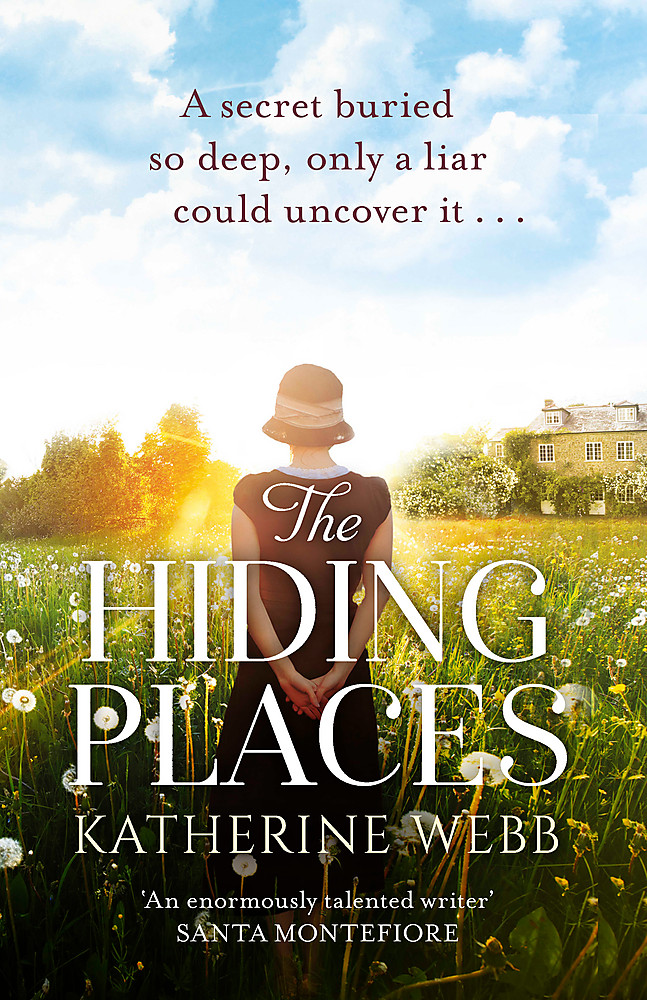
Book Review: The Hiding Places by Katherine Webb

Set in Wiltshire in 1922, The Hiding Places is a mystery which throws together two unlikely allies. When Donny Cartwright is accused of murder – he was caught holding the bloodied murder weapon – the police, unable to find any other suspects, look no further.

Not that the police are sloppy. Inspector Blackman likes to know ‘the why’ of a crime, and Donny didn’t have any reason to commit murder. But Donny, once a talented youth with his heart set on studying engineering, has returned from the war a damaged man. Mere days before, he’d lost control and smashed to pieces two rose bushes at the Hadleighs’ Manor Farm where he works in the garden.

Donny’s teenage sister Pudding (she was a tubby child and the name sort of stuck) is determined to prove Donny’s innocence – he said he didn’t do it and that’s enough for her. Pudding also works at Manor Farm, taking care of the horses, though her father, the local doctor, thinks she has university potential. But with Donny to care for and now her mother showing signs of dementia, she’s not going anywhere.

Oddly enough everything seems to have started with the discovery of an old doll at Manor Farm. Irene Hadleigh has had trouble settling in as the new wife of Alistair Hadleigh. Alistair’s Aunt Nancy dotes on her nephew but is chilly and supercilious towards the incomer. Irene has escaped a scandal through her marriage but is still broken-hearted. So to please her, Alistair’s having the old schoolroom made into her study. When they pull off the mantlepiece and clear out the chimney, the discovery of the doll creates a sense of unease among the workmen – could the doll have been cursed?

The story recounts Pudding and Irene’s gradual friendship through their determination to uncover the murderer. Surprisingly they are both good for each other – Pudding with her chatter brings Irene out of her shell and even gets her riding. Having something important to do gives Irene a bit of backbone. Gradually events from the past make their way to the surface and a bundle of secrets, simmering jealousies and evil intent emerge.

I raced through The Hiding Places, which turned out to be the perfect read for a day of torrential rain. There are some wonderful secondary characters, including PC Dempsey, who has a soft spot for Pudding; Dr Cartwright, Pudding’s troubled father who valiantly tries to put on a brave face but doesn’t always succeed; and young, nature-loving Clemmie, forever mute, who could have stepped out of Hardy. In fact, the atmospheric rural setting, the relentless heat of summer, the distinctions of class also reminded me of Hardy, but maybe with a little less impending doom.

As for the story, there’s a decent sort of twist towards the end that will have you flipping back through the book thinking, ‘How did I miss that?’ The plot then powers on to a satisfactory ending, not Hardy-like at all, thank goodness. Webb is an accomplished storyteller, and with complex characters plus a nice way with prose, there is a lot to enjoy. Four out of five from me.

Book Review: The Long Call by Ann Cleeves

Many readers were disappointed when award-winning crime writer, Ann Cleeves decided to call it a day with her Shetland series. I guess there are only so many crime scenarios you can imagine for a tiny place like the Shetland Islands. But if there’s a silver lining here, it has to be her new series set in North Devon, featuring local police inspector, Matthew Venn.

The Long Call is the first Two Rivers novel and I happily devoured it. The story begins when Matthew attends his father’s funeral having recently returned to the area of his boyhood with his husband, Jonathan. It’s a Brethren funeral and he keeps himself at a distance, not daring to approach his mother, having disgraced himself as a teenager by declaring himself an atheist, dropping out of university and later breaking his parents’ hearts by marrying a man. But his new case, the murder of a troubled loner, Simon Walden, will take him uncomfortably close to the people from his family’s church.

The story of Simon Walden will take some uncovering – the man had shed his life of family, friends and belongings. Plagued by guilt over an accidental death, he had become an alcoholic before being rescued by a church group run by Caroline Preece, the daughter of one of the movers and shakers behind the community centre known as the Woodyard. Caroline took him in as a lodger, helped with counselling and found him some voluntary work.

Surprisingly, Walden made a connection with a woman with Downs Syndrome who also attended a drop-in group at the Woodyard. So much seems to centre on the Woodyard, which is managed by Matthew’s husband, Jonathan. Should Matthew declare a conflict of interest and hand the case over to DCI Oldham? But his boss has his eye on retirement and will only step in if Matthew messes up – so no pressure then.

When another woman with Downs Syndrome goes missing, the first Matthew learns of it is a phone call from his mother – phone calls from his mother are unheard of. The victim is the daughter of a good friend, another member of the Brethren who remembers Matthew and his disgrace. Fortunately he has a smart team to work with. Jen, his DS is from Birmingham, a no-nonsense sort with a failed marriage and two teenagers at home. She’s good at building relationships with witnesses and getting them to spill the beans. DC Ross is young and restless, but eager to prove himself, and there are plenty of opportunities here.

Looking ahead, I know we will come to love Matthew Venn and his sidekicks – Cleeves is so good at character development, highlighting the pressures put on police officers and connecting them to the crime story. This book pivots on the relationships of parents and their children, not just Matthew and his mother, but our other players too. What is it like to bring up a child with severe learning difficulties? What would we do to keep them safe? How far would we go to make our children happy?

So while Cleeves gets plenty of points for character development in her fiction, I am always impressed by the way she can pick apart relationships, the secrets that imbue them and the passions – positive and negative – that they generate. The Long Call has this in spades. Easily a four star read from me.

Book Review: The Perveen Mistry series by Sujata Massey

I love a good crime novel and throw in the setting of India under British rule and I just can’t help myself. That’s probably why I love this new series by Sujata Massey. Her sleuth is Bombay solicitor, Perveen Mistry, the only female lawyer in town – this is the 1920s, after all. She works for her father, has put a terrible marriage behind her and just wants to get on with her career.

The first book, A Murder at Malabar Hill, sees Perveen get involved with three widows of a wealthy mill owner whose estate is being managed by an employee from the firm. Studying the documents which show the women have signed over their inheritance to a trust, Perveen smells a rat, and decides to talk to the widows in person. That’s the advantage of being a female lawyer – the women live in strict seclusion, a male lawyer would never be admitted. Tensions mount as Perveen learns more about the family, and then a murder takes place.

Perveen’s snooping is interrupted by fears for her safety when she thinks she recognises her estranged husband all the way from Calcutta. The story of her ill-fated marriage is woven through the main plot in flashbacks with some resonances with the main story, both revealing the difficulties for women living in very traditional family settings. It’s just as well Perveen’s own family – her parents, brother and sister-in-law, are more forward thinking and loving.

Along for the ride is Perveen’s old friend from her Oxford days, Alice Hobson-Jones, bored and restless to use her fierce mathematical brain now she’s back home with her well-healed parents. Her mother’s keen to see her daughter settle down with a suitable husband, as if that’s ever going to happen. Another woman eager to shape her destiny in a society that would rather she didn’t.

Massey recreates 1920s Bombay with lots of colour, some wonderful meal descriptions, and interesting characters. Perveen is feisty when she needs to be and also has a good memory when it comes to the law – the reader gets lots of insight into the relevant legislature without being too bogged down in details. You get the sense that the author has done her homework. I loved the minor characters: the Mistry’s general factotum, Mustafa who keeps Perveen up to speed with her father’s moods is a particular gem, as is Alice – tall and fair, she’s a head taller than Perveen but a brilliant friend.

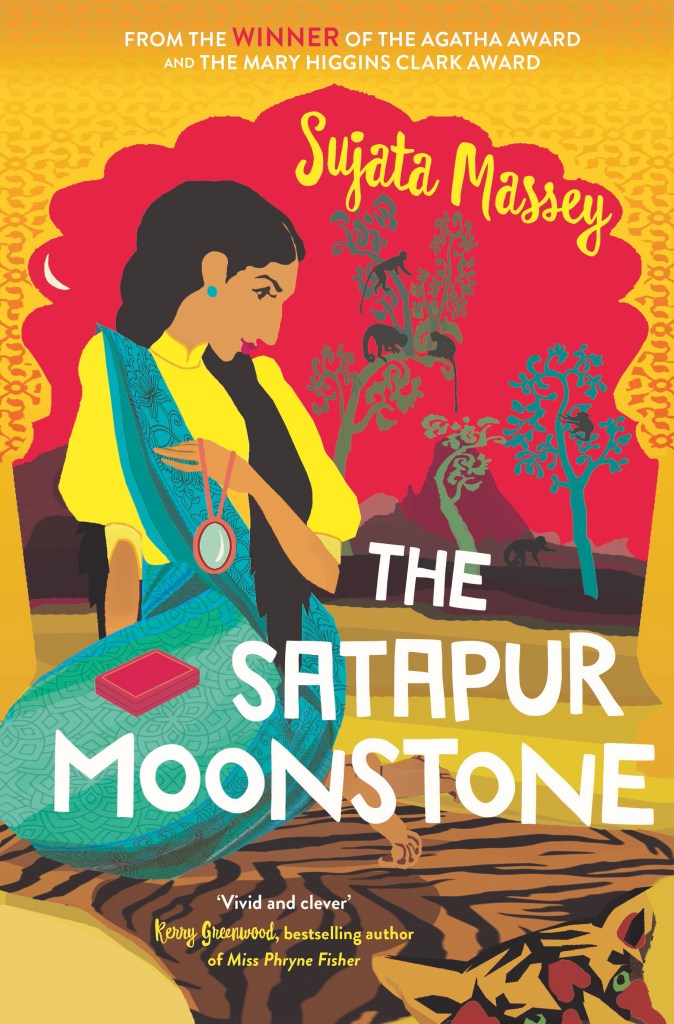
This book won an Agatha Award and the Mary Higgins Clark Award, which is why I wanted to read it after having just devoured the second book in the series: The Satapur Moonstone. Yes, again I read the books in the wrong order, but at least now I’m all square. The second book sends Perveen to the remote state of Satapur, home to the widow of a maharaja and her mother-in-law, the dowager maharani. The two women are in dispute over the education of the young prince and future maharaja, and a lawyer is required to sort out an agreeable solution.

The women live in purdah, so no men are admitted and Perveen is requested by the British agent overseeing their kingdom. Perveen must travel by palanquin, a kind of sedan chair arrangement, through forests inhabited by tigers and other deadly animals to the palace. Here she finds a royal family living under a curse not long after the deaths of both the last maharaja of cholera, and his eldest son to a hunting tragedy.

We’re in monsoon country, transport is difficult and news travels slowly. The local villagers live a traditional and fairly impoverished existence, while up at the palace, we’ve got power plays, secrets and treachery while the uncomfortable political situation brought about by British rule rears its ugly head from time to time. Tension of various kinds build to a ripping ending. This a terrific addition to the series, and some unfinished business for Perveen makes me eager for Book 3.

Book Review: The Spies of Shilling Lane by Jennifer Ryan

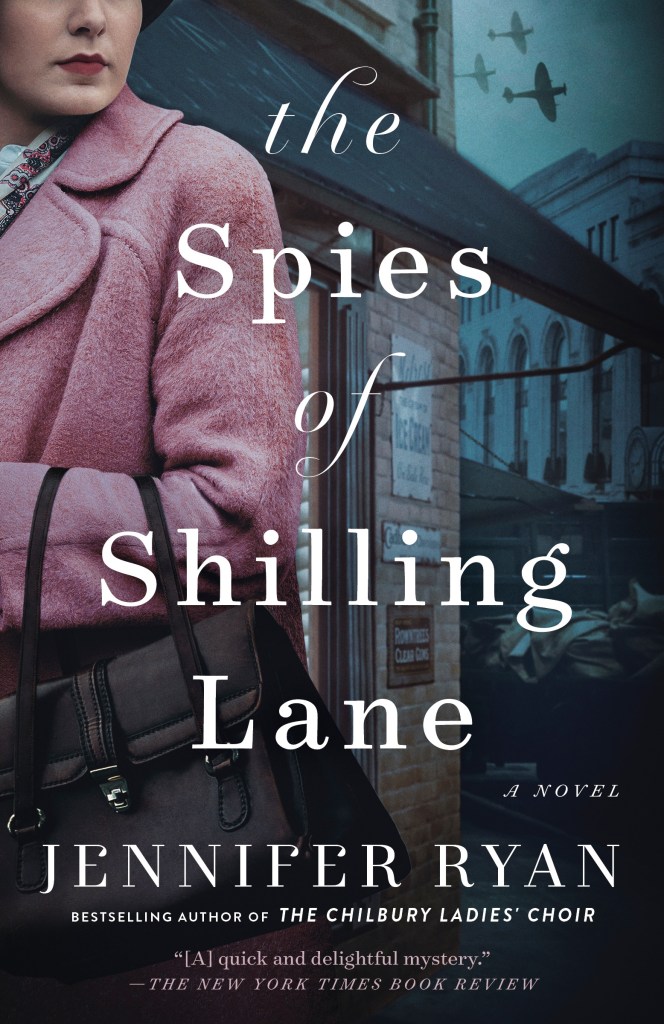
The Spies of Shilling Lane by is another wartime story by Jennifer Ryan, the author that brought us the hugely popular novel, The Chilbury Ladies’ Choir. As before we have a mix of unlikely heroes and heroines thrown into the maelstrom of World War II, with outcomes to surprise both the reader and themselves.

With her second novel, we meet the loud, bossy and unlovable Mrs Braithwaite on her way to London to find her daughter, Betty. It is 1941, and London is being hammered by the blitz, so why would Betty want to leave the comforts of home and the small town of Ashcombe? To make matters worse, Mrs B has been dropped by the Aschombe Women’s Voluntary Service where she was Queen Bee, a role taken on by former friend Mrs Metcalf. The ladies aren’t happy with Mrs B because of her divorce and general bossiness.

No wonder Betty escaped to work for Bexley Sewage Works – who wouldn’t? When Betty seems to have disappeared, Mrs B inserts herself at Betty’s address, number 3 Shilling Lane, also home to landlord, Mr Norris, a quiet unassuming accounts clerk, and two girls: vague and messy Florrie, and coolly beautiful Cassandra, neither of whom were particular friends of Betty’s.

Mrs B discovers that Betty has never been an employee at the sewage works, but a series of clues lead her to a butcher shop in Clapham. Suddenly Mrs B is thrown into the dangerous world of MI5 and an undercover operation to infiltrate a Nazi spy ring. She may have over-focussed on social standing at the expense of her daughter in the past but she’s brave enough to get to the bottom of things, determined to make amends.

Mrs B drags Mr Norris into her plans – a reluctant hero if ever there was one. But while Mrs B is learning what it means to be a caring parent, Mr Norris is developing the courage he’d always thought he’d lacked. In the meantime, London is repeatedly under siege, and our team of reluctant heroes are completely confounded by not knowing who they can trust, Ryan throwing in a few plot twists before the final page.

Jennifer Ryan has created a humorous story about ordinary people doing extraordinary things, with a cast of colourful characters and believable settings. It is also at times an emotional book, the carnage of the blitz creating a relentless backdrop to events, out of which appear small moments of hope. However, I struggled not see Mrs B as a kind of wartime Hyacinth Bucket (tv’s Keeping Up Appearances), and yes, I did find my credulity stretched a little at times. So while I found it competently written and engrossing enough, it’s a three out of four from me this time.

Book Review: Better Luck Next Time by Kate Hilton

Canadian author, Kate Hilton describes her latest novel as a divorce comedy, although there’s a wedding as well, and a treasure trove of family secrets. In the opening pages, Zoe is not looking forward to Christmas, as she is reluctant to reveal that she is getting a divorce. Christmas is tense enough, without dropping that bombshell.

Along with Zoe’s parents, who are hosting the festive meal, plus her brother Zack, we meet Zoe’s uncle and feminist icon Aunt Lydia, and Lydia’s daughters and grandchildren. Zack has won fame and fortune writing a TV sitcom loosely based on the lives of his famous aunt and her family, for which he has never been quite forgiven.

Lydia’s daughter, Beata, is particularly bitter about it, but she has enough to deal with with her teenage son, Oscar, discovering that he wasn’t the product of a sperm-bank after all and has already made contact with his father. Enter, Will, an old pal of Zoe’s from her university days, and also a colleague of Beata’s partner, Eloise. Eloise just happens to be the lawyer handling Zoe’s divorce.

Meanwhile, still on Christmas day, things are obviously not going well in Zoe’s cousin Mariana’s marriage to shiftless but charming Devlin. Things reach a crunch when Mariana snatches up Devlin’s phone and smashes it to bits in the kitchen.

Hilton gets her book off to a flying start, with so much going on with in the lives of Zoe, Mariana and Beata. They’re all great characters – engaging and interesting – while the impossibly high bar set by Aunt Lydia for the younger women in her family hovers in the background. No wonder they keep secrets from each other – secrets, which are due to all come out sooner or later.

The book reminded me a little of Emma Hope’s Expectation, in that we have the same well-meaning pressure from an older generation of feminist women on their daughters whose lives haven’t quite turned out as they’d planned. In Better Luck Next Time, we are reminded how hard it can be for women to ‘do it all’ – manage children, careers, marriage and be true to themselves. Mariana is a journalist who has had to sacrifice writing the important political stories she’s so good at so she can support her family. She ends up writing publicity for a ‘wellness’ company, an industry Hilton sends up beautifully.

There are plenty of amusing scenes, including a feminist rally that turns nasty and a bridal shower which makes you wonder why anyone would ever get married. The book gallops towards another, somewhat, happier Christmas, an ending where its characters have learned a lot about life, love and themselves. This is a funny yet thoughtful novel, with characters you really warm to and plenty of digs at the fads and obsessions of modern life. Just what you want in a comedy for our times. A four star read from me.

Book Review: Redhead by the Side of the Road by Anne Tyler

One of the things I’ve always liked about Anne Tyler is her knack for unlikely characters. There’s never going to be a stereotypical character in a Tyler novel – they’re often a bit quirky, but oddly ordinary as well. Certainly they’re not the kind of people you meet a lot in fiction. Take Micah Mortimer for instance, the main character in Redhead by the Side of the Road.

You have to wonder what goes through the mind of a man like Micah Mortimer. He lives alone; he keeps to himself; his routine is etched in stone.

Micah’s one of those quiet, fanatically tidy, routine driven men of a certain age, whose life could go on the same way for decades. He looks after his apartment building for a reduction in rent (sending out emails about the importance of flattening milk cartons before they go in the recycling), while running his Tech Hermit business, solving people’s home computer problems.

Not only is Micah pernickerty about his cleaning routine (kitchen floors every Monday), he likes to think of himself as a model driver, sticking to the rules, taking care when parking, while an imagined Driving God smiles benignly. All the same his inclination to do the right thing also extends towards people, like his neighbours, but sometimes he misses important signals.

Two things happen that upset his routine. The teenage son of a former girlfriend turns up on his doorstep, wondering if Micah might be his father. Brink Adams (Wouldn’t you know he’d have a name like “Brink”, surmises Micah – something about the blazer and the haircut) ends up staying the night, upsetting the order of Micah’s day, leaving him to wonder why Brink isn’t at college and how to get in touch with his mother.

And when his girlfriend, Cass, phones him with her own problem, fearing eviction because of her cat, Micah doesn’t offer much consolation and Cass dumps him. Suddenly his head is filled with what might have been, not only with Cass, but with Lorna, Brink’s mother, all those years ago.

This is a quiet little story – just nudging 180 pages – and as such seems perhaps less substantial than novels like A Spool of Blue Thread, or Searching for Caleb, with their look at families through the generations and the interactions of characters over time, their secrets and motivations. And yet, Tyler really nails the character of Micah and creates a beautiful little drama about him. It really is the perfect little book and sometimes a small story is just right. An easy four out of five from me.

Book Review: A Theatre for Dreamers by Polly Samson

Escaping to a Greek Island where you can live cheaply for a year just so you can focus on your art, bask in the sun, swim and enjoy the delights of love, food and wine – what an idyll. Hydra in 1960 was just such an island, captured here in A Theatre for Dreamers by Polly Samson. Australian writers Charmian Clift and George Johnston are established on Hydra and help out newly arrived artists eager to take a break from the rat-race to finish their novels, paint or create poetry.

It is where eighteen-year-old Erika holes up, still grieving the death of her mother and escaping a volatile father, London rain and the typing pool. With her is her boyfriend, emerging poet Jimmy, and brother Bobby and his girlfriend. There’s a connection with Charmian through Erika’s mother, and an expectation they can find a cheap house.

Madly in love, Erika doesn’t mind doing the donkey work – making sure they have clean water, meals and fetching ice to keep their food fresh. Charmian takes pity on her and encourages her to write – she sees in Erika a daughter figure, but also the watchfulness of a budding writer.

And there’s plenty to see – in particular the twenty-five-year-old Leonard Cohen, fresh off the boat with his guitar, eager to finish his first novel. But he’s distracted by Scandinavian beauty, Marianne Ihlen who is caught in a disastrous marriage with Axel Jansen, himself an enfant terrible of the literary world in Norway.

As well as a hub for expats coming and going, Charmian and George’s house becomes a second home to Erika. But the pair have financial problems, drink too much and argue a lot, George has poor health and issues with jealousy. Ah, the lives of the bohemians. Shaking off conformity and the rules of the nine-to-five working life, this enclave of creatives explore many new freedoms, break each other’s hearts and live like characters from bacchanalian scenes on a Grecian urn.

Samson has done a mound of research to bring these artists to life, helped no doubt by the records made not only in their writing, but in the pictures of Time-Life photographer, James Burke. The novel is in many ways a social history, highlighting the emergence of the counter-culture era that would turn into the swinging sixties, but also the feminism that waits in the wings.

And boy is it needed as several key female characters are left holding the baby, wiping the weary brows of their men, playing muse and ignoring their own careers. There is a lot in the book to think about as you read about the endless parties, the infidelities and drunken escapades. In the background the conservative local Greek population must have been pleased with the extra business garnered at the time the sponge industry was drying up, while shaking their heads at the various improprieties.

There are a lot of names – you might want to keep the Internet handy. I struggled to keep up with the different personalities that swept through. But I felt a strong sense of being there; Samson describes the island using all five senses and this alone makes the book really quite wonderful. A four out of five read from me.

Book Review: Truly Madly Guilty by Liane Moriarty

Truly Madly Guilty is a novel about ordinary people. They’ve all got their quirks and kinks of temperament, their baggage – some more than others. Simmering with problems, insecurities and resentments, the characters are all set for some kind of train wreck; the setting: an ordinary suburban barbecue.

Moriarty creates a powder keg of volatile ingredients a bit like a chemistry experiment gone wrong. Three families who probably shouldn’t really be friends come together to socialise: There’s Sam and Clementine and their two little girls, Holly and Ruby. Clementine is a cellist, anxious about an upcoming audition; Sam is stressed about the way their finances depend on a his new job in advertising where he feels out of his depth. It’s all causing a toll on their marriage.

Erika is socially awkward and, like her husband Oliver, works in accounting. They are a fit, childless couple and to many seem a bit boring. But both have had terrible childhoods which has helped them connect with each other, if not with other people. Erika was foisted on Clementine as a child, and the two have been friends ever since, although sometimes Clementine wishes Erika was less friendly with her mother and wasn’t always in touch.

Erika and Oliver invite their friends for afternoon tea to put forward a proposal, carefully planned before the two families head next door to a barbecue hosted by wealthy and gregarious Vid and his glamorous younger wife, Tiffany. Vid has recently discovered classical music and becomes a bit fixated on Clementine; Tiffany has something of a shady past. The two little girls are entertained by Tiff and Vid’s ten-year-old daughter Dakota, but sometime later on, with much alcohol having flowed and one or two secrets revealed, something terrible happens.

Moriarty has a knack for feeding out just enough information to get the reader interested, switching timeframes from some weeks after the event, during a period of persistent rain, and the day of the barbecue. We don’t discover exactly what happened until halfway through the book, and not entirely until near the end. The story is told from several perspectives, filling in all the details and building up characters you can feel empathy for. They are so ordinary and yet so unique, after all.

Can the three couples come back from what happened? Rebuild their lives? Learn from their mistakes? There’s also an interesting commentary on class and wealth running in the background, the snobbery associated with money or with talent.

Truly Madly Guilty is a very smart novel with some very poignant moments and a few surprises. I hadn’t ever read a book by Liane Moriarty before, and this will certainly not be the last, striking for me a happy balance between entertainment and something to think about. Four out of five from me.

Book Review: The House We Grew Up In by Lisa Jewell

The Bird family seem to have everything: a yellow brick house in the Cotswolds with a big, rambling garden – the perfect family home. Their mother, Lorelei is a happy, hippie, stay-at-home mother who does lots of fun things with her kids. She holds yearly Easter Egg hunts and keeps all her children’s art to hang on the kitchen walls – all of it, forever! There’s Dad/Colin, an amiable, shambling academic, and four kids: confident Megan, beautiful Beth, Rory, who’s everyone’s mate. And then there’s Rhys.

Rhys was Rory’s twin, a sickly baby who has grown into a quiet, brooding child who nobody likes. When tragedy strikes, cracks appear in the cement that had once held the Bird family together, and each of them struggle in various ways. In particular, Lorelei, with her habit for keeping anything she felt sentimental about, now a chronic hoarder.

The book opens with Meg and her teenage daughter, Molly, having returned to the old Bird family home, to clear it out of all the teetering piles of junk Lorelei has collected over the years and to prepare for her mother’s funeral. Slowly the rest of the family drifts home to help.

The House We Grew Up In follows various characters as it fills in the gaps between then and now. Often we are with Meg who is compulsively tidy, some of the time we’re with Beth who can’t seem to get her life together enough to leave home. Then occasionally we’re with Rory who has a habit of throwing in his lot with the wrong people. And then there are Lorelei’s emails to a man she’s met online

With all different different points of view and shifts in time, the novel can take a bit of concentration to keep track of it all. I was nipping back and forth a bit, checking dates, calculating ages. Was it worth the effort? Definitely yes. Jewell is a brilliant writer when it comes to families that seem happy on the outside and what could go wrong with them and why. She gets you to care for her characters, even when they mess up, and these guys do big time.

And then there’s the guilt. Everyone has something to feel guilty about and with that comes the secrecy. How do members of a family come to terms with the wrongs of the past to rebuild those relationships that were once so special? The House We Grew Up In takes you through all of this and makes you realise that even the seemingly nicest, ordinary people can do very destructive things without meaning to. Another engrossing read from Jewell and a three and a half out of five from me.

Book Review: Alternate Side by Anna Quindlen

There is something about a New York novel – and Alternate Side could be the quintessential New York novel – that always seems to appeal. Maybe it’s because New York is one of those cities that people dream of calling home (like Paris or London, for that matter) – the culture, the food, the parties the opportunities…

And so it is for Nora Nolan, who turns up in New York after college, and here meets Charlie. Alternate Side is partly the story of their marriage, and their finest achievements as a couple – their twins, Rachel and Oliver. And then there’s their house. The Nolans live on a quiet block of infinitely expensive Victorian houses, with a dead-end which makes it even more of an enclave.

They attend parties and barbecues with their neighbours, watch each other’s children grow up, use the same handyman: Puerto Rican Ricky from the Bronx. They all have nannies and housekeepers – for the Nolans, it’s Charity from Jamaica. And to give Nora credit, she does sometimes feel conflicted that all the people she knows have immigrant hired help, black or hispanic, who come from poor neighbourhoods.

Their children, their dogs, and housing prices: the holy trinity of conversation for New Yorkers of a certain sort. For the men, there were also golf courses and wine lists to be discussed; for the women, dermatologists.”

The story begins with Charlie beaming with glee, having finally been offered a space in the street’s only parking lot – an empty section which once contained a house and now has room for a select half dozen cars. As you can imagine, these spaces are highly sought after. When a violent incident occurs, involving Ricky and one of the Nolans’ more insufferable neighbours, things are never quite the same for anybody. Suddenly the gaps between the haves and the have-nots are obvious to all, not just Nora, as issues of racism and entitlement in connection with the block make the news.

Alternate Side is about keeping up appearances, as well as that old adage, be careful what you wish for, you might just get it. Everything seems to fall into Nora’s lap – her job setting up a jewellery museum (only in New York, right?) is one of a string of interesting work opportunities that always seem to come her way. Her marriage: Charlie appeared just at the right time when Nora was suffering from a broken heart. What is it Nora really wants? That is the question.

“People go through life thinking they’re making decisions, when they’re really just making plans, which is not the same thing at all.”

The story though is very much in the telling. Anna Quindlen writes with both wit and wisdom and I found myself chuckling at the snappy dialogue and Nora’s wry outlook, her interactions with Phil, the panhandler who takes up space on the path outside the jewellery museum, the obnoxious notes distributed by neighbour George about rules on use of the parking lot. There is so much to enjoy here as well as a story to make you think – and all set in New York. I loved it. A four and a half out of five from me.