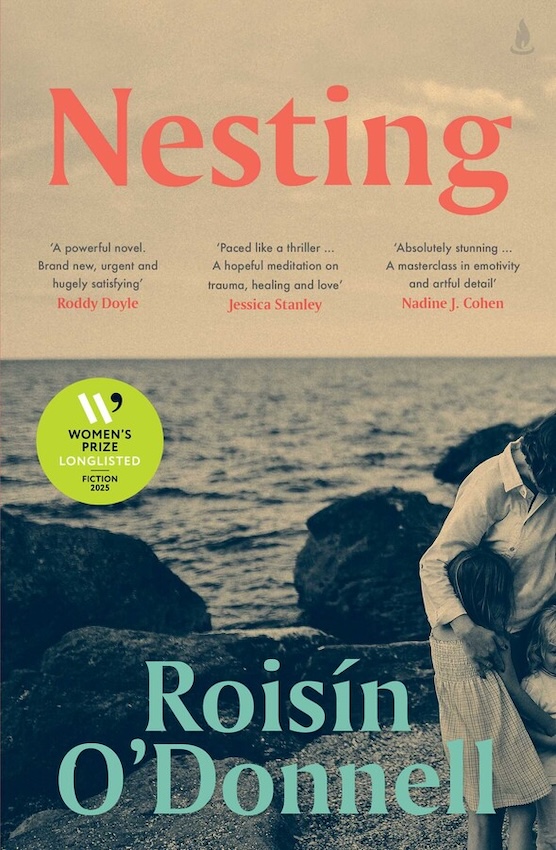
Book Review: Nesting by Roisín O’Donnell – a heart-stopping novel about a woman trying to leave her marriage and start again

This book reads more like a thriller than a slice-of-life contemporary novel. Nesting is about Ciara Fay who decides to leave her husband. She makes the sudden decision to grab the clothes off the line, bundles her children into her car and takes off, not knowing where she’s going. Her husband Ryan, upstairs in the shower, is completely oblivious.

Ciara has very little money. Ryan managed their finances, only giving her a bit of housekeeping money in cash and expecting her to account for it all. All the same, she has saved enough to tide them over for a few days. But with two girls under five, it’s going to be tough, even before she discovers she is pregnant again. The only reason she is putting herself through this is because she is so scared of her husband.

Ciara does everything right – she keeps Ryan informed about needing a break to keep everything above board. She doesn’t want to lose her girls. Her family – a mother and sister – are both in England and she can’t leave Ireland with her girls without their father’s permission.

When she finds a place in social housing, you get a lot of insight into the soul-destroying situation this can be. The lack of space – one hotel room for a family – and minimal cooking facilities. People hide rice cookers in their rooms, but there’s the threat they could be kicked out if discovered. They mustn’t use the lifts, it’s off-putting for the other guests, so they have to sneak up the back stairs. Even so, there’s a sense of community here and Ciara makes friends.

All the while, there are incessant text messages from Ryan which are like a battering ram, either declarations of love or hostile accusations, but always intense. Ciara is always on edge, her husband’s voice constantly in her head, dominating her thoughts. She doesn’t realise how bad it is until she talks to other people.

The story follows Ciara’s desperation to find a home, to find work, to make a new life for herself and Ryan’s ability to always crank things up another gear through lies and deception. So it isn’t surprising there is that thriller level of suspense. So often did I have my heart in my mouth, wondering if Ciara and the children would ever be safe. And it’s right down to the wire in the last chapters. Such an emotional roller-coaster of a read.

Through it all there’s imagery of birds. There are the young crow chicks Ryan finds in an abandoned nest on a building site and decides the girls can help him nurture. Another ploy. But other images too. It’s a beautifully written and crafted book. I enjoyed the audiobook, read by Louisa Harland. Even so, Nesting is so tense, so vivid, I could only listen to a little at a time. But gosh, what a great story. A five-star read from me.

Book Review: The Treasures by Harriet Evans – an immersive family saga and the first of a trilogy

I was happy to put my hand up for this Netgalley offering as I’ve enjoyed several Harriet Evans’ novels before. She often centres her novels around an atmospheric house (Keepsake in The Butterfly Summer; Vanes in The Beloved Girls; Fane Hall in The Stargazers), which I’ve always found appealing. A bit like Manderley in Daphne du Maurier’s Rebecca.

Early on in The Treasures we hear mention of a house called Sevenstones. I imagined a grand old English manor, full of secrets and mystery. In actual fact Sevenstones has more of a cottage feel, a country bold-hole where various members of the cast of characters arrive when they need a break. For some, including Tom Raven’s parents, it was a chance to take a break from the war – World War II that is – and where relationships were forged.

But we first meet Tom as a young boy, living in a two-room cottage with his much loved Dad in Scotland. At the age of nine, he is uprooted by his Aunt Jenny, leaving the simple life behind for more opportunities in London and public schooling, even though his aunt and Uncle Henry really have no idea about children or even running a house without staff. We’re in the 1950s, and there are bomb craters everywhere, and children from the upper classes aren’t to mix with the lower orders, or so Tom’s told.

There’s also another grander house in this book – Valhalla, the American home of the Kynastons. Alice is growing up as best she can, with a father battling demons and debts owed on his orchards. When he takes his life, it seems Alice and her mother are to lose their home on the grounds of Valhalla. Wilder Kynaston was a good family friend and offers them a lifeline, but there’s a price to pay.

We’re well into 1960s by now, and as Jack and Alice grow up on opposite sides of the Atlantic, another war has arrived, and with it the rise of the protest movement, women’s lib and the chance of new freedoms and ways of thinking. The novel takes you through these changes as our two young characters’ stories are set to intersect. But family secrets lurk, throwing roadblocks in their way.

Harriet Evans captures the time really well, and the dilemmas faced by young women like Alice who are trying to forge a new path for themselves, only to find they’re still chivvying for the boyfriends they tie themselves to. The men of the establishment still hold all the power, while choices for women remain limited. But there are others too, like the fathers of both Alice and Jack, who have been left haunted by the past, plagued by guilt or disappointment, also unable to be the people they want to be.

I was curious that the book starts with a modern day setting and a character, Emma, who doesn’t appear again, discovering the ‘treasures’ of the title. These are little mementos Alice has been given by her father on each of her birthdays. But I now see that this novel is the first of a trilogy – I’ll be intrigued to see how the story continues to fill in the gaps in the books that follow. The Treasures is a rich, immersive read with terrific characters you empathise with.

The Treasures is due for release on 12 June. It’s a four-star read from me.

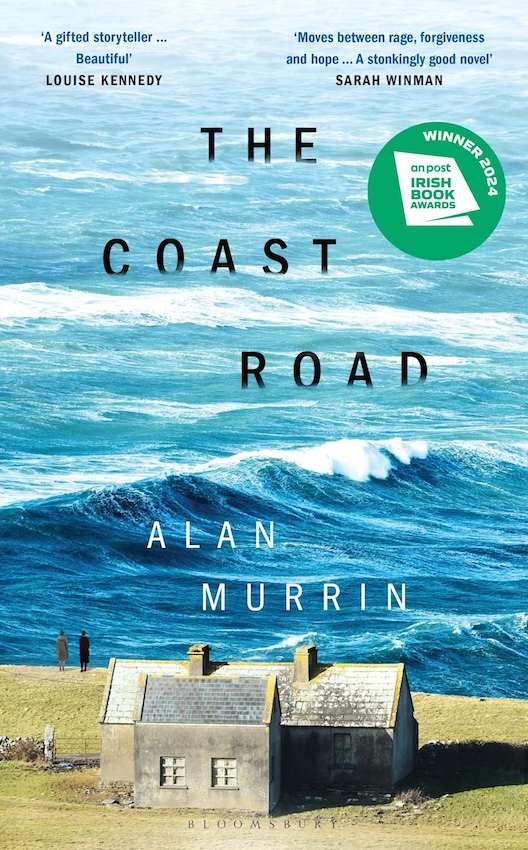
Book Review: The Coast Road by Alan Murrin – a novel about marriage and the price of non-conformity set in small town Ireland

I was impressed by this debut novel, which reminded me of fiction by other Irish authors I’ve enjoyed in the past, such as Anne Enright and Claire Keegan.

The Coast Road is set in a small coastal town in Donegal in the 1990s, a year or two before divorce became legal in Ireland. The story describes the awful predicaments people, and particularly women, could find themselves in while stuck in loveless marriages. It does this through three main characters.

Colette Crowley has escaped her loveless marriage to Shaun determined to live her life on her own terms. She’s a published poet but has done the unthinkable in running off to Dublin to live with a married man. Finding no joy in that relationship, she has come back to be closer to her younger children. But Shaun won’t let her see her kids, and it’s easy to drown her sorrows in booze.

When Colette rents a holiday cottage we meet Dolores Mullen, who is pregnant with her fourth child and all too aware that her husband sleeps with other women. She knows it could be dangerous to rent the cottage up the path from her home to Collette, but with another baby on the way, the Mullens need the money.

And then there’s Izzy, who is married to James Keaveney, a politician and a bully. Not allowed to work, Izzy fills her home with expensive china ornaments and does evening classes. The only brightness in her day are the chats she has with their priest, Father Brian. She knows Collette because her youngest son is friends with the youngest Crowley boy, but gets more friendly with her when she signs up for Collette’s creative writing class.

The three women are all deeply unhappy, and certainly unfulfilled while local opinion, the establishment and gossip all work against any idea of their standing up for themselves. In the background the political machine plays out, as a change in the divorce law is debated. But how this might help these women is yet to be seen, as Colette becomes more unstable, Izzy more angry and Dolores more anxious. The story slowly builds up to a breaking point that has you biting your nails.

As a male author Alan Murrin has done a great job at making these female characters believable, capturing not just their lives, but their voices and inner thoughts in a realistic way. And also their situation in a small town, where men have the power and nobody helps out if there is any sense of non-conformity. The writing is real, at times humorous, particularly through Izzy’s lens, the bigger situations balanced nicely with the minutiae of everyday life. It all adds up to an amazing story and reminded me a little of Claire Keegan’s Small Things Like These with characters needing to find courage to do the right thing against the tide of opinion.

Alan Murrin has won a couple of awards for this debut novel and I’ll be keen to see what he writes next. I enjoyed this as an audiobook and it was a superb read, narrated by Jessica Regan, who does a terrific job with all the characters. The Coast Road is another wee Irish gem and highly recommended – a five-star read from me.

Book Review: The British Booksellers by Kristy Cambron – a story from World War Two with its roots in the previous war

The devastation of Coventry by enemy aircraft during World War II is often described as the Forgotten Blitz. Coventry was targeted because of its munitions factories, but thousands of homes were also destroyed, hundreds of civilians killed and the Cathedral left in ruins..

Kristy Cambron uses this as a background for her novel The British Booksellers, but the story gets going before all that, even before World War I, when we meet two young people: fifteen-year-old Amos Darby the son of a tenant farmer, and twelve-year-old Charlotte Terrington, an earl’s daughter. They have played together for years, and are obviously soulmates, sharing a love of books, Charlotte also being keen on playing the cello, something she’s not allowed to do – it’s unladylike. So far, so Downton Abbey.

As they get older, their friendship deepens, but Charlotte is promised to local gentry, one Will Holt, who’s something of a lad, but determined to have his fair lady. With a war waiting in the wings, the First World War, that is, everything is accelerated and with miscommunications and nobody getting quite the life they had planned, a kind of bitterness settles on Amos’s and Charlotte’s relationship. Jump a couple of decades on, and here we have Charlotte and daughter Eden at their Coventry bookshop, still living at Holt Manor, while across the road Amos lives above his own bookshop, Waverley Novels. They have been not only business rivals but apparently feuding bookshop owners all this time.

But with another war on the go, things are set to be shaken up in more ways than one. The arrival of Jacob Cole, an American solicitor with claims on Eden’s inheritance adds another plot thread and there are suddenly land girls from London to settle in. But Holt Manor’s struggling to pay the bills, so they need all the help they can get. And then there’s the Bltiz.

Kristy Cambron writes a great story about love and war, and there’s a lot here to keep you turning the pages. The characters are complex, appealing and developed well. The scenes of war, of bombing and our characters thrown into the maelstrom of it all are exciting. I enjoyed the scenes with Amos more than all the girls mucking in together and comparing notes about clothes and how to cope without regular access to stockings. Personally, I’d be digging out the less glamorous Lisle stockings, as that manor house, the rain and mud sounded miserably cold.

This is a nice enough novel, but a picky reader might find the prose a little American sounding, the descriptions a little lengthy and over-egged. But the story is terrific and worth picking up for a diverting read that has you eager to find out what happens. The British Booksellers is a three-star read from me.

Book Review: The Berry Pickers by Amanda Peters – an emotional read about identity, guilt and the effects of childhood trauma

Amanda Peters won a cluster of awards, including a Carnegie Medal, for this novel. I’d also heard many recommendations from other readers, so have had this on my to-read list for some time. The Berry Pickers explores what happens when a young Mi’kmaq girl goes missing from the berry fields where her family are working. They are a family of five children, who with their parents travel from Nova Scotia to Maine every year to work in the berry fields to supplement their income.

Every year, they set up camp with other families, and there’s a strong sense of community as the pickers get to work. It’s the early 1960s when six-year-old Joe loses sight of his four-year-old sister Ruthie to look at something for a moment. When he returns, she is gone. An extensive search over the days and weeks that follow yields no clues while the police are reluctant to get involved; there’s even a suggestion that the family were careless. You can’t help feeling they would have been far more helpful for a local family, or a white family.

Joe grows up with this tragedy on his conscience, as well as the loss of his older brother Charlie in a fairground altercation. This sets in place a rage that will affect him for much of his life. When we meet him at the start of the book, Joe is dying of cancer. Now in his fifties, he still does not know what happened to his little sister. Is it too late now for him to find out?

The narrative flips between Joe’s story and that of Norma, a young girl growing up in a middle-class white home. Norma is disturbed by strange dreams and questions about why she is so much darker-skinned than her parents. Her mother, Lenore, is very loving, but over protective and watchful, not letting Norma out to play except in the back garden, hidden from view. It’s a strange, suffocating childhood, which has long-reaching effects on Norma and her adult life.

The plot follows the two main characters through the years – Joe trying to deal with his rage and Norma still questioning her identity, but unable to talk to her emotionally fragile mother about it. Both stories are immensely sad and this makes for quite an emotional read. There’s also the racism constantly directed at Joe and his family, particularly in the years following the loss of Ruthie and Charlie. The authorities are swift to criticise but offer no justice.

Which isn’t to say that the book is didactic or preachy. The storytelling through its two main characters brings the reader into their worlds, raising ideas about culture, motherhood, childhood trauma as well as grief and forgiveness, simply but effectively. It’s a terrific read, powerful and gripping. A four-star-and-a-half-star read from me.

Book Review: The Unquiet Grave by Dervla McTiernan – a pacy new Cormac Reilly crime thriller

I’ll read anything by Dervla McTiernan, so was happy to put my hand up for her new book in the police Sergeant Cormac Reilly series, The Unquiet Grave, when it was offered by Netgalley. This is the fourth mystery featuring Reilly, and I’ve always found him an interesting character – unrelenting yet sensitive, logical but also good at reading people. He always seems to be up against it, whether it’s relationship problems, pressure to close a case early or issues with colleagues. Or all three – which is what we have here.

In previous books, Reilly has struggled to fit in, returning to Galway after years in the force in Dublin. A stickler for doing things by the book, he’s been a whistle blower, which is why, in the new book, he’s being headhunted to run a team investigating police malpractice – not a job to earn him popularity. While he’s mulling this over, he and his sidekick, Constable Peter Fisher, are called to a body discovered in a bog. Fitted out to look like a ritual killing, of the kind discovered in ancient burials, the presence of underwear suggests otherwise.

The body turns out to be that of a polarising head teacher at the local school – Thaddeus Grey, who disappeared two years ago. Found on the outskirts of town near his house, Grey expected high standards of the students, and it turns out, was a bit of a bully. Cormac soon narrows his focus to three students who particularly bore the brunt of Grey’s unpleasantness. But when another body is found in similar circumstances, his bosses and the press are jumping on the idea that it’s a serial killer. Cormac soon has a battle on his hands to bring the actual killer or killers to justice.

Meanwhile, Cormac’s ex-girlfriend, Emma, now married and expecting a child, is desperately worried about her husband Finn who has gone missing in Paris. The French police give her the brush off as he’s not a French citizen and she gets the feeling everyone thinks she’s a hysterical female, whose husband suddenly has cold feet about being a family man. Finn was a cyber security expert in the forces until recently, so Cormac pulls a few strings with an old army mate and gets things going with a police investigation. But nobody’s optimistic.

There’s a further plot thread involving a computer tech. wizard planning a fraud against the lottery company he works for. How all these story threads come together is a masterpiece of crime mystery plotting and keeps the story humming along. What makes it particularly interesting are the moral dilemmas faced by Cormac and Peter as they try to find justice for those caught up in crime, as well as problems in their personal lives.

These issues add layers of complexity that give the story a bit more heft. There’s danger too, with some pacy, edge-of-the-seat moments. Add the relentless Galway weather – it’s either freezing or raining or both, and we’ve got the atmospheric settings I’ve come to expect from McTiernan, who takes us to Paris, London, Dublin as well as some boggy rural corners.

All in all I wasn’t disappointed with The Unquiet Grave and it was great to check in with Cormac Reilly again – I do hope there will be more in the series. I really enjoyed the e-audiobook edition of the novel, published by HarperAudio and read by Aoife McMahon, who captured the personalities of all the characters, which were many and varied. With a publishing date of 30 April, The Unquiet Grave is a four-star read from me.

Book Review: Would You Rather by Maggie Alderson – a beach read about a grieving widow with a grievance

I picked up this book for a light holiday read, intrigued about the story of a woman coping with loss and redefining her life in order to move on. In this case, we’ve got Sophie who has two terrible things happen to her in one day. First Matt, her husband of thirty years, tells her he’s not going to move house with her after all, but stay on in London with his mistress. She’ll be off to their new house in Hastings on her own! And then Matt gets hit by a truck while riding his bicycle and killed.

Suddenly Sophie is an angry wronged wife and a grieving widow all at once. Thank goodness she has the support of her friend Rey, who helps her adjust to her new life, and she soon makes friends with her new neighbours: Agata in her nineties and Olive who calls a spade a spade, both of them widows too. Also among the huge cast of characters are Sophie’s sons, Jack who lives in Australia and Beau, the spitting image of his dad and just as big a hit with the ladies. Beau has also inherited his father’s talent as an artist, making his own brand of jewellery and working as a waiter to pay the bills.

Would You Rather follows Sophie’s story as she gets on with life, her work as a food stylist, and the questions she suppresses about the ‘other woman’. We also follow Beau who has overheard something at the funeral which has him digging into his father’s past. When he gets a rude awakening from girls he’s treated badly, he’s also on a learning curve. Then there’s Juliet, the mistress, a successful jewellery designer. She’s mother of little Cassady when we meet her, and is determined to live life according to her own terms.

These stories are all set to intersect in a fairly predictable way, although the characters have so much going on in their lives there’s lots to keep the reader interested. Sophie decides to keep Matt’s devastating decision to herself, which is difficult when his brothers and their wives are still a part of her world. There were five Crommelin brothers, all it seems larger than life and in their own way full of charm.

The story carries the reader through the dilemmas faced by its three main characters with lots of colour thanks to its attractive settings: seaside Hastings and elegant parts of London with its art auctions, jewellery stores and fabulous parties. I must say I got a little sick of all the parties. There’s plenty of wine and descriptions of sumptuous food too as you might expect with several characters who are terrific cooks and another who is a winemaker.

I did feel sorry for Sophie though. How is someone supposed to grieve or turn their life around when having to keep their chin up at parties? While there were plenty of lessons learnt and positive hopes for fresh starts, ultimately I couldn’t help finding these characters, with the descriptions of their lavish homes and lifestyles, all a little bit shallow. So while I am often up for a feel-good, second-chances story, this novel was disappointing. I’m still not sure why the book is called Would You Rather, but it’s a two-and-a-half star read from me.

Book Review: The Life Cycle of the Common Octopus by Emma Knight – an perceptive coming-of-age novel set in Edinburgh

I had no idea what to expect from this novel. Neither the title nor the cover gives a lot away, but I was soon caught up in the story of a young girl embarking on student life in Edinburgh. Pen and bestie Alice are from Toronto, and although neither wish to cramp the other’s style, they are there for each other as each explores opportunities as first year students together. They become friends with Jo, whose family have a country house they can decamp to, and whose brother, Fergus is soon attracted to Pen. All three girls, particularly Alice, are gorgeous in their own way.

Alice wants student life to be about experiences as much as study. She’s also hoping to land a role in a play and then, if that goes well, a part in an Edinburgh Festival production. She’s larger than life, a bit of a party animal and open to a dalliance with a lecturer – just another box to tick off. Pen, on the other hand, is quieter, more studious and intellectual. Studying in Edinburgh gives her a chance to connect with an old friend of her father’s, a famous author of mystery novels, Lord Elliot Lennox.

Pen wants to be a journalist, so talking to a writer makes sense. But she’s also digging around for reasons behind her parents’ divorce. Why did her father fall out with his best friend, a friend remembered with her middle name? Was there something between him and Lennox’s wife, Christina? Pen writes to Lennox asking to visit him in his stately home, and finds herself welcomed into the family by his wife Christina. She strikes up a friendship with George, a niece with a young baby, and is soon smitten by older son Sasha. But often while she’s there, Elliot Lennox stays in his study, only surfacing for meals.

She and Pen had been friends since well before they had discovered the need to construct an outer shell, like that of an invertebrate animal, to protect the soft inner substance of the self. Childhood friendships often lose their hold at that point, when one sees that the person one loved has learned to disguise herself and will no longer be reachable, or at least not often. What made Alice feel certain, as Pen helped herself to the roll of toilet paper on her desk to wipe her nose, that this friendship could take them through every stage of their lives, cushioning them against the bone-crushing loneliness of being human, was that they did not have to pretend with each other. Silently, she vowed to remember this.

So we have a couple of story threads: Pen’s student life on campus and her growing interest in Elliot Lennox and his family. There’s also her own family issues, too, and secrets from the past. The writing is nicely turned, and thoughtful. But Pen is an introspective sort, so we get a lot of introspection. Lots of Pen making herself miserable about the Lennox family, and what they all think of her, and about Sasha in particular. Just as well Alice is busy getting into strife and dealing with the fallout. This helps give the plot a bit of action.

Emma Knight is insightful on student life, that age when there’s so much to explore and experiment with. Both girls get things wrong, and help each other to move on. But there’s also an underlying thread about parenthood, particularly the demands on mothers, the difficulty of being your true self when there are others depending on you. Christina is a case in point, running a huge estate and keeping everything ticking over so her husband can write books. And she’s a mother on top of that. Which is where the octopus analogy comes in, in case you’re wondering.

This is a book you have to be patient with, it nearly lost me about half way through, but enough happened to keep me curious – particularly about what happened all those years ago and with whom. And the honed writing helps too. I wish I had been at eighteen as clever as Pen with the smart delivery of opinions, which even sparks Elliot Lennox’s approval. But it does make for a somewhat wordy novel, at times. I think Emma Knight is an author to watch, though, and will happily seek out her next book.

I read an advanced reading copy of The Life Cycle of the Common Octopus, courtesy of Netgalley. The book is due for release in bookshops on 10 April and it is a three-and-a-half-star read from me.

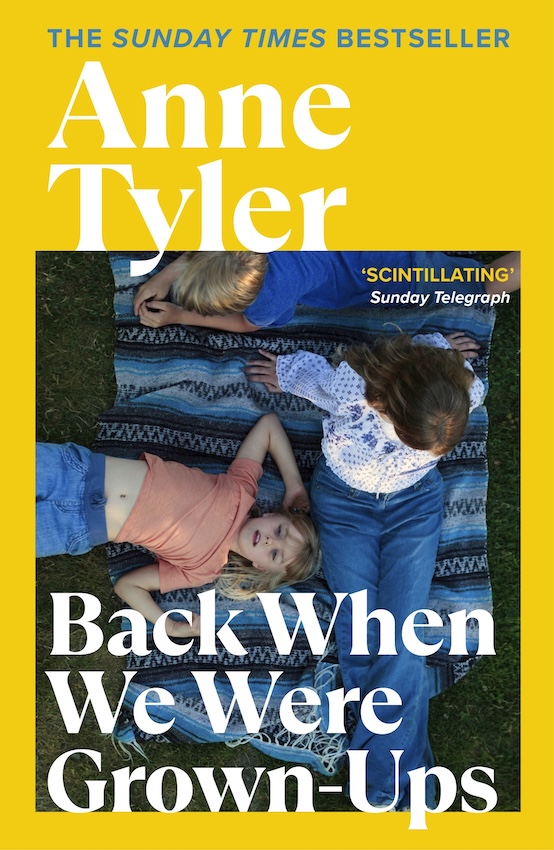
Book Review: Three Days in June by Anne Tyler – a charming novella about marriage, laced with humour and insight

If I had to choose a favourite author, (heavens, what a decision!), Anne Tyler would definitely be on my shortlist. I’ve been reading and rereading her for decades. So picking up her latest book, Three Days in June, I was instantly in my happy place, absorbed in a seemingly ordinary story about ordinary people, and which was unsurprisingly fascinating.

This time we’ve got Gail, who is sixty-one, an assistant school principal who’s about to lose her job. So she’s not happy about that. She leaves work in a huff and then finds her ex-husband, Max, on the doorstep with a cat from the shelter he helps out at. Max is visiting for their daughter’s wedding the following day, but can’t stay with Debbie because her fiancé Kenneth is allergic to cats. Gail isn’t happy about this sudden imposition either, and no way is she about to adopt a cat. No, thank you!

The cat soon settles in, and so does Max, and the former couple get caught up in the wedding arrangements – the wedding rehearsal, shopping for clothes and so on. But the hint of an indiscretion on Kenneth’s part has Gail worried that Debbie is making a huge mistake. She should know. The story flips back in time to the events that eventually led to Gail’s and Max’s divorce.

The clock gathered itself together with a whirring of gears and struck a series of blurry notes. Nine o’clock, I was thinking; but no, it turned out to be ten. I’d been sitting there in a sort of stupor, evidently. I stood up and hung my purse in the closet, but then outside the window I saw some movement on the other side of the curtain, some dark and ponderous shape laboring up my front walk. I tweaked the curtain aside half an inch. Max, for God’s sake. Max with a duffel bag slung over one shoulder, and a bulky square suitcase dangling from his left hand.

Anne Tyler packs a lot into this little book. We get a good deal of character development and insight into the family. There’s the usual gentle humour, which is always a plus, and the characters are wonderful. I instantly warmed to Max, also a teacher, working in a school where he doesn’t earn a lot and rents the same flat he’s lived in for years. He’s a scruffy, gentle bear of a man who doesn’t get in a flap. Early on you feel he’s a good fit for Gail, who’s a bit uptight and pernickety and not so good with people.

There’s also Debbie, a lively, determined kind of girl who doesn’t shirk from speaking her mind. There’s also Gail’s mother, who’s rather amusing in her little digs at her daughter, plus the well-to-do and at times hoity-toity in-laws. The way the different family members bounce off each other is very realistic but also delightfully entertaining.

Three Days in June is classic Anne Tyler – a lovely, warm-hearted read that charms from the first page to the last. I couldn’t help thinking it would make a nice little film, a cut above many wedding movies, that’s for sure. If you’re feeling in the mood for an uplifting read it’s well worth picking up. And check out Tyler’s backlist – she’s had a host of book award nominations, winning a Pulitzer for Breathing Lessons. Three Days in June is a four star read from me.

Book Review: The Bee Sting by Paul Murray – a riveting novel about a family in strife

This is a superbly clever book that seemed to me particularly clever in that its cleverness isn’t at first all that obvious. One thing obvious about The Bee Sting is that it is very long. I don’t often go for long books. They have to have instant readability for me to want to persevere, because of the reading time involved. But once I embarked on this story of a family going through a tough time in small-town Ireland, I just couldn’t stop, because the writing is just so lively, character-driven and, at times, funny.

The story moves between the four points of view of Cass and PJ, teenage children of Dickie and Imelda. Dickie has taken on the family business built up by his father, a car dealership that has, until the recent economic downturn, been a reliable money maker. So much so that the family are among the most well-to-do around town. But now times are tough and Dickie doesn’t know how to fix it. Instead he’s spending his days in the woods with his weird mate Victor, building a bunker in case of an apocalypse.

Dickie was always the smarter son, but less successful with people than his famous footy-playing brother Frank. Everyone remembers Frank, not just for his flair on the sports field, but because of his charm and good-looks. His sudden death a couple of decades before in a car accident only made him seem more of a hero. At the time he was all set to marry Imelda. Dickie with his lack of social finesse and looks that were nothing to write home about seemed like a consolation prize.

Over the course of the book, we discover how Imelda came to marry Dickie instead, as well as both their back stories, Imelda’s coming from a family of ne’er do wells, a violent father with criminal tendencies. Imelda is astonishingly beautiful, which is how she caught Frank’s eye. Marrying Dickie so young and having children soon after, she’s never had a job, but is a brilliant shopper. As money troubles start to bite, she’s in a permanent fury, cross with Dickie and selling off anything she can online to keep at least some money coming in.

Meanwhile Cass has reached that age when everything – her family and life in a town where everyone knows everyone’s business – has become utterly impossible. With her best friend Elaine, she’s plotting to leave as soon as she can. Trinity College in Dublin beckons, but can she keep her studies up enough to pass her A levels when Elaine hauls her off to all kinds of pubs and clubs while they should be studying?

PJ is also having a tough time. His parents aren’t there for him, Cass is eternally cross with him and he’s not socially adept either, parroting facts he’s discovered supplied by his active and curious brain. With the failing of his father’s business, all the town knows about it so school can be hard. He loses himself in violent computer games, leading him to an online friendship. But is that new friend as genuine as he pretends to be?

I hadn’t expected to care for these four characters as much as I did. But Paul Murray takes you right inside their heads, revealing their secrets. In the background we’ve got a support cast of interesting support characters, among them dodgy opportunist Big Mike, Imelda’s great aunt Rose who can see the future, and Ryszard, the handsome charmer and baddie of the story.

While the novel carries you along entertainingly enough, there is a clever plotting that takes the book to the next level. There are very long chapters that build things up, and then very short ones that ramp up the tension. There’s clever stuff with the prose too, the personalities of the main characters reflected in the style. Imelda’s point of view, for instance, is written without punctuation, perhaps an echo of her fierce and furious way of thinking and speaking. There are no quotation marks for speech either, but somehow you soon get used to it and wonder, why do we ever have them in the first place?

Then there’s the ending. I wasn’t going to mention that as I’m still thinking about it, but WOW. Enough said. I’m certainly glad to have read The Bee Sting, even if it was very long, and yes, I’ll look out for more books by Paul Murray, for the writing alone. The Bee Sting is five star read from me.