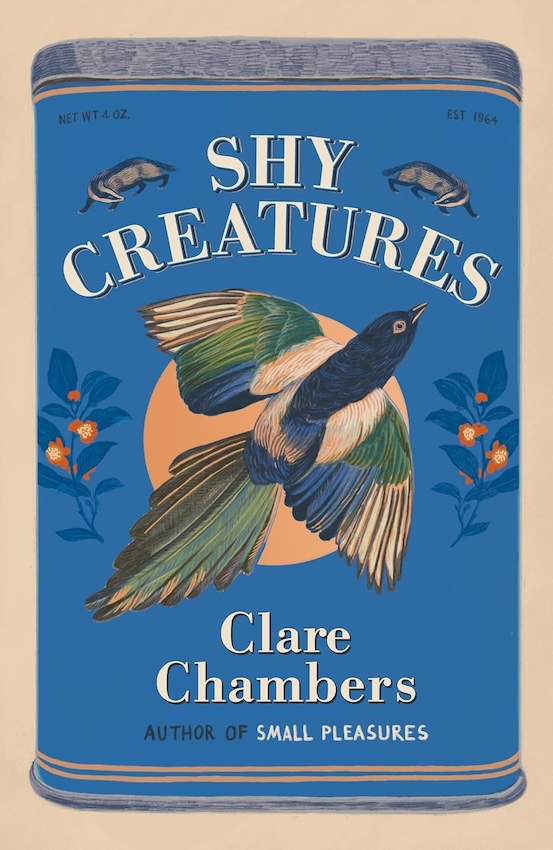
Book Review: Shy Creatures by Clare Chambers – a remarkable story, engrossing and heart-warming

I bought Shy Creatures as soon as it came out as an ebook, and unlike many previously purchased novels, it didn’t sit on my bedside table languishing while I was distracted by other books passing by. It beckoned to me and I was soon engrossed – and gosh, what a satisfying read it is.

Shy Creatures is set for the most part in 1964. Helen Hansford is an art therapist at Westbury Park, a facility for mental health patients. She has been having an affair with Gil Rudden, one of the doctors, which is complicated by his wife being a distant cousin of her mother’s. Gil has promised Helen that as soon as his children are old enough to leave home, he will divorce his wife and marry her. Helen accepts the status quo and muddles on with a less than satisfactory home life, a nagging mother, and a job where she doesn’t feel she makes a lot of difference.

For all that, Helen is passionate about her work and the way Westbury Park is run. The gates are always open, and while some therapy involves dulling the patients’s minds with drugs, doctors like Gil have more modern ideas, which is one of the reasons Helen fell for him. An incident at a nearby house leads Helen and Gil to discover a man who has been shut up indoors for at least ten years along with his only relative, a frail and elderly aunt.

William Tapping, now in his late thirties, has been found in a bad way, in a state of undress, a beard down to his stomach and apparently mute. The house is in a state of disrepair, filthy windows letting in no light, the garden a jungle. When social services intervene, William and his aunt are whisked away to Westbury Park. Here Aunt Louisa implores Helen to find a container hidden in the flour bin that no one else should see, but while she’s at the house, Helen also discovers some drawings in William’s room that display the work of a talented artist.

At the discovery of this cache, Helen’s pulse quickened and she felt a tingle of excitement. No one who had passed through the art therapy room during her residency had shown anything approaching this level of talent. Of all the professionals at Westbury Park, she was uniquely placed to help this hidden man emerge from his place of silence. Even Gil did not have her advantage.

The story follows Helen’s efforts to make a connection with William through art as well as her tracking down some old acquaintances – people he knew at school – in an attempt to find out more about him. We have the ups and downs of Helen’s relationships with Gil, as well as her family, particularly with a teenage niece who has a kind of breakdown. Woven into all of this is William’s story, going back steadily in time until we get to the day when his life changed dramatically, putting in place the kind of house arrest his family imposed on him.

It’s a fascinating story with Clare Chambers’s usual wit and brilliantly evoked characterisation – one of the things that puts her books on my must-read list. And it’s a sad story too, as we consider William’s wasted years. The author recreates the era of the sixties – the music and clothes as well as social attitudes to women, to the mentally frail. The limited choices for girls once they leave school – particularly if they want to please their mothers. We also have the war years, and the privations of rationing, the nightly fear of air raids.

If there’s a theme that often appears in books by this Clare Chambers, it is about finding a place in society when you’re not a natural fit. Many of her characters are on the quirky side and with William, we have someone who quite possibly never will find a suitable niche in the world – particularly a world like Britain in 1964. This, plus Helen’s relationship woes pulls you through the story, along with the eventual revelation of a terrible secret. It’s another brilliant read from Clare Chambers – I can’t recommend it enough – a five-star read from me.

Book Review: 33 Place Brugman by Alice Austin – an engrossing read set in WWII Brussells

Some stories are so much about the setting that it is like a main character. This is the case for 33 Place Brugman, an apartment building in Brussels whose residents are adjusting to life during World War II. As we know, German forces invaded Belgium in 1940 and began an occupation that would last another four years. In this novel, we are treated to a glimpse of normal life before that, and how that changed with the Occupation. The fear and the pressure to conform, to dob people in or risk your life, or else to take courage and resist – to say nothing of food shortages and loss of work.

On the fourth floor of Number 33 are two families: Francois Sauvin, an architect and his daughter Charlotte, and their neighbours the Raphaëls. Leo Raphaël is an art dealer who lives with his wife Sophia, and their children, Esther and Julian. Losing his wife in childbirth, has left Francois to raise his daughter alone, but he’s been lucky to have support from the Raphaëls, particularly Sophia, who has her nanny help out with Charlotte’s care so that Francois can work and sleep.

The children all grow up together, and the two families dine together regularly. So when the Raphaëls disappear one night, without word to anybody, it’s a bolt from the blue. They are a Jewish family, and with stories about Nazi atrocities and the likelihood of another war, the Raphaëls have been lucky to get out when they could.

The Raphaëls leave in the middle of the night, and they leave everything behind.
The sofas and chairs and beds and lamps and heavy carpets and the dining table. The films we made are in a box together with the projector, a set of oil paints, and a blank canvas. On it is a note that reads, For Charlotte. I gasp, the air coming in tight and sharp. I might have thought I was dreaming, but for that note. When I see it, I know the Raphaëls are truly gone.
In their wake, rumours swirl through the building. The Raphaëls haven’t left everything. They took their silver. And the paintings? The paintings simply disappear.

The novel follows the first years of the war and how it affects both the Raphaëls and those that remain at Number 33 – not just Francois and Charlotte, but also Masha, the Russian emigré who lives in the attic, making a living as a seamstress. There’s an elderly widowed Colonel with his dog Zipper, and nosy and unlikeable Miss Hobert – both live below the Sauvins. Next floor down are the DeBaerres whose son Dirk is an old school friend of Julian’s. Each has a part to play in the story as each has to examine their conscience and decide what is the right thing to do.

And this is what the story is so good at. It throws unheard of challenges at its characters, who are complex enough for their decisions to be difficult ones. To keep in the good books of your oppressor, to look out for your neighbour, or to fight back? How to feed your family and to keep them safe.

The novel is also a love story. Firstly, there’s Charlotte, who meets Philippe at art school, where she’s talented and able to see the world in a different way, being quite colourblind. But then there’s Julian, who has always loved Charlotte, which worries his mother. The story also brings in the work of the French Resistance in Paris, through the nefarious Harry, a friend of the Colonel, as well as the war in the air, with Julian signing up for the RAF. This gives the novel plenty of strands, and adds some excitement to balance out the quietly tense periods of the plot, as pressure slowly builds.

For me, 33 Place Brugman was an engaging novel and I was soon swept up in the lives of Charlotte, Julian and their families. It’s quite nail-biting at times, when the reader knows more about the danger around the corner than the characters. The story is also threaded with philosophy, particularly that of Wittgenstein, who is discussed quite a lot – but not knowing a lot about him, I found these references somewhat beguiling. The writing is beautiful though; the characters come to life on the page, as do the settings.

I would have loved to learn what happens to the characters by the end of the war, as the story finishes even before D-Day. An epilogue, maybe? But overall I really enjoyed this original view of the war, and its splendidly evoked setting – so it’s four-stars from me. 33 Place Brugman is to be published on 11 March, 2025 . This advance copy was provided by Netgalley in return for an honest review.

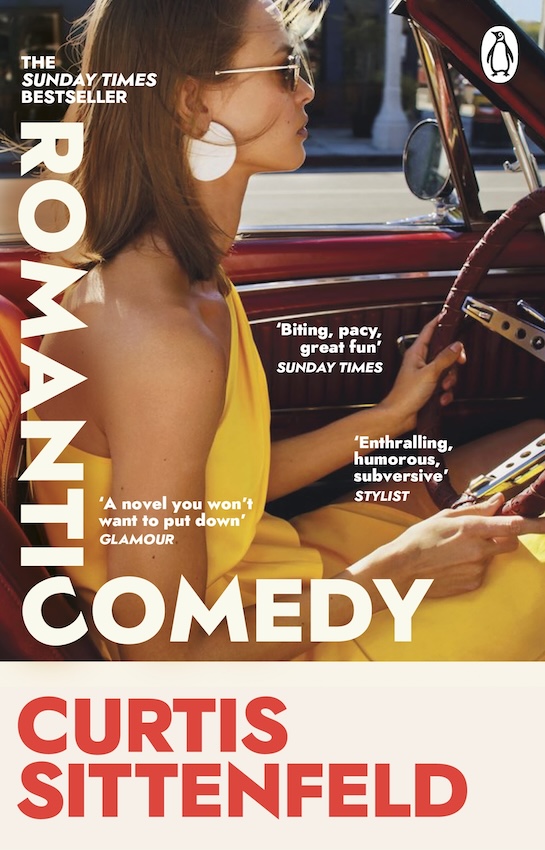
Book Review: Romantic Comedy by Curtis Sittenfeld – a warm and witty novel that explores the affairs of the heart

I loved Eligible, Curtis Sittenfeld’s modern interpretation of Pride and Prejudice, written for The Austen Project and published in 2016. It was smart, funny and romantic, and a very clever update. So I was expecting a similar vibe with Romantic Comedy, a novel about a sketch writer for a late night TV show and an unexpected romance.

Sally Milz has been writing comedy sketches for The Night Owls for almost ten years and has seen a lot of talent come and go. When fellow writer Danny starts dating Annabel, a beautiful actress who is also super talented and bright, Sally is peeved. Why is it that fairly ordinary guys like Danny can date and even plan a future with women who are way out of their league, when it never happens the other way around? There have been several Danny/Annabel type matches at the studio alone but you never see an ordinary-looking woman, or even a mildly pretty one, catching the eye of handsome star in his prime.

The arrival of Noah Brewster, a hugely successful and drop-dead gorgeous music star, as a guest host on the show gives Sally the perfect opportunity for a sketch to highlight this anomaly. The Danny Horst Rule would star Noah as the gorgeous guy who tries to date an average girl. Sally gets more of her skits voted in for the show that week, and so gets to spend more time with Noah at rehearsals. She finds him surprisingly nice, and what’s more, he apparently likes her. He’s easy to talk to and seems to seek her out.

The story follows their interactions and Sally’s growing attraction to Noah, a relationship that she discounts, because there’s no way a guy like that would ever think of her romantically, is there? We meet other people on The Night Owls, particularly fellow actors like Viv and Henrietta, who are Sally’s friends and sounding boards, whose advice is sometimes helpful, and often hilarious. Viv herself has met an eye doctor she’s attracted to so there’s advice going both ways. And we get a bit of Sally’s backstory – a failed marriage, the colleague who broke her heart.

Working on The Night Owls, Sally works excruciatingly long days, and nights, taking naps in her office, but then she’s a perfectionist and gives her work her all. She has decided never again to date a colleague, and has no time for more than an occasional night spent with someone she doesn’t care about. When Noah upsets the applecart of her carefully managed feelings, she doesn’t know what to do.

I heard someone say my name, but at first I was so deeply asleep that I incorporated the voice into my dream. I thought it was Bernard, the janitor, coming to empty my trash can, and, seamlessly, I mumbled, “You can leave the molluscs.” I felt a hand lightly pat my shoulder, and the person said, “Sally, I’m really sorry to bother you” – not a commonly uttered phrase at TNO – and I pulled the T-shrit off my eyes and the earplugs from my ears, sat straight up, and said, “What do you want?”
Hunched over the couch at such an angle that my sitting up had brought our faces within a few inches of each other was Noah Brewster.

This was a fun read for the most part. I found the look behind the scenes of a television show fascinating and Sittenfeld peoples it with plenty of interesting characters and scenarios. Danny’s and Annabel’s relationship has its ups and downs and so there’s plenty going on. There are ups and downs for Sally and Noah too, and a lot of the story has the reader wondering: will they or won’t they? There’s Covid and the lock-downs, long-distance communication and a lot of soul searching. So while this is in many ways a romantic comedy, it’s also at times a serious look at love and life.

Curtis Sittenfeld has written a smart, thoughtful and very romantic novel which has moments of laugh-out-loud humour. My only quibble is that Sally can be difficult company at times, with a tendency to shoot herself in the foot to make a point. Sometimes I wanted to give her a good telling off. So while I didn’t enjoy Romantic Comedy quite as much as Eligible, it’s still entertaining and clever – and a three-and-a-half-star read from me.

Book Review: Back Trouble by Clare Chambers – an oldie but a goodie from a favourite author

If you enjoyed Clare Chambers’s last book, Small Pleasures, as much as I did, you’ll be pleased to know her new book, Shy Creatures, is out soon. I’ve always loved this author’s particular way with empathy and humour, so when I found an earlier book by Chambers at a second-hand bookshop, I was delighted, in spite of having read it years before.

Back Trouble, first published in 1994, is about Philip, who is about to turn forty, and his life for the most part seems to have gone to custard. We first catch up with him at an awkward family New Year’s celebration. His insurance broker brother Raymond is over from Canada with a new batch of photos of his children, recounting their successes (the football and the gymnastics), while Philip has never felt less like celebrating. With the failure of his publishing company he is in debt up to his eyeballs and the love of his life having gone home to New Zealand, life couldn’t get any worse, could it?

A cold chip from an overflowing municipal bin sends Philip head over tail and the ensuing back injury leaves him bedridden. There’s nothing to do but to fish out the notebook and pens from under his bed and begin to write the story of his childhood – a New Year’s challenge flung out by Raymond, to be completed in three months – just a thousand words a day – no probs. We are reminded that this is the 1990s and the Internet is in its infancy, although probably a more modern-day Philip wouldn’t be diverted by technology as he’d be out of data anyway – he’s that strapped for cash.

The kitchen was the first room to be tackled. One of the men from the building site had given Dad and industrial-sized drum of bottle green paint from the batch which his brother, who worked for the Council, had been using to paint the park railings. Cost was Dad’s only criterion in selecting materials. This meant garish rolls of wallpaper from the bargain bucket outside the DIY shop, the top six inches of every roll faded by the sun, and brushes which moulted into the paint. He had an idiosyncratic way of decorating. Being both nervous and impatient he didn’t believe in preparing surfaces, always fearing that something terrible might be lurking beneath a layer of bubbly paper or flaking paint. So instead of stripping paintwork, or even washing it, he would set straight to work, brushing gloss over old gloss, dust, mould and even, in one instance, a dead spider which lay preserved like a Pompeian relic in its shell of green paint.

Philip is such a self-deprecating narrator – he has no illusions about where he’s at as he approaches forty – and his story is warmly humorous as it rattles along to a nicely surprising ending. There are some poignant moments too, particularly in Philip’s childhood, with adults not behaving as they ought to and the weight of knowledge that falls on a young boy growing up. It is easy to blame Philip’s careless yet penny-pinching father, but other adults also turn out to be unreliable or even predatory.

Odd allusions to Great Expectations add an interesting twist. There are a raft of curious characters, quirky, helpful or otherwise, which may be another nod to Dickens, particularly the scene at Philip’s grandmother’s house – the blind matriarch and hoarder of useless furniture, including four unplayable pianos, terrifying in her fierceness; the black-toothed Auntie Florrie smoking her woodbines; Punnet the obese black labrador. It’s like stepping back in time.

For a small book, Clare Chambers packs quite a lot in and it’s hugely entertaining. I know she can always be relied upon for an original and big-hearted read so I am so looking forward to Shy Creatures, released on Amazon at the end of the month. Back Trouble is a four-star read from me.

Book Review: Rules of Civility by Amor Towles – a story of love, friendship and making the right connections in 1930s New York

If I had a list of authors who can make a laundry list sound interesting, Amor Towles would surely be near the top of it. (If anyone has already curated a list like that, I’d love to see it – just saying.) Rules of Civility is Towles’s first novel and the writing is just as good as the later books that have made his name: A Gentleman in Moscow and The Lincoln Highway. There’s the same nuanced prose, the characters that seem to breathe on the page, the originality of the storyline.

In this novel we’re in New York City, mostly over a year that begins on New Year’s Eve 1937. Twenty-somethings Katherine Kontent and her roommate, Eve Ross, are out to celebrate, finding themselves in a lacklustre nightclub, where complicated jazz solos make it kind of interesting. Here they stumble upon Tinker Grey, a slightly older, impeccably dressed and very handsome young man.

The three strike up a friendship that pulls them all in different directions. Both girls are drawn to Tinker, but he’s just so enigmatic, it’s hard to tell if either can win his heart. In the meantime they just hang out together, enjoying the vibe they create as a small group of friends. An accident pushes a guilt-ridden Tinker towards Eve, and Katherine shrugs off her disappointment and gets on with life.

It is Katherine’s voice who narrates the story and we follow her progress from a typing pool, to a publishing house and then the competitive world of a society magazine. She’s sharp, witty and hard working, but then she needs to be – she’s rubbing shoulders with an Ivy League-educated elite, while she herself is from fairly humble beginnings. Everything she has she’s had to earn herself. In the background Tinker and Eve waft in and out of her life, while other relationships come and go.

The book is peopled with lively, colourful New Yorkers – the drinking buddies Katherine makes through the girls she works with; well-heeled and influential friends and acquaintances of Tinker’s; the raw, working class guys who hang out with Tinker’s artist brother. Katherine has a gift for fitting in and adding to whichever group she meets and in this way is the perfect narrator.

In front of the boardinghouse Tinker was standing beside a Mercedes coupé as silver as mercury. If all the girls at Mrs. Martingale’s saved a year’s pay, we couldn’t have afforded one.
Fran Pacelli, the five-foot-nine City College dropout from North Jersey who lived down the hall, whistled like a hard hat appreciating the hem of a skirt. Eve and I went down the steps.
Tinker was obviously in a good mood. He gave Eve a kiss on the cheek and a You look terrific. When he turned to me, he smiled and gave my hand a squeeze. He didn’t offer me the kiss or the compliment, but Eve was watching and she could tell that she was the one who’d been short-changed.

A lot happens in just one year, and you can’t help thinking that for many in 1938, times were tough. But not among the glittering social set of New York. The story builds to some surprising revelations, particularly about Tinker but also about others who pass through Katherine’s orbit, the main action of the story bookended by her visit to a photographic exhibition decades later and a kind of catch-up with what has happened in the meantime.

It all makes for a satisfying read: the brilliantly rendered view of 1930s New York, the story of a woman determined to make her own way, the glorious writing. Rules of Civility is just as good as the other books by Amor Towles, and I look forward to his collection of short stories, Table for Two, as well as whatever else he’s got in the pipeline. I know they’ll all be five-star reads, just like this one.

Book Review: The Library by Bella Osborne – a feel-good read about an unlikely friendship and a library in trouble

A public library can be one of those places that offer a respite from the anxieties of everyday life. And while they’re not the silently bookish places they used to be, hosting community groups, classes and story times, they can still be a place of refuge in a way a shopping mall just isn’t. Bella Osborne has taken this idea to create a story around two lonely people and a friendship that develops at the library.

Maggie is seventy-two, a widow who runs a small holding on the outskirts of town. It’s a lonely life but she fills it with her love for her livestock, yoga and books. Her membership of a book group that meets every Saturday is the highlight of her week. Sixteen-year-old Tom is struggling to keep everything together at home where he lives with an alcoholic father. It’s a battle to make ends meet, and his dad wants him to give up school to join him at the factory – they could use the extra wages. But Tom has his sights on a better life, and Farah, a cute girl, if only she’d look his way.

Tom has as an odd idea that Farah uses the library and visits on the pretext of choosing some romance books for his mother. Soon he’s lugging home a pile of books he has no intention of reading. Maggie gets mugged outside the library on her way to her bus-stop and Tom helps her to her feet. Over time an unlikely friendship forms and Tom discovers the wonders of reading, farm life and finally has someone supportive in his life. Maggie has a glimpse of what having a family of her own might have looked like and feels less alone.

They sat side by side on the cool metal seats and waited for the bus. ‘I think this week’s book club read will be more up my street.’
He was looking about. He seemed to have lost interest in her. She got the book out anyway and showed it to him.
The Fault in Our Stars.’ He nodded. ‘You might like it,’ she said. He nodded again before realising his mistake.
‘Nah. Doubt it.’ Tom looked away.
‘It’s okay, Tom. The others don’t know and I won’t be telling them.’
‘Know what?’ He pulled his shoulders back and stared her down.
‘That it’s you reading the books and not your mum.’
His shoulders sagged with every word, until he was back to his rounded-shoulder posture. ‘How’d you know?’
‘The way you read the blurbs before choosing the books. The conversation about Me Before You.’ She gave a shrug. ‘I’m a bit like a dog with a bone when something doesn’t add up.’
He turned to look up the road for the bus, as if willing it to arrive, but there was ages yet. ‘Well done, Miss Marple.’

When the town council announces plans to shut their library down, Maggie reignites the feisty young woman she was in the sixties, demonstrating at marches, holding placards and making a nuisance of herself. She ropes in young Tom and her book club pals, but it’s an uphill battle when the library door-count has probably been dropping for decades. But as the Joni Mitchell song goes: “you don’t know what you’ve got till it’s gone” and a library is more than just books, it can be the heart of a community.

You can guess how the story will pan out, but there are a few surprises along the way. Maggie is hiding a secret, and so is Tom’s dad. Meanwhile Tom’s issues with his father add complexity as he faces extra pressure when he needs to focus on study if he has any hope of university. But it’s the humour in the odd little mishaps and misunderstandings that makes this a fun read. Maggie and Tom’s friendship is not always plain sailing so there’s some tension there too. Plus, there are puppies.

The Library is a light but engaging read, and anyone who has a fondness for libraries will relate to the characters and their campaign. There’s plenty of book talk too, especially when Tom, with nothing better to do, discovers that romantic fiction is a whole lot better than he expected. This is a warm, feel-good sort of story, cheering and heartfelt and a four-star read from me.

Book Review: The Librarianist by Patrick DeWitt – a quirky and heartfelt novel with a memorably unmemorable main character

Working in a library, of course I was drawn to this book, with its cover showing an old-fashioned library book date-slip. But what the heck is a librarianist? How did that one slip past me, of all people? I just had to find out.

Bob Comet is the librarianist of the title, an everyman kind of character who has always lived for books. Maybe that’s what librarianist means. He is described as “not unhappy” and seventy-one years of age, a solitary man who fills his days with simple pleasures, such as reading, cooking, and walking.

We catch up with Bob in 2005 when he rescues an elderly woman he bumps into at a 7-Eleven, where he’s gone for coffee. The young cashier doesn’t know what to do with her; she’s been staring at the chilled drinks fridge for getting on for an hour. Bob reads a label attached to her clothing and discovers her name is Chip. He manages to get her home to a care facility and before you know it he’s a volunteer, expanding his world and getting to know the residents.

A coincidence at the care facility occurs that shocks Bob and propels the story back to Bob’s youth. We’re back in the 1940s and 50s when Bob’s love of books begins. You get the impression that it is books that rescue Bob from the reality of the hurly-burly of school, his life at home with a mother that doesn’t understand him, and his general aloneness. He becomes a librarian, and takes on his mother’s house when she dies. You imagine a quiet, solitary, bookish life for Bob, and he does too. And then he meets Connie.

The book describes his relationship with Connie, similarly a person who doesn’t fit in but for quite different reasons. There’s also his sudden friendship with Ethan, who turns up at the library carpark one day, too afraid to go back to his apartment across the road, and the angry policeman inside it. Bob’s life has suddenly a friend and some romance in it – until suddenly it doesn’t.

Why read at all? Why does anyone do it in the first place? Why do I? There is the element of escape, which is real enough—that’s a real-enough comfort. But also we read as a way to come to grips with the randomness of our being alive. To read a book by an observant, sympathetic mind is to see the human landscape in all its odd detail, and the reader says to him or herself, Yes, that’s how it is, only I didn’t know it to describe it. There’s a fraternity achieved, then: we are not alone. Sometimes an author’s voice is familiar to us from the first page, first paragraph, even if the author lived in another country, in another century.” Bob held up his stack of Russians. “How can you account for this familiarity? I do believe that, at our best, there is a link connecting us.

But before we catch up with Bob in 2006 again, where the story left off, there’s an odd chunk of the novel that takes us back to 1945 and an eleven-year-old Bob running away from home. Where he gets to and the people he meets makes for an entertaining enough interlude, full of memorable characters, but I couldn’t help asking myself what it was all about. I couldn’t help wondering why it didn’t seem to have an impact on the Bob we meet later, who returns home eventually, remarkably unchanged. Years later, however, he sometimes wistfully dreams about the seaside hotel that took him in for four days..

The Librarianist might not follow the usual rules for novel plotting in some ways, and the ending is perhaps a little odd, too. But it’s a diverting read, and you can’t help getting to like Bob and the people we meet as seen through his eyes. Patrick DeWitt’s prose is delightful, witty, wry and perceptive, bringing Bob and his times to life.

The novel reminded me a little of some of Anne Tyler’s earlier fiction with its characters that don’t fit in, and the events that pull them out of their lethargy or solitary habits. I’ve always got time for a novel like this, particularly if it’s as nicely written as this one. I’ll pick up another DeWitt novel sometime, I’m sure. The Librarianist is a four-star read from me.

Book Review: Gilead by Marilynne Robinson – a love letter from a father to his son and a wonderful contemplation on life itself

In Gilead, John Ames is writing a memoir for his son, a small boy of seven, intended for him to read later, long after his father has gone. Ames, well into his seventies, has a weak heart and fears leaving his boy to grow up without a father. So he wants to write it all down – from his own childhood and his life as the son and grandson of preachers to what’s going on around him in the present. We get bits of history – the Civil War and the Underground Railroad, World War I, the Spanish Flu, and the Great Depression, and how all these events impacted on ordinary folk in small towns like Gilead.

While he’s telling his story, Ames is irritated by the return of Jack, the black sheep son of his good friend Rev. Robert Boughton. Unlike Ames, whose first wife died in childbirth along with their daughter, Boughton has a large family, most of whom live some distance away. Jack, in spite of his chequered history, seems a favourite of his father’s, while Ames is constantly censuring himself for harbouring an ongoing dislike for the younger man, which of course isn’t very Christian of him.

Ideas about what it is to lead a good life in the way God intends us to blend with stories about the characters, their pasts and particularly their problems. Jack’s story is heart-rending, and there’s more about him in the two other Gilead novels: Home and Jack, which I will get to, I’m sure. But what is particularly moving in this book is the tone of the writing, the voice of John Ames. You get such immense love in the way Ames is writing to his son coupled with the sadness that he won’t see him grow up. But with that is also the joy of someone who notices the wonder in simple things.

There’s a shimmer on a child’s hair, in the sunlight. There are rainbow colours in it, tiny, soft beams of just the same colours you can see in the dew sometimes. They’re in the petals of flowers, and they’re on a child’s skin. Your hair is straight and dark, and your skin is very fair. I suppose you’re not prettier than most children. You’re just a nice-looking boy, a bit slight, well scrubbed and well mannered. All that is fine, but it’s your existence I love you for, mainly. Existence seems to me now the most remarkable thing that could ever be imagined. I’m about to put on imperishability. In an instant, in the twinkling of an eye.
The twinkling of an eye. That is the most wonderful expression. I’ve thought from time to time it was the best thing in life, that little incandescence you see in people when the charm of a thing strikes them, or the humor of it. ‘The light of the eyes rejoiceth the heart.’ That’s a fact.

I find myself getting teary-eyed just thinking about Gilead, and the character of John Ames, the heart-felt thoughts of a humble man. You do get quite a bit of religious contemplation, with Biblical references and ideas for sermons, which might not suit every reader. But it’s more wise than preachy and fills out the character of our storyteller. I read this as an audiobook, superbly narrated by Tim Jerome – it was as if John Ames was talking to me in the same room – but I’m glad to have a physical copy to flip through too. Gilead is a beautiful book, which won a number of awards, including a Pulitzer Prize – a modern classic and a five-star read from me.

Book Review: Absolutely and Forever by Rose Tremain – a short and bitter-sweet novel about lost love and finding your way

I was warned that this book was somewhat melancholy, and in a way it is. Absolutely and Forever is about first love, specifically Marianne Clifford’s falling in love at fifteen with handsome and clever Simon Hurst. It is a love she just can’t seem to get over, and years after Simon has disappeared from her life, she still thinks about him in a yearning kind of way.

This might make Marianne appear somewhat daft. But don’t be put off; every moment we spend with her is entertaining. Tremain has written a dryly witty, self-aware character, born at time when a good marriage was often considered life’s ultimate goal for any young woman. We’re thrown into the late 1950s; Bill Haley and the Comets is on every party’s turntable and parents are eyeing up young men with prospects for their daughters. Particularly middle class parents in the Home Counties.

Absolutely and Forever made the shortlist of the Walter Scott Prize for Historical Fiction and although it didn’t win, you can see why it was noticed. Tremain captures the period so well, and through Marianne’s eyes we see how the times, they are a changing. At school, Marianne’s best friend is brave, outspoken Petronella who goes on to university to study sociology and spends the entire book urging Marianne to forget Simon and discover what she’s good at. You can tell Marianne’s smart, but this lesson takes a while for her to master.

On certain days, particularly when I was in the typewriter room of the college and fifteen typewriters were clattering and pinging and the carriages were being shunted left to right, left to right, and the wall clock was clicking away time, measuring our typing speeds, I felt my mind disintegrating. I thought, I’m in a madhouse; life has brought me here, to an asylum of a kind. It wasn’t the old and wondrous Love Asylum, it was now the Grief Asylum, where my heart was being shunted back and forth, back and forth, inside a chamber of despair.

The story takes Marianne through many ups and downs, including tragedy, and a surprise ending. Both turn out to be oddly liberating for our MC. So, yes, there is enough of a story here to keep you reading. But it’s the language that really had me hooked. At one point, Hugo, the man who falls for Marianne enough to put up with her melancholy, says the one thing he really loves about her is that he never knows what she’s going to come out with next. Tremain gives Marrianne’s narrative plenty of charm and flavour.

You can’t help thinking, thank goodness for the Swinging Sixties and women’s lib. For if they hadn’t come along would girls still be growing up pinning all their hopes of happiness on a man and forgetting they have a brain? Absolutely and Forever is a welcome reminder, and at a mere 180 odd pages a nicely-crafted, diversion you can read in a day. A four-and-a-half star read from me.

Book Review: You Are Here by David Nicholls – a witty, feel-good read about hiking and the human heart

I’d seen a bit of David Nicholls on the small screen – the movie of One Day and the TV adaptation of Us – but You Are Here is the first time I’ve actually read a David Nicholls novel. And having just turned the last page, I realise now what I’ve been missing. Because, You Are Here is simply wonderful. The writing, the humour, the characters and the emotions. They’re all there in a perfect package – all that you could want in a book.

The story’s narration alternates between two people: Marnie, a long time single and thirty-eight, who works as a freelance editor from her rented flat in London; and Michael, a recently-separated geography teacher from York. Both are a bit sad and lonely. Marnie has been bruised by her marriage to overbearing, unfaithful Neil, and now that her friends all seem to be married, mostly with kids, she’s dropped out of the loop, doesn’t see anyone, often stays in her flat for days on end. Michael has not recovered from his wife leaving him or from an assault which left him with bouts of PTSD and feeling a coward.

So it’s up to mutual friend Cleo to fix them both up with someone, if only she can drag Marnie north for a hike – a chunk of the Coast to Coast Walk, which Michael, a committed walker, is keen to complete, preferably alone for as much as possible. Michael does a lot of walking as he hates going home. Cleo brings along her thirteen-year-old son as well as gorgeous Conrad, a pharmacist also from London, she’s hoping to set Marnie up with. A pity Tessa couldn’t make it – she loves doing triathlons so would suit Michael well with his love of the outdoors.

But he must not teach. He would be travelling with adults who had no need or desire to learn about drumlins and moraines. The train ticked and hummed, then began to crawl, rattling past sooty Victorian buildings, warehouses, and the new light industry at the edge of town, the sky widening like a cinema screen, opening on to farm and woodland. Seated diagonally across the aisle, the woman with the poorly fitted rucksack was typing noisily but without a table, so that the laptop kept slipping down her new trousers towards her new boots. What was so important that it should take precedence over the view? She was certainly making a big show of it, tutting and blowing up her fringe. It was a nice face, amused and amusing, with a city haircut (was it a ‘bob’? He wanted to call it a ‘bob’) and more make-up than you’d expect on a walker, sometimes rolling her eyes or clapping her hand to her flushed cheek at the words on the screen. He noticed that she was perspiring slightly. Noticed, too, that he’d stopped looking at the view.

But things don’t go as planned for Cleo, and it’s just as well, when soon the weather conspires to leave just Michael and Marnie on the walk, Conrad with no wet weather gear, and Cleo’s son missing his friends. Michael might have hoped Marnie would pike out too, but she’s invested so much in outdoor gear for the trip, and has packed three nice dresses and 12 pairs of knickers, so it seems absurd not to tag along for another day at least.

The two make an awkward couple at first, struggling through the rain and having hiked a number of New Zealand’s ‘great walks’ for the most part in the rain, I really felt for them. But it’s the grit that makes the pearl, and if they can get along enough, who knows what might happen. As a reader, you soon realise the two are better suited than Michael would be with Tessa or Marnie would be with Conrad – Michael is what Cleo describes as wry, and seems to get Marnie’s sense of humour, the jokes no one else seems to notice.

This is a delightful read – I steamed through it – the writing is just so polished but not in a way that makes you think it’s polished. The dialogue is lively and funny – you can tell this will make another lovely movie. But underneath, Nicholls is aware that he’s dealing with two people who have stuff to deal with. He shows a fine understanding of the workings of the human heart and while there is a lot that has you laughing out loud, there are also moments that make you sigh or clutch your chest.

As I said before, this is a perfect book, with two engaging characters you are happy to spend time with, even on a hill walk in the rain. There is a lot of scenery, which is described as much as it needs to be but not so much that it intrudes. I enjoyed the B&Bs and hotels with their themed rooms – one naming its rooms for freshwater fish (Michael finds himself in Chubb). So you get the experience of the walk without having to put on hiking boots. All in all David Nicholls doesn’t put a hiking booted-foot wrong. You Are Here is a five-star read from me.