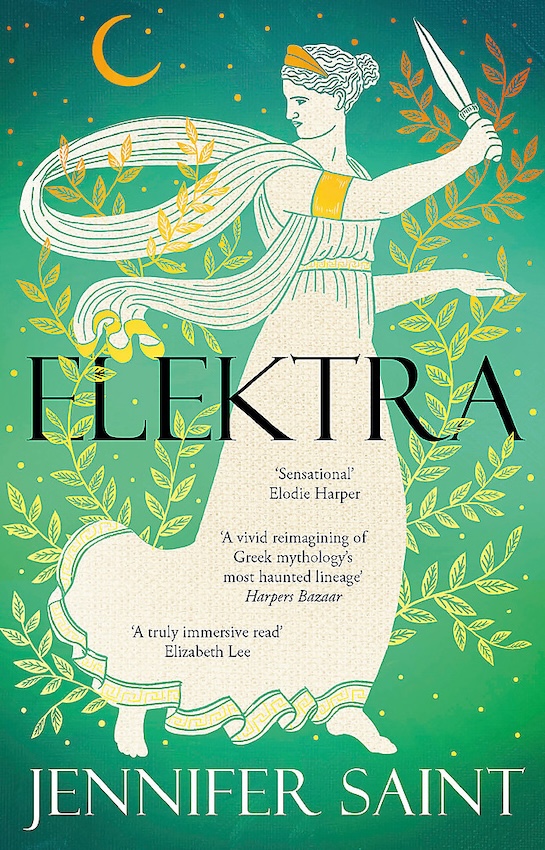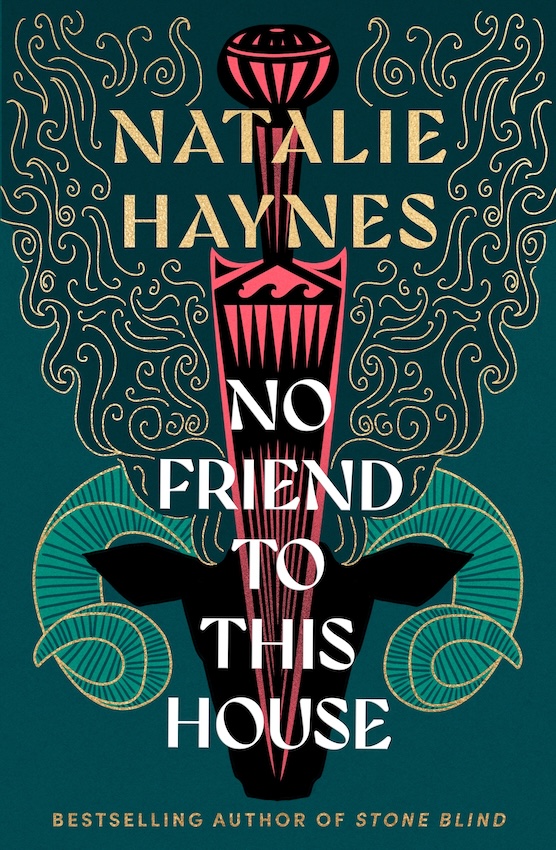
Elektra by Jennifer Saint – a retelling of the Sophocles tragedy for a modern audience

These retellings of stories from Ancient Greek classics can be oddly compelling. The latest to hit my bedside table is Jennifer Saint’s Elektra, a new version of the tragedy by Sophocles. If you haven’t met her before, the eponymous heroine is the youngest daughter of Agamemnon and Clytemnestra. You’ll remember Agamemnon as the leader of the Greek fleet that waged war on Troy – the thousand ships that sought revenge on Paris for making off with Helen – the world’s most beautiful woman, and also Agamemnon’s sister-in-law.

The story starts off with Helen choosing her husband. All the suitors have gathered at the court of her father, the king of Sparta, where she chooses the adoring Menelaus, a second son who will let her stay in Sparta to help rule her father’s kingdom. At the same choosing party is Helen’s sister Clytemnestra. She is impressed by the two brothers from the House of Atreus, particularly the powerful energy emanating from Menelaus’s brother, Agamemnon. After the marriage of Helen, the brothers set sail for the home they have lost to the uncle who’d murdered their father, and with the Spartan fleet behind them, enact vengeance.

It is this house that Clytemnestra marries into, and discovers the terrible curse on the House of Atreaus, one that just won’t leave them alone. It involves murder of innocents, fratricide and revenge – an on-going intergenerational battle for the throne. Things may have settled down after Agamemnon took back his kingdom – if only Paris hadn’t stolen Helen and spirited her away to Troy. You know how it goes.

Jennifer Saint tells the story from the point of view of three women: Clytemnestra, her daughter Elektra and Cassandra, a daughter of Trojan King Priam. Clytemnestra witnesses her husband sacrifice their eldest daughter Iphigenia so that the gods will grant him a wind to take his fleet to Troy. In her grief, she vows to kill Agamemnon on his return, but that’s another ten years away, and her grim decision takes over her life.

Elektra is a child when her father sails off to vanquish the Trojans, and misses him terribly. She is fierce, loyal and ignored by her mother. Clytemnestra’s intentions will set in motion a vengeance of her own. In Cassandra we have the story from the Trojan point of view. Badly treated by Apollo, Cassandra is cursed with a gift to predict the future, but to have her warnings disbelieved. Everyone therefore thinks she is mad – even when she predicts the fall of Troy and sees what’s hidden in the Trojan horse. Taken as a war prize by Agamemnon himself, her story will connect with that of Clytemnestra.

It surprises me just how readable and compelling this novel is given the content. Jennifer Saint does a brilliant job of envisaging the war, the plotting and scheming, the cruel indifference of the gods. One terrible deed just seems to lead to the next, and the characters have few redeeming features. So much bitterness and fury. All three women are trying to make a stand in some way, to determine their future, to make changes – difficult in a world run by power-hungry men and unreliable gods. Humming in the background is the question: if we leave one evil deed unpunished, do we not show contempt for the victim, for human kind and also for the gods?

The ending is brutal, but allows for a small glimmer of hope that the curse has finally come to an end – but who knows? Perhaps that’s another story. Elektra is another excellent addition to the genre, well-researched, intense and atmospheric. A terrific read for anyone who wants to immerse themselves in classical legends – four-stars from me.

Book Review: Stone Blind by Natalie Haynes – an imaginative recreation of the Greek myth of Medusa

Since Madeline Miller’s Song of Achilles, it seems there’s been a growing number of authors turning to classical mythology for inspiration. And it’s no wonder, because the stories of the Ancient Greeks and others are just so engaging.

A cluster have concentrated on the battle of Troy and Odysseus’s subsequent wanderings, while here we have Natalie Haynes’s narrative around the famously hated Gorgon, Medusa. She deserved to have her head cut off, right, turning all those mortals to stone with a single glance? In slaying her, Perseus was a great hero, wasn’t he?

Maybe not. Stone Blind takes us back to Medusa’s birth and her arrival on a rocky shore to be cared for by her Gorgon sisters, Sthenno and Euryale. These two are tusked creatures with snakes for hair, powerful claws and wings that make them swift in the air after their prey. But Medusa is a mortal baby they need to learn how to care for. She has a human form apart from tiny wings and can’t chew carcasses and crunch bones. The sisters keep sheep to feed the baby milk, and learn to make bread.

The three make a loving family, and Medusa grows into a beautiful girl, who attracts the interest of Poseidon, god of the sea. Meanwhile, in another kingdom, a beautiful princess is kept in a dungeon by her father. It is told that Danae will bear a son who will kill King Acrisius, so the king isn’t taking any chances. But what can he do against Zeus, king of the Olympian gods, who breaks into Danae’s cell as a shower of gold. The offspring of this encounter will be Perseus, and how he survives to fulfil his destiny is an interesting strand to this story.

And in the kingdom of Ethiopia there’s the story of Andromeda, another beautiful princess, but without a brother to take over her father’s kingdom is doomed to marry her uncle to secure the royal line. These poor women are pawns in the hands of powerful men; while around humankind and their struggles are the constant machinations of the gods. They’re either like Poseidon and Zeus, raping pretty girls, or they’re bored youngsters like Athene, causing trouble, or perpetually angry like Zeus’s wife Hera, exacting revenge for every slight.

The snakes were patient at first, because they knew no other life. But they longed for heat and light. The cave bored them and they wouldn’t pretend otherwise. They belonged to Medusa and she belonged to them, and they sighed and seethed until she accepted that she could not hide away from the light they craved.

The likelihood of a happy ending for anyone with beauty or an enviable talent seems slim in this world. The ancient Greeks must have suffered many a natural disaster to have come up with such a collection of angry and self-serving gods seeking retribution in so many convoluted ways. And yet they are devoted to them, building elegant temples and beautiful statues, making sacrifices to ward off disaster.

And is a monster always evil? Is there ever such a thing as a good monster? Because what happens when a good person becomes a monster?

Natalie Haynes brings this interplay between gods and mortals beautifully to life, weaving in all the different strands that interconnect the stories. She makes use of the classical Greek chorus which creates some interesting narrative voices: Panopeia the sea nymphs; Elaia, the olive trees; even Herpeta, Medusa’s snakes. There are a lot of plot strands to keep track of and quick switches between them, so the reader has to keep their wits about them. Fortunately, there’s a list of characters at the beginning which I referred to many a time.

The story is an old one, but in Stone Blind it’s very fresh with some deeper meditations on what makes a hero and what makes a monster. I embarked on the novel wondering how I would feel about the character of Medusa, thinking it would be difficult to follow an anti-hero’s journey to her messy end. But Haynes handles it well, creating empathy, and the story never flags. I’m glad I picked this one up and am keen to read more mythological retellings, and more by Haynes. Stone Blind was long-listed for this year’s Women’s Prize for Fiction and gets four stars from me.