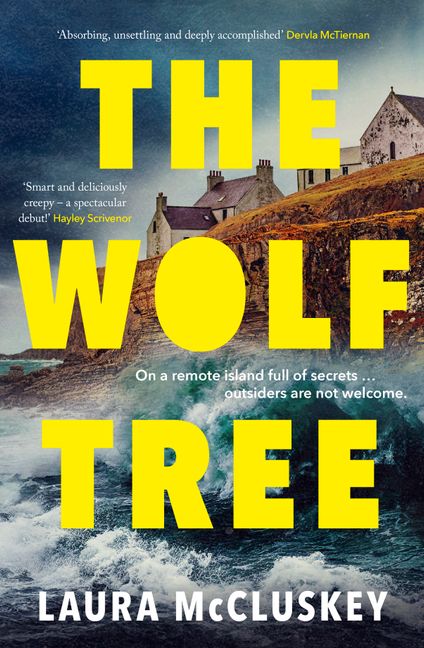
Book Review: The Wolf Tree by Laura McCluskey – a did he fall or was he pushed, Scottish Noir mystery

An island can provide just as much of a locked-room mystery as one in any building, particularly when it’s a remote island like Eilean Eadar, a wild and isolated spot off the West Coast of Scotland. In The Wolf Tree, we are in the shoes of DI Georgina (George) Lennox, who is just getting back to work after an attack that left her badly injured. This new case is supposed to be a box-ticking exercise, and she’s here along with her partner DI Richie Stewart to sign off on a probable suicide – a case to ease George back to work gently.

Of course, the reader knows that isn’t going to happen and things look problematic from the start. Even the boat crossing is wild and treacherous, the weather when they arrive, wet and freezing, the accommodation inconveniently at some distance from the little township. The two cops settle in, George doing her best to disguise from her older colleague and mentor her dependency on painkillers. The island has had to manage without a police presence, without a doctor, a school or social services of any kind for so long, so it isn’t surprising that the locals have learned to manage everything themselves. So they’re understandably reluctant to accept the interference of two cops from Glasgow.

Then there’s the case. Young Alan Ferguson, eighteen and busy applying for places at universities, had supposedly flung himself off the top of the island’s lighthouse. Alan was handsome and amiable, the only child of a widow, but she puts up a wall of animosity when George and Richie show up to ask questions. Hot on their tails, the priest arrives – a hearty, gregarious man, keen to help oil the wheels of the interview. The islanders, like Alan’s mother, are hostile towards mainlanders. It’s only the priest and the postmistress who are welcoming, or is that just nosiness?

Wariness towards incomers goes way back – the islanders had seen off the Protestant Reformation which turned the other western isles and much of Scotland. But Eadar is still staunchly Catholic. Or is it? What is the strange design that adorns the lintels of many of the houses, and why is George warned not to go anywhere near the woods. Pagan beliefs, mythology and superstition seem to hover on the fringes of everyday life. Then there’s the sound of howling wolves that disturbs George at night in a place where surely no wolves exist.

At twenty-eight, George is young to be a Detective Inspector, so it’s easy to imagine in her a tenacity her partner, eager to get back home with his family, seems to lack. It’s this tenacity that sees George asking awkward questions that Richie has to smooth over to avoid unpleasant confrontations. What will she have to do to earn the locals trust enough to talk to her? And what of the three lighthouse keepers who disappeared a hundred years ago? Can this mystery possibly have a connection to the death of Alan Ferguson?

It’s hard to determine which is more hostile and dangerous, the weather on Eadar or the people who live there. By the time we get to the end of the book, there are some stunning revelations and some spookily atmospheric scenes. George, in spite of terrible headaches, manages to think on her feet and probe the truth out of people in a case that will shock the whole community and mainlanders alike. She upsets Richie again and again with her disregard for her personal safety, and this looks unlikely to change anytime soon.

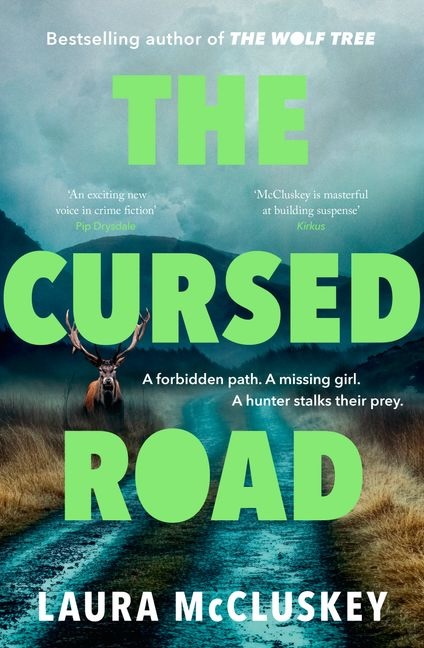
A first of a series, The Wolf Tree is a suspenseful and entertaining read, promising more tricky investigations for our two very different DIs. The Cursed Road is due for publication early next year. I particularly enjoyed the audiobook version of The Wolf Tree, which was read by Kirsty Cox. It’s a four-star read from me.

Book Review: Still Life by Val McDermid – a layered cold case mystery with lots to keep you interested

I’d long known Val McDermid to be one of the top Scottish crime writers, ever since Wire in the Blood showed on our TV screens in the 2000s. While I enjoyed the characters, I’d never really taken to the books as I’m not such a fan of plots about serial killers. But the stories were always complex and the characters engaging. Then I came upon Still Life, a mystery in the Karen Pirie series.

Karen is a DCI from Fife working in a Historic Cases unit. When a body is found by fishermen in the Firth of Forth, Karen is called to investigate due to the dead man’s connection to a politically sensitive missing person’s case she’d had a hand in years before. Karen is a little reluctant as the local police have just started their investigations but is given no choice by her snooty boss “the Dog Biscuit” with Sergeant Daisy Mortimer as her back-up. Daisy is with the original team and with her French degree will be particularly useful when their case takes them to Paris..

This is an engrossing mystery not least because of the interesting characters. Victim James Auld had absconded when the police began to finger him for his brother’s presumed death, although the body of Ian Auld was never found. Ian was a high-level civil servant in the Scotland Office when he disappeared.

There’s a connection to art theft and a well-known Scottish artist who painted unique collage styled portraits of the rich and powerful, lost to suicide around a decade before. And throw in the fact that James had a seven-year stint in the Foreign Legion, and was a talented jazz musician and you start to feel a real interest in the victim. So many strands to investigate and very few clues.

‘He couldn’t have fallen and hit his head on the way in? There’s plenty of rocks along that part of the Fife coast.’
‘The injury’s too regular for that. If you pressed me, I’d be inclined towards a baseball bat or a steel pipe.’
‘So, homicide.’
The professor gave a sharp sigh. ‘You know it’s not my job to make that judgement.’
‘I wasn’t asking, Jenny.’ He softened his words with a bashful smile, then turned to DS Mortimer. ‘The passport?’
She spotted the evidence bags on the side counter and picked up the two relevant ones. ‘It’s a French passport. Issued just over two years ago to a Paul Allard. Like the prof said, he’s forty-nine. His driving licence was issued in Paris at the same time – ‘
‘What? Exactly the same time?’
‘Same date. That’s weird, isn’t it? I mean, nobody has a passport and a driving licence issued on the same date, do they?’

Meanwhile Karen’s Historic Cases sidekick, Jason Murray (the Mint), is left carrying on with the case of a three-year-old body found in a camper van parked in a garage. And if that’s not enough to keep the story humming along, Karen is also upset when the man who killed the love of her life is released from prison. A woman of strong emotions and fierce actions, her grief bubbles to the surface again, threatening to overwhelm a promising new relationship.

But in the end, it’s Karen’s intelligence that shines through. She’s an impressive tactician, works hard and is brilliant in the interview room. The story allows Jason and Daisy to show their strengths too in very different ways, with Daisy a new recruit for more in the series.

If you enjoy character-driven police procedurals, this is a great read with lively prose full of Scottish vernacular. This didn’t hamper my understanding of what was going on, but added an appealing touch of local colour. I broke my rule about reading a series in order – Still Life is number six in the Karen Pirie series – but it didn’t seem to matter; it worked fine as a standalone novel. I’ll be checking in with Karen again and definitely trying some other Val McDermid mysteries. She’s definitely reliable for a satisfying read. Still Life earns a comfortable four stars..

Book Review: The Life Cycle of the Common Octopus by Emma Knight – an perceptive coming-of-age novel set in Edinburgh

I had no idea what to expect from this novel. Neither the title nor the cover gives a lot away, but I was soon caught up in the story of a young girl embarking on student life in Edinburgh. Pen and bestie Alice are from Toronto, and although neither wish to cramp the other’s style, they are there for each other as each explores opportunities as first year students together. They become friends with Jo, whose family have a country house they can decamp to, and whose brother, Fergus is soon attracted to Pen. All three girls, particularly Alice, are gorgeous in their own way.

Alice wants student life to be about experiences as much as study. She’s also hoping to land a role in a play and then, if that goes well, a part in an Edinburgh Festival production. She’s larger than life, a bit of a party animal and open to a dalliance with a lecturer – just another box to tick off. Pen, on the other hand, is quieter, more studious and intellectual. Studying in Edinburgh gives her a chance to connect with an old friend of her father’s, a famous author of mystery novels, Lord Elliot Lennox.

Pen wants to be a journalist, so talking to a writer makes sense. But she’s also digging around for reasons behind her parents’ divorce. Why did her father fall out with his best friend, a friend remembered with her middle name? Was there something between him and Lennox’s wife, Christina? Pen writes to Lennox asking to visit him in his stately home, and finds herself welcomed into the family by his wife Christina. She strikes up a friendship with George, a niece with a young baby, and is soon smitten by older son Sasha. But often while she’s there, Elliot Lennox stays in his study, only surfacing for meals.

She and Pen had been friends since well before they had discovered the need to construct an outer shell, like that of an invertebrate animal, to protect the soft inner substance of the self. Childhood friendships often lose their hold at that point, when one sees that the person one loved has learned to disguise herself and will no longer be reachable, or at least not often. What made Alice feel certain, as Pen helped herself to the roll of toilet paper on her desk to wipe her nose, that this friendship could take them through every stage of their lives, cushioning them against the bone-crushing loneliness of being human, was that they did not have to pretend with each other. Silently, she vowed to remember this.

So we have a couple of story threads: Pen’s student life on campus and her growing interest in Elliot Lennox and his family. There’s also her own family issues, too, and secrets from the past. The writing is nicely turned, and thoughtful. But Pen is an introspective sort, so we get a lot of introspection. Lots of Pen making herself miserable about the Lennox family, and what they all think of her, and about Sasha in particular. Just as well Alice is busy getting into strife and dealing with the fallout. This helps give the plot a bit of action.

Emma Knight is insightful on student life, that age when there’s so much to explore and experiment with. Both girls get things wrong, and help each other to move on. But there’s also an underlying thread about parenthood, particularly the demands on mothers, the difficulty of being your true self when there are others depending on you. Christina is a case in point, running a huge estate and keeping everything ticking over so her husband can write books. And she’s a mother on top of that. Which is where the octopus analogy comes in, in case you’re wondering.

This is a book you have to be patient with, it nearly lost me about half way through, but enough happened to keep me curious – particularly about what happened all those years ago and with whom. And the honed writing helps too. I wish I had been at eighteen as clever as Pen with the smart delivery of opinions, which even sparks Elliot Lennox’s approval. But it does make for a somewhat wordy novel, at times. I think Emma Knight is an author to watch, though, and will happily seek out her next book.

I read an advanced reading copy of The Life Cycle of the Common Octopus, courtesy of Netgalley. The book is due for release in bookshops on 10 April and it is a three-and-a-half-star read from me.

Book Review: Clear by Carys Davies – a spare, impeccably written novel set during the Highland Clearances

The Walter Scott Prize for historical fiction is always on my calendar, with its longlist of brilliant new titles. Among this year’s list was this little book by Carys Davies, and being set for the most part on a remote Scottish island, it immediately caught my eye.

Clear takes us back to 1843, the tail-end of the Highland Clearances, when small holdings made way for sheep, their tenants forced onto unproductive land, emigrating to the colonies or finding other ways to make a living where they could. It’s also the time when Presbyterian ministers signed the Deed of Demission to separate from the Church of Scotland so that congregations could have more say in who they accepted as ministers. These rebel ministers were an evangelical bunch, forming the Free Church of Scotland, which left many of them without a living, at least in the short term.

Among them is one John Ferguson, a main character from this story. He’s a somewhat dour man who aims to set up his own church, but desperately needs funds to get going. So he accepts help from his brother in law, who finds him short-term employment for a land-owner. This Mr Lowrie has recently converted his land to sheep-farming but has one offshore island still requiring the eviction of its single inhabitant. John makes the arduous boat trip beyond Sheltand to a small island where he’s to persuade the man to leave with him in a month’s time, but immediately things do not go well.

In the meantime, we meet John’s wife Mary, a sensible sort of woman who has come late in life to marriage. Now in her forties, she has learnt to manage and think for herself. So in spite of a decent payout, she can see the pitfalls of this project. The islander may not be happy about being thrown off his holding; John may not be able to express the landlord’s decision in a way the islander, a speaker of a rare dialect, can understand. And John is in the meantime cut off from any transport out for a whole month.

The third main character in all this is Ivar, the island’s solitary inhabitant, a man attuned to the harsh nature of living so far north, with no one but his animals to talk to, but who suits his situation so well. He’s been on his own for twenty years, the visits from his landlord’s factor becoming fewer and further-between. How is he going to react to an interloper on his island?

Carys Davies creates a terrific story from these characters, their miscommunications and their solutions to unexpected problems. How the two men come to reach an understanding is a large part of the story, building to an intense and somewhat surprising ending. Like the best in this kind of fiction, it brings history to life through the experiences of well-rounded characters. At only 150 pages it’s a short book, but you feel you have lost yourself in this world, the island setting, as well as the backstories of our main characters – all in carefully honed prose.

I can see why this book has made the Walter Scott Prize longlist. It captures perfectly a time and place, as well as creating a nail-biting read. It’s also well-researched. Carys Davies has incorporated some of Ivar’s vanishing language, evocative and interesting words for the environment she describes. Such a lot for such a small book. While it’s nice to have a long immersive read when you pick up a historical novel, sometimes a short book is a breath of fresh air. I loved Clear – easily a five-star read from me.

Book Review: The Vanishing Act of Esme Lennox by Maggie O’Farrell – a disturbing story about family secrets and the spectre of madness

I’ve had this book on my bedside table for what seems like forever – a ‘just in case’ sort of book for when I’d run out of anything else that begged me to pick it up. I knew it would be good – Maggie O’Farrell is always good, but the subject matter sounded sobering.

The Vanishing Act of Esme Lennox follows an Edinburgh family. Iris receives a letter from a solicitor about a relative she didn’t know she had, the sister of her grandmother, about to be released from care. Esme Lennox has been in a mental hospital for sixty odd years and now needs to be rehoused. Her name has been put down for a rest home, but there’s not a bed available for some weeks. Can Iris look after her in the meantime?

Iris assumes Esme must be unsafe, or unable to care for herself, or both, and with a shop to run and a busy life, is not confident she can take her aunt on. Her initial impulse is to agree to a temporary solution in a hostel. She collects Esme, a woman in her seventies, but the hostel is unwelcoming, peopled with drug addicts and volatile personalities. What can she do but put Esme up in her spare room and explore other options.

In the meantime we get Iris’s story – her close bond with step-brother Alex; the father who died young; her mother in Brisbane; her affair with a married man. Her little shop selling gorgeous pre-loved clothes and accessories. But the bulk of story is about Esme – her childhood in India with an older sister and baby brother. Her quirky personality, her stuffy, unloving parents and the terrible tragedy before the family’s return to Edinburgh. Esme is bright and rebellious, not sensible and manageable like her sister, Kitty. We follow her growing up and the events that tip her over the edge.

Iris waits for Esme to open the door but nothing happens. She puts her hand on the doorknob and turns it slowly. ‘Good morning,’ she says, as she does so, hoping she sounds more upbeat than she feels. She has no idea what she will see behind the door.
Esme is standing in the middle of the room. She is fully dressed, her hair brushed and neatly clipped to one side. She is wearing her coat, for some reason, buttoned up to the neck. There is an armchair next to her and Iris realises that she must have been pushing it across the floor. The expression on her face, Iris is astonished to see, is one of absolute, abject terror. She is looking at her, Iris thinks, as if she is expecting Iris to strike her.

It’s not a happy story, not at all, but it casts a light on the way women with mental health problems, or even if they were just a bit unruly, could be sent away to asylums. All was needed was a determined, usually male relative, and the signing off a doctor. Maggie O’Farrell imagines how a young woman like Iris would feel on discovering that her grandmother had a sister she’d never mentioned, and that that sister had been never been out of her mental facility for sixty years. Just how do you deal with that?

The two discover more about each other as secrets emerge, and in facing up to the truth, Iris also faces up to the truth of her own life, in particular her own relationships. It’s a compelling read and I was not in the least disappointed, in spite of the tragedy of Esme’s situation, as the story surges on to an attention-grabbing finale. I was hooked – I am always hooked with Maggie O’Farrell. I’m not sure if it’s her crisp writing style, or her immensely interesting and empathetically drawn characters, but her books are just so satisfying. As is this one. The Vanishing Act of Esme Lennox is a five star read from me.

Book Review: The Missing Years by Lexie Elliott – a superbly atmospheric psychological thriller

I was drawn to this novel by by the setting. Not only the rural Scottish village but the creepy old house, a large manse that dates back centuries and a history including blood-thirsty reprisals during the Jacobite rebellion. It’s bound to be haunted, and yes the opening sentence of Chapter One is ‘The Manse is watching me.’

The narrator of the story is Aisla Calder who has taken a break from her high-powered job based in London as a television news producer, following the death of her mother. She’s been left an old house in her mother’s will, but she is unable to sell it because the Manse is co-owned by Martin Calder, her father, who walked out on his family when Aisla was a child. He hasn’t been seen since and nobody knows if he is dead or alive. Also missing is the packet of diamonds he was carrying for the company he worked for. It’s all very suspicious.

Each chapter begins with an imaginary account of where he might have got to, while Aisla sets in motion the legal proceedings to prove that he’s dead. After living in the Manse a short time, she’s somewhat reluctant to stay. Thank goodness her sister Carrie has agreed to come to keep her company while she sorts things out. Carrie is a bright young actress in a play a commuter train’s ride away in Edinburgh, but there is a strain between them. Carrie can’t quite forgive Aisla for not being around as she grew up, not coming to see her on stage.

It’s bad enough having to deal with all the family stuff, the loss of a mother who was a terrific artist, but not at all loving, of an unsupportive relationship with a top TV news reporter, and having to negotiate the tricky waters of living with her sister. But there’s creepy stuff happening at the Manse too. Her neighbour, friendly Jamie drops in unannounced to explain about his weird sister, Fiona, who has a fascination with the place. It’s best she has her locks changed.

I want to feel that I am me, created from pure air, my genes unsullied by ancestry. I want to feel that my thoughts and reactions and decisions are mine and mine alone. But being here, in Scotland, in the Manse of all places, has me feeling the weight of my DNA, of the history and memories and behavioural patterns it carries. Of the impact it has had, or might yet have, on what I think of as me.

Aisla finds in the attic some old photos from before Aisla was born showing Jamie’s parents and her own – obviously friends. But what are those aerial maps all about? And then there are hostile locals to deal with – openly abusive old Morag – and nasty things left on the doorstep. The house doesn’t seem to like Aisla much either – the heating turns itself off, the smoke alarm goes in the middle of the night and the bathroom door keeps banging. Aisla was sure she’d closed the window.

An intelligent woman in her thirties, Aisla should be able to deal with a lot of this stuff rationally. But she’s always so tired and the emotional events of recent weeks have taken a toll. This all adds to the tension as things get more and more worrisome. She’s made friends with other locals, the handsome Ben who’s a bit of a player among them, and talks to Jamie’s father who was the policeman who investigated Martin Calder’s disappearance. If only Carrie hadn’t become so chummy with weird Fiona. It’s as if there’s no one she can really trust and as a reader you can’t help wondering which if them is plotting against Aisla. Elliott instills a nice undercurrent of menace.

It all builds to a dramatic, nail-biting showdown with the malefactor, the house creating an eerie backdrop, to say nothing of the Scottish weather. The Missing Years is a satisfying story, a brilliant psychological thriller, a breezy, engaging read that’s also nicely written. It’s sure to please fans of Ruth Ware and Clare Mackintosh. I’m keen to read more by Lexie Elliott – it’s hard to resist a title like How to Kill Your Best Friend. This novel gets four out of five stars from me.

Book Review: The Bookseller of Inverness by S G MacLean – a stunning Scottish thriller of intrigue and revenge

It’s hard for me not to feel a lump in my throat when reading a book that describes so vividly the events around the Jacobite uprisings that aimed to put a Stuart back on the throne. The butchery and barbarism of the government forces at the Battle of Culloden, the subsequent hunting down of Jacobites through Scotland and the harsh penalties enacted on those that were captured, including the ‘traitor’s death’, are hard to read about without feeling, well, rather cross.

With The Bookseller of Inverness, S G Maclean brings this history to life. It’s a murder mystery set in the Highland city of Inverness, the bookseller of the title, Iain MacGillivray, a veteran of Culloden who has somehow survived, though scarred both physically and mentally. He’s a brooding man of thirty-four, silent and dour as he runs his shop and lending library, coming to life a little at dances where he’s a popular fiddler.

Iain’s world is turned upside down and he is hauled out of his melancholy when several events happen in rapid succession. A stranger is found murdered in his bookshop – he’d previously been fossicking for a book he was desperate to find. And we have the return to Scotland of Iain’s father, Hector, who if found by the authorities will surely face death for his connection to Bonnie Prince Charlie, the Young Pretender.

On his desk lay a dirk like the one he had once habitually carried, before the bearing of arms or the wearing of tartan had been forbidden to Highlanders. Tied to the hilt of his knife, though, was a white silk rosette. Iain’s heart began to quicken. It was the white cockade, as worn in his own blue bonnet and in that of practically every other soldier of the prince’s army in the ’45. The white cockade, the most recognisable of all the Jacobite symbols, on the hilt of the knife that had been used to cut the throat of the man sitting dead in his locked bookshop.

Hector tells Iain about The Book of Forbidden Names, which has coded messages revealing traitors to the Jacobite cause. These are not just people who have sided with the government, but those who have ratted on the prince’s followers leading to their capture. Both sides would give their eye teeth for this book, including the victim found in Iain’s shop. Iain thinks he knows where another copy of the book might be, and soon more bodies turn up. It seems there is a killer out there with revenge in mind.

The novel is a brilliant murder mystery/thriller, but it is also an evocative imagining of Inverness in the 1750s, and boasts a wonderful cast of characters. There are the Grandes Dames, the elderly women who gather in Iain’s grandmother’s parlour who add a lighter tone to the story with their gossip; Mairi Farquharson, Iain’s grandmother rules the roost and is fearless in her standing up to English soldiers; Donald Mòr, Iain’s oddball bookbinder, is a master craftsman but spends most of the weekend either drunk or in the cells; the mysterious Ishbel MacLeod, the confectioner and her adopted son Tormod who hangs out with Donald.

Iain’s father Hector is a marvellous invention, a risk-taker and flirt, who in his sixties shows no signs of slowing down. Iain has a difficult time reining him in. There are some nasty English soldiers garrisoned at the town to collect rents and supposedly manage any Jacobite stirrings, but there are good army officers too.

MacLean has done loads of research and adds a lengthy bibliography at the end of the book. Here she explains also about the divisions within the Scots, those for or against the Jacobite cause, those who changed sides and those clans who were divided. Like all good historical fiction, her novel makes you want to read more about what really happened.

The background to the novel may sound a little grim, but The Bookseller of Inverness is a rollicking adventure laced with dry Scottish humour. There’s a bit of romance and the storyline has plenty of interesting twists. Iain is a bit of a hot-headed blunderer, not your Poirot kind of sleuth, and gets himself into some odd corners, but with people like his crazy bookbinder, Donald Mòr, at hand, he manages to get away with it. Underneath his terse manner lies a fierce loyalty to his family.

It would be terrific to think we might join Iain again for another mystery and some more Scottish history, but this book seems to be a stand-alone novel. And the ending leaves things nicely tied up too. But we can live in hope. I enjoyed it so much I’m giving it five stars, and can’t wait to read some more from S G MacLean.

Book Review: The Homes by J B Mylet – a gripping Scottish orphanage mystery

At the back of the book, J B Mylet explains how he was inspired to write this novel by his mother’s own experiences as a child in an institution very like the one in The Homes. As a young girl she thought all children were brought up in similar set-ups: a cluster of houses in a purpose-built of village with twenty or thirty children per cottage with ‘house parents’ and a cook to feed them all. She didn’t realise that most children grew up with their biological families.

And at first it’s the same for Lesley, sharing a room with five other girls, including her best friend, Jonesy, all about the same age. But now she’s twelve, she knows better. She at least gets regular visits from her grandmother, who though kindly, is unable to care for Lesley, and neither can her mother who visits a few times a year. Lesley is bitter about her mother and finds it difficult to believe her when her mother says she’s hoping to bring her home to live with her one day. Jonesy is there is because the state has considered her mother an unsuitable parent.

There are other rooms in Lesley’s house with more girls of different ages and in charge are the Patersons, a childless couple who do their best. But Mr Paterson is not above taking his belt to the girls, in fact it’s expected. Jonesy gets it more than most. She’s just so lively and unstoppable. And everyone is terrified of the Superintendent, Mr Gordon. Jonesy’s non-stop chatter is a foil to Lesley’s quieter intelligence. Meanwhile Lesley escapes into her studies, one of the few children who bus to a local school.

Fears of punishments and schoolyard bullies all fade into the background when an older girl, Jane Denton, goes missing, her murdered body found some days later. When another girl disappears, Jonesy determines to find out who the murderer is, while Lesley acts as a sounding board and is dragged into Jonesy’s sleuthing, throwing the girls into danger. What follows is a fairly classic mystery with plenty of secrets and hidden motives.

And while this is entertaining, it is the characters of the girls, especially Lesley’s narrative voice, sensitive and smart but also easily led down blind alleys, that make the story interesting. That and the strikingly original setting. It’s difficult to forget that these are vulnerable children who deserve so much better. Fortunately not all the adults are unsympathetic. Eadie is the kindly therapist who listens and offers advice; there’s a friendly detective and Lesley gets help just in the nick of time from an unexpected quarter.

The Homes makes for a compelling story, part mystery, part social commentary, that will have you riveted until the last page. But the story behind the story is just as interesting. I wonder what Mylet will come up with next. This book gets a four out of five from me.

Book Review: Meredith, Alone by Claire Alexander: a compelling story about a life spent indoors

It takes some skill to turn the life of an agoraphobic person into an interesting novel. But I was soon hooked by the story of Meredith who hasn’t left her house in 1214 days – that’s three years and three months. Something has happened to Meredith to leave her traumatised and solitary, something which has cut her off from her mother and sister Fiona, once her closest pal. The story weaves in the past with the present as we follow Meredith’s struggles to get out into the world again.

Meredith has made her home a haven with restful colours and orders everything she needs online. She works online as a freelance writer so she really has no need to go anywhere. It just shows you how easy it is to cut yourself off from the outside world if want to. She has her cat, Fred, and her best friend Sadie calls in regularly with her two young children so although the book is called Meredith, Alone, she still has people in her court.

Meredith has support from a group online, StrengthInNumbers, where she makes friends with Celeste and talks to a counsellor, Diane, who conducts regular online sessions. We catch up with Meredith when she has a new visitor – Paul, from Holding Hands. He drops in on Thursdays to make sure Meredith is OK. Paul has his own struggles, and is in between careers. The two become friends over jigsaw puzzles.

I have my fingers on the door handle. Diane and I decided that I would count backwards from twenty. When I reach five, I’ll open the door. By the count of one, I’ll have both feet on my front doorstep. I’ll take five steps down my path, then I’ll go back inside.
It feels good to have a plan.

The book charts Meredith’s attempts to leave her house, which spurs the book onwards, day by day. It also dives back into the past to reveal Meredith’s terrible childhood and the event that drove her indoors. It takes a while for the reader to get all the information you need for her situation to make sense. Without a varied setting, the plot relies on Meredith’s story to drive it along, the slow revelations and your eagerness for her recovery. And it works.

Meredith is good company – smart and for all that’s going on in her life, she keeps herself busy to avoid drowning in the miseries of her plight. The novel has a lot to say about all the pain people hide away from each other, the things that derail marriages and cut family ties. How you cover it up and carry on as best you can. Until you just can’t. But the book never feels weighed down by all this.

Reading Meredith, Alone so soon after Paper Cup, which I thought utterly brilliant, was probably not such a good idea. Both are connected by Glasgow and have main characters with mental health issues and who have broken off from their families. But these novels are very different in feel and Meredith, Alone has very little to suggest its wider setting, apart from the odd reference to Irn Bro. It’s no fault of this novel if it comes off as second best – it’s still a great read and Meredith a great character. It will make you think. So it’s a four out of five read from me.

Book Review: Paper Cup by Karen Campbell – walking in the shoes of a character at odds with the world

It can’t be easy to write from the point of view of a homeless person, particularly one like Kelly. She’s around fifty, an alcoholic whose thoughts never seem to stray far from where she’s going to get the next drink. You might think this makes Paper Cup uncomfortable reading too. And sometimes it is. But far outweighing all that is Kelly’s story and her telling of it. It helps that there’s a bunch of interesting and amusing characters around Kelly and the argo of Glasgow adds a touch of Billy Connelly. You might wonder if Glaswegians ever take themselves seriously.

Paper Cup is a kind of road novel, beginning during a Glasgow evening when a bride-to-be on her hen night makes a connection with the person dossing on a nearby bench. Fed up with the indignities of her evening, bride Susan flings down the bag of pound coins she’s earned for kisses from strangers but accidentally loses her engagement ring. Susan will be heading back to Galloway for her wedding a week away, and she’ll be aghast to discover her ring’s missing.

Kelly has been running from the past, a past that began in Galloway and has caused her to cut ties with her father and sister. What happened ruined Kelly’s life, setting her on a path of self-destruction and she’s been running from it all ever since, losing herself in alcohol. Suddenly, over twenty years later, there’s a reason to go back, and she has a week to get there. Along the way Kelly will meet people who help her, though many avoid her – she smells after all. And in her unlikely way, she’ll help others too, even saving a life and rescuing a dog. Kelly unwittingly becomes the unlikeliest of heroes and very readable.

She abhors it, this strange adolescent fury she feels. And this sharp recall of past events that keeps bowfing out on her – she doesny want that either. What is her mind playing at, opening doors and shaking out corners?
Just leave it well alone, Kelly.
Well, I’m trying, Kelly, I really am, but it seems we are running away with ourselves.

While it’s a kind of redemption story Paper Cup is also packed with humour. The way Kelly just brazen things out, getting away with all sorts, to feed and clothe herself – but then when you have nothing but what you carry with you, sometimes it’s the only way. She finds herself joining a kind of pilgrimage of sacred sites around the coast. She’ll learn about a leper colony and about two women condemned as witches for not adhering to the local faith. History repeats in its casting off of those who don’t fit in.

The novel is also reasonably pacy. With her deadline of one week to reach Susan before her wedding, there are moments when you feel Kelly hasn’t a hope of making it on time. And her wild disregard for rules throws her up against forces that want to stop her, including her own demons. Meanwhile she’s caught the attention of the news media who want to tell her story. You desperately want to give Kelly a hand and fortunately, eventually, someone does.

Paper Cup is a brilliant, heart-felt read, the writing is stunning and it will have you thinking. The next time you come across a homeless person, you might feel inclined to throw a coin into their paper cup. Or maybe you won’t. Either way, you might think about what has happened to them to bring them to the streets. This novel is one of my top reads for the year and gets a well-earned five out of five stars from me.