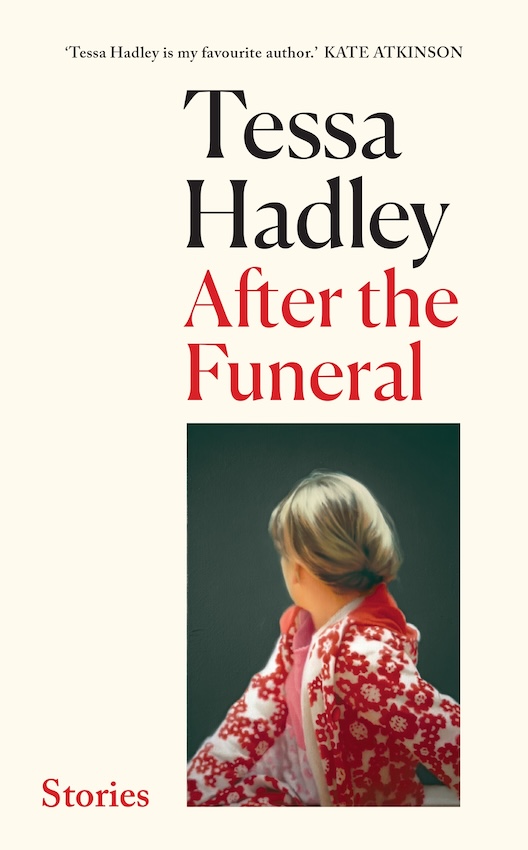
I rarely seem to pick up short story collections these days. There are always so many brilliant new novels coming out all the time, and you get used to the way the plot teasingly unfolds with the longer form, the unrolling of scenes and the character development. But sometimes a short story is just such a wonderful thing. A small, complete entertainment. It can say a lot too.
And that’s what you get with Tessa Hadley’s latest collection, After the Funeral. These twelve stories are for the most part family stories, delving into the reactions and emotions when something happens that upsets the applecart in relationships, between siblings, between parents and daughters and with couples. The subtle undercurrents of the class system are also there. Things are suitable or not suitable, or plainly ludicrous in a particular milieu.
Several stories have children dealing with parents acting alarmingly. The title story has two daughters whose world changes after the sudden death of their father, leaving their beautiful mother, who is something of an airhead, to provide for her family. It’s the 1970s and women didn’t necessarily equip themselves with career prospects back then. A family connection soon sets her up with a job in the office of a dentist. Of course the dentist falls in love with her. In “Cecilia Awakened”, Hadley perfectly captures that feeling you have when you discover as Ceclia does at fifteen, what an embarrassment family holidays, and in particular, parents, can be.
Many of the stories have their roots in the last decades of the twentieth century, while others dip back into the past from the present day. In “The Bunty Club”, three sisters return to the family home when their mother is dying in hospital. They are such different characters, and in a few deft paragraphs, Hadley vividly describes their characters as older women, bookish Pippa, capable Gillian and glamorous Serena – what drives them apart and what can bring them together again.
— Bathroom’s empty! Gillian said. — You should get in before Serena embarks on any aromatherapy. I wish she’d wash the bath out when she’s finished.
— She’s up already, Pippa said. — Look! Worshipping in the garden.
Gillian came to stand beside her. They were spying, and meant to say something dry and funny about their sister, taking advantage of watching her unseen: dancing in the long grass, flitting like a sprite in her black cotton tiered skirt and satiny top – which she’d most likely got from a charity shop, because she was solemn about waste and recycling.
“Funny Little Snake” is set in hippy era London, and is a heart-breaking story of middle-class neglect of a young child, and the woman who attempts to rescue her. In fact there isn’t a lot of good parenting on offer in the collection – distant or missing fathers, mothers wrapt up in their own lives, families recreating themselves after loss or divorce. Tessa Hadley’s writing is too crisp and sharp for the stories to seem downbeat; interesting developments make them crackle with energy.
I’d already enjoyed an earlier novel, The Past, by Tessa Hadley, which was another brilliant look at a family and shares some of the themes on display here so I was expecting to enjoy this collection. I read these stories one after another, but a collection like this could happily sit on the bedside table, ready to be dipped into again and again. But they are so moreish, I dare you not to keep reading until they’re all finished. After the Funeral gets four and a half stars from me.


 Judith McKinnon