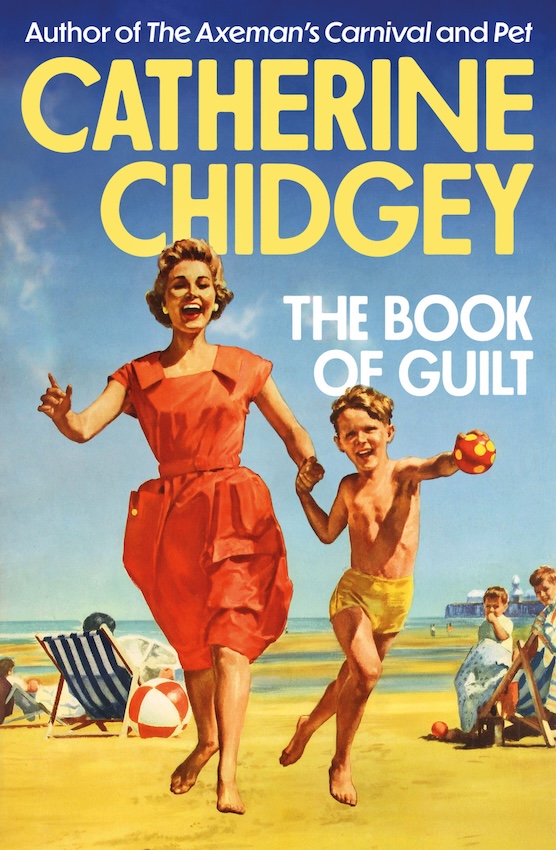
It can be a bit nerve-wracking reviewing a book that has already had a lot of publicity and kudos. Even as you start to read it you know you are supposed to like it, but what if you don’t? Fortunately, The Book of Guilt soon drew me in with it’s 1979 English setting, although it’s not quite like how anyone would remember it.
Catherine Chidgey has reimagined the world as it might have been if England had signed a treaty with Germany in 1943, ending the war and continuing similar scientific experiments to those the Germans had been working on. We’ve got triplets, Vincent, Lawrence and William – 13 year olds who are the last boys living at Captain Scott house, a kind of children’s home. They follow a strict regime of activities and medication, overseen by their caregivers – Mother Morning, Mother Afternoon and Mother Night.
Along with taking daily medicine, their dreams are recorded in the Book of Dreams, and any misdemeanours noted in The Book of Guilt. Lessons are from The Book of Knowledge – a kind of old-school encyclopaedia. The house is shabby, toys are minimal, but then the boys don’t always feel well enough for a lot of physical activity. But once they have beaten “the Bug”, they are promised they will be sent to Margate, a child’s paradise, where they’ll meet up with their old friends again, and every day enjoy the amusement park, described in loving detail.
Soon our reader’s antennae are twitching, as we know this isn’t normal and the boys part of a grander scheme, pawns in some kind of experiment. There are visits by an avuncular Dr Roach, eagerly awaited, with his little dog Cynthia. The mothers are reluctant to share what’s really going on and shut down any questions with platitudes. And when the boys are at last allowed to visit the village, the locals are wary, hostile even.
Through the high-street windows we saw whole sides of pork and whole jars of sweets, mannequins wearing real clothes and painted-on hair, tins of rice pudding arranged in precarious stacks, and, in the bakery window, a little automaton dressed in a white apron and white hat, nodding his head and tapping on the glass with a wooden spoon. But although we were locals – we’d lived in Ashbridge our whole lives, after all – the villagers never really warmed to us; they gave us the briefest of nods if we said hello, and the schoolchildren in their smart uniforms nudged one another and stared wide-eyed, and the shopkeepers stonewalled most attempts at small talk.
The story is told largely from Vincent’s point of view, but interspersed is Nancy’s story, a girl about the same age, whose own family situation is unusual and plagued with secrecy. And then there’s The Minister of Loneliness, who is tasked with overseeing the closing of the boys’ home and others like it, and finding suitable families to take the remaining children. She is clearly uncomfortable about what she sees when she visits the boys at Captain Scott.
This is such an intense read, so haunting I could think of little else. And things get pretty dark, with new revelations and plot developments. At one point I had to take a break, so I read a crime novella about a wife murderer for a bit of light relief. But I did continue and I’m glad I did as it is such a compelling and thought-provoking story.
Chidgey is brilliant at detail and at times this was like a trip down memory lane with artifacts from everyday life circa 1979 appearing – leatherette furniture, the knick-knacks on display, Nancy’s Spirograph. You can feel the world through Vincent and Nancy, just as a young person might, all five senses vividly recounted. And the way children, no matter what circumstances they are living in, will sometimes burst into moments of imagination, or excitable play.
Ideas around power and what should be sanctioned for the greater good, of difference and prejudice and, of course, guilt trickle through the storyline. It all adds up to a top literary achievement and I can see why there’s a lot of talk about the novel. Crafted and intelligent, The Book of Guilt is a five-star read from me.




 Judith McKinnon