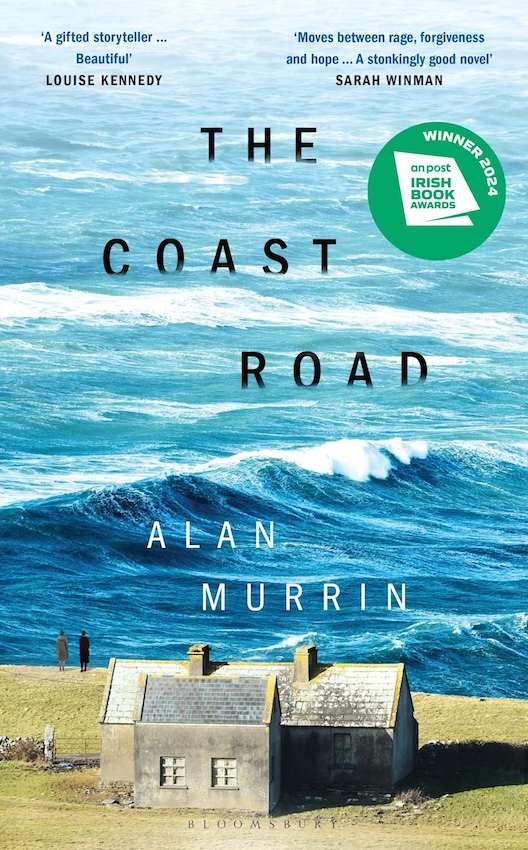
Book Review: The Coast Road by Alan Murrin – a novel about marriage and the price of non-conformity set in small town Ireland

I was impressed by this debut novel, which reminded me of fiction by other Irish authors I’ve enjoyed in the past, such as Anne Enright and Claire Keegan.

The Coast Road is set in a small coastal town in Donegal in the 1990s, a year or two before divorce became legal in Ireland. The story describes the awful predicaments people, and particularly women, could find themselves in while stuck in loveless marriages. It does this through three main characters.

Colette Crowley has escaped her loveless marriage to Shaun determined to live her life on her own terms. She’s a published poet but has done the unthinkable in running off to Dublin to live with a married man. Finding no joy in that relationship, she has come back to be closer to her younger children. But Shaun won’t let her see her kids, and it’s easy to drown her sorrows in booze.

When Colette rents a holiday cottage we meet Dolores Mullen, who is pregnant with her fourth child and all too aware that her husband sleeps with other women. She knows it could be dangerous to rent the cottage up the path from her home to Collette, but with another baby on the way, the Mullens need the money.

And then there’s Izzy, who is married to James Keaveney, a politician and a bully. Not allowed to work, Izzy fills her home with expensive china ornaments and does evening classes. The only brightness in her day are the chats she has with their priest, Father Brian. She knows Collette because her youngest son is friends with the youngest Crowley boy, but gets more friendly with her when she signs up for Collette’s creative writing class.

The three women are all deeply unhappy, and certainly unfulfilled while local opinion, the establishment and gossip all work against any idea of their standing up for themselves. In the background the political machine plays out, as a change in the divorce law is debated. But how this might help these women is yet to be seen, as Colette becomes more unstable, Izzy more angry and Dolores more anxious. The story slowly builds up to a breaking point that has you biting your nails.

As a male author Alan Murrin has done a great job at making these female characters believable, capturing not just their lives, but their voices and inner thoughts in a realistic way. And also their situation in a small town, where men have the power and nobody helps out if there is any sense of non-conformity. The writing is real, at times humorous, particularly through Izzy’s lens, the bigger situations balanced nicely with the minutiae of everyday life. It all adds up to an amazing story and reminded me a little of Claire Keegan’s Small Things Like These with characters needing to find courage to do the right thing against the tide of opinion.

Alan Murrin has won a couple of awards for this debut novel and I’ll be keen to see what he writes next. I enjoyed this as an audiobook and it was a superb read, narrated by Jessica Regan, who does a terrific job with all the characters. The Coast Road is another wee Irish gem and highly recommended – a five-star read from me.

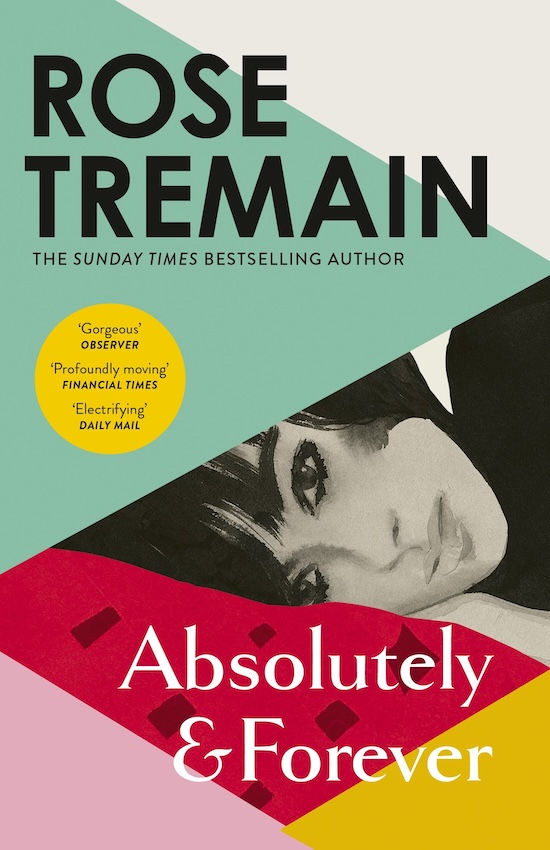
Book Review: Absolutely and Forever by Rose Tremain – a short and bitter-sweet novel about lost love and finding your way

I was warned that this book was somewhat melancholy, and in a way it is. Absolutely and Forever is about first love, specifically Marianne Clifford’s falling in love at fifteen with handsome and clever Simon Hurst. It is a love she just can’t seem to get over, and years after Simon has disappeared from her life, she still thinks about him in a yearning kind of way.

This might make Marianne appear somewhat daft. But don’t be put off; every moment we spend with her is entertaining. Tremain has written a dryly witty, self-aware character, born at time when a good marriage was often considered life’s ultimate goal for any young woman. We’re thrown into the late 1950s; Bill Haley and the Comets is on every party’s turntable and parents are eyeing up young men with prospects for their daughters. Particularly middle class parents in the Home Counties.

Absolutely and Forever made the shortlist of the Walter Scott Prize for Historical Fiction and although it didn’t win, you can see why it was noticed. Tremain captures the period so well, and through Marianne’s eyes we see how the times, they are a changing. At school, Marianne’s best friend is brave, outspoken Petronella who goes on to university to study sociology and spends the entire book urging Marianne to forget Simon and discover what she’s good at. You can tell Marianne’s smart, but this lesson takes a while for her to master.

On certain days, particularly when I was in the typewriter room of the college and fifteen typewriters were clattering and pinging and the carriages were being shunted left to right, left to right, and the wall clock was clicking away time, measuring our typing speeds, I felt my mind disintegrating. I thought, I’m in a madhouse; life has brought me here, to an asylum of a kind. It wasn’t the old and wondrous Love Asylum, it was now the Grief Asylum, where my heart was being shunted back and forth, back and forth, inside a chamber of despair.

The story takes Marianne through many ups and downs, including tragedy, and a surprise ending. Both turn out to be oddly liberating for our MC. So, yes, there is enough of a story here to keep you reading. But it’s the language that really had me hooked. At one point, Hugo, the man who falls for Marianne enough to put up with her melancholy, says the one thing he really loves about her is that he never knows what she’s going to come out with next. Tremain gives Marrianne’s narrative plenty of charm and flavour.

You can’t help thinking, thank goodness for the Swinging Sixties and women’s lib. For if they hadn’t come along would girls still be growing up pinning all their hopes of happiness on a man and forgetting they have a brain? Absolutely and Forever is a welcome reminder, and at a mere 180 odd pages a nicely-crafted, diversion you can read in a day. A four-and-a-half star read from me.

Book Review: All Day at the Movies by Fiona Kidman – a carefully observed story of siblings through the decades

In All Day at the Movies, Fiona Kidman has devised the perfect protagonist to chronicle the story of a family amid the wider social changes of her time. Belinda is a film-maker, known for her sharp eye for detail. Her story is a struggle for survival, for love and for a career, but it’s also one of those sins of the father’s stories too. The events around her arrival in the world are horrific and tragic.

Kidman takes us back to the post-war years, with war-widow Irene, striking out for a new beginning in an attempt to provide a better life for her young daughter, Jessie. Leaving Wellington and the industrial dispute that has put her father off work and caused unbearable tension at home, the two have settled on the tobacco-growing town of Motueka. They have basic housing, a kind of worker’s shack, while Irene does hard physical toil in the fields. Kidman highlights the lack of choices open to Irene, a former librarian, who settles for marriage to the creepy foreman, Jock Pawson.

“There was that girl Iris who wrote books and had babies when she wasn’t married and her life was just all sorrow, mental hospitals and … but her mother couldn’t bring herself to say the word suicide. In the end, dead, anyway. Irene’s mother had known Mrs Wilkinson, the mother of Iris, although she called herself something else, and it had been a terrible thing for her to have to lose a daughter to books. And, Irene’s mother had said, she hoped that Irene wasn’t thinking of writing books. It brought disgrace on a family.”

The story flips forward through the decades, each chapter like a short story in the chronicles of the Pawsons. We’re with young Belinda after her mother’s death and her banishment to live with a grim, sanctimonious aunt, her younger siblings, Grant and Janice left to the mercies of an unloving stepmother and a predatory father. The three siblings each take a turn with the narrative, as they try to make their way in life.

And in spite of an unplanned pregnancy, Belinda finds both love and a career, although there is still much that troubles her. We are in the midst of social change in New Zealand, with events around social justice and women’s rights a part of the wider story. As Belinda attempts to be a good wife and mother to her children, while building a career – thank God for dependable Seth at home – what has become of Janice and Grant?

They’re all walking some dark path, Belinda thinks. The marches have brought out the best and the worst in them all. ‘Are we really marching because black people in South Africa are oppressed by white people?’ she asks Nick. ‘Or are we doing it for ourselves because we have stuff and things and good lives and we feel bad about it?’

Belinda is an interesting character – one of the era when women were encouraged to ‘have it all’, but this also means being pulled in so many directions at once. Grant also seems set on a path that will see him succeed in life, if he can get past the terrible events of his upbringing. He has ambitions of becoming a pilot, and there’s a brilliant scene with four fairly refined elderly women having lunch, and the dramatic effects their actions that day have on Grant’s life to come. Meanwhile Janice seems to have one struggle after another. All three seem to belong to such different worlds – can they ever reconnect?

Fiona Kidman writes with such honesty and naturalness, you are brought into the lives of these characters in a way that seems very real, and so the tragic events that happen hit hard. But there is a wry humour too as she shows the foibles of people, their awkward interactions, their obsessions.

All Day at the Movies is just one novel among a long list of novels that have made Fiona Kidman a household name in New Zealand. As well as a winner of many literary prizes, she’s now Dame Fiona Kidman, and even the recipient of the French Legion of Honour. This book may seem just the story of a family, but probably only Fiona Kidman could write a book like this. Like Belinda she has that telling eye for the detail that captures so much more. It’s a five-star read from me.

Book Review: The Novel in the Viola by Natasha Solomons

You never know what you’ll pick up at a second-hand book fair, but I’m glad I spotted this 2011 novel by Natasha Solomons. The Novel in the Viola is the story of Elise Landau, a plump and rather spoilt nineteen-year-old, not obviously talented like her musician sister, Margot, and opera singer mother, Anna. It is 1930s Vienna, and the Nazis are starting to make things difficult for Jews in the city. As Margot and her husband prepare to escape to the United States and her parents apply for visas to join them there, Elise has no choice but to try for a place as a maid in an English household. Expressing herself in her ‘fluid’ English, she writes, ‘I will cook your goose’. A Mr Rivers of Tyneford offers her a job as parlour-maid and the means to travel.

Elise is determined she will hate England, missing her family desperately, cherishing Anna’s pearls, while learning how to wait at table, lay a fire, polish the silver, all the while running from task to task. Dawdling is the privilege of the moneyed classes, it seems. Mr Rivers is unfailingly understanding, a widower with one son away at Cambridge. He was charmed by Elise’s letter and takes her surname, Landau, to be a good omen, having a fondness for the books by one Julian Landau who Elise admits to being her father. Mr Rivers’s library has all of his books. She doesn’t tell him that her father has entrusted her with a carbon copy of his latest novel, secreted inside an old viola of Margot’s.

Letters from Margot admit their parents struggles to obtain visas, while rumbles of war make things tense in England. But there is light relief when Kit Rivers arrives home for the summer, enchanting everyone around him, particularly the young women, including Diana and Juno, from the local nobility, and even Elise. Not only does Elise gradually fall in love with Kit, but with the countryside around her. She has never lived by the sea before, and suddenly finds she can’t imagine life away from it. Natasha Solomons writes some gorgeous descriptions of this little corner on the Dorset coast and weaves into the story the changing seasons and rhythms of rural life.

The book is full of a terrific characters: snooty Diana who drops acid with every utterance; Art the chauffeur who likes four-legged creatures better than two-legged ones; Mr Wrexham, the butler/valet who wears his tailcoat throughout the most difficult times refusing to let standards slip – to name but three. But it is Elise who is the stand-out character here, losing her puppy fat, and adapting to the difficult role of being not readily accepted upstairs or below, but somehow finding a place in the household. She grows up a lot but never loses her independent streak, her passion.

Solomons has dipped into her own family history to help bring Elise to life, inspired by her great-aunt Gabi Landau who managed to escape the persecution of Jews in Europe by becoming a mother’s help in England. Apparently many refugees arrived in England on a ‘domestic service visa’ leaving their cosseted lives behind them for the challenges of life below stairs. Key aspects of the war drive the plot – particularly reports of brutality to Jews by the Nazis but also the privations of life for those in wartime England, Dunkirk and the war in the air. It is also a record of what life was like in rural England, the customs that knitted the social classes together before the war changed things forever.

It all adds up to a very compelling and yes, sad, book, full of atmosphere, interesting characters although the more emotional moments did seem a little overwrought at times for my taste. But then there was the music, a theme which also pervades Solomons’s The Song Collector, a novel which throws a light on another interesting aspect of English cultural history. Solomons is definitely an author on my watch-list and overall this book didn’t disappoint. A three-and-a-half out of five read from me.

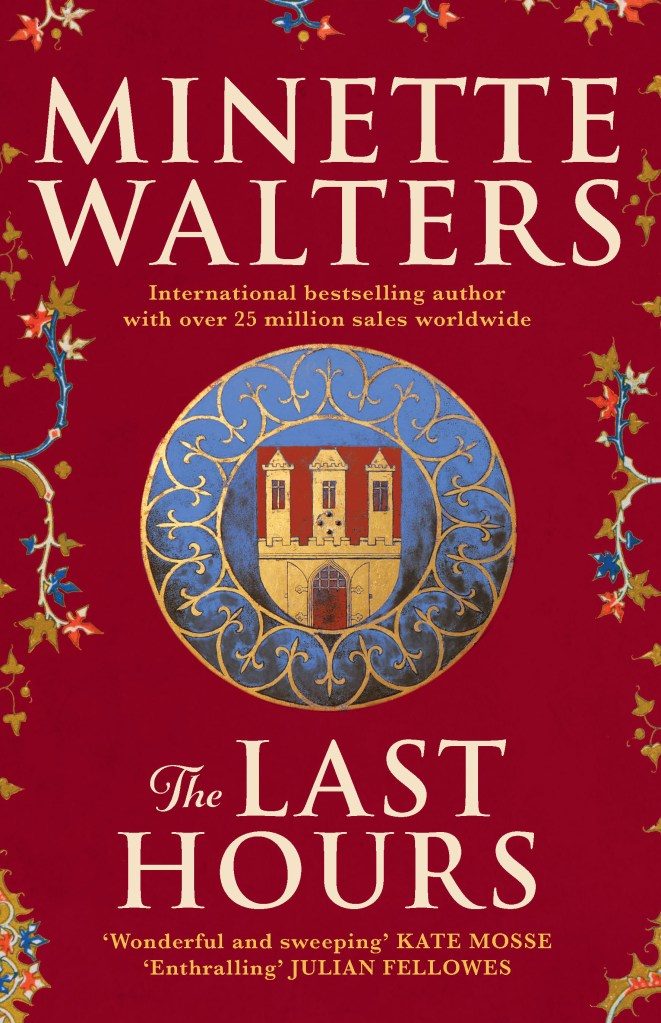
Book Review: The Last Hours by Minette Walters

I probably wouldn’t have picked up a novel set around the Bubonic Plague of 1348 if I hadn’t embarked on a reading challenge. You had to read a book about a pandemic and dodging dystopian themes I plumped for this historical novel – its tagline: For most, the Black Death is the end. For a brave few, it heralds a new beginning.

Venturing into The Last Hours, I found myself thoroughly swept away into Middle Ages Dorseteshire. Of course I remember all those creepy, atmospheric crime novels of Walters I’d enjoyed years ago so knew she could spin a yarn.

Here we’ve got a dysfunctional family – at its head, lord of the manor, Sir Richard Develish. Bawdy, cruel and lacking any subtlety of thought, he believes he keeps his serfs productive by the threat of violence. But it’s his clever wife, Lady Anne, who works with the serfs to ensure productivity is high for the area, all the while keeping her husband’s potential to harm in check. It helps that she can read and he can’t.

Unfortunately, their daughter, Lady Eleanor, takes after her father in stupidity and general nastiness. At fourteen she has beauty and a small dowry. The plan is to marry her off to a local lord’s son in the hope that the union will win Sir Richard preferment, but the lad is said to be sickly. The story begins with Sir Richard setting out to visit his future son-in-law to see for himself. He is accompanied by his steward Gyles Startout and a small team of armed men to guard the dowry but when they arrive, it is soon obvious that people are falling sick.

Gyles, who acts as eyes and ears for his master and mistress, quickly spots there are good reasons to leave hastily, and the party take flight. But by the time they reach home, everyone is ill or left to die, except Gyles. Bringing news of her husband’s death, Gyles nurses the remaining soldiers and stays on the far side of the Develish moat, quarantining himself. Meanwhile Lady Anne decides to bring in all the serfs from their village to keep them safe. It’s effectively a lock-down.

Lady Anne is pretty smart, and maybe just a little before her time. She learnt to keep the sick separate from the healthy when she was growing up at a convent so keeping the world at bay and shoring up the moat are sensible moves. As well as good practices in hygiene, Lady Anne has taught many of the serfs to read, including tall, dark and handsome Thaddeus Thurkell. Growing up a serf and a bastard, young Thaddeus was maltreated by his adopted father, but fortunately rescued by Lady Anne. Now he’s her right-hand-man. As well as Gyles, it’s Thaddeus Lady Anne turns to for advice about protecting her people, and what to do when supplies run low.

The Last Hours is a rip-roaring read, full of danger and acts of valour, intrigue and secrets. You also get a good picture of social conditions of the time. The role of women as chattels of their landowning husbands. The place of serfs, often at the mercy of harsh laws and crueller masters and their priests who reinforce the status quo. Memories of the Norman conquest of barely three hundred years before still fester with those of French descent having the upper hand and often reviled for it. But times are a-changing and maybe all that is needed is a plague to sort out the sheep from the goats, the survivors from the doomed and to auger a new way of doing things.

I suppose I’ll find out in the sequel, The Turn of Midnight, now on my to-read list. The Last Hours is a tale of endurance and human ingenuity with characters you want to cheer for and all the suspense you need to keep you whipping through its 550-odd pages. A surprisingly quick read and an easy four out of five from me.