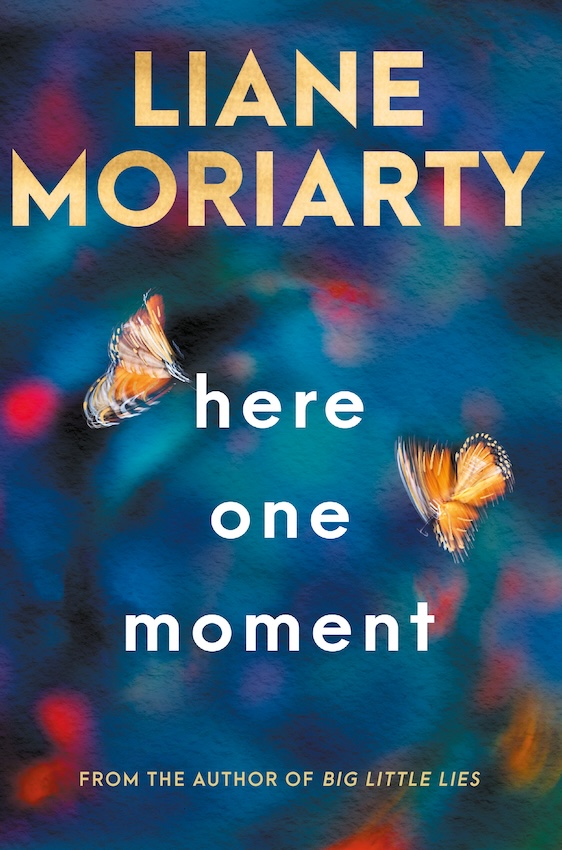
Book Review: Here One Moment by Liane Moriarty – a gripping novel about superstition, mortality and fate

It takes a smart novelist to write an engaging story with multiple characters and viewpoint switches. Liane Moriarty pulls this off really well in her novel, Here One Moment, about a passenger on a short intercity flight who predicts the ages at which her fellow passengers will die and the cause of death. We follow a selection of these passengers in the days, weeks and months following the “Death Lady”‘s predictions as they assimilate what they’ve been told.

Honestly, this is such an original and clever story and Moriarty really pulls you in wth short chapters that flit between Cherry’s story – she’s the Death Lady – and one of a small group of passengers who have been given the short straw – a death predicted for the near future. Understandably their responses vary from being a bit worried, angry, or shrugging the predictions off as nonsense. That is until some of the predictions begin to come true.

Cherry is a pleasant looking, reserved woman of around seventy who arrives on the plane tired and a bit dehydrated. Her mother was a well-known fortune-teller in the Sydney suburb where Cherry grew up. You might think that Cherry has inherited this profession and continued to practise. But Cherry’s a maths geek from a young age. How her life develops takes the reader through the sixties and seventies and on, so that we eventually form a clear picture of why she had her ‘funny turn’ on the plane.

Meanwhile we get to know the half-dozen or so “doomed” passengers and how they deal with what they’ve been told. There’s Allegra, the cabin manager, stunningly beautiful, loves her job and yet has a family history which includes depression. Is she really likely to taker her own life in the next year? There’s engineer Leo, a loving family man, late for his daughter’s performance in a school production, supposedly going to die in a workplace accident. He chums up with Ethan, 30 years old and returning from the funeral of a friend, who has died suddenly, leaving Ethan to wonder about seizing the day.

There’s also the ER nurse in her sixties, still fit and active, as well as the bride, with her new husband, still in their wedding regalia, both women given terrible predictions. But possibly the most difficult to hear is the young mother, Paula, who has had to deal with an unsettled baby through the whole flight, which included a two-hour delay, only to learn at the end of it that her boy will die by drowning, aged seven.

We follow each of these characters, their stories woven in with Cherry’s, as their ‘death-day’ looms. It’s nail-biting stuff, as they’re all likeable people with busy lives, loves and families. You get to the middle of the book as the first predictions seem to come true, wondering if you’re going to like what happens next. Is this some kind of ‘And Then There Were None’ (Agatha Christie) scenario?

Well, you’ll have to read it to find out. I will say that it was interesting to read a book that deals with our mortality, an issue we tend to put to the back of our minds. But in the cases of Leo, Ethan, Allegra and co, death is suddenly there in their minds all the time. And the idea of what you might do differently if you knew what was in your cards, or tea leaves. The question of how much of our destiny do we hold in our hands.

I enjoyed all these character’s stories, even Cherry’s, who seems unlikeable at first, cruel even. I galloped through Here One Moment, desperate to find out the what happened – so it’s a four-star read from me. If you’re doing the 52 Book Club Challenge, Liane Moriarty has a sister Nicole Moriarty who also writes fiction.

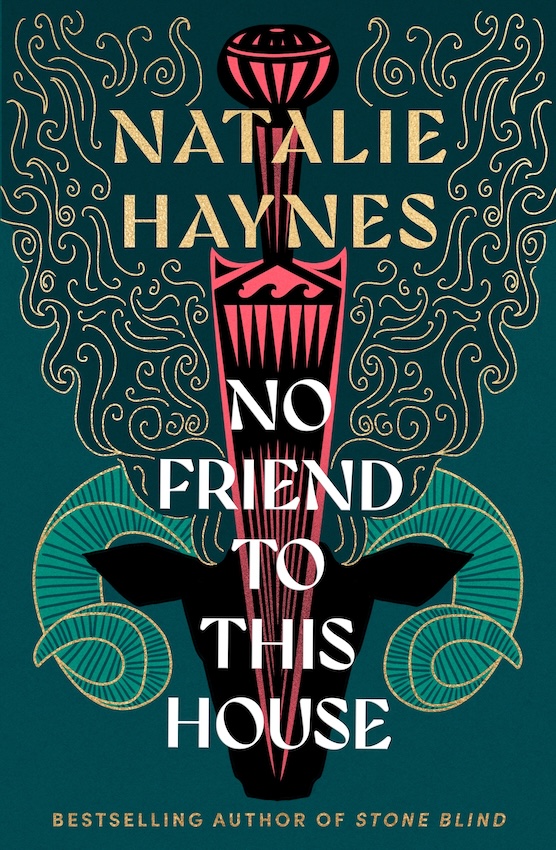
Book Review: No Friend to This House by Natalie Haynes – an evocative reimagining of the story of Jason and Medea

Natalie Haynes really knows her classics. Inspired by a performance of Euripides’ Medea with Diana Rigg in the lead role, it’s the novel, she says, she had wanted to write her whole life. She’s studied the original in Greek and her knowledge comes through in the way the story is layered with history and mythology going back in time.

Many stories about Jason focus on his adventures on his ship, the Argo, with his famous Argonauts who even include Heracles, and their quest to obtain the Golden Fleece. He has to fight a dragon, slay a field of warriors and sail his ship through the crashing rocks of the Symplegades, plus a whole lot more. But in this book, Natalie Haynes switches the focus onto Medea, the princess who defies her father to help him.. And it’s not a happy tale.

Before all that, Haynes weaves in a ton of backstory so that we learn about the fleece itself, the ram it came from and why it was so special. The actual taking of the fleece doesn’t happen until the middle of the book. There are tyrannous kings, including Jason’s uncle who steals the kingdom of Iolcus from Jason’s father. Perhaps it’s this trouble at home that urges Jason to want to seek adventure.

We’ve also got Aietes, king of Colchis, and owner of the fleece, who doesn’t hesitate to dispose of family members. We discover the backstory to why Medea chooses to help Jason and how she becomes besotted with the hero. There’s some meddling from the gods here as Medea is no pushover. She’s an interesting character, a powerful witch who worships Hecate.

It was hardly the fault of the Argo.
This was the kind of thing people said in those days: if you couldn’t blame anyone, you’d say it was the ship. But Jason didn’t set his Argonauts to row across the oceans because he was captain of the Argo; the men built the Argo because Jason wanted to find the fleece. So if you were trying to find the beginning of this story, then that’s where you would go: to the glimmering softness of the golden ram. Would you choose the day it was born? Or the day it appeared in Hellas to rescue two children, about to lose their lives?

Jason is a great leader, handsome, charismatic and skilled enough to win through – although he gets a lot of help, from the gods as well as Medea. But it’s really the story of Medea that anchors the novel. She’s interesting in that she has to deal with being wary of Jason as well as besotted with him – thank you, Cupid. She’s in survival mode a lot of the time, figuring things out, calling upon her magic. She’s clever and strong, but she’ll need to be as going off with Jason is no plain sailing.

If you know anything about the origins of this story, you will know that Medea has been given a lot of bad press. She does some truly terrible things, so she’s not your most likeable heroine. And in this world of legend, not many characters are as heroic or even as kind as you might expect. There’s a ton of characters too. Haynes piles in short episodes from the past to fill you in on why this happened, and why fate decrees that something else has to be the way it is. It’s complex and you will find yourself riffling back to the helpful List of Characters and the map at the start of the book time and time again.

No Friend to This House is a very readable and different sort of novel, abundantly well researched and this gives it that ring of authority. You come away feeling you know the real Jason and Medea, the way the ancient Greeks would have known them. It also shows how women can be marginalised in our histories, and what they may suffer because of the grand schemes of men. It’s a stunning read and stacks up well among other novels based on ancient legends – a four-and-a-half star read from me.