Book Review: The Silence In Between by Josie Ferguson – a remarkable historical novel about a family divided by the Berlin Wall

I’ve read quite a few books about World War II from the Allies’ point of view – the families caught up in the war, on either side of the Channel, the people who helped Jewish children escape at risk of their lives and the SOE recruits dropped behind enemy lines to help the Resistance or lead downed Allied airmen out of occupied territory. Loads about Bletchley Park too. But I haven’t come across nearly so many about what it was like from the German perspective.

While The Silence In Between describes what happens to ordinary people in East Berlin when the Wall went up, it also dips back to follow the lives of a mother and daughter during the war and the terrible treatment they received at the hands of Soviet forces in 1945. Events of both periods are firmly linked.

The book opens in 1961 with the Wall. Lisette has just had a baby, and while she is ready to take little Axel home, the hospital want to keep him in for a bit longer. She goes home to fetch some things for him and to spend the night with her husband and daughter, and that’s when the Wall goes up. Overnight, Lisette and Axel are separated. The situation is made more poignant by Lisette’s admission to herself that she loves Axel more than her daughter, teenage Elly. As the days and weeks pass with no means of contacting the hospital or any news of Axel, Lisette sinks into despair, losing her speech.

Elly’s life goes from carefree outings with friends to trying to manage her mother. She decides the only way to save her family is to bring Axel back herself. The Wall is patrolled by armed Soviet officers sent over from the USSR, ordered to shoot anyone attempting to cross the border. By chance Elly meets the one soldier who doesn’t shoot. She has a gift for hearing music in other people, and the music the soldier Andrei has tells her she can trust him. In the background is the awareness that there are people watching and reporting back, a spy in every apartment block. Secrecy is of the essence.

The story follows Elly’s plan to cross to West Berlin, which is told from Elly’s perspective, interwoven with Lisette’s narrative of her survival in Berlin during WWII. Lisette witnesses many terrible events, the barely acknowledged rounding up of the Jews; the pressure from nosy neighbour, Frau Weber, to meet her nephew, a Nazi officer; the lack of food; the fear of bombing, which becomes a reality as the war progresses. We learn why she never bonds with Elly, her worries for Julius, the boy she loves, fighting on the Eastern Front in a war he doesn’t agree with.

Throughout the book is music. Lisette is an accomplished pianist and gives lessons to a young girl who becomes like a sister. Elly has her own kind of musical synasthesia and a keyboard in her bedroom, which she loves to play, but for reasons she doesn’t understand, it only upsets her mother. If you check out Josie Ferguson’s website, there are pieces of music you can listen to that relate to some of the characters, composed by the author’s brother.

The Silence in Between is a gripping novel, beautifully written that had me constantly on edge. On the one hand I couldn’t wait to see what happened next, while also being almost too anxious to find out. I almost broke my rule about not reading the back of the book to see how it ended. But the book is much more than its story, and gives a good picture of what life was like on either side of the Wall, and the lot of women in Berlin during the war. Some of this makes for grim reading.

The Silence in Between is a brilliant debut, well-researched and gripping, offering a different view of the war as well as Berlin in 1961. Well recommended, it’s a five-star read from me.

Book Review: The British Booksellers by Kristy Cambron – a story from World War Two with its roots in the previous war

The devastation of Coventry by enemy aircraft during World War II is often described as the Forgotten Blitz. Coventry was targeted because of its munitions factories, but thousands of homes were also destroyed, hundreds of civilians killed and the Cathedral left in ruins..

Kristy Cambron uses this as a background for her novel The British Booksellers, but the story gets going before all that, even before World War I, when we meet two young people: fifteen-year-old Amos Darby the son of a tenant farmer, and twelve-year-old Charlotte Terrington, an earl’s daughter. They have played together for years, and are obviously soulmates, sharing a love of books, Charlotte also being keen on playing the cello, something she’s not allowed to do – it’s unladylike. So far, so Downton Abbey.

As they get older, their friendship deepens, but Charlotte is promised to local gentry, one Will Holt, who’s something of a lad, but determined to have his fair lady. With a war waiting in the wings, the First World War, that is, everything is accelerated and with miscommunications and nobody getting quite the life they had planned, a kind of bitterness settles on Amos’s and Charlotte’s relationship. Jump a couple of decades on, and here we have Charlotte and daughter Eden at their Coventry bookshop, still living at Holt Manor, while across the road Amos lives above his own bookshop, Waverley Novels. They have been not only business rivals but apparently feuding bookshop owners all this time.

But with another war on the go, things are set to be shaken up in more ways than one. The arrival of Jacob Cole, an American solicitor with claims on Eden’s inheritance adds another plot thread and there are suddenly land girls from London to settle in. But Holt Manor’s struggling to pay the bills, so they need all the help they can get. And then there’s the Bltiz.

Kristy Cambron writes a great story about love and war, and there’s a lot here to keep you turning the pages. The characters are complex, appealing and developed well. The scenes of war, of bombing and our characters thrown into the maelstrom of it all are exciting. I enjoyed the scenes with Amos more than all the girls mucking in together and comparing notes about clothes and how to cope without regular access to stockings. Personally, I’d be digging out the less glamorous Lisle stockings, as that manor house, the rain and mud sounded miserably cold.

This is a nice enough novel, but a picky reader might find the prose a little American sounding, the descriptions a little lengthy and over-egged. But the story is terrific and worth picking up for a diverting read that has you eager to find out what happens. The British Booksellers is a three-star read from me.

Book Review: The Mischief Makers by Elisabeth Gifford – an imagining of the life and creativity of Daphne du Maurier

As a girl, I remember being given a number of Daphne du Maurier’s books and enjoying them immensely – particularly Rebecca and The Scapegoat. There were adaptations of her novels and stories that appeared on TV – I’ve seen several versions of Rebecca, and then there was Hitchcock’s The Birds. I read her darker, spookier short stories too. She always struck me as a master storyteller and remarkably original for her time.

Elisabeth Gifford explores what made du Maurier tick in her new novel The Mischief Makers – how she got her inspiration as well as her family life, before and after marriage. It also describes the encouragement she got from J M Barrie, her Uncle Jim, the author of Peter Pan and guardian to her five cousins, the Llewelyn Davies boys.

I’m not sure how Elisabeth Gifford managed to write such a nicely concise and well put together story because there must have been such a lot left on the cutting room floor. The du Mauriers and J M Barrie are all such fascinating people. As a young girl Daphne was often at the theatre, her father, Gerald du Maurier, one of the outstanding theatre actors of his time. It was during a run of Barrie’s The Admirable Crichton that her parents had met, her mother starring opposite Gerald. Daphne’s grandfather was the author of Trilby and creator of the character Svengali, the evil mesmerist whose name lives on.

Daphne married Major Frederick (Tommy) Browning, himself an interesting man, a career soldier who set up the first British Airborne Division that was instrumental in the defeat of Germany during WWII. Knighted for his war work, Daphne became known as Lady Browning, although the strain the war put on their marriage was one they struggled to recover from. And of course Daphne’s immersion into her work as a writer, her determination to live quietly in Cornwall, which at times cut herself off from her husband, even, at times, her children.

But it’s the stories of her cousins, the Davies boys, and their recollections of their guardian that is really interesting. Peter as an older man is constantly engrossed in letters and memorabilia, trying to make sense of his childhood, whether or not they were simply used by Barrie, and the tragic death of his brother Michael as a young man. Was Barrie somehow at fault?

Daphne sees similarities between Barrie and herself, as writers stepping into imaginary worlds, discovering their characters in the people they meet, as well as in themselves. She even seems to feel Rebecca watching her, a somewhat disturbing presence. This insight into the mind of Daphne the writer is illuminating and fascinating. You also get a strong sense of what people went through in the last century with two world wars, and the social changes that followed, as seen through Daphne’s eyes.

The Mischief Makers is quite a tour de force, a brilliant read, particularly for a life-long Daphne du Maurier fan like me. The writing is pared back and straight-forward, mostly written from inside Daphne’s head, but with some extra chapters slipped in from earlier family experiences, the results of Peter’s research. It all comes together to create an overall picture of a very complex woman and her world. I wonder if we’ll see the book among those long-listed for the Women’s Prize for Fiction this year. It’s a five-star read from me.

Book Review: The Last Line by Stephen Ronson – a World War Two thriller with a home-front hero who’ll stop at nothing

I’m not really sure what to make of The Last Line, Stephen Ronson’s first book in a series following wartime hero John Cook. The cover promises that Cook is “the Jack Reacher of 1940s Britain”, and that would certainly seem to be true. But it took me a while to get used to a character like Cook in a WWII Suffolk setting.

After serving in the First World War, Cook had decided he wanted more action, and found it as a Commando in India. Once he got that out of his system, he got busy turning around a struggling family farm and buying up more land. When we meet him, Cook is just quietly minding his farm when a Spitfire crash lands in one of his fields, chased by a Messerschmitt, an interesting scene that reminds us that the war is dangerously close to British soil.

As a farmer, Cook needn’t rejoin his regiment, but you can’t keep a good man down and he plans to get back into the action as soon as possible. But the War Office has other ideas for him, and he’s instead asked to be part of an Auxiliary Unit, a resistance group designed to make things difficult for a German invasion, which after the fall of France now seems imminent. He meets a man named Bunny in a pub who tells him to find some people he can trust to lend helping hand, people who are prepared to give their lives in a ‘last line’ of defence, before the tanks roll their way on up to London.

And so we get to meet a few other determined sorts, among them young Eric, out poaching every night, Cyril with his hidden radio gear, and Lady Margaret who is struggling to save her estate from ruin, but has a stash of munitions ready to go. There’s some instant chemistry between LM and Cook, but before any romance can take place, our dashing hero has some local battles on his hands. The daughter of his accountant has been murdered – she’d been worried about a young evacuee and had been asking awkward questions.

These lead Cook to The Grange, a stately home also struggling to pay the bills, where he spots odd comings and goings involving trucks, a couple of young spivs who aren’t dressed for the country, and a padlocked barn. He puts his Commando knowledge to good use, how to make himself invisible as well as how to get answers out of people who think a sidearm makes them tough. They’re always in for a surprise as Cook will stop at nothing and knows how to kill with his bare hands.

It’s fair to say, however, that the malefactors are truely vile and get what they deserve. But as the death toll rose, I just couldn’t help wondering how Cook could get away with it all. Perhaps Bunny would pull a few strings. In the end I decided to just go with it and enjoy the story as a kind of boy’s own adventure for grown-ups.

The support characters are interesting and offer scope for development in the novels to come. I liked Lady Margaret, she’s not afraid to get her hands dirty, and the young evacuee, Frankie. He’s struggling to fit in, has obviously come from poverty, but Cook takes him on in an endearing way. I hope we get more from Mrs Cook, John’s mother, who seems a salt of the earth type, and has a lot to put up with.

The Last Line is a diverting read, with plenty of pace and a lively style that suits the period and the main character. The second book is already published (The Berlin Agent), and I’m interested enough in Cook & co. to find out what happens next. This one’s a three-star read from me.

Book Review: 33 Place Brugman by Alice Austin – an engrossing read set in WWII Brussells

Some stories are so much about the setting that it is like a main character. This is the case for 33 Place Brugman, an apartment building in Brussels whose residents are adjusting to life during World War II. As we know, German forces invaded Belgium in 1940 and began an occupation that would last another four years. In this novel, we are treated to a glimpse of normal life before that, and how that changed with the Occupation. The fear and the pressure to conform, to dob people in or risk your life, or else to take courage and resist – to say nothing of food shortages and loss of work.

On the fourth floor of Number 33 are two families: Francois Sauvin, an architect and his daughter Charlotte, and their neighbours the Raphaëls. Leo Raphaël is an art dealer who lives with his wife Sophia, and their children, Esther and Julian. Losing his wife in childbirth, has left Francois to raise his daughter alone, but he’s been lucky to have support from the Raphaëls, particularly Sophia, who has her nanny help out with Charlotte’s care so that Francois can work and sleep.

The children all grow up together, and the two families dine together regularly. So when the Raphaëls disappear one night, without word to anybody, it’s a bolt from the blue. They are a Jewish family, and with stories about Nazi atrocities and the likelihood of another war, the Raphaëls have been lucky to get out when they could.

The Raphaëls leave in the middle of the night, and they leave everything behind.
The sofas and chairs and beds and lamps and heavy carpets and the dining table. The films we made are in a box together with the projector, a set of oil paints, and a blank canvas. On it is a note that reads, For Charlotte. I gasp, the air coming in tight and sharp. I might have thought I was dreaming, but for that note. When I see it, I know the Raphaëls are truly gone.
In their wake, rumours swirl through the building. The Raphaëls haven’t left everything. They took their silver. And the paintings? The paintings simply disappear.

The novel follows the first years of the war and how it affects both the Raphaëls and those that remain at Number 33 – not just Francois and Charlotte, but also Masha, the Russian emigré who lives in the attic, making a living as a seamstress. There’s an elderly widowed Colonel with his dog Zipper, and nosy and unlikeable Miss Hobert – both live below the Sauvins. Next floor down are the DeBaerres whose son Dirk is an old school friend of Julian’s. Each has a part to play in the story as each has to examine their conscience and decide what is the right thing to do.

And this is what the story is so good at. It throws unheard of challenges at its characters, who are complex enough for their decisions to be difficult ones. To keep in the good books of your oppressor, to look out for your neighbour, or to fight back? How to feed your family and to keep them safe.

The novel is also a love story. Firstly, there’s Charlotte, who meets Philippe at art school, where she’s talented and able to see the world in a different way, being quite colourblind. But then there’s Julian, who has always loved Charlotte, which worries his mother. The story also brings in the work of the French Resistance in Paris, through the nefarious Harry, a friend of the Colonel, as well as the war in the air, with Julian signing up for the RAF. This gives the novel plenty of strands, and adds some excitement to balance out the quietly tense periods of the plot, as pressure slowly builds.

For me, 33 Place Brugman was an engaging novel and I was soon swept up in the lives of Charlotte, Julian and their families. It’s quite nail-biting at times, when the reader knows more about the danger around the corner than the characters. The story is also threaded with philosophy, particularly that of Wittgenstein, who is discussed quite a lot – but not knowing a lot about him, I found these references somewhat beguiling. The writing is beautiful though; the characters come to life on the page, as do the settings.

I would have loved to learn what happens to the characters by the end of the war, as the story finishes even before D-Day. An epilogue, maybe? But overall I really enjoyed this original view of the war, and its splendidly evoked setting – so it’s four-stars from me. 33 Place Brugman is to be published on 11 March, 2025 . This advance copy was provided by Netgalley in return for an honest review.

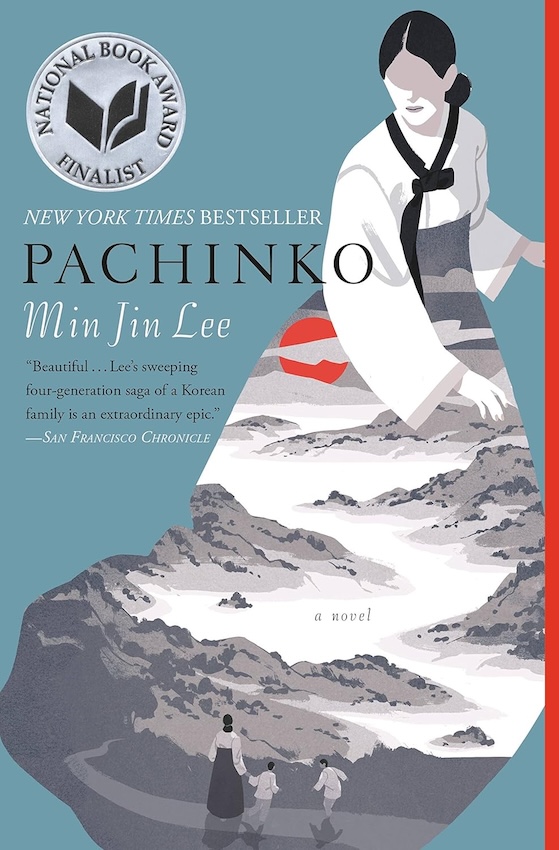
Book Review: Pachinko by Jin Min Lee – an immersive family saga of a Korean family over generations

I’d heard so many recommendations for this novel, and spotting it was available to watch as a TV series, decided I needed to read the book first – and I’m so glad I did. Pachinko is such a memorable novel, taking you into a world I had little knowledge of – a Korean family through the generations and their attempts to survive Japanese invasion of their homeland, a world war and making a new life in Japan.

The main character through it all is Sunja, who lives with her mother in their boarding house in an island fishing village. There is an obvious presence of the Japanese – harvests taken to Japan, rules that must be obeyed and any hint of insurrection severely punished. Times are hard, but the women do well enough until Sunja finds herself pregnant at sixteen to handsome trader, Koh Hansu. Sunja looks likely to suffer a terrible disgrace but rescue comes from an unlikely direction.

Baek Isak arrives ill with tuberculosis, looking for shelter, seemingly on death’s door. Sunja and her mother nurse him back to health, saving his life. But Isak is a good man, a young missionary who is passing through on his way to a church in Osaka. He suggests marriage would be good for both him and Sunja. She will travel with him to a new life in Japan.

In Osaka, Koreans struggle to make a living, and few landlords will rent them houses, so they live in a kind of shanty town of cobbled together dwellings. It’s a culture shock, but Isak’s brother Yoseb and sister-in-law Kyunghee are so welcoming, Sunja slowly imagines a future where there is both family and love. The story follows Sunja and Isak, and the generations that follow, through at times terrible hardship as World War II takes hold and life becomes even tougher. In spite of what happens, Sunja shows grit and determination to give her sons, Noa and Mozasu, a better life.

The story takes its name from Pachinko parlours, a form of gambling that is tolerated in Japan, a bit like a penny arcade where there are rows of slot machines. Perhaps this is a metaphor for the story in the way that characters are at the mercy of fortune, struggling to take hold of their own destiny in a country where there is so much discrimination. Women too, both Japanese and Korean, are also assigned roles that are hard to break out of. The story takes you up until the late 1980s – before K-pop and fusion cuisine, which have made Korean culture popular in the west.

There was consolation: The people you loved, they were always there with you, she had learned. Sometimes, she could be in front of a train kiosk or the window of a bookstore, and she could feel Noa’s small hand when he was a boy, and she would close her eyes and think of his sweet grassy smell and remember that he had always tried his best. At those moments, it was good to be alone to hold on to him.

And yet it is the Pachinko business that gives the younger generations of Sunja’s family a chance to build a future, perhaps even a small fortune. Before that, Sunja and Khyungee sold home-made kimchi and sweets to help put food on the table – a hard-scrabble life, but which forges a bond between the women.

This is an at times harrowing story, and you can’t help feeling for the characters and what they’re up against. There are world events taking place in the background that impact on them, as well as changes in culture and the way people live that give the story a sense of scope. It’s all fascinating, moving and riveting while Sunja is a character you won’t ever forget. It’s one of those both beautiful and sad books that stay with you, and a five-star read from me.

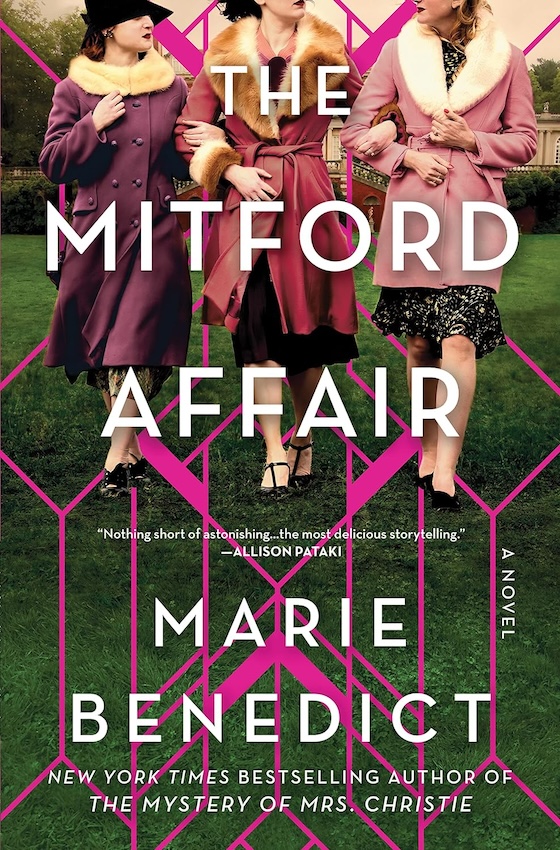
Book Review: The Mitford Affair by Marie Benedict – a novel about an extraordinary set of sisters and the politics that divided them

I’ve been fascinated by the Mitfords ever since I saw a British TV adaptation of Nancy Mitford’s Love in a Cold Climate which aired in the 1980s. Nancy was a witty novelist who moved in literary circles during the 1930s and ’40s, rubbing shoulders with Evelyn Waugh and his ilk. She mined her family and the upper classes for material for her books, which are still very readable today. Nancy had five sisters and one brother, and with eccentric parents, each sibling seemed to be more extraordinary or oddball than the next.

These are the characters that people Marie Benedict’s novel The Mitford Affair, which concentrates on the years 1932 to 1941, with the rise of fascism in Europe and the opening chapters of World War II. Told from the viewpoints of sisters Nancy, Diana and Unity, you couldn’t ask for more varied characters, each with a very distinctive narrative voice. As the years pass, Nancy watches in horror as Diana goes to ever more extremes to promote the politics of her lover Oswald Mosley, and as Unity heads off to Germany to become a kind of Hitler acolyte. As war becomes inevitable, Nancy has to decide if her loyalty lies with family or her country.

As a reader, you feel very much on the side of Nancy, who seems to be the voice of reason among her sisters. She’s also dealing with a lot personally, in particular a problematic marriage and ever more desperate attempts to bear a child. Meanwhile Diana has ditched an adoring, wealthy and titled husband for a man who is already married and the voice of fascism in Britain. She devotes her energies to his cause even when Mosley declares he cannot offer her marriage or any kind of respectability.

Then there’s Unity. Always the least liked in her family – the only daughter to be sent to school so her mother didn’t have to put up with her – you get the feeling that today, Unity would be diagnosed with a mental condition, possibly as bipolar or a spectrum disorder. Much younger than Nancy or Diana, she’s only in her late teens when we meet her, her half of her bedroom festooned with pictures of Hitler and Mussolini, as opposed to Jessica who on her side of the room has etched the hammer and sickle into the window.

After the Olympia Hall rally and the violence of the Blackshirts inflicted at the slightest provocation, undoubtedly on Mosley’s orders, I could no longer even pretend to be in the same political ranks as my sisters. Did we not live in a society where free speech was guaranteed? Could Mosley not bear the slightest critique of BUF and his rule. The strutting, posturing, flag-waving, and shows of bravado I’d chuckled at privately now seem menacing rather than humorous, and I felt an urge to unmask Mosley and his dangerous army as hooligans through my writing. I also began to wonder if I could use my writing as a way to awaken my sisters from this madness.

Unity’s adoration for Hitler is like any ordinary girl’s crush on a matinee idol, but such is her fervour, that she talks her mother into sending her to a finishing school in Munich and staking out a café popular with Hitler himself. She’s a difficult character to be with, but Benedict captures her intensity with sympathy, despite her anti-semitism and support for a cruel totalitarian regime. Hers is the saddest story of the three, and you can’t help feeling that with affection from her family, and some half-decent parenting, Unity could have had a brighter future. But that’s not to be.

This is one of those books that is so much more extraordinary for being based on real events and real people. I found myself often heading to the internet for more background, and it’s all there. The Mitford Affair is an enthralling read, although not an easy one, considering what Diana and Unity were prepared to do for a political cause that would lead to such terrible events in Europe. But I couldn’t help feeling that the writing could have been sharper – there are some rather convoluted sentences, and a few Americanisms slip through now and then. As a study of how political fanaticism can take someone over, though, it does the trick. It’s a three star read from me.

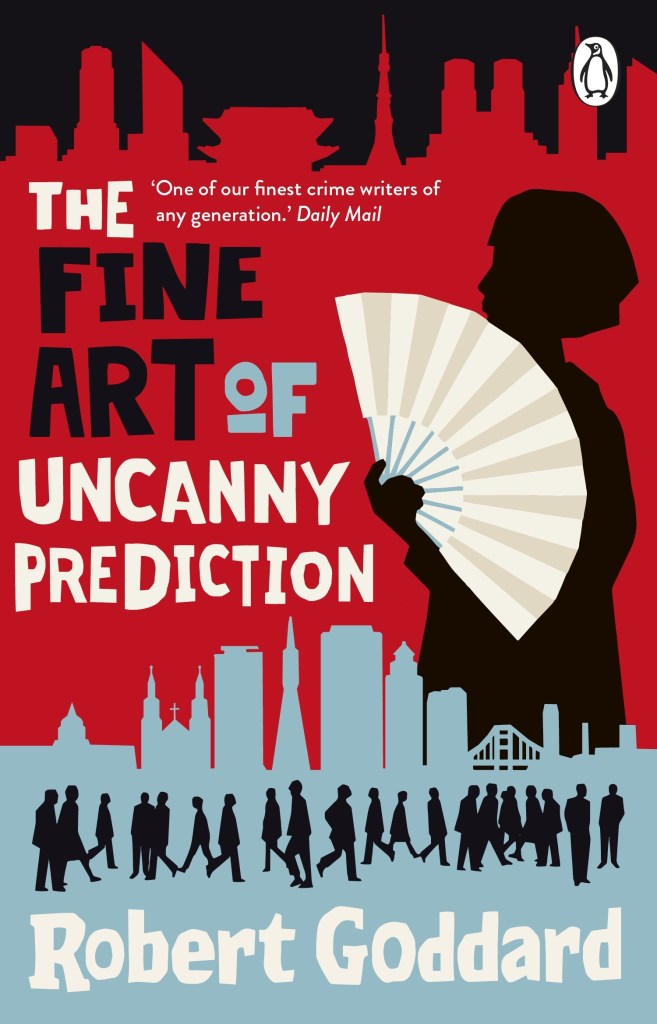
Book Review: The Fine Art of Uncanny Prediction by Robert Goddard – the invisibly detecting Wada returns for a new puzzle in her home country

Like Andrew Taylor (see previous post), Robert Goddard is a recipient of the CWA Diamond Dagger Award for his long career in putting out superbly plotted crime fiction. Mostly he’s a writer of stand-alone novels, but his latest book takes us back to Japan where we first met Umiko Wada in The Fine Art of Invisible Detection and a case that brought her to England and a convoluted mystery that helped her cut her teeth as a detective.

In The Fine Art of Uncanny Prediction, Wada has taken over the investigative business set up by her late boss, Kazuto Kodaka. Wada is a middle-aged woman who was widowed young. She’s outwardly unremarkable and, like many fictional private investigators, her work is her life. With a brother in New York, it’s left to Wada to check in on her mother, which is problematic in more ways than one.

The story gets going with a new case, an elderly man who has lost contact with his son. Fumito Nagata is worried his son, Manjiro may be depressed, even suicidal, following the collapse of his business, but Fumito is unable to contact him. Mr Nagata wants Wada to find him and report back. The younger Nagata is also the nephew of Teruki Jinno, head of a prosperous construction business that has been in the family for decades, a business that did well out of rebuilding Tokyo after the war.

Wada’s investigation will take us back to those dark days after Tokyo was firebombed, into a labyrinthine plot full of strands but all focused on power and money. She’s also being pestered by her brother to see to what’s going on with their mother – she’s taken on a lodger, an ex-Sumo wrestler who has fallen from grace. Wada’s brother is appalled.

‘I have you down as a solitary person. Is that right?’
‘It is not wrong.’
He frowned at her. ‘Do you ever let your guard down, Wada?’
‘Occasionally.’
‘Am I likely to see it happen?’
‘Unlikely, I would say.’
Then he grinned. ‘See, that’s what I like about you. You’re just so damn honest.’

The story also slips back in time to the mid 1990s and a case being investigated by Kodaka, again involving the Jinno construction company. Kodaka is asked to determine the recipient of large sums of money, paid into a bank account by the late founder of the company for over fifty years. The case will also have Kodaka asking questions around the Kobe Sensitive, the mysterious woman who phoned in a prediction about the Kobe earthquake – a prediction that was ignored but proved to be tragically accurate.

The plot flips between the two time periods, and the cases of the two detectives that will, of course, show how they connect towards the end. There’s a lot going on and a raft of characters to remember – I made frequent use of the character list at the start of the book. But I persevered, because Goddard is such a brilliant storyteller, there’s a thread of humour running through it all and Wada is such an interesting character – one of those ordinary people flung into extraordinary circumstances and somehow coping surprisingly well.

Yes, there’s plenty of danger, and Wada can’t ever be sure who to trust. There’s her connection to Kodaka, a more typical fictional detective who drinks too much, but knows his stuff, and has a will to stand up for the underdog. I enjoyed how the story includes how the two met, and how Wada became involved in the tricky business of detecting, much to her mother’s disappointment.

The setting of Tokyo seems very real – we get the trains, the distinctive suburbs and Tokyo’s hinterland. There’s a visit to San Francisco too – both settings come to life on the page. Underneath what turns out to be a ripping good yarn, full of twists, are thoughts on the devastation and ongoing effects of war, and those who prosper from it. The possibility of predicting earthquakes – both scientifically and through a kind of ‘gift’ is a fairly original concept for a detective novel and adds a good deal of interest.

There are still plenty of surprises as it as it all comes together towards the end, and as a reader I felt I was in the hands of a seasoned professional, an author that makes it all work so cleverly, creating a supremely satisfying read. Not that I was surprised. He’s done it so often before. The Fine Art of Uncanny Prediction is a four and a half star read from me.

Book Review: The War Pianist by Mandy Robotham – wartime danger across the airwaves

This is one of those wartime novels featuring a heroine who is just an ordinary girl toughing it out against Hitler. She probably never wanted to get involved in the Resistance or working as a spy for SOE, but something has triggered her desire to get involved. There will be a couple of military aircraft from the era on the front cover, discretely in a corner so you know it’s a war story. A ton of books like this have been written lately, and they can be a fun read, but how do you tell which are the good ones?

I’d really enjoyed the audiobook version of The Resistance Girl by Mandy Robotham, which took me to the war in Norway. It had engaging characters, a really nasty malefactor, a bit of romance, plenty of suspenseful dodging of the enemy, and the promise of a happy ending. But I learned a lot about the war in Norway and how it affected people, the heroic ways they fought back. The story didn’t shy away from some of the horrific events of the war but describes them off-stage so nothing’s ever too harrowing for the reader.

And it’s much the same here with The War Pianist. Marnie works at the BBC in London helping to prepare radio scripts for airing. Her parents have decamped to Scotland and apart from cousin Susie who is wondering about leaving London too, her only family is Gilbert, her adored grandfather, still running his tailoring business near Trafalgar Square. But after a bombing raid by the Luftwaffe, Marnie is horrified to discover the shop has been levelled and her grandfather is dead.

Reeling with grief, Marnie goes back to the shop one day in search of a memento of her beloved relative only to find hidden away in a basement cupboard, a radio set for transmitting. Gilbert was a man with a secret, and Marnie worries that he might have been a spy. As she carries the radio away with her she is brought to a halt by an ARP warden who turns out to be someone else keeping a secret. Willem is a Dutch Resistance fighter in London to help shore up support from Britain on the behest of Queen Wilhelmina.

Willem persuades Marnie to take over from Gilbert, sending coded messages to Corrie, Willem’s fellow Resistance fighter in Amsterdam. Marnie knows all about radios from her work at the BBC, and she and her grandfather used to play games in Morse Code when she was young. So Marnie, fired up with rage against Hitler because of the Blitz and her grief, is the perfect recruit to step into Gilbert’s shoes. But she has to be careful, as there are reports of fifth columnists supporting the enemy at large, who are watching and listening. Who can she trust?

When the inevitable sirens stir the BBC’s populace into the basement that evening, something in her – she doesn’t know what – is drawn in the opposite direction, up onto the roof of Broadcasting House. Climbing out into a sky already glowing orange and a wind warmed by fiery destruction, she stands aghast. It’s as if Hitler has taken a match to a box of fireworks and simply sprinkled the contents across London – the red tracer fire of ack-ack guns meeting mandarin sparks from a fresh explosion, tiny pockets of green-blue glow like fireflies amid the rubble as the gas mains are hit below. A rainbow of destruction that’s both vivid and grotesque.

The story weaves Marnie’s story in with Corrie’s in Amsterdam, where things are a lot more desperate under the Nazi Occupation. It’s only 1940 and the resistance is in its early stages while reprisals and food shortages are the order of the day. There are reports of devastation in other cities like Rotterdam and fear is widespread. But Corrie continues with her radio, messages kept as brief as possible to avoid her site of transmission being pinpointed by the enemy.

The story takes Marnie across to Amsterdam where the plot ramps up a lot. Here the evil Nazi officer, Lothar Selig, is keen to make his mark – he also turns up in The Resistance Girl – when one of the Willem’s team disappears. There’s an emotional connection, so this gives the story a bit more punch. Marnie is also torn emotionally, but will do anything to help and her radio skills become crucial. The story builds to a taut ending and it’s a satisfying read, without ever being too grim centre stage.

I confess I didn’t enjoy this quite as much as The Resistance Girl, although it’s still a pacy read and interesting for the most part. The romantic element seemed a bit forced, maybe because the character of Willem is not particularly well developed. I might give Robotham another go, or if I’m in the mood for a good wartime story, I’ll head back to Pam Jenoff or Kate Quinn, who are pretty solid in this genre. The War Pianist gets three out of four stars from me.

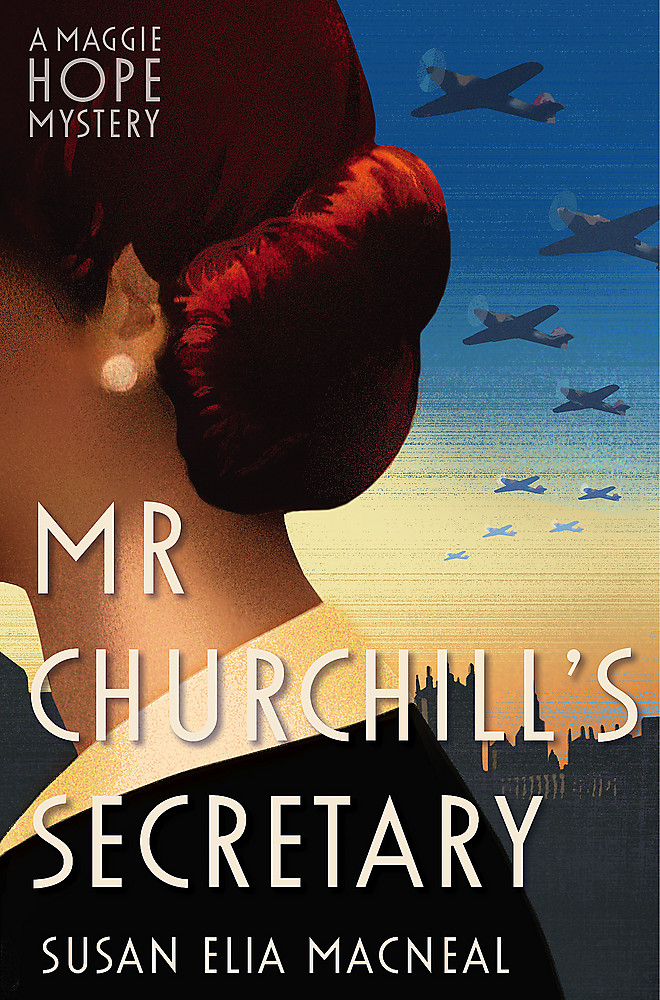
Book Review: Mr Churchill’s Secretary by Susan Elia MacNeal – a light but lively WWII mystery

This novel is the first in a wartime mystery series that features American-raised Maggie Hope, a young woman with a formidable brain. Which is how it should be. I like a brainy female sleuth. You know she’s going to have to figure things out rather than stumble around, picking up clues by accident.

Maggie has moved to London not so long ago. She was supposed to sell her grandmother’s house and then settle back into her studies in mathematics, taking up her place at an American university. She graduated top of her class and academic expectations are high. But along comes a war, World War II, that is, and Maggie wants to do her bit. She loves London and decides to apply for an under secretary position in the prime minister’s office. She doesn’t get it, of course. She’s a girl and they only take men, but when her friend, David suggests she try for a job as the PM’s secretary, she reluctantly gives it a go.

Maggie is desperate to use her maths brain, but at Number 10, she’s thrown by Churchill’s odd habits and cryptic commands, while being urged to keep her head down and do what she’s told by her superiors. Fortunately she has a cheery group of friends to hang out with, including her flatmates: Paige, an old classmate from America’s Deep South and hearty, Irish Chuck plus a pair of scatty twin sisters. David, is always dropping by. His life has always been a little risky as he’s gay when you weren’t really allowed to be so what’s a little war in the general scheme of things? He keeps everyone’s spirits up but his best friend John is moody and somewhat awkward around Maggie.

The story switches to that of Claire who is visiting the Saturday Club, a group of Nazi sympathisers, and Michael, who is letting off bombs around the place for Ireland. While the narrative builds towards a plot agains the PM, Maggie has questions about her parentage. There’s something her guardian, Aunt Emily, is not telling her. When she goes to find her parents’ graves, her mother is there for all to see, but her father’s grave is missing.

Things get more complicated with codes appearing in mysterious places and a visit to Bletchley Park, while pretty much everyone among the cast of characters is in danger from something. Whether it’s the bombs raining down on London, or Nazi sympathisers determined not to have their plans foiled, Maggie’s life has just got a lot more perilous. Things go down to the wire for Maggie, the PM and an iconic building in London, but luckily there’s Maggie’s amazing brain to save the day.

Anyone imagining this series to be ideal for fans of Jacqueline Winspear’s Maisie Dobbs, might want to reconsider. I think they are quite different beasts. The Winspear books reveal a lot about the war, and recent history, often taking a little understood aspect and making it the basis of a story. Her characters are really put through the ringer and there’s a strong emotional charge.

The Maggie Hope books would seem to be a more imaginative bunch of stories and are quite a lot lighter in tone. There’s lots of dancing in nightclubs, romance and general socialising, more about the music of the time, what people were wearing which adds colour and sets the scene. I shall probably continue with the series, but my reasons for picking up a Maggie Hope book will be for a lighter kind of entertainment. Mr Churchill’s Secretary gets three stars from me.