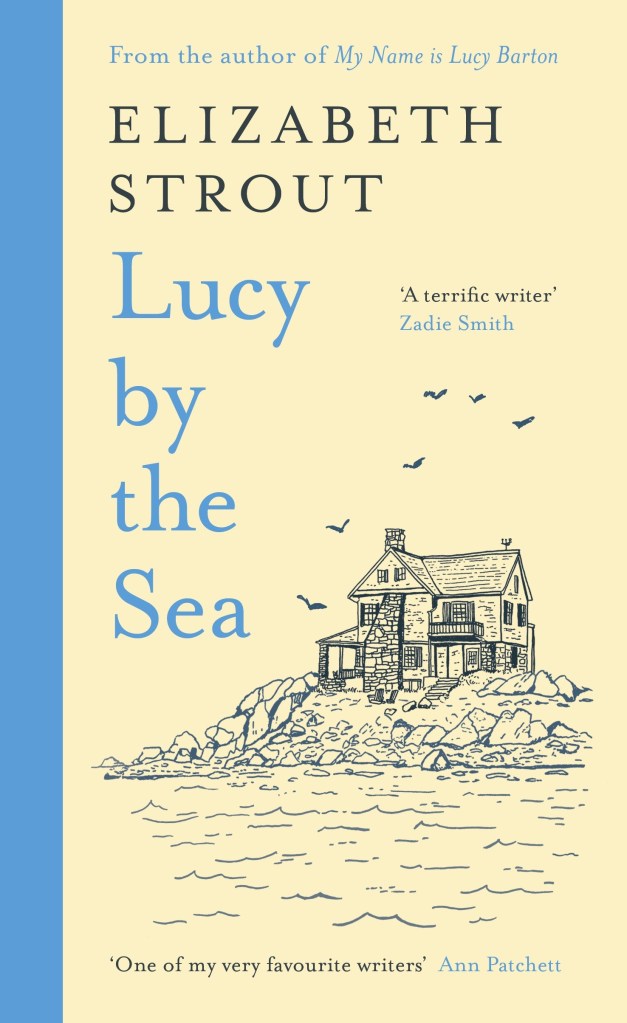
If you’re an Elizabeth Strout fan like I am, you’ll have come across Lucy Barton before. She’s an easier character to like than Olive Kitteridge, the character of the eponymous novel which earned Strout a Pullitzer Prize. Lucy is a novelist who has come from a very humble beginning in a small town. So she tends to turn her author’s eye on the world – watching people’s interactions and thinking.
Lucy’s upbringing and her relationship with her mother are the subject of the first book, My Name Is Lucy Barton. Her hometown, Amgash is the subject of the stories in Anything Is Possible, and is where Lucy returns to visit her siblings who are still there, after her long absence in the city. Oh, William is Lucy’s story again, and concerns her relationship with William, her first husband. And this continues in Lucy by the Sea, which is also what some people might call a “Covid novel”.
And I found this a bit difficult to start with. William is a scientist, and as he watches the news about the virus decides it’s time to leave New York. He wants Lucy to leave too and persuades her to pack a suitcase and go with him to the small seaside town of Crosby in Maine. They’re only going for a few weeks. He also insists their two daughters, Becka and Chrissy to move out of the city too – although Becka resists. William’s the only one who can see what’s coming.
The novel takes you back to those terrible early days – the deaths, and the lockdowns, the personal distancing and the fear. We see it all through Lucy’s eyes and being a writer, she’s observant and sensitive. New York was hard hit and news footage on TV is must-see viewing for William. When they venture out to go shopping the locals give them the cold shoulder and one day they find an angry sign on their car telling them to go back to New York.
A strange compatibility was taking place gradually between William and me. I had even forgotten about how I used to have to go down to the water and swear because he wasn’t listening to me when we had supper. I mean, we were essentially stuck together, and we sort of adapted to it.
Thank heavens for Bob Burgess, the genial lawyer (and also a main character in The Burgess Boys, which I also highly recommend). Bob makes them welcome, finds them some Maine licence plates and becomes a good friend of Lucy’s. The story takes us through the months that follow, the couple’s fears for their daughters, William’s attempt to reconnect with his lost sister, their settling in at Crosby as well as shifts in their own relationship. There is more sadness than joy, but there is still hope by the last pages.
For quite a way through this novel I felt a lot more uncomfortable as I read than I usually do with Strout’s fiction. And this is because she brings to life that terrible time as Covid first took hold and also the political events that followed – the divisions in society shown on the TV, and so on. But somewhere towards the end, I felt the wisdom of the book and I went from wanting to rush through the book to get it finished to taking my time and enjoying it.
Much is made of Lucy having come from poverty. Strout has made this an asset, even if it troubles Lucy, as it means she can talk to just about anybody. I love her openness and truthfulness. Her attempts to understand people from other walks of life and across the political spectrum. I wish more authors did this. And William is forced in this book to confront again the terrible way he treated Lucy years before. It seems the Covid crisis makes everyone focus on what really matters in their lives.
Lucy by the Sea is well worth the read, even if you wonder what else can be written about this character. It is a thoughtful novel, and makes you think. And the writing is so natural, it really seems like your inside someone’s head. But if you’re not ready to relive that awful time, give it another year or two. It’s a four-star read from me.

 Judith McKinnon