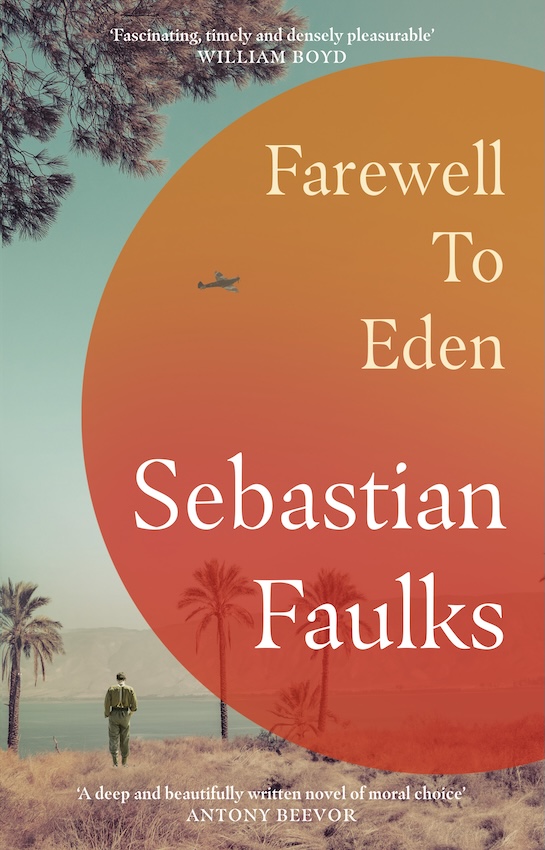
You often learn something in a Sebastian Faulks novel. In Farewell to Eden I learned about the establishment of the state of Israel – through the eyes of main character Philip Deval, an English army officer. We’re in 1946, and with WWII finally over, Philip, unsure what civilian life would offer him back in England, has signed up to help in the final days of the British Mandate. The Sea of Galilee glimmers, the sun’s out and it’s almost like a holiday – if it weren’t for the sudden eruptions of violence here and there. Not everyone’s happy with the British presence in Palestine, it would seem.
The events that happen, the people he gets to know will leave a lasting impression, and the story slips both back in time to years before the war and Philip’s meeting Alice, a fellow philosophy post-grad. student, as well as what happens after Philip’s stint in Palestine. We follow Philip’s life over the decades, and for a lot of the book I thought it was just a book about Philip’s coping with war’s aftermath as well as world events seen through a bystander’s eyes. Philip’s a regular nice guy, pleasant company who makes friends easily, and a good leader of men – the perfect bystander character.
First off, he has a doctorate in philosophy, so the ideal person to evaluate and consider events in the light of the wisdom of the ages. And with his great friend, Matthew, the army chaplain there are interesting conversations about politics, religion, love and life. Philip has a tragedy he has never quite managed to get over – where was God in all that? Among the cast of characters we meet a survivor of the Holocaust, so as well as what he sees in Palestine, there’s plenty to mull over.
The book begins a bit later, in 1951, with Philip having drifted into a teaching career. He fetches up at Witchelm, a small girls boarding school where he settles in as a French teacher. Again, he gets on well with pupils and staff alike. But you can’t quite help feeling that he’s a fish out of water. After what he’s seen as a soldier and now it’s netball umpiring and evening cocoa in the staffroom. Yet, Sebastian Faulks is such a master of plot and character, you know there’s a reason for everything that happens.
Every aspect of the day was strange, Philip found. The urgent running of the girls in the corridor after lunch – but on Wednesdays only. For what reason could that be? An issue of sweets or letters of home? The change of clothing on a Saturday from the grey flannel skirts and walking shoes into trousers with navy pullovers and brown plimsolls. The weekly whole-school assembly with the staff lined up in what seemed like evening dress, for which Ian Linwall had to lend him a bow tie. Why? Miss Darwood in a blue statin dress, staring at her feet, Dr Chilvers in a man’s suit with trousers, her fringe and brown bob neatly brushed as she gazed out at the school, waiting for Miss Graveney’s entrance.
Farewell to Eden is another masterwork by Faulks. The author has done a ton of research and the Palestine chunks of the book give the reader a good grounding in the history of the establishment of Israel, the factions and the politicking. So very timely when you consider recent events. And while you do learn some history this is also a brilliantly entertaining read as well. The scenes of Philip enjoying himself with Alice’s family, with his fellow soldiers, are fun. Philip has a wry humour and there’s wonderful dialogue, but action too. So lots to keep the reader amused. And then that ending – wow!
It’s always nice to discover exciting new authors – and today we are so spoilt for choice. But it’s also wonderful to read a favourite author and discover he’s still up to scratch. I couldn’t wait to get my hands on Farewell to Eden and I was not disappointed. It’s a five-star read from me.