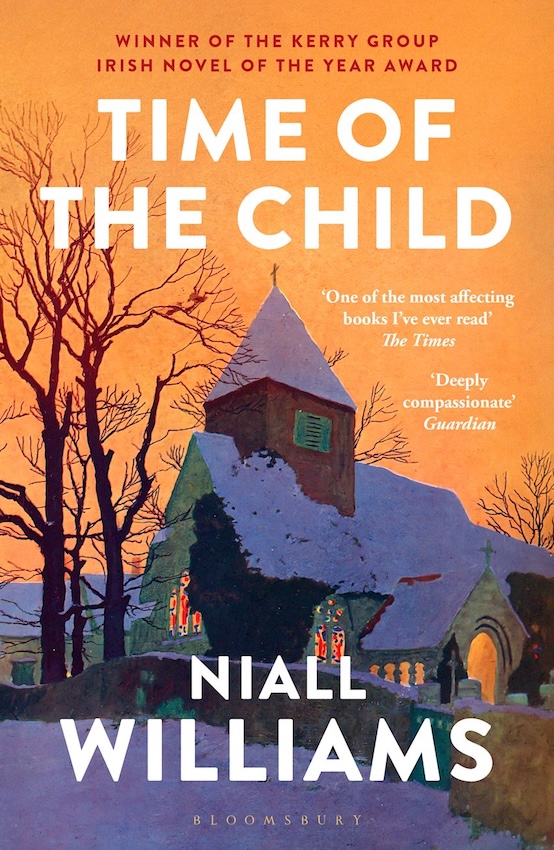
This is one of those novels that rewards perseverance, opening as it does in a way a fable might begin, and taking its time with setting the scene and establishing character. The writing also takes a bit of getting used to, but once you’ve got the hang of it, you might find yourself utterly hooked, as I was.
Time of the Chid is set in Faha, a small town in Claire. It’s 1962 and we’re in the lead up to Christmas with a story centred mostly around the town doctor, Jack Troy, and his unmarried daughter Ronnie. There’s a lot of scene setting as we follow Jack on his rounds, and his reminiscences about lost love. He and Ronnie are isolated from the rest of the town in that they have no obvious social equals. Ronnie’s sister begs her to let her find a match for her, but Ronnie is happy where she is – what seems like loneliness to others is freedom to her.
Doctor Troy and Ronnie rattle around in Avalon, a large rambling home that doubles as a doctor’s consulting room, the house riddled with mice and various kinds of rot. It’s not a place you’d want to spend winter in, and the weather here is a character in itself, in various versions of wet – rain, sea mist or fog – and always chilling. Jack has a lot on his plate working in a town where people are mostly struggling to pay doctors fees in a timely manner, an ageing population and a priest who is losing his mind to dementia.
In the parish, the doctor had the standing that close acquaintance with suffering bestowed. Beneath his waved grid of silver hair, his sunken eyes said that acquaintance came at a cost. He had a worn air, his complexion tending now to ashen, his top lip covered with a shoebrush moustache he had grown to put a small distance between himself and the hurt of the world. Although he lived in the magnificent dilapidation of Avalon House, and carried himself in a manner that Faha might have summarised as Not like us, he was vouchsafed a place of honour in the parish by the twin virtues of not leaving and being indispensable.
There’s also young Jude Quinlan who comes from a poor farming family, with a father who drinks and gambles away much of what he earns. We follow Jude helping his father bring the cattle to sell at the town fair and you get more on this colourful event, the characters and how the townsfolk interact with each other, the expectations and buzz as people prepare also for the Christmas season. All of this before the pivoting event of Jude discovering an abandoned baby.
The story follows what happens with the baby, rescued by the doctor and Ronnie, and secretly cared for. We get a view of an Ireland where children born out of wedlock were a shame to be whisked away by the authorities, and your imagination conjures up orphanages run by nuns and not a lot of love. The baby meanwhile captivates Ronnie and the doctor, and as Christmas looms, each separately imagines what might happen next and how to fix it.
This is a delightful read, a gentle story that packs an emotional punch, with characters that you really get to care for. It’s all particularly enhanced by the wonderful writing in spite of sentences that are often long and convoluted in an Irish sort of way, and brimming with imagery that is somehow just right. Some, particularly the humorous ones, I just had to read out loud. There’s plenty to make you think, with themes around what is the right thing to do, about guilt and atonement, the spirit of Christmas and whether there is in fact a God.
I loved this book and seeing that Time of the Child is the second novel set in Faha, will be hunting out its predecessor, This Is Happiness – there’s a third, Oh, Now to be published later this year. Time of the Child won the Kerry Group Irish Novel of the Year 2025 and is a five star read from me.


Many years ago, I read several books that Williams co-authored with his wife. They were about their lives in Ireland and were delightful.
LikeLiked by 1 person
Thanks, Joyce. I’ll see if I can hunt them out.
LikeLiked by 1 person
The wife’s name is Christine Breen. The first one was called Oh Come Ye Back to Ireland.
LikeLiked by 1 person
That’s great. Thank you so much for looking that up.
LikeLike