Book Review: Bone Lands by Pip Fioretti – first in an Outback Noir series and a cracking good story

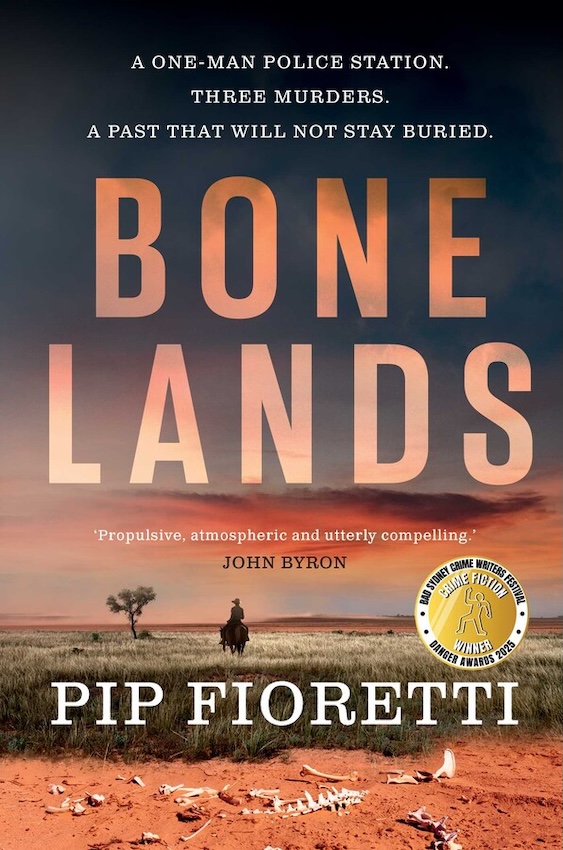
Pip Fioretti writes a kind of genre blending crime novel with Bone Lands, which combines everything that we love about Outback Noir – the big skies and harsh, dry landscapes, the Aussie battlers who live there – with a hardboiled policeman and puts it all in the historical setting of 1911. And as a character, mounted trooper Senior Constable Gus Hawkins has a lot going for him. He’s complex in that he’s well-educated and sounds it, with several tours in the Boer War behind him which have left him with both mental and physical scars. He’s smart and resourceful, but that old PTSD means he drinks too much and gets into fights.

But then, everyone here seems to get into fights, well, just about. It’s a hardscrabble existence out in the back-blocks of New South Wales. Hawkins’ little town of Calpa is a ‘blink and you miss it’ kind of place, with a pub, a post-office, the police station and not a lot else. It’s a one-man station, with tasks often concerned with managing unrest – there’s not a lot to do in Calpa but drink your wages away – local admin like gun permits and the like. But riding home from monitoring behaviour at a dance honouring the King’s coronation, Hawkins comes across a serious crime – three young members of the same family brutally murdered.

The Kirkbride family are well-off landowners, running a huge sheep station, and not well liked in this haves and have-nots kind of place. With the endless work required to make money from wool, they have a huge labour force of hardened men of the land. Life is cheap and violence comes easy. But when the violence is against their own, the grim landowner and patriarch Robert Kirkbride is oddly reluctant to have Hawkins nosing around too much, preferring to believe in the ‘robbery gone wrong’ theory. It doesn’t help that Gus has had a romantic connection with the remaining daughter, Flora.

It was a six-hour ride upriver to Bourke. In summer it was a bastard of a ride, one I preferred to do at night if I had a choice. The thing to do was carry a tin of Josephson’s Australian Ointment. Buckskin breeches were made so you didn’t chafe, but six or more hours in the saddle on a hot day and everything chafed, from balls to brain. The glare was blinding but our official hat was a jaunty pillbox affair, which would be just the thing for a Parisian gendarme but was ridiculous out here. I shoved it in a saddlebag and wore a cabbage-tree hat like every other man in the bush.
The sun was on its way across a vast blue sky, a westerly wind blowing. I noticed a shape ahead in the distance, moving slowly. Dancer stopped at the sight of it. He didn’t like things that moved, nor did he like things that didn’t move. So there we were, his ears pricked forward, completely still, every muscle tensed and ready to flee.
‘How’d you get into the police force, mate?’ I said, stroking his neck. ‘Bribed someone, eh?’

But Gus is determined to find out what happened. These were his friends and he wants to bring some closure for Flora, too, who has become unhinged by the deaths of her siblings. It doesn’t help when two detectives arrive from Sydney with their own way of doing things, but none of the nous for dealing with the locality or shifty farm labourers. If conflict is the linch pin of a good story, then this one has it in spades. You can’t help but feel for Gus, even if he is, quite often, his own worst enemy.

Other characters are interesting too, particularly in relation to Gus. His initial dislike of Trooper Lonergan, a somewhat wet behind the ears type, sent from Bourke to manage the station while Gus looks after the detectives, mellows into friendship. Other characters are lightly drawn but the author captures their essentials in a way that makes them immediate. The few female characters – this really is a man’s world – have to manage as best they can, and we can’t help but sympathise over how they’re treated. The plot steams along towards some surprising revelations to make for a very satisfying mystery.

Bone Lands is atmospheric and absorbing, with sentences that are nicely honed and laced with wit, making Gus Hawkins good company. It’s a great start to a series – there’s already a second book (Skull River) with another due out next year, which is good news. Bone Lands is a five-star read from me.

Book Review: Six Little Words by Sally Page – finding your family where you least expect it

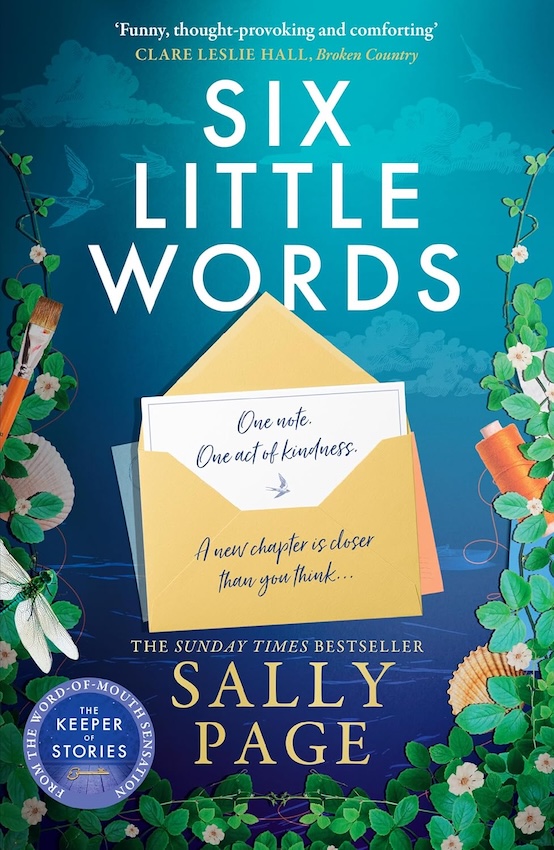
I wasn’t expecting to enjoy this novel as much as I did. Six Little Words is a second chances story following Kate, a cancer survivor whose three daughters have all left home. She loves her house in a coastal Norfolk town and the little café that’s her local. But her life is missing something, possibly family. It’s at Luigi’s café that she strikes up a friendship with Pia, Danish and effortlessly stylish, and also here that a card appears on the community noticeboard. It simply says, ‘To be or not to be’. It turns out to be a call out for anyone wanting to join an amateur art group.

At one time, before she got a “sensible” job doing accounts, Kate had been a painter, and now thinks she’d like to try oils. Somehow she convinces Pia to go to the first meeting with her. The group has been jump-started by Tay, the girl who works at the café, something for Bardy, who’s a kind of foster father, to get him out of his rut. Bardy’s sons now live in New Zealand, his ex-wife is heading there too, and he’s feeling a bit sorry for himself. A former English teacher (Mr Shakespeare), he soon gets into organising the group and the story follows what happens when you throw a bunch of strangers together and add some art.

She was a golden yellow.
That luminous tone that sits between the glistening hue of honey and a wheatfield caught in the slanting rays of an August evening. He saw it as soon as he met her. He wonders sometimes if he glimpsed it, turned to the glow, even before she walked into his classroom: dull-red exercise books held in the crook of her arm, spines nestled against her hip.
She had introduced herself – Miss Anderson … Hana – a new teacher, like him. She laughed at his name. Most did. Then left for her own classroom, his life changed forever.

We also meet elderly couple Linda, a forthright former nurse, and her husband Leonard who won’t wear his hearing aids. Lou (Luigi) is Bardy’s best friend and he turns up, perhaps dragged along by Tay. And there’s Bardy himself, who has a gift in that he sees people as colours. He writes little colour themed poems, but keeps all this a secret, pretending he wants to write stories. Others have secrets, but nobody has anything like the secret that Kate’s hiding. Not that she means to hide it, it’s just that events sweep everyone along before she has a chance to mention it.

And of course everyone’s got a problem, big or small, and over the course of the story, they come to the surface. Characters rally round, and what begins as an art group becomes something more. There’s plenty of humour in the way the characters bounce off each other, misunderstand things and eventually sort things out. There’s romance too, which keeps the plot simmering along. And then there’s the Bard. Lovers of Shakespeare will enjoy the quotations that begin each chapter.

I particularly liked the way Sally Page conjures up the Norfolk setting, with the marshes and wading birds – Leonard’s a keen bird-watcher so you learn a bit about that too. It all adds up to a lovely story, a gentle but thought-provoking read. I enjoyed the novel as an audiobook, and the reading was excellent, performed by Christine Rendel. Six Little Words is a four-star read from me.

Book Review: Tata by Valérie Perrin – an evocative story with a complex web of family secrets

Valérie Perrin is well-known for her bestseller, Fresh Water for Flowers, a book that’s been on my to-read list for a little while. So when Tata popped up on Netgalley, I grabbed the chance to read it. And I’m so glad I did. Tata (which means Auntie) is such an engrossing story, bringing us into the world of Agnès Dugain, a film director who has been unable to work since her actor husband left her. A phone call out of the blue from a small town in Burgundy informs her that her beloved Aunt Colette has died. Which would be sad news, indeed, except Agnès believes her aunt was buried in the Gueugnon cemetery three years ago.

It soon transpires that Colette lived quietly in a secluded house for the last three years, carrying a secret. Agnès leaves Paris to view the body and to discover anything she can about her aunt’s final years to solve the mystery of who is buried in her aunt’s place. The story flips back to the 1950s and the farm where Colette grew up with her little brother, Jean. There’s not much parental love, and the children are expected to work, rather than further their education. But, in spite of this, Jean is discovered to be a musical prodigy.

Colette will do anything to protect Jean, but fortunately there’s help from Blaise, both her friend and the landowner’s son from the chateau, where there’s a magnificent piano. We learn of her apprenticeship to a cobbler in the town, and where Colette finds a niche and some happiness. Meanwhile, Agnès receives from Colette’s good friend and co-conspirator a suitcase full of cassette tapes and so listens to her aunt’s story in her own words.

There are numerous plot threads, and more secrets are slowly revealed. We’re taken to Gueugnon in the 1960s, and its football team, back further to events of the war and its legacy. You read about Agnès’s own career and how she met her famous actor husband. As she looks into the past, Agnès is forced out of the slump that has taken over her since her divorce and reconnects with old friends and makes new ones. She starts to think about a new story.

Throughout are numerous cultural references, including the movies that have inspired Agnès, the music of her father, the popular fashions and songs that evolved over time. I loved coming across film titles of movies I’d also loved, such as La Double Vie de Véronique, The Piano, and Un Coeur en Hiver, which I remember from a film festival. There are scenes in cafés, although Agnès doesn’t often have any appetite, but others eat and we’re treated to that as well. But at heart it’s a story about what we will do to protect the people we love, about friendship and the ties that make us a family. It’s heartbreaking – there are cruel characters as well as terrible historical events – but it’s also hopeful, charmingy written and full of wit.

Tata seemed to me a quintessentially French novel, and while I knew nothing of this particular small town, it was easy to imagine the stone houses, the narrow streets, the little shops and cafés. And the style of storytelling seems very French as well. I loved it. I could happily have started back at page one and read it all again. Tata is due for publication on 23 June, and I read it thanks to Netgalley and Europa Editions. It’s a five-star read from me.

Book Review: My Friends by Fredrik Backman – a coming-of-age story and a meditation on life, art and love

I’ve not often read a book that took such a philosophical look at the human condition, in particular the emotional cost of loving other people and of loving ourselves. About being able to say yes to life, when all around you is pain. This sounds kind of heavy, but in Backman’s hands it never is. Not really.

My Friends begins with a famous work of art and a young girl soon to turn eighteen, who has run away from her foster home with cans of spray paint in her backpack. Lousia has had a hard start to life, and when things go wrong at an exhibition of a painting loved by all the world, she runs down a back alley, where she meets, of all people, the artist. That’s all he has by way of a name, the artist, and when Louisa meets him he’s very ill.

Before long Louisa is on a train, running from her life, and latching on to Ted, the artist’s childhood friend. They’re also lugging along with them, the painting, yes, that one. The artist had got Ted to sell everything he had to buy it back and then unexpectedly bequeathed it to Louisa, a girl with nothing and whom he’d only just met.

Yes, it’s a crazy kind of premise, but soon, shy awkward Ted is heading home on a train, reluctantly with Louisa, who never stops talking, except to listen to his story of how the painting came to be. It’s the story of a summer when four friends are turning fifteen, how their odd friendship came about, and how things are all set to change before school starts again.

“I’m not an artist, I’m -“
The janitor interrupted him so sharply that his ladder wobbled:
“You’re an artist if you create something! You’re an artist if you don’t see the world the way it is, if you hate white walls! No one else decides what art is, no one can stop you loving whatever you like, the cynics and critics can have control of all the other crap on the planet … but they can’t decide how hard your heart beats! Become whatever you want, but don’t become one of them. Art is a fragile enough light as it is. It can be blown out by a single sigh. Art needs friends, with our bodies against the wind and our hands cupped around the flame, until its’s strong enough to burn brightly with its own power. Until it’s an inferno. Unstoppable.”
The boy hesitated for a long time before saying:
“I can’t paint the way the art teacher wants. I can’t paint things. There’s something wrong with my brain.”
“That’s because you don’t paint things the way they look, you paint them the way they feel,” the janitor replied.

First Ted tells Louisa about the artist, that weird kid who tends to get bullied, until Joar steps in and fights back on his behalf. Joar is loud, brash and tells terrible jokes. It’s Joar who crashes into Ted on his bike and who brings him along to the pier – where the friends hang out. Then there’s Ali, the only girl, who is fierce and loud, and a match for Joar. The four build a tight friendship that sees them through the difficulties of their home life, each of which is heartbreaking in its own way.

The story is teased out in chapters interspersed between Ted and Louisa’s lengthy train journey, which is interrupted by all kinds of hiccups. Louisa is difficult to put up with, and yet Ted can see why the artist took a shine to her. She draws too, endlessly sketching away, though doubtful of her talent. You get a lot about the need to believe in yourself and the power of art to transform lives.

At times I did find this book lacking in pace – the kids are always getting into trouble and there are endless anecdotes about that. And that train journey seems to take forever. But it all comes together well and the there are enough surprises to keep you interested. I’m glad I read My Friends. It’s original, inventive and thoughtful and leaves the reader thinking about it long after the last page – a four-star read from me

Book Review: Eat Slay Love by Julie Mae Cohen – a never-a-dull-moment revenge comedy

I often enjoy novels in audiobook format that I wouldn’t necessarily pick up as a print copy and find some unexpected delights. Unlikely friendships lie at the heart of this story about three women from very different walks of life conned by the same man.

To Lilah, he’s Zachary, a caring, romantic man she bonded with over books at the library where she works. Lilah is in her twenties and has recently won a lottery. She’s shy and naive, but while she has a loving dad, a retired postman with a fondness for model trains, she’s very much in need of some guidance about managing her nest-egg. Zachary is always there to lend a helping hand – of course he is.

Opal is a post-menopausal fitness guru with a blunt, matter-of-fact manner determined not to let another woman fall for her ex-husband’s tricks. Only to Opal he was Zander, and three years ago, he’d disappeared with all her money. Then there’s Marina, a harried mother of three, who has just started dating again after her divorce. Xavier has helped her rediscover her sex-drive, but Opal knows that while Marina may be strapped for cash, she has just inherited her grandmother’s well-appointed house in the leafy suburbs of London, which makes her a sitting duck.

The story opens with a man at the bottom of Marina’s cellar stairs, unconscious, tied up and with Peppa Pig plasters on his head to stop the bleeding – Marina’s not completely heartless. Opal and Lilah arrive to assist – and so begins a friendship that bonds over what to do with Zachary/ Zander/Xavier. Each woman has a back story. Lilah with her love of books, her job at the library where she has to deal with a resentful colleague, and then the money, a break-in at her new house which ended in tragedy.

Marina struggles to convince her mother that she is in fact divorced and that she shouldn’t have to sell her grandmother’s house to share the inheritance with her brother and cousins. Her granny was a woman ahead of her time and knew the value of independent means for a woman like Marina. Her legacy is dependent on Marina being no longer married to her selfish, cheating ex.

Opal has never had friends before – she’s a determined business woman and not very likeable, a bully to her staff. But someone seems to be following her. Could it be Zander? Her bonding with Marina and Lilah over the Zander problem is unexpected and transformative. The story flips between each main character so we can see their insecurities around trusting the other two, their dilemmas and the dangers. Complications pile up on top of each other, bringing out new strengths the women never knew they had.

This was such a fun read, well written and bubbling with humour. The narration by three different actors (Clare Corbett Katherine Press and Rebecca Norfolk) for the three narrative voices was brilliantly performed. Eat Slay Love is a four-star read from me.

Book Review: Time of the Child by Niall Williams – a beautifully crafted period novel set in rural Ireland

This is one of those novels that rewards perseverance, opening as it does in a way a fable might begin, and taking its time with setting the scene and establishing character. The writing also takes a bit of getting used to, but once you’ve got the hang of it, you might find yourself utterly hooked, as I was.

Time of the Chid is set in Faha, a small town in Claire. It’s 1962 and we’re in the lead up to Christmas with a story centred mostly around the town doctor, Jack Troy, and his unmarried daughter Ronnie. There’s a lot of scene setting as we follow Jack on his rounds, and his reminiscences about lost love. He and Ronnie are isolated from the rest of the town in that they have no obvious social equals. Ronnie’s sister begs her to let her find a match for her, but Ronnie is happy where she is – what seems like loneliness to others is freedom to her.

Doctor Troy and Ronnie rattle around in Avalon, a large rambling home that doubles as a doctor’s consulting room, the house riddled with mice and various kinds of rot. It’s not a place you’d want to spend winter in, and the weather here is a character in itself, in various versions of wet – rain, sea mist or fog – and always chilling. Jack has a lot on his plate working in a town where people are mostly struggling to pay doctors fees in a timely manner, an ageing population and a priest who is losing his mind to dementia.

There’s also young Jude Quinlan who comes from a poor farming family, with a father who drinks and gambles away much of what he earns. We follow Jude helping his father bring the cattle to sell at the town fair and you get more on this colourful event, the characters and how the townsfolk interact with each other, the expectations and buzz as people prepare also for the Christmas season. All of this before the pivoting event of Jude discovering an abandoned baby.

The story follows what happens with the baby, rescued by the doctor and Ronnie, and secretly cared for. We get a view of an Ireland where children born out of wedlock were a shame to be whisked away by the authorities, and your imagination conjures up orphanages run by nuns and not a lot of love. The baby meanwhile captivates Ronnie and the doctor, and as Christmas looms, each separately imagines what might happen next and how to fix it.

This is a delightful read, a gentle story that packs an emotional punch, with characters that you really get to care for. It’s all particularly enhanced by the wonderful writing in spite of sentences that are often long and convoluted in an Irish sort of way, and brimming with imagery that is somehow just right. Some, particularly the humorous ones, I just had to read out loud. There’s plenty to make you think, with themes around what is the right thing to do, about guilt and atonement, the spirit of Christmas and whether there is in fact a God.

I loved this book and seeing that Time of the Child is the second novel set in Faha, will be hunting out its predecessor, This Is Happiness – there’s a third, Oh, Now to be published later this year. Time of the Child won the Kerry Group Irish Novel of the Year 2025 and is a five star read from me.

Book Review: Precipice by Robert Harris – history unfolds in a fascinating drama involving love and war

I’d not read a Robert Harris novel before, but was curious about the events Precipice describes – the indiscretion of a prime minister writing endless letters to his much younger mistress, revealing state secrets. The potential for said letters to get into the wrong hands as Britain tips into World War One.

In the author’s notes at the beginning and at the end of the book, you learn that all of the above events are quite well documented, historians have devoted entire books to the subject, and that the letters written by the prime minister as they appear in the book are authentic. My interest even more piqued, I happily plunged in.

The story begins describing the life of the Hon. Venetia Stanley, a member of a somewhat fast set known as the Coterie who live in London, enjoying the excess afforded to them by money and privilege, and amusing themselves in various daring ways. It’s the summer of 1914, and Venetia is expected to attend a boat party on the Thames, an invitation the PM, H.H Asquith begs her to cancel in favour of meeting him. He needs help with the Irish question, as he tells her in his letters. The boating trip ends in disaster, just as well Venetia cried off at the last minute, and we meet policeman, Paul Deemer.

Deemer, an invented character, is a nice contrast to the elevated world of the PM and Venetia. He’s just an ordinary sergeant at the Met, has a young brother rescued from various scrapes by a promising career in the army, while Paul having recently broken off an engagement, is not sure about his future. His parents are dead, and he’s a quiet, lonely sort, ideal for a hush-hush project with Special Branch.

Asquith writes to Venetia several times a day (postal deliveries numbered twelve a day in London at the time), the two meet at various social occasions, and go for a Friday “drive” together, where the PM shares with Venetia the burdens of his role, the decisions he is tussling with and often revealing copies of telegrams and other top secret documents. Venetia is intelligent, offers a sounding board and emotional encouragement. He’s like a politician who has made it to the top job, only to discover it’s a lot harder than he’d anticipated.

In the background, as war is declared we meet lots of the key players, such as Lord Kitchener, Winston Churchill and and Lloyd George. I’ve never read such a clear account of how WWI began, nor how agonising it was for the British government to make the final decision to declare war on Germany. As the months pass, the huge confidence of those like Churchill is put to the test as troop losses start to take their toll on morale.

This is all quite fascinating, while Paul spends his days doing things he’s not comfortable about in his new role. Harris has done an amazing job in weaving in the letters with events they describe as they unfold. But anyone wanting a riveting spy novel might be disappointed. This is much more a story about three characters and their emotional journey as the world turns to chaos. And it’s well done, carrying with it a depth of research that makes everything that happens seem very real. I’ll certainly read another Robert Harris; Precipice is a four-star read from me.

Book Review: This Story Might Save Your Life by Tiffany Crum – an original and riveting L.A. thriller with all the feels

I hadn’t a clue what to expect from this debut novel, and even looking back having turned the last page, it still seems an interesting mix of genres – by turns a psychological thriller, a dramedy and a love story.

This Story Might Save Your Life is named after the massively successful podcast hosted by besties Benny and Joy. The idea behind the show is life-threatening situations, and how to survive them. Each episode describes one such event researched by one of the team, who then asks the other, how would you escape – for instance, being caught in the mouth of a humpback whale. So yes, we’re not just talking house fires and boats capsizing.

There’s a lot of comedic banter, and it’s really the personalities of the two that make the show work. Neither Benny or Joy ever thought they’d be still doing the show years later but subscribers write in with their own near-death survival situations and it goes from strength to strength. Joy’s husband Zander has helped grow the brand, running the business side of things and even taking the show on tour.

The situation is complicated by Joy’s medical condition. She has narcolepsy, which means those closest to her are aware that she might just fall asleep at any moment. With care and meds she leads a fairly normal life. The other complication, which happens right at the start of the book, is that during the season that the Santa Ana winds threaten trees and cause general mayhem, Joy and Zander disappear from their home.

We get Benny’s story about the disappearance, the police investigation and the growing concern that the two may be in danger. Benny’s not a big fan of Zander – there’s some jealousy there between them – so his main concern is for Joy whose narcolepsy makes everything tricky anyway. Interwoven with the all the CSI, the search teams and suspicious looks from a probing Detective Keller is Joy’s story. She and Benny have a publishing deal to write a two-person memoir, so this is her story, going back to her learning to deal with her illness, make a life for herself, her meeting Benny and then Zander.

The switching between the two stories makes you beaver through the chapters desperate to see what happens next. Joy’s backstory is just as interesting as Benny’s search for clues, slowly bringing us up-to-date with potential reasons for the disappearance. The plotting is excellent, but the characters are engaging too. Joy and Benny are charming and funny – Joy captures our empathy because she’s just so positive in spite of her medical condition, while Benny’s a bit of a goof, but also intense. He’s also been through some difficulties and has a temper.

Zander is a bit of a dark card, and there are other characters who have emotional connections to the two MCs – among them Zander’s sister Mallory, and Benny’s ex, Luna, which adds further complications. It’s quite likely someone’s lying, but who? And even Benny and Joy seem to be hiding something. So there are plenty of twists that keep you eagerly reading to the end. I also loved the L.A. setting which Tiffany Crum helps you visualise – a place I’d be happy to revisit.

I read this novel courtesy of Netgalley and Hachette, Australia for an honest review. It’s a great story, and I’d certainly be keen to read more by Tiffany Crum. This Story Might Save Your Life is due for publication on 10 March and is a four-and-a-half star read from me.

Book Review: The Cursed Road by Laura McCluskey – another dark and twisty mystery set in the Scottish Highlands

When I spotted on Netgalley a second book in Laura McCluskey’s DI Georgina Lennox series, I quickly expressed my interest. I’d been well entertained by George’s first appearance in The Wolf Tree, a crime novel set on a remote Scottish Island, full of secrecy, superstition and twists. George is a stroppy character, young for a DI but has a good nose for detective work. So she’s partnered with DI Richard Stewart, an experienced avuncular sort, the good cop to George’s bad, doing his best to keep George out of trouble.

But in The Cursed Road, the tables have been turned. The traumatic events of the first book left both cops reeling, George undergoing some months of recovery and therapy, which have made her stronger, steadier. Richie on the other hand has not done the therapy, won’t look George in the eye, and has a short fuse that has their Superintendent worried. When a case comes up – the discovery of the body of a young woman in a remote corner of the Highlands – the two are sent to the town of Kirkcree to investigate, George also tasked with keeping an eye on Richie, reporting back anything that causes concern.

Emotions are running high for Richie. He’s the lead because ten years ago, a young woman disappeared from the same area. Cara Reid had a difficult start to life, lacked family support, but she always kept in touch with her younger brother, until suddenly she didn’t. Richie has never forgotten the case, blaming himself for not finding her. The new victim was found with Cara’s name scratched on her arm. The two cases must be linked, surely.

George and Richie settle in somewhat testily at their small-town inn, supposedly there for just one night to see what they can find out from interviewing the pathologist and investigating the crime scene. It would be easy to see this as a shooting accident gone wrong. Further along the road where the body was found is an exclusive resort catering to international tourists wanting to hunt deer. Investigations unearth disputes the owners have with an old Scottish family that has lived in the area for centuries in their crumbling castle. Suddenly the story is peppered with interesting characters and potential suspects.

Other people on George’s radar include the creepy guy who eyeballs George at the village pub, and the journalist Hendry Shaw who made a big story out of George and Richie’s discoveries on the island. He particularly highlighted George’s part in the case, which hasn’t helped her relationship with Richie. George doesn’t hesitate to give Hendry a piece of her mind, especially when he follows them to Kirkcree. But is he beginning to wear George down?

A curse, a hundreds-year-old feud and a ghostly apparition all add to the atmosphere in this curious case. Clues and suspicious behaviour stretch the stay of the two detectives and with that the danger level rises. The detective’s partnership is put under pressure and George has to be the mature one, adding a bit of depth to the characterisation. The story builds nicely in pace with a nail-biting finish and George shows her mettle. It all adds to a clever, original and entertaining murder-thriller and a four-and-a-half-star read from me.

The Cursed Road was published this week on 24 February. I received a review copy courtesy of Netgalley and Harper Collins Publishers Australia.

Book Review: Hamnet by Maggie O’Farrell – a story about Shakespeare, his family and the tragedy that haunted them

Maggie O’Farrell’s one of my favourite authors, but for some reason I forgot to read Hamnet. Then the movie came out and reminded me. To be fair, I wasn’t sure I would enjoy a story which involves the death of a child. And yes, there’s suffering as well as grief here. But O’Farrell also fills the book with so much life and sensation, vividly bringing you into the English countryside, the period, and the small town where Agnes/Anne and William Shakespeare live.

The first and biggest chunk of the book is a dual timeframe story which tells you how William Shakespeare meets Agnes Hathaway, when he is sent to tutor her young half-brothers. They are both extraordinary people and can see that in each other as soon as they meet. Agnes, because who wouldn’t notice a tall, striking woman carrying a falcon; and William, because Agnes can see into people with a kind of extra-intuition, and observes in the bored eighteen year old, the huge imagination and talent that will make his name.

The story flips between their love story and over a decade later when young Hamnet and his twin sister Judith are in the yard together. Judith starts to feel ill and goes inside to lie down. The twins live with their older sister and mother in a narrow house sharing a yard with Agnes’s in-laws. They are in and out of each other’s houses. But when Judith falls ill, her mother is at her brother’s farm, tending her bees. The other women, his grandmother and aunt are out, and his grandfather ill-tempered and volatile, leaving Hamnet running desperately into the street to find help.

In a few scenes, Maggie O’Farrell shows us how their family works, the town they live in, the period, and the surrounding countryside. It’s all so vivid and full of the young boy’s energy, his desperation. By the time the women return, Judith is gravely ill, and there are the tell-tale signs of the plague. Time passes slowly and fast at the same time. Hamnet’s waiting for help, then slipping into sleep next to his twin, but everyone else around them is too busy to notice where the children are, only cross they haven’t done their chores.

We all know what happens, it’s on the back cover even if you’ve forgotten the history. But it’s still nerve-wracking reading. ‘Go upstairs,’ you want to tell the grown-ups. ‘Check on your children.’ In the meantime we have the alternate chapters describing Agnes and William’s marriage, William’s ongoing restlessness, his father’s endless displeasure with him, the plans to go to London. There are peripheral characters too. Agnes’s sensible brother and bitter step-mother, the story of Agnes’s own mother, long dead, but who had an affinity with nature, and the healing skills that Agnes herself has inherited.

It’s in the last section of the book that things really come together. We are not waiting for help this time, but for William to return home, urgently sent for to see for the last time his dying child. The passing years, William’s continued absences. How it all comes together is brilliantly done and the ending is stunning. Again you have the immediacy in how O’Farrell brings you into the lives of her characters. We feel what they feel, the sensations coupled with their own internal monologue are so well crafted.

Hamnet is such a beautifully put together story, and the ending so brilliantly done that you finish the book well satisfied. This alone is worth the five stars I’m giving this book. I’m also pleased to report that Maggie O’Farrell has a new book, Land, due out in June.