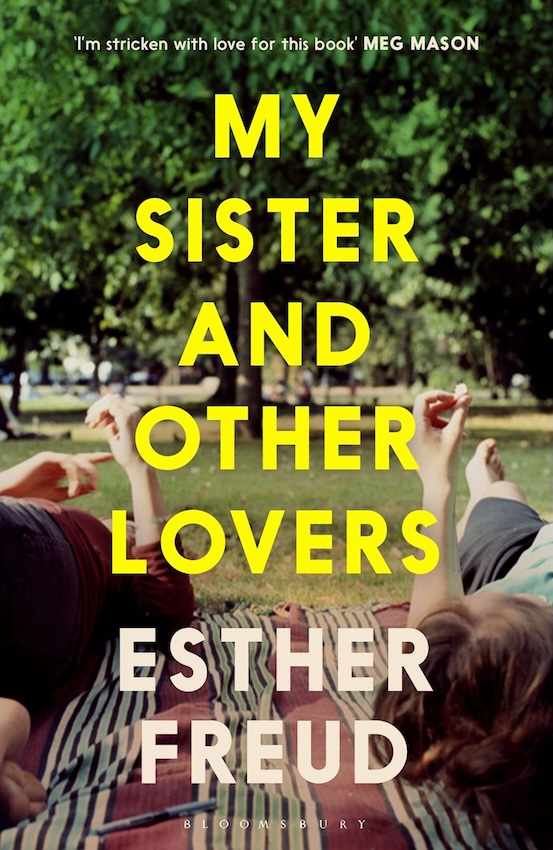
Esther Freud is one of those authors I always read, so I was eager to check out her new book My Sister and Other Lovers. It’s a return to the characters of Hideous Kinky, her first novel, also made into a film starring Kate Winslett, which is well worth a viewing too, if you can find it. The earlier story follow’s two young girls, Lucy and Bea, when their mother abruptly leaves their father, taking them to Morocco in search of enlightenment in the 1960s. Their mother is very young, parental supervision is minimal and the children often left to themselves, sometimes frighteningly so.
In the new book, we pick up the story of Lucy, now fourteen, Bea soon disappears off to university, but there’s a little brother, Max, now, and the mother has recently left Max’s father. They eventually arrive at a commune, and again there are adults behaving badly, and no one minds what Lucy gets up to.
We follow Lucy’s story, her awkward relationship with her mother, as she goes on to study drama, and the remoteness of Bea. The past is a dangerous country, but inspires Bea to make a film of their childhood in Morocco, in which she reveals she never felt safe. Lucy seems continually in search of a family, men are predatory when they see a young girl without few parental boundaries. Later it seems impossible to establish a lasting relationship with any boyfriend. Men come and go, are unpredictable, sometimes just as lost as she is. She never seems to get close enough to anyone to really understand what’s going on with them, her sister included.
It was high summer when the police arrived. Someone must have let them in, and shown them up the stairs. They stood, a man and a woman, awkward in shirtsleeves, at the door. ‘What’s this about?’ my mother asked. Max clung to her skirt.
‘We have reason to believe your daughter may be implicated in a crime.’
I blanked my face. I’d seen it: Free Astrid Proll in red letters on the bus shelter. Baader-Meinhof scrawled across the Wartlington Hotel.
‘No.’ I shook my head.
‘We have information relating to a terrorist cell.’
‘Here, in East Sussex?’ My mother laughed.
I laughed too and they turned to look at me, in my school uniform, ink from a pen I’d used to do my homework staining my thumb.
‘We have the name Lucy on a list.’
‘Wrong Lucy.’ My mother crossed her arms.
We move through the decades and Lucy eventually builds a new career, has a chance to start a family, but nothing is easy, however hard she tries. It’s a very bohemian environment described, ephemeral and sometimes insubstantial and the language reflects this. I found myself at times rereading paragraphs to discover the underlining meaning. Esther Freud’s novels often delve into the autobiographical for inspiration and I couldn’t stop wondering where the real ended and the imagined began.
Esther Freud is the daughter of Lucien Freud, the artist, as well as the great-granddaughter of Sigmund Freud. If she was ever to write an autobiography, I’m sure it would be fascinating. In the meantime, her fiction is well worth exploring. My Sister and Other Lovers is a four-and-a-half star read from me.

 Judith McKinnon
Great review Judith, sounds like a really interesting read.
LikeLiked by 1 person