Book Review: The Authenticity Project by Clare Pooley

Book connections can be puzzling. What led me to seek out this novel was probably a recommendation in connection with another book I enjoyed, but what it was escapes me. This story similarly connects random characters, one leading onto the next.

It begins when elderly Julian leaves an exercise book in Monica’s café, with the title The Authenticity Project carefully lettered on the cover. Inside Julian describes his loneliness since his wife died, and how he lost friends and relationships, now going days without talking to anyone. He closes with the challenge to whoever picks up the book to ‘tell your truth’.

Monica does. She writes about her longing for a family, in particular, a husband and a baby. She’s in her late thirties and fears she’s left it too late. But Monica doesn’t just tell her truth, she decides to help Julian. She’s looked him up online and discovered he’s a once famous artist, and a minor celebrity in his day. Her plan is to weasel him out of his cave by advertising for an artist to teach drawing at her café. He regularly stops by for coffee, so is sure to see it. She leaves the exercise book in a bar where it is picked up by Hazard, a stock broker with addiction issues and so the story goes on.

Hazard is an interesting character in that he’s a really obnoxious on the one hand, but has the self-awareness to take himself off on a retreat to Thailand to detox. Perhaps a new Hazard hides beneath all that drug and alcohol fuelled brashness. The exercise book is just the trigger he needs. He’s read both Julian’s and Monica’s ‘truths’ and decides to help Monica from his tropical hideaway.

More characters join the chain. Happy-go-lucky, live-for-the-moment Riley, an Australian gardener, who doesn’t understand the English with all their hangups. New mother, Alice, who has a social media addiction, as well as the husband and baby Monica craves. But they don’t make her happy. They’re all interesting and entertaining in their way, although it’s Monica and Hazard who are the most engaging and complex, the ones who can’t make up their mind what they want or how to get it.

The Authenticity Project is a light and entertaining novel. The changing viewpoints work well because everyone is trying to fix things for others, creating dramatic tension, and a community of sorts emerges. It made me wish Monica’s café was just up the road so I could pop in, join an art class or curl up on a sofa with a book. The references to famous people of the eighties Julian used to hang out with, his designer wardrobe and old LP collection, add plenty of colour and I loved the Fulham setting. It’s a a feel-good kind of read, maybe just the thing for the holidays with an original, well-executed storyline. I’m giving this one a three and a half out of five.

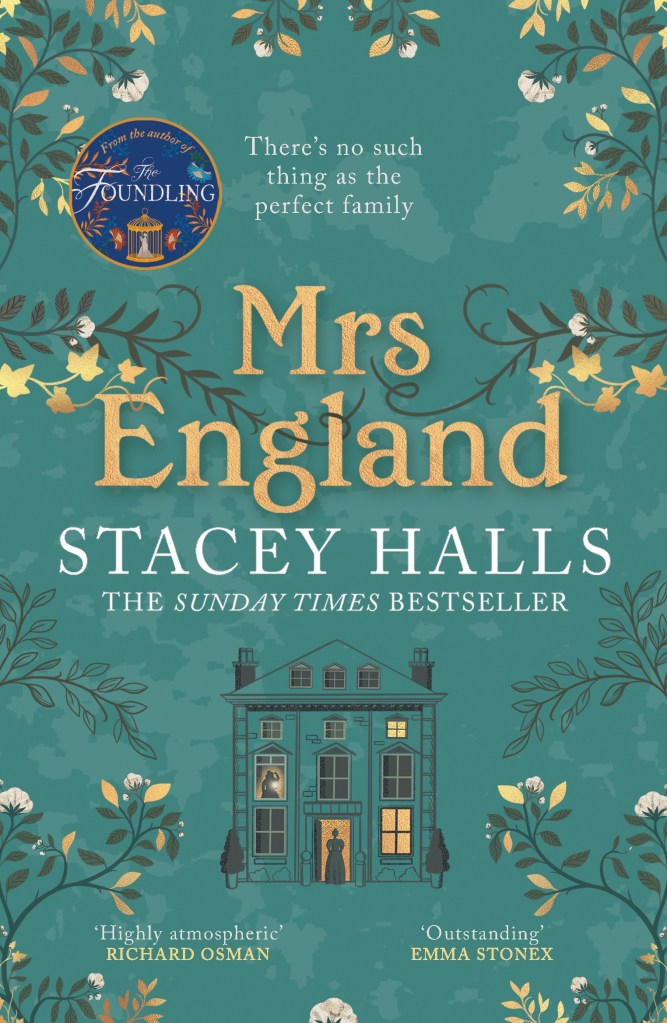
Book Review: Mrs England by Stacey Halls – secrets and suspense in a Yorkshire mill town

The blurb on the book mentioned the word ‘Gothic’ and so I opened the book expecting some chilling scenes and perhaps even hauntings. My earlier experience of this author had been The Familiars, a gripping story about witch hunts in 17th Century England. So I knew Halls could take us to some dark places. And there is a degree of darkness here, of menace even, but is it Gothic?

Certainly there’s a large stately home in an isolated part of Yorkshire. It’s mill country, and the air is thick with coal-dust from all the steam-powered cotton milling machinery. Ruby May is a Norland nanny who has just said goodbye to her first family now they’re off to Chicago. She’d love to go too, but her own family need her. She’s a humble grocer’s daughter from Birmingham and there’s a tragedy in her past that has left her hating her father and with a disabled sister.

She takes the only job on offer – nobody wants a nanny in the summer holiday season – to take charge of four children ranging from a year to ten year’s old. Mr England’s old nanny has died and the children soon warm to Ruby, who takes them on outings and supervises a better diet. She is almost like the mother to them – Mrs England rarely leaves her room. Mr England makes up for his wife’s lack of engagement with her children by being an affectionate father and is surprisingly friendly to Ruby, which she finds disconcerting.

Other characters include Mr Booth, young Saul’s tutor, who confides in Ruby that there’s something not quite right in the household. Blaise, the housemaid, is plain spoken and haughty towards Ruby, as if she suspects Ruby might lord it over the staff and wants to nip any such superiority in the bud. We meet Mrs England’s family, the Greatrexes, who own a larger mill and even a town, and with whom Mrs England has a strained relationship. So Ruby is caught between upstairs and downstairs, not quite a servant while having to tiptoe round the feelings of her employers.

Thank goodness she warms to the children, but you can’t help feeling that they could be in danger and this drives the plot. There’s a hint of The Turn of the Screw by Henry James, so perhaps that’s where the Gothic quality lies. Ruby does all she can to keep the children safe, but she can’t do it all alone, and who can she trust? The story builds to a dramatic ending and although it takes a while to get going, it’s still really engaging. I think this is because Ruby herself is interesting: her worries about her own family and in particular her falling out with her father. Halls feeds out just enough information to keep you curious.

One story thread of Mrs England is based on an event that really happened, which is briefly described in a note at the end of the novel. If you want to maintain the maximum suspense as you read, don’t read this until you finish the story, but it is extraordinary. I like the way Stacey Halls seems to draw inspiration from real events for her novels – she is turning out to be one of my must-read authors. She really gets under the skin of her characters, bringing the past to life and this book continues the trend. It’s a gently cracking read and gets a four out of five from me.

Book Review: Unsettled Ground by Claire Fuller – an atmospheric and psychological story set in rural Wiltshire

I’ve had my eye out for this book ever since it was shortlisted for the Women’s Prize for Fiction. Unsettled Ground is the story of twins, Jeanie and Julius Seeder, who at fifty-one are still living at home with their mother, Dot, when she suddenly dies. All at once they have to figure out what to do, how to manage. Dot obviously took care of the family finances, but the cake tin that stored all their cash, from Julius’s odd jobbing and the women’s piecemeal market gardening, is virtually empty. Their electricity has been disconnected because of unpaid bills, then Jeanie discovers even more debts, to say nothing of the funeral costs.

Unfinished schooling, a basic, almost off-the-grid lifestyle and a lack of real-world experience mean the twins struggle to figure out how to make ends meet or get the help they need. Jeanie is barely literate, while Julius was traumatised when his father was killed in a farming accident, which means he can’t travel by car without motion sickness. Bridget, their mother’s old friend grudgingly drives Jeanie to appointments while pouring out unwanted advice. When their landlord’s wife issues an eviction notice unless arrears in rent of thousands of pounds are paid off, things are desperate indeed.

The plot pulls you in from the start as curve-ball after curve-ball are lobbed the twins’ way. You read on hoping they make a break from the past to find some happiness. Or, at 51, is it too late? Julius has always resented the need to stay, his mother, Dot, using Jeanie’s fragile health to keep him around. Dot had always felt that making music, gardening and living off the land were all that anybody needed, creating a small family sanctuary. But all it does is fill the twins with mistrust towards the agencies that might help them and the bullying they received at school casts a long shadow.

Told from Jeanie and Julius’s point of view, you have immense sympathy for these characters, while getting a taste of what it’s like to live in a small, insular community that isn’t always kind. And at the heart of it all are one or two family secrets that will overturn everyone’s assumptions. It’s an interesting psychological study of maternal love, guilt and fear inspired by ignorance. The setting of rural Wiltshire during a cold snap in spring is an evocative background – you get the sense of nature in all its glory, ready to invade, to rot and overrun.

It’s a bit like there are two sides to everything here – the good and the bad: the good side of mothering and the dark turn it can take; of neighbours, of nature and of love. It’s a powerful story that gives you lots to think about as well as a cracking good read, with more than a hint of the old adage: be careful what you wish for. The saving grace for the twins is music, peppering the story with old folk songs that Dot has passed on to her children. Claire Fuller used a playlist while writing the book which she describes here on her website. This is my first novel by Claire Fuller, and I am sure it won’t be my last. Unsettled Ground earns a four out of five from me.

Book Review: Sorrow and Bliss by Meg Mason

This novel is a very intimate look at someone’s mental illness, which could in itself drive the reader into a depressed state if it weren’t for the scintillating prose which is a times laugh-out-loud funny. Martha Friel is turning forty at the beginning of the book, her marriage crumbling around her, as she looks back at her life to pinpoint the moments of significance to try and make sense of it all.

She is the child of eccentric parents. Her mother is a sculptor of minor significance who drinks a lot and drives her father, a poet who cannot quite bring himself to publish a long awaited collection, to leave them. You could say the apple doesn’t fall far from the tree when you look at Martha and her mother, who is difficult and at times cruel. But her father always returns, shutting himself away in his study among his books and poetic thoughts. Martha has a sister, Ingrid, who manages to lead a more balanced life, marrying Hamish and producing unplanned-for children with alarming regularity.

Then there is Aunt Winsome and Uncle Rowland who live in Belgravia and have funded Martha’s parents’ house and the girls’ schooling because being an unpublished poet and a sculptor of minor significance is no way to support a family. There are cousins, Nicholas, Oliver and Jessamine, as well as Oliver’s friend Patrick who’s father lives in Hong Kong and who has nowhere else to go at Christmas. As well as the closeness between the two sisters, much of the story is that of Patrick and Martha’s relationship.

That is what life was, and how it continued for three years after that. The ratios changing on their own, broken, completely fine, a holiday, a leaking pipe, new sheets, happy birthday, a technician between nine and three, a bird flew into the window, I want to die, please, I can’t breathe, I think it’s a lunch thing, I love you, I can’t do this any more, both of us thinking it would be like this forever.

Martha’s terrible rages, her problems with sounding normal at work or at parties, her unreliability, her snarky remarks, make her difficult to get on with and yet she inspires great affection from those who make the effort. She’s smart and shows odd moments of empathy.

The reason I had gone to London was for Peregrine’s funeral.
He had fallen down the central staircase at the Wallace Collection and died when he struck his head on a marble newel post at the bottom. One of his daughters gave the eulogy and looked earnest when she said it was exactly how he would have wanted to go. I wept, realising how much I loved him, that he was my truest friend, and that his daughter was right. If it hadn’t been him, Peregrine would have been acutely jealous of anyone who got to die dramatically, in public, surrounded by gilt furniture.

And while we get to see what Martha’s unspecified condition looks like, and the difficulties of getting appropriate medical help, the novel also gives thought to what makes people happy, the simple things often that people take for granted. Maybe it’s only when life is at its darkest, that you get to really understand this. I loved the characters in particular. Martha’s family are individually either odd or difficult, but they are all interesting and have their redeeming points. Patrick has his own sorrows – his lack of family, his struggles with his problematic love for Martha.

Meg Mason writes with such flair and understanding I surprised myself with how much I enjoyed Sorrow and Bliss. It is one of those funny/sad books, which can be entertaining and profound in equal measure. Mason is a New Zealand born author who lives in Sydney and this is her first book published in Britain. It is easily one my favourite reads for the year and really deserves its five out five from me.

Book Review: The Famished Heart by Nicola White – an unusual crime story set in 1980s Dublin

I picked up The Famished Heart, initially thinking it would be a bit like Dervla McTiernan’s brilliant crime series featuring Cormac Reilly. They both have lead police officers who don’t fit in with their colleagues and a boss who probably doesn’t like them either. You get a good deal of police station politics in both. But this book is more of a slow-burner that reminded me of some of Ruth Rendell’s Wexford novels (now there’s a blast from the past!) with its focus on a small community and psychological drama.

We’ve got three main narrative points of view. Father Timoney is the unlucky priest called to visit two middle-aged sisters in his parish who haven’t been seen in weeks. What he finds would shock even the most seasoned of clerics: the Macnamara sisters have apparently starved to death, possibly willingly for religious reasons. Timoney has his own problems too. He’s only been in his parish a few months, has a dwindling congregation, an unheated church that is an architectural monstrosity, and a spiteful housekeeper. Throw in back pain and a lack of confidence and he’s really struggling.

Frances Macnamara is the sister that got away. She’s a glamorous actress who, now in her forties, is finding it hard to get well-paid roles, leaving her strapped for cash. She’s in New York when she receives the news of her sisters’ deaths. Flying home she teams up with a niece who was supposed to look in on her aunts, but there’d been a falling out with the older sister and she’s living in a grungy flat. So there’s nowhere for Frances to stay but in the house where it all happened. They soon get the keys because the police don’t think the deaths suspicious.

Well, Detective Inspector Vincent Swan thinks they’re suspicious; someone’s wiped any fingerprints from the door handles and made a crude arrangement of some ornamental animals. But Swan’s being stood down while there’s an investigation into police brutality. He’s not a violent man, unlike the two officers also under investigation, the kind of officers he really doesn’t get along with. Just as well Detective Garda Gina Considine is on the job. She’s the only female officer on the team and suffers sexism on a daily basis – this is Dublin in the ’80s, after all. But she’s smart and a good pairing for sensitive and thoughtful Swan.

Just when you think this story is all about religious mania – and to some extent it is – another death leads our two detectives in another direction and the plot really heats up. You finish the book thinking this is a satisfying mystery, but you’ve also come to know the characters really well. White writes about relationships superbly – throwing people together and seeing how they spark off each other and then come to new realisations. This makes you want to check in with Vincent Swan another time, so it’s good news that this is the start of a series. The second book is an earlier novel and book number three is out next year. A Famished Heart scores a four out of five from me.

Book Review: The Wildling Sisters by Eve Chase

Stories featuring old houses in the English countryside and a dark secret from the past are always entertaining. Throw in four sisters on the brink of adulthood with a glamorous but unreliable mother, two dangerous young men and an aunt who is, well, a bit batty and you’ve got the ingredients for an engrossing read.

The Wildling Sisters (or The Vanishing of Audrey Wilde) starts off with a body being dragged to a hiding place, a brief scene laced with foreboding, then flips to 50 years later when a young family are considering buying a crumbling mansion in the country. They are escaping London to start again. Jessie and Will have a preschool-age Romy in tow, as well as Bella, Will’s teenage daughter. Bella is surly and uncommunicative following her mother’s death and having to cope with a step-mother. An incident at her London school had her expelled and also makes Jessie uneasy about Romy’s safety.

The family discover Applecote, a large country house in need of repair that also bears a shadow – the disappearance of twelve-year-old Audrey Wilde in the 1950s. The locals won’t come near it and while Will gets stuck in London for work, Jessie has to deal with the burden of the new move and Bella’s bad behaviour with little support.

The story flips back to the heatwave of a 1950s summer that sees the four Wilde sisters staying with their distracted Aunt Sybil and peculiar Uncle Perry. Grief over their missing cousin Audrey consumes Sybil, and Margot at fifteen is aware of how similar she is to Audrey. She sneaks into Audrey’s room, a kind of shrine to her cousin, and admires her clothes.

And the sisters are a little wild to be sure. They’re also beautiful and have the confidence of their class and having a mother who hasn’t imposed a lot of rules. It’s just as well they have each other to rely on. Things get complicated when Harry Gore from the neighbouring estate and his friend Tom turn up by the river and flirt with the girls.

Yes, there’s a river – the logical place for Audrey to have disappeared, but there are also standing stones that add an air of youthful sacrifice, and endless summer heat that stirs the emotions. Margot tries to get a sense of what happened to her cousin, while dealing with a yearning for Harry and an emotionally demanding aunt.

There’s plenty to keep you turning the pages here; Chase keeping you guessing with cliffhangers at the end of each chapter as the story flips back and forth between narrators. Each of our main characters, Jessie, Margot and even Bella, have to deal with worrying events, as well as their tentative place in their families. This lifts the novel above being just a story about a scary house with a dark secret. Both Jessie and Margot will learn a lot before the end of the book when the puzzle pieces finally slot into place.

I really enjoyed my first Eve Chase novel. It’s a bit like reading Katherine Webb crossed with Ruth Ware and the writing is crisp and elegant too. A great escapist read, The Wildling Sisters gets a four out of five from me.

New Books for the Must Read List

Towards the end of the year, all the new books appear that publishers are keen to push for Christmas. Here’s a look at some of the titles I’m excited about, most of them authors I’ve read before and admire hugely.

The Magician by Colm Toibin
This novel describes the life of Thomas Mann, a complex man, winner of the Nobel Prize for literature, and a secret homosexual, living in Munich among the bohemian and intellectual set. This in itself makes for an interesting story. But throw in the rise of Naziism, the rumblings of war and the development of fascism and communism across Europe, and the scope of the novel expands hugely. At one time I really enjoyed the novels of Thomas Mann. I found them engrossing for the richness of the writing, the characters and the way they captured an interesting time and place, so this one is definitely one for the list.

The Gardener by Salley Vickers
This novel about two sisters who buy a cottage in the country with an overgrown garden, and the Albanian gardener they hire to tame it, is sure to be a good read. Family dynamics, secrets and an English rural setting are always appealing in fiction. Vickers is a terrific writer as she puts her own varied careers as an actress, cleaner and psychoanalyst to good use in her novels. She is wonderful with characters and the turning points in their lives that define them. I loved Dancing Backwards, Cousins and Miss Garnet’s Angel so I am really looking forward to this one.

Oh, William by Elizabeth Strout
Lucy Barton is a character who crops up here and there in Elizabeth Strout’s novels set in Maine. Not so long ago, she had a book to herself – My Name Is Lucy Barton – and her story continues in the new book which according to the blurb captures ‘the enduring bond between a divorced couple in a poignant novel about love, loss and the family secrets that can erupt and bewilder us at any point in life’. Some readers may regret the story doesn’t focus on that unforgettable character Olive Kitteridge, but I’m rather glad to have the chance to check in with Lucy again.

Lily: a tale of revenge by Rose Tremain
Tremain has been writing stellar novels since the 1970s. I loved The Gustav Sonata and The Road Home for the plotting and characters written with immense humanity. The new book is set in Victorian London, following the life of a foundling, her attempts to make a living for herself and the terrible secret she hides. It sounds a gripping story in itself with an atmospheric setting but add Tremain’s brilliant credentials as a novelist and this is sure to be a very satisfying read.

A Woman Made of Snow by Elisabeth Gifford
Not long ago I reviewed The Lost Lights of St Kilda, a wonderfully atmospheric historical novel based on a community eking out an existence on a wild Scottish island. Now we’ve got a new story, similarly set in a remote part of Scotland, with an old country estate, family secrets and a kind of cold case mystery at its heart. Gifford is becoming one of those authors you can depend on for an engaging and haunting read so here’s one for the bedside pile.

The Shadows of Men by Abir Mukherjee
Making its way to the top of my list is the new Wyndam/Banerjee novel set in 1920s Calcutta. While these are mystery novels in one sense, they also describe a lot of the politics of the day, the rule of the British and the racial tensions that simmer beneath it. There’s heat and dust, the heady 1920s, class and privilege. The writing is witty, and Mukherjee doesn’t stint from throwing Wyndham into some truly precarious situations to keep the plot simmering. In The Shadows of Men, the two policemen investigate the death of a Hindu theologian while the city is on the brink of religious war.

Book Review: Take Nothing With You by Patrick Gale

I thought this novel was going to be about a man facing down cancer, but it’s actually a coming of age story, bracketed by what might be a very treatable cancer diagnosis and a new relationship. And music. I love novels that take you on a journey of your own. With Take Nothing With You, I found myself visiting YouTube to discover or rediscover the beautiful cello pieces described in the book.

Eustace lives with his parents in an elegant inherited house in Weston-Super-Mare. His parents run it as a rest home, which makes for Eustace, their only child, an unusual childhood. While he must be quiet and not disturb the guests, he is also left a lot to his own devices. It’s a family living in a kind of genteel poverty; they never go away on holiday because they live at a seaside resort – what could be nicer?

As he grows up, a cello concert is a revelation and brings Carla, his new music teacher into his family’s world. Carla is warm and intuitive, passionate and generous. She spots a talent in Eustace and fosters it, as well as striking up a fond friendship with Eustace’s apparently friendless mother. You get a lot of music detail as Eustace learns about fingering and the complexities of playing solo or with a group. If you like classical music this is really interesting and Gale has the insight of an accomplished musician. As Eustace develops musically, he also becomes aware of his sexuality and this forms another thread in the story.

Eustace is a sensitive character who always seems to be just missing out. At the start of the book he has just fallen in love, while receiving a cancer diagnosis. His education is full of missteps as well. The reader wants him to reach out and grab life with both hands. In the background, his parents’ restrictive lifestyle, strains upon their marriage, his mother’s moment of recklessness all affect the story in interesting and dramatic ways.

Patrick Gale writes with warmth and wit creating a brilliant story arc that captures the man that is Eustace, as well as the boy. The subordinate characters are just as interesting, each empathetic in their own way. And the settings: the Somerset seafront town, the music school in Scotland, plus the 1970s, are evocatively created here too. I don’t know why it has taken me so long to read this, but it was a complete joy because Gale is such a beautiful writer. And I am delighted to see that he has a new novel out early next year. This one scores a four and a half out of five from me.

Book Review: The Hunting Party by Lucy Foley – a tense mystery that keeps you guessing

This novel is very similar in structure to The Guest List, Foley’s later book (which I reviewed last year) so it’s hard not to make comparisons. Both use the same before and now time shifts and leave the reader guessing not only who the murderer is – there are multiple candidates – but also the identity of the victim. The cast of characters – victims, witnesses and suspects – is cut off from the world by a weather event in both books. So beginning the earlier book, I asked myself, should I feel a little short-changed?

But in no time The Hunting Party swept me off into the story, because Foley is superb at creating tension and drama. The scenario is a group of nine friends who take the train for a weekend away in Scotland to see in the New Year at a remote hunting lodge. Most of them have been friends since university, although it is Emma, a more recent addition to the group, who arranges everything. She’s here as she’s Mark’s girlfriend. Mark is Julian’s best mate and Julian is married to Miranda, and these two are the alpha couple of the group. Julian and Miranda are fabulously wealthy and incredibly good looking. They seem to have it all and as we know that means trouble, particularly with their continued disregard for other people’s feelings.

The lodge is run by two live-in staff. Heather, recovering from loss, prefers her own company and the quiet of the remote setting. Doug is also running away from something – a checkered past that includes PTSD from his stints as a soldier in Afghanistan. His past is littered with violence, and he’s in charge of the shooting. You can’t help wondering what it might take to set him off. The presumptuousness and bad behaviour of a group of drunk friends might just do the trick.

Not long into the story there is a snow storm which turns the hunting lodge and its grounds into an island. When a body is found, emergency services are unable to send help until the weather lets up, leaving Heather and Doug to manage the situation – two very fragile people.

As I said, Foley is a master at building tension, the before and now time-frame keeps you guessing, but slowly fills you in with what’s going on in the heads of several characters, as well as their interactions with others. The party of friends are mostly people you wouldn’t want to spends a lot time with. There are supreme displays of arrogance and one-up-manship, and multiple secrets. Games of Twister and Truth or Dare oiled with an abundance of alcohol as well as drugs don’t help. It’s easy to empathise with Heather and even Doug, who appear vulnerable. Can they trust each other enough to keep things from boiling over?

The story bounces along to a tense ending where more violence is set to happen and the method and motives keep you guessing till the end. Overall I had to feel happy with the story as I was well entertained. The audiobook version I listened to was well-done and brought the book to life superbly. But I wonder if Lucy Foley will break out with a new type of story for her next novel. A better class of beach read, I’m going to give The Hunting Party a three and a half out of five.

Book Review: I Couldn’t Love You More by Esther Freud – three women and the secret that divides them

Esther Freud’s new novel looks at the impact of a secret adoption on three generations of women. When Kate tries to find her birth mother, she’s not really at a good place emotionally to deal with what she might find. Her relationship with Matt is going through some difficulties and she has her daughter, Freya, to consider. Freya seems to be oddly obsessed with death for one so young. And then there’s the idea in the back of her head – why did her mother give her away? And it’s too difficult to discuss all this with her adoptive mother, who could so easily feel betrayed.

If you could give me … I try out the phrases as I help prepare the lunch, but my mother is explaining the best way to make gravy and I don’t interrupt. Afterwards she takes Freya to say goodbye to the bees. She has three hives, white clapboard, a surprising hobby for someone so concerned with peril.”

The story flips through the years to tell the story of Kate’s mother, Rosaleen, beautiful and headstrong, who escapes Ireland at eighteen for London. Her much older lover, an up and coming sculptor, has found her a job at a London newspaper where she works in the mail department, although that’s not what she tells them back home. Her family believe Rosaleen is a journalist, and her name will appear in bylines in the Express any day.

Meanwhile back in Ireland, Rosaleen’s mother Aoife (pronounced Eefa), can’t help missing her eldest daughter. Her story takes us through her marriage to Cashel, whose strict notions of propriety echo that of many Irish households in the mid 1900s. A girl who becomes pregnant is no better than she should be and must be hidden away in shame, her baby taken to a respectable family. We see the other side of this, the convents who ran laundries on the back of the free labour young pregnant girls offer in return for board and secrecy.

This is a story that has been told before, but Freud makes it fresh through her empathy for her characters. We’re taken back to the sixties, and a slice of the artistic Demi-monde, through the eyes of a young girl who for a budding reporter, doesn’t ask nearly enough questions. We’re also back in rural Ireland, with farming and rain and the endless round of chores. And then there’s Freya’s world, herself an artist, working as an art therapist, when maybe she needs a bit of therapy herself.

It’s always a joy to read Esther Freud and this novel didn’t disappoint. It took me a while to settle into the style though. I know we read a lot of books with multiple narrative viewpoints and these were clear enough through chapter headings. But the time switches confused me a little to begin with. Perhaps the disjointed time frame mirrors Kate’s state of mind – she doesn’t know where she is with Matt, her job, and the past keeps intruding on her thoughts.

If you want to read a book that takes you right into the hearts of its characters, revealing their pain – there’s a lot of it here – and their struggles to make a future, I Couldn’t Love You More is a terrific read. It’s also a powerful reminder of historic injustices against women and that the feminist movement has come a long way. The scenes in the convent that takes in Rosaleen are horrific. It’s a moving story told simply and elegantly and after a break since Mr Mac and Me (seven years!), worth the wait. Let’s hope there’s another book around the corner as Freud’s one of my favourites. A four out of five read from me.