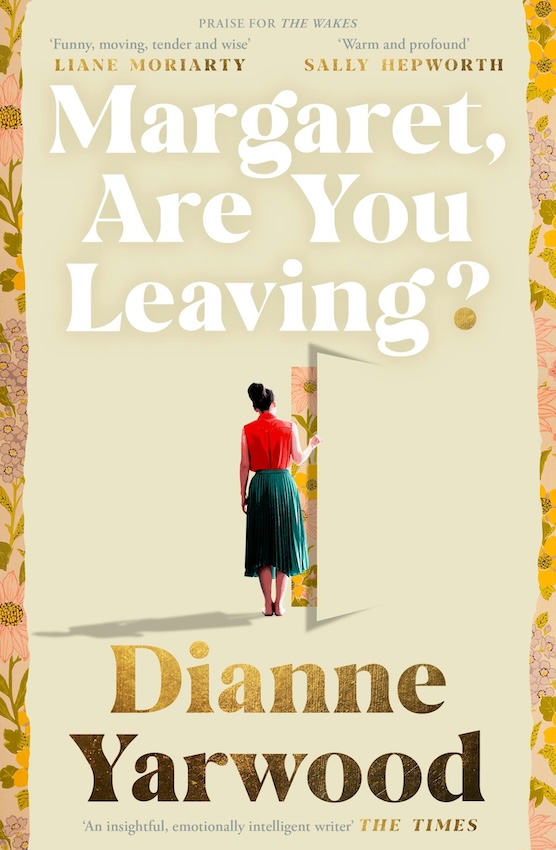
Book Review: Margaret, Are You Leaving? by Dianne Yarwood – an empathetic, insightful story about finding your roots

Yet another book about a character coming to terms with her family’s past, but no less enjoyable for all that. I’d chosen the book for its interesting and attractive cover – yes, covers do matter – and was soon engrossed in Maggie’s story. She’s an engaging character, a real live-wire, now in her forties. We’re in Sydney a couple of decades ago and Maggie’s at work where she fields calls from viewers for a television channel. She’s interrupted by a phone call from her brother Lucas with the news that her adoptive mother is dead.

The news is a shock, but not because of grief, but rather because it reminds Maggie of her terrible childhood. Lucas also reveals that he has found some documents about Maggie’s birthmother, but she’s reluctant to go down that path, aware that the woman gave her up when she was two, and that makes two mothers that were unable to love her. The book follows Maggie’s eventual decision to find out more about her origins and the journey that takes her.

When Maggie’s not at work at the station, she also has a job as a part-time teacher aide, which she loves and has a talent for. She’s particularly good with troubled children, seeing in them the need for connection that she had missed out on. You can’t help thinking what a terrific mother she’d have been herself.

I loved the character of Maggie, who really carries the novel. She’s madly enthusiastic for cooking – there’s lots of delicious food described – and when she’s unhappy, goes fishing, whatever the hour. I particularly loved her dog, a pointer called Brian, who strikes me as one of the best literary dogs I’ve met.

She drove to Rodd Point and parked by the water, then set herself up on the stone sea wall with Brian locked by her side. The water was inky and changing in the moonlight. She wore a small head torch and it lit up her hands, the fishing line, the ledge where she sat with her legs dangling over its edge.
It occurred to her that she’d come here to scream. To scream and scream and not be heard. But there was someone else. A little further along a man stood on one of the small rocky ledges in front of the wall. Fishing as she was. Alone and quiet as she was.
So instead she held one finger on the line waiting for movement and worked to fend off despair. Her chest rose and fell, water lapped. Brian lay beside her with his head resting on her leg.

Maggie also bonds with her TV channel co-worker Anna, who has her own mother-related subplot. As an Englishwoman having settled in Australia, Anna desperately misses her family back home – particularly her mother. This mother is the opposite of Maggie’s mother, the two phoning each other most days, while Anna’s own home life revolves around children and family.

The story reveals some sad truths about Australia’s immigration history – particularly the difficulties European migrants found adjusting to life in Australia, often carrying the burden of their wartime experiences. Maggie’s experiences in institutional care as a troublesome child also make for sobering reading. In the Author’s Note at the back of the story, more of this is explained plus that this book is inspired by the life of the author’s friend.

But the overall feel of the book is uplifting, a feel-good read due to the empathy Dianne Yarwood creates for her characters, even the not very nice ones. There’s wisdom and humour as well, and maybe it was a little too feel-good for me, but you can’t help wanting a happy ending for someone who has had so much sorrow. Margaret, Are You Leaving? is a three-and-half star read from me.
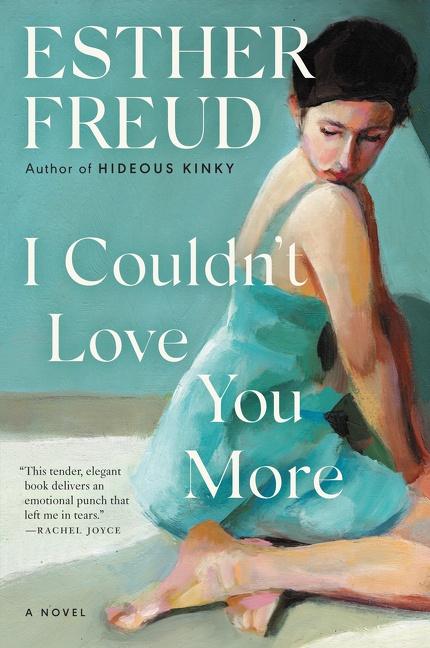
Book Review: I Couldn’t Love You More by Esther Freud – three women and the secret that divides them

Esther Freud’s new novel looks at the impact of a secret adoption on three generations of women. When Kate tries to find her birth mother, she’s not really at a good place emotionally to deal with what she might find. Her relationship with Matt is going through some difficulties and she has her daughter, Freya, to consider. Freya seems to be oddly obsessed with death for one so young. And then there’s the idea in the back of her head – why did her mother give her away? And it’s too difficult to discuss all this with her adoptive mother, who could so easily feel betrayed.

If you could give me … I try out the phrases as I help prepare the lunch, but my mother is explaining the best way to make gravy and I don’t interrupt. Afterwards she takes Freya to say goodbye to the bees. She has three hives, white clapboard, a surprising hobby for someone so concerned with peril.”

The story flips through the years to tell the story of Kate’s mother, Rosaleen, beautiful and headstrong, who escapes Ireland at eighteen for London. Her much older lover, an up and coming sculptor, has found her a job at a London newspaper where she works in the mail department, although that’s not what she tells them back home. Her family believe Rosaleen is a journalist, and her name will appear in bylines in the Express any day.

Meanwhile back in Ireland, Rosaleen’s mother Aoife (pronounced Eefa), can’t help missing her eldest daughter. Her story takes us through her marriage to Cashel, whose strict notions of propriety echo that of many Irish households in the mid 1900s. A girl who becomes pregnant is no better than she should be and must be hidden away in shame, her baby taken to a respectable family. We see the other side of this, the convents who ran laundries on the back of the free labour young pregnant girls offer in return for board and secrecy.

This is a story that has been told before, but Freud makes it fresh through her empathy for her characters. We’re taken back to the sixties, and a slice of the artistic Demi-monde, through the eyes of a young girl who for a budding reporter, doesn’t ask nearly enough questions. We’re also back in rural Ireland, with farming and rain and the endless round of chores. And then there’s Freya’s world, herself an artist, working as an art therapist, when maybe she needs a bit of therapy herself.

It’s always a joy to read Esther Freud and this novel didn’t disappoint. It took me a while to settle into the style though. I know we read a lot of books with multiple narrative viewpoints and these were clear enough through chapter headings. But the time switches confused me a little to begin with. Perhaps the disjointed time frame mirrors Kate’s state of mind – she doesn’t know where she is with Matt, her job, and the past keeps intruding on her thoughts.

If you want to read a book that takes you right into the hearts of its characters, revealing their pain – there’s a lot of it here – and their struggles to make a future, I Couldn’t Love You More is a terrific read. It’s also a powerful reminder of historic injustices against women and that the feminist movement has come a long way. The scenes in the convent that takes in Rosaleen are horrific. It’s a moving story told simply and elegantly and after a break since Mr Mac and Me (seven years!), worth the wait. Let’s hope there’s another book around the corner as Freud’s one of my favourites. A four out of five read from me.