Book Review: Tenderfoot by Toni Jordan – a coming-of-age novel set in the world of greyhound racing

There has been a lot about the greyhound racing industry in the news lately, with information coming to light over the cruelty towards the dogs, the frequent euthanising of young animals. This novel couldn’t be more timely but I didn’t need a lot of prompting to pick it up, having immensely enjoyed Toni Jordan’s previous novels, Dinner with the Schnabels and Prettier if She Smiled More.

Tenderfoot by Toni Jordan, is a coming-of-age novel about 12-year-old Andie. Set in 1970s Queensland, Andie narrates the story, decades later, of the year her parents marriage ended and she lost her dad, and with him the four greyhounds that made up his business.

Andie loves those dogs, especially Tippy, but they are not pets. We are introduced to the nefarious world of greyhound racing, gambling and addiction. Jordan keeps what really happens to the dogs off centre stage, which is fortunate, so we never really know the specifics of what happens to Shep, Crumbs, Sally and Tippy who used to live in the basement – the how and the when. Anyone who has a fondness for dogs might still find this sobering reading, so be warned.

Through it all Andie is a brilliant character, determined to win back her dad, her friends and her dog, solve the mystery of what happened to Macavity, her former bestie’s cat. All this despite her difficult mother, Mum’s shady boyfriend Steve, and a world that seems to block her ambitions at every turn. Andie is a determined battler with an eternal optimism that she can make everything normal again.

Jordan balances the seriousness of what happens – a promising child of parents who constantly let her down, the greyhound and gambling business, the adults with their own demons – with humour that comes from children interacting with adults who aren’t as adult as they should be. The characters come to life through dialogue, something the author does really well – the caustic remarks and endless criticism from Andie’s Mum, the sly innuendo that bounces between her and Steve, the playground politics that Andie struggles with.

Jordan recreates the 1970s, down to the choice of sweets available at the corner store. You also get a scorching Queensland climate for plenty of atmosphere and a poor neighbourhood where gambling is for some the only hope. It all comes together well for a thought-provoking and moving read – five stars from me. I read the novel courtesy of Netgalley. Tenderfoot is due for release on 26 August.

Book Review: Stone Town by Margaret Hickey – atmospheric outback noir and a new case for our troubled cop

This book is the second of Hickey’s books featuring Detective Senior Sergeant Mark Ariti, whose life was going nowhere in the first book, Cutter’s End, until he was rescued by a case that took him back to where he lived as a boy. Now he’s living in his late mother’s house in Booralama and has taken charge of the local police station with a wider region of small towns to look after. This is rural Australia, north of Adelaide, and Mark soon has a new case, bringing us to the small town of the title.

Mark is called out on a night of torrential rain. Three teenagers have discovered a body on land that was once mined for gold, now popular with bird-watchers. But what was Aidan Sleeth doing, wandering about at night, some distance from home. A property developer, he’d been buying up land to turn what was a haven for wildlife into sections for new homes and making enemies along the way. Which might be why he’s been shot in the head, execution style.

As it often goes in these country towns, no one wants to talk about it. The teenagers are too upset, their families protective. The neighbours are reluctant to get involved. Whether Mark likes it or not, two detectives are sent from Adelaide to help with the case, both in their own ways arrogant, the senior detective taking over his office, the junior detective making brash comments that jar. And they’re more worried about a missing officer than the murder they’re supposed to be investigating.

Detective Sergeant Natalie Whitstead has been doing surveillance work on the wife of an organised crime boss, Tony Scopelliti, currently serving a sentence in prison. When her car is discovered near Stone Town, Mark can only assume she’s dead, her body thrown down a mineshaft. Brief chapters in italic type would suggest otherwise, making the reader feel like a child calling out at a Punch ‘n Judy show, “she’s over here” and hoping the police will find her in time.

Of course the two cases will at some point converge, and Mark, an experienced and sensible officer, will show up the Adelaide cops, who turn out to be more complex characters than first assumed. If that isn’t enough, his old mate Superintendent Conti has warned Mark that there’s a leak to suggest one of his new colleagues is getting information back to Scopelliti. Can Mark keep an ear out?

So Mark has a lot on his plate. To make things more interesting, he’s going through a few personal issues: missing his kids since his divorce, grief for his late mother, as well as that feeling you have when you’re over fifty and back at your childhood home – a sense that life has passed you by. As a reader you can’t but like the guy but also you worry about him.

What I really liked about the story was the way Hickey captures rural life, particularly the old allegiances among people who have grown up in an area and unfortunately for some, know all their secrets. Wherever Mark goes, people fondly remember his mother, a woman who was close friends with fellow members the Country Women’s Association, who to many seem to have a strong say on how things are done. Mark’s interactions with these women and other crusty characters, particularly at the pub, often add to the gentle humour that runs through the story.

I thoroughly enjoyed Stone Town, and will definitely be keen to check in with Senior Sergeant Ariti again. Hickey has written three in the series as well as a couple of stand-alone titles. If you’ve enjoyed other Aussie Rural Noir authors such as Jane Harper, Garry Disher and Sarah Bailey, Margaret Hickey is well worth giving a try. Stone Town is a four-star read from me.

Book Review: The Radio Hour by Victoria Purman – a feel-good story taking you behind the scenes of a 1950s radio drama

I was instantly charmed by The Radio Hour and soon drawn into the world of its main character, Martha Berry. About to turn 50, Martha’s been working at ABC, the big, state-owned Australian broadcasting corporation, for decades and knows all the ins and outs of radio production.

Shunted from department to department, Martha’s always been there when another secretary has left to get married – there are no married women at ABC. She’s sensible, pragmatic and knowledgeable – everything her new boss isn’t. That’s Quentin Quinn, fresh-faced and twenty-something, on his first ever radio serial, As the Sun Sets.

Radio dramas of this kind were popular entertainment for those at home – often a break in the housewife’s busy day, the stories and characters adored equally. But waiting in the wings is a threat to this happy status quo – television. Quinn is soon out of his depth. He’d much rather be writing an action show with cops and robbers, not a soap following the lives of a butcher, his wife and daughter and the people who step into the shop.

Quinn starts the day late, spends long lunches out drinking and leaves early, while the first airing of As the Sun Sets looms closer and there’s still no script. What’s Martha supposed to do? A fond reader of the classics, Martha knows a thing or two about storylines and characters, to say nothing of the things that women at home worry about. She’s well liked by her mother’s friends and joins their conversations on the verandah when she returns from work. And then there’s April, May and June, the three young secretaries she befriends at ABC. She lends an ear to their worries and they welcome her advice.

Martha’s led a quiet life at home with her widowed mother and has never pushed herself forward for anything. But once’s she’s helped select the cast and booked the recording studio, she can’t let the show down. Before you know it Martha is writing for As the Sun Sets, pretending to an increasingly drunk-on-the-job Quinn that the scripts are all his work – she’s just typing them up.

On the surface The Radio Hour is a light, feel-good read, and it captures so well the 1950s era and values. But the casual misogyny dished out on a daily basis to the female staff, the sexist management structure and the predatory behaviour of some of the men towards the young women in their midst will make your blood boil. How Martha and her female colleagues fight back gives the story something to cheer about, but you know it’s going to be a long haul.

Victoria Purman has obviously done some homework and references real people as background figures, such as, Gwen Meredith, a well-known writer of radio drama and role model for Martha, and the ‘had enough’ character, Joyce Wiggins is inspired by real-life producer Joyce Belfrage. The author even worked at ABC in her early career as a journalist, though quite some time after the events of her novel. This all shines through in a story that brims with authenticity and interesting radio production detail.

I enjoyed The Radio Hour immensely. I loved Martha and her friends and will certainly look out for more by this author – she’s got quite a backlist of historical fiction. I received a complimentary copy of this book. Opinions expressed in this review are completely my own. The Radio Hour is a four-star read from me.

Book Review: The Wakes by Dianne Yarwood – a thoughtful, contemporary read about life, death and catering

So we’re back in ‘feel-good fiction’ territory with a novel mostly about Clare, whose husband has had a kind of conniption and decided to leave their marriage. She becomes unhinged by this and takes some long service leave, and this coincides with her meeting a new neighbour, Louisa, who has plans for a catering business centred on funerals. Clare is persuaded to help out – she’s always been a dab hand in the kitchen and her chicken sandwiches are to die for – ha, ha!

Louisa is a larger-than-life character – tall and funny as well as kind. She’s soon in and out of Clare’s kitchen when Clare needs a friend. An accident that has left her face bruised and her front teeth chipped has confined Clare to her home. We find out that Louisa’s bouncy, chatty manner hides a secret heartache.

The story flips to Chris and his own marriage break-up – a relationship that has turned sour when he and his wife found they were unable to conceive. He thinks back to his relationship with Beth when he was in London – was she his one great love? He determines to find out if she is still in Australia – he has a box of her things he’d like to return. Chris is also no stranger to death, being an ER doctor, and it is this that brings about his first meeting with Clare at the caterers’ very first wake.

Clare worked at a very fast pace. It wasn’t until people began streaming through the doors that Louisa admitted how uncomfortable she felt around crowds. Somehow, stupidly, she’d thought mourners would be different. Quieter, less of a strain on her sensibilities. But not so. The opposite, really – all those families. She disappeared into the kitchen as the room filled up. I’ll hold the fort in there, she said with a look of concern and apology. And so Clare moved around the room in something approaching a run: she hovered by groups, raced off to the kitchen, came back, checked on what people had, offered plates and darted off again.

The Wakes makes you aware of the idea that “in the midst of life we are in death” in that it is the passing of loved ones and the proximity of death that makes the characters feel aware of the wonders of life. That we only have one and we must seize the day. But there’s also a lot about the complexities of friendship. Chris’s great friend is Max, who is dying; there are other friends – particularly Paul, who was also in London during the Beth era.

Paul has his own chapters, too, and his role in the story is important as a catalyst for what happens. Paul’s a kind of counterpart for Louisa in that he’s always quick with the ready wit and can rattle off a vast selection of pop culture references at any given opportunity. But Paul’s life is an empty shell. We are not really supposed to like. him – he works in advertising – but I couldn’t help feeling sorry for him. Chris, as an ER doctor, is obviously more worthy.

Perhaps it was these moral undertones that put me off the book a little. That and the funerals. It is difficult to balance the weight of grief with that of the hopeful resolutions that we wish for the characters. Sometimes it just got a bit too much. Or was it just that I liked the more light-hearted scenes better? Perhaps if I’d just lost someone dear to me, I’d have found the book more relatable. The Wakes is a three-star read from me.

Book Review: Thirst for Salt by Madelaine Lucas – a story of melancholy and nostalgia told through the senses

I confess I had a couple of goes at this novel, which I’d heard such good things about. And it’s not as if it gets off to a slow start. I was soon swept up into the narrator’s story – a woman in her late thirties reminiscing about a relationship from over ten years before, and the man, Jude, whom she’s never quite forgotten.

I imagined some kind of reconciliation, a meeting of some kind. What would they say to each other? How would they feel about each other now? Would such a meeting rekindle old feelings? Would there be new revelations about what really happened?

But that’s not what happens. Thirst For Salt is a journey back to a year in the life of the narrator – do we ever learn her name? – viewed from the point of view of her older self. It’s a journey filled with nostalgia, melancholy and yearning.

Our narrator meets Jude at the beach where she and her mother have rented a cottage for a summer holiday. He’s an older man of 42, compared with the young woman’s 24. She swims a lot on her own and this attracts Jude’s concern – all kinds of creatures lurk in the water, he tells her, and there are no lifeguards at this beach. Sharkbait, he calls her.

The cool shock of the blue. Movement, water, salt, light, heat. I began every day that way, my first week at Sailors Beach. Rising up with the waves and kicking down into the depths, into those sudden cold patches where the sun didn’t reach. Patterns of light on the surface, shadows passing above, water darkening. The fear, sometimes, of something brushing past my leg – a tangle of kelp or a lone gull landing beside me. Rocks seemed to quiver on the silty bed below, and once, I caught sight of a silver ray.


Parallel to their story, is the narrator’s relationship with her mother, who was just 24 when her daughter was born, a relationship that’s almost sisterly. Her mother has always lived a Bohemian kind of life, her long separated father, an itinerant, so learning how a long-term relationship works isn’t easy. By contrast, Jude seems a more solid, settled kind of guy. He’s a man of steady habits, with his own routines. He’s even living in the old family beach house built by his father.

The novel is an intimate portrayal of a relationship that reminded me a little of Sally Rooney’s Normal People. It is also a story that evolves through all the senses – the feeling of the sea on skin, the sights and sounds of the beach, of nature, both summer and winter. There’s taste and scent as well, in the old things Jude has in his house, the meals they prepare together. And the writing is just gorgeous.

As I said, I put this book aside after the first third or so, a little frustrated at the lack of obvious plot. But I still wanted to know how it ended and found myself picking it up again as an audiobook, which in this case was read by the author. It seemed to work and Madelaine Lucas gives a nuanced and engaging performance, capturing perfectly the feelings of loss and sadness that haunt the pages. I’m glad I persevered; Thirst for Salt is a four star read from me.

Book Review: Prettier if She Smiled More by Toni Jordan – another hilarious round with the Schnabels

I hadn’t realised until I started it, that Toni Jordan’s latest novel features a bunch of the same characters we met in Dinner with the Schnabels – one of my favourite reads from 2022. In Prettier if She Smiled More, we follow the story of Kylie Schnabel who at the start of the book is about to experience three disasters that upend her life – all before Wednesday. By the end of the week, nothing will be the same.

Kylie Schnabel, if you remember, is the oldest sibling, daughter of Schnabel matriarch Gloria. She works as a pharmacist and likes to think she has everything under control. She’s very serious and is a stickler for detail, hardworking and a little abrupt. She’s been working at the same small suburban pharmacy since she graduated, living frugally and planning her life around one day buying the shop from her genial boss Tim who’s approaching retirement.

Life’s all going to plan, until one day it isn’t. Kylie gets to work on Monday to discover that Tim is selling his shop to a chain of pharmacies, a big business conglomerate all set to modernise and refurb. Gail from Pharmacy King insists Kylie reapply for her job – just a formality, and even though Kylie has a work ethic second to none and has won a Young Pharmacist of the Year award, the reader knows it’s going to be tricky. Kylie’s sometimes grim, no-nonsense manner is going to be a problem.

Then there’s Colin, Kylie’s partner, who is supposedly away at a business conference but activity on his Fitbit suggests he’s getting up to some extra-curricular hanky-panky. Kylie suddenly sees unpatchable cracks in their relationship. When Gloria breaks her ankle and needs full-time care, Kylie finds herself back at her childhood home, dealing with a mother who doesn’t want to be looked after and somehow ends up baby-sitting Caesar, a tiny Pomeranian.

There are plenty of funny moments, and Kylie’s internal monologue is always entertaining – she’s such a force of nature. But coming home where the decor is still stuck in the 1980s and there are so many reminders of her childhood, suddenly the past comes back with a wallop. Why has Kylie’s bedroom been turned into a sewing room, while her siblings, Tansy and Nick’s rooms are still intact, just as they left them? Then there’s her parent’s acrimonious divorce and memories of her childhood anguish, of being the eldest and having to be the sensible one when her mother was in pieces.

‘Your … father, is this?’ Ramona said, picking up one of the photos. ‘Is very handsome, but familiar somehow?…
  …In those years before Photoshop, what could be done about David, who was in the centre of many of the said photos and who Gloria wished dead several times a day in a variety of painful ways? Facing the grinning face of her ex-husband every day in her own home was untenable.
  Gloria’s solution had been to cut out a range of Kevin Costner heads of varying sizes from different magazines and glue them over similarly sized David heads. Now the family photos lined up on the mantel were of Gloria and Kevin, standing proudly behind their children, young Kylie, Tansy and Nick.

There’s a lot for Kylie to deal with, all in one week, including a tennis open day for Gloria, who is a children’s tennis coach. There’s finding a nurse who will want to stay with her mother so that she can get back to work when Gloria has other ideas. Kylie’s brother Nick talks her into going on a date with one of his mates. And on top of everything, Kylie has agreed to host the family lunch on Sunday. As the pressure mounts, something has to give.

Prettier if She Smiled More is a smart and often hilarious second-chances kind of novel. The format is similar to Dinner with the Schnabels, with one character having a lot to get done as the days of a single week slip by and each day heralds more problems. The final chapter brings everything to a head and somehow everything gets fixed, but in a way Kylie, the meticulous over-planner, would never have predicted a week earlier. I loved it and wouldn’t say no to another Schnabel novel if Toni Jordan feels so inclined. This one’s gets an easy five out of five stars from me.

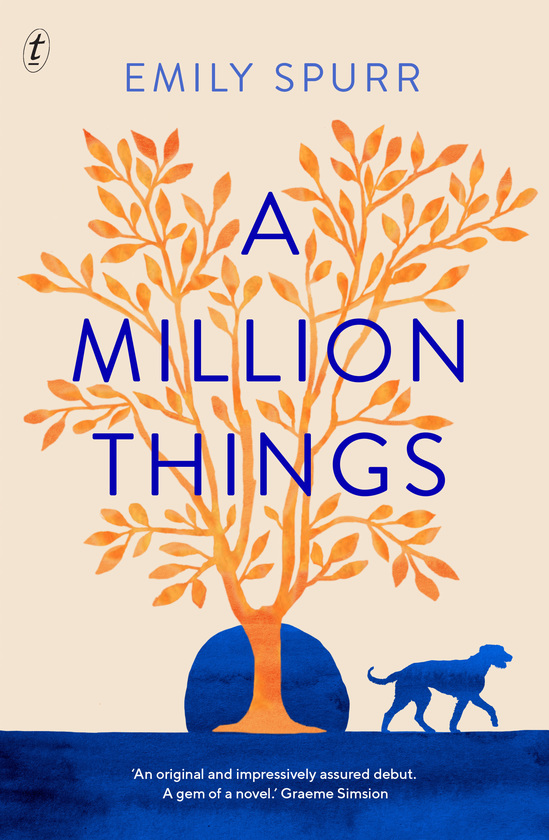
Book Review: A Million Things by Emily Spurr – a resilient young heroine struggling with loss

I was drawn to this book by its compelling storyline – a young girl all alone, trying to pretend nothing is wrong after her mother disappears. Well, that’s how it seemed to start with. The book’s told from the point of view of ten-year-old Rae – but it’s not your standard first-person narrative voice. Often Rae is talking to a ‘you’ – the mother who isn’t there.

It would be easy to assume that the mother is missing because she hasn’t come home. But Rae’s mother has been mentally ill for quite some time. No wonder Rae knows about the routine of managing meals and getting herself to school, of walking Splinter, the dog. Rae has had to be the grown-up a lot of the time. Only this time Rae’s mother has ended her life in the backyard shed. With no one else to turn to, Rae must manage as best she can on her own.

Rae decides to keep going on her own. She becomes adept at keeping up appearances. She gets herself off to school, takes care of the house, and feeds the dog. There’s no time for grief. If only that nosy old lady next door wasn’t always on her front verandah watching. But Lettie has secrets of her own, things she doesn’t want anybody knowing about. It’s only when Rae hears her calling for help one day that the two discover that they need each other.

Each time you’d go, noises muffled and sharpened and silence got loud. I’d stand still, trying not to breathe, waiting for the door to open and for you to come back through it. The silence you left after you grabbed the keys from the bowl on the table and slammed out the door would stand like a person beside me. The bang made me jump every time. Even though I knew it was coming. Knew from the second your eyes lost focus and tightened and you stopped seeing me and saw only this thing ruining your life.

Things become more complicated by the arrival of new people along the street, Oscar who is the same age as Rae, just wants to make friends, but when he parrots critical comments of his mother about Lettie, Rae finds herself sticking up for her neighbour. She doesn’t want social services nosing around.

It is heartbreaking the lengths Rae will go to pretend everything is normal, alleviated in some part by her growing friendship with Lettie. We slowly get pieces of Lettie’s story, her family tragedy. The tension builds as all the plates Rae tries to keep spinning descend one by one and a dramatic event brings help from an unexpected quarter.

This is one of those books that has you holding your breath – you are so much in Rae’s impossible world. The friendly banter between Rae and Lettie lightens things a little, but the old woman’s situation is horrendous as well. You feel how easy it is for life to get on top of you and the book becomes a sensitive portrait of the effects of mental illness, but of resilience as well. The reluctance to let someone else into your life when you need help; of not wanting anything to change. Of holding onto the grief that ensnares you, that keeps the missing loved one there as a constant presence.

A Million Things was shortlisted for the Victorian Premier’s Unpublished Manuscript Prize and won the BookBrowse Best Debut Novel 2021. Emily Spurr is certainly a writer to watch. A Million Things gets four stars from me.

Book Review: Exiles by Jane Harper – Aaron Falk is back in an atmospheric new mystery

I’ve read all of Jane Harper’s novels. It was possibly her first book, The Dry, that triggered a popular interest in Aussie Noir, giving Scandi Noir a run for its money. For me, it was Jane Harper that got me reading Australian mysteries and I imagine it was the same for many readers. There’s just something special about novels set in the outback.

Since The Dry we’ve had a second Aaron Falk novel – Force of Nature is soon to hit the big screen – and now, a long-awaited third. Exiles sees the Melbourne detective visiting friends in rural wine country for a christening. It’s a bitter-sweet time for Greg Raco’s family. While Aaron is going to be godfather to Raco’s baby boy, nobody can forget what happened at the same time a year ago. The Marralee Valley Annual Food and Wine Festival was on and it was here that Kim Gillespie disappeared, leaving her baby Zoe asleep in her pram.

Kim’s older daughter from her long-term relationship with Charlie Raco, Greg Raco’s winemaker brother, is desperate for answers. Now seventeen, she’s running a campaign, aided by Charlie and her good friend Joel, handing out flyers and canvassing potential eyewitnesses. Aaron, with all his detective smarts, somehow gets roped in.

And there’s another cold case – the hit-and-run death of Joel’s father at the Reservoir, a spot adjacent to the festival grounds, and it’s the Reservoir where Kim’s shoe was found. Is this a coincidence or are the two cases linked? Aaron has the added complication of meeting up with Gemma again, Joel’s mother – someone he’d met through Raco, and who he can’t quite forget.

Even in the gloom Falk could see it stretching out, vast and open in its centre, then twisting and curving to fill the turns and gullies that formed the banks. It was big. Bigger than he remembered. The opposite bank was just visible across the swathe of water, but he couldn’t see the westernmost edge, or the dam that lay somewhere to the east. The festival grounds felt far behind them, but Falk could hear a distant low thrum of music and crowd noise undercutting the stillness.

Emotions are high in this story with two teenagers having lost parents and not having any answers. Aaron’s a bit of a softy and is sympathetic. The story also hearkens back to the events from the school days of Kim and the Racos. Like the current batch of kids from the local high school, the opening night of the wine and food festival was when there was a big party in the woods near the Reservoir, something local cop, Sergeant Dwyer would love to shut down.

There’s a lot going on in each of the characters’ lives, and we slowly get a picture of a community, of complicated loyalties among old friends, old grudges and a fair bit more besides. We haven’t got a dry, scarily hot landscape. But the stunning countryside surrounding the grim spectre of the Reservoir and all its secrets makes for another atmospheric setting.

Add some superb writing, and a twist in the story I didn’t see coming and I’m happy to say that Jane Harper has done it again. Exiles is another cracking read and is satisfying on several levels. I’ve also got a feeling we might see Aaron Falk again – I hope so; he’s a complex and interesting detective. Exiles gets four and a half out of five from me.

Book Review: Wildflowers by Peggy Frew: a haunting, witty and compassionate story about sisters

You can be forgiven for wondering what you’ve got yourself into a few pages in with Wildflowers. The narrator, Nina, is clearly not coping and while she’s brilliant at bringing you into the story, the vivd way her world is brought to the page through all the senses, she seems bent on self-destruction. You can’t help asking yourself, how will she make it through the next three hundred odd pages. Peggy Frew has created a brilliant character study of someone at the end of her rope.

In the past month, Nina has boxed up all her clothes, her curtains, her cooking utensils and anything useful, apart from the frypan and spatula she uses to fry her evening egg, eaten out of the pan. She gets her outfit for the day not from her wardrobe but from bags of donated clothing outside a charity shop, raided under cover of darkness. Nothing fits properly and yet she manages to hold down her admin job at the hospital, the staff cafeteria providing left-overs nicked from newly vacated tables

Her Dunlop Volleys flapped a bit. They were better with the Explorers; Archie McNamara’s socks were too thin. Under the tracksuit pants the seam of the satin shorty things seemed intent on bisecting her, and the lace on the too-tight bra was irritating the skin near her armpits.

What has brought Nina to this? The book flips back to the past to describe the events of Nina’s life and in particular her relationships with her sisters, Meg and Amber. Elder sister Meg was always the sensible one, chastising her laid-back parents over how they allow little sister Amber to run wild. Amber is dazzling, gloriously pretty but also with a charisma that is perfect for the stage and she’s soon a child actor in a film. What happens here eventually drives Amber to drug addiction.

Nina is the smart one, but she’s also a ditherer, uncertain what to do with her life. While Meg chooses her study path and makes a go of it, Nina finds student life daunting, blazing through her studies but strangled by shyness. She doesn’t know how to be.

The tremulous romanticism by which she’d been so strongly affected upon first leaving her family – which she’d always felt, but which in the lonesome splendour of her cobwebbed room and with the aid of her poetry classes had crystalised from a homely, unexplained presence into something not unlike a calling – this had not receded. It was melancholy, that’s exactly what it was: a sadness that was exquisite. She was kind of addicted to it. And she found that she couldn’t – simply could not – reveal this aspect of herself to anyone.

She drifts through unsatisfying relationships with men, a habit that continues well into her adult years. While she’s smart, Nina’s not so good at life so it’s not surprising she leaves the Amber problem to her mother and to Meg – until, that is, after years of Amber problems, Meg enlists Nina’s help in a last ditch attempt to cure their little sister.

The novel is threaded through with humour – I love the description of Nina pretending to listen to Meg’s hectoring voice on the phone while cleaning the grout on the bathroom tiles with baking soda, only to discover she’s out of white vinegar and furtively googling whether or not balsamic would work instead. Not everyone enjoys this odd mix of despair with wit – Meg Mason’s utterly splendid Sorrow and Bliss seemed to polarise readers – but for me it it works a treat.

Throw in some lovely, evocative writing – whether describing the rainforest retreat where the girls try to cure Amber, student flats or city scapes, Frew brings Nina’s world to life. This makes her story seem very real and adds to the huge compassion we feel for her as readers. I love this sort of book, and can happily add Peggy Frew’s name to a list I’m gathering of Australian authors, which include Charlotte Wood and Toni Jordan, as well as New Zealand born Meg Mason, who I’m keen to read again. Wildflowers gets a full five stars from me.

Book Review: The Place on Dalhousie by Melina Marchetta – a warm-hearted novel about finding family where you least expect it

I picked this book up as it was recommended by a librarian, my final task in the Turn Up the Heat winter reading challenge at the library. The Place on Dalhousie came out in 2019, and I am reminded a little of the first book I read by Marchetta – Looking for Alibrandi, published in 1992 – with its strong Australian sense of place and memorable characters.

In the recent book we have three main characters flung together by circumstances trying to make the best of things. Rosie Genarro is a care-giver in rural Queensland when she meets Jimmy in the middle of a natural disaster. He’s part of the rescue team when Rosie has to get her recalcitrant elderly client out of her home before floods destroy it. Two years later she’s back in Sydney with a baby, living in her parents’ house. Only her parents are both dead – Rosie’s still mourning her father – and she’s in a stand-off with her stepmother, Martha, over who owns the house. Jimmy is nowhere to be seen.

Martha is also still grieving Seb, who according to Rosie, she married far too soon after the death of her mother. Martha has a high-pressure job, and is desperate for some leave. She’s also a prickly, difficult woman, and sharing her home with her step-daughter and her unsettled baby is ramping up her stress levels. Somehow she gets dragged into a netball team with her old schoolmates, coached by a faded footy star and former schoolgirl crush, the once more single brother of one of her mates.

When Jimmy finds his long-lost phone, he discovers he’s also a father. He travels to Sydney to meet his son and perhaps to make things right with Rosie. It’s not all plain sailing, though. He’s working in the mining industry in Perth, bunking in with friends on the weeks he’s rostered off. Rosie is distrustful and it will take a lot to win her over. Both are very young and have dreams of a new career path – Rosie as a midwife; Jimmy as a paramedic. But study is expensive and so is renting a place in Sydney. They are really up against it.

As I said, Marchetta is really strong on characters. I loved Martha’s netball mates, and the awkward friendships Rosie makes with the two other misfits from a mother’s coffee group. Even the house – the place on Dalhousie – has a personality. It epitomises all the family love that has gone into turning it from a the rundown ‘worst house in the street’ to something special. No wonder neither Martha or Rosie want to part with it. The story builds to a brilliant ending with a couple of nice twists.

Marchetta is a dab-hand with smart, funny dialogue, capturing the characters and also the voices of Australians of European descent, particularly the Italians. Martha’s of German descent so there’s that too. You get a great sense of place, whether it’s rural Queensland or suburban Sydney. Now that I’ve read her first book and much more recently her latest, I’m wondering why I haven’t read anything in between. I’m giving this book a four out of five.