Book Review: The Visitors by Caroline Scott – The Enchanted April meets Birdsong with a smidgeon of du Maurier

Sometimes you just pick up a book for no particular reason and it’s a very pleasant surprise. The Visitors has a gorgeous cover, so that was probably what attracted me, and luckily it turned out to be quite a find. Don’t judge a book by the cover – how often have we heard that maxim, but the truth is that we often do.

This book is Esme’s story. It’s the early 1920s and Esme’s a war widow and housekeeper to fussy, but kindly, Mrs Pickering in Yorkshire. Mrs P sends Esme off to Cornwall – her doctor’s recommended rest and recovery after Mrs P had a bout of flu. Esme is to make sure the house belonging to her brother is suitable for an extended stay over summer. Gilbert, himself a war veteran, has set up a kind of seaside retreat for himself and several other men from his unit, all in need of healing. They throw themselves into art and gardening and it’s all a bit too Bohemian for Mrs P’s tastes.

Esme doesn’t hit it off with Sebastian, sent to the station to fetch her – he thinks she’s been sent to snoop – but the others soon charm her. There’s Clarrie who makes delicious meals from the garden’s bounty; Hal who doesn’t speak but who puts together miniature ships in bottles; and then there’s Rory, somewhat wild and unkempt looking, in whom Esme discovers a fellow nature lover. Esme herself writes a weekly nature diary for the Huddersfield Courier, so there are plenty of descriptions of birdlife, flowers and the variations of the weather.

Soon we’re swept into a gorgeous setting, and this in itself would be a pleasant place to be as a reader, but there’s the war and its legacy to be dealt with. Esme is still grieving for her husband Alec, killed in 1916, and as he was from Penzance is hoping a visit to his childhood home will fill in a few gaps. She’d hardly got a chance to get to know him before the war began and off he went.

But the war has its secrets and there are a few big surprises that make the story much more than a charming summery read. I found myself tugged emotionally here and there as scenes from the war – Rory also puts pen to paper – are woven through the plot. Meanwhile Esme’s own personal discoveries create a shift in her feelings and open her up to new possibilities. The plight of the women left behind with the loss of so many young men, hovers in the background. It all comes together beautifully, with some great characters in Esme and Rory, but also Mrs P and Gilbert and even Sebastian, all of whom are interesting company.

And yet it’s probably the setting of Cornwall that was most memorable for me, not just the pretty scenery, the weather, the flowers and the sea. There’s the history and folklore as well. Reading The Visitors, it’s hard to imagine who wouldn’t want to up-stakes and move there. It reminded me a little of The Enchanted April by Elizabeth von Arnim with its characters similarly finding an idyllic place to heal. All in all the book was a pleasant surprise and I shall be hunting out more from Caroline Scott. This one’s a four out of five read from me.

Book Review: Trio by William Boyd

I didn’t know quite what to expect when I stepped into the world of Boyd’s latest novel, Trio. One thing I might have guessed is that its three main characters will be put to the test. Set in Brighton in 1968, the story centres on the making of a film with a ridiculous title. There’s remarkably little glamour as we’re taken behind the scenes – Brighton isn’t exactly Hollywood. The narrative switches between each of three main characters who are connected with the film.

Talbot Kidd, in his sixties, is the reserved, genial film producer who following the recent law reform decriminalising homosexual relations, is wondering about his own sexuality. But everyone keeps coming to him with their problems – film stock is going missing, the leading actress won’t work with the couple of acting hacks hired to play her mother and father and could it be true that his business partner is fleecing him? And then there’s that blasted song he hears everywhere he goes about the park with the cake left out in the rain, the sweet green icing flowing down … you know the one.

The leading actress, lovely Anny Viklund, is an up-and-coming American star with a poor taste in men. Her current boyfriend is a French freedom-fighter philosopher but before that she was married to an anarchist-terrorist and now the FBI want to talk to her. Luckily her co-star Troy offers easy, uncomplicated sex, and she’s got a stash of uppers and downers to keep her on an even keel. But she can’t help wondering why she has no control over her own life.

The third narrator, Elfrida Wing, is married to Talbot’s director, Reggie Tipton, a serial philanderer suddenly requesting everyone to call him Rodrigo. Elfrida is a famous novelist who hasn’t written a book for ten years, and passes her days as an accomplished secret alcoholic. It doesn’t help that the literary world described her as the new Virginia Woolf, an author she feels she has little in common with. When she comes up with the idea of writing a novel about the last day in Virginia Woolf’s life, she’s suddenly on fire again. But can she get on top of her drinking?

…and she soon stood on the high embankment looking down on the slow-moving stream, wondering if this were perhaps the actual point where Virginia had filled her coat pocket with a heavy stone and then waded in. Where had she learned that fact about the stone? She searched her memory. That’s right: Enid Bagnold had told her at a party years ago.

Boyd explores each of these characters’ flaws, foibles and secrets, yet I found each of them oddly likeable. He captures them at a time of crisis in their lives and keeps pouring on the pressure. This makes the story gallop along together with the lengths each of them go to maintain their secrets. Bubbling underneath is a gentle wry humour, particularly with Talbot and Elfrida, a kind of world-weariness English characters sometimes have, as if they are on the outside of themselves looking in.

Of course, Boyd is happy to throw barbs at the self-important figures that people the film and literary worlds. There’s also the frivolity of life in Britain in 1968 while across the channel the student riots were on the go and political change in the air. Name dropping of well-known writers and entertainers adds to the fun. But there are serious issues that each character has to struggle with, making this an amusing but also a very satisfying novel. But with William Boyd I wouldn’t have expected anything less. A four and a half out of five read from me.

Book Review: On Hampstead Heath by Marika Cobbold

Marika Cobbald’s new book On Hampstead Heath is a witty comment on our times, a kind of comedy of errors, with an unlikely heroine at its heart. Thorn Marsh is a news editor, a passionate believer in the role of the news media to uncover the truth and to keep the public well-informed. At forty-four, her career is everything, but when her paper is taken over by a media conglomerate she is shifted from the news desk to the midweek supplement to write The Bright Side. A prickly, curmudgeonly individual, she is the last person to write happy, inspiring stories.

Along with Thorn, there’s a bunch of quirky characters to enjoy. Nancy, Thorn’s mother who never loved but she has her reasons; Mira, Thorn’s new editor, who gives Thorn a good run for her money when it comes to dry one-liners; Lottie, Thorn’s neighbour, a Holocaust survivor and secret dope smoker and who is more like a mother figure than Nancy; Lottie’s niece, Jemima, disapproving and disappointed.

She turned an accusing eye on me. ‘The media have a great deal to answer for in all of this, affording celebrity status to people whose main contribution to society is putting their heads in a tank of maggots. My Year Fives thought Florence Nightingale was a contestant on Love Island.’

‘I only recently found out that a Kardashian isn’t a rifle,’ Lottie said, and finished her gin.

Desperation and alcohol lead Thorn to make up a story using a photo snapped on Hampstead Heath curtesy of her still friendly ex-husband, Nick.  Suddenly the world is sharing and retweeting her story about The Angel of the Heath, a flame haired apparition on the Viaduct Bridge, who had recently turned Thorn’s head rescuing her neighbour’s dog.

Lies pile up on top of lies as Thorn digs a hole from which it seems impossible to extricate herself. She has only herself to blame, and pours out her story to Nick and Lottie. She learns the hard way that getting the best story isn’t the only thing in life.

While there’s a good deal of desperation, Thorn is such a likeably difficult character and a dry, dark humour bubbles through every sentence. Thorn grows from someone who only lived for her job to someone who learns to love not only others but herself. But it’s never treacly or too serious and the ending is superb.

I loved On Hampstead Heath, but then I’ve always really enjoyed Cobbold’s books. But it has been a long stretch between the new book and her last one – ten years in fact. Hopefully we won’t have to wait as long for her next novel. On Hampstead Heath gets a four and a half out of five from me.

Book Review: The Authenticity Project by Clare Pooley

Book connections can be puzzling. What led me to seek out this novel was probably a recommendation in connection with another book I enjoyed, but what it was escapes me. This story similarly connects random characters, one leading onto the next.

It begins when elderly Julian leaves an exercise book in Monica’s café, with the title The Authenticity Project carefully lettered on the cover. Inside Julian describes his loneliness since his wife died, and how he lost friends and relationships, now going days without talking to anyone. He closes with the challenge to whoever picks up the book to ‘tell your truth’.

Monica does. She writes about her longing for a family, in particular, a husband and a baby. She’s in her late thirties and fears she’s left it too late. But Monica doesn’t just tell her truth, she decides to help Julian. She’s looked him up online and discovered he’s a once famous artist, and a minor celebrity in his day. Her plan is to weasel him out of his cave by advertising for an artist to teach drawing at her café. He regularly stops by for coffee, so is sure to see it. She leaves the exercise book in a bar where it is picked up by Hazard, a stock broker with addiction issues and so the story goes on.

Hazard is an interesting character in that he’s a really obnoxious on the one hand, but has the self-awareness to take himself off on a retreat to Thailand to detox. Perhaps a new Hazard hides beneath all that drug and alcohol fuelled brashness. The exercise book is just the trigger he needs. He’s read both Julian’s and Monica’s ‘truths’ and decides to help Monica from his tropical hideaway.

More characters join the chain. Happy-go-lucky, live-for-the-moment Riley, an Australian gardener, who doesn’t understand the English with all their hangups. New mother, Alice, who has a social media addiction, as well as the husband and baby Monica craves. But they don’t make her happy. They’re all interesting and entertaining in their way, although it’s Monica and Hazard who are the most engaging and complex, the ones who can’t make up their mind what they want or how to get it.

The Authenticity Project is a light and entertaining novel. The changing viewpoints work well because everyone is trying to fix things for others, creating dramatic tension, and a community of sorts emerges. It made me wish Monica’s café was just up the road so I could pop in, join an art class or curl up on a sofa with a book. The references to famous people of the eighties Julian used to hang out with, his designer wardrobe and old LP collection, add plenty of colour and I loved the Fulham setting. It’s a a feel-good kind of read, maybe just the thing for the holidays with an original, well-executed storyline. I’m giving this one a three and a half out of five.

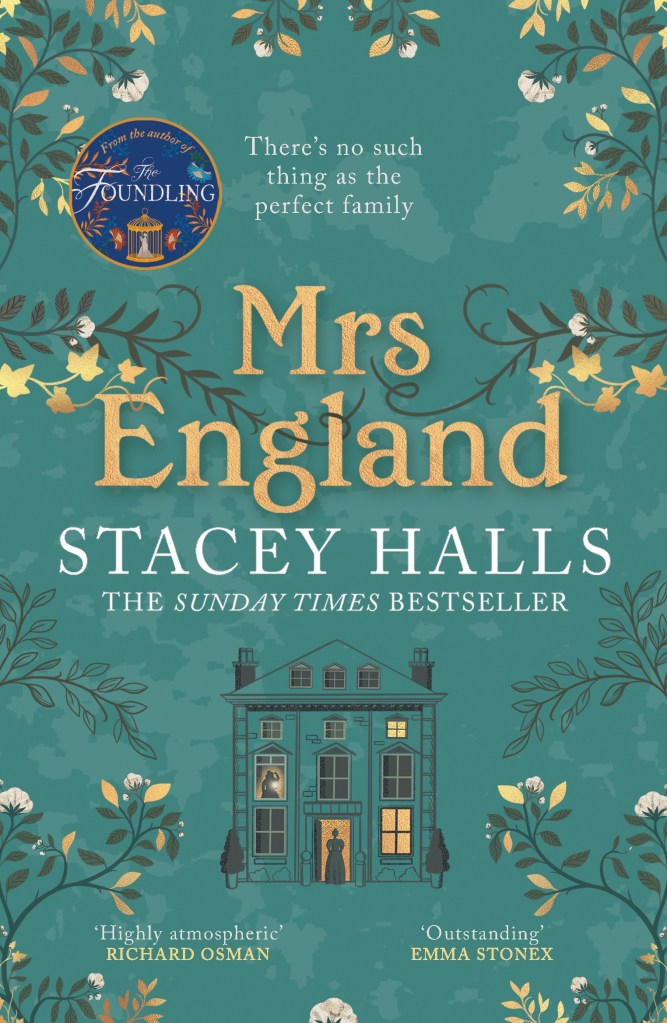
Book Review: Mrs England by Stacey Halls – secrets and suspense in a Yorkshire mill town

The blurb on the book mentioned the word ‘Gothic’ and so I opened the book expecting some chilling scenes and perhaps even hauntings. My earlier experience of this author had been The Familiars, a gripping story about witch hunts in 17th Century England. So I knew Halls could take us to some dark places. And there is a degree of darkness here, of menace even, but is it Gothic?

Certainly there’s a large stately home in an isolated part of Yorkshire. It’s mill country, and the air is thick with coal-dust from all the steam-powered cotton milling machinery. Ruby May is a Norland nanny who has just said goodbye to her first family now they’re off to Chicago. She’d love to go too, but her own family need her. She’s a humble grocer’s daughter from Birmingham and there’s a tragedy in her past that has left her hating her father and with a disabled sister.

She takes the only job on offer – nobody wants a nanny in the summer holiday season – to take charge of four children ranging from a year to ten year’s old. Mr England’s old nanny has died and the children soon warm to Ruby, who takes them on outings and supervises a better diet. She is almost like the mother to them – Mrs England rarely leaves her room. Mr England makes up for his wife’s lack of engagement with her children by being an affectionate father and is surprisingly friendly to Ruby, which she finds disconcerting.

Other characters include Mr Booth, young Saul’s tutor, who confides in Ruby that there’s something not quite right in the household. Blaise, the housemaid, is plain spoken and haughty towards Ruby, as if she suspects Ruby might lord it over the staff and wants to nip any such superiority in the bud. We meet Mrs England’s family, the Greatrexes, who own a larger mill and even a town, and with whom Mrs England has a strained relationship. So Ruby is caught between upstairs and downstairs, not quite a servant while having to tiptoe round the feelings of her employers.

Thank goodness she warms to the children, but you can’t help feeling that they could be in danger and this drives the plot. There’s a hint of The Turn of the Screw by Henry James, so perhaps that’s where the Gothic quality lies. Ruby does all she can to keep the children safe, but she can’t do it all alone, and who can she trust? The story builds to a dramatic ending and although it takes a while to get going, it’s still really engaging. I think this is because Ruby herself is interesting: her worries about her own family and in particular her falling out with her father. Halls feeds out just enough information to keep you curious.

One story thread of Mrs England is based on an event that really happened, which is briefly described in a note at the end of the novel. If you want to maintain the maximum suspense as you read, don’t read this until you finish the story, but it is extraordinary. I like the way Stacey Halls seems to draw inspiration from real events for her novels – she is turning out to be one of my must-read authors. She really gets under the skin of her characters, bringing the past to life and this book continues the trend. It’s a gently cracking read and gets a four out of five from me.

Book Review: Unsettled Ground by Claire Fuller – an atmospheric and psychological story set in rural Wiltshire

I’ve had my eye out for this book ever since it was shortlisted for the Women’s Prize for Fiction. Unsettled Ground is the story of twins, Jeanie and Julius Seeder, who at fifty-one are still living at home with their mother, Dot, when she suddenly dies. All at once they have to figure out what to do, how to manage. Dot obviously took care of the family finances, but the cake tin that stored all their cash, from Julius’s odd jobbing and the women’s piecemeal market gardening, is virtually empty. Their electricity has been disconnected because of unpaid bills, then Jeanie discovers even more debts, to say nothing of the funeral costs.

Unfinished schooling, a basic, almost off-the-grid lifestyle and a lack of real-world experience mean the twins struggle to figure out how to make ends meet or get the help they need. Jeanie is barely literate, while Julius was traumatised when his father was killed in a farming accident, which means he can’t travel by car without motion sickness. Bridget, their mother’s old friend grudgingly drives Jeanie to appointments while pouring out unwanted advice. When their landlord’s wife issues an eviction notice unless arrears in rent of thousands of pounds are paid off, things are desperate indeed.

The plot pulls you in from the start as curve-ball after curve-ball are lobbed the twins’ way. You read on hoping they make a break from the past to find some happiness. Or, at 51, is it too late? Julius has always resented the need to stay, his mother, Dot, using Jeanie’s fragile health to keep him around. Dot had always felt that making music, gardening and living off the land were all that anybody needed, creating a small family sanctuary. But all it does is fill the twins with mistrust towards the agencies that might help them and the bullying they received at school casts a long shadow.

Told from Jeanie and Julius’s point of view, you have immense sympathy for these characters, while getting a taste of what it’s like to live in a small, insular community that isn’t always kind. And at the heart of it all are one or two family secrets that will overturn everyone’s assumptions. It’s an interesting psychological study of maternal love, guilt and fear inspired by ignorance. The setting of rural Wiltshire during a cold snap in spring is an evocative background – you get the sense of nature in all its glory, ready to invade, to rot and overrun.

It’s a bit like there are two sides to everything here – the good and the bad: the good side of mothering and the dark turn it can take; of neighbours, of nature and of love. It’s a powerful story that gives you lots to think about as well as a cracking good read, with more than a hint of the old adage: be careful what you wish for. The saving grace for the twins is music, peppering the story with old folk songs that Dot has passed on to her children. Claire Fuller used a playlist while writing the book which she describes here on her website. This is my first novel by Claire Fuller, and I am sure it won’t be my last. Unsettled Ground earns a four out of five from me.

Book Review: Sorrow and Bliss by Meg Mason

This novel is a very intimate look at someone’s mental illness, which could in itself drive the reader into a depressed state if it weren’t for the scintillating prose which is a times laugh-out-loud funny. Martha Friel is turning forty at the beginning of the book, her marriage crumbling around her, as she looks back at her life to pinpoint the moments of significance to try and make sense of it all.

She is the child of eccentric parents. Her mother is a sculptor of minor significance who drinks a lot and drives her father, a poet who cannot quite bring himself to publish a long awaited collection, to leave them. You could say the apple doesn’t fall far from the tree when you look at Martha and her mother, who is difficult and at times cruel. But her father always returns, shutting himself away in his study among his books and poetic thoughts. Martha has a sister, Ingrid, who manages to lead a more balanced life, marrying Hamish and producing unplanned-for children with alarming regularity.

Then there is Aunt Winsome and Uncle Rowland who live in Belgravia and have funded Martha’s parents’ house and the girls’ schooling because being an unpublished poet and a sculptor of minor significance is no way to support a family. There are cousins, Nicholas, Oliver and Jessamine, as well as Oliver’s friend Patrick who’s father lives in Hong Kong and who has nowhere else to go at Christmas. As well as the closeness between the two sisters, much of the story is that of Patrick and Martha’s relationship.

That is what life was, and how it continued for three years after that. The ratios changing on their own, broken, completely fine, a holiday, a leaking pipe, new sheets, happy birthday, a technician between nine and three, a bird flew into the window, I want to die, please, I can’t breathe, I think it’s a lunch thing, I love you, I can’t do this any more, both of us thinking it would be like this forever.

Martha’s terrible rages, her problems with sounding normal at work or at parties, her unreliability, her snarky remarks, make her difficult to get on with and yet she inspires great affection from those who make the effort. She’s smart and shows odd moments of empathy.

The reason I had gone to London was for Peregrine’s funeral.
He had fallen down the central staircase at the Wallace Collection and died when he struck his head on a marble newel post at the bottom. One of his daughters gave the eulogy and looked earnest when she said it was exactly how he would have wanted to go. I wept, realising how much I loved him, that he was my truest friend, and that his daughter was right. If it hadn’t been him, Peregrine would have been acutely jealous of anyone who got to die dramatically, in public, surrounded by gilt furniture.

And while we get to see what Martha’s unspecified condition looks like, and the difficulties of getting appropriate medical help, the novel also gives thought to what makes people happy, the simple things often that people take for granted. Maybe it’s only when life is at its darkest, that you get to really understand this. I loved the characters in particular. Martha’s family are individually either odd or difficult, but they are all interesting and have their redeeming points. Patrick has his own sorrows – his lack of family, his struggles with his problematic love for Martha.

Meg Mason writes with such flair and understanding I surprised myself with how much I enjoyed Sorrow and Bliss. It is one of those funny/sad books, which can be entertaining and profound in equal measure. Mason is a New Zealand born author who lives in Sydney and this is her first book published in Britain. It is easily one my favourite reads for the year and really deserves its five out five from me.

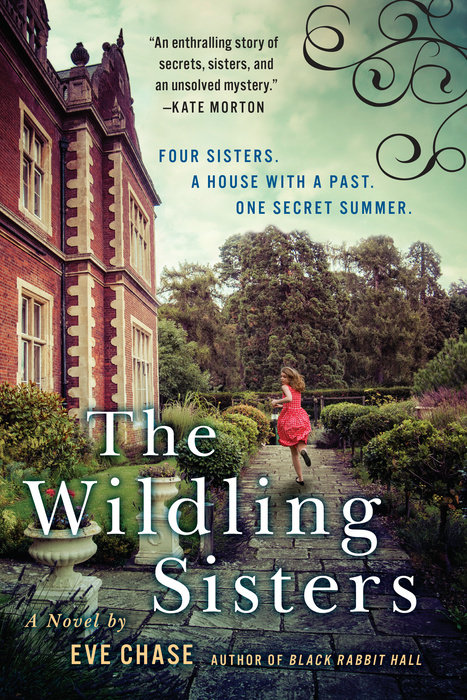
Book Review: The Wildling Sisters by Eve Chase

Stories featuring old houses in the English countryside and a dark secret from the past are always entertaining. Throw in four sisters on the brink of adulthood with a glamorous but unreliable mother, two dangerous young men and an aunt who is, well, a bit batty and you’ve got the ingredients for an engrossing read.

The Wildling Sisters (or The Vanishing of Audrey Wilde) starts off with a body being dragged to a hiding place, a brief scene laced with foreboding, then flips to 50 years later when a young family are considering buying a crumbling mansion in the country. They are escaping London to start again. Jessie and Will have a preschool-age Romy in tow, as well as Bella, Will’s teenage daughter. Bella is surly and uncommunicative following her mother’s death and having to cope with a step-mother. An incident at her London school had her expelled and also makes Jessie uneasy about Romy’s safety.

The family discover Applecote, a large country house in need of repair that also bears a shadow – the disappearance of twelve-year-old Audrey Wilde in the 1950s. The locals won’t come near it and while Will gets stuck in London for work, Jessie has to deal with the burden of the new move and Bella’s bad behaviour with little support.

The story flips back to the heatwave of a 1950s summer that sees the four Wilde sisters staying with their distracted Aunt Sybil and peculiar Uncle Perry. Grief over their missing cousin Audrey consumes Sybil, and Margot at fifteen is aware of how similar she is to Audrey. She sneaks into Audrey’s room, a kind of shrine to her cousin, and admires her clothes.

And the sisters are a little wild to be sure. They’re also beautiful and have the confidence of their class and having a mother who hasn’t imposed a lot of rules. It’s just as well they have each other to rely on. Things get complicated when Harry Gore from the neighbouring estate and his friend Tom turn up by the river and flirt with the girls.

Yes, there’s a river – the logical place for Audrey to have disappeared, but there are also standing stones that add an air of youthful sacrifice, and endless summer heat that stirs the emotions. Margot tries to get a sense of what happened to her cousin, while dealing with a yearning for Harry and an emotionally demanding aunt.

There’s plenty to keep you turning the pages here; Chase keeping you guessing with cliffhangers at the end of each chapter as the story flips back and forth between narrators. Each of our main characters, Jessie, Margot and even Bella, have to deal with worrying events, as well as their tentative place in their families. This lifts the novel above being just a story about a scary house with a dark secret. Both Jessie and Margot will learn a lot before the end of the book when the puzzle pieces finally slot into place.

I really enjoyed my first Eve Chase novel. It’s a bit like reading Katherine Webb crossed with Ruth Ware and the writing is crisp and elegant too. A great escapist read, The Wildling Sisters gets a four out of five from me.

Book Review: Take Nothing With You by Patrick Gale

I thought this novel was going to be about a man facing down cancer, but it’s actually a coming of age story, bracketed by what might be a very treatable cancer diagnosis and a new relationship. And music. I love novels that take you on a journey of your own. With Take Nothing With You, I found myself visiting YouTube to discover or rediscover the beautiful cello pieces described in the book.

Eustace lives with his parents in an elegant inherited house in Weston-Super-Mare. His parents run it as a rest home, which makes for Eustace, their only child, an unusual childhood. While he must be quiet and not disturb the guests, he is also left a lot to his own devices. It’s a family living in a kind of genteel poverty; they never go away on holiday because they live at a seaside resort – what could be nicer?

As he grows up, a cello concert is a revelation and brings Carla, his new music teacher into his family’s world. Carla is warm and intuitive, passionate and generous. She spots a talent in Eustace and fosters it, as well as striking up a fond friendship with Eustace’s apparently friendless mother. You get a lot of music detail as Eustace learns about fingering and the complexities of playing solo or with a group. If you like classical music this is really interesting and Gale has the insight of an accomplished musician. As Eustace develops musically, he also becomes aware of his sexuality and this forms another thread in the story.

Eustace is a sensitive character who always seems to be just missing out. At the start of the book he has just fallen in love, while receiving a cancer diagnosis. His education is full of missteps as well. The reader wants him to reach out and grab life with both hands. In the background, his parents’ restrictive lifestyle, strains upon their marriage, his mother’s moment of recklessness all affect the story in interesting and dramatic ways.

Patrick Gale writes with warmth and wit creating a brilliant story arc that captures the man that is Eustace, as well as the boy. The subordinate characters are just as interesting, each empathetic in their own way. And the settings: the Somerset seafront town, the music school in Scotland, plus the 1970s, are evocatively created here too. I don’t know why it has taken me so long to read this, but it was a complete joy because Gale is such a beautiful writer. And I am delighted to see that he has a new novel out early next year. This one scores a four and a half out of five from me.

Book Review: Black Out by John Lawton – noirish wartime thriller

I couldn’t remember why I’d put Black Out on my Must Read list. It must have been recommended in glowing tones somewhere as it doesn’t have the look of the kind of book I normally read. But when I eventually picked it up, I was soon hooked. And that’s in spite of it beginning with a grisly discovery – a severed arm on a bomb site.

We’re in London, 1944, and the Blitz has turned whole blocks into rubble. You’d think it would be easy to pass off a killing as death by explosion and get away with it. Fortunately, Sergeant Troy of Scotland Yard knows murder when he sees it. Soon he’s connected it to another death and a disappearance, men who have recently turned up in Britain from Germany. Why would anyone bring them across in the middle of a war just to kill them in this cloak and dagger way?

The plot will involve the American secret service (Office of Strategic Services – which will soon be the CIA) as well as an underground group of Communist sympathisers. There is not one femme fatale , but two, one of them rather short and the other rather tall.

Sergeant Freddie Troy is himself an interesting character. The son of Russian emigré parents, his father made his fortune in newspapers. So Troy went to Harrow, but eschewed university for the police. At twenty-eight, he has decided to stick with the police rather than enlisting in one of the services. Why should he fight for a country that interned his older brother and his uncle? But London in the Blitz is no picnic. Here’s Troy getting a bit of a lecture from older brother, Rod.

‘…The war was, as you put it, good to me. I rather think I enjoyed it. But you didn’t did you?’ You got shot – “
‘Twice.”
‘Stabbed.’
‘Four times.’
‘Bombed.’
‘Twice again.’
‘Beaten up.’
‘More times than I can count. Look, Rod, what’s the point you’re tying to make? You’re not telling me all this tosh just to let me know I missed a trick by not volunteering.’

While I tired a little of the women in Troy’s life, the tall and the short, and even Troy is a cold fish at times, I did enjoy other characters immensely. The pathologist, Kolankievicz, is a wonderful creation with his wild ear hair and colourful language; you don’t want to mess with Superintendent Onions who is bluntly North of England and bull-headed, and then there’s Troy’s side-kick, DC Wildeve who has a gift for intuition and general smarts. Troy and Wildeve are known at the Yard as ‘the tearaway toffs’. Even the scruffy kids who find the arm in scene one are each interesting in their own way, while there’s an eccentric Russian uncle who holds forth on Speaker’s Corner.

Troy’s kind of interesting too, trying to manage all the people in his life and failing miserably. He’s a loner at heart and often his own worst enemy. The story bounces along with a good mix of action, police deduction and Troy getting things wrong, with short, sharp chapters that make for an easy read. But most of all, I enjoyed the smart writing. The dialogue is crisp and a bombed-out London evocatively described.

Black Out is the first book in the series and with the war coming to a close and a peace that will be challenging once the Iron Curtain comes down, there is plenty of potential character development for Troy in the books that follow – although the books seem to jump around a bit chronologically. There’s lots to enjoy here and I shall certainly check in with Troy again. Black Out gets a three and a half out of five from me.