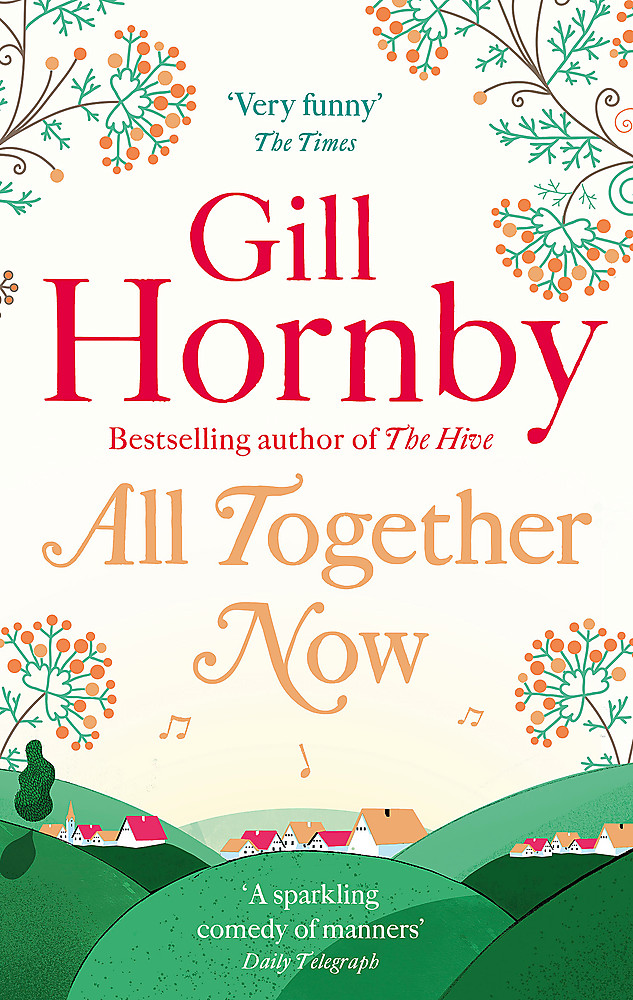
Book Review: All Together Now by Gill Hornby – a heart-warming read full of quirky characters, humour and song

Sometimes all you really want is a nice, “feel-good” novel – something to chase away the darker clouds of a difficult day. The best of them will have characters you’ll warm to, a plot with a few surprises and an emotional pull – tears or laughter, either way, I’m not fussy.

I haven’t been in a choir since school, but still remember the whoosh you get when a lot of people get together and harmonise in song. Gill Hornby brings her joy for choral singing into her story about a struggling choir in a dead-end town. All Together Now follows the lives of three main characters: socially-awkward Bennett, once a choir boy and now, recently single again, he’s at a loose end; librarian Annie who does all the donkey work for the choir as a way of dealing with her “empty nest”; and Tracey, who is too cool for choirs, but can really belt out a number in the privacy of her home. Tracey also has a burning secret.

The story starts off with a car accident that leaves the Bridgeford Community Choir rudderless, its choirmaster hospitalised and in a coma. There’s a county choral championship up for grabs, and a town in dire need of invigorating – but can a medley from The Sound of Music or The Carpenters be the answer?

Tracey spots the choir performing outside the station one day and it makes her cringe. She’s one of life’s soloists. When her layabout son of twenty-two goes out to work one evening, she suddenly feels liberated. She dusts off her old music collection and begins to sing. A knock on the door and there’s someone she recognises; it’s Lewis from the choir, surprisingly also a neighbour, who rather than demanding Tracey turn it down a bit, implores her to join their choir.

Tracey became aware that, rather than the raspy, throaty one that she used when she was singling along with Billy, she was using her chest voice for once, and she could feel the calming, anti-depressant effect it had on her stressed-out body. But it wasn’t until she was back in the living room, tucked up with her glass and the bottle on the sofa, that she realised exactly what it was she was singing. Christ almighty. Those bloody belters had wormed into her ear, through to her brain, down to her lungs. They had regressed her. She was regressing. For the first time in nearly thirty years, she was spending the night in alone pretending to be Karen bloody Carpenter. How sad was that?

The story follows the lives of Annie, Tracey and Bennett in parallel to the struggling choir that might just save them all. Tracey finds she’s not such a soloist after all, in the choir or in life; Bennett steps up to help save the town, and proves to his kids that he’s almost kinda cool; Annie takes a hard look at her marriage and makes a surprising discovery. And the choir gets a bit better. It’s an uplifting tale, but it’s also full of laughs and dry wit, particularly in the way the characters bounce off each other, disagree but also sing together. There are some amusing and some discordant minor characters that give the plot a bit of tension.

The story is peppered with music – the lines of songs nicely mixed in the scenes describing the choir in rehearsal so you have a sense of how it all sounds. Most of the songs are pretty familiar, but in case you don’t know them there’s a handy play-list of at the back and even a Spotify link so you can hear them as well.

All Together Now really hits the spot for a big-hearted, cheering sort of read, more character driven than a gripping page-turner, the prose bright and witty. I’ll probably not be rushing off to join a choir anytime soon, but will happily curl up on the sofa with another book by Gill Hornby. This one’s a four-star read from me.

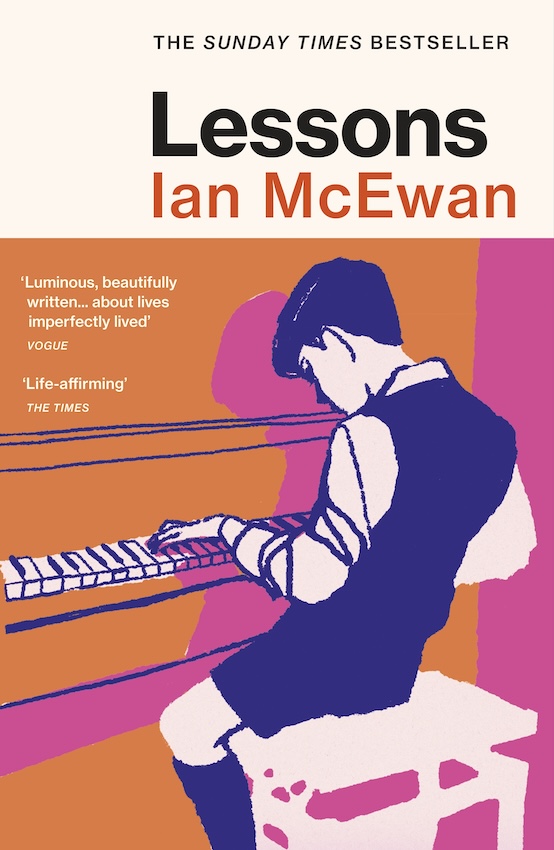
Book Review: Lessons by Ian McEwan – an epic read in more ways than one

Ian McEwan is usually a reliable author, one I’ve turned to before anticipating a satisfying and intelligent read. And that’s pretty much what you get with Lessons. The story follows Roland Baines from his childhood and delivery to an unusual boarding school – we’re in the late 1950s – through his schooling and into adulthood, and on to the present day. Critical to his story are the lessons he has at school with a predatory and obsessive piano teacher.

Rolande’s experiences, the grooming and sexual predation by Miriam Cornell, have an ongoing effect on his life. At first the story weaves these scenes from school with a police enquiry into the disappearance of Rolande’s wife Alissa in the 1980s. She has left a note and sent postcards from Europe, so there’s no obvious reason to suspect foul play, but DI Browne wants to be sure. Roland has been left holding the baby, literally, seven-month-old Lawrence.

The story meanders through the years bringing the past up to the time of Alissa’s vanishing and beyond and along with Roland’s story we have key moments of recent history. There’s the Cuba Missile Crisis, which is what sends Roland into a spin, cycling towards danger and Miss Cornell. There’s the fall of the Berlin Wall, another key factor in Roland’s life, the rise of New Labour and much more. Roland is a political animal and there are groups of friends around the dinner table, and lively discussions.

Throughout, Roland considers the effects of broader events in history on his path through life. It is obvious that Roland had potential to have a solid career in something, possibly even as a concert pianist. But failing at school and then bringing up a child on his own have led to a working life that is a cobbling together of hotel piano playing, occasional journalism, and tennis coaching. He’s also a terrific dad. He has relationships with other women but most of them don’t stick. Has he been ruined emotionally by Miss Cornell?

Against his chest he felt the baby’s heartbeat, just under twice the rate of his own. Their pulses fell in and out of phase, but one day they would be always out. They would never be this close. He would know him less well, then even less. Others would know Lawrence better than he did, where he was, what he was doing and saying, growing closer to this friend, then this lover. Crying sometimes, alone. From his father, occasional visits, a sincere hug, catch up on work, family, some politics, then goodbye. Until then, he knew everything about him, where he was in every minute, in every place. He was the baby’s bed and his god. The long letting go could be the essence of parenthood and from here was impossible to conceive.

And yet all in all, Roland’s has been a good life. A life rich in people, experiences and love. He hasn’t been a big achiever; he’s had to be a parent, rather like the lives of many women. So there’s a feminist message here too – not only through Roland, but in the stories of Alissa, her mother and Roland’s mother too.

Roland’s a likeable protagonist, which is just as well as we are with him throughout all the things in life that trouble everyday people. What secrets have his parents kept all these years? How will a new government affect things? Or even, are we on the brink of another world war? The tiny things as well as the broader issues. It’s a novel full of wisdom, and the gaining of it, and I suppose these are also the lessons of the title.

For quite a way through I thought nobody, and certainly not Roland, was learning any lessons. He really does seem to bumble along, reacting to things, rather than making decisive steps in any direction. But he mostly gets there in the end and there are some memorable scenes. McEwan creates these beautifully. The scenes with Miss Cornell are somewhat creepy, but affecting.

While not especially long, it’s a monumental work, and I admire Lessons hugely, but somehow it felt at times rather a slog. I think this is down to the lengthy timescale of the book and also the way it lingers on life’s more difficult moments, of life slipping away, of our mortality. You can relate to this for sure, but you long for lightness and hope. In the end I was glad to have read Lessons, but certainly glad to finish it too. So it’s a four-star read from me.

Book Review: The Lie of the Land by Amanda Craig – a cracking novel of rural England, the plight of the middle classes, with a mystery thrown in

Sometimes when you pick up a novel, you just instantly know you are in good hands. I felt like this about The Lie of the Land with its interesting premise – a couple desperate to divorce but can’t because they have no money. So they rent out their London house and find cheaper digs (together!) in the country with their children.

Stories where people ditch the city for the countryside for whatever reason have been around since the novel has, quite probably, or at least since Green Acres appeared on TV in the sixties. But there’s always fresh material to mine, particularly when you’ve got such complex characters as Quentin and Lottie Bredin. Quentin is older than Lottie and his career as a journalist has taken a dive – he’s rude and arrogant and has upset too many people. To make matters worse, Lottie has discovered he’s had several affairs, and all the while she’s been left to manage the home and her children.

Lottie was once an up-and-coming architect, and keeps her home like something out of House and Garden. Perhaps that is what makes her so difficult for Quentin to live with: her fastidiousness, her sharp tongue, plus her ongoing tiredness since the birth of their daughters – Rosie (6) and Stella (8). An opportunity to rent a farmhouse near Quentin’s parents in Devon ridiculously cheaply has them reluctantly leaving London and all its temptations behind.

The novel has a load of interesting plots woven together, with several main narrators. We’re with Lottie, angry and grieving over the way Quentin has treated her, while she tries to balance the books and economise. If they can stick it out for a year, they can clear their debts and sell the London house. This will pay for their divorce and leave enough capital to set up house separately.

Her daily walk includes a visit to the village shop, a Portakabin crouched in the church car park. The design makes her wince, but just to talk to another adult who doesn’t hate her is a relief.
 ’Home-made?’ she asks, pointing to pasties, keeping warm in front of the counter.
 ’Oh, yes. We don’t hold with Humbles.’
 ’It’s good that Shipcott still has a shop.’
 ’It doesn’t make a profit,’ the woman says, shyly. ‘We volunteer, though we all worry about being held up at gunpoint.’
 ’Do you really?’
 ’You’d be surprised. There’s crime here, my lovely, just like everywhere else. But how else are pensioners without cars going to get their food and money each week?’
 She has never known people like this, with their terrible teeth and terrible clothes and kindness. That’s what astonishes her most: the kindness.

We’ve also got Quentin, who can’t believe the nosedive his career has taken, but is still trying to keep in the swim while being a decent father. There’s Xan, Lottie’s eighteen-year-old son, desolate at missing out on a place at Cambridge and at the idea of his London life coming to a halt. Showing us the rural point of view, there’s Sally, a district health nurse with her own quiet grief.

While this seems to be mostly a novel of a marriage, there’s also a grim mystery with the hideous death of the previous tenant at Long Farm, an unsolved crime no one has told the Bredins about. You know you will find out the who and why of the crime by the end of the book, but in the meantime there’s so much character development, as rural life weaves its charm and throws up new challenges for the family.

We get plenty of insight into rural issues, particularly the struggles for farmers to make a living off the land in a competitive market-driven economy. The Polish immigrants that fill in doing unpleasant and exploitative work the locals avoid is evocatively depicted in scenes at Humbles Pie Factory where Xan picks up a casual job. Also the loss of a way of life, the closing of schools as people move away.

Then we’ve got a look at intergenerational relationships, particularly between Quentin and his dying father – the guilt, the disagreements and old scores. And about parenthood, both good and bad, as well as the redemptive power of music and literature. Quite a lot to think about then.

The writing sparkles with wit and vivid descriptions, and is polished and nuanced. You don’t have to like the characters, certainly not all the time – Craigs shows them warts and all – but you can’t complain they’re not interesting. Each finds themselves caught up in difficult dilemmas that give the story plenty of go. Meanwhile all the plates Craig keeps spinning are carefully balanced and then caught at the end for a cracking finish. I loved every minute of it and, although it’s not saying a lot – this being only February – The Lie of the Land is quite my favourite book of the year. A five star read from me.

Book Review: The Keeper of Stories by Sally Page – a big-hearted novel about letting go

I’d forgotten why this book was on my list – probably a glowing review somewhere (thank-you, if that was you), but was soon ensconced in the story. I quickly discovered a novel packed with quirky characters and gentle humour – two key ingredients for a pleasant, feel-good read.

The Keeper of Stories takes us to the English university city of Cambridge, where Janice cleans people’s houses and discreetly collects people’s stories. This isn’t for any inclination towards blackmail; it’s just a kind of hobby. Many of these stories come from clients: the famous opera singer who has come from humble beginnings, charming but frail Carrie-Louise, and recently widowed Fiona and her boy Adam who are still grieving. Everyone knows Janice is the best cleaner in Cambridge, but not everything’s plain sailing.

For a start there’s her husband Mike, who is a serial job-quitter, never keeping the same employment for more than a month or two. To make things worse he always leaves on a sour note. He belittles Janice for her humble work even though it’s her earnings that keep a roof over their head, and his insistence on sending their son Simon to boarding school has caused a rift between mother and son.

When two of her more difficult clients, Mrs YeahYeahYeah and her husband Mr NoNoNotNow ask her to clean for the husband’s autocratic mother, Mrs P, it might just be the straw that breaks the camel’s back for Janice. Yet she forms an unlikely alliance over stories with Mrs P. Catching the bus – Mike nearly always has the couple’s car – her attention is caught by one of the drivers who reminds her of a geography teacher.

“How many stories do you think that there are in the world? Seven? Eight? I can’t remember how many. I read in a magazine somewhere that there are only a certain number of stories ever told.”
  Mrs B sits quietly, watching her.
  Janice sighs. “You and I both know what’s coming, don’t we? It’s a predictable story. It has been played out in hovels and palaces around the world since the beginning of time. There are no new stories, Mrs. B.”
  “But this is your story, Janice, and I believe you need to tell it.”
  “Do I? Will it make any difference? I can’t change the ending.”
  “That’s where I think you’re wrong.”

Mrs P’s has determinedly unsettling ways, trading stories, including that of the scandalous Becky, a courtesan from Paris and her rise in society, in her attempts to hear Janice’s story. For we soon realise that Janice’s collecting of stories is her way of avoiding her own, a story that she feels is too dreadful to tell. Through all this, Mrs P also has a battle on her hands to stay in her university flat, while her son wants to throw her out. Janice is soon doing her bit to help.

There’s plenty of humour and whimsy in Janice’s interactions with her clients while the story builds in drama as it seems likely for Janice that change is in the air. This will not be without pain, but Janice has her friends to help her through, as well as Decius, the sweary dog that Janice walks for Mrs YeahYeahYeah, and who patently thinks Janice should be his owner.

We’re in classic ‘second chances’ territory here, and it all comes together nicely for a big-hearted read. The writing is witty enough to avoid being sentimental – often a danger with this type of book. Keen readers will enjoy the references to literature, while the characters are varied are and interesting. Look out for Page’s new novel, The Book of Beginnings, which will be out later this year. The Keeper of Stories is a four star read from me.

Book Review: The Mitford Affair by Marie Benedict – a novel about an extraordinary set of sisters and the politics that divided them

I’ve been fascinated by the Mitfords ever since I saw a British TV adaptation of Nancy Mitford’s Love in a Cold Climate which aired in the 1980s. Nancy was a witty novelist who moved in literary circles during the 1930s and ’40s, rubbing shoulders with Evelyn Waugh and his ilk. She mined her family and the upper classes for material for her books, which are still very readable today. Nancy had five sisters and one brother, and with eccentric parents, each sibling seemed to be more extraordinary or oddball than the next.

These are the characters that people Marie Benedict’s novel The Mitford Affair, which concentrates on the years 1932 to 1941, with the rise of fascism in Europe and the opening chapters of World War II. Told from the viewpoints of sisters Nancy, Diana and Unity, you couldn’t ask for more varied characters, each with a very distinctive narrative voice. As the years pass, Nancy watches in horror as Diana goes to ever more extremes to promote the politics of her lover Oswald Mosley, and as Unity heads off to Germany to become a kind of Hitler acolyte. As war becomes inevitable, Nancy has to decide if her loyalty lies with family or her country.

As a reader, you feel very much on the side of Nancy, who seems to be the voice of reason among her sisters. She’s also dealing with a lot personally, in particular a problematic marriage and ever more desperate attempts to bear a child. Meanwhile Diana has ditched an adoring, wealthy and titled husband for a man who is already married and the voice of fascism in Britain. She devotes her energies to his cause even when Mosley declares he cannot offer her marriage or any kind of respectability.

Then there’s Unity. Always the least liked in her family – the only daughter to be sent to school so her mother didn’t have to put up with her – you get the feeling that today, Unity would be diagnosed with a mental condition, possibly as bipolar or a spectrum disorder. Much younger than Nancy or Diana, she’s only in her late teens when we meet her, her half of her bedroom festooned with pictures of Hitler and Mussolini, as opposed to Jessica who on her side of the room has etched the hammer and sickle into the window.

After the Olympia Hall rally and the violence of the Blackshirts inflicted at the slightest provocation, undoubtedly on Mosley’s orders, I could no longer even pretend to be in the same political ranks as my sisters. Did we not live in a society where free speech was guaranteed? Could Mosley not bear the slightest critique of BUF and his rule. The strutting, posturing, flag-waving, and shows of bravado I’d chuckled at privately now seem menacing rather than humorous, and I felt an urge to unmask Mosley and his dangerous army as hooligans through my writing. I also began to wonder if I could use my writing as a way to awaken my sisters from this madness.

Unity’s adoration for Hitler is like any ordinary girl’s crush on a matinee idol, but such is her fervour, that she talks her mother into sending her to a finishing school in Munich and staking out a café popular with Hitler himself. She’s a difficult character to be with, but Benedict captures her intensity with sympathy, despite her anti-semitism and support for a cruel totalitarian regime. Hers is the saddest story of the three, and you can’t help feeling that with affection from her family, and some half-decent parenting, Unity could have had a brighter future. But that’s not to be.

This is one of those books that is so much more extraordinary for being based on real events and real people. I found myself often heading to the internet for more background, and it’s all there. The Mitford Affair is an enthralling read, although not an easy one, considering what Diana and Unity were prepared to do for a political cause that would lead to such terrible events in Europe. But I couldn’t help feeling that the writing could have been sharper – there are some rather convoluted sentences, and a few Americanisms slip through now and then. As a study of how political fanaticism can take someone over, though, it does the trick. It’s a three star read from me.

The Mother by T M Logan – a light, escapist thriller and perfect holiday read

Another thriller seemed a good choice for the holiday season – something to while away the minutes between basting the turkey and digging out the good crystal. And this one certainly suited the day. An easy read with short chapters so you can pick up where you left off, and an opening scene that has you hooked from the beginning – a woman, assumedly the ‘mother’ of the title, watching her own funeral.

Yes, I’m sure this has been done before, but it’s always interesting to see a funeral from the late departed’s point of view. But for Heather (yes, another book about a Heather!), hiding behind heavy-framed glasses and dyed hair, she has the pain of seeing her own children for the first time in years and they are visibly distressed.

The story flips back to Heather’s former life, ten years before, when she was a busy mother of young boys, with a career in HR and a husband, Liam, who is a rising MP. They have a pleasant home in Bath, and it would seem a charmed life, if a little hectic. Then, one evening, once the children are in bed, Heather discovers Liam is hiding something from her – he’s unusually evasive and there’s the scent of cologne on his clothes. The two argue. Next morning Heather wakes to find her husband dead.

The story flips forward again and we’re with Heather as she’s released from prison. She’s on parole after serving a nine-year sentence, sharing a room at a hostel with three other women, and with serious conditions surrounding her release. These include keeping away from witnesses from her trial, and from her boys. How is she going to clear her name, let alone be a mother again?

Until Liam’s murder, I had never really appreciated how privileged I was – and what it might be like to lose that privilege overnight. Because from the moment Liam died, all of it – the police, the press, the courts, the system – had turned against me. And from the moment the guilty verdict was read out, I became the enemy, the outsider, the other, to be feared and reviled and never to be trusted again.

Heather is really up against it. Her former middle-class life is in tatters, and she has no one to turn to – her mother now dead and her in-laws refuse to have anything to do with her. Slowly she builds up a support group – Owen Tanner, the journalist who has never given up on her case and fellow hostel inmate, Jodi – a woman from the other side of the tracks. She even manages to convince sister-in-law Amy to help.

The story gathers steam as Heather pieces together facts from her case, helped in part by those Tanner has garnered that reveal something shady within Liam’s constituency office. The appearance of heavies that follow and threaten her would suggest that someone has got something to hide. Heather has to risk breaking the conditions of her parole again and again. Can she discover the truth before she’s sent back to prison?

T M Logan really knows how to plot an enthralling thriller that keeps you turning the pages. The unmasking of the killer near the end packs quite a surprise in a nail-biting finale. The character of Heather is an ‘everywoman’ type you can empathise with. Subordinate characters are interesting too, if a little lightly drawn. My only quibble is how did the police get it all so wrong. Why didn’t Heather’s defence team put up more of a fight? All the evidence seems to be circumstantial. On the other hand, perhaps this happens a lot more than we know. We hope the system is a fair one, but is it really?

The Mother is a pacy, escapist read, well-written and with engaging characters. But after A Bird in Winter it seemed a little ordinary. Oh, well. You can’t have everything. I’ll probably pick up another by this author when I want a book I can easily get lost in. This one’s a three-and-a-half star read from me.

Book Review: A Bird in Winter by Louise Doughty – a pacy thriller that’s more than meets the eye

I’ve heard so many recommendations of Louise Doughty’s novels, among them Apple Tree Yard, which was also televised. So when A Bird in Winter appeared I snapped it up, expecting an intelligent thriller and for the most part I wasn’t disappointed.

The Bird of the title is Heather, nicknamed by her father who was a former intelligence officer in the British Secret Service. Heather makes a roundabout entrance into the service, too, shoulder-tapped and mentored by Richard, her father’s own former protégé. When the story begins Heather is a high-ranking official in the service, working out of an office in Birmingham that has been set up recently to seek out agents who have ‘turned’. A signal at a meeting and Heather abruptly leaves the building and goes on the run.

It’s a compelling beginning. We read with bated breath as Heather collects a stashed bag all set up for such an eventuality. There’s money, a burner phone, a fake passport and a couple disguises – she can be a homeless person one moment, or morph into a middle-aged hiker the next. She hops on and off trains and heads north for Scotland. So far, so James Bond.

Only it isn’t. This isn’t a convoluted espionage thriller, full of action set pieces and a showdown with the baddies at the end complete with guns and random mayhem. Although there is a storm at sea. As Heather waits out the time it will take for her rescue, the story slips into the past – Heather’s spell in the army which is where she meets Flavia. Heather and Flavia become like sisters, sticking up for each other against the misogyny they face daily. Then there’s the special connection Heather has with Flavia’s daughter, and events that lead to them losing contact.

The plot then picks up as Heather tries to piece together the clues to her betrayal, the weakness that was exploited and the treachery that has left her out in the cold. She still has one or two friends who will help her, but she knows she’s on borrowed time. Will she make it out alive?

  He was there that morning to give a PowerPoint presentation about various cases he had been involved with. We had quite a few of these sessions, historical examples of successful missions and, sometimes, the unsuccessful ones, everything that could and had gone wrong. In those talks, we got to learn from the missions the public never hears about – the terrorist attacks that were foiled and how, the demonstrations where invaluable intel was garnered, and why.
  And sometimes, we got to learn about the things that had been missed, the real reasons six or fourteen or thirty-two people had lost their lives when nobody should have died. The men and women who gave those talks had something haunted about them, sometimes apologetically so, sometimes tinged with defiance. Ancient Mariners, all of them.

While there is a lot going on and plenty to keep you turning the pages, A Bird in Winter is a subtler kind of thriller. Doughty takes her time with Heather, showing her as a multifaceted character – a woman who has sacrificed much for her career, and it’s lonely at times. She has all kinds of regrets, particularly around relationships, including Flavia, and also her mother. As a reader you want to like her, and so you become desperate for her to survive, to be able to start a new life, a happier life even.

We get brilliantly evocative settings as Heather adapts to her surroundings, as well as scenes of quiet domesticity, where she tries to be a normal person. But always in the background is the ever present danger. It’s a clever balancing act, and it makes you imagine yourself in Heather’s shoes. There’s also a darkness here, in the cold side of Heather’s make up, which means she can do what it takes, as well as the ever present violence that is for the most part just off stage.

This is such a well written and satisfying novel, definitely a slow-burner, and one that takes its genre into a more literary sphere. I shall be eager to read more by Louise Doughty. A Bird in Winter is a four out of five star read from me.

Book Review: The Stargazers by Harriet Evans – madness and music plus a crumbling country mansion

The Stargazers is one of those family sagas spanning the generations where dark events of the past threaten to derail the younger generation’s future. At the centre of this story is Fane Hall, the grand family mansion that was once a glittering venue for parties and weekend guests.

But since the loss of Iris’s father in the Somme, the new Lord Ashley, Iris’s Uncle Clive, will be taking over Fane Hall and she and her mother will be forced to leave. Iris can never forget her belief that Fane belongs to her – if she had been a boy there would be no doubt – and for decades to follow, it is Iris’s searing ambition, to reclaim Fane.

The story flips forward to 1969 and we meet a young couple – Sarah a gifted cellist and her writer husband Daniel – who are delighted to have bought a house in The Row in London’s Hampstead. The house needs a lot of work which is why it’s so cheap, but the two are very much in love and soon settle in and make friends with the neighbours. Among them the beautiful Lara, who had lived in the house from childhood when it was bubbling with family life. Though she becomes friendly with Sarah she finds entering the house disturbing. There’s talk of her tragic family – the loss of a brother and her beloved parents.

Sarah’s own upbringing was the opposite. Iris was a cruel and remote parent and the story flips back to reveal a childhood of deprivation and abuse. She and her sister, Vic, now rarely speak, have fallen out years ago, but at one point Vic was Sarah’s saviour and the sisters were everything to each other. We go back to their time at school, to Sarah’s flowering talent as a cellist, to their time at Fane and meeting Uncle Clive, who is crumbling just as much as the house is.

Iris watches them all turn slowly towards her. What a disappointment she is, for if she had been born male, everything would have been all right. She would have saved the family, saved Fane Hall from Uncle Clive. This is not how it should have been. Because it is her house.

There are all these threads to untangle, questions to answer. Who is the mysterious Bird Boy, and what caused the rift between the sisters? What happened to the house at Fane and what is Iris’s hand in it all? But the story also captures the difficulties of being a parent – Sarah struggles with her moody, headstrong daughter and with being Daniel’s wife. And how do you raise a child with love, when your own childhood was so deprived? Daniel is charming and popular, bringing people into the house for all-day Sunday lunch, while Sarah would dearly love some peace and quiet, to be herself. Will she ever play the cello again?

The story slowly fills in the blanks, but builds in plenty of suspense as well. There’s danger, but there are surprises too making for a very engaging story. I thought the plot was great, the characters interesting, but the writing was a little sloppy at times, as if it needed a bit more crafting or an editorial eye. Even so, I was happy to while away a few hours immersed in Sarah’s story. I have a read a few novels by Harriet Evans and will no doubt pick her up again for a relaxing read. The Stargazers gets three and a half stars from me.
Book Review: The Shadows of London by Andrew Taylor – a ripping read set during the reign of Charles II

Andrew Taylor has had a lot of practice in the art of mystery-thriller writing. At one point in his long career he gave us the Bergerac series, which was also televised – I fondly remember watching it aeons ago with my parents. There have been numerous more series and standalone novels, and in 2009, Taylor was awarded the Diamond Dagger, the Crime Writers Association’s most prestigious award for a lifetime’s contribution to crime writing in the English language.

But in my view, he was just warming up. His latest series is one of my favourite historical mystery series – the James Marwood and Cat Lovett novels set in the years following the Great Fire of London – hence the series title: Ashes of London. The two main characters are frequently at odds with each other, but somehow their paths always cross, usually when there’s murder involved.

As you might recall, Marwood is a rising young man in the corridors of government and in The Shadows of London we catch up with him as an assistant to Lord Arlington, the King’s most trusted advisor. Cat has meanwhile been busy with her architecture business – there’s so much work to do in a city half destroyed by the Great Fire. Her latest project involves rebuilding an almshouse, but work grinds to a halt when a body is found at the site, the man’s face battered beyond recognition.

The local magistrate, Mr Rush, was previously involved in the project, but had a falling out with Cat’s client, Robert Hadgraft, and puts a hold on any work until the murder is resolved. Cat is desperate to resume work as she needs to keep her workers committed to the building work and somehow pay off her suppliers. She turns reluctantly to Marwood to see if he can persuade Arlington to intercede on her behalf. Before you know it, the two are investigating the murder, and yes, again, the unpleasantly conniving Duke of Buckingham appears on the scene.

Marwood has had run-ins with Buckingham before, in particular with the Duke’s vicious henchman, Durrell, whose distinctive appearance is noted by a witness connected to the recent murder. The story is all set for more regal intrigue and takes you to Newmarket, where the King and his court turn up for the spectacle of horse racing. But before we get there we meet Louise, a maid of honour to the Queen, left behind at Whitehall because of an ailment.

Louise is the other thread to the story – a young impoverished noblewoman, once a maid of honour to the King’s late sister. Charles II has given her a home along with one or two other French ladies-in-waiting following his sister’s death. But Louise is worried that her youthful beauty will be irresistible to the King. The Ashes of London series sheds a light on a number of the King’s characteristics, some of them endearing, but here we see him as something of a sexual predator. And Louise should be worried. On top of everything else she has as secret, a problem she’s turned to the Duke of Buckingham, of all people, to handle.

Louise thought with the cold, merciless clarity of a trapped animal that the ambassador would have made a fine preacher had he not chosen instead to be a pander.
Colbert leant even closer. He skewered her with those uncomfortable eyes. His voice hardened. ‘Kings are not like other men. They are chosen of God, and to serve them is a great blessing. To serve two would be doubly blessed. Do you agree?’
‘I seek to serve God and my king, sir,’ she said in a voice that was barely audible above the noises outside. ‘Always.’
He sat back and gave her a thin smile. ‘Of course. I had expected no less of you.’

Everything builds nicely into a thrilling well-paced story, as Marwood juggles the demands of his work with the murder investigation while his enemies close in. There’s a new love interest, and when all seems lost, help comes from a surprising direction. There’s a ton of period colour and insight into the workings of court so you know Taylor has done his homework. But also there’s the perilous situation for women of the time. Cat struggles to be taken seriously as an architect, but at least she strives to be independent. Other women, no matter what class they belong to, have little choice when it comes to their future, doing anything they can to keep a roof over their heads.

The Shadows of London is number six in the series, and I confess to feeling a lump in my throat as I turned the last page because I simply didn’t want it to end. Although it has a very good ending, and you have a feeling that Marwood and Buckingham will have more scores to settle, so there’s promise for more books. I certainly hope so – I’m sure there’s lots more to say about the era of Charles II, and loads more interesting history to mine. The Shadows of London gets five stars from me.

Book Review: The Patient by Jane Shemilt – a creepily suspenseful novel with two picturesque settings

I felt sorry for Rachel from the first page of Jane Shemilt’s latest novel. Rachel’s a respected GP, and lives in the picturesque town of Salisbury with her teacher husband. But things are distant between them – a spark has died and life’s a bit dreary. And then there’s the daughter – Lizzie, who scarcely talks to Rachel, harbouring a grudge about the lack of quality time Rachel was able to give Lizzie growing up.

But that’s not the problem. The problem is Rachel has stepped over the line with a patient and now her world’s in chaos. She wasn’t even supposed to be working when a suicidal patient turned up at the medical centre. Rachel recently lost a patient to suicide, so gives Luc plenty of time, listening as he pours out his heart. When Rachel discovers Luc is a new neighbour, having renovated the old house she remembers belonging to a childhood friend, she also meets his glamorous American wife, Ophelia, and her charming brother and Ophelia’s little boy. The perfect family – or are they?

Luc has a everything, it seems, but he and Rachel are drawn to each other but, as we all know, doctors aren’t supposed to embark on relationships with their patients – especially vulnerable ones with a mental illness. We meet Rachel as she’s recollecting everything that happened in the months preceding – her lawyer has told her to write it all down while she’s in custody. As a reader we realise that Luc has gone off the rails, that a terrible crime has been committed and somehow Rachel’s involved.

The plot see-saws in time, back and forth, filling in the gaps – Rachel’s fear she’s being followed, her tricky relationship with a woman at work, an obsessive patient, her escape to a conference in France and her affair with Luc. It seems nobody’s on her side – apart from her dear neighbour Victoria, but she’s away on photo shoots a lot or off caring for a dying mother.

As the narrator, Rachel is the perfect character for a story like this. She’s intelligent, obviously, but very trusting, so the plot delivers plenty of surprises as facts rise to the surface. As a reader you are in the position of constantly yelling, look out behind you! And why is she so vague about whether or not she locked up her house? She really needs to be more careful. But she also seems to know her stuff as a doctor – you can tell Jane Shemilt’s own work as a GP inspired her story.

The setting is gorgeous. As well as Salisbury it takes you to the South of France, and the countryside around Arles, where Van Gogh painted his sunflowers. Luc’s mental illness is a kind of echo of Van Gogh’s. But inside of a prison cell is not so nice, particularly when you’re on the cusp of losing everything.

The Patient is a well put-together, nicely written addition to psychological thriller genre. There are plenty of surprises and the before and after timeframe maintains suspense nicely. I enjoyed the novel as an audiobook, read by Hilary McLean, who gave the character of Rachel just the right tone. It’s very easy to binge on psychological thrillers like these, they can be so compelling, particularly the good ones. The Patient is a four star read from me.