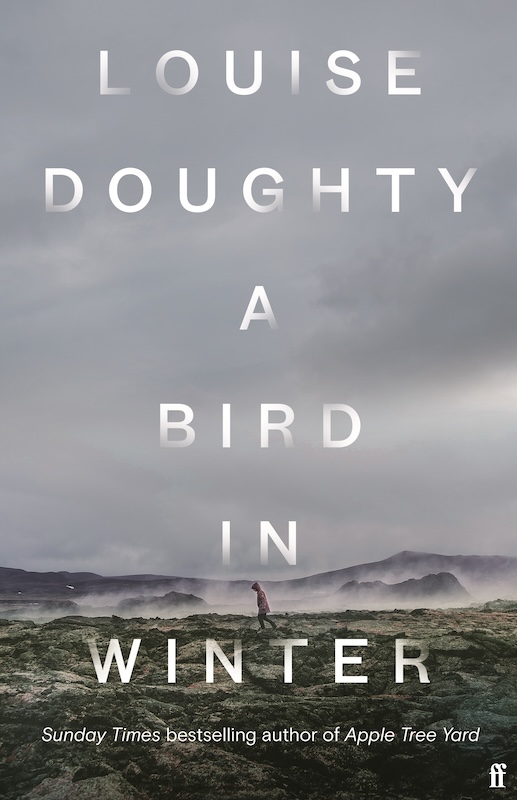
Book Review: A Bird in Winter by Louise Doughty – a pacy thriller that’s more than meets the eye

I’ve heard so many recommendations of Louise Doughty’s novels, among them Apple Tree Yard, which was also televised. So when A Bird in Winter appeared I snapped it up, expecting an intelligent thriller and for the most part I wasn’t disappointed.

The Bird of the title is Heather, nicknamed by her father who was a former intelligence officer in the British Secret Service. Heather makes a roundabout entrance into the service, too, shoulder-tapped and mentored by Richard, her father’s own former protégé. When the story begins Heather is a high-ranking official in the service, working out of an office in Birmingham that has been set up recently to seek out agents who have ‘turned’. A signal at a meeting and Heather abruptly leaves the building and goes on the run.

It’s a compelling beginning. We read with bated breath as Heather collects a stashed bag all set up for such an eventuality. There’s money, a burner phone, a fake passport and a couple disguises – she can be a homeless person one moment, or morph into a middle-aged hiker the next. She hops on and off trains and heads north for Scotland. So far, so James Bond.

Only it isn’t. This isn’t a convoluted espionage thriller, full of action set pieces and a showdown with the baddies at the end complete with guns and random mayhem. Although there is a storm at sea. As Heather waits out the time it will take for her rescue, the story slips into the past – Heather’s spell in the army which is where she meets Flavia. Heather and Flavia become like sisters, sticking up for each other against the misogyny they face daily. Then there’s the special connection Heather has with Flavia’s daughter, and events that lead to them losing contact.

The plot then picks up as Heather tries to piece together the clues to her betrayal, the weakness that was exploited and the treachery that has left her out in the cold. She still has one or two friends who will help her, but she knows she’s on borrowed time. Will she make it out alive?

  He was there that morning to give a PowerPoint presentation about various cases he had been involved with. We had quite a few of these sessions, historical examples of successful missions and, sometimes, the unsuccessful ones, everything that could and had gone wrong. In those talks, we got to learn from the missions the public never hears about – the terrorist attacks that were foiled and how, the demonstrations where invaluable intel was garnered, and why.
  And sometimes, we got to learn about the things that had been missed, the real reasons six or fourteen or thirty-two people had lost their lives when nobody should have died. The men and women who gave those talks had something haunted about them, sometimes apologetically so, sometimes tinged with defiance. Ancient Mariners, all of them.

While there is a lot going on and plenty to keep you turning the pages, A Bird in Winter is a subtler kind of thriller. Doughty takes her time with Heather, showing her as a multifaceted character – a woman who has sacrificed much for her career, and it’s lonely at times. She has all kinds of regrets, particularly around relationships, including Flavia, and also her mother. As a reader you want to like her, and so you become desperate for her to survive, to be able to start a new life, a happier life even.

We get brilliantly evocative settings as Heather adapts to her surroundings, as well as scenes of quiet domesticity, where she tries to be a normal person. But always in the background is the ever present danger. It’s a clever balancing act, and it makes you imagine yourself in Heather’s shoes. There’s also a darkness here, in the cold side of Heather’s make up, which means she can do what it takes, as well as the ever present violence that is for the most part just off stage.

This is such a well written and satisfying novel, definitely a slow-burner, and one that takes its genre into a more literary sphere. I shall be eager to read more by Louise Doughty. A Bird in Winter is a four out of five star read from me.

Book Review: The Stargazers by Harriet Evans – madness and music plus a crumbling country mansion

The Stargazers is one of those family sagas spanning the generations where dark events of the past threaten to derail the younger generation’s future. At the centre of this story is Fane Hall, the grand family mansion that was once a glittering venue for parties and weekend guests.

But since the loss of Iris’s father in the Somme, the new Lord Ashley, Iris’s Uncle Clive, will be taking over Fane Hall and she and her mother will be forced to leave. Iris can never forget her belief that Fane belongs to her – if she had been a boy there would be no doubt – and for decades to follow, it is Iris’s searing ambition, to reclaim Fane.

The story flips forward to 1969 and we meet a young couple – Sarah a gifted cellist and her writer husband Daniel – who are delighted to have bought a house in The Row in London’s Hampstead. The house needs a lot of work which is why it’s so cheap, but the two are very much in love and soon settle in and make friends with the neighbours. Among them the beautiful Lara, who had lived in the house from childhood when it was bubbling with family life. Though she becomes friendly with Sarah she finds entering the house disturbing. There’s talk of her tragic family – the loss of a brother and her beloved parents.

Sarah’s own upbringing was the opposite. Iris was a cruel and remote parent and the story flips back to reveal a childhood of deprivation and abuse. She and her sister, Vic, now rarely speak, have fallen out years ago, but at one point Vic was Sarah’s saviour and the sisters were everything to each other. We go back to their time at school, to Sarah’s flowering talent as a cellist, to their time at Fane and meeting Uncle Clive, who is crumbling just as much as the house is.

Iris watches them all turn slowly towards her. What a disappointment she is, for if she had been born male, everything would have been all right. She would have saved the family, saved Fane Hall from Uncle Clive. This is not how it should have been. Because it is her house.

There are all these threads to untangle, questions to answer. Who is the mysterious Bird Boy, and what caused the rift between the sisters? What happened to the house at Fane and what is Iris’s hand in it all? But the story also captures the difficulties of being a parent – Sarah struggles with her moody, headstrong daughter and with being Daniel’s wife. And how do you raise a child with love, when your own childhood was so deprived? Daniel is charming and popular, bringing people into the house for all-day Sunday lunch, while Sarah would dearly love some peace and quiet, to be herself. Will she ever play the cello again?

The story slowly fills in the blanks, but builds in plenty of suspense as well. There’s danger, but there are surprises too making for a very engaging story. I thought the plot was great, the characters interesting, but the writing was a little sloppy at times, as if it needed a bit more crafting or an editorial eye. Even so, I was happy to while away a few hours immersed in Sarah’s story. I have a read a few novels by Harriet Evans and will no doubt pick her up again for a relaxing read. The Stargazers gets three and a half stars from me.

Book Review: The Shadows of London by Andrew Taylor – a ripping read set during the reign of Charles II

Andrew Taylor has had a lot of practice in the art of mystery-thriller writing. At one point in his long career he gave us the Bergerac series, which was also televised – I fondly remember watching it aeons ago with my parents. There have been numerous more series and standalone novels, and in 2009, Taylor was awarded the Diamond Dagger, the Crime Writers Association’s most prestigious award for a lifetime’s contribution to crime writing in the English language.

But in my view, he was just warming up. His latest series is one of my favourite historical mystery series – the James Marwood and Cat Lovett novels set in the years following the Great Fire of London – hence the series title: Ashes of London. The two main characters are frequently at odds with each other, but somehow their paths always cross, usually when there’s murder involved.

As you might recall, Marwood is a rising young man in the corridors of government and in The Shadows of London we catch up with him as an assistant to Lord Arlington, the King’s most trusted advisor. Cat has meanwhile been busy with her architecture business – there’s so much work to do in a city half destroyed by the Great Fire. Her latest project involves rebuilding an almshouse, but work grinds to a halt when a body is found at the site, the man’s face battered beyond recognition.

The local magistrate, Mr Rush, was previously involved in the project, but had a falling out with Cat’s client, Robert Hadgraft, and puts a hold on any work until the murder is resolved. Cat is desperate to resume work as she needs to keep her workers committed to the building work and somehow pay off her suppliers. She turns reluctantly to Marwood to see if he can persuade Arlington to intercede on her behalf. Before you know it, the two are investigating the murder, and yes, again, the unpleasantly conniving Duke of Buckingham appears on the scene.

Marwood has had run-ins with Buckingham before, in particular with the Duke’s vicious henchman, Durrell, whose distinctive appearance is noted by a witness connected to the recent murder. The story is all set for more regal intrigue and takes you to Newmarket, where the King and his court turn up for the spectacle of horse racing. But before we get there we meet Louise, a maid of honour to the Queen, left behind at Whitehall because of an ailment.

Louise is the other thread to the story – a young impoverished noblewoman, once a maid of honour to the King’s late sister. Charles II has given her a home along with one or two other French ladies-in-waiting following his sister’s death. But Louise is worried that her youthful beauty will be irresistible to the King. The Ashes of London series sheds a light on a number of the King’s characteristics, some of them endearing, but here we see him as something of a sexual predator. And Louise should be worried. On top of everything else she has as secret, a problem she’s turned to the Duke of Buckingham, of all people, to handle.

Louise thought with the cold, merciless clarity of a trapped animal that the ambassador would have made a fine preacher had he not chosen instead to be a pander.
Colbert leant even closer. He skewered her with those uncomfortable eyes. His voice hardened. ‘Kings are not like other men. They are chosen of God, and to serve them is a great blessing. To serve two would be doubly blessed. Do you agree?’
‘I seek to serve God and my king, sir,’ she said in a voice that was barely audible above the noises outside. ‘Always.’
He sat back and gave her a thin smile. ‘Of course. I had expected no less of you.’

Everything builds nicely into a thrilling well-paced story, as Marwood juggles the demands of his work with the murder investigation while his enemies close in. There’s a new love interest, and when all seems lost, help comes from a surprising direction. There’s a ton of period colour and insight into the workings of court so you know Taylor has done his homework. But also there’s the perilous situation for women of the time. Cat struggles to be taken seriously as an architect, but at least she strives to be independent. Other women, no matter what class they belong to, have little choice when it comes to their future, doing anything they can to keep a roof over their heads.

The Shadows of London is number six in the series, and I confess to feeling a lump in my throat as I turned the last page because I simply didn’t want it to end. Although it has a very good ending, and you have a feeling that Marwood and Buckingham will have more scores to settle, so there’s promise for more books. I certainly hope so – I’m sure there’s lots more to say about the era of Charles II, and loads more interesting history to mine. The Shadows of London gets five stars from me.

Book Review: The Patient by Jane Shemilt – a creepily suspenseful novel with two picturesque settings

I felt sorry for Rachel from the first page of Jane Shemilt’s latest novel. Rachel’s a respected GP, and lives in the picturesque town of Salisbury with her teacher husband. But things are distant between them – a spark has died and life’s a bit dreary. And then there’s the daughter – Lizzie, who scarcely talks to Rachel, harbouring a grudge about the lack of quality time Rachel was able to give Lizzie growing up.

But that’s not the problem. The problem is Rachel has stepped over the line with a patient and now her world’s in chaos. She wasn’t even supposed to be working when a suicidal patient turned up at the medical centre. Rachel recently lost a patient to suicide, so gives Luc plenty of time, listening as he pours out his heart. When Rachel discovers Luc is a new neighbour, having renovated the old house she remembers belonging to a childhood friend, she also meets his glamorous American wife, Ophelia, and her charming brother and Ophelia’s little boy. The perfect family – or are they?

Luc has a everything, it seems, but he and Rachel are drawn to each other but, as we all know, doctors aren’t supposed to embark on relationships with their patients – especially vulnerable ones with a mental illness. We meet Rachel as she’s recollecting everything that happened in the months preceding – her lawyer has told her to write it all down while she’s in custody. As a reader we realise that Luc has gone off the rails, that a terrible crime has been committed and somehow Rachel’s involved.

The plot see-saws in time, back and forth, filling in the gaps – Rachel’s fear she’s being followed, her tricky relationship with a woman at work, an obsessive patient, her escape to a conference in France and her affair with Luc. It seems nobody’s on her side – apart from her dear neighbour Victoria, but she’s away on photo shoots a lot or off caring for a dying mother.

As the narrator, Rachel is the perfect character for a story like this. She’s intelligent, obviously, but very trusting, so the plot delivers plenty of surprises as facts rise to the surface. As a reader you are in the position of constantly yelling, look out behind you! And why is she so vague about whether or not she locked up her house? She really needs to be more careful. But she also seems to know her stuff as a doctor – you can tell Jane Shemilt’s own work as a GP inspired her story.

The setting is gorgeous. As well as Salisbury it takes you to the South of France, and the countryside around Arles, where Van Gogh painted his sunflowers. Luc’s mental illness is a kind of echo of Van Gogh’s. But inside of a prison cell is not so nice, particularly when you’re on the cusp of losing everything.

The Patient is a well put-together, nicely written addition to psychological thriller genre. There are plenty of surprises and the before and after timeframe maintains suspense nicely. I enjoyed the novel as an audiobook, read by Hilary McLean, who gave the character of Rachel just the right tone. It’s very easy to binge on psychological thrillers like these, they can be so compelling, particularly the good ones. The Patient is a four star read from me.

Book Review: The Bookbinder of Jericho by Pip Williams – a war-at-home story set among Oxford’s printing presses

Pip William’s first novel, the inordinately successful The Dictionary of Lost Words was always going to be a tough act to follow. But when The Bookbinder of Jericho came my way I was soon swept up in Peggy’s story – the work she does at the Oxford’s Clarendon Press in the bindery’s folding room with other women. It’s a segregated working environment, the women collating the pages from the printing room, folding them ready for stitching and binding, a man’s job. Just as it’s men who are always the machine operators and compositors, mechanics and readers.

Oxford itself is also segregated along class lines. Peggy and twin sister Maude live on a canal boat, still missing their mother who died several years before. The are ‘town’, the ordinary working folk who live outside the walls that separate the academic inhabitants of Oxford – or ‘gown’. But we’re on the brink of World War I, and things are set to change.

Peggy can’t help trying to read the books they are folding; she’s smart and yearns for a higher education. Her mother was also a reader, and their canal boat is crammed with books and parts of books that didn’t made the grade, But her sister needs her, or so she thinks, and Peggy sticks by her side. Maude is a little fey, her fingers always busy folding even in her spare time, her conversation a parroting of the phrases of others. The arrival of Belgian refugees, and in particularly Lotte, a grief-stricken woman who joins them at the folding bench, shakes up Peggy’s relationship with her sister, challenging her excuses for avoiding change.

I’d been walking past Somerville all my life, imagining what it was like for the women on the other side of the wall. Now, here I was, a little bit of Jericho littering an Oxford quad. I remembered when I first thought of being one of them – I’d been listening when I shouldn’t have been. She’d be well suited to the Oxford High School, my teacher had said. I know that, Ma had replied, but she won’t leave Maude. My teacher persisted. I think she’s bright enough for college. Ma sighed, It’s not always enough, though, is it? I’d thought of the income I could start earning at the Press, the difference it would make. I’d stopped listening

Other characters breeze through the book and rock Peggy’s world. There’s Gwen, the upper class girl she meets when the two volunteer to read to wounded soldiers. Gwen is ‘gown’, but finds Peggy’s world fascinating. Peggy can’t be sure if her friendship’s genuine or is she just a pet project? Then there’s Bastiaan, the badly scarred Belgian soldier Peggy is drawn to during her hospital visits. He would definitely be ‘gown’ if he were at home, studying architecture, but war has a levelling effect and the two meet as equals.

Tilda is the girls’ mother’s great friend, a flamboyant actress who becomes a VAD at the front, her letters revealing the horrific realities of life in the field hospital at Etaples. There’s Rosie in the canal boat ‘next door’, whose son Jack marches off to war with so many of the boys from the Press. We also momentarily meet Vera Brittain (Testament of Youth) when Peggy attends a function for the refugees at Somerville – the women’s college Peggy eyes with longing.

As Peggy’s views of things are challenged by her new acquaintances, the war grinds on, news of horrific battles and casualty lists filtering back to Oxford. The book is divided into parts which roughly equate to a year in the war, and a book from the presses. In the background there’s another battle going on – the battle for women’s rights, the suffrage movement on hold for the duration. This enlivens the conversations Peggy has with Gwen, but it’s hard for Peggy not to feel bitter. The vote for women when it comes will only be for women over thirty and landowning ones at that – the vote by no means universal.

As the plot goes, The Bookbinder of Jericho isn’t exactly riveting reading. Like Peggy’s life, all the action seems to be happening to someone else, somewhere else. Peggy seems to be in a kind of holding pen, waiting. As a reader I found myself waiting too. What makes the book interesting is the world Pip Williams has created. The little enclave in the printing presses of Oxford is well researched and described in detail. Lovingly so. Then there’s Peggy and Maude’s canal boat and life on the water. Everything tucked into corners to make the most of the space. The frugality of their world – apart from paper, which is everywhere.

So The Bookbinder of Jericho gets top marks for characterisation and world building, for bringing history to life. But I did find myself rushing through it to get to ‘the good bits’ rather than savouring it. There’s still a lot to like and even more to think about so I’ll probably read this author again. This novel’s gets three and a half out of five stars from me.

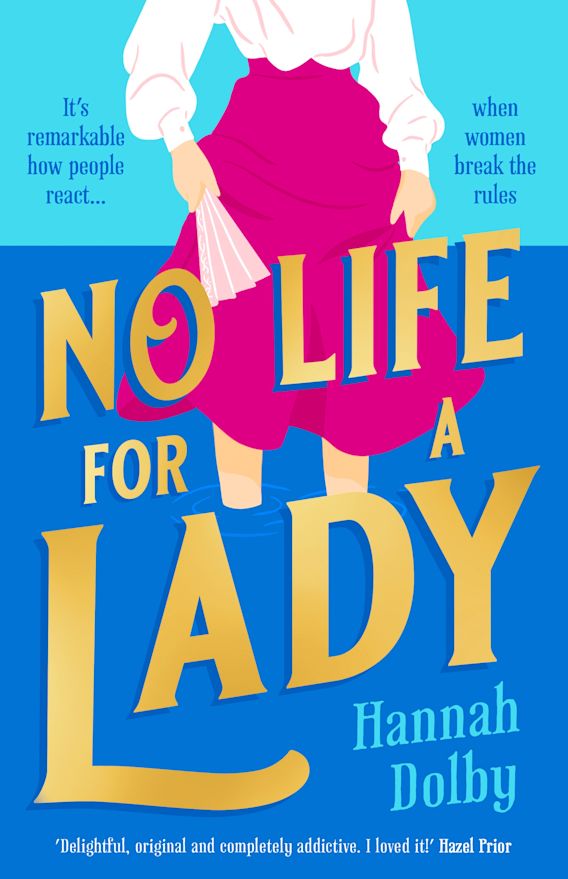
Book Review: No Life for a Lady by Hannah Dolby – a light and humorous adventure

This novel was a breath of fresh air, a lively read that was a welcome pick-me-up without challenging the brain cells too much. Part rom-com, part mystery with a little comedy of manners thrown in, No Life for a Lady follows Violet Hamilton who lives with her father in the English seaside town of Hastings.

We’re in the final years of the 19th century, and at 28, Violet should be happily married off by now, according to her respectable banker dad. But Violet is determined never to marry, her parents own marriage having been somewhat less than blissful. So much so that a decade ago, Violet’s beautiful mother Lily disappeared. She’d just popped out to visit friends one evening and never returned.

Lily’s disappearance might have been an accidental drowning as she was last seen on the pier. Had she fallen into the sea and been washed away? That certainly seems to be a possible theory and the one Mr Hamilton propounds to Violet, all the better for her to put her mother behind her and move on with her life. But Violet feels she would know if her mother had died, and thinks she could be out there somewhere, maybe even needing help.

When Violet decides to hire a detective, she sets in motion a chain of unforeseen events that spell disaster on one hand, but also push Violet to becoming a sleuth herself. Frank Knight is the only detective in town and eagerly takes on her case. But Violet is unimpressed with his lack of professionalism, and his assumptions about Lily seem set to defame her rather than save her.

The disappointments of the decade had been compounded by the realisation it was almost impossible for a lady to take up a respectable profession. I had been set on the idea, but now my attic was filled with the skeletons of half-finished hats, faded botanical specimens and, most tragic of all, dusty portraits of a few worthy occupants of the town. This last career had ended abruptly when I persuaded the wife of the town mayor to pose for a portrait. I had faithfully included all three of her chins, upon which she told me she had only sat for me out of sympathy, forbade me to continue as an artist and left, chins wobbling in fury.

Violet finds an old newspaper which leads her to Benjamin Blackthorn, a reluctant detective who has given up the trade in favour of selling furniture in the old, slightly seedy part of town. While he is the opposite of Knight in every way, Benjamin refuses to take on her case, but Violet wears him down enough to allow her to help with one or two cases that require a woman’s touch. Violet is more enthusiastic than subtle at the outset, which leads to some hilarious confrontations.

Dolby’s manuscript for the book was the runner-up in the Comedy Women in Print awards, and there are plenty of fun scenes, the writing’s witty, but there’s plenty to think about too. There are issues around the constraints placed on women in the era, of class and the lack of choice when it comes to making a living: marriage, servitude or prostitution seem to be the main options for women. Add to that the resigned tedium of being stuck in an unhappy marriage; the ignominy of divorce.

Packed with an assortment of quaint and humorous characters, the story builds to a dramatic conclusion involving surprising revelations and a fair amount of danger. For a young lady of her time, Violet has to step outside the norm of proper behaviour but finds allies in surprising places. The ending leaves us with possibilities for a sequel, perhaps more cases for Violet to solve. I shall certainly be keen to read more of Violet’s adventures. No Life for a Lady gets four out of five stars from me.

Book Review: The Night She Disappeared by Lisa Jewell – another stylish psychological thriller from an always-reliable author

I often pick up a Lisa Jewell novel when I want a light, engrossing read. The Night She Disappeared is one of those books where the rich girl from a loveless family makes friends with the much loved poor girl with problems – and disaster ensues.

Tallulah lives in a village with her divorced mother and brother and is doing fine until an unplanned pregnancy has her reconsidering her options. She’s barely out of school so enrols at the nearest polytechnic, a bus ride away and organises her life around her baby. She didn’t plan on living with her boyfriend, Zach, but he is insistent he wants to get back together and she unbends and lets him move in with her at her Mum’s home. Mother, Kim is delighted as she sees in Zach someone who adores her daughter and will be a good father.

But Tallulah meets Scarlett at the bus stop – glamorous, dangerous looking Scarlett, who is at the same college, doing art to Tallulah’s social work course and the two become unlikely friends. Scarlett lives at Dark Place, a large house across the woods that has a dark history, but has had lavish amounts spent on it. As the weeks and months roll by, Tallulah compartmentalises her life between college, home life with her family and Zach, and secret meetings with Scarlett.

The story flips between Tallulah’s story and a year or so later when Sophie moves into the village with her partner Shaun. He’s the new head teacher at Maypole, a private school a mere woodland stroll from Dark Place, where Tallulah and Zach were at a party they night they disappeared. Sophie is an author of cosy mysteries, but here she’s suddenly aware of an unsolved mystery right on her doorstep.

When Sophie finds a sign saying “Dig here” and an arrow, she can’t help herself. What she finds soon draws her into Tallulah’s story, as well as meeting Kim working the bar at the local pub, a woman she wants to help. But in the background there’s her own relationship to consider. Shaun is obviously stressed. He has only chosen the job at Maypole to help fund the expensive schooling his ex-wife has insisted on for their daughters. And he and Sophie have never lived together before. They used to enjoy London so much too. Raking up what happened on the school’s doorstep isn’t going to help Shaun settle in to his new job.

Meanwhile Kim is battling away, trying to manage the baby as well as keeping alive her hope for Tallulah’s return. There are a bunch of minor characters who have a role in what happened and who could be suspects in the case. There’s a nice policeman who listens and does what he can. The story moves to an astonishing and gripping ending and I’d be amazed if you manage to put it all together before it’s all revealed. It might even give you goosebumps.

I am happy to say that The Night She Disappeared did its job; it’s a stylish, engaging, relaxing read. The main characters who tell their story are easy to empathise with, even if they do silly things or fail to stick up for themselves. And the plot is nicely measured out between them to keep you hooked. I’m not sure I enjoyed it as much as others I’ve read by Jewell, but it’s still an easy four out of five stars from me.

Book Review: The Mysterious Case of the Alperton Angels by Janice Hallett – another twisty mystery that will have you hoodwinked

I’m beginning to know what to expect every time I pick up a novel by Janice Hallett. First of all it will be told in an unusual format – often in emails and texts or transcriptions from recorded conversations. The other thing is that the story will have me totally hoodwinked. Normally, with mystery novels, I have a go at trying to solve the mystery from the clues presented, considering the characters and their motives, their histories. But for this novel, I didn’t bother trying, just went along for the ride.

The story begins with documents from a safe deposit box relating to the publication of a book. We follow Amanda Bailey, a journalist and writer of true-crime books, when she is commissioned to write a book on Alperton Angels. This was a cult lead by the self-titled Gabriel Angelis, now residing in prison for the murder of a waiter. Eighteen years ago, the cult ended in the deaths of several of its members, and the miraculous rescue of a baby, which the cult believed to be the Antichrist.

There is no doubt that Gabriel Angelis is an evil man, and that prison is the best place for him, in spite of his pleas that he did not kill anyone. But what he did do was lure vulnerable teenagers into his orbit, in this case Holly and Jonah, who survived the ritual bloodbath eighteen years ago, Holly saving the baby from sacrifice when the stars were apparently in alignment.

Eighteen years later, where is that baby now? That is going to be the main focus of Amanda’s book along with the whereabouts of Holly and Jonah and what they’ve made of their lives since. But a rival publishing company is also interested in the Angels, and have chosen Oliver Menzies to write another book on the case.

Oliver and Amanda were on the same journalism course twenty odd years ago, a course that Amanda left abruptly without qualifying. And when her publisher suggests that she and Oliver work together to begin with so that they can ensure their books cover different territory, Amanda is not a happy camper.

It’s not easy getting people to talk about what happened, but one thing that does come across is that Amanda is a consummate professional and slowly the facts slot into place. Oliver just bumbles along and the What’sApp banter between them adds plenty of entertainment. This is just as well as a book of emails and texts would soon pall if Hallett didn’t manage to make them lively. So too are the transcriptions typed up by Ellie Cooper for Amanda. Ellie is a kind of sounding board for Amanda’s discoveries and offers lots of good thoughts, plus her asides as she transcribes Amanda’s phone-recorded interviews are a hoot.

But it’s the plot that really has you hooked, packed with twists and turns, and beguiling little details that had the police stumped. What was the deal with that Mini Clubman that ran off the road and disappeared? And those weird newspaper adverts – what did they mean? Hallett really knows how to use red herrings. Towards the end of the book, you suddenly begin to realise what really happened, and start to join the dots and see connections. Suddenly the unbelieveable all begins to make perfect sense.

The Mysterious Case of the Alperton Angels is another diverting read from Hallett but it works best if, as a reader, you enjoy puzzles. We only get to know characters as they reveal themselves in their emails and texts – we don’t even know where they live, or even a lot about what they look like. But perhaps Hallett deliberately impedes the reader’s empathy for them because of how untrustworthy many of them are.

I think Agatha Christie would approve of Hallett’s style. How many times have I read Poirot remind Hastings not to take too much at face value. How you can never be sure that a witness isn’t lying. And it’s the same here. The Mysterious Case of the Alperton Angels is a modern take on the classic detective novel. I can only gaze on and admire its cleverness. But cleverness isn’t everything in a book and I like a bit more from my crime fiction; I like to feel something too. So its a three-and-a-half star read from me.

Book Review: The Murder of Mr Wickham by Claudia Gray – a cosy mystery that brings back the characters of Jane Austen

You may have noticed there’s quite a collection of novels based on one or other of the six completed novels of Jane Austen. I have read a few and enjoyed them greatly. But Claudia Gray takes this genre to a new level with her delightful mystery, The Murder of Mr. Wickham.

Honestly, if anyone in Jane Austen’s ouevre deserved to be bumped off it is surely George Wickham. He’s that rascal that threatened to ruin Lydia Bennett in Pride and Prejudice, as well as spoiling the marriage prospects of her sisters. He’d almost ruined Darcy’s sister as well. In Claudia Gray’s novel, we catch up with Wickham at a house party, not at Pemberley, the seat of the Darcies, but at Donwell Abbey, the home of Mr Knightly and his wife, Emma, from that other Jane Austen novel.

Guests at the house party include Mr Knightly’s old friend Fitzwilliam Darcy, his wife Elizabeth and their son Jonathan, a handsome but socially awkward young man of around twenty. Then there’s cousin Edmund Bertram and his wife Fanny (from Mansfield Park) as well as the Wentworths, Frederick and Anne (from Persuasion) who were renting Emma’s childhood home when a staircase collapsed and urgent repairs required.

Also joining the guest-list are the Brandons, Colonel Brandon that is and his young wife Marianne (from Sense and Sensibility). That just leaves Northanger Abbey, which is represented by seventeen-year-old Juliet Tilney, the daughter of Henry Tilney and Catherine, now a novelist who Emma admires. Emma has taken a shine to Juliet and invited her so that the girl can see new people and a change of scenery. With Jonathan Darcy staying, here’s also a hint of Emma’s propensity to match-make.

So you can see that Claudia Gray has really pushed the boat at to draw on all six novels for inspiration and does a terrific job, throwing Austen’s characters together and seeing what happens.

There’s already a tense atmosphere as Mr Knightly is troubled by the financial losses his younger brother has incurred due to a venture masterminded by none other than George Wickham. The same venture has also caught out Captain Wentworth, losing him a chunk of the money that he won as prizes as a naval officer in the war with Napoleon. It was this money that enabled him to hold his head high against the snobbery of Anne’s family. But without it, he fears he’s let Anne down and they may need to return to sea.

Since Pride and Prejudice George Wickham has had a further twenty plus years to cause misery to the Darcies, and more crimes come out of the woodwork when the bounder turns up at Donwell Abbey to call in some debts. It’s the middle of a stormy night when the murder takes place, the guests all restless and anxious for various reasons.

The only two characters who don’t make the suspects list are young Juliet, who had never met the victim before her visit, and Jonathan Darcy, who spent the night calming his horse in the stables when the storm was at its most severe. They never would have thought of investigating the crime themselves if it hadn’t been for the magistrate of the district, Frank Churchill (remember him from Emma?), who assumes the killer must be among the Donwell staff, or passing “gypsies”. Juliet, in particular, is appalled at the idea of someone going to the gallows unjustly.

The two team up, secretly sharing their findings at midnight in the billiard room, and Jonathan finds it so much easier to talk to Juliet than he might have otherwise, now there’s something practical to talk about. The story has plenty of pace and builds to an unexpected resolution as more and more secrets are revealed. In the crucible of a murder investigation, relationships are tested and new understandings emerge.

I enjoyed The Murder of Mr. Wickham immensely, which has all the wit of an Austen novel, Claudia Gray bringing the characters to life beautifully. The good news is this is the first in what looks like a new series featuring Juliet and Jonathan as unlikely but very appealing sleuths. I’m giving it four and a half stars – the audiobook version is narrated with aplomb by Billie Fulford-Brown – and am keen to see what happens in The Late Mrs Willoughby, which is Book No. 2.

Book Review: The White Hare by Jane Johnson – a haunting country house mystery with a touch of magic

We’re back in Cornwall for another novel set in the 1950s and I was in my happy place listening to this as an audiobook. I often hunt out these evocative country house stories.

The White Hare begins with a family of three arriving to take on a run-down country house with the aim of turning it into a guest-house. Somewhere comfortably-off urbanites might sojourn for a change of pace and some gentle pampering. This is Magda’s idea. In her fifties, Magda is an imperious, demanding and determined woman who won’t take no for an answer.

Her daughter, Mila, passively just does what her mother tells her, hoping to build a home for her and young Janey. But although she has strong feelings, she keeps them in check, because she owes her mother her salvation. A chance for a new start, having been duped by a bigamous husband and left with a five-year-old daughter. Remember, it’s the mid 1950s, when a woman’s reputation was everything.

The house is of course a mess, but in the barn they also discover an unwelcome guest. Jack, the interloper, says he hadn’t meant to trespass; he was just exploring the nearby countryside and would soon be on his way. But Janey has warmed to Jack, and when Jack reveals he can fix their car, and is handy with a hammer and nails, he becomes the women’s saviour when they face one crisis after another.

The locals don’t take kindly to strangers. It is said the house is haunted and when Mila mentions seeing a white hare on the road the day they arrived, all sorts of strange legends start to emerge. Then there’s Jack. He and Mila soon warm to each other, but Jack seems to be harbouring secrets. There’s also a creepy vicar, but fortunately for Mila, friendship and support are on hand from a local healer and her artist girlfriend.

The story follows Magda and Mila’s rocky relationship as they struggle to bring the house into a reasonable state of repair ahead of a lavish New Year’s Eve party Magda hopes will entice acceptance from the locals. The folklore of the area won’t leave Mila alone, and there are odd discoveries that hint at a tragedy involving the previous owners of the house.

To make things even more creepy, Janey seems to have discovered a way of communicating with an otherworldly presence through her toy rabbit. The story builds to a dramatic ending where the real and unreal converge and the present reveals, and can finally bury, past wrongs. The characters of Magda, Mila and Janey are interestingly developed – there’s nothing like adversity to bring people together.

I loved the story – the perfect sort of audiobook, narrated brilliantly by Danielle Cohen – intriguing and full of mystery with a bit Cornish history thrown in. Listening to a book like this takes me back to those old fireside tales that begin with, ‘let me tell you a story’. If you like books by Katherine Webb and Kate Morton, you’re sure to enjoy The White Hare, a four star read from me.