Book Review: Shrines of Gaiety by Kate Atkinson – a story from flapper era set in London’s seedy Soho

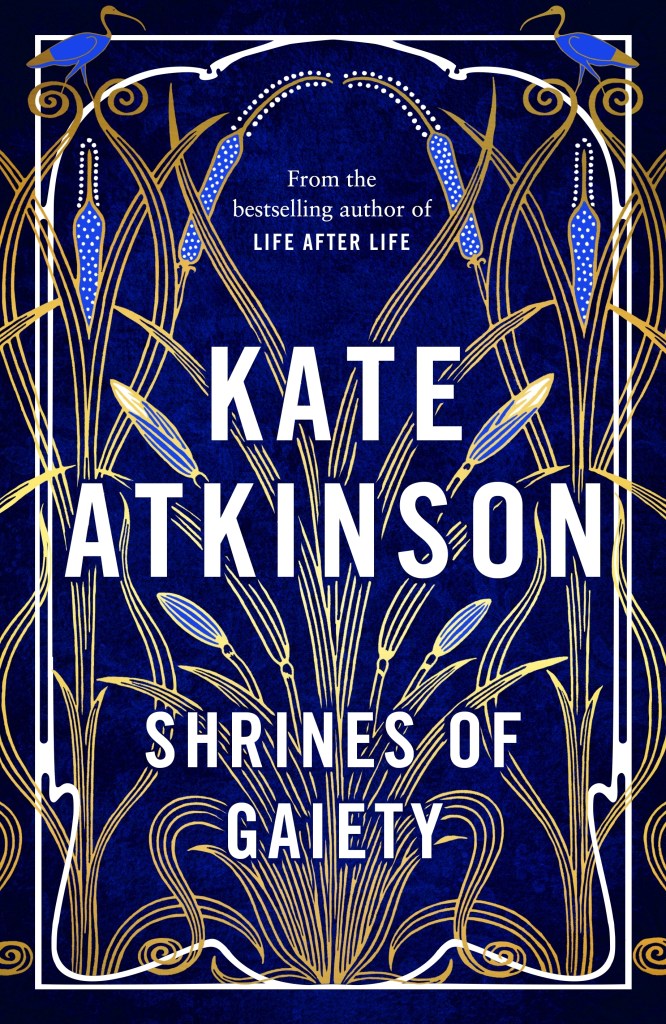
I find it so easy to slip into a Kate Atkinson novel, whatever the storyline, because the writing is just so smart. In Shrines of Gaiety, the main focus of the story is the goings-on of a family of nightclub owners in 1920s London, overseen by the matriarch, Nellie Coker. A Scottish woman widowed young and with a family to support, she’s done a few dodgy things to make her fortune, intent not only on supporting her children, but advancing them in society.

We meet Nellie as she’s leaving after a short stint in Holloway, the London prison for women. One of her nightclubs had been raided and liquor found being sold on the premises. Usually she gets a tip-off from a policeman – Inspector Maddox from Bow Street police station – but not this time. Is Maddox still loyal? There’s someone else sniffing around – a gangland boss who’s keen to get his hands on a set of nightclubs and settle an old score.

Observing Nellie leaving Holloway is Chief Inspector Frobisher, the detective tasked with cleaning up Soho’s nightlife and the rot that has set in at Bow Street. With him is Gwendolen, a librarian from York who is on the hunt for two young girls who have run away to London to go on the stage. London has a habit of swallowing up young women and a few have been turning up dead, fished out of the Thames.

Gwendolen is an interesting character as she has the fortitude of someone who has nursed during the recent war, but post-war life has been a little tame, living in genteel poverty with her listless mother. When her mother dies, she discovers an inheritance which gives her the freedom to travel to London, where she can explore a new life. The missing girls set her off on a mission. Both Frobisher and Nellie Coker offer Gwendolen interesting opportunities.

As well as following Frobisher’s policing, and Gwendolen’s snooping, we meet the younger Cokers: eldest son Niven, who is battle hardened from the war, unflappable and smart. His sister Edith is Nellie’s natural successor, practical, though not as pretty as her sisters. But something has unhinged Edith lately. With their Cambridge education, Betty and Shirley are primed to marry into the aristocracy, though they also lend a hand with the clubs. Younger son Ramsay is rather effete and an easy victim of anyone trying to get at Nellie, but nevertheless has literary aspirations. Young Kitty at eleven suffers from neglect and is largely uneducated while no-one notices that she’s also in danger.

‘Give Mr Frazzini a box of chocolates, will you?’ Nellie said to Betty.

Nellie sold the boxes for fifteen shillings each but bought them wholesale from somewhere in the north for a shilling a box, all prettied up with ribbons (a penny each) by soldiers disabled in the war. The dance hostesses made a great fuss of persuading their partners to buy the boxes for them and then, after a few chocolates had been eaten, the boxes made their way back to the storeroom they’d come from and were refilled, ribbons adjusted, and sent out to be sold again.

The narrative bounces around all of them, as well as Freda and Florence, the two missing girls, creating a giddy plot that will keep you on your toes. I’ve heard this book described as Dickensian, and I suppose it is with its varied cast of characters, and the way the criminal element rubs shoulders with the law, the sudden reversals of fortune – there’s even a gang of women pickpockets. The story paints a picture of the mad excesses of the 1920s, the jazz and the flappers, the endless partying as everyone tries to forget the recent war.

I enjoyed this book enormously because the writing is lively and amusing and you really can’t guess what will happen next. The situation looks dire for the stray women caught up in the seamy side of Soho, but even those with money can lose everything on the turn of a card. Help and goodness are in short supply but come from unexpected quarters. I chuckled my way through the book at some points; nervous for particular characters at others. At the end of the book, Atkinson gives potted histories of what happens next to all the major players, which may please or annoy some readers I confess to being a little annoyed but it’s still a four out of five stars read from me.

Book Review: Mother’s Boy by Patrick Gale – an imagined life of Cornwall’s favourite poet

I’ve read a ton of novels by Patrick Gale – I love his writing for its warmth, perception and the characters. They’re always shown with all their flaws, and yet they make for oddly likeable company. Gale reveals what makes them them interesting and ordinary at the same time.

Like Charles Causley, Cornwall’s favourite poet – the subject of the latest Gale book, Mother’s Boy. The story takes us back to the early part of the twentieth century, and the courtship of Causley’s parents, both of them working in service: Laura as a maid in a small household and Charlie who drives a pony and trap for a local doctor. They marry while World War I is getting up steam and see little of each other for years. Charles is born in 1917, his father shipped home eventually, but with TB.

The story clips along through the years, with chapters about Charles’s early life as a boy in Launceston while his father is still alive, school life and his knack for language, a talent for the piano and his discovery of poetry. There are two unlikely friendships, the butcher’s boy who once bullied him and Ginger, the annoying boy who followed him around and listened outside as Charles practised on the piano. His mother’s thrill to find Charles a safe job at a desk; Charles’s disappointment that he won’t be continuing his education.

Then another war, and Charles’s acceptance into the navy as a coder. There are several chapters that progress the war, and Charles’s romantic connection with two men. Each chapter shows a new discovery or aspect of the war through key events or changes to Charles’s life, the novel finishing a few years after the war.

Parallel to Charles’s story is Laura’s, working away at her little laundry business, her days ruled by the weather and the rigid timetable required to get it all done. Her love for Charles is a constant. Fortunately for Laura, the ache of missing Charles while he is away at war is tempered by the evacuees she takes on, the Americans setting up bases around the town and later the prisoners of war who inhabit one base once the soldiers have headed across to France.. So we get an interesting glimpse of the war at home.

And while she suffered, Charles was either out at his play-reading group or rehearsing with his dance band or drinking beer with friends, or else he was shut in his room, stabbing away at his typewriter or listening intently to the radio, as often not to some programme about the international situation and politics, which made her head spin if she tried to follow it, and telling her to knit more quietly.

The two main characters are so nicely drawn, so empathetic, that you feel you know them well. Charles is refined and educated, a lover of good theatre and literature, his working class mother often bemused by the things he says. The story ambles along through the years with sudden events that make you really feel for mother and son; some happy moments but also the tragedies that you’d expect because of the war.

You get a strong sense of what it was like to be born different, both artistic as well as gay in a time and place when such things were problematic; and yet Charles manages to be true to himself in a way that works for him. But at what cost? The story pulls you along, each chapter adding something new on both an intimate scale as well as within the wider world. I thought I’d close the book and think, yes that was an interesting read and very true to its subject matter. And then wham! The final scene, in its quiet living room setting, quite blew me away. There was a lump in my throat. There were tears.

Patrick Gale’s novels often have a way of creeping up behind you, leaving you a little stunned, but in a nice way. His author’s notes reveal that Causely was often asked why he hadn’t written a full memoir, not just the few autobiographical fragments that remained after his death in 2003. Causley’s reply was that it was all there in the poems. The poem Angel Hill, quoted in full at the end of the book, could be a case in point and ties in beautifully with Gale’s novel, particularly that final scene.

Mother’s Boy is a stand-out novel by an accomplished writer whose work never disappoints. If you like this book, it is worth checking out the author’s notes on his website wihich add detail and some interesting photos. You can tell that Charles Causley has become close to his heart, and Laura too. I love books where you feel the author has poured his heart into a story. I feel this is the case here and why it gets a five out of five from me.

Book Review: The Homes by J B Mylet – a gripping Scottish orphanage mystery

At the back of the book, J B Mylet explains how he was inspired to write this novel by his mother’s own experiences as a child in an institution very like the one in The Homes. As a young girl she thought all children were brought up in similar set-ups: a cluster of houses in a purpose-built of village with twenty or thirty children per cottage with ‘house parents’ and a cook to feed them all. She didn’t realise that most children grew up with their biological families.

And at first it’s the same for Lesley, sharing a room with five other girls, including her best friend, Jonesy, all about the same age. But now she’s twelve, she knows better. She at least gets regular visits from her grandmother, who though kindly, is unable to care for Lesley, and neither can her mother who visits a few times a year. Lesley is bitter about her mother and finds it difficult to believe her when her mother says she’s hoping to bring her home to live with her one day. Jonesy is there is because the state has considered her mother an unsuitable parent.

There are other rooms in Lesley’s house with more girls of different ages and in charge are the Patersons, a childless couple who do their best. But Mr Paterson is not above taking his belt to the girls, in fact it’s expected. Jonesy gets it more than most. She’s just so lively and unstoppable. And everyone is terrified of the Superintendent, Mr Gordon. Jonesy’s non-stop chatter is a foil to Lesley’s quieter intelligence. Meanwhile Lesley escapes into her studies, one of the few children who bus to a local school.

Fears of punishments and schoolyard bullies all fade into the background when an older girl, Jane Denton, goes missing, her murdered body found some days later. When another girl disappears, Jonesy determines to find out who the murderer is, while Lesley acts as a sounding board and is dragged into Jonesy’s sleuthing, throwing the girls into danger. What follows is a fairly classic mystery with plenty of secrets and hidden motives.

And while this is entertaining, it is the characters of the girls, especially Lesley’s narrative voice, sensitive and smart but also easily led down blind alleys, that make the story interesting. That and the strikingly original setting. It’s difficult to forget that these are vulnerable children who deserve so much better. Fortunately not all the adults are unsympathetic. Eadie is the kindly therapist who listens and offers advice; there’s a friendly detective and Lesley gets help just in the nick of time from an unexpected quarter.

The Homes makes for a compelling story, part mystery, part social commentary, that will have you riveted until the last page. But the story behind the story is just as interesting. I wonder what Mylet will come up with next. This book gets a four out of five from me.

Book Review: Meredith, Alone by Claire Alexander: a compelling story about a life spent indoors

It takes some skill to turn the life of an agoraphobic person into an interesting novel. But I was soon hooked by the story of Meredith who hasn’t left her house in 1214 days – that’s three years and three months. Something has happened to Meredith to leave her traumatised and solitary, something which has cut her off from her mother and sister Fiona, once her closest pal. The story weaves in the past with the present as we follow Meredith’s struggles to get out into the world again.

Meredith has made her home a haven with restful colours and orders everything she needs online. She works online as a freelance writer so she really has no need to go anywhere. It just shows you how easy it is to cut yourself off from the outside world if want to. She has her cat, Fred, and her best friend Sadie calls in regularly with her two young children so although the book is called Meredith, Alone, she still has people in her court.

Meredith has support from a group online, StrengthInNumbers, where she makes friends with Celeste and talks to a counsellor, Diane, who conducts regular online sessions. We catch up with Meredith when she has a new visitor – Paul, from Holding Hands. He drops in on Thursdays to make sure Meredith is OK. Paul has his own struggles, and is in between careers. The two become friends over jigsaw puzzles.

I have my fingers on the door handle. Diane and I decided that I would count backwards from twenty. When I reach five, I’ll open the door. By the count of one, I’ll have both feet on my front doorstep. I’ll take five steps down my path, then I’ll go back inside.
It feels good to have a plan.

The book charts Meredith’s attempts to leave her house, which spurs the book onwards, day by day. It also dives back into the past to reveal Meredith’s terrible childhood and the event that drove her indoors. It takes a while for the reader to get all the information you need for her situation to make sense. Without a varied setting, the plot relies on Meredith’s story to drive it along, the slow revelations and your eagerness for her recovery. And it works.

Meredith is good company – smart and for all that’s going on in her life, she keeps herself busy to avoid drowning in the miseries of her plight. The novel has a lot to say about all the pain people hide away from each other, the things that derail marriages and cut family ties. How you cover it up and carry on as best you can. Until you just can’t. But the book never feels weighed down by all this.

Reading Meredith, Alone so soon after Paper Cup, which I thought utterly brilliant, was probably not such a good idea. Both are connected by Glasgow and have main characters with mental health issues and who have broken off from their families. But these novels are very different in feel and Meredith, Alone has very little to suggest its wider setting, apart from the odd reference to Irn Bro. It’s no fault of this novel if it comes off as second best – it’s still a great read and Meredith a great character. It will make you think. So it’s a four out of five read from me.

Book Review: The Driftwood Girls by Mark Douglas-Home – a twisty mystery involving fiction’s favourite oceanographer

I’d almost forgotten how much I’d enjoyed the previous ‘sea detective’ mysteries and so this book almost slipped under my radar. It’s been a while since The Malice of Waves, Douglas-Home’s previous novel about his beleaguered oceanographer sleuth. Cal McGill runs a small business out of his Edinburgh flat, mapping ocean currents for clients who are missing things – often loved ones – lost at sea. He has pictures of flotsam and jetsam on a pinboard that dominates his living/working space, some of them rather grisly. So yes, he’s an odd sort.

It’s not unusual for him to find himself in a tight spot and at the start of The Driftwood Girls everything seems to be going wrong. After talking to an elderly man who looked set to jump from a bridge, the news media have labelled him as the bad guy when the old fellow disappears. Clients have dropped him like a hot potato and he’s almost out of cash. Then he learns that his old uni friend Alex is dying and is called to make good a promise to bury him in the middle of Alex’s favourite lake, which being illegal, will have to be done post-burial and under cover of darkness.

Out of the blue, Cal is contacted by Kate Tolmie, desperate to find her sister Flora who left a mysterious note with Cal’s name on it. Twenty-years before Kate and Flora’s mother disappeared off the coast of France when she was due to return to her family via ferry. The disappearance was big news at the time but no clues have ever come to light. Kate also hopes Cal can find out what happened to her mother, and there’s a personal connection too. Flora was Alex’s fiancée.

The story switches to Texel, an island holiday spot in the Netherlands, where the body of a young English girl lost at sea washed up, also twenty-three years ago. Here her old school-mate Sarah has made her home, guilt-ridden for not being a better friend. Of course, only Cal can make the connection. And what’s the connection to the death of a beggar at an Edinburgh train station, stabbed in an adjacent alley. All clues point to Kate Tolmie being the killer but DS Helen Jamieson isn’t so sure.

Helen is the other great thing about these books. She, like Cal, is an awkward character, not getting on with her colleagues because of her need to examine all the facts to ensure the right person is put away. Imagine that! Her IQ is off the chart and she’s got a massive crush on Cal. The two have become friends over several cases, but Cal is a terrible person to be friends with as he disappears for months at a time and doesn’t keep in touch.

Friendship is a recurring theme throughout the book – the awkward friendship between Cal and Helen, Cal’s sporadic memories of time spent with Alex, and their friend Olaf. There’s Sarah and her elegant French neighbour, as well as her memories of lost friend Ruth. Friendship has its obligations which can cause strain as much as it enriches people and we can see that here. Then there are all those secrets. Cal is in for a few surprises about the old pals he lost touch with and it is fortunate that Helen is investigating as she helps connect the dots.

This is a lovely twisty read with some really evocative coastal settings that add a ton of atmosphere. You get enough of the science of oceanography for it to add interest without weighing the story down. Mark Douglas-Home deftly weaves together all the plot threads – and there are a few of them – in a way that keeps you up reading to see what happens. All in all it’s a very satisfying mystery, but I hope we won’t have to wait too long before Cal’s next investigation. A four out of five read from me.

Book Review: The Fell by Sarah Moss – an empathetic and gripping story of the pandemic

The Fell reads a bit like several interwoven stories, each from the perspective of a different character. The single day setting of the book gives it more of a short-story feel, in that you only get glimpses of the past while the immediate future is left up in the air. This concentrates the tension of what happens when Kate goes for a walk and seems to disappear.

The story is set in a small town in the Pennines where Kate lives with her son Matt and they’re just scraping by. Kate works as a waitress and she does a bit of pub singing, but that’s all come to a halt since a contact at work has become ill with the Covid virus and she’s forced to take a couple of weeks off and to isolate at home.

This is hard for Kate as she’s a keen walker. She’s up on the paths into the wilderness near her home normally every day. She loves nature and living her life with care for the environment. As we meet her, she’s running out of money and there’s not much in the cupboards, certainly not a lot to feed a hungry fifteen-year-old. The house always seems to be cold adding to the sense of times being tough. So you can’t blame Kate for escaping her worries in a fit of desperation and striding up the path to the fell. She only plans a quick walk before dark, but something happens and she doesn’t return.

The story flips from Kate’s character to Matt’s, a caring kid who worries about his mum. As time goes by, he is torn between phoning for help and the fear that his mother would be in terrible trouble. She could face a huge fine they can ill afford, so the hours tick by and Matt waits. He hesitatingly visits next door where Alice is also finding things tough.

Recently widowed, Alice has dinner with her daughter via Skype, but since her battle with cancer, her daughter never stops pestering her about her health. Even though Alice is on her own, it’s like someone is always peering over her shoulder, making her feel guilty about baking all those cookies and not taking better care of herself. She misses her friends and trips to town, stuck at home because of her age and vulnerable health.

The fourth narrator is emergency rescue responder Rob. Now divorced, he should be at home with his teenage daughter – it’s his rostered weekend. But when the call comes through that a walker’s gone missing, he knows his duty is to the missing woman. Kate has a teenager at home too – probably worried sick. Imagine if that was his daughter. He’s torn but it’s a life and death situation – with chilly November temperatures, hypothermia could be fatal if they don’t find Kate soon.

Moss has created four very believable and empathetic characters in a situation many of us will recognise. This is the first book I’ve read that where the Covid pandemic as a key part of the story, not just an interesting background. She conjures up the anxiety, isolation and insecurity felt by many during those difficult times. And also the obsessiveness: the bread baking and the sanitising of groceries.

You get the sense that everyone is battling themselves – to say nothing of social media shaming – doing the right thing on the one hand while desperate for some relief on the other. Some tiny treat. I remember that feeling well. Whether it’s just getting out of your house, playing computer games or eating cookies for dinner.

The Fell’s a short book, and you plough through the pages to see what happens next. I would have liked at least an epilogue to see if all that worry was justified and because I felt so invested in the characters I wanted a little bit of optimism for them. Something for them to look forward to. But this is a perfectly pared down story, and those focussed anxieties don’t let up until the end.

The Fell is also one of those books where there are no quotation marks, which kind of works, adding to that stream of consciousness narration, and I did get used to it. Eventually. The chapter headings are all lower case, which makes them oddly emphatic. But all this vanishes as you read, because of your connection with the characters. If it isn’t too soon for you to read a Covid novel, give this one a go. At the end of the day, it’s just a darn good story – and a four out of five read from me.

Book Review: Black Rabbit Hall by Eve Chase – secrets and lies in an evocative Cornish setting

I love these novels set in old English country houses, specially when family secrets, heartbreak and mystery are added to the mix. Old houses can add a Gothic quality, as it is with Black Rabbit Hall, although that’s not the house’s real name. Pencraw’s a dilapidated mansion on the Cornish coast, subject to storms and heady summer heat and it’s the home to the Alton family when they’re not in London.

The young Altons are a blessed with loving parents – beautiful Nancy who hails from New York, and Hugo who is struggling to maintain the old house, with its leaky roof and unreliable floorboards. The couple are devoted to each other, and adore their kids: little Kitty, nature-loving Barney, fifteen-year-old Toby and his twin sister Amber who narrates most of the story. Their world comes crumbling down when Nancy dies suddenly in a riding accident, and the children become more wild and unkempt.

Amber does her best to fill in as a mother figure to the two younger children while Toby acts more weirdly than ever. He has a fixation with what to do if civilisation comes to an end – it’s 1968 and the Cold War and the nuclear arms race are all go. He’s a survivalist but not in a good way and argues constantly with his father. It doesn’t come as a surprise when Hugo invites an old flame to visit but it’s a shock when she arrives with her seventeen-year-old son, Lucien. Caroline is the opposite of their warm, spontaneous mother, but she’s got money and might just save Black Rabbit Hall.

The story flips between Amber’s narration and Lorna’s some thirty odd years later. Lorna and her fiancé Jon are looking for a wedding venue, and Amber has a distant memory of visiting Black Rabbit Hall as a child with her mother. There is an emotional pull here for Lorna as her mother has recently died, lacing the memory with nostalgia. Finding the house almost defeats them, but it’s also a shock when they get there and it seems the Hall is not quite ready for hosting weddings, despite what the website says.

Jon and Amber look set to fall out over the Hall, Amber still excited about finding the perfect setting for the wedding, Jon more realistic having noticed the general state of disrepair. Then there is the lack of staff, the house inhabited by the frail and elderly Mrs Alton and Dill, her flustered general factotum. Amber is talked into visiting for a weekend to help make up her mind – no pressure! What she experiences when she’s at the Hall is more about disturbing distant memories and uncovering family secrets that giving the place a trial run. What is it about Black Rabbit Hall that seems to prod deep into her consciousness?

The story slowly comes together as we go back through the years to fill in the gaps as the Alton children have to deal with family upheaval while still grieving for Nancy. Lorna also teases out hints from the past which make her doubt her future with Jon. In each narrative there is a gathering storm and sense of impending doom, which has you galloping through the book to find out what happens. It all comes to a startling and intense ending but there is resolution as well.

For me the book had hints of Daphne du Maurier, not only with the Cornish setting, but with the cruel, Mrs Danvers-like malefactor and the Gothic qualities of the house. Chase also does a great job with the family dynamics, particularly the way she writes about siblings and the intense connections between the twins, the pressure on the older sister to keep things together and the difficulty for her to be her own person.

Black Rabbit Hall is the perfect read if you like old country house mysteries and evocative settings. The characters are easy to empathise with, honestly they break your heart, and there is an interesting dichotomy between long summer days where nothing seems to happen and events hurtling characters into rash behaviour. This is my second Eve Chase novel – I’d previously enjoyed The Wilding Sisters – and it didn’t disappoint. I’ll be heading back for more. Black Rabbit Hall (which incidentally won the Saint Maur en Poche prize for best foreign fiction) gets a four out of five from me.

Book Review: A Tidy Ending by Joanna Cannon – a beguiling psychological dramedy

You never quite know what you’re getting yourself into when you pick up a Joanna Cannon novel. Each is unique, but there’s a few common themes. The Trouble with Goats and Sheep has two young girls concerned with the disappearance of a neighbour and what unravels in their cul-de-sac during a simmering 1970s summer. Three Things About Elsie is set in a retirement village with its elderly protagonist trying to keep a grip on reality while haunted by a secret from the past. A vein of dark humour runs through both books and it is the same here with A Tidy Ending.

Linda just wants to be like other women she sees in the catalogues delivered to her new house, addressed to Rebecca Finch. Rebecca used to live in the house Linda and Terry have just moved to – just around the corner from their old house. In her early forties, Linda’s either wearing the same old housecoat she’s had for decades, or clothing from the charity shop where she works part-time. According to her mother, she’s just too ‘big boned’ to aspire to anything more glamorous. But surely there’s more to life than pushing the hoover around and fish-fingers for tea.

Although she’s married to Terry, it’s a lonely kind of marriage and Linda doesn’t have any friends. She tries to suggest going for a coffee with Ingrid down the road, but Ingrid just never quite has the time. You can’t help wondering if it’s because of something that happened to Linda when she was a child and the terrible events around the death of her father. Meanwhile, a young woman has been strangled nearby. There’s nothing like a murder to get the neighbours talking and Linda and her mother are soon swept up in speculation. Even Terry, normally sat in front of the telly watching sport, takes an interest.

The story follows the extraordinary lengths Linda goes to make friends with Rebecca Finch. Meanwhile another girl is murdered amid talk of a serial killer lurking in the neighbourhood. We learn more about Linda’s childhood in Wales and what happened to her father. Threaded through the narrative are chapters that seem to be set in a ward for the mentally ill. There are a lot of loose ends to tie up before any hint of the story’s ‘tidy ending’.

There’s a tinge of humour running through Linda’s narrative and even though she’s not the easiest character to like, you can’t help feeling some empathy for her. Will she manage to sort out her life and get what she wants or is she doomed to be misunderstood, disliked or even stuck in ongoing mental care? The characters around her – the fussy, demanding mother; the nosy, busy-body neighbour Malcolm – are beautifully observed, but it takes a lot of concentration to keep up with what’s going on in the story. So even though Linda is such an awkward character, you can’t help wanting to know what happens to her and you race towards a stunning and unpredictable ending.

I love the way Joanna Cannon combines sharp psychological observation with clever plotting and she’s done it here again. I’m not quite sure what genre this – is it a ‘domestic’ thriller? A dark comedy? Or something unique of Cannon’s own devising. Whatever it is, she’s a breath of fresh air – original and hugely entertaining. A Tidy Ending scores a four out of five from me.

Book Review: All Among the Barley by Melissa Harrison – a compelling historical novel set in rural England

I’ve heard so much to recommend this novel and the setting of 1930s Suffolk also was appealing. It’s the story of Edith Mather who is fourteen during the summer of 1934 and everything’s gearing up towards harvest time. Her parents are tenant farmers with the help of John, who survived the battlefields of WWI, and Doble, their old farm hand. Edith’s brother Frank helps too and at seventeen is courting a local girl, his future mapped out for him. Older sister Mary is already married and has a baby, so Edith’s future seems set to follow in a similar direction. Alf Rose on a neighbouring farm already has his eye on Edie.

Then Connie FitzAllen arrives on the scene, visiting farms to research the old rural ways, with plans to write a book – her articles appearing in journals as Sketches from English Rural Life. Her fear is that farming traditions might be lost as mechanisation becomes widespread, farmers’ wives buy bread from the bakery instead of making their own and the conveniences of canned goods change the way people prepare meals. Connie takes a shine to Edith, who shows her round the village, and helps the visitor any way she can. To be fair, Connie lends a hand with the harvest, but what is her secret agenda?

Sketches from English Rural Life –

There is surely no better repast than country dishes, innocent of the fashions of the modern age. They may not be refined, but here there is good, wholesome food such as may be found on every English farm where butter is churned by hand, cheese is made, and bread is daily baked.

The story is told through Edith’s eyes and she’s an engaging narrator. She’s intelligent – her old teacher would have liked to see her study further, giving her exercise books to encourage her to write. But Edith’s needed on the farm. There’s all that laundry every Monday, and the chickens to care for as well as all the work to help bring in the harvest. It seems everyone has Edith’s time organised for her, including the incomer, Connie. No wonder she’s getting into a bit of a state.

But then all the characters are interestingly complex. Edith’s father seems to be under pressure – making the farm pay isn’t easy. There’s the depression after all, and he’s one of those typical men of his time who bottles up his feelings, resulting in sudden rages. Edith’s mother suffered as a girl as her mother was considered a bit of a witch. Connie is also complex, with her intense fondness for both Edith and her mother, her ability to charm even the stolid menfolk with her talk of politics and new ideas, though not at the expense of rural traditions, of course.

And then there’s the countryside. Harrison describes it in lush detail that makes you feel you are there, not just the flora and fauna as she sees it, but how it changes with the seasons, or even as day turns to night. She has a very distinctive voice and it doesn’t surprise me that her website describes her both a “novelist and nature writer”.

Our barley was well along now, flaxen from a distance and with the beards tipping over almost as we watched. The wheat, too, was ripening: the stalks were still-blue-green, but the tops of the ears were fading to a greenish-yellow, a tint that would become richer and spread down the ears as they fattened to finally gild the stalks and leaves. Then the sound of the cornfields would alter: dry, they would susurrate, whispering to Father and John that it was nearly time. The glory of the farm then, just before harvest: acres of gold like bullion, strewn with the sapphires of cornflowers and the garnets of corn poppies and watched over from on high by larks.

But in this idyllic setting there are darker dramas afoot, a hint that one war has past leaving its scars on people, while we are aware of another just around the corner. The characters meanwhile have their own more immediate issues creating so much strain that things seem set to boil over. This causes enough tension to sweep the reader along towards an ending you might not quite be prepared for. It’s a great historical read – a combination of characters you can feel for, great writing and a brilliant recreation of time and place. I can see why All Among the Barley has been so well reviewed. I can’t think of anything I didn’t like about so it’s another five star read from me.

Book Review: The Twyford Code by Janice Hallett – a new puzzle from an inventive mystery writer

I was impressed by Hallett’s debut novel, The Appeal, which was written in text messages, emails and similar correspondence – an epistolary novel for our time. More interestingly it invited the reader to solve the mystery and figure out whodunit. And now Hallett’s done it again with her second book, The Twyford Code, only this time the story is written for the most part in transcripts of audio files from a phone.

Steven Smith has just been released from prison after a lengthy stretch for a crime that is not revealed until towards the end. We learn he was a career criminal, working for an established family of crims. They’d looked after him when he was teenager, feeding him, clothing him and showing him the trade. He’d dropped out of school at fourteen after something went terribly wrong on a school trip involving the disappearance of a favourite teacher, Miss Isles. Steven can’t help blaming himself.

Nearly forty years ago, Steven found a book on a bus travelling to school, and showed Miss Isles, who read it to the class. These are the kids who are in reading recovery, the ones with dyslexia and other learning difficulties, but Miss Isles knows how to inspire them. The book with echoes of Enid Blyton’s Famous Five stories, is written by Edith Twyford, much discredited in recent years, her books a tad racist and paternalistic for modern times. But the story captivates the class and Miss Isles who says there are clues in the book to missing gold secreted away during World War II. Twyford and her husband were spies and Steven’s book is full of code-like annotations. Can Miss Isles and the class solve the puzzle?

Steven is hazy about what happened on the school trip to Twynford’s cottage, and the disappearance of his teacher. So he tracks down his classmates in the hope of filling in the gaps. The audio files are his way of documenting his findings – he is hampered by his limited literacy – and they are addressed to Maxine, his probation officer. The technology captures his way of speaking exactly, his London accent, so that Miss Isles becomes ‘missiles’; must have translates to ‘mustard’ and so on. In a way this takes a bit of getting used to, but it also adds personality.

Among the recorded dialogue, the diary entries, and so on there’s still plenty of action. It seems danger lurks and where there’s gold there’s always someone who will do anything to get it. We are slowly filled in on Steven’s past, his criminal history and his family. But mostly this is a clever and engaging mystery. You get caught up in trying to figure out what is real and what’s just Steven’s imagination – he’s a classic unreliable narrator, worldly-wise in some ways, naive in others.

The Twyford Code is a brilliantly planned and executed puzzle, but I did at times tire of Steven’s company. This is perhaps a limitation of telling the story in this way. I also struggled to keep all the facts straight, but perhaps I wasn’t meant to. The twists and revelations make for a clever and appealing ending, enough to save the book for me. I’m giving it a four out of five while wondering whatever will Janice Hallett think of next?